Monthly Archives: April 2007

BN still the preferred choice

BY 4.30pm, with just 30 minutes to the end of balloting in Ijok, the calls from Barisan Nasional campaigners started coming.  

They had telephoned to declare the Barisan Nasional’s victory based on the turnout at stations which were regarded as white (deemed pro-government) and grey (mixed sentiments) areas.  

In short, many known Barisan supporters had turned up to cast their votes, which gave the ruling coalition the confidence.  

The white areas were in Pekan Berjuntai Bestari, Pekan Ijok, Tuan Mee and Pekan Berjuntai while the grey areas were Sungai Darah, Jaya Setia and Simpang Ijok.  

Two hours later, as the ballots were being actually counted at the Batang Berjuntai community centre, word leaked out that the Barisan had won by 1,850 votes, a bigger majority. 

It has been a hard-fought battle with nail-biting moments for the Barisan and Parti Keadilan Rakyat.  

There were plenty of anxious moments as the political temperature peaked with reported scuffles involving supporters of both sides.  

Datuk Seri Najib Tun Razak was reportedly stopped from entering an opposition stronghold by opposition supporters.  

At Bukit Badong, two buses ferrying women and children were blocked by PKR and PAS men using four-wheel-drive vehicles at about 4pm but the Barisan claimed they were just supporters. 

The Barisan men, too, had their accusations, claiming the opposition was using heavy-handed tactics by intimidating voters.  

At noon, leaders from both sides looked worried as the voter turnout was just 14% and telephone calls were frantically made to their officials to get the voters out.  

But in the end, 81.88% or 10.049 registered voters turned up to cast their votes by 5pm when the stations closed. 

Their fears were that rain, which was predicted in the afternoon, would deter the voters from coming out of their homes.  

Najib made telephone calls to MCA leaders, who had congregated at Pekan Ijok, wanting to know their assessment of Chinese turnouts. They assured him that the trend of Chinese voters was that they would only vote after they had finished their work. In the end, they turned up in big numbers.  

But most locals by then had provided small indications of their voting preferences by going to the checking counters of their preferred candidate.  

In the end, it was the bread-and-butter issues which mattered the most to the 12,272 voters in a constituency which wanted tarred roads, lighting, schools, halls, better places of worship and amenities.  

They also wanted an elected representative who would be there for them when they needed him. Their choice, in the end, was Parthiban, 38.  

The majority of Chinese voters decided to stick to the Barisan despite the call by DAP chief Lim Kit Siang to support PKR candidate Tan Sri Khalid Ibrahim, 61. But there were pockets of unhappy Chinese voters who were responsive to the opposition’s calls on several national issues.  

The Barisan leadership must now find out why these segments of Chinese voters backed the opposition although the coalition has won this time.  

There were concerns that the Indian voters would be unhappy as the late Datuk K. Sivalingam was said to have neglected the constituency while the dissatisfaction among the Ijok MIC division over the choice of candidate would cost the Barisan some votes.  

But MIC leaders worked hard to neutralise the campaign by PKR that claimed the MIC had forgotten the estate people and that Sivalingam had made promises which he did not fulfil.  

Despite Datuk Seri Anwar Ibrahim and other heavyweights leading the campaign, with subtle calls to Malay voters to back a Malay candidate, the majority of Malay voters stayed with Barisan.  

Quick action by Umno leaders helped to ease doubts on whether Parthiban would be able to help the community.  

Najib opened a service centre at a newly-built office block along the Pekan Ijok main road, which would be run by a special assistant appointed by Mentri Besar Datuk Seri Dr Mohd Khir Toyo. It remains the only office in the yet-to-be-occupied block.  

The Prime Minister’s visit to the constituency is also said to have helped pacify the dissatisfied Umno grassroots and doubting voters.  

Despite the aggressive campaign – which saw 1,000 policemen having to stop a fracas between Barisan and PKR campaigners, where bottles and poles were used as missiles – it was clear that the Barisan had an edge from the start.  

As the race entered its last lap, it did not help that Khalid, in a slip of the tongue at a gathering, reminded voters to support the Barisan. For many locals, the blooper was a reminder that Khalid had benefited from the Barisan, something which the Barisan harped on subsequently.  

PKR’s defeat is a major setback to Anwar and the party that had fielded a big name in the polls against a minnow. 

It is a victory of sorts for Najib who had to bear the brunt of the attacks against him. 

But more importantly, the voters sent an important message to PKR – the sharing of power among the major ethnic groups is sacred. The use of race in Ijok was highly disturbing, to say the least. 

Now that Parthiban has been declared the victor, he would have to work doubly hard over the next eight months ahead of the general election, speculated to be called early next year.  

He may have had the strong advantage of the coalition muscle this time around but in the general election, where the heavyweights have to fight their own battles, he would have to take on Khalid again in round two minus their strong presence.  
Close race in Ijok likely


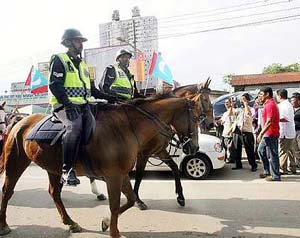
Keeping order: Mounted policemen patrolling Batang Berjuntai in Ijok yesterday.

“This is not slander, I have the proof,” he told a cheering crowd in no uncertain terms of what he thought of Khalid, who is now the PKR treasurer-general.  

Najib also fired another salvo against Datuk Seri Anwar Ibrahim, accusing the latter of not practising transparency, which the PKR was advocating now.  

Also at the gathering at Simpang Tiga Ijok was Tan Sri Mohd Desa Pachi, the first chief executive officer of PNB, which is Guthrie's parent company. 

Najib’s expose caught many by surprise as the media was not given any indication he would be making a “big announcement” although before nomination day last week MIC president Datuk Seri S. Samy Vellu had warned he would show “how much a golden boy Tan Sri Khalid Ibrahim is.” 

Over the past one week, PKR speakers, led by Anwar, had made allegations of corruption against Barisan leaders at their highly-charged ceramah (talks) but what Najib revealed must have stunned the opposition camp. 

The mood in Ijok is that politicians who live in glasshouses should not throw stones but no one is sure whether the revelations by Najib would be enough to swing the anti-establishment and undecided voters. 

“Kalau kita nak cerita, banyak yang kita boleh cerita, lebih menarik, lebih berwarna warni (if we wish to reveal, there are plenty of stories, more interesting and more colourful ones),” Najib warned, saying there were those who cakap tak serupa bikin (do not practise what they preach). 

But PKR is surely aware of the implications, as Khalid was quick to issue a press statement yesterday to refute the allegations. 

Saying he had acquired the shares at market price, Khalid said he had instructed his lawyers to prepare a lawsuit against Najib and “all others who have been making false and unfounded statements” against him. 

Yesterday, the Prime Minister decided to visit the constituency personally for the final push. Regarded as an ace, Barisan campaigners believe that Datuk Seri Abdullah Ahmad Badawi’s presence would help. 

The opposition has not aimed their salvos at Pak Lah throughout the campaign, preferring to target Najib, as the elder politician is well regarded among voters in the Malay heartland in Ijok. 

Not to be outdone, the PKR is holding a big gathering of key opposition leaders today as a finale to their campaign, hoping that their parting words would leave an impression on their listeners. 

But as of now, there is no letting up until voting begins tomorrow. It may be the final lap here but campaigners are still putting up posters, banners and billboards as if the campaign has just started. 

If the political temperature was high on nomination day, it has now gotten hotter as both sides wait nervously for the outcome of the hardest fought by-election under Abdullah’s leadership. 

Poll casters from political groups and intelligence agencies have all predicted a close call and given a win to the Barisan but still believe the by-election is being keenly fought with possible last-minute swings.  

This is not the time for mistakes as campaigning enters the critical stage. 

There will only be nine peti undi (ballot boxes) for the Ijok electorate of 12,272 voters and the election results are expected to be known by 9.30pm tomorrow, with only three recounts allowed under the election laws. 

The stakes may be high and the players are jittery but like a poker game, many of the voters are keeping their cards close to their chests with their stoic faces and not letting slip how they would vote tomorrow. And this is worrying for both sides. 

It’s no joke in Ijok


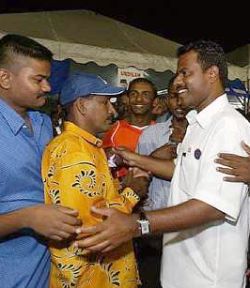
Ready to serve: Parthiban meeting some of his supporters at Pekan Ijok yesterday. Voting should not be based on race.

At Pekan Ijok, where the wet market is located, the road is often jammed these days as it has become the favourite area for the candidates and campaigners to meet voters. 

Parti Keadilan Rakyat has set up a table with laptops to help voters check the voting stations, where they will cast their votes this Saturday while just a few steps away, Barisan Nasional parties have their operation centres. 

Here, campaigners from both sides would congregate to clap, cheer and jeer political leaders passing by the road in their vehicles. With their loud hailers, impromptu speeches are often made for the people. 

The campaigners are often aggressive and persistent as they stop people going to the market.  

When this writer told two tudung-clad mak cik that he would not be voting (without telling them that he was not a voter in Ijok), he received a loud lecture on the responsibility of a citizen. 

At a coffee shop nearby, campaigners from both sides often stopped by for a break. For the star struck locals, who are often armed with cameras, it is there that they pose for photographs with national leaders. 

There is a carnival atmosphere in this sleepy town, which is about a 30-minute drive from the Bukit Jelutong interchange. This, however, can also provide a false impression of the political climate here, as both sides think of every possible way to draw voters to their gatherings. 

But with less than three days to voting, the tension is rising.  

Barisan leaders have privately admitted the contest would be tough but believe they would still win while the opposition think they have the best fighting chance. In short, both believe they can win. 

On Monday night, it was reported that police had to step in to stop a PKR ceramah at Taman Pancaran in Bestari Selatan, where Datuk Seri Anwar Ibrahim was scheduled to speak. 

The police said it was an illegal gathering. 

But whether there was permit or otherwise, Federal Reserve Unit (FRU) personnel obviously wanted to stop the rising temperature as some 50m away, Datuk Seri Najib Tun Razak was addressing about 200 people at a Barisan function. 

The situation would have been explosive if the two leaders were allowed to proceed with their ceramah, just barely 50m away from each other, with their thousands of supporters. 

On nomination day last Saturday, 1,000 policemen had to stop a fracas between Barisan and PKR supporters. Bottles and flag poles flew, with several political leaders claiming they were hit as they pointed fingers at each other for causing the fracas. 

Thousands of campaigners have converged on Ijok with the respective state liaisons setting up operation centres. It would not be wrong to say there could be an equal, if not, bigger number of campaigners than the 12,272 voters. 

Officials said both sides have compiled daily assessment reports on the possible voting trends of the voters with predictions on how the Malay, Chinese and Indian communities would vote. 

The biggest concern would be the Malays, who comprise 51% of the voters, as their decision would have the biggest impact on the outcome of the result of the by-election.  

Their target is the predominantly Malay areas of Bukit Badong and Kampung Ijok. 

Yesterday, Umno vice-president Tan Sri Muyhiddin Yassin reminded Malay voters that although Barisan candidate K. Parthiban was an MIC member, he would be able to work for their interest as this was the Barisan spirit.  

Selangor Mentri Besar Datuk Seri Dr Khir Mohamed Toyo went a step further by saying he would adopt the constituency and would be appointing a special assistant for Ijok. 

Barisan has taken a gamble, as a matter of principle, by deciding on an Indian candidate although the constituency has only 28% Indians and the opposition candidate is Tan Sri Khalid Ibrahim, a Malay.  

If voting is based on race instead of a candidate’s policies and credentials, then it would be a sad day for Malaysia.  

As we wait to celebrate the country’s national day, the people of Ijok should vote for Parthiban, not because he is an Indian or a Malay, but because he is a Malaysian. Likewise, no one should be voting for Khalid because he is a Malay as it would be a seriously unhealthy political trend. 

The MCA campaigners are also working hard to deliver the Chinese voters as they would play a crucial role in the event the Malay votes are split.  

But MCA officials are cautious, declining to say how much votes they can get from the community but they are working hard to secure them.  

While the DAP flags are conspicuously absent from Ijok, there are many Indian and Chinese campaigners in PKR T-shirts to square off with MCA and MIC campaigners for votes from the two communities. 

It's a fierce fight. As the Barisan and Keadilan step up their campaign, the suspense in Ijok has also become more intense.  

Despite the seemingly carnival mood in Ijok, for the campaigners, it is really no joke in Ijok.  

A hot by-election at Ijok

THE two contenders in the Ijok by-election – Barisan Nasional’s K. Parthiban and Tan Sri Khalid Ibrahim of Parti Keadilan Nasional – are fast becoming mere supporting actors in the political drama being played.  

Their roles, in the eyes of many Malaysians, seem to have been reduced significantly. Instead, Datuk Seri Najib Tun Razak and Datuk Seri Anwar Ibrahim have emerged as the main players.  

The co-actors appear to be MIC president Datuk Seri S. Samy Vellu and PKR president Datin Seri Dr Wan Azizah Wan Ismail.  

The players have wasted no time getting into the ring to trade blows and the fight has been fast and furious since nomination day when bottles and flagpoles flew in a fracas.  

Nothing has been spared and the indication is that there will be plenty of personal attacks over the next one week.  

Keadilan has tried hard to link Najib with the case of the Mongolian woman, Altantuya Shaariibuu, with relentless insinuations that those charged with the murder were closely linked to him.  

The hearing of the case has been scheduled for June 4 and any discussion on the case would be deemed to be sub judice. But that has not stopped the opposition from raising questions at its ceramah.  

Anwar has reportedly posed questions relating to links and connections of the powerful in the case.  

Even on nomination day, the opposition had chanted boisterously Altantuya’s name outside the centre. We can be sure her name would be heard continuously throughout the campaign.  

Aware of the attacks, Najib has said that he would not shy away from the issue, promising to answer them within the confines of the law.  

The Deputy Prime Minister has said he has nothing to hide and that it was all right to talk about the matter.  

Najib has little choice but attempt to talk about the issue openly because refusing to do so would be perceived as an inability to address the accusations. It is clear that the opposition merely wants to raise doubts in the minds of the voters.  

The fact is that there is little the opposition can talk on the matter despite wanting to harp on the Altantuya case. All it hopes for is to hit an emotional chord at the mere mention of her name. Apart from that, there is little substance.  

Not to be outdone, Barisan campaigners have reportedly made innuendoes of sodomy openly.  

Anwar is obviously not amused and has filed a RM10mil suit against MCA Youth secretary-general Dr Wee Ka Siong for making a remark that the former has found offensive.  

The suit, filed by Anwar last week, alleged that Dr Wee, the MP for Air Hitam, had uttered remarks that had tarnished Anwar’s name.  

It is widely accepted that politics is dirty but the level of mudslinging at this early stage of campaigning is a little unusual.  

For some observers, there is little to gain politically from this by-election for both sides, at least from the power structure, but no one wants its pride bruised.  

With a 51% Malay electorate, Umno wants to prove that it can retain these votes while Keadilan wants to win them badly.  

For Samy, he has to show that the MIC can wield influence on the 28% Indian votes, one of the highest in the country for the community.  

Then there are the crucial 21% Chinese votes, which the MCA must deliver in this closely fought battle.  

The talk is that there are more campaigners from both sides than the 12,272 voters in Ijok, with more than 10 campaigners assigned to take care of a voter.  

Like Machap, Ijok was an unheard of town among most Malaysians until last week. It has suddenly received national attention.  

From a sleepy hollow, a carnival atmosphere has taken place with voters having to choose to attend a Mawi concert, see an impersonator of the late Mardur Gopalamenon Ramachandran (MGR) or listen to a no-holds barred ceramah by Najib or Anwar.  

The Chinese restaurants in Ijok, which serve arguably the best “beggars’ chicken” in Selangor, have been doing a roaring business since last week.  

The road repairs and other amenities that have suddenly poured into the constituency have been a bonus for the people.  

For the time being, the voters in Ijok are keeping the nation in suspense and we wait eagerly to find out the ending of this political drama that has unfolded.  

Seeing past the heat and fury

COMMENT BY WONG CHUN WAI

The first indication of what to expect from this by-election came on Wednesday night when Datuk Seri Najib Tun Razak fired the first salvo. 

He promised more peluru (bullets) against Parti Keadilan Rakyat (PKR) and its advisor Datuk Seri Anwar Ibrahim when the campaign gets hotter. 

His warning was blunt – stop raising the Altantuya Shaaribuu murder case or face the consequences. 

The Deputy Prime Minister said he had never touched on Anwar’s personal matters, adding: “If I want to talk, I can. However, I do not want to embarrass him because we know he has a wife and children.” 

It was certainly a loaded statement. In short, people, or rather, politicians who live in glasshouses should not throw stones. 

Anwar has reportedly been using the case of the murdered Mongolian, in which defence analyst Abdul Razak Baginda has been charged, in his ceramah rounds nationwide. 

With Anwar expected to lead the charge in the Ijok campaign, the likelihood is that Anwar would end up becoming one of the issues.  

The curtain-raiser was at the recent Machap by-election where Anwar was used as a subject by the campaigners.  

One result is a RM10mil suit against MCA Youth secretary-general Dr Wee Ka Siong, who reportedly made remarks in Hakka that Anwar found offensive. 

The suit, filed by Anwar on Monday, alleged that Dr Wee, the MP for Air Hitam, had uttered remarks that had tarnished Anwar’s name. 

But PKR's candidate, Tan Sri Khalid Ibrahim, would also not be spared. MIC president Datuk Seri S. Samy Vellu has served notice that he would expose the former chief executive of Guthrie Group Bhd and group chief executive of Permodalan Nasional Bhd. 

Said the Works Minister: “I will tell all about how much a golden boy Tan Sri Khalid Ibrahim is.” 

Over the next week, Malaysians can expect plenty of revelations of the political players and possibly plenty of legal suits, too.  

But as the side issues get better media attention, it should not be lost on Malaysians including the voters of Ijok of the importance of power sharing among the major races in Malaysia. 

We take it for granted often without giving much thought to it. The third biggest component party in the ruling coalition, the MIC, does not have a single constituency that is predominantly Indian.  

The Sungai Siput parliamentary constituency, of which Samy is the MP, has 46,779 Malays (31.5%), Chinese 41.5%, Indians 22.5% and orang asli 4.5%.  

Yet, the party has nine MPs and 19 state assemblymen, and in almost every state ruled by the Barisan there is one MIC state executive councillor.  

It can be argued whether these MIC legislators have truly served the interest of the community but the point is that the Alliance and now the Barisan has ensured representation of major ethnic groups.  

It is that readiness of the coalition to share power in a multi-racial society that is surely a matter for all of us to appreciate.  

In Ijok, which is predominantly Malay with over 50%, the MIC has been given the constituency despite having only a 28% Indian electorate.  

The Umno leadership, under Datuk Seri Abdullah Ahmad Badawi, could have easily pandered to the demands of some Umno grassroots leader to field a Malay candidate but to his credit, he has refused to do so, believing in the time-tested concept of power sharing and the loyalty of MCA and MIC.  

The Barisan has now gone into the by-election fully aware that it will be a difficult fight and many may not want to acknowledge it but the possibility of losing Ijok is there.  

But the principle is this – the Barisan is prepared to field an MIC candidate at the risk of losing it.  

PKR has rejected allegations that it is appealing to the Malay majority constituents by fielding a Malay candidate at the expense of the Indian minority.  

Its leaders claim that the party practices multi-racialism and it advocates equal opportunity and treatment of all Malaysians, regardless of race. Its vice-president R. Sivarasa has reportedly said that its political positioning on various issues is more important.  

But “winnability” appears to be the main criterion for the PKR here and nothing else. In the case of Ijok, it is obvious that PKR leaders know, deep inside their hearts, that a Malay candidate stands a better chance.  

It would be sad if race is the criterion for the selection of a candidate, based on the racial breakdown of a constituency, because the Chinese and Indian population is shrinking.  

In decades to come, there could even be more Indonesians than the two communities.  

Where would the representatives of these two communities be contesting if they have no majority presence if we set such a precedent?  

It is already bad enough that PAS only fields Muslim candidates but its objective is at least clear to us – that it wants to set up a theocratic Islamic state.  

Despite talk of wanting to allow non-Muslims to be associate members, PAS will never compromise on its dogmatic stand.  

In DAP’s case, the party has a record of fielding many Malay and Indian candidates in predominantly Chinese areas.  

Race should not be an issue in the Ijok by-election and Malaysians hope that the policies of contesting parties should be the deciding factor. 

Malaysia is watching.  

Burst pipe fiasco: What a shame!

Abdul Rahim went on to say that he had seen similar shoddy workmanship at several other buildings in Putrajaya.  

Strong words indeed. Malaysians would certainly like to know the names of the contractors who had carried out such lousy jobs. They have plenty of explaining to do and Public Accounts Committee chairman Datuk Shahrir Samad has correctly asked PWD officers to explain as public funds were used. But we all know that this is not the first time and we can be sure that it won’t be the last.  

Just two years ago, Education Minister Datuk Seri Hishammuddin Hussein Onn revealed to the press that he was shocked to find six of the seven computer laboratories in schools in his constituency still unusable, two years after they were built.  

Again, it was due to extensive shoddy workmanship of the buildings, which included instances whereby repairs were going on after more than six months.  

In one case, the computer laboratory of the school was found to be useless after it was discovered that the contractor had failed to notice that it was built on top of a main water pipe, it was reported. This led to the floor of the building reportedly being soaked in water.  

Some of us remember when then Education Minister Tan Sri Musa Mohamad revealed that about 1,200 computer laboratories nationwide were deemed unsafe due to shoddy workmanship by the private contractors involved in the project.  

The question is: Why do these problems keep cropping up and who are these bad contractors? Were they engaged for these government projects because of their competency or because of their political links?  

These are justifiable questions and certainly taxpayers do not want to see their money wasted.  

We have grown familiar with warnings from politicians threatening to blacklist errant contractors but we wonder if they are really carried out or were these remarks made just to appease angry voters.  

In 2004, Prime Minister Datuk Seri Abdullah Ahmad Badawi directed the PWD to take over 16 schools and five community colleges nationwide, which had serious structural defects. Some did not even have amenities like access roads, it was reported.  

Last year, it was reported that a RM48mil school in Sabah was under serious threat from landslides, endangering the building’s structure. In cases like this, we wonder who the consultant engineers were and whether the authorities had given approvals for these institutions to operate when there are structural faults. It’s not just lousy workmanship but equally bad inspection by the authorities concerned, who did not take into account the safety of the people.  

Repair works do not come cheap these days. Last year, Datuk Seri S. Samy Vellu queried why RM100,000 had to be spent on repair work and termite treatment in seven classrooms.  

It’s a shame that we continuously read of such problems as they would only give the impression that we tolerate such abuses of public funds. 

A grave matter

Her family had bought a house in Section 8 from the Perbadanan Kemajuan Negri Selangor (PKNS), which had used the nearby forest reserve to promote the sale of its sprawling new township. 

Many city folk who wanted to live near a green lung bought houses and land to build bungalows, believing that the state government would be committed to protecting the 100-year-old forest. 

But residents at Section 8, 9 and 10 now feel cheated. They are also appalled at the eagerness of the state government in wanting to bulldoze through its plans in a high-handed manner without any respect for the views of the affected residents. 

First, they were told that a cemetery would be created next to their land and now, to their horror, they found that the Petaling Jaya Structural Plan 2020 has bigger plans to develop the reserve. 

There have been allegations that the cemetery is only part of a large-scale plan to create a township with the land being alienated to the Petaling Jaya City Council. One news report claimed that the council was entering into a joint-venture agreement with a company co-owned by two Indonesians. 

It is already bad enough that the cemetery issue has divided the community – one group that wants the cemetery but most of whom do not live in the area while the other group is the one affected and is understandably against it. 

Tempers have flared at meetings between both groups. And matters have aggravated with revelations that a sports complex, a community hall and living quarters for the Petaling Jaya City Council may be built on parts of the forest reserve. 

State executive councillor and Kota Damansara assemblyman Datuk Mokhtar Dahalan, the proponent of the burial ground, has the support of one section of his constituents but he has been rightly questioned by others. 

The cemetery covers 22ha but nature lovers want decent answers as to why a total of 58.83ha of the forest reserve had its status reportedly revoked, according to a gazette notification dated Aug 6, 2004. 

More importantly, there is a huge track of land in Sungai Buloh already reserved as a burial ground. However, according to Mokhtar, it has been found to be unsuitable for burial. It has been said that the burial ground in several areas have been found to be too rocky but surely the authorities may want to consider remedial work. If an open sea can be reclaimed and mountains removed, surely it would not be an engineering feat. 

The Kota Damansara controversy is not just about the setting up of a burial ground and the possible destruction of a forest reserve. It is not a religious issue and neither is it just about pleasing some nature lovers. 

It is about respecting legal procedures and the views of residents affected the most by it. It is one thing to consult residents staying outside the affected area but another to hear out those in Section 8, 9 and 10. Imagine how Mokhtar would feel if a office block were built next to his home without his views being sought. 

Residents are upset because they believe that the forest has been degazetted in a suspicious way that smacks of non-transparency.  

It is commendable that the protesters, comprising residents of all races, have stood together despite attempts to use race and religion to break their solidarity.  

These residents have expressed their disgust at such shameful tactics by certain individuals to intimidate and coax them into silence. 

Elected representatives, regardless of their race or religion, should not tolerate any use of gangsterism to scare off those who do not share their views. It is utterly shameful. 

It is also not true that the trees are less than 10 years old as claimed by certain officials at meetings because there are several species found only in primary forests. Doubters can call up the Malaysian Nature Society for a 40-page brochure of pictures and information on the Kota Damansara Community Forest. 

The affected residents have stated that they are NOT against the setting up of a cemetery but are against the de-gazetting of the forest and the manner it had been carried out. Sadly, the cemetery issue has been used to rally support from some misinformed constituents. 

The affected residents also want PKNS to put up its development plan so that the people would know whether these projects would benefit them or just the pockets of some people. 

Their concerns are justified because the forest reserve has always faced constant development pressure.  

The protest is not just about saving some birds or monkeys but a measurement of Malaysia’s commitment towards implementation of the Local Agenda 21 and protecting our greens.  

If we cannot even be entrusted to save our forest reserve, how do we explain to our children and grandchildren why they no longer have a green environment?  

Let common sense prevail

All Subashini, 28, wants is to keep her two children and end their marriage in a civil court. Her husband, businessman Muhammad Shafi Abdullah, formerly T. Saravanan, 31, has instead applied to the Syariah court to end their civil marriage.  

There are dire consequences. First, she is worried that as a non-Muslim mother fighting to keep her children, the odds could be against her in a Syariah Court. Her son has become a Muslim, she claims, without her knowledge. The boy converted to Islam with Saravanan last May. 

Second, as a non-Muslim, she should not be seeking redress in a Syariah Court because the Federal Constitution clearly states so. Should we no longer take this legal document seriously? 

But more worrying for non-Muslims is that this unprecedented move could be the basis for future cases involving non-Muslim and Muslim parties. Even Muslim lawyers and experts have expressed their worries. 

As lawyer Datuk Zaid Ibrahim wrote in a newspaper article on the case: “Even if Subashini wants to submit to the Syariah Court, she can’t. Jurisdiction is not a question of choice or submission; it is a question of law.”  

A seemingly straightforward court case has grown increasingly difficult, with self-proclaimed defenders of faiths getting into the picture, because the Court of Appeal has given the impression that it wants to wash its hands off the case. 

On March 13, the Court of Appeal decided that Subashini had to seek redress at the Syariah Court for the break-up of her family and the custody of her children, one of whom has become a Muslim. 

It would have been much easier had Saravanan first divorced Subashini, settle child custody and property matters under civil law before he converted to Islam. But that was not the case. 

Instead, he has taken a different route, best known to himself, and put the whole family into a tight spot. At the same time, the legal implications of his case have put the rest of the nation in a tight spot. 

Last week, Subashini won a minor victory – she obtained the green light from the Court of Appeal to preserve her civil rights, pending her appeal to the Federal Court 

Given the sensitivity of religious matters, the case is now in the spotlight as the nation watches how the Bench intends to resolve this legal wrangle to the satisfaction of everyone. 

We don’t need to be lawyers and law professors to know that the Federal Constitution clearly stipulates that the Syariah Court has no jurisdiction over non-Muslims. It’s that simple.  

Even if Subashini agrees to take her case to the Syariah Court, she cannot do so. It does not matter whether she would get a fair or biased hearing at the Syariah Court. That is beside the point and should not even be a matter for debate. 

To suggest that non-Muslims should not fear the Syariah Court and that they must accept the purported political-religious reality, as some quarters have implied, is grossly unfair and totally unrelated to the core of the issue.  

No one would argue over the ability of the Syariah Court to dispense justice but the position of civil laws and the Federal Constitution is clear. That is why it is sometimes referred to as the common law, which means laws applicable to Muslims and non-Muslims. 

But more importantly, as the nation awaits to celebrate the country’s 50th anniversary, we have a right to ask ourselves what our founding fathers, who had spent endless hours writing the Federal Constitution, would have thought of this case. 

The Federal Constitution, we are aware, was part of the social contract agreed on by the founding fathers, and certainly any move that violates or even dilutes the status of the Federal Constitution is of serious concern. 

But more importantly, surely the civil courts are in a position to provide the solution to Subashini’s problem. As Zaid correctly pointed out: “Surely the son is as much hers as it is his and shouldn’t the mother’s wishes be taken into account in an important matter such as the faith of her child, especially when he is so young? 

“We have had many arguments put forward by those who are experts in the law but these people do not have to endure the pain and suffering undergone by Subashini.” 

Let common sense prevail. We are sure Malaysians are able to handle Subashini’s case with justice and compassion. After all, that is what the law is all about for those who seek legal redress.