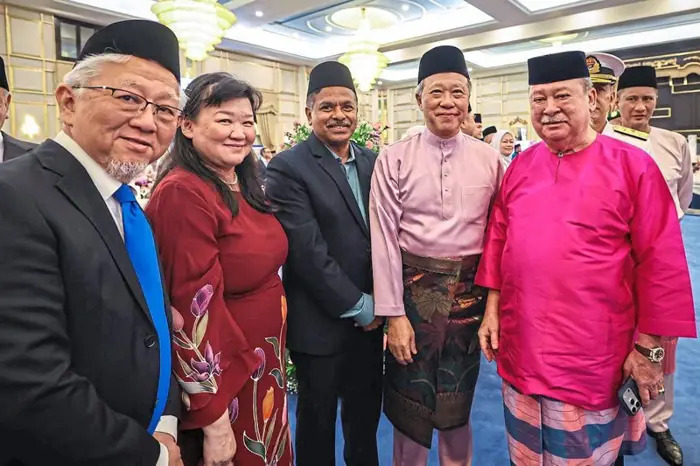
Spirit of the season: His Majesty Sultan Ibrahim, the King of Malaysia, who is well-known for his very muhibbah personality, with (from left) Datuk Kuik Cheng Kang (Group Editor In Chief, Media Chinese International Ltd), Datin Paduka Esther Ng (Chief Content Officer, Star Media Group Berhad), Arul Rajoo (Editor in Chief, Bernama), and Datuk Wong Chun Wai (Chairman, Bernama) at Istana Negara earlier this week. — Handout
ANYONE who has only spent their time reading social media content, especially on politics, can be forgiven for thinking that this country is being torn apart by race and religion issues.
Nothing good seems to be taking place in this country. Unfortunately, such toxic narratives, which include a heavy dose of fake news, have eaten into the lives of many Malaysians.
So consumed are they by these manipulative stories, especially on the Threads platform, that they are not seeing the beauty around them.
“Social Media Malaysia” is increasingly defined by suspicion and guarded spaces.
For the past one month, I have been invited by my Muslim friends and contacts for Ramadan buka puasa functions as well as on-going Hari Raya open houses.
Not many Malaysians, especially non-Muslims, are aware that in Arab countries, Syawal is only celebrated on the first day of Hari Raya. In Malaysia, it is feted for a full month.
Hari Raya is among the most beautiful and enduring expressions of what it means to be Malaysian.
The involvement of neighbours, friends, colleagues, and even casual acquaintances – of all races and religions – make these gatherings very special and unique.
Everyone is made to feel welcome, and that has long been – and should remain – the hallmark of Malaysia.
Hari Raya Aidilfitri is a deeply significant religious celebration marking the end of Ramadan. Yet in Malaysia, it has also evolved into a shared national tradition.
Non-Muslims arrive in baju kurung and batik shirts, gamely uttering a few phrases of “Selamat Hari Raya” and “Maaf zahir dan batin”.
No one checks identity cards at the door. No one asks who you voted for, what language you speak at home, or which god you pray to. You are welcomed because you came.
Inside, the scene is a portrait of harmony, laughter, and happiness that rarely makes the news.
These interactions may seem ordinary, but collectively they form the invisible glue that holds a plural society together.
Many take this for granted.
From modest kampung houses to grand official receptions, the spirit is remarkably consistent: generosity without calculation.
The hosts cook for days, not knowing exactly how many will come, trusting that the effort itself is meaningful. Guests reciprocate with conversation, laughter, and presence. It is a social ritual built on goodwill, not obligation.
Indeed, it’s no longer just the aroma of lemang and rendang that rises at these gatherings. I have noticed that the Chinese-inspired char koay teow has become part of Hari Raya servings. The mamak mee goreng and tosai are also a must nowadays.
This tradition did not arise from policy papers or national campaigns. It grew organically from decades of living side by side – attending one another’s weddings and funerals, sharing tools over fences, sending food during illness, watching each other’s children grow up.
The open house is simply the most visible expression of that everyday coexistence.
Social media amplifies the loudest, angriest voices, creating the illusion that hostility is widespread. Yet, step into any Raya open house and that illusion collapses.
The beauty of Malaysia lies in our ability to live comfortably with each other.
We celebrate each other’s festivals not as spectators but as participants – lighting lamps during Deepavali, tossing yee sang during Chinese New Year, and visiting longhouses during Gawai and Kaamatan.
Hari Raya open houses stand at the heart of this culture of mutual presence.
To allow divisive rhetoric to erode this tradition would be to surrender one of the country’s greatest intangible assets: social trust.
Perhaps the most meaningful response to voices of division is not anger but participation. Attend an open house. Take your family. Taste unfamiliar dishes. Compliment the host. Apologise for past shortcomings and forgive small grievances.
Post photos of smiling multiracial groups rather than screenshots of inflammatory comments. Every handshake, every shared table, every spontaneous laugh is a quiet reaffirmation that Malaysia’s centre still holds.
In the end, Malaysia is not sustained by slogans or speeches. It is sustained by millions of ordinary encounters in living rooms across the country – moments where differences fade and common humanity takes over.
Hari Raya open houses remind us that beyond politics and online noise, respect and affection still flow naturally among Malaysians.
The only thing Malaysians will have to look out for will be their waistlines and the sugar level in their blood.
Thank you to all my Muslim friends – and even non-Muslim CEOs who are hosting company Hari Raya open houses – for the many Hari Raya invitations!