Monthly Archives: May 2026

Far more than just a pledge


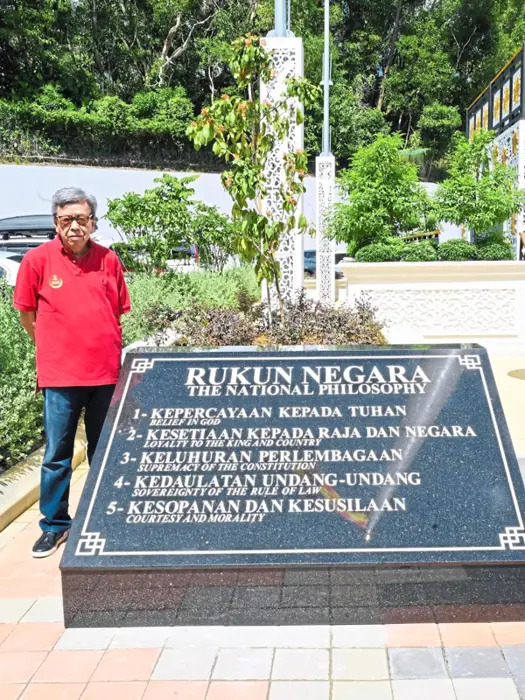
Royal order: The Sultan of Selangor, Sultan Sharafuddin Idris Shah, says all assemblymen in the state should go to Dataran Selangor twice a month to read the Rukun Negara inscribed on a plaque there. — Photos: Selangor Royal Office’s Facebook

THE Rukun Negara was never meant to be just a ceremonial pledge to be recited absent-mindedly during school assemblies or national events.

Instead, our founding fathers had bigger plans when they painstakingly drafted the preamble and five principles.

It was born out of one of the darkest moments in our history – the racial riots of May 13, 1969, when the nation realised that political rhetoric, communal suspicion, and irresponsible leadership could tear apart the fragile fabric of a young country.

More than five decades later, why do we have the impression that the Rukun Negara is no longer given serious recognition?

We like to tell ourselves that the Rukun Negara remains relevant but ironically, those who should be upholding its spirit the most – our politicians – are often the very people undermining it.

Last week, the Sultan of Selangor, Sultan Sharafuddin Idris Shah, said all assemblymen in the state should go to Dataran Selangor twice a month to read the Rukun Negara inscribed on a plaque at the square.

He singled out Seri Kembangan assemblyman Wong Siew Ki of DAP and the party’s former state executive member Ronnie Liu.

“I encourage them to go to Dataran Selangor every week to understand and appreciate the Rukun Negara,’’ His Royal Highness said in a statement.

The Sultan did not provide specific reasons for directing his remarks at the two individuals.

However, the statement is widely understood to be linked to the ongoing controversy over pig farming in Selangor, as both men had previously been associated with the issue in public discourse and criticism.

The remarks by Wong and Liu had earlier drawn criticism from several quarters, particularly within the Malay and Muslim communities; the two had made comments relating to pig farming projects in Selangor, which were perceived by some as disrespectful to the Selangor ruler.

Sultan Sharafuddin had previously maintained his position that he does not consent to any pig farming activities being carried out in any district in the state.

The five principles of the Rukun Negara are simple, clear and timeless: Belief in God, loyalty to King and country, supremacy of the Constitution, rule of law, and courtesy and morality.

These are not mere abstract ideals but the minimum foundation required for a diverse nation like Malaysia to survive and prosper.

Tuanku’s message is for all politicians in Selangor and not merely the two from the DAP.

The Palace’s unhappiness is that political discourse has become increasingly coarse, divisive and reckless.

Contentious and sensitive issues would be better discussed amicably behind closed doors. Playing to the gallery isn’t going to help.

The question is not a matter of the limits of a constitutional monarchy but the tone used and whether sufficient wisdom and sensitivity were exercised, as commentator Anas Zubedy wrote.

The matter involves the palace, the rakyat and the wider social fabric of Malaysia.

“In life, it is not only what you say that matters, but also how, when and where you say it. One may legally argue a point and yet still fail in wisdom, manners and cultural sensitivity,’’ he said, adding that, “Respectful engagement matters. Tone matters. Context matters. Institutions matter’’.

Contentious issues should rightly be resolved effectively through proper consensus and without the need for sound bites and hits on social media platforms.

We now see politicians – and probably paid cybertroopers and influencers – exploiting race and religion for short-term gains, questioning constitutional arrangements whenever convenient, insulting institutions, and reducing serious national issues to endless political theatre.

Social media has worsened this culture, rewarding outrage over reason and provocation over prudence.

Many politicians speak passionately about patriotism but they sound hollow in reality as they behave in ways that weaken national unity.

Some demand respect for their own beliefs while showing little respect for the sensitivities of others.

Others preach morality while engaging in toxic politics that normalise hatred, mockery, and character assassination.

This is precisely why the Rukun Negara must not be treated as a relic of the past.

The principle of courtesy and morality, for example, may sound old-fashioned in today’s combative political climate, but it is perhaps the principle Malaysia most urgently needs to turn to.

Democracy does not mean permanent hostility. Political competition should never come at the expense of basic decency and mutual respect.

Likewise, the supremacy of the Constitution and the rule of law cannot be selectively defended only when politically convenient.

Politicians cannot claim to support democratic institutions while simultaneously attacking them whenever decisions do not favour their narratives.

The Rukun Negara was intended to create a common national identity above ethnic and political divisions. This is clearly reflected in the preamble of the Rukun Negara which says Malaysia nurtures the ambitions of:

  • Achieving a more perfect unity amongst the whole of her society;
  • Preserving a democratic way of life;
  • Creating a just society where the prosperity of the country can be enjoyed together in a fair and equitable manner;
  • Guaranteeing a liberal approach towards our traditional heritage that is rich and diverse;
  • Building a progressive society that will make use of science and modern technology.

The Rukun Negara recognised that Malaysia’s diversity is both our strength and our vulnerability. Without shared principles, a plural society can quickly descend into mistrust and fragmentation.

The Rukun Negara was drafted by key historical figures. And it needs to be pointed out that diversity and shared principles were the reason why, in the first tenet, the belief in God, the word “Tuhan” was chosen.

When elected representatives openly trade insults, play up racial insecurities, or flirt with extremist rhetoric, they normalise intolerance for the next generation.

Politics then becomes less about governance and nation-building and more about perpetual anger and division.

Malaysia’s stability over the decades did not happen by accident.

It was built on compromise, moderation, and an understanding that no single community can dominate this country alone. The Rukun Negara reflects that social contract.

Critics may dismiss it as idealistic or symbolic, but nations survive on shared values and collective discipline.

Remove those guardrails and society becomes vulnerable to polarisation and extremism.

The danger is not that Malaysians no longer know the Rukun Negara. Most can still recite it. The danger is that many no longer internalise it.

Perhaps it is time to stop treating the Rukun Negara merely as a school recital and start treating it as a national code of conduct – especially for politicians seeking public office.

Leadership is not only about winning elections. It is also about setting standards for society.

If politicians themselves cannot embody the principles of respect, restraint, and constitutional loyalty, then the Rukun Negara risks becoming little more than words on paper.

Perhaps it is time for all Parliament and state assembly meetings to begin with these lawmakers singing NegaraKu and reciting the Rukun Negara.

Rain Rave’s success music to the ears


Big win: The recent Rain Rave Water Music Festival 2026 attracted many international visitors and reportedly raked in RM200mil in tourism income. — GLENN GUAN/The Star

THE Rain Rave 2026 Water Music Festival event in Bukit Bintang, Kuala Lumpur, has been a huge success, no doubt about it.

The Tourism, Culture and Arts Ministry has been cautious in releasing official figures as it is still tabulating the numbers. But that has not stopped the Malaysian Inland Tourism Association from claiming that the three-day event raked in RM200mil in tourism income, drawing over 180,000 visitors.

Its president, Mint Leong, reportedly said the festival boosted economic activity during the Labour Day holiday period around May 1, recording 1.4 billion click-throughs on global social media platforms and giving Malaysia huge international exposure.

This is an interesting angle as the event should not be measured merely by crowd size or estimated revenue.

Money derived from the festival is certainly essential. After all, Rain Rave was created as a tourism product precisely for that.

Anyone who actually took the trouble to visit the scene would have noticed the large number of families, senior citizens, and, more importantly, tourists.

Of course, there were also immigrant workers who took advantage of the holidays to unwind with free entertainment.

But did anyone see any hedonistic activities as imagined by some individuals and groups?

No.

Gender segregation may be practised in Kelantan, Terengganu, Kedah and Perlis but surely not in KL. It must have disappointed the naysayers that the event attracted many Malaysians of all faiths.

Rain Rave 2026 has effectively ticked several structural boxes to prove that it is an exemplary modern tourism product.

First, it demonstrated the power of low-cost, high impact programming – that explains why Bukit Bintang was the best choice of location.

It could accommodate a huge audience with hotels, restaurants, businesses and MRT connections nearby. A place like Sepang, Selangor, and its space would not be able to offer such attractions close by.

Unlike mega events that require heavy infrastructure and public spending, Rain Rave leveraged existing urban spaces in KL, turning streets into stages and participants into content creators.

This kept costs relatively contained while maximising visibility.

Second, it validated the growing importance of the experience economy. Rain Rave was not a passive spectacle but an immersive, participatory event – people did not just watch, they became part of the show.

This is critical in an era in which travellers, especially younger Asians, prioritise shareable experiences over traditional sightseeing. Instagram postings of themselves are a top priority!

Third, the event showed how social media amplification rivals physical attendance. For those who didn’t make it to KL, millions, mainly young people, watched it online across the globe.

Just think of the free advertising that social media has given to Malaysia as a result of Rain Rave 2026.

While the headline figures of tens of millions of views needs to be treated cautiously, the qualitative impact is undeniable: the festival generated sustained online chatter, user-generated content, and cross-border visibility.

In effect, every attendee became a micro-broadcaster, extending KL’s reach far beyond the actual footprint of the event.

A lot of fuss has been made about Rain Rave 2026 being an imitation of Thailand’s Songkran water festival. It certainly was not.

Rain Rave carved out a more urban, music-driven identity – a hybrid of street party and water festival.

This differentiation matters because it avoids the trap of imitation and instead builds a distinct, exportable brand.

Finally, and perhaps most importantly, Rain Rave proved that controversy – if managed – can be an accelerant rather than a liability.

The debates the event sparked about culture and propriety may have unsettled some quarters, but they also expanded the conversation and drew attention well beyond the usual tourism audience.

In the digital age, visibility often follows friction.

Taken together, these factors suggest that Rain Rave is not just a one-off success but a scalable model.

It offers Malaysia a template for future events: relatively low in cost, high in engagement, digitally amplified, and anchored in urban energy.

We are beyond the question of whether it worked, the challenge now is whether it can be institutionalised, refined, and repeated without losing its spontaneity – the very quality that made it succeed in the first place.

Rain Rave 2026 would not have taken off without a strong-willed politician like Tourism, Arts and Culture Minister Datuk Seri Tiong King Sing who dared to openly snub the critics.

Amusingly, he was attacked on social media for being a DAP politician when he is actually the president of Sarawak’s Progressive Democratic Party – in fact, he beat DAP candidates to win his Bintulu seat in the past six elections.

He is blunt and brash. He doesn’t care about having to pander to the media. In fact, many of us find it hard to get a response from him, but in the end, it is the delivery that matters.

The media has reported that Malaysia’s status in tourism has been “a strong overperformance relative to the region’’ with 10 million arrivals in 2022, 20.1 million in 2023, and 25 million in 2024, according to The Edge. The Star reported 38 million total visitors.

Malaysia was among the earliest in Asean to cross pre-Covid-19 benchmarks, well ahead of Thailand and the Philippines.

We have also seen record-breaking revenue numbers with RM71.3bil in receipts in 2023 and RM102bil to RM106bil in 2024.

The Star reported a 43% jump in receipts in just one year, and for the first time we crossed the RM100bil mark.

The bottom line is that Malaysia’s revenue growth is outpacing arrivals growth, which suggest higher per capita spending and better yield per tourist.

The Department of Statistics Malaysia reported that the total tourism contribution was RM291.9bil in 2024 – which is 15.1% of the shared GDP – as well as 3.5 million jobs or 21.6% employment of the workforce.

The reality is Malaysia is an attractive tourist spot but beaches, jungles and street food are not enough.

The Rain Rave event must now be institutionalised and become a fixed spot in the calendar, so tourists know exactly when to come.

Let’s retain a strong tourism product and a performing minister if it helps the economy. It’s the bottom line that matters.

Seeing red over book ban

FINALLY, there’s some sense of rationality. Home Minister Datuk Seri Saifuddin Nasution Ismail has announced, rightly, that the Home Ministry is in the midst of revoking the ban on the memoir of Shamsiah Fakeh, a former communist.

It is hard to comprehend how a book, which has been in circulation for nearly 20 years, is suddenly deemed dangerous and banned.

The book was first published in 2004 by Universiti Kebangsaan Malaysia (UKM), one of the country’s premier universities, and not by an ordinary one-man show non-governmental organisation.

Shamsiah was a prominent nationalist leader and a member of the Communist Party of Malaya (CPM), who lived in exile in China for many years.

Finally in 1994, following the 1989 peace agreement signed between the CPM and the government of Malaysia in Thailand, permission was granted for her return with her family.

The feminist and leader of a women’s organisation, AWAS (Angkatan Wanita Sedar), died in 2008 following years of poor health at the age of 84.

Her granddaughter Jamaliah Jamaluddin, from DAP, is serving as the Bandar Utama assemblyman and Selangor state executive councillor.

UKM has rightly interviewed the prominent CPM Malay woman leader, who had returned home, by filling the gaps of history through its series of oral history exercises.

It does not matter whether we agree with her political inclinations, but history should never be the victor’s version.

As academics, UKM had a chance to listen to a CPM leader and to record what she had to say.

It is odd that only the Bahasa Malaysia version of Shamsiah’s book was banned, according to reports.

But a check online showed that the Malay version is still readily available. The reality is that many books, which were banned or are still banned, can be found with a simple click.

From The Communist Manifesto by Frederich Engels and Karl Marx to Mao Zedong’s The Little Red Book and the Malay version of the Bible, they are freely available to be read and downloaded.

It makes a mockery of any decision to ban Shamsiah’s book, with Saifuddin Nasution saying the book-banning process had led him to “fire fight” as he had only learned about the ban after enforcement had taken place.

The other two books banned by officials were Komrad ASI (Rejimen 10): Dalam Denyut Nihilisme Sejarah written by Aziz Suriani and Mao Zedong: China dalam Dunia Abd ke-20, a translation of a book by Rebecca E. Karl.

Shamsiah’s book is not the only published works on former CPM leaders, many of whom have passed away or are in the last lap of their lives.

Others include Memoir Rashid Maidin: Daripada Perjuangan Bersenjata Kepada Perdamaian (2005), Memoir Abdullah CD: Zaman Pergerakan Sehingga 1948 (2005) and Memoir Suriani Abdullah: Setengah Abad Dalam Perjuangan (2006), all published by Strategic Information Research Development (SIRD).

Kudos must go to the Cabinet for deciding to act against the Home Ministry ban following its meeting, as it is an affirmation of intellectual maturity and historical confidence.

Malaysia is no longer haunted by the ghosts of dead communists.

Communist China is a close friend of and big investor in Malaysia; and let’s be truthful – the Chinese mainlanders have long embraced capitalism.

That the memoir could exist quietly for 20 years before being deemed objectionable suggests it is less a genuine threat than an uneasy relationship with our own past.

It also exposed a recurring dilemma in governance: when enforcement appears arbitrary or delayed, it risks eroding the credibility of the very institutions tasked with safeguarding public interest.

By reversing the ban, Saifuddin Nasution has signalled a more measured and pragmatic approach.

It reflects an understanding that Malaysians today are better equipped – educationally, socially and politically – to engage with complex and even controversial chapters of history without fear of being unduly influenced or misled.

This is not the Malaysia of decades past, when information was scarce and narratives tightly controlled. Today’s citizens navigate a far more open information ecosystem, where ideas compete and are tested in the court of public opinion.

To some, Shamsiah is part of a painful chapter linked to the communist insurgency and the sacrifices of security forces and civilians alike. To others, she represents a personal story shaped by ideology, struggle and exile.

Allowing her memoir to be read does not legitimise her political stance; rather, it recognises that history is rarely one-dimensional.

For younger Malaysians in particular, access to such materials offers an opportunity to better understand the ideological currents and human experiences that shaped the country. It encourages them to ask questions, to compare narratives and to appreciate the sacrifices that underpin the peace and stability they enjoy today.

But meanwhile, Saifuddin Nasution still has to await the advice of the Attorney General’s Chambers, although it may seem like a minor administrative procedure.

The real threat to Malaysia isn’t dead communists, but racial and religious extremists and corrupt leaders.

They are the ones that need the attention of the authorities.

To poll or not to poll, that’s the question


Unnecessary distraction: Having an election in these times of global turmoil is not prudent. — Filepic/The Star

DESPITE continuous speculation that the general election could be held soon, there is actually no urgency for the unity government to call for one. Its full term ends only in December 2027.

Even then, the prime minister has another 60 days before polling day. Assuming that Datuk Seri Anwar Ibrahim wants to serve a full term, he has more than a year from now.

He has already emphasised that politics needs to take a back seat as Malaysia, like the rest of the world, grapples with the oil crisis and the escalating cost of living every day that the Iran conflict goes on.

No one knows how long this will drag on. The Strait of Hormuz remains shut and the supply of oil is slowing to a trickle.

The PM faces a familiar but increasingly urgent political dilemma: whether to call for fresh elections now, amid gathering economic headwinds, or to hold the line until conditions are more favourable.

This debate is sharpened by the reality of a looming oil supply crunch, rising global tensions, and the knock-on effects that will inevitably be felt at home – from inflationary pressures to fiscal strain.

On the one hand, there is a compelling argument for seeking a fresh mandate sooner rather than later.

Periods of crisis demand clarity of leadership and many Malaysians would put their faith in Anwar.

Many of us are baffled by PAS president Tan Sri Abdul Hadi Awang who questioned the necessity for a fuel price hike. Surely he should know better – unless he has no idea that global prices are fixed and that Malaysia is a net importer of oil.

Then there is Perikatan Nasional chairman Datuk Seri Dr Ahmad Samsuri Mokhtar, who proposed the setting up of a non-partisan national council comprising representatives from NGO, academia, industry and civil society to develop strategies to handle rising energy prices and supply and logistics disruptions.

The Terengganu Mentri Besar surely means well, but with the extremely fluid situation daily, there is really no time for a talk shop.

It is best to leave it to PETRONAS, the Finance Ministry and the experts with oil industry background to decide on the measures, which would include seeking oil supplies from alternative sources.

A government that goes to the rakyat and secures a renewed endorsement can govern with stronger legitimacy, make difficult decisions with greater confidence, and rally the nation around a coherent plan.

In times of economic uncertainty, hesitation can be costly. Markets, investors and ordinary Malaysians alike value decisiveness and stability.

An oil crisis is anticipated, and it is not a distant threat. Any sustained disruption to supply will push up fuel prices globally, affecting everything from transport costs to food prices.

For a country like Malaysia – an oil producer but which provides subsidies on fuel at RM7bil a month – the policy choices will be politically sensitive and economically painful.

Rationalising subsidies, managing public expectations, and cushioning vulnerable groups will require firm and trusted leadership.

An election, if won convincingly, could provide that political capital.

On the other hand, calling for polls in the midst of such uncertainty is not without risk. Elections are, by nature, disruptive.

It is also a highly expensive exercise. The last general election, in 2022, cost taxpayers nearly RM2bil.

The Melaka state administration’s term ends in December while Johor’s ends in April next year. A Sarawak state election could be held by this year, too, although its administration’s term only ends in 2027.

Former Elections Commission deputy chairman Datuk Seri Wan Ahmad Wan Omar reportedly said that, from an election management perspective, holding state and general elections simultaneously is the best method to save funds, manpower and resources.

He said that if state and general elections were to run concurrently, it would cost up to RM1.3bil, saving up to RM200mil in gross budgeted costs.

But money aside, when we are facing a serious economic problem, including cutting costs, it is hard to accept our politicians crisscrossing the country spending huge sums of money on political events – and burning fuel for unproductive reasons.

Politicking can also distract from governance at a time when full attention is needed on managing the economy.

Campaign rhetoric may over-simplify complex policy choices, with populist promises over-shadowing fiscal realities. Worse, a fractured or inconclusive result could produce political instability – precisely what the country cannot afford in a crisis.

There is also a matter of timing from a political stand-point. Delaying elections until next year may allow the ruling coalition to consolidate its position, strengthen internal cohesion, and improve its standing with voters.

Given time, economic condi-tions could stabilise, and the government may even be better positioned to mitigate the worst effects of the oil shock. Political sentiments, often fluid, may shift in its favour.

The biggest concern for many in Putrajaya is this: If the oil crisis deepens and the cost of living rises even more sharply, public frustration could harden into disillusionment.

Although the price of fuel in Malaysia is second lowest in Asean, locals still complain about the increasing cost of fuel. It is hard to talk logic when pockets are empty and jobs may be lost.

It is easy for the opposition to make empty but populist promises. Governments are rarely rewarded for presiding over hardship, even when the causes are external.

A splash of courage in KL for tourism

KUALA Lumpur’s inaugural Rain Rave Water Music Festival has done more than soak revellers in Bukit Bintang. It has washed away a familiar Malaysian trait: our instinct to fear the new.

Nothing will get done if there is always negativity, suspicion and doubt each time we want to begin a tourism project.

Tourism revenue is a low-hanging fruit. As more Asian tourists turn to regional holidays instead of Europe and West Asia, we need to up our game.

In the weeks leading up to the event, apprehension was palpable. Questions were raised about culture, congestion, propriety and even necessity.

Some worried it would be an imported concept ill-suited to local sensibilities. Yet, as the music played on Thursday night and the crowds gathered, those fears proved largely unfounded.

To put it bluntly, the massive crowd of mostly young people did not give two hoots about the politicians and groups who tried to pour water on the event.

Careful planning made the difference. Authorities put in place traffic control, crowd management and safety measures, deploying hundreds of personnel to ensure order and security.

The result was not disorder, but a controlled, vibrant celebration that drew thousands and injected life into the capital.

It was not a hedonistic gathering, as some groups tried to project to discredit Rain Rave 2026.

More importantly, the event demonstrated something Malaysia’s tourism industry has long needed: imagination.

Positioned as part of the Visit Malaysia 2026 push, Rain Rave was never just a party. It was conceived as a strategic urban tourism activation — a deliberate attempt to drive visitor traffic, boost spending and showcase Malaysia’s multicultural identity in a contemporary format.

And it worked.

The festival blended music, culture, food and creative industries into a multi-sensory experience that appealed to a younger, regional audience increasingly shaping travel trends.

There were even traditional Malay cultural dances and, of course, Malaysian food was available.

Crucially, Rain Rave also distinguished itself from the more familiar water-based festivities in the region, particularly Thailand’s Songkran.

It was not a copy of Songkran, which ironically the Kedah and Kelantan governments had organised their own versions of in April.

Songkran, for all its exuberance, is largely decentralised and spontaneous. It is a joyous free-for-all where water pistols, buckets and hoses become tools of playful ‘combat’ on the streets.

Its charm lies in its informality and tradition, but it can also be indiscriminate, with passers-by inevitably becoming targets whether they wish to participate or not.

Rain Rave, by contrast, was curated rather than chaotic.

It was not about aiming water at one another, but about creating a shared, immersive environment where music, light and water effects were synchronised.

The ‘rain’ became part of the stagecraft, a unifying element rather than a weapon.

Participants were not adversaries in a water fight, but co-experiencers in a choreographed spectacle.

The water also helped cool down the huge crowd. This distinction matters.

It made Rain Rave more inclusive, more controlled and arguably more exportable as a tourism product.

It was not about splashing strangers, but about staging an experience.

With geopolitical tensions such as the ongoing Iran conflict casting a shadow over long-haul travel, many Asian tourists are turning closer to home.

Regional travel is no longer a secondary option. It is the main game.

In such an environment, destinations that innovate will win, while those that remain static will be left behind.

Rain Rave signals that Kuala Lumpur understands this shift. It recognises that tourism is no longer just about beaches and shopping malls, but about experiences: immersive, shareable and distinctive.

In contrast, Langkawi is almost a dead town. Once hailed as Malaysia’s crown jewel, Langkawi has struggled to keep pace.

The island still boasts natural beauty, but its tourism model has become increasingly constrained.

This is what happens when local authorities over-regulate, carry out inconsistent policies and show reluctance to embrace new lifestyle offerings.

Visitors today are not just looking for scenery. They want energy, spontaneity and choice.

When every initiative is met with hesitation or burdened by layers of control, the result is stagnation.

In Bukit Bintang, the authorities took a calculated risk and were rewarded. In Langkawi, caution has too often become paralysis.

Rain Rave looks set to become an annual tourism event, as social media went viral over the massive turnout.

It is probably a case study, once competitors look at how it has become so attractive and successful.

This is not an argument for recklessness. Standards, safety and cultural sensitivities must always be respected.

But there is a difference between responsible governance and overbearing control. The former enables growth; the latter suffocates it.

Rain Rave shows Malaysians, across backgrounds, are ready to embrace new ideas when they are thoughtfully executed.

It proves fears of social disorder are often exaggerated. It underlines a simple truth: tourism thrives on confidence.

Innovation will sometimes be uncomfortable. It will invite criticism.

But without it, there will be no progress.

Just as importantly, Rain Rave is not the kind of extravagant, big-budget spectacle that strains public finances.

In short, the argument by some politicians who questioned why the event was allowed when the Madani government is on austerity does not hold water.

The core elements, water, music, urban space and crowd energy, are already available.

Unlike mega events that require massive infrastructure, costly venues or long-term commitments, this festival leverages existing city assets in Bukit Bintang.

The returns, however, are immediate and tangible.

Hotels fill up. Restaurants and retail outlets see higher footfall.

The informal economy, from vendors to ride-hailing drivers, benefits from the surge in activity.

In tourism terms, this is high-yield with relatively low capital outlay.