THERE are plenty of grievances against Prime Minister Datuk Seri Anwar Ibrahim and his opponents have probably thought that the timing is right to step up the pressure on him to step down.
The march tomorrow to demand his resignation appears to be initiated by PAS and the other Malay-based political parties.
The response at the state-level protests did not generate the enthusiasm that the organisers had wanted as the turnout was dismal.
They would certainly want to put up a better show in Kuala Lumpur to prove a point but they should not expect the size to be like the series of rallies organised by the Coalition For Clean and Fair Elections (Bersih).
The protests that were carried out in 2007, 2011 and 2012, mainly in Kuala Lumpur and other cities, drew a massive multi-racial crowd.
This is in contrast to the one coming up tomorrow, which to many Malaysians, the likelihood would be Malay-centric involving far right and religious groups.
Depending on who you talk to, some PAS leaders have claimed 50,000 people will march to the event while one MP puts the number at 500,000.
The police, however, is only sending out 2,000 officers. They probably have intelligence reports.
If Gerakan, a partner of Perikatan Nasional, and other non-Malay parties, were to participate, they would just be mere tokenism with little impact or relevance.
A sea of green with protesters mostly “imported” from Kedah, Perlis, Terengganu and Kelantan is almost certain.
It will be a surprise if there are urban, liberal figures who are prepared to walk along with these PAS leaders with a bad record in running their states. Kedah, Perlis and Kelantan are in the category of Malaysia’s poorest states.
As political analyst Oh Ei Sun of the Singapore Institute of International Affairs rightly pointed out, Muda risks eroding its modest support base by aligning with conservative groups.
The protests would draw good optics for these parties but obviously they know they do not have the numbers to bring down Anwar.
If they have enough MPs on their side, a vote of no confidence would have to be tabled during the current Dewan Rakyat meeting. The dare has been put up by the PM and the challenge is unlikely to be taken up.
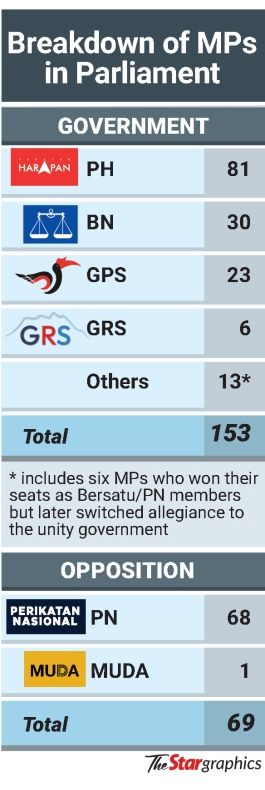
In the 222-member Dewan Rakyat, the unity government has 153 seats with DAP (40), PKR (31), Amanah (eight) and Upko (two), Umno (26), MCA (two), MIC (one) and PBRS (one).
Gabungan Parti Sarawak has 23 seats and Gabungan Rakyat Sabah (six); other government aligned parties and independents have 13 seats including six ex-Bersatu MPs.
The opposition has 69 seats with PAS (43) and Bersatu (25) and Muda (one). Even if the nine rebel PKR MPs decide to be in opposition, the numbers still do not add up.
In short, the PM and his government are in no danger of collapsing. Anwar remains secure and has no reason to step down.
Veteran journalist Datuk Kadir Jasin said the rally is not likely to bring down Anwar and that until the next general election, the only way to remove Anwar is to prove that he no longer commands the majority of support of MPs.
“No rally, protest or march will bring down Anwar so long as he maintains the support of the majority in Parliament,” he wrote on Facebook.
The next general election must be held by Feb 17, 2028, which is still a long way off. There had been speculation earlier that Anwar may call for an election as early as next year but it does not look likely now.
Next comes the most obvious question – if they want Anwar to be toppled as PM, who then should be the successor?
Will the replacement be Opposition Leader Datuk Seri Hamzah Zainudin or Bersatu president Tan Sri Muhyiddin Yassin or ailing PAS president Tan Sri Abdul Hadi Awang?
Nobody seems to be able to give a reply. In fact, no one wants to even indicate who will be the next PM if Perikatan forms the next Federal Government because it would be against them.
They know the options do not seem attractive enough to voters although they gripe about Anwar’s weaknesses.
The biggest complaint is the rising cost of living, which like many other world leaders, Anwar, too, has to grapple with.
The expanded Sales and Service Tax, and perceived slow reforms have also upset many including his voters.
Besides, whoever takes over him wouldn’t have any immediate answers. Not to forget the economic legacy issues he has inherited as a result of the 1MDB looting.
But one thing is certain, something which Anwar has to live with – democracy in Malaysia will get noisier.
His predecessors, especially 100-year-old Tun Dr Mahathir Mohamad, would not have tolerated such dissent because he had the draconian Internal Security Act at his disposal and he had no qualms of locking up his critics.
He shut down newspapers and ensured the media toe the line because the free for all social media had not existed then.
Anwar has to grit his teeth and tolerate dissent, especially his rebel MPs, because he has always spoken up for differences in views, and as long as they defend his leadership in party and government, he has no other choice.
He has taken to the streets to protest and such democratic practices would need to be accepted.
But the public has also matured. They have asked what is the point of tomorrow’s protest and whether it is a genuine manifestation of public discontent, as the organisers have claimed, or mere political optics.