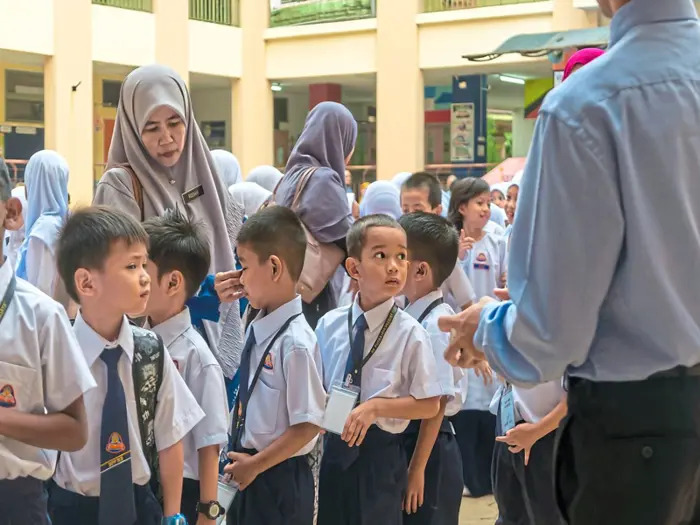
Trying to do their best: It’s time to prioritise the teaching profession. Teachers are not mere government civil servants, they are thought leaders, nation-builders, and motivators. — Posed photo/123rf
THE nation continues to debate whether those under 16 should be banned from having social media accounts, if CCTV and security detectors should be installed in schools, and about mental health counselling training for teachers.
Sadly, no one has come out to talk about support for our teachers.
More work has been loaded on them as they become surrogate parents the minute children are dropped off at school gates.
If the kids are top scorers, parents take the credit and bask in reflected glory, but if they are under performers, the teachers get the blame.
In the staff room, teachers are becoming data entry clerks, filing endless meaningless reports to schools and education departments.
The once-feared disciplinary teachers, many of whom we older people remember until today, have lost their power in the present day school system.
They can even be charged in the courts for whacking ill-behaved kids.
Many of us from the older generation would never dare tell our parents then that we had been given a beating in school by these teachers, who roamed the corridors with canes in hand.
If our parents came to know, we usually ended up getting another round of punishment. Now, kids run to their overprotective parents to whine. The parents, in turn, run to their lawyers and the media, to make exaggerated allegations.
No wonder we keep hearing about teachers opting to retire early. The reported main reasons for their decisions include a loss of interest in teaching (67%), followed by family problems (about 17%) and health issues (around 7.7%).
Other factors include a heavy workload, administrative burdens and difficulty adapting to changes in the profession. They also struggle with inconsistent policies, syllabus density, and overly hierarchical school management and structures.
Recently, Deputy Education Minister Wong Kah Woh said 19,179 primary and secondary school teachers opted for early retirement between 2022 and May this year, with most citing loss of interest in teaching.
He said the ministry had outlined seven measures aimed at reducing teachers’ workloads, including scrapping low-impact school events and appointing members of the public as examination invigilators.
He also said the ministry had introduced teaching assistants at schools with more than 1,500 students to help reduce teachers’ administrative workloads.
It is good to read that the grievances of teachers have been heard and plans are being made to help them.
Teachers are more than educators. They shape the minds and character of the next generation. They have made a difference in many lives.
They are often the first role models outside the family, the ones who nurture dreams, spark curiosity, and guide children towards a better future.
I’m sure all of us, regardless of our age, still remember the names of teachers who made an impact on our lives. Of course, the bad ones are still etched in our minds too, but I believe many of us from the older generation had mostly good experiences.
Yet, despite their indispensable role, Malaysian teachers continue to be undervalued, underpaid, and underappreciated.
We call them “heroes” every Teacher’s Day, and when they retire, especially the headmasters, they are accorded a grand send off. Tears are shed, sometimes. But once the speeches and photo ops are over, very little changes.
During the national day parade, we see Malaysians getting excited over the muscled Abang Bomba and even the police canines. Certainly, we should consider giving our teachers just as prominent a role during the National Day march past.
For far too long, our teachers have carried the nation on their shoulders without receiving the recognition and perks they truly deserve. The respect they deserve has faded, with teaching no longer seen as a noble, well-paid profession. Malaysia will never attract the best minds if we continue down this path.
Teaching has never been a simple job but it is now harder than ever. Beyond delivering lessons, teachers are expected to be counsellors, administrators, event organisers, exam invigilators, medical officers, disciplinarians, and surrogate parents.
In the recent school stabbing case, they even had to apprehend a boy walking around with knives.
Their jobs don’t end after the long school hours either – there’s grading papers, preparing lesson plans, or attending meetings too. Now, they even have to learn about artificial intelligence and STEM to keep up with modern lesson modules.
Our teachers deserve better. For many, salaries are barely enough to match the rising cost of living.
Promotion opportunities can be limited and bureaucratic, and the allowances or perks they receive do not reflect the magnitude of their responsibilities.
Let’s not forget those who are posted to rural schools with few facilities. They literally live in hardship.
It is unfair that here teaching is regarded as a “safe government job with pensions’’ as the reality is in many other countries, including neighbouring Singapore, teaching is a prestigious, well-paid career that attracts top talent.
Teachers are not mere civil servants, they are thought leaders, nation builders and motivators.
Countries that prioritise education understand that quality teaching is the single most powerful tool to break cycles of poverty, foster innovation, and build a competitive economy, as one report put it.
Our Malaysian teachers deserve better.
A Japanese proverb sums it up perfectly: “Better than a thousand days of diligent study is one day with a great teacher.”