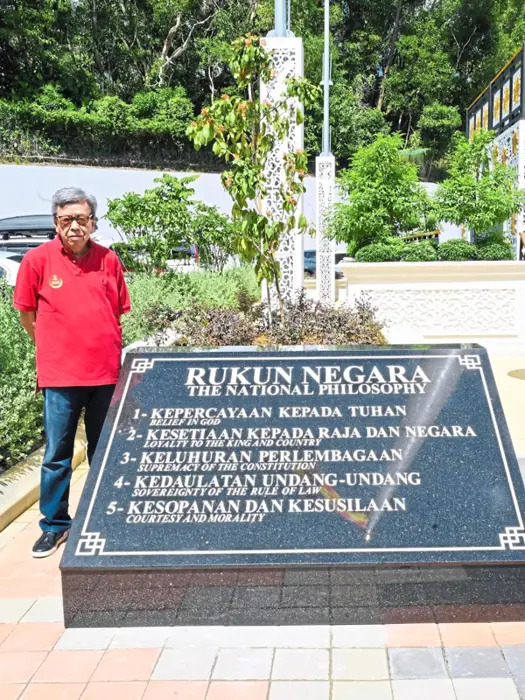
Royal order: The Sultan of Selangor, Sultan Sharafuddin Idris Shah, says all assemblymen in the state should go to Dataran Selangor twice a month to read the Rukun Negara inscribed on a plaque there. — Photos: Selangor Royal Office’s Facebook
THE Rukun Negara was never meant to be just a ceremonial pledge to be recited absent-mindedly during school assemblies or national events.
Instead, our founding fathers had bigger plans when they painstakingly drafted the preamble and five principles.
It was born out of one of the darkest moments in our history – the racial riots of May 13, 1969, when the nation realised that political rhetoric, communal suspicion, and irresponsible leadership could tear apart the fragile fabric of a young country.
More than five decades later, why do we have the impression that the Rukun Negara is no longer given serious recognition?
We like to tell ourselves that the Rukun Negara remains relevant but ironically, those who should be upholding its spirit the most – our politicians – are often the very people undermining it.
Last week, the Sultan of Selangor, Sultan Sharafuddin Idris Shah, said all assemblymen in the state should go to Dataran Selangor twice a month to read the Rukun Negara inscribed on a plaque at the square.
He singled out Seri Kembangan assemblyman Wong Siew Ki of DAP and the party’s former state executive member Ronnie Liu.
“I encourage them to go to Dataran Selangor every week to understand and appreciate the Rukun Negara,’’ His Royal Highness said in a statement.
The Sultan did not provide specific reasons for directing his remarks at the two individuals.
However, the statement is widely understood to be linked to the ongoing controversy over pig farming in Selangor, as both men had previously been associated with the issue in public discourse and criticism.
The remarks by Wong and Liu had earlier drawn criticism from several quarters, particularly within the Malay and Muslim communities; the two had made comments relating to pig farming projects in Selangor, which were perceived by some as disrespectful to the Selangor ruler.
Sultan Sharafuddin had previously maintained his position that he does not consent to any pig farming activities being carried out in any district in the state.
The five principles of the Rukun Negara are simple, clear and timeless: Belief in God, loyalty to King and country, supremacy of the Constitution, rule of law, and courtesy and morality.
These are not mere abstract ideals but the minimum foundation required for a diverse nation like Malaysia to survive and prosper.
Tuanku’s message is for all politicians in Selangor and not merely the two from the DAP.
The Palace’s unhappiness is that political discourse has become increasingly coarse, divisive and reckless.
Contentious and sensitive issues would be better discussed amicably behind closed doors. Playing to the gallery isn’t going to help.
The question is not a matter of the limits of a constitutional monarchy but the tone used and whether sufficient wisdom and sensitivity were exercised, as commentator Anas Zubedy wrote.
The matter involves the palace, the rakyat and the wider social fabric of Malaysia.
“In life, it is not only what you say that matters, but also how, when and where you say it. One may legally argue a point and yet still fail in wisdom, manners and cultural sensitivity,’’ he said, adding that, “Respectful engagement matters. Tone matters. Context matters. Institutions matter’’.
Contentious issues should rightly be resolved effectively through proper consensus and without the need for sound bites and hits on social media platforms.
We now see politicians – and probably paid cybertroopers and influencers – exploiting race and religion for short-term gains, questioning constitutional arrangements whenever convenient, insulting institutions, and reducing serious national issues to endless political theatre.
Social media has worsened this culture, rewarding outrage over reason and provocation over prudence.
Many politicians speak passionately about patriotism but they sound hollow in reality as they behave in ways that weaken national unity.
Some demand respect for their own beliefs while showing little respect for the sensitivities of others.
Others preach morality while engaging in toxic politics that normalise hatred, mockery, and character assassination.
This is precisely why the Rukun Negara must not be treated as a relic of the past.
The principle of courtesy and morality, for example, may sound old-fashioned in today’s combative political climate, but it is perhaps the principle Malaysia most urgently needs to turn to.
Democracy does not mean permanent hostility. Political competition should never come at the expense of basic decency and mutual respect.
Likewise, the supremacy of the Constitution and the rule of law cannot be selectively defended only when politically convenient.
Politicians cannot claim to support democratic institutions while simultaneously attacking them whenever decisions do not favour their narratives.
The Rukun Negara was intended to create a common national identity above ethnic and political divisions. This is clearly reflected in the preamble of the Rukun Negara which says Malaysia nurtures the ambitions of:
- Achieving a more perfect unity amongst the whole of her society;
- Preserving a democratic way of life;
- Creating a just society where the prosperity of the country can be enjoyed together in a fair and equitable manner;
- Guaranteeing a liberal approach towards our traditional heritage that is rich and diverse;
- Building a progressive society that will make use of science and modern technology.
The Rukun Negara recognised that Malaysia’s diversity is both our strength and our vulnerability. Without shared principles, a plural society can quickly descend into mistrust and fragmentation.
The Rukun Negara was drafted by key historical figures. And it needs to be pointed out that diversity and shared principles were the reason why, in the first tenet, the belief in God, the word “Tuhan” was chosen.
When elected representatives openly trade insults, play up racial insecurities, or flirt with extremist rhetoric, they normalise intolerance for the next generation.
Politics then becomes less about governance and nation-building and more about perpetual anger and division.
Malaysia’s stability over the decades did not happen by accident.
It was built on compromise, moderation, and an understanding that no single community can dominate this country alone. The Rukun Negara reflects that social contract.
Critics may dismiss it as idealistic or symbolic, but nations survive on shared values and collective discipline.
Remove those guardrails and society becomes vulnerable to polarisation and extremism.
The danger is not that Malaysians no longer know the Rukun Negara. Most can still recite it. The danger is that many no longer internalise it.
Perhaps it is time to stop treating the Rukun Negara merely as a school recital and start treating it as a national code of conduct – especially for politicians seeking public office.
Leadership is not only about winning elections. It is also about setting standards for society.
If politicians themselves cannot embody the principles of respect, restraint, and constitutional loyalty, then the Rukun Negara risks becoming little more than words on paper.
Perhaps it is time for all Parliament and state assembly meetings to begin with these lawmakers singing NegaraKu and reciting the Rukun Negara.