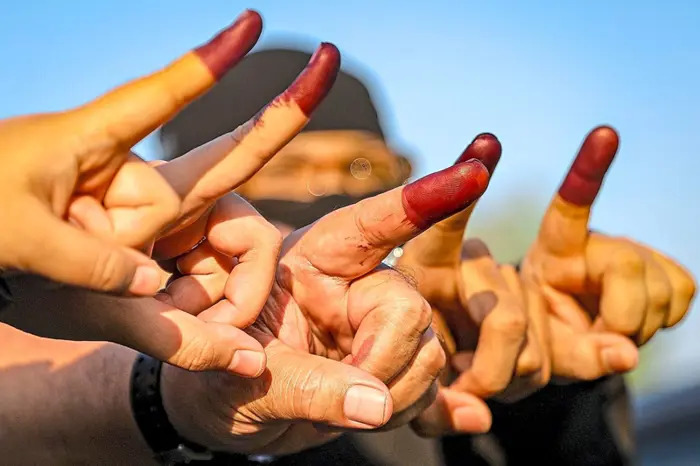
Choosing wisely: Malaysian voters need to ask the right questions of their candidates. — Bernama
WHEN the people of Johor went to the voting booths yesterday to cast their ballots, we can be certain the majority ignored the call by Tun Dr Mahathir Mohamad.
The former prime minister had asked voters to pick only Malay candidates in the polls.
This was after PAS president Tan Sri Abdul Hadi Awang had made a similar call, saying the state government must continue to be led by Malay leaders to preserve Malay-Muslim leadership in Johor.
These two ageing politicians are oddballs. Both share the same simplistic approach of offering Malaysians a political shortcut.
Forget competence. Forget integrity. Forget that we are all Malaysians. According to Dr Mahathir, Malay voters should simply vote for Malay candidates.
PAS has since changed its stance to be friendlier towards the MCA and MIC, reportedly because they are with Barisan Nasional and are not like the purportedly extremist DAP, which is part of Pakatan Harapan.
The irony is that many Malaysians, including Malays, also perceive PAS as an extremist party.
Instead of asking voters to scrutinise the record of candidates, to check policy documents, financial records, their educational qualifications, and to ask awkward questions about governance, the two are only keen on the ethnicity of the candidates.
Can you imagine if voters begin asking, “Awak Melayu kah (are you Malay)?”, “Awak Muslim ke (are you Muslim?)?”; or if Chinese-based and Indian-based parties ask their supporters to do the same thing with their ethnicities?
Perhaps those two politicians should ask Malaysians to extend the principle beyond politics.
The next time you need heart surgery, don’t ask whether the surgeon is qualified. Ask if he shares your ethnicity.
If your house catches fire, insist the firefighters first confirm their racial identity before reaching for the hose.
When we order food, we should ask the delivery service, “Budak yang hantar makanan, dia Melayu Muslim ke (Is the person delivering the food Malay-Muslim)?”
When boarding an aircraft, will we ask “Kapten Melayu-Muslim ke? Flight attendant sama juga kan (Is the captain Malay-Mus-lim? Same goes for the flight attendants, right)?” Should the other races do the same too and demand crew of their “own kind”?
Never mind the pilot’s flying hours and the crew’s quality of service. What truly matters is whether everyone in the cockpit and cabin belongs to the “correct” community.
Absurd? Of course.
Yet this is precisely the logic, or rather illogic, behind asking citizens to choose leaders primarily because of race.
It is a curious argument coming from Dr M, someone who spent decades insisting Malaysia needed capable administration, economic growth, and national development. One would have thought that after leading the country for over 20 years across two premierships, the benchmark for political leadership would be experience, competence, and results rather than ancestry.
Apparently not.
Perhaps Malaysia has misunderstood democracy all along. To some people, elections are not about selecting the best representatives but about your race and religion.
If we take their logic – which we can presume would extend beyond the Johor state polls and eventually reach the general elections, then Malaysia is in deep trouble.
Hadi does not care that his party can’t even run Perlis, Kedah, Terengganu, and Kelantan efficiently but is determined to get to Putrajaya. His faithful followers don’t care either.
But with Dr Mahathir and Hadi’s twisted logic, the race and religion narrative would certainly simplify political debates.
“What’s your plan to improve Johor’s economy?”
“I’m Malay.”
“Excellent. Next question: How will you address the rising cost of living?”
“Still Malay.”
The unfortunate implication is that race somehow guarantees good governance. History has been less than enthusiastic about this theory.
Corruption has never needed an IC to verify race and religion before money changes hands. Inflation does not discriminate when it comes to race and religion.
Potholes possess no racial preference. Bureaucratic inefficiency speaks every language fluently.
Citizens waiting in hospital queues are rarely comforted by knowing that the minister responsible happens to share their ethnicity. It’s the quality of the healthcare workers that matters.
There is another odd assumption in voting along racial lines, if we are to accept the call of the two leaders.
It quietly suggests Malay voters are incapable of judging candidates on merit.
That the Malays cannot compare policies, evaluate integrity, or recognise competence unless someone first points out the candidate’s race.
This is hardly the compliment its advocates appear to think it is.
Malay voters, like every other Malaysian, are certainly perfectly capable of asking sensible questions.
Has this person served the public honestly? Can this candidate manage public finances responsibly? Does this representative show integrity when nobody is watching?
Remarkably, none of these questions require a DNA test.
Malaysia’s Federal Constitution certainly recognises the country’s unique history and provides special provisions for Malays and the natives of Sabah and Sarawak.
It also establishes a shared citizenship that expects elected representatives to serve everyone in their constituency.
Johor, perhaps more than most states, understands this reality. Its prosperity has never depended on everyone looking alike.
Instead, it has depended on attracting investment, welcoming talent, encouraging enterprise, and convincing people that tomorrow will be better than today.
Investors, inconveniently, tend to ask about infrastructure, political stability, and the rule of law rather than the ethnicity of the local elected representative.
Race remains an important part of Malaysia’s identity. No reasonable person disputes that. The greatest irony is that race-based politics always promises security while quietly delivering permanent division.
If every community is encouraged to vote only for “its own”, eventually everyone becomes suspicious of everyone else, and every election becomes an ethnic census with campaign posters.
Democracy deserves better.
Malaysia deserves leaders who unite rather than divide, persuade rather than provoke, and solve problems rather than sort citizens into categories.
If the best candidate happens to be Malay, vote for that candidate. If the best candidate happens to be Chinese, Indian, Iban, Kadazan or Orang Asli, vote for that candidate.
That is not colour-blind idealism. It is simply how meritocracy is supposed to work.
After all, if race alone were enough to guarantee good leadership, Malaysia would have solved all its problems decades ago.
We have Malay leaders who have been convicted of corruption, including those who have plundered the nation’s wealth on an unimaginable scale.
Have we forgotten that the country faces a financial obligation of RM51.4bil because of the 1Malaysia Develop-ment Berhad scandal in which at least US$4.5bil (RM18.31bil) is alleged to have been misappropriated?
But there is also a longer list of Malay leaders who have served the country very well, in both the public and private sectors.
Their competence and qualifications are well-known, and they have reached the pinnacles of their careers on their own.
Likewise, there are Malaysians of other races who have put their lives on the line for our beloved country.
When Dr Mahathir and Hadi enter hospital for treatments, I am sure they will insist on the best doctors and nurses – and not ask if they are Malays and Muslims.
They will also not ask that the bags of blood they receive during surgeries come exclusively from Malays and Muslims.
There are only good and bad people – and they come from all races and religions.
The only race that matters is for Malaysia to race to the top, to remain competitive and be stable.