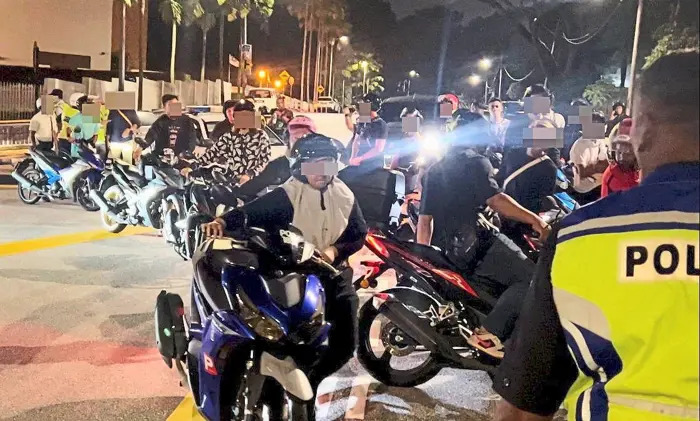
Danger on the roads: A file photo provided by the police of a round-up of motorcycle riders caught performing stunts near in George Town. — PDRM Penang
IT used to be just a small group of young men speeding down the road on their roaring motorcycles – but now, it seems to have grown monstrously.
Last week, Penang police had to break up a large illegal street racing event near the Butterworth Outer Ring Road toll plaza in Bagan Ajam.
A large-scale operation was carried out after viral social media videos showed a massive crowd of mat rempit. They reportedly blocked the highway toll exit with their bikes to turn the public road into a makeshift racing circuit. The illegal blockade forced heavy vehicles like lorries to slam on their brakes, disrupting traffic and causing severe safety risks.
In April, a group of mat rempit in Kota Baru turned the flyover ramp of the newly upgraded Sultan Ismail Petra Airport into an illegal racing track.
While these are obviously illegal gatherings, Malaysians have also noticed large scale “convoys”, or sanctioned motorcycle rides, led by politicians.
No one argues against convoys that have received the approvals of the respective authorities, including the police.
But there have been fatal accidents.
In July, four riders died in a crash involving 12 motorcycles and a car on the East Coast Highway near the Jabor toll plaza in Kuantan.
They were reportedly travelling towards Kemaman, Terengganu, for a RXZ members gathering (RXZ refers to the Yamaha RX-Z motorcycle model).
In August, five participants died in separate road accidents while travelling to or returning from the RXZ members 7.0 gathering in Terengganu.
The event attracted thousands of motorcycle enthusiasts. Obvi-ously, there is an attraction among Malaysia’s young voters for motorcycle convoys.
But there is something seriously wrong when politicians, who should be setting examples of responsible behaviour, choose to court popularity by organising or joining motorcycle convoys without giving sufficient attention to the message they are sending.
The sight of a politician surrounded by hundreds of motorcyclists may make for an impressive photograph.
The roar of engines, the cheering crowds, and the spectacle of motorcycles moving together can create an atmosphere of excitement. For a politician seeking public attention, it is an opportunity that’s difficult to resist.
But beyond the photographs and social media postings, a more fundamental question needs to be asked: What exactly are these politicians promoting?
Are they encouraging responsible riding, road safety, and constructive engagement with young people? Or are they simply exploiting the appeal of the mat rempit culture for political mileage ahead of the general election?
This is not an argument against motorcyclists. Far from it.
Millions of Malaysians depend on motorcycles for their daily commute, while many young people have a genuine passion for motorcycles, engines, and motorsports. They deserve respect, opportunities, and the right to pursue their interests safely.
We must also be careful not to label every young motorcyclist a mat rempit. Not everyone who joins a convoy is involved in illegal racing, dangerous stunts, or traffic offences.
There is a clear distinction between celebrating motorcycle culture and appearing to glamorise behaviour associated with reckless riding, illegal street racing, and a disregard for traffic laws.
Politicians, of all people, should know the difference.
More importantly, they should understand that their public appearances carry a responsibility that goes beyond the immediate excitement of an event.
Malaysia has spent years trying to educate road users about the dangers of reckless riding. Road safety campaigns warn against speeding, dangerous manoeuvres, and the failure to wear helmets.
Families have lost sons and daughters in road accidents, while survivors have had to live with permanent injuries.
Motorcyclists are particularly vulnerable because they have little physical protection when an accident occurs. A moment of recklessness can destroy not only the rider’s future but also the lives of family members who depend on them.
Against this backdrop, politicians should be sending an unmistakable message: Obey the law, respect other road users, and never put lives at risk for entertainment, excitement, or public attention.
Instead, there are political leaders who enthusiastically associate themselves with motorcycle gatherings without making responsible riding a clear priority.
These politicians risk sending precisely the wrong signal. It is not enough to insist that an event is merely a community engagement programme.
Last month, a political party even added a religious twist to its massive motor convoy by claiming it was aimed at propagating faith.
The public is entitled to examine the circumstances, the conduct being encouraged, and the example being set.
If politicians want to reach out to young motorcyclists, they should do so by promoting discipline, providing opportunities, and addressing their concerns. They should not depend on the spectacle of a convoy to create an impression of popularity.
Unfortunately, this sort of political theatre has become increasingly familiar.
A politician turns up at an event, is greeted enthusiastically by a crowd, poses for photographs, perhaps climbs onto a motorcycle, and leaves with a collection of images suitable for social media platforms.
The message is simple: Look at how popular I am; look at how many young people support me.
But popularity is not the same as good leadership, and a large crowd is not proof that a politician has earned the public’s trust.
The problem with politics built around such spectacles is that it rewards immediate visibility rather than meaningful results.
Politicians cannot tell young people to obey the law on Monday and then appear indifferent to the same issue when seeking their support on the weekend.
It would be good if politicians use such gatherings to promote helmet use, road discipline, and community safety, and not merely to “ride” a wave of popularity.
If the principal attraction is the political spectacle, then the exercise deserves greater scrutiny.
Where are the politicians when the cameras are gone? The real test begins when the engines stop and the cameras are switched off.
What have these politicians actually done for the young people whose company they so eagerly seek?
These are fair questions, not an attempt to deny politicians the right to engage with any section of society.
Young people should not be treated as a convenient audience that can be mobilised whenever a politician needs to demonstrate grassroots support.
They are citizens with real problems, ambitions, and expectations. They deserve more than an occasional appearance by an elected representative.
For some, motorcycles are simply a means of getting to work. For others, they represent an affordable hobby or a possible career.
A minority may be drawn into illegal racing because of peer pressure, the excitement of speed, or the desire for recognition.
The motivations are not all the same, and the solutions cannot be reduced to blanket condemnation.
Neither can the problems be solved by politicians who choose to flatter young people without challenging behaviour that endangers them and others.
A responsible leader must be prepared to tell a crowd what it needs to hear, not merely what it wants to hear. That includes reminding riders that public roads are not racing circuits, that dangerous stunts are not a demonstration of courage, and that no politician’s presence gives anyone permission to break the law.
Politicians must also recognise that public perception matters. Their actions can legitimise an activity, influence behaviour, and communicate priorities, whether or not that is their stated intention.
If they want to participate in motorcycle events, they should make their commitment to road safety visible and unmistakable.
They should also be quick to condemn dangerous behaviour regardless of whether or not the offenders are their supporters.
Ordinary Malaysians who drive home after work, parents taking their children to school, and pedestrians crossing busy roads have every right to expect that public safety will not be compromised for a politician’s publicity.
That is a far more constructive approach than treating motorcycle convoys as political rallies in disguise.
Ultimately, the measure of a successful motorcycle event should not be the number of engines roaring down the road, the size of the crowd, or the number of views generated on social media. It should be whether the event promotes responsible riding, strengthens community ties, and leaves participants with a better understanding of their responsibilities.
There is nothing wrong with a politician wanting to connect with young people. Politicians are free to ride alongside the people they represent. But they must also be prepared to lead them in the right direction.
A convoy may generate publicity for a politician. But it takes a real leader to ensure that young Malaysians do not become casualties of a culture of recklessness – or victims of political expediency.