


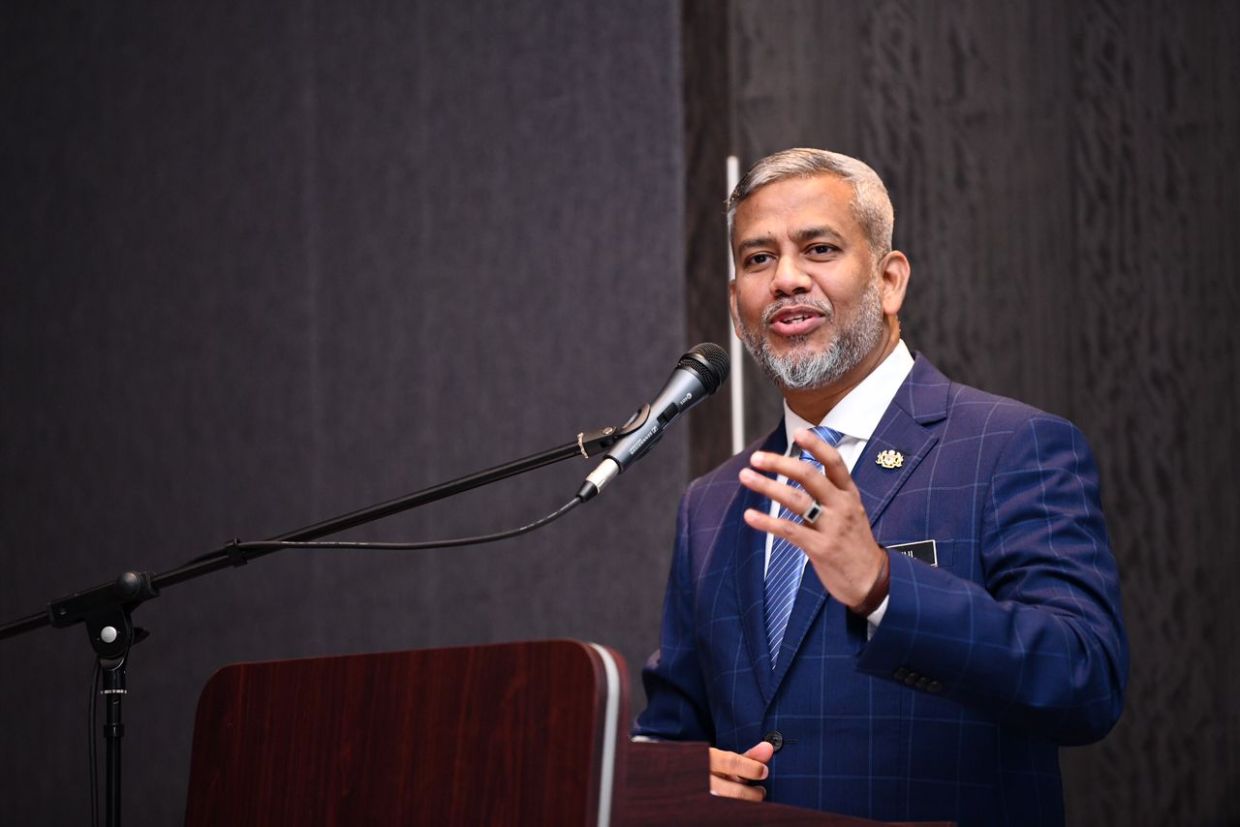
“To remain effective and relevant, we must evolve and stay ahead of the nation’s human capital development trends,” said Datuk Shahul Hameed Dawood
HUMAN Resources Development Corporation (HRD Corp) Chief Executive Datuk Shahul Hameed Dawood talks about the work that it has successfully carried out and why the organisation wants it to benefit all Malaysians, including those from Sabah and Sarawak, writes WONG CHUN WAI.
WONG: You have introduced a lot of changes in HRD Corp since you took up the role of chief executive. Can you tell us more about HRD Corp’s evolution in the last two years?
Shahul: When I first came on board, I had two key priorities; expand our core mandate collecting the levy from employees and disbursing training grants for their employees’ development and taking the organisation on a digital transformation journey.
I am happy to note that we have managed to do both, thanks to the vision of the Minister of Human Resources Datuk Seri M Saravanan and the support of our chairman, Datuk Seri Jamil Salleh, together with HRD Corp’s board of directors.
The expansion of the PSMB Act 2001 took effect on March 1, 2021, covering 18 sectors and 238 subsectors. As a result, today we have over 75,000 registered employers with 4.1 million employees eligible for training and upskilling.
As for the latter, we formed a Digitalisation Department that was responsible for assessing our technology adoption as an organisation and providing comprehensive recommendations on how to proceed.
This led to the deployment of three new tech initiatives: our Go-to Cloud, Smart Workplace and Channel Expansion.
These laid the foundation for the introduction of our MyHRDCORP Super App. We are the first public sector organisation to have a super app in Malaysia.
Can you please share more about your digital transformation and the Super App?
Our Go-to-Cloud strategy enables us to utilise a hybrid multi-cloud ecosystem that improves the organisation’s speed, efficiency and agility. This has helped us to cater to multiple concurrent requests while protecting data security.
Through the Smart Workplace software and solutions, our employees are given the flexibility to complete their tasks and handle customer requests efficiently, regardless of whether they are working at home or in the office.
Then, there is Channel Expansion, the effort that created more channels and platforms for internal employees to communicate with each other and external stakeholders to reach out to our representatives – the most notable feature being our Ask Bella AI chatbot.
MyHRDCORP is a super app that is designed to provide the latest information on HRD Corp while bringing all our products and services under one easy-to-use platform.
It is aimed at supporting our key stakeholders; registered employers, trainers, training providers and Malaysian individuals, to utilise our services in meeting their personal, professional and business needs.
Since the app went live in August, we have seen about 8,500 downloads and received positive feedback on its use by stakeholders.
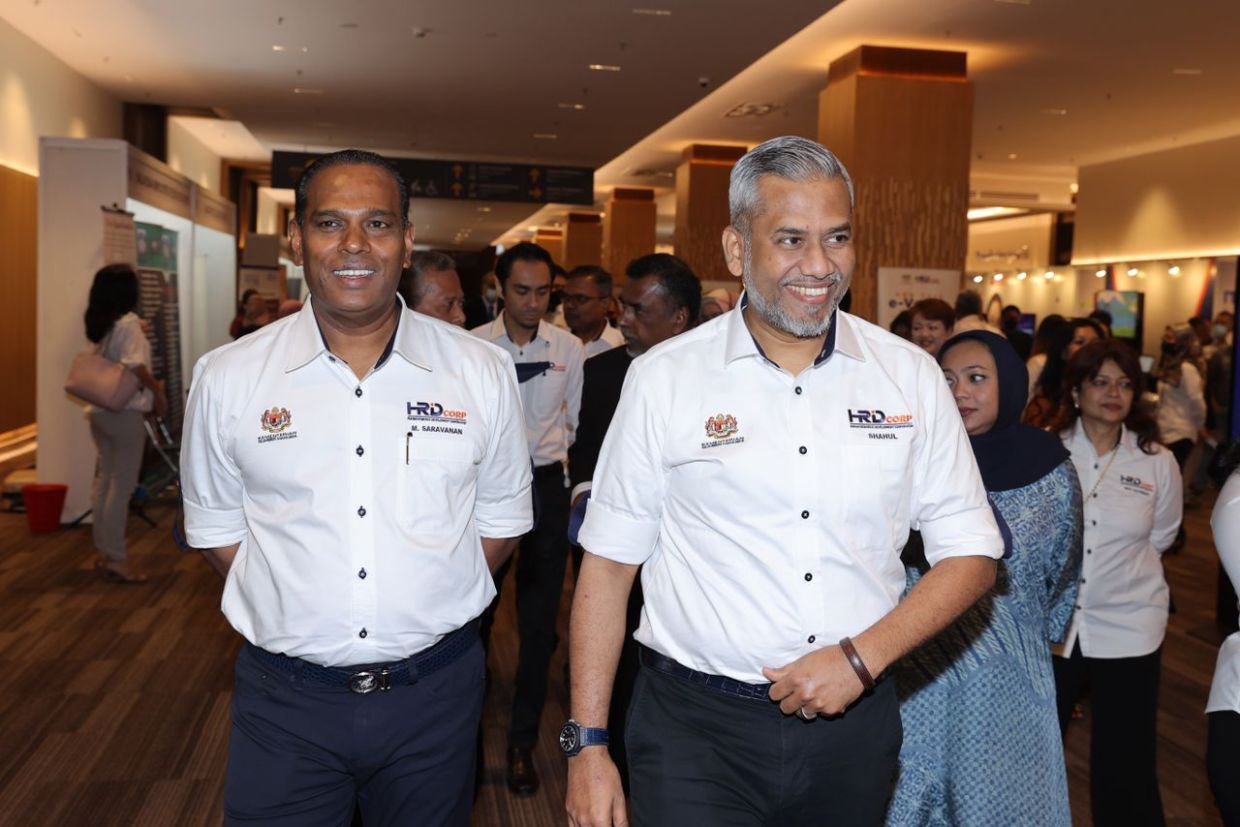
Datuk Shahul Hameed Dawood (right) together with Human Resources Minister Datuk Seri M Saravanan (left).
Who can benefit from the Super App?
Employers can check their levy balance as well as grants and claims status. They can also advertise vacancies while individuals can search and apply for jobs and training programmes.
They can also build a skills dashboard on the platform.
Trainers and Training Providers can submit proposals and check the status online, track their training attendance and effectiveness as well as market their courses to more people on the platform.
Beyond these two major efforts, HRD Corp has also introduced many new programmes and initiatives under your leadership. Can you tell us more about these programmes?
We introduced Penjana HRDF in June 2020 at the height of the pandemic. The programme provided reskilling programmes to graduates and retrenched workers, followed by income-generating opportunities (through entrepreneurship and freelancing) for B40 communities.
Then, there is Upskill Malaysia, an integrated centralised platform that provides information on upskilling, reskilling, cross-skilling and multi-skilling programmes offered and funded by government ministries and agencies.
HPC is a one-stop virtual portal that provides employment and income-generating opportunities to Malaysians through job matching and placement, training and development, as well as career counselling and coaching.
e-LATiH, on the other hand, has become Malaysia’s premier e-learning platform that offers all Malaysians unlimited access to free high-quality and internationally recognised skills development courses.
We also want to upgrade our level of training, here, via HRD Corp Microcredential, which is the first industry-based micro-credential in Malaysia that holds the largest repository of microcredential-based courses with more than 25,000 courses acknowledged through the HRD Corp Microcredential Framework.
You took the organisation through a major rebranding exercise last year, going from HRDF to HRD Corp. What would you say is the biggest change in the organisation since, and what is your proudest achievement at HRD Corp?
HRD Corp is a 29-year-old organisation. To remain effective and relevant, we must evolve and stay ahead of the nation’s human capital development trends.
When I was appointed, our Minister of Human Resources Datuk Seri M Saravanan shared with me his vision of wanting to HRDF to become responsible for every aspect of talent development in Malaysia.
So, this became my priority together with the senior leadership team and all employees of the organisation.
Previously, we were only known as an agency that collects a levy from employers and funds their training programmes.
Today, we have expanded our role through the following – placement, employment and income-generation initiatives for all Malaysians through most of our new strategic initiatives.
For example, lets look at Place & Train – previously we only funded training programmes for employees of registered employers or just general training programmes for unemployed individuals or graduates.
Now, we also offer placement for individuals followed by the training required to perform the job they are placed in.
We believe this is important, as there is no point in individuals developing their skills if they can’t get jobs.
Due to all of these new programmes and initiatives, we are now recognised as the primary custodian of all Malaysia’s upskilling, training and human capital development efforts by the prime minister himself.
So, the rebranding is more than just a name change.
It’s a clear validation of our expanded role and responsibilities in strengthening Malaysia’s human capital landscape.
Can you tell us about SCOPE, the Second Chances and Opportunities for People to Excel – for former prisoners – you mentioned that HRD Corp has trained and provided jobs for 1,000 former prisoners in 2021 and aims to train and provide jobs for 5,000 more in 2022.
This is a programme that has attracted a lot of enthusiasm and attention. I always believe that everyone must be given a chance. Sometimes, even a second chance.
There is a lot of interest from employers in the construction, restaurant and tourism sectors.
The Star reported that the famous Hameediyah nasi kandar restaurant in Penang provided jobs to these former prisoners as waiters. This was indeed very uplifting to these people.
Datuk, it is interesting that HRD Corp has also initiated programmes for senior citizens, housewives, etc. Tell us a bit more about that.
I am glad that you asked me this. We have SEBA – Seniors Back in Action for retirees and old people, HEARTS – Housewives Reactivate Talent Scheme for single mothers and B40 women, and OTEP – OKU Talent Enhancement Programme for persons with disabilities.
Which is why HRD Corp wants to emphasise that no one will be left out. Many senior citizens, housewives and OKU are productive, and they can still contribute. They, too, deserve to be upskilled and provided with employment and income-generation opportunities.
How has the response been for all the new programmes and initiatives that you have launched?
We have been receiving very positive response for all our new programmes and initiatives from our key stakeholders such as employers, trainers and training providers.
At the same time, the response from employer associations, industry players and the wider Malaysian public have also been encouraging.
This is because we have pivoted to helping more Malaysians build their capabilities while identifying and capitalising on new income-generating opportunities.
As the custodian of Malaysia’s human capital development efforts, it is important that we stay ahead of the curve and introduce efforts and programmes that will empower businesses and talents for the future of work. All of our efforts in the past two years have been focused on achieving this goal.
Datuk, I want to go back to the micro-credential issue. There were a lot of comments in the media and by the public about the HRD Corp Microcredential initiative that was launched recently. What is your take on this?
Before we go into the HRD Corp Microcredential initiative, it is important that people first understand what micro-credential is.
Micro-credential is proof of learning outcomes acquired by a learner after a short learning experience, as measured by their knowledge, skills and attitudes.
Previously in Malaysia, micro-credentials were only offered through the academic pathway.
The HRD Corp Microcredential Initiative is the first industry-based micro-credential in Malaysia.
It was developed to offer quality assured training that intensively measures and monitors the effectiveness of the training and its key learning outcomes.
There is also a strong need for this for our registered employers and their employees. This is because our research indicates that in 2019, out of 1,028,793 training places approved only 4.4% (44,932) were for certification courses.
HRD Corp spent close to RM94mil funding these courses. And within that, some were just certificates of attendance or certification from non-recognised bodies that offer little to no value to employers and employees.
Furthermore, between 2019 and 2021, about 18% of the complaints we received from employers were about the low quality of training delivery.
Therefore, the initiative was developed to address these issues and meet the current needs and demands of our registered employers and their employees.
The HRD Corp Microcredential framework follows a comprehensive 12-step verification, monitoring and certification/badging process.
So, both HRD Corp and the employers have more control over the quality of the training programmes and can determine whether they are effective in helping employees gain new skills relevant to their job roles and functions.
However, we took note of the feedback from industries, and we formed a Technical Working Committee comprising 22 employer associations that have discussed and deliberated the fee structure and implementation mechanisms for the HRD Corp Microcredential initiative.
More details will be announced soon.
Many people are saying that the micro-credential fee is unnecessary and could burden employers and training providers. What is your comment?
This is inaccurate. The micro-credential fee will be embedded within the total course fee and follows the same allowable cost matrix for all HRD-funded levy programmes with its own ceiling limit for each scheme.
This is similar to the approach we use for existing certification programmes that are funded by the HRD levy, where the certification cost is embedded within the total course fee.
Therefore, employers are not paying extra or using up their levy faster to train fewer people.
However, we are putting the Microcredential initiative on hold while we deliberate on the details further with the Technical Working Committee.
People are also saying that with all these new initiatives and programmes that HRD Corp is rolling out, it is going beyond its role as an industry regulator to become a for-profit organisation. What is your comment?
HRD Corp is a statutory authority responsible for Malaysia’s human capital development. As a 29-year-old organisation, how we perform this responsibility has evolved and changed with the times.
But our core DNA remains the same; to ensure that Malaysian talent and workforce gain the knowledge and skills development opportunities they need and for Malaysian businesses and industry to get a highly trained, knowledgeable and capable workforce that can support organisational and national economic growth.
We are also strictly governed by the Pembangunan Sumber Manusia Berhad Act 2001, which outlines our powers and functions as an organisation. This includes determining the terms and conditions for the disbursement of the levy for training programmes, as well as establishing guidelines for processing applications for the fund.
Everything we roll out has been in accordance with the power and authority prescribed to us via the Act.
I understand that HRD Corp will be organising its National Human Capital Conference and Exhibition 2022 in November this year. Can you tell us more about it?
As the primary driver of Malaysia’s human capital development efforts, we understand the challenges that businesses and workforce are facing in this post-pandemic business recovery and acceleration era.
The conference is our way of elevating the conversation and helping talent and businesses address challenges and embrace new opportunities in the future of work.
With the theme HR 5.0 Embracing the Next Evolution in Human Resource Development, the conference will feature five tracks over two days such as The Future of Work, Innovating at the Workplace, Generational Workforce Change, Disrupting the Current Model of Learning and Development and The Role of Workplace Leadership
What can we expect from HRD Corp in the next year?
We will continue to amplify our digitalisation initiatives with new programmes and initiatives.
We will also be strengthening our HRD Corp micro-credential rollout and introducing taxonomy programmes.
What about HRD Corp’s role in Sabah and Sarawak?
I have been making trips to these two states. Mind you, Sarawak is a big state. We want to have closer interactions with registered employers, trainers and training providers through various initiatives.
We had the HRD Corp Open Day Series in Kota Kinabalu in June and Kuching in July and the Chief Executive Engagement Series in Miri in September and Tawau/Sandakan in October.
The aim is to share more updates on our products and services, and also listen to them and address all their problems and issues in accessing our services on the spot.
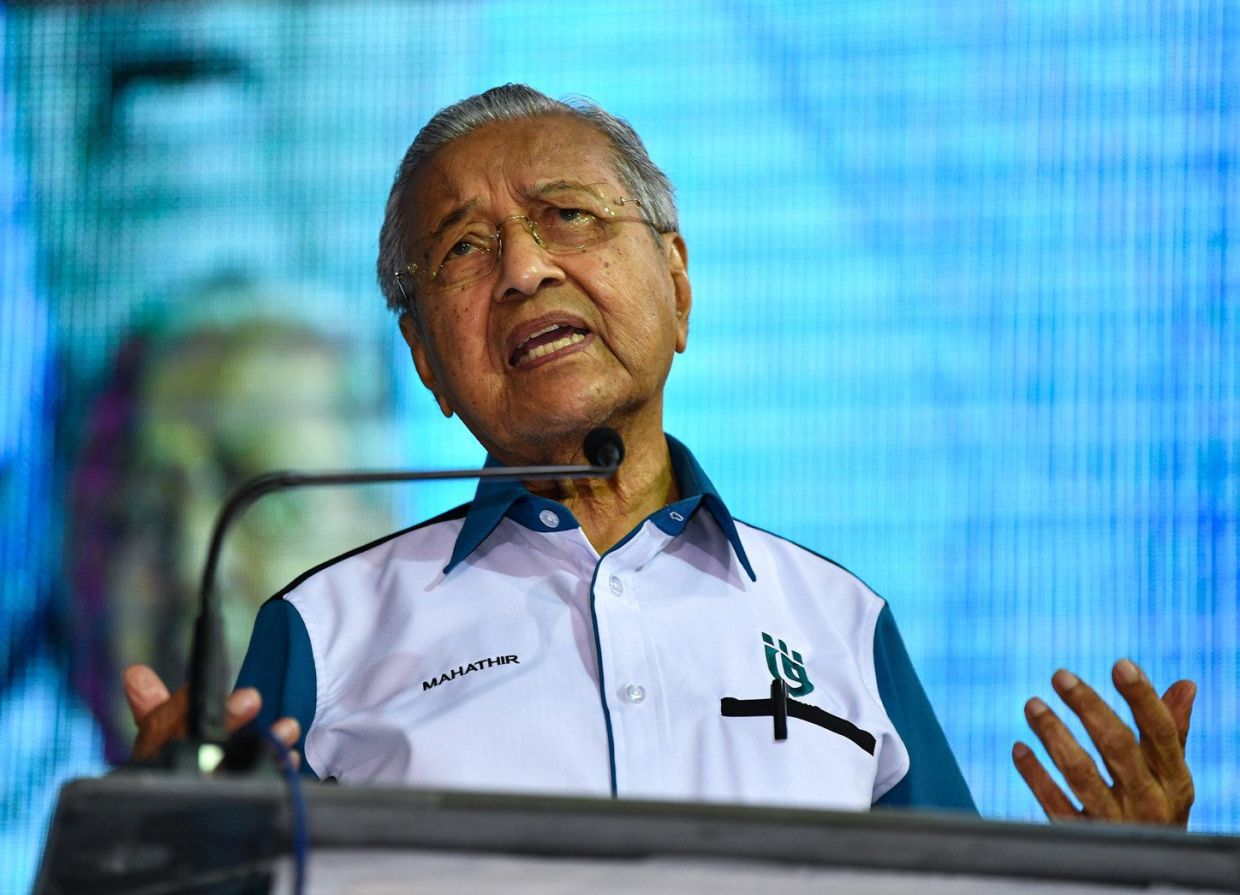
IT looks certain that Tun Dr Mahathir Mohamad (pic), who now heads the Pejuang party, will defend his Langkawi parliamentary seat in the impending general election.
The former prime minister, who turns 98 next year, does not have much choice as he is the only candidate from his party who has a realistic chance of winning.
Although he has announced that his newly-formed movement Gerakan Tanah Air (GTA), led by Pejuang, will be contesting in 120 seats, he should not be too ambitious.
In the Johor state election in March, all 42 Pejuang candidates lost their deposits.
In GE15, the field is expected to be crowded with Opposition parties, which will not be helpful to his coalition of Muslim-Malay political parties and non-governmental organisations.
Most of the coalition leaders are has-beens and unknowns while even the electorate still has no idea what Pejuang – or the coalition – really stands for.
That, however, has not stopped Dr Mahathir, who was twice PM, from saying he “would reluctantly accept the responsibility of leading the government for a third time if needed”.
The Malay Mail reported him as saying at a GTA forum at the Bangi Convention Centre last week that “he would prefer a less taxing role, one that would allow him to advise or be an expert consultant to the prime minister”. But he was quick to add: “If the insistence were to be incessant, I would find it hard to only think about myself.”
“So, if the insistence is there, I will accept,” he said when asked about his willingness to assume the mantle for a third time.
“However, it cannot be for the full term,” he told the audience in Bangi. “Maybe just for a year.”
With due respect to Dr Mahathir, a seasoned political player, he may have been trying to boost the confidence of his audience ahead of the polls.
Heading a fledgling political party and a hurriedly put-up coalition, Dr Mahathir would surely want to instil hope and belief that victory is possible and that he can become a PM for a record third time.
Dr Mahathir may be good at setting records, but it would not be wrong to suggest that most Malaysians do not share his enthusiasm. In fact, we are quite horrified at the thought.
His political detractors, especially those in Umno, would want him stopped as Pejuang’s entry could split the Malay voters.
The same sentiment is shared by Perikatan Nasional led by Tan Sri Muhyiddin Yassin.
While Dr Mahathir’s coalition talks of uniting the Malays and Muslims, the other two similar coalitions think it will be the other way around.
He has no friends in the Opposition either. Prior to his resignation as prime minister in 2020, Dr Mahathir had been meant to pass the post to PKR president Datuk Seri Anwar Ibrahim, but he never did so, claiming there was no formal agreement setting a deadline for him to do so.
Dr Mahathir is still respected by non-Malays for his two decades as PM but that admiration took a huge dent after the collapse of the 22-month old Pakatan Harapan government. He has been blamed for the downfall as he quit as PM.
Worse, his occasional racist remarks have alienated many non-Malays.
While 60% of the country’s population are Malays, non-Malays find such narratives of race and religion outdated and reflecting poorly on political leadership.
Political leaders around the world have become younger – many are even in their 30s and 40s – and voters are looking for new ideas and a better Malaysia.
But Dr Mahathir still talked of race, saying at the Bangi convention that “he only wished to see his vision for the Malay community come to pass under a caring and trustworthy government”.
At 97, it is very hard for Dr Mahathir to change his beliefs.
His legacy is already ruined, but he can earn a last round of respect if he talks of bringing Malaysians together.
It is unfortunate that as the nation celebrates 65 years of independence, our political leaders still want to harp on Muslims and Malays as if other Malaysians, including the large non-Muslim bumiputra population in Sabah and Sarawak, do not exist at all.
The Chinese population may be declining but it remains an important 25% and playing a crucial role in Malaysia’s economy. The same goes for the Indians.
Prime Minister Datuk Seri Ismail Sabri Yaakob’s “Keluarga Malaysia” campaign may be seen by some as mere political rhetoric, but it resonates with the call for diversity and inclusiveness.
Dr Mahathir’s problem is that he cannot let go. In March, he “confirmed” that he would not defend Langkawi due to health reasons but in June, he changed his mind, saying he “may” defend his seat if no suitable candidate is found.
Now, it is almost sure he will be a candidate.
Dr Mahathir deserves a rest from politics. He was discharged from hospital early this month after a bout of Covid-19 and in February, he had to undergo a procedure for a heart problem.
Seriously, he needs to know when to exit the stage. No one is indispensable and there is nothing worse than old scripts and sequels. It really turns off the audience.

THE US Federal Reserve has only one aim – to continue its jumbo interest hikes to curb inflation in that country even if it means the rest of the world suffers.
In short, we can all drop dead but it’s not their problem.
Bloomberg analyst Marcus Ashworth wrote a report which said the “cure may be worse than the ailment” in describing the interest hikes, the latest of which saw rates raised by another 0.75 percentage points, lifting the target range to 3%-3.25% – the highest level in almost 15 years.
It was aptly headlined “Jerome Powell to the rest of the world: Drop dead.” Powell is the chairman of the Federal Reserve. One thing is certain – the Fed is going to raise interest rates again. The US will do so because it wants Americans to cut spending and save more.
The US central bank is carrying out this action at what has been described as “a pace and magnitude unprecedented for nearly three decades.” The talk is that the rate will be raised further in autumn.
It means it will become costlier for Americans to take out a mortgage for a house, loan for a business or borrow money for a student loan. The hope is that consumers and businesses will borrow less and spend less.
With that, the Fed hopes the US economy will cool down and recover as US inflation hits a 40-year high.
With inflation hitting 9.1% in July and hovering at around 8.5% since, the American economy is in serious trouble.
By increasing interest rates, the Fed hopes for some respite but it also means the rest of the world has to suffer because the US dollar is tied with other currencies.
Malaysia is not spared. Like other economies, it will see more financial misery and more hardship as the cost of living shoots up.
The rate rises in the US will contribute to higher inflation and currency devaluation – in simple terms, a weaker ringgit, for us.
The ringgit has already depreciated by 7.5% against the US dollar since the start of the year. But what many doomsayers are not pointing out is that the Japanese yen has slid by 19.2%, the lowest in 24 years.
Even the pound sterling has taken a beating, dropping 14.4%, the lowest in 37 years while the euro has weakened by 11.7%, the lowest in 20 years.
According to the International Monetary Fund (IMF), other currencies which have deteriorated include the Chinese yuan, Thai baht, Norwegian krone, Danish krone and New Zealand dollar – all more than 9% YTD (year-to-date) against the dollar.
Those not familiar with the impact of the rates rise have blamed the Malaysian government, implying incompetence.
The critics include politicians who probably understand better and are well-versed with economics. However, the general election is coming up, the silly season is here and guns have been drawn. As the saying goes, all is fair in war and in love.
The nationalistic Chinese media, Global Times, described the US action as “a sharp blade to cut the world” and that the hike in interest rate again as “the beginning of another nightmare.’’
It claimed that ‘’36 currencies around the world have lost at least one-tenth of their value this year” citing the Sri Lankan rupee and Argentine peso, which fell by more than 20% since the US dollar strengthened.
The ringgit, meanwhile, has risen by 14.2% against the yen, 8.2% versus the pound and 4.5% vis-à-vis the euro.
So, with the drop in the value of the ringgit, has Malaysia done that badly? Well, we could do better but we are not really in the dumps.
Malaysia is not in a financial crisis. Our government leaders including Finance Minister Datuk Tengku Zafrul Aziz are saying it but some of us do not want to hear them out.
But according to former Treasury secretary-general Tan Sri Sheriff Kassim, a country is in crisis when the government defaults on its debts or when the banks and money changers don’t have enough foreign currency to meet the demand.
“When businesses can’t get bank loans, when people rush to banks to take all their money out before it’s too late (that’s when a nation is in crisis),’’ he said.
Sheriff, a co-founder of the highly respected Group of 25, which comprises influential Malays, said this has happened in Egypt, Greece, Lebanon and Sri Lanka – leading to the IMF coming in with a rescue package and imposing conditions such as reforms to cut inefficiencies, wastages and leakages in the government’s financial management.
“Malaysia does not need IMF or World Bank money, although we maintain the annual consultation process to benefit from their international experience on development and financial policies,’’ he said.
Without a doubt, Malaysia needs to improve on its revenue and cut down on populist spending. It’s not sustainable.
With the weakening of the ringgit, our imports will become more expensive, especially food. While we can blame the US for our weak ringgit, we cannot just sit still. Bank Negara has to put up a strong strategy to defend our ringgit.
On the plus side, Malaysia’s gross domestic product (GDP) has grown for three consecutive quarters. The GDP grew by 3.6% in the fourth quarter of 2021, 5% in the first quarter of 2022 and 8.9% in the second quarter.
Our inflation rate is around 2.8% which is among the lowest in Asean but that is because many of our essential items are subsidised, with a hefty RM80bil bill.
There are Malaysians who are cynical about the figure, but they should know that we have held on well, especially on fuel.
There is a trust and confidence deficit in Malaysia. Malaysians are the worst critics of our country. Not everything is hunky dory, and we have valid reasons to be angry about the level of corruption and the utter inadequacies of our politicians. But Malaysia hasn’t fared that badly.
The irony is that as the US economy becomes sick, it is the rest of the world that has to swallow the bitter medicine.
THERE must be consistency. When the Sultan of Selangor ordered state awards bestowed on former prime minister, Datuk Seri Najib Razak, to be revoked, Malaysians found out that they still had to address Najib by his title.
He may have lost his “Datuk” and “Datuk Seri” titles from Selangor, but he still has similar titles from many other states.
The same is true with Datin Seri Rosmah Mansor. Her title, too, was revoked by Sultan Sharafuddin Idris Shah, but like Najib, she received awards elsewhere as well. In any case, if Najib keeps his title, Rosmah is also entitled to still use “Datin Seri” as his spouse.
Penang has also revoked Najib’s state award, which carries the title “Datuk Seri Utama”.
And before His Royal Highness issued the order last week, and before the Federal Court’s recent decision, Negri Sembilan had already revoked the Datuk Seri Utama title from Najib as far back as 2018. Najib was conferred the title of Datuk Seri Utama Negeri Sembilan or SPNS in 2005.
The palace also nullified the Darjah Seri Paduka Tuanku Ja’afar Yang Amat Terpuji (SPTJ) title it awarded Rosmah in 2006.
It remains to be seen if the other Rulers will follow Negri Sembilan and Selangor’s lead, but it’s not looking likely.
The Conference of Rulers or the respective Rulers need to standardise the practice concerning convicted recipients, to protect the sanctity and value of the awards they have conferred.
No one should be seen to receive preferential treatment or consideration because of his or her status, while those who have had their titles revoked may have committed lesser crimes.
It’s never easy to take away titles. There is great reluctance because no one wants to embarrass or hurt the other person, but the institution of the Rulers is far greater than face-saving exercises.
As it is, the perception of many ordinary Malaysians is that there are far too many titled people in this country.
It’s debatable if these recipients even contributed to some of the states from which they received their awards. Many are far too young to be called Datuk, seriously, and it makes a mockery of the entire awards system.
It has been reported a notorious gang of 60 hardened criminals had included four low-level politicians with the titles of Datuk and a Datuk Seri. They were reportedly from the Gang 360 Devan gang and then, there was also the leader of the notorious Gang 24 – a Datuk Seri – who was among 22 men held in other arrests. It’s a mystery whether these gang leaders had their titles withdrawn.
Selangor is an exception. For starters, Sultan Sharafuddin is known to be selective in conferring awards.
His annual honours list is short, and he doesn’t entertain any form of lobbying for such awards.
The Selangor state constitution states that only a maximum of 40 Datuk titles can be conferred each year. Most of the time, the Datuk titles awarded are far fewer than that.
HRH also imposed other strict conditions – including the minimum age of 45 – for a person to be conferred the state’s Datukship and to limit the number of recipients and protect the image and dignity of the awards.
There should also be no double standards in the revocation of awards to those convicted of crime even if it’s at the first level of the court.
If the appeals courts reverse their verdict, the awards can always be returned to the recipients.
A check with the records shows at least 11 personalities had their titles revoked and three others suspended by Selangor.
They include the late tycoon Tan Sri Eric Chia Eng Hock in 2006, following his conviction over the Perwaja Steel scandal.
Former Selangor mentri besar Dr Mohd Khir Toyo also had his Datuk Seri title, which came with the Keahlian Darjah Kebesaran Seri Paduka Mahkota Selangor (SPMS) First Class award, cancelled and revoked in 2015, after he was found guilty of corruption.
HRH also revoked PKR president Datuk Seri Anwar Ibrahim’s Seri Sultan Salahuddin Abdul Aziz Shah award in 2014.
The award, which carried the title Datuk Seri, was conferred upon Anwar in 1992 when he was deputy prime minister.
A media statement announcing the revocation said Anwar was stripped of the award for “repeatedly questioning the integrity of the Sultan in dealing with the Selangor mentri besar crisis, and also questioning other issues pertaining to Islam”.
The mentri besar crisis in question was the turn of events following the infamous Kajang Move, which saw then mentri besar, the late Tan Sri Abdul Khalid Ibrahim, ousted and replaced by Datuk Seri Muhamed Azmin Ali, who is currently the International Trade and Industry Minister.
The late Tan Sri Ting Pek Khiing, a prominent Sarawakian businessman, had his Datuk title revoked by the Sultan of Selangor in 2011 after the former was declared bankrupt.
Interestingly, Tun Dr Mahathir Mohamad and his wife, Toh Puan Dr Siti Hasmah Dr Ali, chose to return their titles on their own accord in 2017.
Many regarded it as a pre-emptive move as they expected their titles to be taken away.
Tuanku was incensed by derogatory remarks Dr Mahathir made against the Bugis community at the time.
The Royal Council of the Selangor Court had also called for a sedition probe on Dr Mahathir.
The biggest test of leadership – and that includes the royalty – is to make difficult but necessary and just decisions.
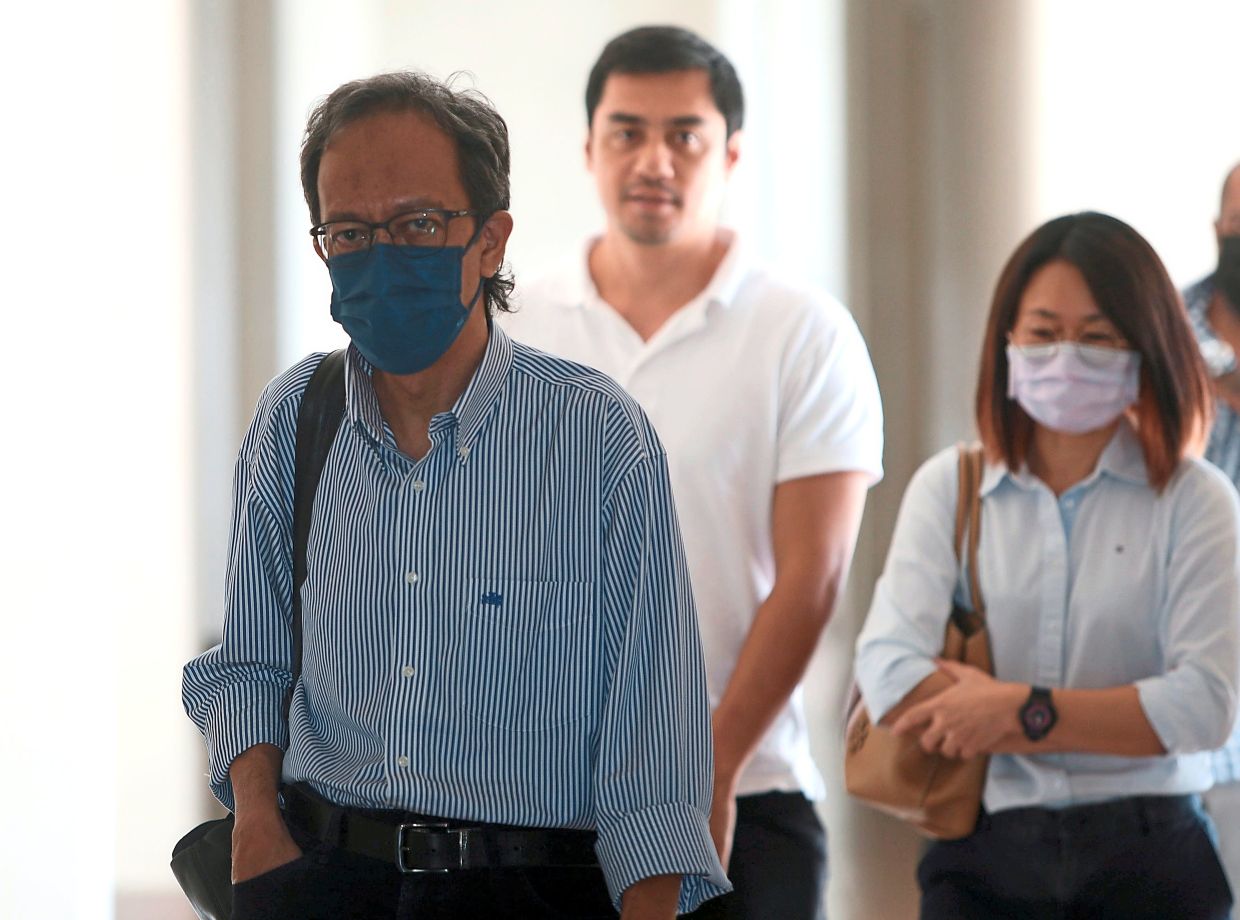
Ahmad Azam and The Edge editor-in-chief Kathy Fong at the Petaling Jaya Magistrate’s Court – Bernama
IT’S an irony. Two years ago, The Edge carried an expose of how a group of individuals, supposedly acting in concert, had amassed shares in more than 20 public-listed companies, where they were most actively traded.
They often had huge fluctuating sharp prices and according to the financial publication, the companies were all linked to one person.
Nine of the 21 companies mentioned had their offices in an office block in Petaling Jaya.
The report revealed the names of the companies and individuals allegedly involved and purportedly showed discrepancies.
The Edge said the authorities had raided the offices for involvement in manipulation of penny stocks on Bursa Malaysia.
It said the group controlled as many as 60 companies on Bursa Malaysia, claiming that the control came from Hong Kong.
But fast forward to 2022, no one named by The Edge has been arrested nor charged by the Malaysian authorities.
Instead, the former editor-in-chief of The Edge Ahmad Azam Mohd Aris was charged at the Magistrate’s Courts with criminal defamation over the reports published in 2020 and 2021 during his tenure.
The Edge’s contributing editor M. Shanmugam has also been named as an accused in one of the cases.
The charges are most unusual and baffling.
If the aggrieved party, in this case, a businessman, then he should file a civil suit against The Edge for a massive sum of money as his image has been allegedly tarnished.
It is a civil dispute and most media organisations have accepted this as part of their occupational hazards.
But the media fraternity, not just The Edge, has every right to ask why the police and the Deputy Public Prosecutor’s (DPP) office in Kuala Lumpur are taking the responsibility on the issue?
In fact, we want to know whether the allegations reported by The Edge have any basis and what has been the outcome of the investigations, if any, as the public has every right to know.
If the allegations are baseless, then so be it, the police or any of the authorities should tell us so, that the well-researched articles are nothing more than the reporters’ figment of imagination.
Certainly, the public, especially the small-time investors, who have lost their money, would want to know too.
The Edge has also refused to name the reporters involved in the reports, despite being asked by the police, saying “it is because we want to ensure the safety of our journalists that the two articles were published without any names.’’
The two articles carried the byline – The Edge Malaysia –instead of individual names.
The Edge Media Group chief executive officer Datuk Ho Kay Tat has rightly said that the businessman should sue the pants out of The Edge, and certainly the police and DPP should convey the same message.
Of course, freedom of speech does not mean an open licence to slander and defame anyone but in this dispute over the contents of the two articles, let the lawyers from both sides fight it out.
Surely, the police and DPP have more pressing and urgent matters to handle, particularly in hunting down the real crooks.
The mood of the media over the charging of Ahmad Azam and Shanmugam has caused much uneasiness and anger, in most newsrooms.
After all, if it can happen to Ahmad Azam and Shanmugam, it can also happen to any of us in the other media outlets.
Worse, Ahmad Azam was only told about the charges against him at 6.30pm on the eve of the charges on Tuesday.
But for sure, members of the media are standing in support of the two gentlemen and The Edge.
IT’S time for the budget again.
If there is a sector that needs an honest and realistic review, it has to be the gaming industry.
An estimated RM3bil is lost in tax revenue annually from the government coffers because of illegal betting syndicates.
Yet nothing much has been done to fight these operators.
For a start, it is perplexing that the Common Gaming Houses Act 1953 (CGHA) has yet to be revised.
The other existing laws, such as the Lotteries Act 1952 and Betting Act 1953, are older than the country’s age.
The penalty for illegal gambling under this archaic law is a paltry fine of up to RM5,000, a maximum six-month jail sentence, or both, while operators can be fined up to RM50,000, jailed up to three years, or both.
With such a light punishment, why would that be a deterrent to operators that are raking in billions of ringgit?
There’s no minimum in the penalty to be meted out.
Thus, if the law is interpreted as “up to RM5,000 or RM50,000,” it can also mean it could be a mere RM1,000 as an example.
Likewise, “jail of up to three years” can also mean no jail sentence at all.
To put it simply, the present laws are not tailored to deal with illegal gambling and more so as these operations are now conducted in cyberspace beyond national borders.
Online gaming, including even online casinos, are widespread with these operators cleverly changing their domain names regularly to prevent detection or their domains being blocked.
The six licensed number forecast operators (NFOs) that pay huge taxes have also found themselves in a tight spot.
They are the Peninsular-based Magnum, Sports Toto and Damacai with the other three being Special Cashsweep, Sabah88 and Sandakan4D, with operations in Sabah and Sarawak.
These legal operators, operating in a highly regulated environment, had an estimated revenue of over RM9bil previously with sales tax amounting to RM2bil annually.
Except for Damacai, owned by Pan Malaysian Pools Sdn Bhd, which is governed by the Totaliser Board, none of the other operators are allowed to accept calls and have bets placed via the mobile phone.
But the irony is even the illegal small-time neighbourhood operator can take bets via WhatsApp from their clients.
The reality is that there is a need to draw up tougher laws to deal with online gaming, as even the Anti-Money Laundering Act 2001 and Prevention of Crime Act 1959 are not designed to deal with illegal gambling and more so if they were conducted in cyberspace.
Singapore, for example, has its Remote Gambling Act, to curb online gambling while its laws allow banks to bar transactions or payments to online gambling operators while those associated with the business, including those managing operations as a third party, would also face consequences, according to a report in The Star.
Under Singaporean law, those caught can be fined heavily, with amounts ranging from S$20,000 (RM65,000) to S$500,000 (RM1.6mil), and jail terms of up to seven years.
The reality is that illegal 4D betting syndicates have grown larger and more sophisticated over the last decade, while existing laws remain unchanged.
The government and legitimate NFOs continue to lose huge chunks of money because of inaction.
In June, Deputy Finance Minister Datuk Zahidi Zainul Abidin said the government was looking at updating the CGHA to better tackle online gambling.
It was heartening to hear Zahidi say that the Ministry of Finance (MoF) was even considering allowing certain online games involving “betting’’ and ‘’gift offers’’ to be regulated, while the Minister in the Prime Minister’s Department Datuk Seri Wan Junaidi Tuanku Jaafar said he was awaiting the MoF for the proposed amendments.
He agreed that the current laws on gaming were outdated especially when it came to online gaming.
We need to adopt a realistic approach to the gaming industry as we are talking about a huge amount of revenue and taxes.
The business is already a stifling one and a difficult one to operate, but the reality is that any indifference by the government would only benefit the criminal operators as well as corrupt enforcement officials.
Calls by religious groups or politicians to close down legitimate NFO outlets won’t be helpful either. It would have a counter-effect actually.
There was no difference from the Prohibition of the 1930s in the United States, when it tried to ban alcohol as it drove drinking underground with the beneficiaries being the illegals.
More than ever, as the government seeks to increase its revenue and tax collections for 2023, the MoF can allow existing NFOs to operate in a more flexible approach.
For a start, it does not make sense they are still unable to accept bets online in the digital age.
It also needs to carry this out with a proposed amendment to the CGHA to make it tougher for illegal gaming operators.

FAKE news about Datuk Seri Najib Razak has shifted into overdrive even though he’s already incarcerated at Kajang Prison.
Last week, two social media postings about the former premier made their rounds.
It’s unbelievable the number of people – including those who are supposedly well-informed – who swallow hook, line and sinker these misleading and deceitful messages.
Judging from the comments on some portals, there are Malaysians who believe them.
The first was a posting that claimed “Najib isn’t in a cell. A good friend whose cousin is a senior prison officer at Kajang said Najib is given a house within the prison grounds.”
These houses are supposedly meant for senior prison officers, and it was claimed that Najib is enjoying house arrest.
We should know better because the red flags were already there. It says the information came from “a friend” and if that wasn’t enough, “whose cousin is a senior prison officer”.
Well, a friend of mine whose cousin is a senior prison officer said it’s not true. The media, which often quotes anonymous sources, will never accept information from a third party.
For starters, the Kajang prison complex has homes for wardens with families and a flat for wardens who are single.
They both sit away from the prison detention building and the prison headquarters, where the administration is located.
If Najib is placed in an officer’s home and not a cell, that will surely be leaked out fast and furiously in this digital age of social media.
Don’t expect every prison warden or their family members to be fans of Najib. They won’t cast a blind eye.
This is not 1989, when Abdullah Ang, a former banker convicted of criminal breach of trust, was accorded special privileges while serving time and could reportedly wilfully walk in and out of prison.
Even that was exposed by a newspaper, the Malay Mail, and that was in the pre-Internet age.
Then there’s a video posting showing Najib in a pink baju Melayu, in a home, looking at a 2010 photograph hanging on a wall and joking with four men.
Disturbingly, many angry Malaysians believed this was his prison cell or a hospital ward.
But the video was posted by Najib himself ages ago when he visited a Felda settler, Ithnin Abdullah, in Kledang, Kota Tinggi, Johor.
You can check his Instagram account to view it. Someone deviously used this video to make it look like he is in his new cell or a hospital ward.
Understandably, many Malaysians are upset that Najib, who has committed a heinous crime and sentenced to 12 years’ jail, has been so quick to seek a pardon.
And hardly two weeks after being jailed, he sought to be sent to hospital to have a recurring stomach-related ailment treated, with his daughter saying her father “is highly prone” to stomach ulcers that flare up under stress or during an episode of gastritis.
But even if it were true, the cynicism and scepticism would be irrepressible, as they would be for claims by lawyers and their clients who seek postponement of their cases on medical grounds. It’s the oldest delaying tactic used by lawyers in court and prisoners in jail because going to the hospital or prison clinic is surely better than rotting in a cell.
Last week, the Malaysia Now portal ran a report that said after November 2017, Datuk Seri Anwar Ibrahim spent much time at Cheras Rehabilitation Hospital until his release in May 2018.
The PKR president was sentenced to six years’ jail for his sodomy conviction but was released a week after Pakatan Harapan’s victory in the May 2018 General Election, following a royal pardon backed by Tun Dr Mahathir Mohamad’s new government.
The portal also carried pictures of Anwar on his bed with his regular stream of visitors, which included Najib, Datin Seri Rosmah Mansor and Datuk Seri Dr Ahmad Zahid Hamidi and wife, Datin Seri Hamidah Khamis.
A Google search will reveal many news reports and photographs of these high-profile visits.
Although the Prison Department says all prisoners will be treated equally, it’s easy to think that VVIP prisoners such as ex-politicians, ex-lawyers, ex-corporate figures and ex-police officers would get a slightly better deal.
For one, at least Anwar and the other politician prisoners had their own cells with attached bathrooms, or were located near the hospital clinics instead of the overcrowded cells.
But there’s no hot water for Najib, so he must bathe in cold water. He is, presumably, provided with a fan and a table, but furnishing will be sparse.
There are sound security reasons for keeping him in solitary confinement. I don’t think the authorities want to risk such prisoners being hurt by their cellmates.
But for now, Najib remains a Member of Parliament. He will continue to draw his allowances and remunerations as an MP.
This, again, will upset many people, but he still has two last ditch attempts to keep his Pekan parliamentary seat.
His lawyers have filed for a review of the Federal Court decision which upholds his conviction in the SRC International Sdn Bhd case, but this could just be clutching at straws.
Then there’s the application for a royal pardon, and while no provision exists in the law for the duration of a prisoner’s jail term before being pardoned, the practice is the person must serve a “considerable time”, and that usually means at least three years.
Besides, Najib still has four other pending cases against him, and surely that will weigh on the King’s decision. How many times can his Majesty pardon him?
But all this debate over whether Najib can remain an MP will be a moot point when Parliament is dissolved. He will automatically lose his Pekan parliamentary seat and will not be able to seek re-election.
If there’s a positive to take from Najib’s case, it’s that Malaysians are learning about our court requirements and procedures.
Many people have asked why Najib was allowed to move freely before the Federal Court judgement, which was his final court procedure of the charge in question.
That’s how our laws, which are based on the British model, work.
Well, he wasn’t denied bail and he had a final appeal platform – the Federal Court. Once it ended, he went straight to jail.
Likewise Rosmah, who was sentenced to 10 years’ jail for each of her three graft charges and fined a total of RM970mil, is at home because she was allowed bail and still has the Court of Appeals and Federal Court to take her case to. It may take two to three years before she finally exhausts her appeals.
The Malaysian court system, which is modelled after the British judiciary, may seem slow, but it provides sufficient avenues for an accused and the defence team to prepare their cases.
Najib may no longer be in the public eye, except for his appearances in court for his ongoing cases, but he’s still a newsmaker because only a fine line separates fame and infamy.
His popular social media platforms are now run by his team, but they still have a large following.
That says a lot, but it would be foolish for Umno to go the general election with Najib as its main cause, and that certainly will also affect the other Barisan Nasional parties.
The electorate wants to know how voting for Barisan can benefit the people and country, rather than treating the general election as a referendum to free or pardon Najib.
Barisan, especially Umno, must get its machinery started instead of talking about influencing party members to sign petitions supporting Najib. The recent Umno meeting may have been good for hardcore Najib supporters to let off steam, but it made the party look like it has lost its sense of objectivity.
That’s not how a party goes into a general election. It’s bad optics.
Let’s be real. Instead of casting doubt and making aspersions at the judiciary, Umno should claim credit for upholding and respecting the laws in this country. No one is above the law, after all.
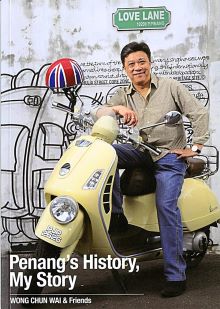
PENANG'S HISTORY, MY STORY
Click on image to purchase book
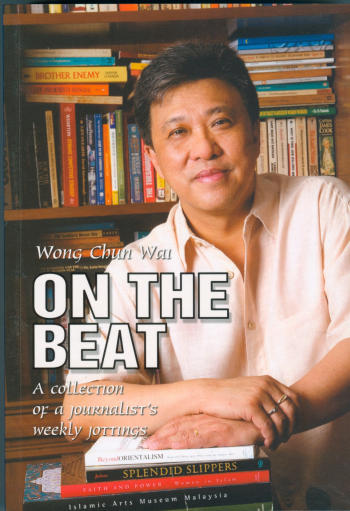
A COLLECTION OF WONG CHUN WAI'S JOTTINGS
Click on image to purchase book