Monthly Archives: July 2025

ASEAN Leadership Redefined: Anwar’s Quiet Diplomacy Halts Thailand-Cambodia Deadly Clash


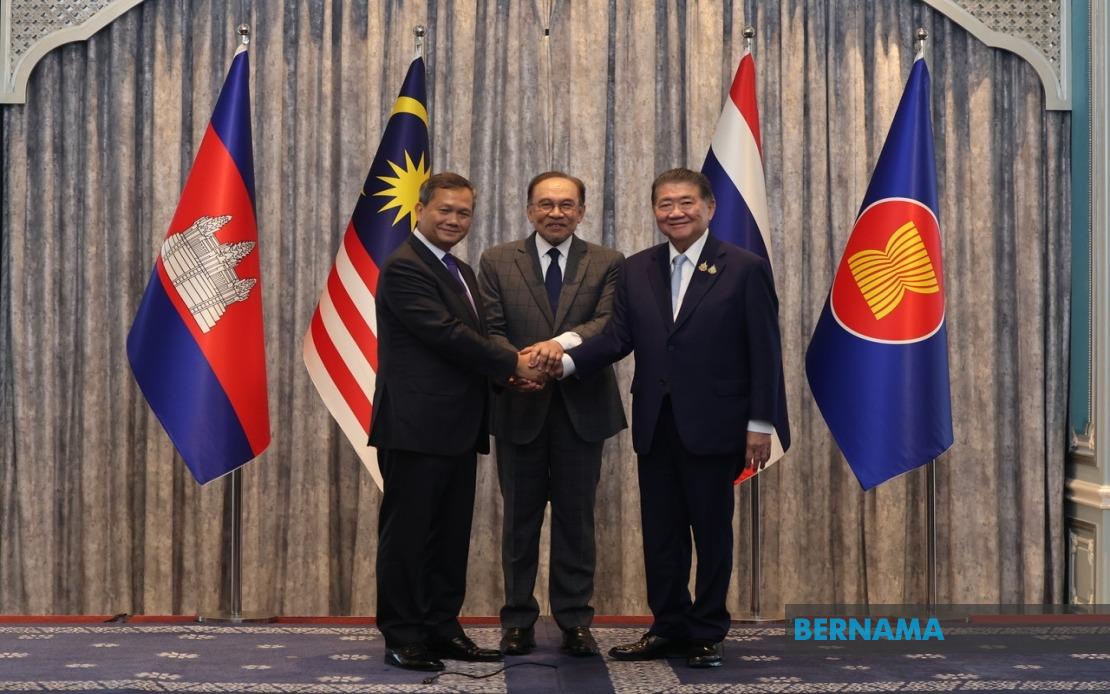
Prime Minister Datuk Seri Anwar Ibrahim (centre) witnesses Cambodian Prime Minister Hun Manet (left) shaking hands with Thailand’s Acting Prime Minister Phumtham Wechayachai (right) following a Special Joint Meeting at the Seri Perdana Complex. The high-level Special Meeting was held to ease escalating tensions following an armed confrontation between the two countries.

KUALA LUMPUR, July 29 (Bernama) — Let’s give Datuk Seri Anwar Ibrahim the credit when it is due.

For a while, many were left wondering how he was going to bring together two angry ASEAN member countries that were locked in a deadly conflict.

It didn’t help that at one point, a Thai Foreign Ministry official was quoted as saying that it did not need a third country to be involved.

The spokesman, Nikorndej Balakura, reportedly stated that Thailand prefers bilateral negotiations.

But the Prime Minister quietly and swiftly went behind the scenes to orchestrate a landmark ceasefire.

It was complex, more so when it involved resolved historical tensions, but certainly with the hard work of our Foreign Ministry, Anwar pulled it off.

It is certainly a boost to his credentials as the chair of ASEAN 2025. It will be awkward for him to talk about ASEAN unity if the two nations continue to fire rockets at each other.

The five-day border conflict – marked by artillery exchanges and mass civilian displacement – ended with an “immediate and unconditional” cessation of hostilities.

It was a swift and effective intervention, the kind rarely seen in Southeast Asian diplomacy.

Anwar’s role as mediator has earned widespread praise, not only for de-escalating a dangerous flashpoint but also for revitalising ASEAN’s credibility in managing intra-regional disputes.

For a regional bloc often criticised for its inertia, Malaysia’s leadership in this instance marks a meaningful shift.

Critics have always dismissed ASEAN as a talk shop, but continuous talking to each other is surely better than going to war.

It would have badly tarnished his image if Anwar had failed to bring the two nations to the table.

What stands out is Anwar’s ability to bring both sides to a ceasefire amid rising nationalist rhetoric and domestic political sensitivities in both Bangkok and Phnom Penh.

The participation of international observers from the United States and China further underscores the delicate balancing act Malaysia managed to perform. In an era of intensifying superpower rivalry in Southeast Asia, Malaysia’s non-aligned posture proved an asset, not a liability.

Admittedly, economic reforms and domestic governance still dominate the national conversation, but this diplomatic victory may offer a needed boost to Anwar’s leadership narrative.

It shows a Malaysia that is not merely reactive but assertive and constructive on the global stage.

Of course, the road ahead is uncertain. A ceasefire is not a peace treaty. The underlying territorial and political disputes between Thailand and Cambodia remain unresolved.

A veteran Thai journalist texted me to warn against any celebrations until the frontiers are actually quiet.

The BBC reported that “shells and rockets continued to land in both countries even as the peace talks were underway; it will take a little longer to cool the emotions on both sides.”

Still, Malaysia’s offer to facilitate ongoing dialogue – and potentially a peacekeeping framework -positions Kuala Lumpur as a long-term convener, not just a crisis manager.

Anwar has long been known as a reformist and a consensus-builder. His handling of this crisis has now added a new credential to his portfolio: regional statesman.

For Malaysia, this moment should be a reminder of what thoughtful diplomacy and principled leadership can achieve.

The BBC reported that President Donald Trump may have delivered the kick with his trade talks threat that enabled this ceasefire, but it is Malaysia that is getting the credit.

It said, “The world was watching – and Malaysia delivered.”

Stop this mass murder by starvation


Dying slowly: Displaced Palestinian mother Samah Matar holding her malnourished son Youssef at a school where they are sheltering amid a hunger crisis in Gaza City. — Reuters

IT’S plain murder on a massive scale, starving the Palestinians to death in defiance of global opinion.

What is happening in Gaza now is one of the world’s worst hunger crises being deliberately carried out right before our eyes.

This famine is not the result of a drought, a failed harvest, or a natural disaster. It is man-made — driven by the choices of governments, the inertia of international institutions, and the indifference of too many with the power to stop it.

These are cruel, deliberate, and intentional acts to slowly and painfully wipe out an entire nation of people by starving them to death.

Israel is carrying out this heinous genocide because it knows the world cannot do anything much it, or does not want to.

The United States, its most powerful ally, has not said anything about the famine. The European Union has at least warned Israel over the worsening starvation crisis in Gaza. The US has reportedly said its envoy Steve Witkoff will head to Europe for ceasefire talks and to create an aid corridor.

It will just be words and words and more words. We know these are mere hypocrisies and the US and EU must bear a heavy responsibility.

These are the countries that supply arms, offer diplomatic cover, and issue standard statements of “deep concern” while failing to compel change in the aggressor.

Worse, they have taken action against individuals and institutions who have spoken up for the Palestinian cause, with such criticisms often conveniently labelled “anti-Semitism’’.

In Gaza, the water systems have reportedly been destroyed, and food production has ground to a halt. The media has reported that a strict blockade – tightened further since the war began – has left aid agencies struggling to deliver even the most basic supplies.

Food convoys are delayed, blocked, or attacked. Aid workers have been killed. Warehouses bombed.

The entire 2.1 million population of Gaza is facing prolonged food shortages, with nearly half a million in catastrophic situations of hunger, acute malnutrition, starvation, illness and death.

It started with the bombings which flattened most parts of Palestine, driving out the people. Now comes the most horrific act, starving the people to death.

All of us, regardless of our faith and culture, are confronting a profound moral test – one we are currently failing.

We should be outraged – Israel is not above moral scrutiny and its actions cannot be justified, and certainly not excused, by the Christian theological belief that Israelis are “God’s chosen people”.

It does not grant them immunity. Like everyone else, they have to be held accountable, as it targets the very space that the Christian faith holds most dear.

The Jews are mostly not Christians, and many have openly shown their contempt for Christian pilgrims visiting Jerusalem. There is enough recorded evidence.

The Jews may have a special place in Biblical history but the modern state of Israel under Prime Minister Benjamin Netanyahu is not beyond reproach.

Recently, at least three people were killed and 10 others wounded, including a priest, in Israel’s attack on the Holy Family Church, Gaza’s only Catholic church, prompting Pope Leo XIV to call for an immediate ceasefire.

The only response from Israel? A note of regret, claiming it was stray ammunition.

How can we do nothing and just watch when innocent people, including elderly people and women and children, are literally being killed by stopping the supply of food.

In many reported cases, when Palestinians gathered to collect their food, they were shot at and killed by Israel soldiers.

Since 2023, three Christian churches have been bombed and the only Christian-run hospital in Gaza, the Al-Ahli Arab Hospital, has been targeted five times.

It was reported that at least one of those attacks killed nearly 500 people – and it was carried out on Palm Sunday.

The systematic genocide has gone into a frenzied mode with the United Nations warning that nearly half of Gaza’s 2.3 million people face catastrophic food insecurity.

One in three children under two is acutely malnourished. These are not projections – they are symptoms of a population on the brink.

The UN has reportedly said at least 500 aid trucks must enter Gaza each day to meet basic needs. On most days, fewer than 100 get through. In the north, the situation is worse. According to Unicef, children are dying of hunger before help can reach them.

What is happening in Gaza is not a Muslim problem. Any God-fearing human being should be outraged.

Israel has violated international humanitarian law, it’s that simple. It is no longer a question of politics or religion. It is a question of basic humanity.

The right to food is foundational. The right of a child to survive cannot be conditional on the outcome of a war.

How can we tolerate and watch as infants die of hunger and doctors operate in hospitals without electricity, clean water, or even milk for newborns?

The least we can do is pray for the Palestinians, show moral support, act with courage, and join the growing global call for a sustained ceasefire.

That means unrestricted access to humanitarian aid. It also means calling into account those obstructing it.

What is happening in Gaza should not be just the concern of congregation prayers in mosques but should also be raised in churches and temples because no one can condone genocide.

No nation is above public accountability and, certainly, the Biblical Israel is not the same as modern day political Israel.

Just a matter of political optics

THERE are plenty of grievances against Prime Minister Datuk Seri Anwar Ibrahim and his opponents have probably thought that the timing is right to step up the pressure on him to step down.

The march tomorrow to demand his resignation appears to be initiated by PAS and the other Malay-based political parties.

The response at the state-level protests did not generate the enthusiasm that the organisers had wanted as the turnout was dismal.

They would certainly want to put up a better show in Kuala Lumpur to prove a point but they should not expect the size to be like the series of rallies organised by the Coalition For Clean and Fair Elections (Bersih).

The protests that were carried out in 2007, 2011 and 2012, mainly in Kuala Lumpur and other cities, drew a massive multi-racial crowd.

This is in contrast to the one coming up tomorrow, which to many Malaysians, the likelihood would be Malay-centric involving far right and religious groups.

Depending on who you talk to, some PAS leaders have claimed 50,000 people will march to the event while one MP puts the number at 500,000.

The police, however, is only sending out 2,000 officers. They probably have intelligence reports.

If Gerakan, a partner of Perikatan Nasional, and other non-Malay parties, were to participate, they would just be mere tokenism with little impact or relevance.

A sea of green with protesters mostly “imported” from Kedah, Perlis, Terengganu and Kelantan is almost certain.

It will be a surprise if there are urban, liberal figures who are prepared to walk along with these PAS leaders with a bad record in running their states. Kedah, Perlis and Kelantan are in the category of Malaysia’s poorest states.

As political analyst Oh Ei Sun of the Singapore Institute of Inter­national Affairs rightly pointed out, Muda risks eroding its modest support base by aligning with conservative groups.


The protests would draw good optics for these parties but obviously they know they do not have the numbers to bring down Anwar.

If they have enough MPs on their side, a vote of no confidence would have to be tabled during the current Dewan Rakyat meeting. The dare has been put up by the PM and the challenge is unlikely to be taken up.

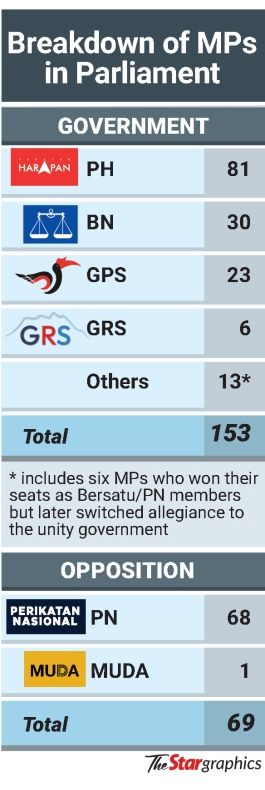
In the 222-member Dewan Rakyat, the unity government has 153 seats with DAP (40), PKR (31), Amanah (eight) and Upko (two), Umno (26), MCA (two), MIC (one) and PBRS (one).

Gabungan Parti Sarawak has 23 seats and Gabungan Rakyat Sabah (six); other government aligned parties and independents have 13 seats including six ex-Bersatu MPs.

The opposition has 69 seats with PAS (43) and Bersatu (25) and Muda (one). Even if the nine rebel PKR MPs decide to be in opposition, the numbers still do not add up.

In short, the PM and his government are in no danger of collapsing. Anwar remains secure and has no reason to step down.

Veteran journalist Datuk Kadir Jasin said the rally is not likely to bring down Anwar and that until the next general election, the only way to remove Anwar is to prove that he no longer commands the majority of support of MPs.

“No rally, protest or march will bring down Anwar so long as he maintains the support of the majority in Parliament,” he wrote on Facebook.

The next general election must be held by Feb 17, 2028, which is still a long way off. There had been speculation earlier that Anwar may call for an election as early as next year but it does not look likely now.

Next comes the most obvious question – if they want Anwar to be toppled as PM, who then should be the successor?

Will the replacement be Opposition Leader Datuk Seri Hamzah Zainudin or Bersatu president Tan Sri Muhyiddin Yassin or ailing PAS president Tan Sri Abdul Hadi Awang?

Nobody seems to be able to give a reply. In fact, no one wants to even indicate who will be the next PM if Perikatan forms the next Federal Government because it would be against them.

They know the options do not seem attractive enough to voters although they gripe about Anwar’s weaknesses.

The biggest complaint is the rising cost of living, which like many other world leaders, Anwar, too, has to grapple with.

The expanded Sales and Service Tax, and perceived slow reforms have also upset many including his voters.

Besides, whoever takes over him wouldn’t have any immediate answers. Not to forget the economic legacy issues he has inherited as a result of the 1MDB looting.

But one thing is certain, something which Anwar has to live with – democracy in Malaysia will get noisier.

His predecessors, especially 100-year-old Tun Dr Mahathir Mohamad, would not have tolerated such dissent because he had the draconian Internal Security Act at his disposal and he had no qualms of locking up his critics.

He shut down newspapers and ensured the media toe the line because the free for all social media had not existed then.

Anwar has to grit his teeth and tolerate dissent, especially his rebel MPs, because he has always spoken up for differences in views, and as long as they defend his leadership in party and government, he has no other choice.

He has taken to the streets to protest and such democratic practices would need to be accepted.

But the public has also matured. They have asked what is the point of tomorrow’s protest and whether it is a genuine mani­festation of public discontent, as the organi­sers have claimed, or mere political optics.

A high target — can we meet it?


Growth needed: The next five years will thus be crucial for Malaysia if it is to become a high-income nation. — FAIHAN GHANI/The Star

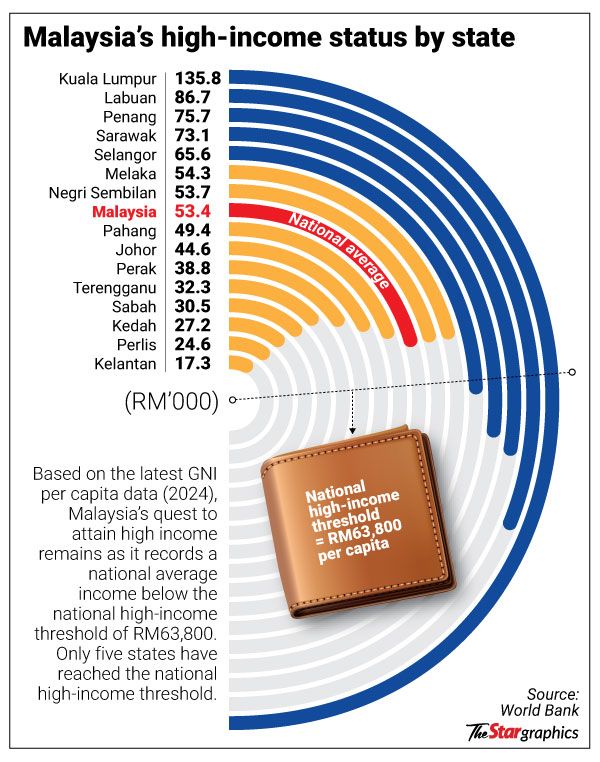
HERE’S the good news – the World Bank has declared Kuala Lumpur, Labuan, Penang, Sarawak and Selangor to be high-income states. The bad news, though, is that Malaysia as a whole is not there yet.

This is the latest high-income data based on Gross National Income (GNI), which is the total amount of factor incomes earned by the residents of a country. The country’s GNI per capita of RM53,400 annually falls short of the high-income threshold of RM63,000.

Kudos to Sarawak as it has solidified its position since joining the high-income state ranks in 2023. It must be doing something right.

Three years ago, there were only three states – Penang, KL and Labuan – on the list but Sarawak joined two years ago and Selangor made the cut last year.

Now, there are a total of five high-income states (including federal territories) but the vast majority of states are below the threshold – and that’s not good as they exert a pull on the country as a whole as it bids to join the club.

The findings, however, do not come as a surprise. Malaysia remains caught in the middle-income trap.

We are too rich to compete with low-cost economies like Vietnam and Cambodia but we are just unable to stand alongside high-income nations like South Korea and Singapore.

South Korea, once poorer than Malaysia in the 1960s, is now a global tech powerhouse. It achieved this through strategic industrial policy, heavy investment in education and R&D, and a relentless focus on productivity.

Singapore, without natural resources, became a financial and innovation hub through clean governance, meritocracy, and human capital development.

Malaysia now finds itself outpaced by these countries that were once on equal or even lesser footing, and if we are not serious about moving up, we could soon be overtaken by Vietnam.

This is not just about achieving a statistical milestone. It’s about ensuring Malaysians enjoy better jobs, stronger public services, global competitiveness, and the ability to keep our brightest minds at home.


The next five years will thus be crucial for Malaysia. We can’t afford to miss the boat.

The upcoming 13th Malaysia Plan (RMK13), covering 2026-2030 and Budget 2026 need to address the issues that are holding us back from becoming a high-income country. If we don’t, we will lose out to more of our neighbours.

RMK13 and Budget 2026 may represent our last – and best – chance to break free and secure high-income status.

For a start, the plans must boldly tackle governance and institutional weaknesses. Policy inconsistency, bureaucratic inefficiency, and rent-seeking behaviour continue to erode investor confidence.

RMK13 must be reform-driven and bold. It cannot be business as usual. Certainly, we don’t need the plan to be tabled with poetic language. It’s the content that matters.

A high-income country needs not only a strong economy, but strong institutions. For one, the judiciary has to be protected and judges must be persons of integrity. Perception is important.

A strong political will is also essential and Malaysia certainly cannot keep changing prime ministers and governments.

We need to fund the future, not the past, and we cannot live like we did in the past, with heavy subsidies which have spoiled Malaysians.

Where RMK13 provides the vision, Budget 2026 must be the engine. Fiscal policy must be repurposed not just to spend, but to invest – in people, productivity, and innovation.

As the world moves rapidly toward a knowledge- and innovation-based economy, Malaysia is at a critical juncture.

We have to increase funding for TVET (technical and vocational education and training), with incentives tied to graduate employability. Among others, we need:

> STEM scholarships and national reskilling initiatives for workers displaced by automation.

> Tax incentives and matching grants for R&D, automation, and green technologies.

> Expanded digital infrastructure, particularly in rural areas, to promote inclusive growth.

> A Malaysian Innovation Fund to support start-ups in Artificial Intelligence, biotech, and climate tech

Malaysia must address its productivity crisis. Growth can no longer rely on cheap labour or natural resources. We must transform our industrial base through digitalisation, automation, and a strong pivot towards advanced manufacturing and services.

This means supporting high-value sectors like semiconductors, electric vehicles, biotechnology, and green energy.

To make these a reality, we must overhaul our education system. Our youth are entering a job market that demands digital skills, creativity, and adaptability.

Are our tertiary institutes producing the right kind of graduates who are trained and marketable? Malaysia needs graduates with strong technical skills in in-demand fields like IT, engineering and healthcare.

Strong soft skills, adaptability and an entrepreneurial mindset certainly help. It will be even better if they have the ability to speak and write in Bahasa Malaysia, English and Chinese.

With due respect, the teaching of the Laos and Cambodian languages in our schools can wait even though they may be just elective courses.

Within Asean, Malaysia has advantages over some member countries. Beside our language skills, we have an established legal system, and we have the British to thank for that.

Malaysia has a strong middle-class base as well as a sound political system. Our democratic system can be noisy at times but it’s often restrained.

Malaysia has enough lawyers and doctors and it doesn’t help that every year we produce students with a string of distinctions who believe they are entitled to places in the top universities in the country.

Are the distinctions secured by our SPM students even on par with the standards imposed by Singapore, Hong Kong and the United Kingdom?

RMK13 must prioritise TVET reform, industry-academia collaboration, and investments in STEM (science, technology, engineering and mathematics) education from an early age.

We are still talking about STEM while China is already introducing AI modules – and at primary school level!

Third, the plan must put innovation and research at the heart of national strategy. Malaysia currently spends less than 1% of GDP on R&D. To become a creator – not just a user – of technology, this must rise to 2–3%, with strong government-industry-academia partnerships.

At the same time, Budget 2026 must address the brain drain by offering meaningful career paths and incentives for Malaysians abroad to return home – including tax relief, housing support, and leadership fast-tracks for top talent.

Expatriates with skills, and who have worked in Malaysia, surely deserve an easier track to be permanent residents.

Malaysia has the resources, the location, and the population to succeed – but seems to lack the political will and strategic coherence to execute bold reforms. We spend a great deal of time on inconsequential and unproductive political discourse, often on murky issues of race and religion.

Tomorrow’s investments in Malaysia are no longer about setting up factories, which outdated aging politicians still seem to think about when questioned about where foreign direct investments would go.

All is not lost, though. Attaining high-income status is not easy for any state or country. This year only one nation – Costa Rica – moved from upper middle income to high-income category.

But it is certainly not going to be easy for Malaysia. No one can predict what next year may bring given the uncertain and volatile economic outlook which doesn’t bode well for trading nations like Malaysia.

The World Bank high-income threshold is not fixed and it adjusts its measurement each year, so a lot depends on how Malaysia would compare with other nations but let’s not forget that even if we grow, other countries could compete harder and that could make the high-income goal even more distant.

Malaysians, especially the politicians, must understand this for the interest of the nation.

Look at the graph – the bottom three worst performing states are Kedah, Perlis and Kelantan, which speaks volumes. We can’t help these states if they prefer politicians who have promised them a ticket to heaven, while little is done for the here and now.

RMK13 and Budget 2026 can change that – if they are driven by vision, evidence, and courage.

For the country, the window to become a high-income nation is closing. We must act – boldly, intelligently, and urgently – before it shuts for good.

The Plan must be to benefit all


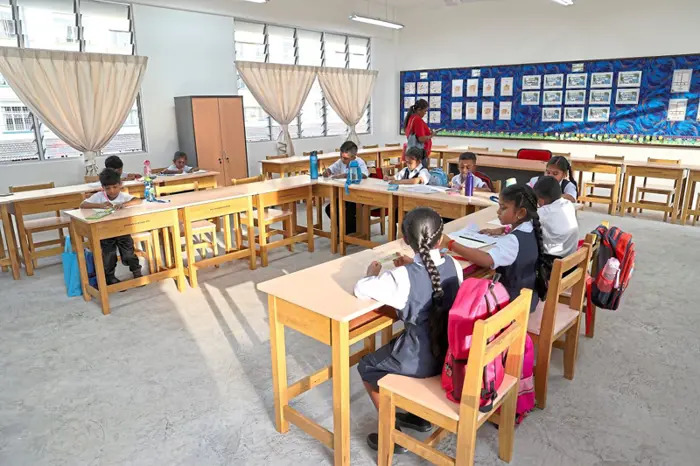
Urgent attention needed: Unlike this vernacular school in Petaling Jaya, many of the Tamil schools in the country are in a bad state. Furthermore, 12% of Indian children are born underweight and 18% suffer from stunting. — ART CHEN/The Star

THE causes behind the problems faced by a significant segment of the Malaysian Indian community have been mostly identified. Now, it should be the time to find effective and sustainable solutions.

Certainly, it cannot be done overnight after seven decades of Merdeka when many in the community remain entrenched in a cycle of poverty and structural exclusion.

But short- and medium-term initiatives must be done so the community sees that actual actions are being carried out. Indians have had enough of politicians who make great promises but fail to deliver.

This is not just a Malaysian Indian problem but a Malaysian problem and it signals a national development failure, as stated in a working paper.

The proposals were put up by Yayasan IItizam and Sustainable Inclusive and Consultative Council (SICC) under the guidance of Prof Dr Mahendran Saggaran Nair and Prof Santha Vaithilingam from Sunway University.

“Rising school dropout rates, a widening income gap within the community, constrained access to economic opportunities, and chronic underrepresentation in high-growth sectors are no longer merely socioeconomic concerns; they pose an emerging threat to national cohesion and resilience,” the report said.

If allowed to persist, “this structural inequity will not only undermine national productivity but will also deepen cynicism, erode trust in public institutions, and diminish participation in democratic processes.

“Inaction, therefore, is not a neutral policy position but a liability. In short, the policy of inaction is no longer tenable. However, the future need not mirror the past.”

Not known to many is that, late last year, Yayasan IItizam and SSIC, sat down with over 200 Indian participants from youth, women, community leaders, civil servants and professional bodies as well as small-and-medium size enterprise leaders.

Among the attendees was PKR deputy president Nurul Izzah Anwar, who was there as the executive chairman of the think tank, Polity.

Without much fanfare, she took part in the workshops, listened to the participants, took questions and in the end, together, they provided inputs to transform the ideas and issues into policies, with the coming 13th Malaysia Plan (RMK13) in mind.

The plan is crucial as it is a strategic development plan for the period 2026-2030 as Malaysia navigates a post-pandemic recovery, technological upheaval, and an uncertain global economy, while our society contends with rising living costs, educational inequalities, and cracks in national unity.

The RMK13 is not just another policy document – it is Malaysia’s most important national blueprint to rebuild equitably, grow sustainably, and move forward together.

While we think the RMK13 will mostly be like previous plans, which will lay out the standard development priorities across the economy and society, we expect more from the Madani Government.

The Plan must go further – it must be bolder, more inclusive, and unapologetically people-first.

Malaysians who had voted Pakatan Harapan into power understand that it is not the dominant party in government, in particular PKR, and it has been weighed down by compromises and promises not fulfilled yet – or what many see as unkept.

Prime Minister Datuk Seri Anwar Ibrahim has to get this one right. It doesn’t help that the previous Economy Minister Datuk Seri Mohd Rafizi Ramli has quit and that Finance Minister II Datuk Seri Amir Hamzah has to table it in Parliament this month.

It will not be an easy development plan.

The interests of the predominantly Malay voters need to be properly addressed, and certainly the Madani Government does not want to be accused of any neglect by their opponents.

Then, there are the unhappy Chinese voters, who used to be political fixed assets, but their goodwill now needs to be renewed again, as they face an increasingly tough economic environment.

For the Indians, there is no question that the government has to win back their faith too, as they too, have become disillusioned.

While the Indian community has contributed significantly to the nation’s development – in education, business, civil service, and culture – segments of the community remain economically and socially vulnerable.

Persistent issues such as low household income, limited access to higher education, under-representation in high-skilled jobs, and urban poverty continue to impact many Malaysian Indians, particularly those in the bottom 40%.

RMK13 must move beyond broad-based approaches and adopt targeted, data-driven interventions that directly uplift Indian households.

The participants have proposed dedicated education funds for Indian students in underperforming schools, entrepreneurship and upskilling grants tailored to Indian youth and small business owners, support for non-governmental organisations (NGOs) already doing groundwork in Indian communities and recognition of the unique socioeconomic conditions faced by estate workers and urban poor Indians in national poverty frameworks.

They also proposed the restructuring of the Malaysian Indian Transformation Unit (Mitra) into a statutory agency with a clearly defined mandate with governance and oversight by the government, the private sector and community.

They also suggested an Indian Development Innovation Fund to support women and youth venturing in emerging sectors including launching “Rebel Builders” such as Youth Startups and incubators to promote innovation and businesses, including investment in the green economy.

Another proposal was for a national mapping of Indian SMEs in critical technologies to create opportunities in the digital economy.

Today, Malaysian Indians account for a mere 1.3% of national equity while 90% of students from B40 families drop out before completing Form 5.

Unemployment among Indian youth rates close to 9.5%, nearly double the national average.

The study paper said social distress indicators are equally alarming: 71.8% of known gang members are Indian, and rates of substance-abuse among urban B40 Indian populations are surging.

Furthermore, 12% of Indian children are born underweight, 18% suffer from stunting and 19% of single mothers in Malaysia are Indians – most of whom live in poverty.

This is further compounded by pervasive hiring discrimination, with only 9% of Indian candidates receiving interview call backs compared to 44% of Chinese applicants with identical qualifications and experience, thus creating an additional barrier to fair wages and career progression for Malaysian Indians.

The result is a labour market that disincentivises education and traps communities in low-skilled, low-wage sectors.

For Malaysian Indians, the promise of education as a vehicle for social mobility is becoming increasingly elusive.

The surge in Indian gang related activity and substance abuse in B40 Indian neighbourhoods demands heightened policing, judicial, and rehabilitation expenditures, a report added.

The report, however, also used the term “B60” to refer to the bottom 60% of income earners within the community to reflect a data-driven recognition that socio-economic vulnerability now extends beyond the traditional B40 bracket.

For many in this B60 group – especially the youth and families in urban and semi-urban areas – education remains the best avenue for upward mobility and for breaking the cycle of intergenerational poverty.

However, pouring in hundreds of millions into these programmes would be meaningless if there is no accountability and governance.

The money should not be to benefit political cronies but for real people who need and deserve the support. Piecemeal handouts to Indian voters, as was done in the past, won’t help to resolve the woes of the community.

Let’s hope that these over 40 detailed proposals, at least some of them, will be included in the RMK13 and Budget 2026.

They have been submitted to the Prime Minister’s Office via the Indian Community Affairs Department, and to the Economy Ministry.

They are not aspirational ideas but ready-to-execute initiatives, and certainly the powers that be should seriously consider these proposals. Merely studying them is not enough.

As the writers of the proposal wrote, this is not about special treatment for the Indian community – it’s about equitable opportunity. Development cannot be meaningful if it leaves a community behind.

The Indian quandary


Hoping for better: S. Sobashini Priya and husband M. Hesharhishi Rao after casting their vote in Penang during the 15th General Election. Indian Malaysians make up about 6.6% of the population, translating to roughly 2.2 million people, with about 1.5 million eligible voters. — CHAN BOON KAI/The Star.

A WEEK is a long time in politics, the late British prime minister Harold Wilson is reputed to have said. He was right.

In politics, much change can occur in a short space of time.

The next general election is still over two years away, and it may seem like a long time but it will be foolish of any political parties, including the present government, to take lightly the frustrations of Indian voters.

They used to be the locked-in voters of Pakatan Harapan but over the past few months, it may have lost a substantial number of them.

One does not need a survey to gauge the unhappiness of Indian voters who feel that they have been used like pawns in every election, lured with sweet promises that never materialised.

It does not matter which party the politicians are from but this time, the weight of resentment and unforgiving mood is greater than before, maybe because they had higher expectations of Pakatan.

The old play book, with the theatrics of song and dance routines, greetings in Tamil, garlands and Indian outfits, are not likely to work anymore.

Candidates can also forget about last-minute handouts in walkabouts, with silly attempts at making thosai for the media.

Indian Malaysians make up about 6.6% of the population, translating to roughly 2.2 million people, with about 1.5 million eligible voters.

Though numerically small, their votes have outsized influence in marginal urban and semi-urban constituencies across Selangor, Perak, Penang, Negri Sembilan, Melaka and parts of Johor.

Everyone knows that every single vote will matter in the next general election as the race would probably be the tightest in the country’s electoral history.

Unless an understanding is reached, we may even see component parties of the unity government contesting against each other, causing a split in votes.

For Indians, the list of grievances is long but topping the list is that their voices are often missing from national conversations.

It’s not enough that they are merely included in tourism promotion videos and dances to reflect Malaysia’s diversity.

They are not looking for charity but want respect and fairness. In fact, even though they are a minority and one of the founding races in achieving independence, they are not even asking for affirmative action.

While steps have been taken by the government to help the Indians, there is a need to reform its approach to economic empowerment, which must include a targeted strategy to lift B40 households through skills training.

The Vanigham Financing Scheme launched by the SME Bank, aimed at supporting the growth of small and medium enterprises, particularly among Indians, is a good initiative. It makes sense to help entrepreneurs as they create jobs and opportunities.

It provides financial assistance for asset acquisition, commercial vehicles, and working capital, helping businesses expand and become competitive. SME Bank has reportedly allocated RM50mil for the Vanigham Financing Scheme.

Then, there is the Malaysian Indian Transformation Unit (Mitra), led by the Prime Minister’s Department, which is a special unit to address the socioeconomic development of the Indian community.

Its tasks include helping Tamil schools, Indian entrepreneurs, and the social development of the community.

So it would be unfair to claim that the Madani government has not done anything to help the Indians. But those tasked with carrying out these huge responsibilities need to go beyond mock cheque presentations by politicians. They need to use social media platforms to show the faces of real people who have benefited from these programmes.

It would be even better if these video clips carry touching human interest stories of the beneficiaries, with subtitles so non-Indian voters can also know what has been done to assist their fellow Malaysians.

If religious leaders like Ustaz Ebit Liew, with 6.5 million followers on Instagram, and Human Resources Minister Steven Sim, with 47,000 followers, can do it, certainly other leaders can use the same template to record their contributions.

Announcements of millions of ringgit being given out have become blind spots and the voters, especially the Indians, have become cynical.

It is also important that voters know how the SME grants have been disbursed, with indepen-dent audits and clear metrics of success.

The upcoming 13th Malaysia Plan (2026-2030) provides an opportunity to address the needs of the community in a mean-ingful and strategic manner.

As a minority, Indian students surely deserve a fair shot, even if they’re not prioritised, at getting scholarships from the Public Service Department (JPA) and other sources, as well as chances at university placements. Surely they are not about to take away places from other races.

The bottom line is this: it is a needs-based issue and a recognition of the compounded disadvantage Indian students face.

It is commendable that Indians have been given representation in the Malaysian government, especially in the police and Foreign Ministry with several high-profile appointments.

But this needs to be extended to many other areas in the civil service, judiciary, government-linked corporations, and policymaking bodies with meaningful roles and participations, not merely token appointments.

Rightly or wrongly, the community also wants to see genuine Tamil representation in the Cabinet and state executive councils. To them, Sikhs are not Tamils, who make up the majority of Indians in Malaysia.

They feel proper representation would empower the community in discharging the responsibilities.

It does not matter that numerous Tamil leaders have failed previously, including at Cabinet level, but to many in the community, it is a matter of recognition.

It isn’t just about political correctness but also about basic respect in a plural society.

Politicians who remain silent in the face of insensitive remarks made against Hindus by recalcitrant individuals, especially religious preachers who get away without facing criminal charges, aren’t going to win Indian votes.

This perceived inaction in the face of hate speech has caused much unhappiness in the Indian community, and that is surely unacceptable in multiracial Malaysia, especially when the line is clear – anything against race, religion, and royalty cannot be tolerated.

There is still time for meaningful reforms and actions. Two years is sufficient time to regain the Indian vote.

In a 2024 national youth survey, the Merdeka Center said it found that Indians think they face high-level discrimination and the community feels marginalised, with 62% of Indians reporting they experience unfair treatment and discrimination and only 28% feeling they are fairly treated.

The bottom line is that the Indian vote cannot be won with last-minute aid before elections. Time is running out fast to regain the trust of their small-in-volume but crucially decisive votes.

The government needs to engage with Indian organisations at various levels, and while not everything can be done, half the battle is won when our leaders, including the Prime Minister, listen to people.

The community is seeking a real leader who can provide hope, not empty promises.

When thousands of young Malaysian Indians, including schoolchildren, reportedly turn up in full force for funerals of gang leaders and underworld figures, as former Member of Parliament Charles Santiago revealed, then something has gone terribly wrong.

It is a classic case of how the marginalised and disen-franchised behave when established and mainstream community leaders have failed them, in their eyes.

They then seek powerful, defiant figures to hero worship, even if they are criminals or gangsters, as pointed out by Urimai’s Dr P. Ramasamy.

Ironically, there are over 12 Indian-based political parties, including Indian Muslims and Sikhs, claiming to represent the community but all have failed to live up to the community’s expectations.

The Tamil poor, especially in the B40 (low income) group, live in low-cost houses in urban areas and estates in rural areas but there are also many well-educated and well-travelled Indians, who are tired of being boxed into ethnic politics.

They want the leadership to speak and listen to all Malaysians – not just to racial categories.

If Indian voters – who used to be Pakatan’s fixed assets – abandon the party, they also are not about to give their votes to Perikatan Nasional, simply because they don’t want PAS.

But if they stay away from voting, it should worry Pakatan.

There is still hope for Pakatan to reach out to Indian voters and not wait until the next general election. If it does not, there is a danger the Indians will just stay home and watch Vaanavil on TV – for more entertaining and less painful dramas.


Smile, it’s Visit Malaysia Year

VM2026 is off to a good start with tourist arrivals already beating Thailand, making us the top destination in the region. Welcoming tourists with a smile and service can only make things better.

IT certainly feels good that Malaysia is now the number one tourist destination in Asean with record-breaking arrivals, overtaking Thailand as the region’s most visited country.

In the first quarter of 2025, we had over 10.1 million foreign tourists, with Malaysia seeing a 10% rise in international arrivals year-on-year, generating RM27.5bil in tourism revenue.

That is a 24% increase, with the average spending per visit hitting RM4,300, according to reports.

The challenge now for all of us is to maintain that pole position as we kick off Visit Malaysia Year 2026 (VM2026).

Promoting tourism isn’t just the work of people like tourist guides, hoteliers, restaurant owners and drivers — it is the job of every Malaysian, and we should all see ourselves as ambassadors.

These include our Immigration officers, who never seem to put on a smile at entry points, especially airports.

There are also Customs officers who shout at arriving tourists to place their luggage for inspection, especially at busy KLIA2.

Having travelled to 60 countries, I can vouch that many have the same attitude, but I have also experienced when officers smile and welcome me. It made such a big difference.

The immediate test for us will be from Oct 1, when China’s annual National Day “Golden Week” starts.

The one-week holiday is regarded as one of the world’s busiest travel periods.

It is an extended holiday for Chinese tourists because it combines public holidays and adjusted weekends, leading to a continuous week off until Oct 8 and more.

According to reports, in 2023, about 11.82 million cross-border trips were made during the combined Mid‑Autumn and National Day “Golden Week” (Sept 29-Oct 6), averaging 1.48 million border crossings per day – nearly 85% of the 2019 pre-pandemic level.

Last year, Chinese travellers made 7.59 million outbound trips during the October holiday – a 33% increase year-on-year, with the peak day for border crossings coming on Oct 5, with 2.035 million individuals crossing.

Malaysia is a preferred destination among the Chinese for many reasons, which our neighbours cannot match.

The visa-free policy, cultural affinities, affordability, unparalleled destination, diversity and targeted marketing with continued government and industry support have made all this possible.

Over 40 countries have offered visa-free entrance to Chinese tourists because everyone recognises Chinese tourists as the world’s top spenders.

They reportedly spent US$196.5bil (RM829.4bil) internationally in 2023.

Malaysia is also just a short four-hour flight from major Chinese cities like Beijing, Shanghai, Chengdu, Xian and Chongqing, with the same time zone.

Our hotels and transportation are excellent with good value for money, and it is certainly cheaper than Singapore or even Thailand, in some cases.

Chinese tourists also prefer not to use cash as it has almost disappeared in their country.

Digital payment integration, such as Alipay, Wechat Pay and automated Customs e-gates have helped.

They also feel welcome here as ethnic Chinese form a significant part of Malaysia’s multicultural society and Mandarin is widely spoken, with shared festivals, cuisine, and cultural touchstones.

The new set of younger Chinese tourists no longer comes by the busloads. They prefer to visit Malaysia at their own pace.

The environment and the seas are on their minds, which is why Sabah and Sarawak are top destinations.

They also enjoy our clean beaches and sea, but they cannot understand why Semporna town, the gateway to Sipadan, continues to be an eyesore and a massive waste dump.

Penang and Melaka are popular choices because of their heritage and cultural links to China, especially Hokkien-speaking Xiamen.

Let the numbers speak. According to reports, 3.7 million Chinese tourists visited Malaysia in 2024, soaring +130% year-on-year, with January-September 2024 seeing 2.5 million Chinese arrivals, surpassing 2023 totals.

Malaysia is aiming for five million Chinese visitors in 2025, with tourism receipts from these travellers expected to reach RM30bil.

All this, however, is bad news for Thailand, which used to be the number one spot for Chinese travellers.

While the current political upheavals won’t worry China tourists, Thailand is facing a sharp decline in visitors from its most important tourism market.

A mix of safety concerns, rising travel costs, and changing traveller preferences is reportedly driving this dramatic shift.

Public confidence in Thailand took a major dive earlier this year after the high-profile kidnapping of Chinese actor Wang Xing near the Thailand-Myanmar border.

Wang was reportedly abducted by a criminal network linked to regional scam operations, prompting a media frenzy in China and a wave of trip cancellations.

It is said that Chinese social media platforms were flooded with calls to avoid Thailand, with hashtags warning against visiting the country trending for weeks.

The incident reportedly drew attention to the broader issue of scam networks and human trafficking operations along Thailand’s border regions – raising alarms about tourist safety.

It reinforced the message in a 2023 China-made movie, No More Bets, which explores the issue of Chinese citizens being trafficked to South-East Asia and forced into online fraud.

The movie is said to be based on real-life events.

Thailand is doing everything to welcome the Chinese, but the damage has been done.

There was more bad news for Thailand. Reports of Thai durians containing Auramine O, a yellow dye and a chemical with potential health risks, being exported to China became major news.

Thailand’s loss has become Malaysia’s gain, with many opting to come here instead.

And VM2026 aims to attract 35.6 million tourists – a bulk of them from China – with a target of RM147.1bil in tourism revenue.

Let’s make this happen together with our smiles and friendliness.