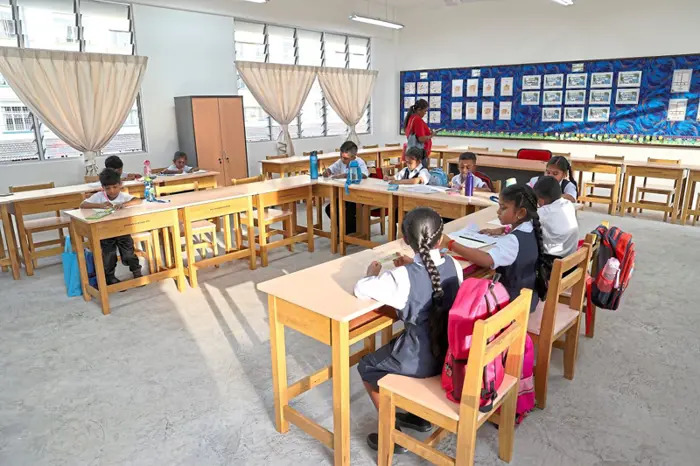
Urgent attention needed: Unlike this vernacular school in Petaling Jaya, many of the Tamil schools in the country are in a bad state. Furthermore, 12% of Indian children are born underweight and 18% suffer from stunting. — ART CHEN/The Star
THE causes behind the problems faced by a significant segment of the Malaysian Indian community have been mostly identified. Now, it should be the time to find effective and sustainable solutions.
Certainly, it cannot be done overnight after seven decades of Merdeka when many in the community remain entrenched in a cycle of poverty and structural exclusion.
But short- and medium-term initiatives must be done so the community sees that actual actions are being carried out. Indians have had enough of politicians who make great promises but fail to deliver.
This is not just a Malaysian Indian problem but a Malaysian problem and it signals a national development failure, as stated in a working paper.
The proposals were put up by Yayasan IItizam and Sustainable Inclusive and Consultative Council (SICC) under the guidance of Prof Dr Mahendran Saggaran Nair and Prof Santha Vaithilingam from Sunway University.
“Rising school dropout rates, a widening income gap within the community, constrained access to economic opportunities, and chronic underrepresentation in high-growth sectors are no longer merely socioeconomic concerns; they pose an emerging threat to national cohesion and resilience,” the report said.
If allowed to persist, “this structural inequity will not only undermine national productivity but will also deepen cynicism, erode trust in public institutions, and diminish participation in democratic processes.
“Inaction, therefore, is not a neutral policy position but a liability. In short, the policy of inaction is no longer tenable. However, the future need not mirror the past.”
Not known to many is that, late last year, Yayasan IItizam and SSIC, sat down with over 200 Indian participants from youth, women, community leaders, civil servants and professional bodies as well as small-and-medium size enterprise leaders.
Among the attendees was PKR deputy president Nurul Izzah Anwar, who was there as the executive chairman of the think tank, Polity.
Without much fanfare, she took part in the workshops, listened to the participants, took questions and in the end, together, they provided inputs to transform the ideas and issues into policies, with the coming 13th Malaysia Plan (RMK13) in mind.
The plan is crucial as it is a strategic development plan for the period 2026-2030 as Malaysia navigates a post-pandemic recovery, technological upheaval, and an uncertain global economy, while our society contends with rising living costs, educational inequalities, and cracks in national unity.
The RMK13 is not just another policy document – it is Malaysia’s most important national blueprint to rebuild equitably, grow sustainably, and move forward together.
While we think the RMK13 will mostly be like previous plans, which will lay out the standard development priorities across the economy and society, we expect more from the Madani Government.
The Plan must go further – it must be bolder, more inclusive, and unapologetically people-first.
Malaysians who had voted Pakatan Harapan into power understand that it is not the dominant party in government, in particular PKR, and it has been weighed down by compromises and promises not fulfilled yet – or what many see as unkept.
Prime Minister Datuk Seri Anwar Ibrahim has to get this one right. It doesn’t help that the previous Economy Minister Datuk Seri Mohd Rafizi Ramli has quit and that Finance Minister II Datuk Seri Amir Hamzah has to table it in Parliament this month.
It will not be an easy development plan.
The interests of the predominantly Malay voters need to be properly addressed, and certainly the Madani Government does not want to be accused of any neglect by their opponents.
Then, there are the unhappy Chinese voters, who used to be political fixed assets, but their goodwill now needs to be renewed again, as they face an increasingly tough economic environment.
For the Indians, there is no question that the government has to win back their faith too, as they too, have become disillusioned.
While the Indian community has contributed significantly to the nation’s development – in education, business, civil service, and culture – segments of the community remain economically and socially vulnerable.
Persistent issues such as low household income, limited access to higher education, under-representation in high-skilled jobs, and urban poverty continue to impact many Malaysian Indians, particularly those in the bottom 40%.
RMK13 must move beyond broad-based approaches and adopt targeted, data-driven interventions that directly uplift Indian households.
The participants have proposed dedicated education funds for Indian students in underperforming schools, entrepreneurship and upskilling grants tailored to Indian youth and small business owners, support for non-governmental organisations (NGOs) already doing groundwork in Indian communities and recognition of the unique socioeconomic conditions faced by estate workers and urban poor Indians in national poverty frameworks.
They also proposed the restructuring of the Malaysian Indian Transformation Unit (Mitra) into a statutory agency with a clearly defined mandate with governance and oversight by the government, the private sector and community.
They also suggested an Indian Development Innovation Fund to support women and youth venturing in emerging sectors including launching “Rebel Builders” such as Youth Startups and incubators to promote innovation and businesses, including investment in the green economy.
Another proposal was for a national mapping of Indian SMEs in critical technologies to create opportunities in the digital economy.
Today, Malaysian Indians account for a mere 1.3% of national equity while 90% of students from B40 families drop out before completing Form 5.
Unemployment among Indian youth rates close to 9.5%, nearly double the national average.
The study paper said social distress indicators are equally alarming: 71.8% of known gang members are Indian, and rates of substance-abuse among urban B40 Indian populations are surging.
Furthermore, 12% of Indian children are born underweight, 18% suffer from stunting and 19% of single mothers in Malaysia are Indians – most of whom live in poverty.
This is further compounded by pervasive hiring discrimination, with only 9% of Indian candidates receiving interview call backs compared to 44% of Chinese applicants with identical qualifications and experience, thus creating an additional barrier to fair wages and career progression for Malaysian Indians.
The result is a labour market that disincentivises education and traps communities in low-skilled, low-wage sectors.
For Malaysian Indians, the promise of education as a vehicle for social mobility is becoming increasingly elusive.
The surge in Indian gang related activity and substance abuse in B40 Indian neighbourhoods demands heightened policing, judicial, and rehabilitation expenditures, a report added.
The report, however, also used the term “B60” to refer to the bottom 60% of income earners within the community to reflect a data-driven recognition that socio-economic vulnerability now extends beyond the traditional B40 bracket.
For many in this B60 group – especially the youth and families in urban and semi-urban areas – education remains the best avenue for upward mobility and for breaking the cycle of intergenerational poverty.
However, pouring in hundreds of millions into these programmes would be meaningless if there is no accountability and governance.
The money should not be to benefit political cronies but for real people who need and deserve the support. Piecemeal handouts to Indian voters, as was done in the past, won’t help to resolve the woes of the community.
Let’s hope that these over 40 detailed proposals, at least some of them, will be included in the RMK13 and Budget 2026.
They have been submitted to the Prime Minister’s Office via the Indian Community Affairs Department, and to the Economy Ministry.
They are not aspirational ideas but ready-to-execute initiatives, and certainly the powers that be should seriously consider these proposals. Merely studying them is not enough.
As the writers of the proposal wrote, this is not about special treatment for the Indian community – it’s about equitable opportunity. Development cannot be meaningful if it leaves a community behind.