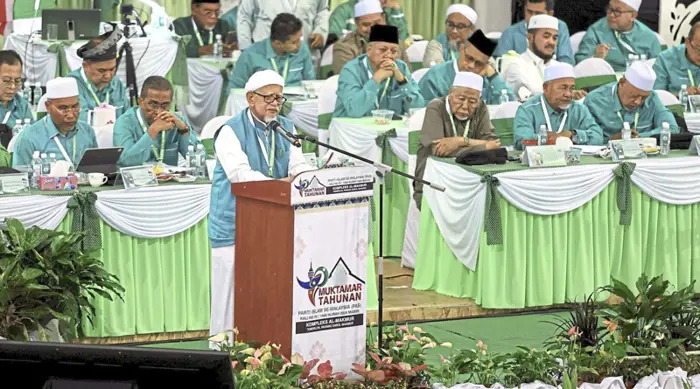
Big challenge: PAS’ ideological stance has made it difficult for it to win the trust of Chinese and Indian voters. —The Star
AS Malaysia’s political landscape shifts ahead of the next general election, PAS continues to face deep challenges in courting support from non-Malay communities – particularly the Chinese.
Take the protest crowd calling on the Prime Minister to step down last week.
It was huge. It does not matter if it was 18,000, as police estimated, or 500,000 as the Islamist party likes to think.
It was still a large presence – but it was also an overwhelmingly Malay crowd, mostly from the east coast states of Kelantan and Terengganu, and of course, Kedah and Perlis in the north.
These are PAS strongholds and even if the states are the worst economic performers, it did not stop the party from questioning Datuk Seri Anwar Ibrahim on his handling of the economy.
What was glaringly missing from the protests were Chinese and Indian participants, except for the token presence of Gerakan, Urimai, and Malaysia Indian People’s Party leaders.
None of them are serious political players and were likely roped in to demonstrate some sense of multiracialism and opposition unity.
The key NGOs involved in the series of Bersih protests from 2005, which had called for clean and fair elections, stayed away.
Former Bersih chairman Maria Chin Abdullah reportedly said that the Turun Anwar rally did not represent the wider Malaysian public and lacked clear demands.
The damning reality is this: despite commanding a strong Malay-Muslim base, PAS’ ideological stance has made it difficult for it to win the trust of Chinese and Indian voters, and its prospects with the Indian community remain uncertain.
Yes, both communities are upset with the unity government for the increasing cost of living, expanded sales and services tax, slow pace of reform, and lack of help for marginalised Indians, but they have not come to the point of wanting to throw out the PM.
They are sensible enough to know that disposing of the PM after just over two years is not going to make Malaysia better.
Instead, it could be disastrous politically and economically. They are also aware that the available options are hardly attractive.
PAS knows that it cannot form the Federal Government on its own – or even be the main component party of the government.
The party spooks most non- Muslims in the peninsula, and in Sabah and Sarawak, and it has no one to blame but itself for the optics and narratives its leaders have chosen.
PAS has long pushed for the implementation of their version of Islamic governance, including Sharia law and hudud punish-ments – positions that sit uneasily with many non-Muslim Malay-sians. Chinese voters, in particular, tend to support secular, multicultural parties which frequently clash with PAS on fundamental issues of gover-nance and minority rights.
As a Universiti Malaya political analyst put it, PAS’ policies and rhetoric are often framed through an Islamic lens, which makes Chinese voters feel excluded or even threatened, and that has been the party’s historical ceiling in non-Malay constituencies.
The Chinese community, largely well-travelled urban and middle-class, prioritises economic growth, educational access (especially for vernacular schools), good governance, and anti-corruption.
These are areas which PAS sees as secondary to its core religious focus. The Chinese haven’t forgotten the apologetic stance taken by its president Tan Sri Abdul Hadi Awang on corruption.
PAS, with its religiously conservative image and strong alliances with Malay right wingers, is often seen as lacking commitment to multicultural ideals.
Its leaders, who are mainly theologians, are not regarded as the right fit to govern Malaysia.
The perception is that the party’s agenda doesn’t align with the values or rights of non-Muslims, who are not going to take the risk when it comes to voting, knowing that the Chinese population is declining sharply.
The constant call for a Malay-Muslim unity front, with claims that Islam and Malay rights are eroding, will also not win PAS non-Malay votes.
There has been no real attempt by PAS to bring up any issues affecting the Chinese and Indian communities, as well as the many ethnic groups in Sabah and Sarawak.
Its elected representatives continue to be obsessed with things like dress codes and banning concerts.
The headline-grabbing statements by PAS leaders on liberalism, gender roles, pluralism, and secularism will further alienate voters in Chinese majority constituencies, where social values tend to lean towards being more liberal and cosmopolitan.
It is perplexing that PAS actually believes that Kelantan is a shining example of a well-run state when it cannot even supply clean water to all of its constituents.
However, while Chinese support may remain elusive, the Indians may be a different kettle of fish. Some political observers believe PAS sees potential in reaching out to disenchanted Indian voters, many of whom feel increasingly alienated from mainstream coalitions.
“The Indian community has long struggled with issues of marginalisation, especially in terms of poverty, education, and job opportunities,” according to a report quoting a Klang Valley-based political researcher.
“If PAS can convincingly address socioeconomic grievances – without making it about religion – it could find some traction, especially among lower-income Indian voters.”
However, PAS’ appeal to Indian voters is complicated by the same issues that trouble its relations with the Chinese electorate.
Furthermore, Indian-majority areas are often represented by parties such as PKR or DAP, which are seen as more inclusive.
To date, PAS has not fielded a significant number of Indian candidates, nor has it developed a strong policy platform specifically addressing the Indian com-munity’s concerns – factors that continue to limit its reach.
While it’s true that many Indian voters are frustrated with both Pakatan Harapan and Barisan Nasional, PAS has failed to make inroads among them because it has not shown any real policy interest in minority issues or in promoting inclusive leadership.
Opportunistic political rhetoric will not win votes, it’s that simple, and depending on minnow Indian-based parties won’t be effective.
PAS’ biggest test may not be electoral maths but whether it can, or even wants to, broaden its appeal without alienating its conservative core.