View wisely: Media literacy is needed especially for older social media users to learn to discern real from fake news, and spontaneous from staged or AI-generated content. This is now part of being a responsible digital citizen.
IT’S deplorable and unacceptable that some Malaysian influencers have become obsessed with numbers rather than values.
Their actions are not just in poor taste but lack maturity, and this has become a disturbing trend of influencer culture.
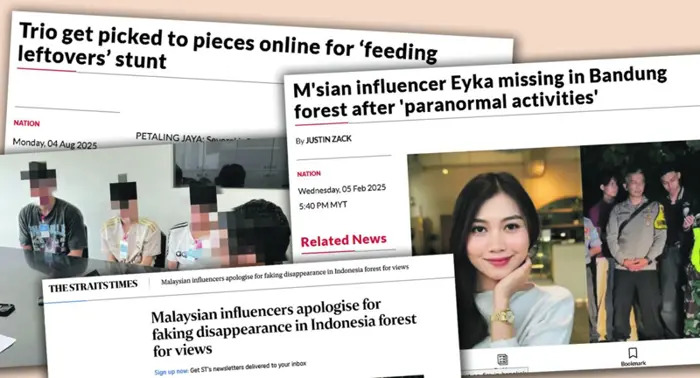
Two recent incidents have sparked widespread public outrage in Malaysia – one group staged a fake disappearance in the jungle, pretending to be lost in the Malaysian wilderness.
Another, in an act masquerading as charity, handed a homeless man food scraps containing mostly bones.
In their defence, one of the three implicated claimed that the man was actually given a proper packet of rice and chicken – and that it was all part of an act.
To most of us, though, it was an act of humiliation. Or, to put it bluntly, it was pure stupidity.
Poverty became a performance. This man’s hardship was co-opted for online clout, his reaction captured for an audience that had no stake in his wellbeing.
In our old school journalism, this would have been categorised as fake news and the book would have been thrown at them.
Now, that comes to the point of the video. Was it a calculated performance to degrade dignity and distort reality, all in pursuit of likes, views, subscribers and followers?
Worse, in race sensitive Malaysia, the actions of the three persons were totally insulting and we assume that they had had no thoughts about the consequences of their actions.
In the case of the influencers who staged their disappearance in the jungle, they didn’t just manipulate their followers – they exploited the public’s empathy and trust.
Search and rescue operations had to be conducted and human resources were basically wasted.
Imagine the consequences if a real emergency had taken place at the time?
The drama built over days until it unravelled. The entire irresponsible narrative had been fabricated.
But such staged actions are not new. Platforms like Instagram and TikTok have long rewarded curated, polished, and highly controlled content.
The rise of artificial intelligence (AI) and an arms race for perfection have pushed this culture into a new realm – one where the boundary between real and fake is almost entirely erased.
There have been many videos with supposedly positive messages which were nothing but just an act.
I am sure many of us have seen videos of so-called kind-hearted food traders who gave free food to someone claiming he was short of money or claimed to have forgotten to bring his wallet.
This template has been re-hashed so many times, in many different ways, but to a seasoned media person, the position of the cameras immediately give away the fact that it’s simply an act.
There are also politicians and religious figures who carry out their charity work with a battery of videographers following them, complete with professional lighting and cameras.
No one stumbles upon a poor homeless person. They have to be contacted and arrangements made.
This is not merely cosmetic editing. It’s the construction of a completely fabricated version of life – one where hardships are dramatised, kindness is scripted, and nothing is left to chance.
Charity often appears suspiciously coordinated. A conveniently placed camera captures the “spontaneous” moment of generosity.
A tearful recipient reacts perfectly on cue. Everything is staged to hit the emotional sweet spots that will drive engagement. But the question must be asked: if you’re scripting kindness for clicks, is it kindness at all?
These celebrities present themselves as saviours while offering little of substance. Their kindness is conditional – visible only when a camera is rolling, performative rather than personal.
Unfortunately, in today’s social media landscape, it is about short videos, quick messages and instant reactions.
The young audience has no time for long text – like this one – and there is little interest in research and sound narratives.
So who cares that it is fake content, AI manipulation, or exploitation as long as it gets eyeballs, is engaging, sensational, dramatic and brings in the numbers. It’s all is fair game.
There are legal consequences, though.
In the case of the jungle hoax, the culprits have been taken to the court as it involves public safety and resources are involved.
Content that uses AI must be required to put a disclaimer that AI has been used in the making of the video.
Finally, media literacy is needed for viewers, especially the older ones. Surely, we should not be so gullible as to believe the Prime Minister and our tycoons would invite you to invest in questionable schemes with unbelievable financial returns?
How many times can the Prime Minister’s Office keep issuing denials that these are fakes as this content keeps morphing? Just stop being greedy.
And stop believing those direct messages from people who want to be your best friends after following just a few of your postings.
Learning to discern real from fake, spontaneous from staged or AI-generated content, is now part of being a responsible digital citizen.