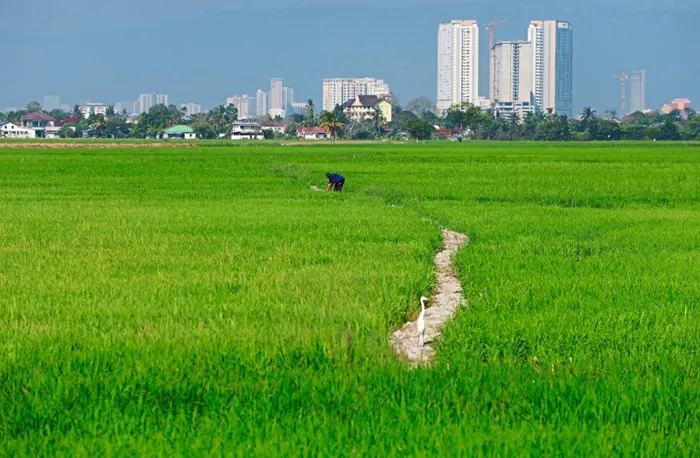
Limited diversification: Kedah has an income problem, mainly due to its narrow economic base that is overly dependent on agriculture. — ZHAFARAN NASIB/The Star
WE don’t need a referendum for Penangites to decide if they wish to be placed under Kedah. It is a non-starter.
The latest attempt by Kedah Mentri Besar Datuk Seri Muhammad Sanusi Md Nor to claim his neighbouring state has hardly generated any talk in Penang. No one takes his continued pursuit of a multi-million ringgit “lease payment” for Penang Island and Seberang Jaya seriously.
It’s nothing more than a political stunt to stay in the news. Penang’s sovereignty has long been settled under the Federal Constitution since 1957.
Sanusi has reportedly said Kedah was appointing a team to begin legal action over Penang’s relationship with Kedah, claiming the court action would be based on historical and legal grounds.
Legal and historical arguments aside, Penangites would never want their state to be placed under Kedah for reasons that go far beyond politics.
Identity, economics, governance style, and lived experience all shape how Penangites see themselves – and none of these align naturally with the idea of being administered from Alor Setar.
Penang is multiracial and cosmopolitan while Kedah, with due respect to its people, is near mono-ethnic and inward looking.
Penangites are fiercely proud of their state – to the point of being criticised as parochial – its multicultural heritage, food culture, iconic arts scene, and global reputation as a vibrant, modern city-region.
Penang’s identity is one of Malaysia’s most recognisable brands. To many Penangites, the suggestion of being absorbed into another state is absurd.
We treasure our lifestyles and quality of life. We are comfortable with international tourists, expatriates, and global companies.
Penangites are happy with their cinemas, pubs, cafés, and entertainment outlets, as well as open concerts, which PAS frowns upon.
The state is known for its fiercely independent thinking. Penang is the home of the country’s earliest newspapers, with the Prince of Wales Gazette printed in 1805.
The Penang-based Kwong Wah Yit Poh was founded in 1910 by Chinese revolutionary Dr Sun Yat Sen and is regarded as the oldest surviving Chinese daily.
The Star, too, was born in the state in 1971, as was the now-defunct Straits Echo, which began operations in 1903.
Then we have long-standing non-governmental organisations such as the Consumers’ Associa-tion of Penang (CAP), Aliran, and Sahabat Alam Malaysia, and illustrious leaders like the late SM Mohamed Idris, CAP’s president.
In fact, PAS itself was founded in Butterworth, Penang, on Nov 24, 1951, and was initially known as Persatuan Islam Sa-Malaya.
Penangites have thrown out three chief ministers and every CM knows that they will be placed under scrutiny. Penangites wouldn’t tolerate any half-baked leader with ludicrous suggestions such as “taking back” another state.
For decades, Penang has cultivated a reputation for relatively efficient local governance, economic planning, and progressive urban initiatives.
Penangites, accustomed to active civil society engagement, open debate, and an administration that positions the state as an economic hub, will never exchange that for governance under a completely different political culture, especially under PAS with its religious narratives.
Penang’s economy is powered by high-tech manufacturing, services, tourism, and international investment.
The state’s concerns revolve around maintaining competitiveness in global supply chains, improving public transport, and developing digital infrastructure.
Kedah, on the other hand, is listed among the poorest states in Malaysia and often cited as a state with high poverty, facing similar issues to Kelantan, with few job opportunities and little economic potential.
The state faces poverty due to a combination of factors, including a narrower economic base beyond agriculture, weaker governance, and socioeconomic disparities with limited diversification.
It has also been reported that weak governance is hindering Kedah and other states from attracting the necessary investments needed for development.
Kedah is also reportedly the second poorest state in terms of GDP in 2021, and, seriously, Sanusi should focus on doing a better job as MB.
Putting Penang under Kedah will simply mean being governed under a different economic framework and could slow progress, weaken investor confidence, and alter the direction of a state that is doing well.
Penangites are well aware of the historical connection to Kedah from centuries ago but that ended when the 1957 Federal Consti-tution was passed.
Likewise, there is no longer any requirement for Kedah to send “bunga emas” (golden flowers) to Thailand as a diplomatic tribute every three years, a practice that began in the 14th century and ended in the late 19th century.
Penangites have no time for fantasy claims. Sanusi’s reality check should be the state’s never ending poverty problems.
He has a lot to do to raise his state’s standards. He should be worrying about that, not fantasising about Penang.