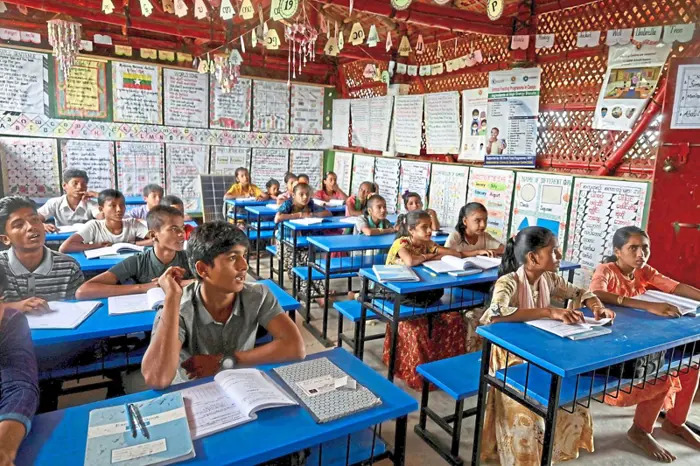
Big challenge: Rohingya refugee children attending a class at a school in Kutupalong refugee camp in Ukhia, Bangladesh. Malaysia does not have any mechanisms for education, healthcare, employment, and social integration for refugees. — AFP
JUST a decade ago, Rohingya refugees were portrayed by our politicians as a Muslim minority persecuted by Myanmar’s oppressive military regime. The politicians pushed the case into a powerful symbol of Muslim solidarity.
The political branding peaked between late 2016 and 2018, and was primarily aimed at gathering support ahead of the country’s general elections.
Former Umno president Datuk Seri Najib Razak even led a high- profile rally in Kuala Lumpur – with his party’s political rivals beside him, to boot.
The cause became a convenient platform for politicians seeking to demonstrate their Islamic credentials and appeal to domestic Muslim sentiments.
In short, these refugees were openly welcomed into Malaysia.
But following domestic backlash in 2020, Najib clarified that his pro-Rohingya solidarity was meant to stop the violence in Myanmar, not an open invitation to refugees to relocate to Malaysia.
Fast forward to 2026, the resentment against the Rohingya community has peaked, with much of the anger coming from the Malay community.
Malay social media, especially on Threads, is full of postings calling for these stateless people to be sent home.
Non-Muslims are asked why they have stayed out of the debate. Well, many did enter the debate a decade ago – they said these refugees should not come over – only to face undue criticism then.
Netizens who pose these questions over social media now probably weren’t even born then and have no background context to the issue.
To put it simply, at the height of the Rohingya crisis, questioning this approach was politically risky, especially for non-Muslims.
Humanitarian concerns understandably dominated public discourse. Images of desperate refugees fleeing violence generated sympathy among many Malaysians.
The narrative was straightforward: fellow Muslims were being persecuted and Malaysia had a moral obligation to help.
But what was largely absent, however, was any serious discussion of the long-term implications.
There are now an estimated 180,000 registered Rohingya refugees in Malaysia, with a huge settlement in Langkawi, Kedah, and Selayang, Selangor. There could be more, many unregistered.
As Malaysians grapple with the increasing cost of living, they are now less ready to carry the burdens of others, especially as pressure increases on public services.
Common complaints include: visible poverty and begging, including at Bukit Bintang, Kuala Lumpur; overcrowded settlements; isolated incidents of crime; perceptions of poor integration; and competition for low-skilled jobs and public resources.
What many do not realise is that Malaysia does not have a formal refugee law, so many refugees remain in legal limbo.
The politicians who championed their cases then definitely did not think too much about how we would eventually handle them.
Few politicians asked difficult questions then, including how many refugees Malaysia could realistically absorb?
What would happen if the crisis lasted not years but generations? What mechanisms would exist for education, healthcare, employment, and social integration?
Would the refugees remain indefinitely in legal limbo? Who would bear the financial and social costs of managing a growing stateless population?
So we essentially are now stuck with the Rohingya refugees’ lack of legal status, which leaves many trapped in poverty and at the risk of exploitation.
We can’t deport them either as Myanmar doesn’t recognise them. Neither does neighbouring Bangladesh, which has about 1.2 million Rohingya refugees residing in camps near the Bangladesh-Myanmar border.
Let’s be honest: there are no third countries welcoming Rohingya refugees with open arms.
What was supposed to be temporary shelter in Malaysia has, unfortunately, become a permanent home for these Rohingya.
Malaysia is now saddled with a situation in which a sizable stateless population resides within its borders without a clear pathway to permanent settlement, citizenship, repatriation, or third-country resettlement.
For the Rohingya themselves, life remains precarious. Many work in informal sectors, have limited access to formal education, and live under constant uncertainty about their future.
For Malaysian authorities, the challenge grows more complex every year. Enforcement agencies, healthcare systems, schools, and local communities must contend with permanent realities that temporary policies were never designed to address.
For ordinary Malaysians, frustrations have become more visible. Many citizens increasingly question why a problem that was presented as temporary appears to have no end in sight.
The politicians who championed the Rohingya had their immediate political rewards. The policy costs were not thought of but the bill is now coming due.
The country cannot indefinitely maintain a large stateless population without generating social tensions.
At the same time, it cannot simply wish away the reality that many Rohingya have spent significant portions of their lives in Malaysia and have few realistic alternatives.
Perhaps we should allow controlled legal employment in certain sectors – because the reality is, prohibiting legal work pushes refugees into the underground economy.
A work-permit system restricted to specific sectors suffering labour shortages could reduce illegal employment, increase tax and levy collection, reduce dependence on charity, and lower incentives for begging and the setting up of informal businesses.
This would likely be more acceptable to Malaysians if it were limited, monitored, and tied to registration.
We cannot stop their children from attending their own schools. A generation growing up without education is a long-term risk for everyone.
Our politicians and policymakers cannot hope for the Rohingya problem to go away. It won’t.
But as we head towards elections, no politicians would now want to be dragged into an issue where they risk losing votes.