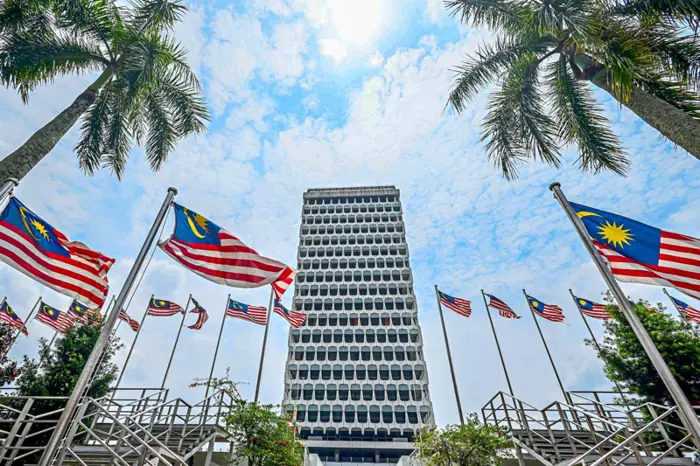
Shared identity: Our national flag is a reminder that despite our differences in race, religion, language, politics and background, we belong to the same nation. — Bernama
THE National Day is a time when we come together in unity but over the past few years, the nation has been on tenterhooks in the run-up to the country’s celebrations.
The Jalur Gemilang is meant to unite us. It is a symbol of a country we share; a reminder that despite our differences in race, religion, language, politics and background, we belong to the same nation.
Yet, every year, we seem capable of turning the flag itself into another source of division of a racial dimension.
There is something deeply ironic about the way we sometimes argue about the Jalur Gemilang.
The country is celebrating its 69th anniversary of independence soon. As far as I remember, there have only been isolated cases of the national flag being hung upside down.
It was never a controversy in the last six decades but it has now degenerated into a national crisis.
Maybe we didn’t have social media then and maybe we didn’t have nasty racist politicians.
A flag is hung upside down. Another is displayed the wrong way. Someone puts it up at an incorrect angle, a few times by foreign workers.
A business premises uses a slightly faded flag. A netizen spots it, takes a photograph, posts it online and the outrage begins.
Politicians quickly jump into the fray. Statements are issued. Police reports are threatened or lodged.
Social media commentators demand action.
The language becomes increasingly heated, as though a badly displayed piece of fabric is somehow the greatest threat facing Malaysia.
Last year, a newspaper editor was even handcuffed over an improper edited version of a copy depicting the national flag. Surely, there have been worse cases of criminal acts when even the suspects were not handcuffed.
Of course, the Jalur Gemilang should be treated with respect. There are proper protocols for displaying the national flag, and there is nothing wrong with reminding Malaysians about them.
But there is a difference between correcting a mistake and turning every mistake into a national crisis.
We should ask ourselves whether we have lost sight of the bigger picture. Is nation building really about making sure every flag is perfectly positioned, while some Malaysians remain divided along racial and religious lines?
Is patriotism measured by how loudly we condemn someone who makes an innocent mistake with the flag?
Or should patriotism also mean how we treat our fellow Malaysians, how we defend the rights of others, how we reject racism and extremism, and how we contribute to a more united society?
It takes only a few minutes to take a photograph of a wrongly displayed Jalur Gemilang and upload it to social media. It can take months or even years to heal any rifts in the nation.
The National Day should be filled with stories of Malaysians who have dedicated their lives to bringing Malaysia and Malaysians together.
They include teachers who educate children in rural areas, soldiers who put their lives on the line, nurses who care for the sick, the police constable who stands under the rain directing traffic, the firemen who enter a blazing building and many more unsung heroes.
There is more to it than just the flag. We want to see leaders who teach our children to respect people of different faiths. This takes patience.
We want to see politicians who preach moderation, tolerance and compassion while bringing Malaysians together despite political differences. This requires real leadership.
It includes creating equal opportunities, improving education, fighting corruption, strengthening institutions and ensuring that every Malaysian feels that they belong. This requires far more than a social media posting.
Unfortunately, we have politicians in our midst who prefer to generate a different kind of outrage. They are mostly political mice when it comes to corruption issues for all their put-up bravado.
They prefer to develop an unfortunate habit of confusing symbolism with substance.
Putting up thousands of flags during National Day is easy. Building a Malaysia in which people of different backgrounds genuinely feel proud to call themselves Malaysian is much harder.
We can sing patriotic songs, attend National Day celebrations and wave the Jalur Gemilang but if we continue to insult one another because of race or religion, what exactly have we achieved?
The national flag should remind us of our common identity, not become another weapon in our political arguments.
It is much easier for politicians to condemn a shopkeeper than to explain how we intend to bridge the widening divisions in society.
Let’s not forget that it is easier to demand punishment than to build reconciliation and even that, we know some political recalcitrants are selective in their targets.
If someone displays the flag incorrectly, educate them, as in most countries. There is no need to make a political spectacle out of it.
If there are clear guidelines, explain them. If a deliberate act is involved, then let the appropriate authorities deal with it according to the law.
Lest we forget, the Jalur Gemilang belongs to all Malaysians.
The flag does not ask whether we are Malay, Chinese, Indian, Kadazan-Dusun, Iban or from any other community. It does not ask whether we are Muslim, Buddhist, Christian, Hindu or followers of another faith. It simply represents Malaysia.
It’s time for Malaysians to ask the petty politicians what they have done for Malaysia instead of making threats, calling names and looking for badly hung flags on social media.