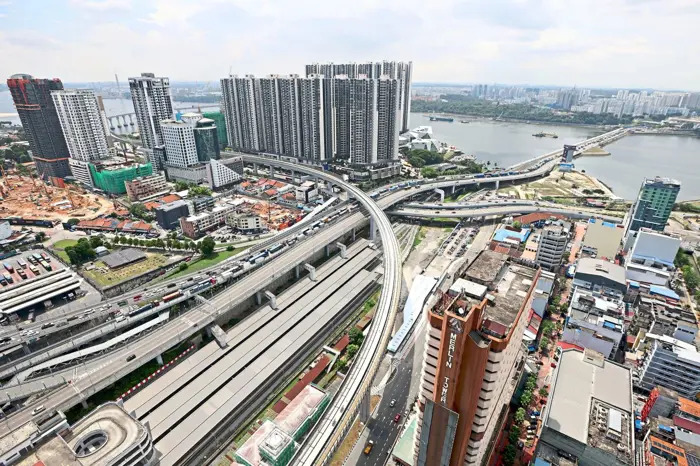
Stability is key: The endless politicking in Malaysia might be welcomed as a little spice across the Causeway but spice is not what attracts investors, it’s predictability, says the columnist. — THOMAS YONG/The Star
MALAYSIAN news companies are used to getting calls from their counterparts in Singapore looking for content they can use to help fill up their pages, especially when the more exciting news comes from across the Causeway.
For the past few weeks, news breaks have taken place at a swift pace – from the constitutional crisis in Negri Sembilan to the house arrest decision for Datuk Seri Najib Tun Razak, which has sparked a national debate.
Umno, a main component partner in the Federal Government, has also been posturing and taking a different approach on several issues.
Last week, the Negri Sembilan palace sacked the entire state executive council at almost midnight. Before that, Mentri Besar Datuk Ismail Lasim announced the state exco endorsed a disputed proclamation to remove Yang di-Pertuan Besar Tuanku Muhriz Tuanku Munawir, though the MB had earlier claimed he signed that document under duress.
And before the week was out, the neighbouring Melaka state government announced the dissolution of the state assembly.
So Malaysians will now see an election coming up – just a month after the Negri Sembilan state polls.
It’s an endless round of politicking in Malaysia, with which we can expect the usual unproductive rhetoric with divisive race and religious narratives.
Seriously, Malaysia could do with being a little more boring.
Perhaps we need to learn an uncomfortable lesson: Being boring is not necessarily a bad thing.
In fact, when it comes to attracting investors, boring can be downright good. Investors are not tourists. They don’t come here looking for excitement, drama, or a political plot twist every few weeks.
They are looking for something much less glamorous: political stability. Investors don’t want to spend their time talking to political leaders to secure a deal only to see the leaders they talked to losing their jobs.
So with the uncertainties ahead of a general election that will possibly take place a year from now, no one should be surprised if investors decide to put their plans on hold.
As always, the losers are the rakyat.
They want to know what the rules are today, what they are likely to be tomorrow and, preferably, what they will look like five years from now.
They do not want surprises, especially when we have PAS leaders talking of changing and discarding tested laws simply because they date back to the colonial era.
Our legal system has worked well and that is our asset. When businessmen sign deals, they know they can trust the legal system if they need to seek redress, unlike in Cambodia, Indonesia, Thailand, or Vietnam where the systems are different.
Malaysia has done remarkably well in attracting investments, particularly in the electrical and electronics, data centre, semiconductor, and digital sectors.
Bank Negara Malaysia has said that strong fundamentals, a deep production ecosystem, and supportive policies are sustaining investor confidence.
But we should not take that confidence for granted. The global investment landscape is becoming more competitive.
Countries are fighting for the same factories, data centres, technology companies, talent, and billions of ringgit in capital.
And investors have choices. They can ask very simple questions: Is the government stable? Are policies consistent? Can regulations be understood?
Will a decision made today still be valid tomorrow? Can I plan my business without having to read the political tea leaves every morning? These are not unreasonable questions.
Singapore has built much of its economic reputation around precisely these qualities. Its economic agencies point to political stability, transparent institutions, and a pro-business environment as important reasons global companies use it as a regional hub.
There is a reason why Singapore can sometimes appear, well, boring.
The trains arrive on time, the airport works efficiently, the rules are clear, government agencies tend to know what they are doing – and investors seem to like this kind of boring.
A recent assessment by global management consulting firm Kearney placed Singapore eighth in its 2026 FDI Confidence Index, reflecting the investment intentions of more than 500 senior executives from major international companies.
Singapore’s stable regulatory environment and efficient business processes were cited among its strengths.
Never mind if the politicians are extremely boring and most people cannot remember their names. The Singapore press can’t even call up their ministers directly unlike in Malaysia.
Malaysia, of course, has something Singapore doesn’t have in the same abundance: space, natural resources, a large domestic market, a sizable workforce, manufacturing expertise, and enormous potential.
We don’t need to become Singapore but perhaps we could learn to be a little more predictable. That does not mean Malaysia should stop reforming.
Reforms are necessary. Some old policies need to be removed. Some new ones must be introduced. Inefficiencies have to be tackled and difficult decisions cannot always be postponed simply because they are politically inconvenient.
But there is a difference between reform and constant uncertainty.
What worries businesses is not necessarily change itself. It is the possibility of having to change direction every time there is a new political development.
Malaysia sometimes behaves as though every policy announce-ment must have a little drama attached to it. We debate, counter-debate, clarify, clarify the clarification, then someone says the clarification was misunderstood.
By then, the investor has probably gone for lunch, or worse, flown out of KLIA.
This is where the government’s emphasis on political stability matters.
Prime Minister Datuk Seri Anwar Ibrahim himself recently said political stability is crucial to maintaining Malaysia as a trusted investment destination, arguing that investors need confidence in stability before committing funds, according to Bernama.
Bank Negara has made a similar point, noting that policy consistency and strong economic fundamentals support investor confidence.
Importantly, Malaysia has re-entered Kearney’s Index after an absence of 12 years – and at a very respectable 21st spot. Perhaps that’s because we’ve had a relatively calm four years until now. For sure, we cannot change PMs four times in five years.
So perhaps the message for Malaysia is quite simple: Slow down.
We need to take a breather. Not every political disagreement needs to become a national crisis. Not every policy needs to be reinvented. Not every government announcement needs to produce a counter-announcement before lunchtime.
Don’t change rules regularly or, worse, overnight.
Sometimes, the best thing a government can do for business is simply to let businesses get on with business.
Sometimes the most reassuring government announcement is the least exciting one: “The policy remains unchanged and if it is no good, just cancel it.” And there is nothing wrong in making a reversal if it helps.
Boring speeches and statements may not generate many headlines but they might generate jobs. Malaysia does not need to become dull. We should remain energetic, innovative and ambitious. But perhaps our politics could become a little less theatrical, and our policymaking a little more predictable.
We have enough drama in the world already. News organisations here are getting tired of politicians who shoot off their mouths with mindless racist remarks.
Investors are not asking Malaysia to be perfect. They are asking whether they can trust the ground beneath their feet.
And if being a little boring helps to provide that confidence, perhaps boring is exactly what we need right now. After all, there are worse things for a country to be known for than being predictable.