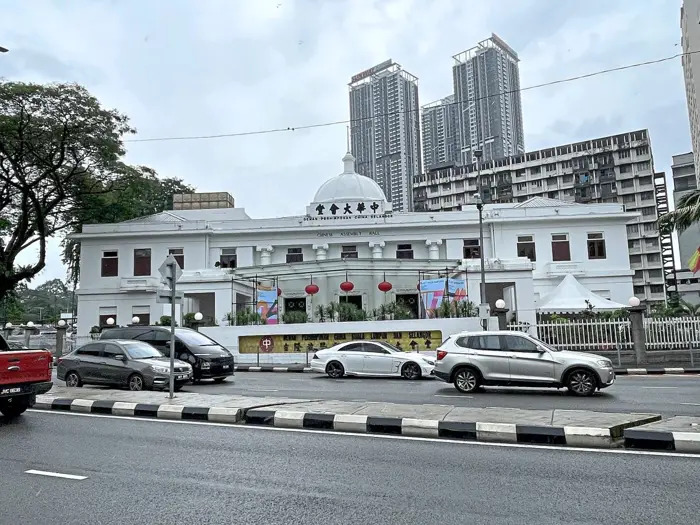
No profit in it: The piece of land on which KLSCAH sits is no longer of any commercial value because it cannot be converted into any other use such as to put up an office block or a high-rise residential condominium. — Filepic/The Star
THIS is what happens when everything is looked at through a racial lens.
There is now a hue and cry over the 99-year lease extension for the Kuala Lumpur and Selangor Chinese Assembly Hall (KLSCAH) at a nominal premium of RM1,000.
Across the country places of worship, mission schools, charitable organisations, and cultural associations regularly receive token land premiums or quit-rent reductions.
Granting nominal premiums to non-profit, religious, educational, and heritage bodies is a long- standing administrative practice across Malaysia, not an exception carved out for one group.
The rationale is simple: When an organisation operates on a non-profit basis and serves a public or community function, public policy favours allowing it to channel its limited resources into maintenance and community programmes rather than paying commercial land taxes to the state.
The KLSCAH issue has triggered a largely unnecessary public controversy.
What ought to have been a straightforward discussion on heritage has instead degenerated into a debate with racial overtones.
Could this be because Federal Territories Minister Hannah Yeoh happens to be a DAP leader and is an easy target?
At the heart of the dispute is a comparison between the RM1,000 nominal fee and the site’s estimated commercial renewal valuation of RM4.67mil.
Critics have seized upon this figure to argue that the government forfeited millions in public revenue to favour a specific community institution.
However, framing the issue as a zero-sum racial concession ignores the strict legal conditions attached to the renewal, as well as established land administration norms in Malaysia.
First and foremost, KLSCAH did not receive a commercial windfall; in fact, it permanently surrendered its commercial development rights.
According to clarifications from Yeoh and the hall’s leadership, the nominal premium was granted only after KLSCAH agreed to convert the land’s status from commercial to institutional use.
In short, the piece of land on which KLSCAH sits is no longer of any commercial value because it cannot be converted into any other use such as to put up an office block or a high-rise condominium.
Under its previous title, the prime Jalan Maharajalela plot reportedly held substantial market value precisely because it could theoretically be redeveloped for such commercial purposes.
By accepting institutional zoning, KLSCAH has given up its commercial interest. It is now legally barred from monetising the land for private commercial development.
Expecting a non-profit organisation to pay a commercial-rate premium for land it can never commercially exploit runs counter to basic principles of land valuation.
Second, the building’s status as a protected historical monument places heavy financial responsibilities on its custodians.
Completed in 1934, the distinctive 103-year-old neoclassical structure was officially gazetted as a National Heritage site in 2007 under the National Heritage Act 2005.
While heritage gazettement recognises a building’s architectural and historical significance to the nation, it also imposes strict limitations on renovations and demands continuous, specialised maintenance to preserve the facade and interior.
Unlike a commercial landlord who can tear down an ageing structure to maximise floor-area ratios, a heritage custodian bears the ongoing cost of conservation for the public’s cultural benefit.
In short, KLSCAH has no commercial development value and runs an annual operating deficit of about RM400,000 as a result of its ageing structure and increasing maintenance costs.
KLSCAH has long played a huge role in Kuala Lumpur’s civic life.
Although founded a century ago to serve the Chinese community in Selangor and Kuala Lumpur, the hall has evolved over the decades into an inclusive public square.
Its auditoriums and meeting rooms routinely host multiracial civil society forums, academic lectures, arts performances, book launches, and national dialogues open to all Malaysians regardless of background.
Treating the institution purely through a narrow communal lens overlooks its broader contribution to the capital’s democratic and cultural fabric.
Strangely, the loudest critics to the nominal premium to KLSCAH are often also the quietest mice over the colossal sums of corruption and financial abuses in the country.