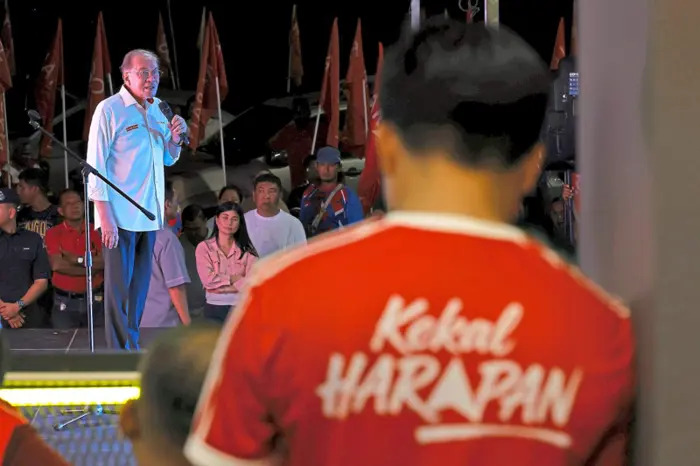
Governing effectively: With more than one year to go, Anwar has to push through all the reforms, including the proposed laws pending in Parliament. — Bernama
IT is only to be expected that the Prime Minister will now find himself under pressure following Pakatan Harapan’s disappointing performances in the Johor and Negri Sembilan state elections.
As always in Malaysian politics, every electoral setback immediately fuels speculation of an early general election.
There will be voices within and outside the government arguing that a fresh mandate is needed to reset the political landscape. Within Pakatan, there could be doubts and even a temptation to push for snap elections.
But that would be a mistake for Datuk Seri Anwar Ibrahim.
Politics is often about timing. Winning elections is not merely about riding the momentum but also knowing when not to go to the polls.
The unity government was never conceived as a conventional coalition formed after an election.
It was born out of necessity after the 2022 General Election produced a hung Parliament.
Its purpose was to provide stability in a country exhausted by years of political upheaval, revolving-door prime ministers, and shifting parliamentary alliances.
Calling another general election barely halfway through the parliamentary term would undermine that very objective.
The present unity government’s term runs until February 2028, and it has until then to call for elections, although many have questioned if the component parties are sincere in wanting to work together.
The recent state election results deserve careful study, but they should not be exaggerated. State elections are frequently influenced by local issues and personalities and regional dynamics.
They are not always reliable indicators of how Malaysians will vote in a national election.
Johor has always had its own unique political culture, while Negri Sembilan has historically produced electoral outcomes that differ from national trends. Reading these contests as an inevitable forecast of Putrajaya’s future would be simplistic.
More importantly, there is little evidence that Malaysians are clamouring for another general election.
What voters consistently say, whether in opinion surveys or daily conversations, is remarkably similar: They want lower living costs. They want jobs. They want better wages. They want efficient public services. They want less political drama.
Very few are asking for another nationwide campaign.
Barisan Nasional, PAS, and Wawasan worked on a simple narrative: vote for Malay-Muslim Unity. That tactic worked well and all it needed was for Barisan, PAS, and Wawasan to avoid multi-cornered fights.
Barisan has given PAS a backdoor entry into Negri Sembilan but Umno party president Datuk Seri Zahid Hamidi has said Barisan will defend all its 21 state seats in Melaka, the next battleground.
It is also yet to be seen if PAS will make way for Barisan in states like Kedah, Perlis, and Terengganu, which are now under the Islamist party’s control.
Despite the Malay-Muslim unity push, the fallout between two Umno factions in Negri Sembilan was already evident a day after polling.
The Federal Government’s priority should therefore remain governance rather than electioneering.
Anwar himself has repeatedly argued that Malaysia lost valuable years because political leaders were preoccupied with survival instead of governing. It would be ironic if his administration now gets drawn into the same cycle.
The economic fundamentals also suggest caution. Malaysia continues to navigate an uncertain global environment marked by geopolitical tensions, supply chain disruptions, and uneven economic growth.
Investors value predictability above almost everything else. Few developments create greater uncertainty than an unexpected general election. Businesses delay investment decisions. Consumers become cautious. Civil servants inevitably become more focused on political transitions than policy implementation.
The costs are real, even if they rarely make headlines.
There is also the question of unfinished reforms and the need to review hugely unpopular policies, especially the sales and service tax and e-invoice implementation which has hurt the small and medium-sized industries (SMEs) and even ordinary citizens.
The resentment has been loud and only the Prime Minister can fix it. Time and patience are running out.
The SMEs represent over 97% of local businesses and they drive the local economy. They reportedly contributed 39.7% of GDP, providing a value-added output of RM689.8bil.
They serve as the backbone of the economy, driving growth, employment, and trade across the country, hiring 48.7% of the total national workforce.
We are talking about the livelihoods of 8.09 million working Malaysians.
Then there is unhappiness in the Malaysian logistics and freight forwarding industry, which faces a mix of global geopolitical shocks and severe localised structural strains. The resentment over several pressing operational and systematic bottlenecks is loud as the players feel they have not been properly consulted over regulatory issues.
The Madani administration has embarked on subsidy rationalisation, tax reform, industrial transformation, civil service improvements, and governance initiatives.
None of these reforms produce instant political rewards, while many may also involve short-term political pain before longer-term benefits emerge.
Abandoning this programme midway for an election would risk leaving reforms incomplete while denying voters the opportunity to judge them based on actual outcomes.
Politics should not become an endless series of opinion polls. There are other practical considerations.
The unity government itself continues to evolve. Relations among its component parties remain complicated.
Frustrated voters have even reminisced fondly about the Tun Dr Mahathir Mohamad and Datuk Seri Najib Razak administrations, forgetting the fact that they led dominant parties in government unlike the present unity government with 18 partners.
Electoral cooperation that works in one state also does not necessarily translate into success elsewhere.
Seat negotiations would also be far more difficult if Parliament were dissolved today.
The recent elections have also exposed unresolved questions within both government and opposition coalitions about leadership, strategy and cooperation.
For Anwar personally, the challenge is no longer proving that he can become prime minister. That chapter has been written. The greater test is whether he can show that political stability delivers better governance than perpetual campaigning.
History tends to remember administrations for what they accomplish rather than how frequently they seek electoral validation.
The opposition, meanwhile, will undoubtedly interpret the recent results as evidence that national momentum is shifting.
Every opposition seeks to convert state victories into federal ambition and to create doubt.
But governing parties should not make strategic decisions based on opposition confidence.
Malaysia’s Constitution provides for a parliamentary term of up to five years for good reason. That allows a government sufficient time to implement policies before returning to seek the people’s verdict.
Unless the government loses its parliamentary majority, there is little constitutional or political necessity to cut that term short.
The strongest response to electoral disappointment is not another election but better governance and speedier reforms.
If the administration can demonstrate that inflation is under control, investment continues to flow, wages are improving, public services are becoming more efficient, and reforms are producing tangible benefits, the political narrative may look very different when the next general election does arrive.
The voters have already spoken once in 2022. They entrusted Parliament with the responsibility of governing a deeply divided nation.
That responsibility has not expired simply because a few state elections have produced uncomfortable results.
The best campaign for the next general election begins not with dissolving Parliament, but with governing effectively until the time comes.
With more than one year to go, Anwar has to push through all the reforms, including the proposed laws pending in Parliament.
But the clock is ticking away fast.
He has to invest more in keeping his voter bank happy and forget about pandering to those who would not vote for him, but in fact want him to go.
Finally, let’s not forget that the unity government was formed following the intervention and decision of the Yang di-Pertuan Agong, Al-Sultan Abdullah Ri’ayatuddin Al-Mustafa Billah Shah, after the 2022 election produced a hung Parliament.