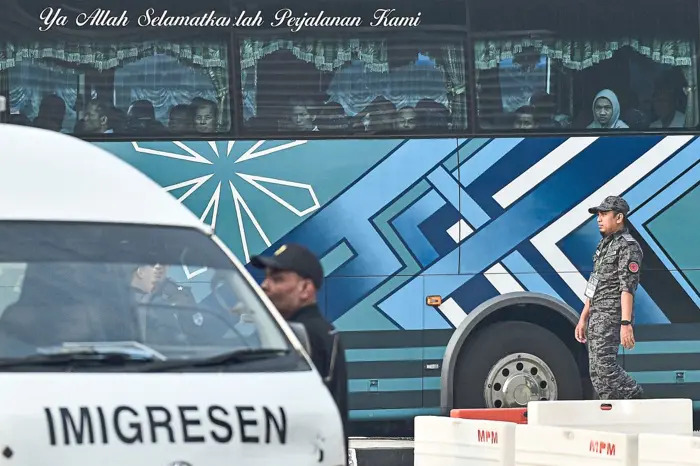
Tipping point: A bus carrying Myanmar nationals being repatriated from Malaysia seen heading toward to navel base in Lumut. —AFP
IT’S a problem that has been festering for far too long. Now, Malaysia has reached a point where we can no longer avoid having an honest conversation about illegal immigrants and refugees living and working in the country.
We already have more than 200,000 UN-registered refugees and maybe tens of thousands more unregistered ones. The Government’s decision to begin repatriating Myanmar nationals who are willing and eligible to return home is therefore understandable and deserves to be supported.
It is part of the basic responsibility of any government to manage its borders, enforce immigration laws and determine who has the right to remain in the country.
The first group of 1,476 Myanmar nationals has been repatriated under a wider programme involving 5,000 people. The Government has stressed that that the process is voluntary and will be carried out in coordination with Myanmar.
That distinction matters.
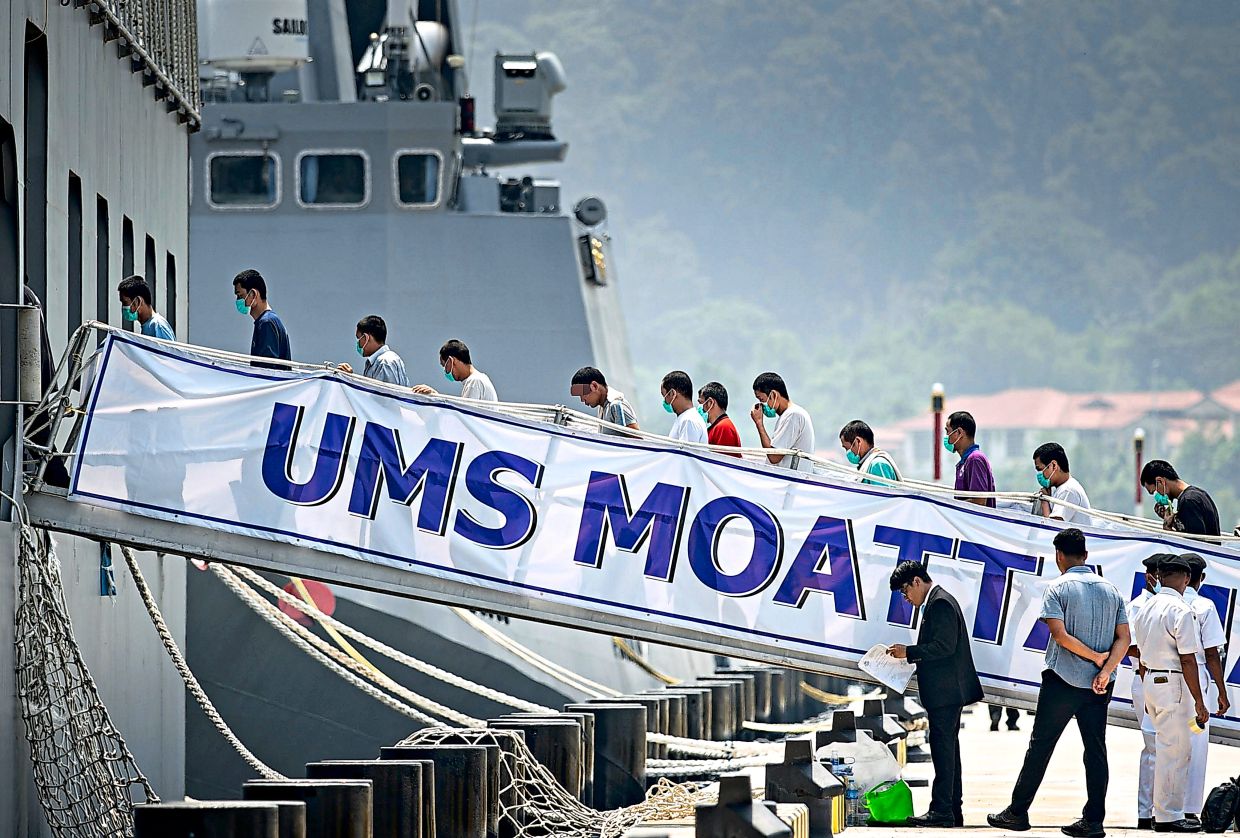
Myanmar refugees getting on board Myanmar’s naval ship UMS Moattama for their journey home. — Bernama
Malaysia can be compassionate without abandoning immigration control. We can be humane without allowing our immigration policies to become meaningless.
For years, Malaysia has opened its doors to people fleeing war, persecution and poverty. We have done so even without being a signatory to the 1951 UN Refugee Convention.
The burden has nevertheless grown enormously as the birth rate of certain ethnic groups exploded. As of February this year, UNHCR figures showed some 215,600 refugees and asylum seekers registered in Malaysia, including about 193,800 from Myanmar.
Of these, around 126,000 are Rohingya, which has resulted in a great deal of unhappiness among many Malaysians regardless of race and religion.
The continuous presence of many foreign beggars at tourist spots especially around the prime Bukit Bintang area – and the inability of the authorities to stop them – has angered many Malaysians.
Without a doubt, behind every statistic is a complicated human story. Some came because they were escaping persecution. Others came because Malaysia offered jobs and economic opportunities.
Some have legal documents, some have refugee documentation, while others have fallen outside the system altogether.
This is precisely why we need a proper distinction between refugees, asylum seekers, legal foreign workers and undocumented migrants.
They cannot all be treated as one. The most difficult question, of course, concerns the Rohingya.
Social media is full of videos from netizens complaining about their lifestyles and inability to live with their Malaysian neighbours, especially in the Selayang area.
There is a growing rumbling among Malaysians that those who have been here for years should be returned home to Myanmar.
That is understandable from the perspective of a country struggling to manage a large foreign population. But saying that people should return is much easier than making it happen.
Myanmar has historically refused to recognise the Rohingya as citizens, and the conditions in Rakhine State remain deeply complicated.
The United Nations refugee agency has also warned that Myanmar remains unsafe and that any return must be voluntary, informed, safe and dignified.
If Malaysia wants the Rohingya to return, the question is not simply whether Kuala Lumpur wants them to go.
The question is whether Naypyidaw will genuinely accept them back, whether they will have a place to return to, whether they will be safe and whether there will be an international mechanism to monitor their return.
Without those conditions, forced repatriation would simply move a humanitarian problem from one country to another.
That does not mean Malaysia has to accept an open-ended refugee policy either. It means we need a realistic policy. Malaysia cannot become a permanent settlement for refugees from every regional conflict.
Our politicians have to be blamed. They were the ones who welcomed them, believing that playing the “Muslim brotherhood” narrative would win them votes.
In 2016, then-Prime Minister Datuk Seri Najib Tun Razak and PAS president Tan Sri Abdul Hadi Awang attended a solidarity rally in Kuala Lumpur to express support for the Rohingya.
Decades later, it has backfired badly, and these politicians washed their hands of this fiasco.
At the same time, we cannot simply deport people to places where they may face genuine danger, or even death.
There is a middle ground: registration, screening, temporary protection, work rights where appropriate, strict enforcement against criminal activity, and eventually a credible pathway towards voluntary return when conditions permit.
The same principle should apply to foreign workers. Malaysia has benefited enormously from foreign labour. Our plantations, construction sites, factories, restaurants and other industries have relied on workers from countries such as Bangladesh, Pakistan, Indonesia, Nepal and Myanmar.
And we should acknowledge an important fact: many of these workers are here legally. The Immigration Department lists Bangladesh and Pakistan among approved source countries for foreign workers, subject to the relevant rules and quotas.
So, the issue should not be about nationality but neither should we dismiss the discomfort felt by ordinary Malaysians when they see large concentrations of foreign workers in their neighbourhoods, public spaces and businesses.
That discomfort needs to be understood, rather than immediately dismissed as xenophobia.
There is a difference between saying “we don’t want foreigners” and saying “we need better control of the number, location and conditions of foreign workers”.
Malaysia needs foreign workers in certain sectors. But such labour should supplement our workforce, not become an excuse for employers to avoid investing in productivity, automation and better wages for Malaysians.
The Government therefore has to manage both sides of this equation: the needs of business and the concerns of citizens.
Legal workers must be treated properly and paid according to the law. Employers must be responsible for their workers. Recruitment agents must be properly regulated.
And when employment ends, repatriation must actually take place rather than leaving people stranded or slipping into the undocumented economy.
Our own immigration rules already require employers to ensure that foreign workers are repatriated when their employment ends, through the proper channels.
The bigger issue is enforcement. For too long, Malaysia’s immigration debate has swung between two extremes – complete tolerance on one side and blanket hostility on the other but neither approach works. We need a grown-up immigration policy.
For the Rohingya, Malaysia will need diplomacy, not slogans. If Myanmar is eventually prepared to accept them and create genuine safe conditions, voluntary return should be part of the solution.
The problem now is that no one wants the Rohingya. Myanmar does not want them as they are not recognised as its citizens.
Western countries which may criticise the repatriation do not qualify to take a strong stand against us – they are welcome to take in the Rohingya to walk the talk.
But until then, Malaysia needs to manage the reality in front of us. We cannot permanently carry the refugee burden for the region and pretend that immigration controls do not matter.
Malaysia can remain a compassionate country while also being a country with borders, laws and limits.
That is not a contradiction. It is what a responsible country is supposed to be. However, patience among many Malaysians is running thin.