Author Archives: wcw

Our right to speak up

We live in a multi-racial, multi-religious and multi-cultural Malaysia, where any law, whether hudud or civil, will affect all of us.

SERIOUSLY, I am fed up of being told that I should not comment on the proposed hudud laws by PAS and the party’s fans because I am not a Muslim.

The argument is that I have no right, and also no understanding of hudud, thus I am automatically disqualified from discussing it.

Another naïve retort is that this issue should be left to learned Islamic scholars.

So we have the likes of people like the Muslim activist group Ikatan Muslimin Malaysia (Isma) chief Abdullah Zaik Abdul Rahman taking this line of argument further. In his inability to articulate his views convincingly and fairly, he has resorted to threats.

In linking the non-Muslims who oppose the introduction of hudud to a particular ethnic group, he has even called the Chinese citizens in this country “immigrants” and “trespassers” and told them to be grateful for what they have enjoyed in Malaysia.

I wonder if the Isma president is aware that although our Constitution defines Malays as those who profess the Muslim faith, it does not mean that all Muslims in Malaysia are ethnically Malay. What about the converts from other races?

I know so many wonderful people who are ethnically Chinese or Indian, but are also good Muslims. How will all these saudara baru feel to be told off that they are “immigrants” and “trespassers”?

And all my Muslim friends who have been to Mecca always tell me how surprised they all were to see Muslims from all over the world, of all nationalities and ethnicities. It is estimated that there are 25 million Muslims in China, far more than the number of Muslims in most of the Arab countries.

And then the Isma president tells us that PAS’ hudud laws should be applicable to non-Muslims – which runs contrary to his argument that non-Muslims have no say. If hudud is going to be imposed on us, non-Muslims, then why shouldn’t we have a say?

Like it or not, the reality is that we live in a multi-racial, multi-religious and multi-cultural Malaysia, where any law, whether hudud or civil, will affect all of us.

We have a sad situation in Malaysia when one is unable to advocate intellectually or, rather, intelligently. Many of us are unable to take part in a discourse with a rational mind, preferring to shut down or, rather, shout down those who take a different stand.

And the saddest part is that these threats mostly take on a religious and racial slant. That seems to be the way Malaysia is heading.

Until now, non-Muslims are waiting for an answer, or to be convinced, as to how a rape victim would be treated under PAS hudud laws if there is a need to produce four male witnesses.

And just because four witnesses cannot be found, it does not mean a rape did not take place. It also doesn’t mean that the woman has committed adultery.

A non-Muslim wants to know how the law would be applied, since the victim and the rapist can be of different religions in plural Malaysia.

Why should the non-Muslim be regarded as hostile, with no rights whatsoever to even bring up such questions?

For that matter, I am sure Muslims themselves would want to know how this situation would be dealt with as well.

To bring it to another level, if the PAS hudud isn’t about amputation of hands and limbs with regard to petty theft, then non-Muslims surely want to know whether those who steal the country’s money via corruption would also be subjected to such punishment?

And, as one writer rightly argued, “What about civil servants, developers and politicians who allow the rape of our forests in the name of development? What kind of laws would these greedy people be subjected to?”

There are many Malaysians, and I dare say both Muslims and non-Muslims, who are disturbed by what is happening in our country.

Those of us who are in our 50s would remember how, during our school days, it was constantly drummed into us that Malaysia is a plural society or masyarakat majmuk. We live in a country of many races and religions, or berbilang kaum dan agama.

We took all this very seriously, and rightly so too. We memorised the five principles of the Rukunegara – Belief in God (Kepercayaan kepada Tuhan), Loyalty to King and Country (Kesetiaan kepada Raja dan Negara), Supremacy of the Constitution (Keluhuran Perlembagaan), the Rule of Law (Kedaulatan Undang-undang), and Courtesy and Morality (Kesopanan dan Kesusilaan).

Then little disturbing changes began creeping into our text books.

We began to notice that Parameswara had disappeared from our history books and was soon followed by Yap Ah Loy, whose founding of Kuala Lumpur was put in doubt.

Surely Abdullah Zaik is old enough to note the contributions of the Chinese and Indians in opening up the country’s economy, unless he failed his exams in school or is too proud and too blind to accept the contributions of other races who have made Malaysia what it is today.

He surely cannot be blind to the sacrifices of non-Muslims in the security forces who dedicated their lives to fighting the communists in the Emergency, and the many MCA leaders who were killed because they were regarded as traitors by the communists.

Ignorant fools and bigots like him should not be allowed to get away with their remarks. If the authorities choose to look the other way, it is as good as telling many of us that such people are tolerated or, worse, even endorsed by them.

Wrong is wrong, and we are glad that former Prime Minister Tun Dr Mahathir Mohamad has the courage to tell Abdullah Zaik off.

And let us not forget the administrators at Universiti Institut Teknologi Mara, who allowed two foreigners – in this case, Indonesians – to speak at a seminar which was essentially a threat to racial and national unity. If it isn’t, most of us do not know what it is.

Again, we would like to know how two foreigners can preach anti-Christianity sermons in a state-financed university whose students also include many Christians from Sabah and Sarawak.

As a student in Universiti Kebangsaan Malaysia, I had to do Islamic Studies, which was a compulsory subject. But I enjoyed the lectures. I appreciated the opportunity to learn about Islam and until today, I defend the wisdom to teach the subject.

I have continued to deepen my study of Islam and I have conti­nued to collect books on Islam on a monthly basis. My private library has one of the best collections of books on Islam, I dare to say.

And as a Sixth Form student, I signed up for Islamic History and in my first year at UKM, I signed up for the Malay Letters Department. On a personal level, there are Muslims in my family too.

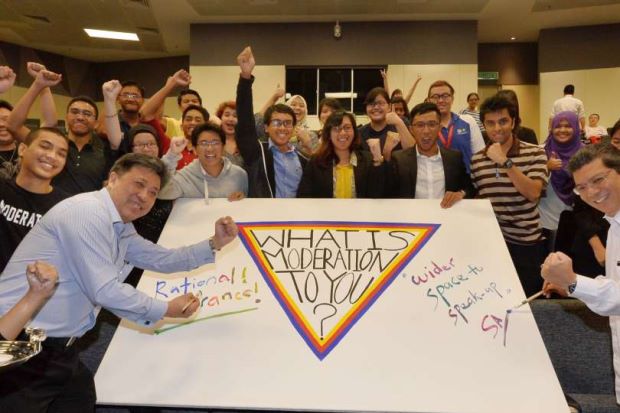
I may not be an expert in religion but, like many of us, we will defend our right to speak up. Do respect our rights as citizens too, and our wish to keep Malaysia moderate, which was what our founding father Tunku Abdul Rahman had set out to do for this beloved country of ours.

Fight to keep Malaysia secular

PAS members attending the 59th muktamar at Stadium Melawati in Shah Alam. - Filepic

PAS members attending the 59th muktamar at Stadium Melawati in Shah Alam. – Filepic

It is simply wrong for anyone to suggest that non-Muslims have no right to debate on the hudud issue on the basis that they do not understand Islamic laws.

ONE of the biggest misunderstandings in the current debate on the push by PAS to implement hudud in Kelantan is that it will not affect non-Muslims, and that being the minority, they have no say on the matter.

This line of argument ignores the fact that Malaysia is a multi-racial and multi-religious country. Nothing is isolated within one community itself.

Hudud is essentially the Islamic penal code and because a crime can be committed by anyone, Muslim and non-Muslim alike, there are bound to be consequences on how any criminal offence will be handled.

In the case of rape, what if the victim and the accused are of different faiths? How would such cases be tried and under which law? Must a non-Muslim victim bring four relia­ble male witnesses to prove her case against the Muslim accused if the case were tried in a syariah court?

And what if two buddies, one Muslim and one non-Muslim, are charged with robbery? How will the sentence be meted out, and in which court?

There can never be two sets of penal laws in this country, where hudud can be implemented in Kelantan or Terengganu, for example, while the rest follow the federal Penal Code.

Is PAS also saying that if it were to form the federal government, hudud laws would be implemented entirely?

It is simply wrong for anyone to suggest that non-Muslims have no right to debate on this issue on the basis that they do not understand Islamic laws.

Worse, there are non-Muslim groups who naively believe that non-Muslims are not involved at all. They are either being politically misty-eyed or simply reluctant to enter the fray. Or they do not want to oppose the move by PAS because of political expediency.

Then, at the other extreme, there are groups like the Ikatan Muslimin Malaysia (Isma), whose president Abdullah Zaik Abdul Rahman was quoted as saying that “non-Muslims in the country have no right to oppose the plan to implement hudud and they should understand that there are limitations to what they could say”.

Non-Muslims, said Abdullah, “should be thankful that they have more than what they need in this country”.

“I don’t see what their contributions are for them to be given so many privileges in the first place,” he had reportedly said, adding that “their strong stand against hudud gives the impression that they are in a dream world; they must realise that they have no say in determining the future of Muslims in this country.”

Even without hudud, we have already seen how complicated it can be in conversion cases as well as marital disputes involving Muslims and non-Muslims due to jurisdictional issues of the civil and syariah courts.

Until now, we have not seen how the authorities intend to resolve the case of a Muslim convert who has taken away his son from his Hindu wife, whom he has divorced.

The civil court granted a custody order to the Hindu wife while the syariah court issued the same order to the Muslim ex-husband. And the police have said they are caught in the middle as both orders are binding.

After all, the Federal Constitution states clearly that the civil and syariah courts have equal status but perform different functions.

If we extrapolate further, what about business disputes and cases of criminal breach of trust? People of different faiths work together, and they are bound to be involved in such issues at some point.

Surely all Malaysians have the right to ask how these cases would be dealt with?

There are existing laws to deal with these issues, but what if hudud also comes into play?

What if different parties opt to go to different courts, insisting on their religious rights and obligations?

There is plenty for PAS to explain, even if Kelantan is predominantly Muslim and the state government is controlled by PAS, because the stakeholders are not just Muslims.

If its partners in Pakatan Rakyat claim they are not aware of what the Islamist party is up to, then the implications are even more serious.

In Selangor, where PKR leads, the state religious authorities have seized Bibles which carry the word Allah and the state government is powerless in dealing with the issue.

The state religious body, in short, has become more powerful than the Mentri Besar and the other state executive councillors who appear to be sending out the message that there’s nothing they can do.

One lesson that has emerged is that when it comes to religious laws, there are some who will conveniently shut down any argument or dissent from non-believers, simply on the premise that they have no such rights or understanding.

But with secular laws, opposing sides can bring any matter to the open court and argue their cases. Fight to keep Malaysia secular, that’s the only choice to keep the country moderate.