Author Archives: wcw

Fair game without crossing the line

NOT many Singaporeans are going to admit it, but I have personally experienced many cases where Malaysia has been talked down to because our neighbours feel they are better off.

Indeed, they are way ahead of us. As much as we hate admitting it, we are the losers.

That’s a fact. We can see the massive differences the minute we cross over to the island republic from Johor Baru.

Their infrastructure is world-class, their leaders have impressive credentials, and corruption is arguably non-existent.

And as long as the Singapore dollar continues to be three times more valuable than our ringgit, they have reason to thumb their noses at us. They have earned the right to brag.

But let’s be frank. Many Singaporeans carry a chip on their shoulders and actually think they are superior.

Let me share a story. I am currently on a tour of a few European countries organised by Trafalgar Tours. They are reliable and I am always among guests who are usually over the age of 60. Peers, I guess.

They tend to be from English-speaking countries like the United States, United Kingdom, Australia, Canada, New Zealand and South Africa.

Most of the time, the Asians are from Malaysia and Singapore. Occasionally, there are Indians too.

But it’s the Malaysians and Singaporeans who are often happy to be in each other’s company since, after all, both nations have so much in common.

We were in one country once, remember?

Negaraku existed long before Majulah Singapura. While both nations adopted the Malay language as their official language, Malaysians can actually speak Malay while many Singaporeans are unable to do so.

Travelling together, we laugh at ourselves when we confess that we were actually carrying chilli sauce and cup noodles.

But the little rivalry, cynicism and disdain eventually crop up, most of the time in an innocently natural way, without even my newfound Singaporean friends realising it.

This trip, a very sweet aunty asked me if it was really true that the SMART tunnel in Kuala Lumpur was a stormwater bypass tunnel and able to alleviate traffic jams.

“The taxi driver who took me to KLIA (Kuala Lumpur International Airport) told me it can stop floods and divert traffic jams. I didn’t believe it, of course, how can Malaysia be so ‘kheng’ (awesome in Cantonese) one?”

I had to disappoint her and tell her that it was true.

Next, she asked why the Malaysian government was “so stupid” as to build KLIA so far from the city, “unlike Singapore, where the airport is really in the city and so convenient.”

I had to remind her that it’s because Singapore is just a tiny city. Sure, it’s a country, but it’s really a city and so, anywhere you build an airport or facility, it will be in the city.

But having said that, who can we blame when our KLIA has lagged so far behind the award-winning Changi Airport?

Our aerotrains at the 25-year-old KLIA, which ferry people between the main terminal and the satellite building, have broken down completely, which is surely a national disgrace.

Luggage takes ages to arrive at the carousel in comparison with busier airports, including even Heathrow Airport in London.

Any seasoned traveller can give a longer list of better airports.

KLIA, which opened in 1998, was ranked among the top 10 airports in the world on four occasions – in 2001, 2010, 2011 and 2012 – but has since seen a steady decline in rankings.

It was down to the 44th spot in 2018. In the latest World Airport Survey, it was at No. 67.

The airport is under the jurisdiction of Malaysia Airport Holdings Bhd and not Malaysia Airlines, as many travellers assume.

If it was in the private sector, heads would roll, but a government-linked corporation works differently, with a high level of tolerance for incompetency.

And still on airports and planes, this Singaporean aunty has never flown on Firefly, the Malaysian airline that operates out of Sultan Abdul Aziz Shah Airport (better known as Subang Airport).

According to her – and my relatives in Singapore – they just don’t feel safe flying on turboprop-powered planes.

I can never comprehend why propellers frighten so many Singaporeans. At least those I have encountered.

Every time I take a taxi on arrival in Changi – Firefly now flies to Seletar – the taxi drivers would confess they have never heard of Firefly.

And then, like a recorder, they would start telling me how sorry they are that I am from Malaysia.

But over the past two years, I have noticed a phenomenal change.

These self-appointed political analysts now train their guns on Singapore instead of Malaysia as they whine about the high-cost of living, increasing utility bills, their toilet-sized flats and how grandfathers must still work until they drop dead when they should be enjoying their golden years.

They curse their government leaders and PhD-holder ministers who are cut off from the realities of the working class.

This does not surprise me as my journalist friends in Singapore tell me that their ministers do not take phone calls or even text messages, unlike politicians in Malaysia.

So, I tell these grumbling cabbies that I feel sorry for them.

Their million-dollar flat would easily get them a three-storey house in Malaysia and two cars, at the least.

If they have a lot of time to kill, like many Malaysians, they can just go on social media and scold their ministers.

But nothing will happen to us in Malaysia for running down our politicians unlike Singapore.

So no need to be “kiasi” (afraid to die or to be afraid in Hokkien) of “jeng hoo” (government in Hokkien).

Well, it’s good to be hard-working and competitive in Singapore, but I am enjoying my much laid-back lifestyle in Malaysia. What a beautiful place.

Sure, Malaysians of various races may complain about each other behind their backs, but we are decent enough to never to cross the line.

We hold the peace.

And for sure, we won’t be offensive like stand-up comedian Jocelyn Chia, who sings her praises about Singapore and tells off Malaysians, but has disposed of her Singapore passport for the United States.

Any worthy comedian can tell you that it’s fine to take a dig at any nationality or ethnic group.

Even our Malaysians poke fun at Singaporeans, but most of these jokes are never offensive.

Chia has now become famous for being a bad comedian. She is supposed to make us laugh and not make us angry.

Of course, we can laugh at ourselves – we are not that immature.

I am sorry, Jocelyn, but you would never make it in Malaysia, or in Singapore and Batam, unlike Singaporeans Gurmit Singh aka Phua Chu Kang or Michelle Chong aka Ah Lian.

Besides, you can never compete with our politicians.

We have too many of these jesters in Parliament who drive us hysterical daily.

And I am sorry that you had to pack up and leave Singapore, presumably because you cannot change your government.

Over here, we have had three prime ministers in five years.

And there is even another round of elections, albeit at the state level state, after about seven months ago when we last voted.

Err, Jocelyn, I am just trying to be funny, in case you didn’t get it.

Rinse and repeat

IT’S tragic that many Malaysians are forced to be concerned about the political narrative being consumed by race and religion in the years to come as our demograpic landscape changes.

The spiel to defend the Malay race and religion because they’re purportedly under threat, is simply preposterous.

There are 77 Muslim, 16 non-Muslim bumiputra, 43 Chinese and 15 Indian MPs supporting the Pakatan Harapan government.

In Parliament, out of the 222 MPs, 131 are Malays and 24 are Muslim bumiputra MPs.

From the 1.7 million working in the civil service, almost 90% are Malays and bumiputra. The same ethnic make-up can be said of the army and police forces.

Then, there are the King, respective Sultans and Tuan Yang di-Pertua, who are all Malays.

Only the Penang Chief Minister is Chinese, while the rest are all Malays.

How on earth is Malay power under siege and requires protecting?

Unfortunately, this tale is already past the brewing stage. Ahead of the state elections in July, we will see our politicians trying to outdo one another.

The state assemblies of Selangor, Kedah, Terengganu, Negri Sembilan, Penang and Kelantan will surely be dissolved simultaneously within the third week of June.

In Selangor’s case, the state assembly automatically ends on June 25, so that means a few days before that, royal consent will be needed to dissolve the state assembly, probably by June 19.

Penang’s state assembly ends in August, but the state government has decided to dissolve around the same time as the rest, too.

All these six states are now predominantly Malay in make-up. Even in Penang, the Malay population is currently nearly on par with that of the Chinese.

According to 2022 figures, the state’s population comprises 42.57% Chinese, 41.40% Malays, 9.92% Indians and 6.12% constituting other races.

The reality is that the Chinese and Indian populations have irreversibly plunged.

As of July 2022, 69.9% of the Malaysian population was classified as bumiputra, 22.8% Chinese and 6.6% Indian.

Figures in 2021 indicated that the bumiputra share of the population in Sabah was 84.15% while in Sarawak, 75.9%. The bumiputra category includes the Orang Asli in the peninsula and indigenous people of Sarawak.

Perikatan Nasional comprises Bersatu, a Malay-based party, PAS, which has advocated for Malaysia to be an Islamic state, and multiracial Gerakan, seen as a token presence.

Bersatu, despite its Malay rights platform, however, has not spooked non-Muslims, unlike PAS, because many Bersatu leaders are from Umno and PKR, meaning it has more public engagement with non-Muslims.

Pakatan, which leads the unity government with Barisan Nasional and other Sabah and Sarawak parties, can’t afford to compete with Perikatan on religion, especially with PAS.

Yes, many sections of Malays, including grassroots Umno members, are uncomfortable with DAP. That is a reality, and it will take time for Umno members and supporters to get used to this relationship.

After all, it was only five months ago, during the general election, that Umno leaders hammered PKR, DAP and Datuk Seri Anwar Ibrahim. Who’s to blame if Umno leaders now sound hypocritical?

But it will be disastrous if the Prime Minister tries to trump PAS on religious issues, and neither should Pakatan try to match or outdo Bersatu or Umno in aggressively defending Malay rights.

Instead, find common ground with the Unity Government delivering on the economic front by bringing tangible investments and introducing sound policies.

What Pakatan can do is help the true Malay entrepreneurs, contractors and traders in business awards, and not political businessmen.

The ringgit’s value isn’t going to go up if our Malay politicians only care about race and religion.

Why would foreign investors want to pump money into Malaysia if we keep grabbing international headlines for all the wrong reasons?

Confiscating Swatch watches which supposedly feature the term LGBT is surely an over-reaction. These timepieces aren’t going to trigger a mass buy. Have we come down to this level?

And after these confiscations, do we expect PAS voters to actually give their votes to Pakatan despite its attempts to tread the moral high ground?

Instead, all it has done is angered progressive Malays in urban areas, especially in Lembah Pantai, and traditional non-Muslim voters.

Worse still, the PM issued a non-committal remark on the raids to justify the action, while Home Minister Datuk Seri Saifuddin Nasution Ismail seemed to have taken a long time to clarify the controversy, which gave the impression that he wasn’t updated on the raids, rightly or wrongly.

How these watches can cause public disorder is baffling and adding insult to injury, Malaysia is reportedly the only country that had ordered the confiscation of these “risque” watches!

At the same time, the government has confirmed that it aims to table the contentious amendments to the Syariah Courts (Criminal Jurisdiction) Act 1965 – also known by its Bahasa Malaysia initials RUU 355.

Previously, PAS had attempted to table the Bill seeking harsher punishments for Syariah offences, raising the Syariah Courts’ maximum sentencing limit to 30 years’ jail, RM100,000 fine and 100 strokes of the cane.

Sketchy, best describes the details of the unity government’s version of the RUU 355 and the difference from that proposed by Marang MP Tan Sri Abdul Hadi Awang. The timeline for when RUU 355 will be tabled is equally vague.

But the announcement by the Minister in the Prime Minister’s Department (Religious Affairs) Senator Datuk Dr Mohd Naím Mokhtar – a respected former judge – at this juncture, seems to give the impression the government wants to reaffirm its stand on Islam.

We need leaders who promote compassion and acceptance, not those fanning the flames of controversy and even threatening Malaysians of other races.

I think logical Malaysians, regardless of their faith, would not accept such a narrow political direction for this country.

Non-Muslims don’t deserve to be eyed with suspicion after more than six decades of independence. Please don’t use us as whipping boys in the quest for political power.

While politicians know the game better, let’s not run away from the bigger reality and responsibility that a strong nation is also run on strong economic and business foundations.

Malaysia needs to convince the world that it’s a progressive and moderate country.

Straight from the heart

Charity is about providing sincerely and without bias.

MALAYSIAN tycoon Tan Sri Vincent Tan is one of the country’s most generous philanthropists. He receives requests for financial assistance from organisations and individuals daily and a panel helps him vet these pleas.

Their task is to ensure that these applications are genuine and well-deserving. One thing that struck Tan was that the committee repeatedly recommended Tzu Chi, the Buddhist charity group.

The businessman then decided to find out more about Tzu Chi himself and it eventually included a meeting with the founder, Master Cheng Yen, a Buddhist nun.

That was eight years ago, and it has become a turning point for Tan. He has always been a practicing Buddhist, but he consequently decided to commit himself to becoming a vegetarian and an active Tzu Chi follower.

While many are aware of Tan’s philanthropic work, not many know that he has visited the homes of refugees in KL and even helped at a home for the disabled in Kuala Kubu Baru, sans fanfare, with other Tzu Chi followers.

It has also stunned Tan that Cheng Yen, who is now 86, runs a global organisation without having stepped out of her Taiwan base.

Today, Tzu Chi is an international humanitarian organisation that aspires to relieve the suffering of the needy with its presence in 63 countries and regions including the United States, Australia, Asean and various nations in Europe and even Africa.

This year, the organisation marked its 57th anniversary while Tzu Chi Malaysia will celebrate its (30th) year milestone in August.

But each year, on the second Sunday of May, Wesak Day, Mother’s Day and Tzu Chi Day are celebrated simultaneously.

Unlike other Buddhist groups, which focus more on spiritual concerns, Tzu Chi is known for its community service and outreach programmes including medical, educational and disaster relief for even non-Buddhists.

In fact, in Malaysia, a large part of its help is extended to non-Chinese as well as non-Malaysians, including refugees and stateless people.

In Indonesia, the Tzu Chi arm has even contributed generously to Islamic schools while in South America, the beneficiaries included Catholic organisations.

“Tzu Chi has helped to clean up mosque compounds in flood hit areas in Kelantan and has provided help for Muslims, and churches, too,” shared Tan.

During the floods at Taman Sri Muda, Selangor, on Dec 20, 2021, Tzu Chi deployed 3,000 volunteers each day for relief work daily until early 2022.

As of 2022, Tzu Chi Malaysia has about 1.23 donors, 20,000 volunteers and 8,000 commissioners.

Commissioners are those who have served Tzu Chi for at least two years in various responsibilities, attended training and have pledged to dedicate themselves to carrying out Tzu Chi missions with the right belief and mindfulness.

Archbishop Julian Leow Beng Kim, for example, linked up with Tzu Chi Foundation of Malaysia to deliver beds and trolleys for the Sungai Buloh Hospital at the height of the Covid-19 outbreak in 2021.

In fact, he showed up for the celebration of Tzu Chi Day last week. A section of the Tzu Chi Foundation building in Kepong, KL is adorned with pictures of leaders of other faiths with Tzu Chi representatives including the Pope.

The images also depict the work it has done in various parts of the world.

Tzu Chi Malaysia has certainly become a familiar name to many Malaysians for its consistent hard work.

It was brought to Malaysia by a Taiwanese, Ye Ci Jing, in (1988), when she was posted by her company to work in Penang. That’s when she took the opportunity to promote Tzu Chi to the local community.

At around the same time, Taiwanese couple David Liu and Echo Chien came to Melaka to set up a factory. They learned of Tzu Chi and began to promote its mission in Malaysia.

While personalities like Vincent Tan, Tan Sri Michelle Yeoh and Tan Sri Lim Wee Chai have elevated Tzu Chi Malaysia’s profile, the success of this organisation belongs to thousands of ordinary men and women who have quietly dedicated themselves to serving Malaysians, regardless of their faith and race.

As is Tzu Chi’s practice, the givers take a bow when they assist someone because they regard it as a privilege to serve.

Serving isn’t just about donations but involves hitting the dirt, literally, such as relief work in disaster areas and even bathing and cleaning up the disabled.

The lesson here is simple – our faith is irrelevant because, ultimately, it’ s about what we do during our time on Earth.

Have we done enough to help our fellow human beings, or do we just want to earn plaudits for purportedly being pious?

Sporting value


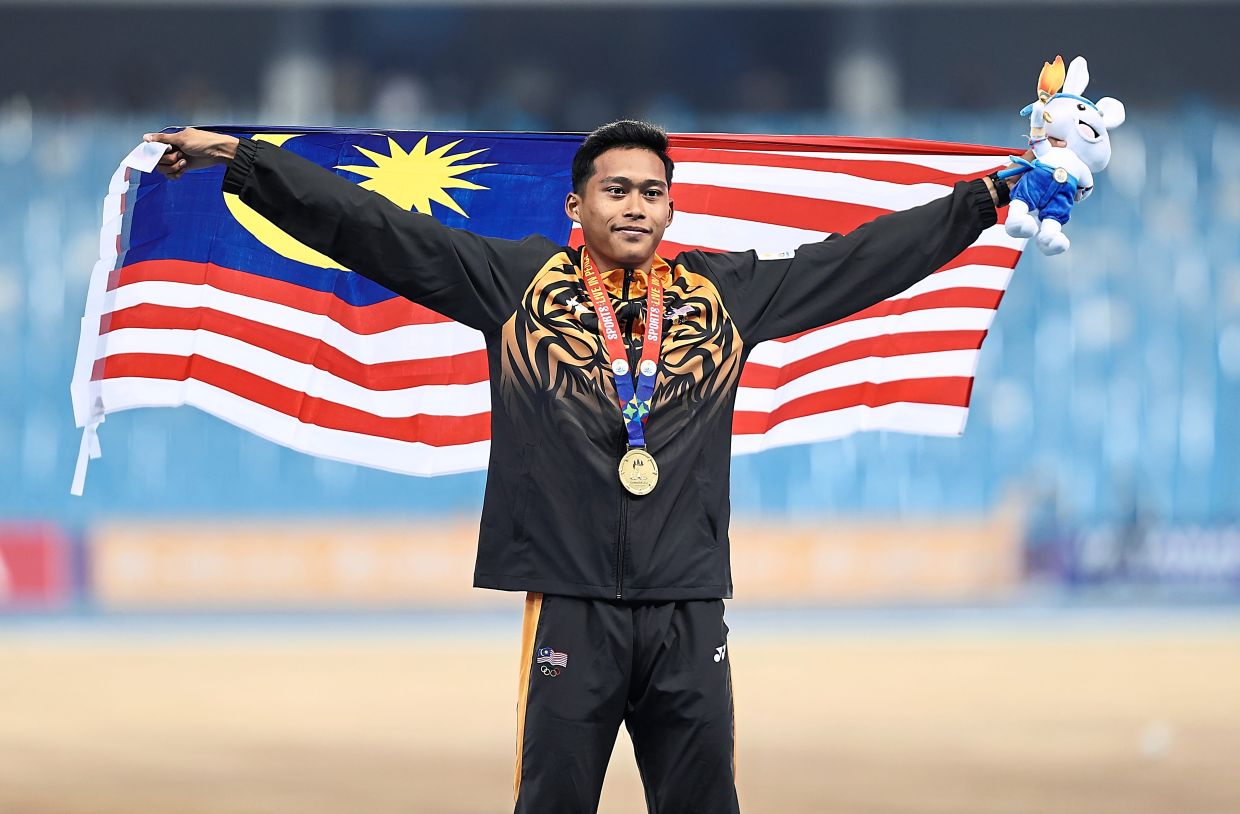
Umar Osman, the 400m gold medallist, is just 20 years old and it was his first SEA Games. — FAIHAN GHANI/The Star

TRUTH be told, we’ve never taken the Youth and Sports Ministry seriously and neither have we provided comprehensive training and care for our sports persons. And yet, we expect miracles from them.

The most junior Member of Parliament is slotted for the ministry post, and it’s viewed as an insignificant position.

Even the Deputy Education or Deputy Finance Minister role seems to be more prestigious than a full Youth and Sports Minister.

So, it comes as no surprise that the Youth and Sports Ministry gets less than an RM1bil budget, which is among the lowest. The National Unity Ministry is probably in that category, too.

Of this amount, only RM394mil was allocated for sports, unfortunately.

It’s like saying national unity isn’t important or, while sports galvanises the nation, which politicians fail to, this is still the best budget that can be offered.

How many of our 33 million people are youth aged 18-40 and surely this large youth population also matters to the ministry.

Rubbing salt into the wound, Malaysia has changed the Youth and Sports Minister much faster than we dispose of our prime ministers.

In recent years, ex-Umno MP Khairy Jamaluddin held the post for 61 months, a tad over five years.

His successor didn’t fare so well. Syed Saddiq, the MP for Muar and Muda president, managed 20 months while Reezal Merican, the former MP for Kepala Batas, kept his job for 18 months.

Former Tambun MP and Bersatu deputy president Ahmad Faizal Azumu, popularly known as Peja, served for only 16 months.

As Malaysians would know by now, every successive minister wants to leave their mark by introducing some new programmes, and it’s always the ministry officials who are left to implement new set-ups, targets and KPIs. Imagine the disruption at the ministry for the last decades.

Current Youth and Sports Minister Hannah Yeoh, who is just five months into the job, blamed political instability for Malaysia’s poor performance at the recent South-East Asian (SEA) games.

She got hammered for her excuse. She could have phrased it better, but she isn’t entirely off the mark because she is right.

The entire ecosystem is rotting. Ask any sportswriter in the media, and they’ll be able to share what has gone wrong with sports in this country. A cup of coffee won’t be enough to hear the whole story.

It will include tales of underfunded sports associations needing politicians to provide patronage and money, among other things. Unfortunately, these lawmakers hang on to their posts like the associations belong to them and their bootlickers.

Then, there are the talented young ones, for example, who start their training at the badminton academy at 5am every morning, then head back to class like any schoolkid, and after years of training, aren’t even given the opportunity to compete overseas.

With no exposure and the chance to play competitively, it can sometimes mean being sent home with nothing to show.

Yeoh seems to have taken a gamble by letting new talents compete at the SEA Games.

We finished poorly in the gold count, but let’s hope in the long run, this strategy works. It’s uncertain how this plan will fare, and ultimately, we’ll just have another new Sports Minister who will enjoy the fruits of someone else’s labour.

In the Malaysian contingent, 63% of the athletes – or 427 of the 674-strong team – were below 23 years old. Out of these 427 Under-23 athletes, 222 won 18 gold, 21 silver and 66 bronze medals.

Around 62% of the team, or 423 athletes, made their debut at the Games, with 211 having podium finishes and contributing 12 gold, 20 silver and 46 bronze medals.

Sometimes, many of us miss the ray of hope in the sea of criticism. Umar Osman, the 400m gold medallist, is just 20 years old and it was his first SEA Games, while platform diving gold winner Lee Yiat Qing is merely 15 years old.

Windsurfer Muhammad Hafizin Mansor is 17 years old and got his first SEA Games gold medal at his first Games. Ng Jing Xuen, 15, won her first gold in golf.

As a die-hard Arsenal fan, I can accept the team finishing behind Manchester City with the latter’s more experienced and well-drilled players.

In contrast, Arsenal has the highest number of young players and, with lower wages, no less.

They can’t be expected to be English Premier League and Champions League winners overnight. It takes a while to put a title-challenging team together.

The experiences and lessons learned this year and the purchase of new experienced players will be necessary for the 2023/2024 season.

Arsenal and many neutral fans are disappointed that the Gunners slipped and drew in three games at the tail end of the season, which was costly to their title ambitions. However, no one gave Arsenal a ghost of a chance when the season started.

Now, that comes to the same point. If Malaysia wants to win, we must spend. Unfortunately, our country has no money for that.

According to reports, the Singapore government allocated S$464.49mil (RM1.6bil) for its sports programme while Thailand provided 800 million baht (RM106mil) for sports in 2023. Indonesia contributed Rp1.57 trillion (RM481.1mil) for its Sports and Youth Ministry in 2021.

Now, let’s be realistic, too. Malaysians love football, whether it’s the local or foreign leagues, but we’ll never make it big. Our physique is not built for top tier football.

We can win regionally, but the fact that we must keep reminiscing about our past glories and still talk of Mokhtar Dahari, Santokh Singh and Soh Chin Aun, heroes of the 1970s and 1980s, goes to show we haven’t produced any real football legends since.

It’s better for us to invest our limited resources in sports we can excel at, like badminton, squash, bowling, shooting, golf, table tennis, cycling and sailing.

All is fair in love and war. Surely we need more naturalised citizens to help us win. Look at Singapore, and even Cambodia.

And we need to pay for talents. Malaysian badminton coaches are helping the Japanese and South Koreans, earning between RM50,000 and RM100,000 a month.

This is how modern sports works. From paying top dollar for the best trainers and psychologists to giving our team mental strength and even having nutritionists prepare the right food for our athletes, we need proper financial support and resources.

We can’t put together a team in two months or less, to train and then send them off to the Sea Games.

The New Straits Times reported “as expected, it was a one-sided affair from the first whistle” where Malaysia lost 3-0 to Vietnam in the AFF Cup late last year.

Let’s be realistic – if Malaysia expects to excel, that will encompass proper training, planning and finances.

Train kept a rollin’


Human capital is a crucial resource for the growth and development of any country, and Malaysia is no exception.

IT’S fair to say that many Malaysians don’t take training seriously, even if the bill has already been footed.

The levy paid by employers continues to be under-utilised and the Human Resources Development Corp (HRD Corp) has had to hound employers to use the money for training.

Millions of ringgit from the levy are being left idle by companies from the mandatory deductions.

In 2022, HRD Corp collected about RM1.81bil and disbursed around RM758.4mil, leaving a levy balance of RM1.05bil from the 81,706 employers. In 2023, it has projected to collect RM2.2bil and disburse RM1.7bil.

In desperation, HRD Corp has decided that levies left unutilised after two years will be forfeited.

Many bosses are reluctant to allow their staff to attend upskilling courses for fear that their operations and productivity will be affected.

They expect courses to end within a day, if possible, and if it’s a five-day training session, employees are left to face grumpy looks from their superiors.

Staff, on the other hand, sometimes think training is a drag, displaying indifference.

Some senior level workers, especially in managerial ranks, think they know everything or fear their inadequacies exposed if they’re in a physical class with their colleagues.

An out-of-base team building outing seems to be the only way to sign up workers, but if the sessions aren’t properly organised or structured, they will end up being a trip remembered for silly games, with little impact for self-improvement.

Everyone needs training. Learning is a life-long journey. Only an ignorant and egotistical person will insist there’s no need to pick up new skills.

For companies, it’s about future-proofing their organisation and for workers, it’s about re-tooling and upgrading themselves to increase their value.

Human capital is a crucial resource for the growth and development of any country, and Malaysia is no exception.

Today, Malaysia enjoys a literacy rate of 96.1% and ranks 25th out of 141 countries globally in terms of human capital development, becoming the second highest ranked South-East Asian country in the survey, just behind Singapore.

But that’s not enough. The Government, via the HRD Corp, is correct to set a target of inculcating the spirit of lifelong learning in all Malaysians, fostering a conducive and collaborative environment for training and development among talents and industry players.

And strengthening the upskilling, reskilling and multiskilling ecosystem for trainers and trainees is a further step forward.

To kick off these initiatives, the week-long National Training Week (NTW) 2023 will be officiated by Prime Minister Datuk Seri Anwar Ibrahim today.

It will encompass a week of nationwide training events and activities that bring together organisations and individuals from various backgrounds and industries and provide them with training and development opportunities.

Training programmes will be organised all over Malaysia and offered to all Malaysians on the house.

NTW will be championed by the Human Resources Ministry and HRD Corp. It will feature other government ministries and agencies, industry players, industry associations, individuals, academia, training providers and more.

The target is 125,000 trainees nationwide from May 22-28, involving 5,000 trainers, training providers and collaborators.

There will be 5,000 courses across hundreds of skill areas with a targeted 500,000 training hours.

It’s unprecedented as these courses are worth RM250mil in training value, but it will all be free this week.

Nearly 18,000 courses are offered online and offline as displayed on the NTW website, with over 50,000 participants from children, teenagers to senior citizens.

There are eight regional launches happening across Malaysia, including in Johor, Sarawak, Negri Sembilan, Sabah, Pahang, Penang and Melaka, followed by the finale event in Putrajaya today.

Kudos to the Human Resources Ministry and HRD for having this week-long programme, which brings students, higher learning institutions and industry players together to upgrade the skills and knowledge of our workforce, to enable them to meet industry demands and expectations.

As Mahatma Gandhi said, “Live as if you were to die tomorrow. Learn as if you were to live forever.”

What’s next after rainbow watches – Paddle Pop?

AN incident a couple of days ago escaped the attention of the national media, but Sabah’s Daily Express reported it with an appropriate headline – “Comedian has the last laugh on PAS.”

Popular Singapore stand-up comedian Kumar performed to a capacity crowd at the Financial Park Convention Hall in Labuan.

But it almost didn’t take off. The Labuan Corporation licensing committee was reportedly under pressure to have the show cancelled, purportedly on grounds of morality.

The allegations were that the comedian was a transgender, and the claims had gone around for five days before the concert.

The Daily Express reported that the protests came from PAS.

Here’s the sad part. As a compromise, the show proceeded on the condition that it was strictly for non-Muslim adults.

The newspaper reported that the organiser was compelled to announce refunds for Muslims who had bought the tickets earlier, including those from Brunei.

Kumar, whose real name is Kumaran Chinnadurai, had performed to a full house in Kota Kinabalu before heading to Labuan.

This is probably the first time in Malaysia’s history where Muslims were banned from attending a comic show involving a purported transgender, and the first time that a government authority succumbed to pressure from PAS, an opposition party.

Since when does the Labuan Corporation, a local authority under the Federal Territories Ministry, which now comes under the Prime Minister himself, take orders from PAS, or any other religious body?

Was it an arbitrary decision by a Labuan Corporation official? Are we heading towards a situation where each time PAS calls for a cancellation, it must be obeyed?

The same applies to the action by the Home Ministry to raid 11 Swatch watch outlets in shopping malls across the country on May 13 and 14.

Strangely, five malls in Alor Setar, Kuala Terengganu, and Kota Baru – all PAS controlled states – were reportedly let off with warnings. In Johor Baru and Kuching, they were just as lucky but not those in Kuala Lumpur and Sabah.

Enforcement officers reportedly seized the brand’s “Pride Collection” featuring watches with rainbow colours after social media users linked the collection to British band Coldplay’s support for the lesbian, gay, bisexual, and transgender (LGBT) community.

The raid on these watch outlets was a first too. It is unprecedented and puts us on a slippery slope to extremism. If news reports are to be believed, the authorities were acting on the comments on social media.

Many leaders like Canadian Prime Minister Justin Trudeau, Australian PM Anthony Albanese, Finland PM Antti Rinne and London Mayor Sadiq Khan, the Mayor of London, have all openly endorsed and taken part in PRIDE parades. Should we then ban these leaders from coming to KL, going by this warped logic.

The list includes the PMs of Luxemburg, Xavier Bettel and Serbia, Ana Brnabic. Then there is Pete Buttigieg, the US Secretary of Transportation, and Germany’s former health minister Jens Spahn.

Australian Foreign Minister Penny Wong, the Sabah-born politician, is openly gay. So, what are we going to do about that? Maybe she can never visit Labuan from now on?

This also comes in the wake of a comment by PAS MP for Pasir Salak, Jamaluddin Yahya, who called for LGBT community to be classified as mental health patients.

Malaysia was never a society that openly embraces LGBT practices. There won’t be any PRIDE parades and gatherings. There won’t be same sex marriages. Malaysia is still a conservative country, and this includes non-Muslims.

But most of us are not going to persecute anyone who chooses to live differently in private, including going to the extremes of declaring these people as having mental disorders.

Really, it is the MP who needs mental help. The raids on Swatch outlets is a classic case of over-reacting.

Will we soon have stand-up comics and singers, whose gender identities are questioned, being limited only to non-Muslim audiences?

That will be a sad day for my many good Muslim friends who operate and perform at stand-up comic outlets.

It happened last week, for the first time, because the Labuan Corporation was too timid to tell off those who applied pressure.

Something is terribly wrong when we prefer to worry about rainbow-coloured watches and a comedian when politicians ignore more important concerns like how to boost the economy, the cost of living and education standards.

I may have to rush out and but the rainbow-themed Paddle Pop ice cream before some officials decide to issue an order to stop the sales of such gelato. They may think it represents the LGBT, too.

Well, somewhere over the rainbow…

Clean up act


Free advice: His Majesty Sultan Johor said he was prepared to provide the federal government with “the best but cheapest” alternative. — Screencapture via Facebook/Sultan Ibrahim Sultan Iskandar

IT may seem like a negligible issue unworthy of the intervention of His Majesty Sultan Ibrahim Ibni Almarhum Sultan Iskandar.

But those who know the Johor Ruler can vouch that nothing escapes his attention, especially when a company pockets RM180mil to clean the state, and yet fails miserably.

Tuanku didn’t keep his cards close to his chest but revealed his fury to Malaysians through a video that has gone viral.

He expressed his annoyance at the pathetic level of upkeep of the state’s low-cost flats.

“Even the animals in the zoo are better off than (those in) these flats. It looks like the people are living in chicken pens (coops?),” he said.

The video captured His Majesty’s anger, where he conveyed his unhappiness with his officials, just before granting an audience to Local Government Development Minister Nga Kor Ming.

Tuanku is known for being blunt and he didn’t mince his words. He complained about there being more than 200 Members of Parliament but there were millions of rakyat living in low-cost flats and he’s adamant that these premises deserve to be better maintained.

Many of the flats are dilapidated and littered with rubbish. He added that “some of these places have also become breeding grounds for pests and insects.”

The affected areas include the flats in Stulang Laut, Skudai, Larkin, Tampoi, Kempas, Taman Johor and Taman Perling.

At his meeting with Nga, he told the minister that he understood there were allocations for Johor but reminded him Johoreans were taxpayers, too.

“Remember something, we are taxpayers here. We are paying RM180mil to SWM, but their cleaning and garbage collection services are not satisfactory,” Tuanku intimated.

SWM Environment Sdn Bhd is a Kuala Lumpur-based concession which handles integrated solid waste management and public cleaning in Johor, Melaka and Negeri Sembilan.

The organisation is owned by Taliworks Corporation Bhd, a public utilities company involved in water treatment, waste management, highway concession and construction.

The Sultan is upset that the agreement with SWM is so “watertight that you can only complain but it cannot be dismissed.

“There is no exit clause to say that you can dismiss SWM. Here, we have a responsibility to the rakyat,” he said.

He said most Johoreans are unaware that SWM is responsible for the clean-up services and blamed the local councils and the state government for the poor maintenance.

His Majesty said he was prepared to advise Nga “for free” and provide the government with “the best but cheapest” alternative.

He said he had gone on the ground to check for himself the poor services rendered and showed the photographs as proof to Nga.

His Majesty said whether he was in Malaysia or travelling abroad, he is always kept abreast of the situation in the state “as I have my eyes and ears everywhere.”

“But I will also check after the reports are made. But if my rakyat is staying in a kandang ayam, I can’t accept it.

“Now you are a minister in the Unity Government, but what they did before was no good,” he told Nga, who promised to study and “call them to take action.”

Tuanku issued another statement following the video release warning that no one should politicise his remarks on the deplorable state of maintenance at the flats.

“This is not something new. Previous governments knew about the terrible condition of the flats but did nothing,” he said.

Recently, His Majesty had complained about the pot-hole riddled highway in the state, revealing his car rims were dented because of it.

He had once quipped that “even a blind man sitting in car would know when he reaches Johor.”

But it isn’t merely Johor that suffers these maintenance issues. I guess many of our leaders including MPs and State Assemblymen have not travelled enough in their constituencies in Kuala Lumpur and Selangor.

It’s common to see rubbish strewn along the streets in Petaling Jaya, especially in SS2, and the back lanes are certainly a source of embarrassment.

But of course, community living requires cooperation and a sense of responsibility among the residents.

It’s not entirely the duty of the local government, but we also expect the local authorities to buck up because most of us have stayed in these areas long enough to see the declining standards of maintenance.

Whether it’s in Bandar Klang, Selayang, Kepong, Puchong or in PJ, many parts of the Klang Valley are in a pathetic state.

It’s not clear if the contractors are doing a bad job or if the respective councils lack sufficient funds, but the bottom line is it’s unacceptable to ratepayers.

Media organisations are receiving pictures depicting heaps of uncollected rubbish and potholes more frequently than ever.

Do any of our officials and elected representatives dare say otherwise and claim they have done a great job?

Frustrating is an understatement.

Seeing ancient treasures of Yogyakarta up close and personal


The writer standing among the stupas at Borobudur in Yogyakarta. — Photos: FLORENCE TEH

Despite the long-standing temptation, it took me ages to finally visit Yogyakarta, which is a crying shame because this Indonesian city is just a hop, skip and jump away from Kuala Lumpur.

Regarded as the centre of traditional art and cultural heritage, this is the home of the massive Borobudur Buddhist temple as well as the stunning Prambanan Hindu temple.

The more famous Borobudur is the most visited tourist site in Indonesia, drawing about 2.5 million visitors annually. That’s also the reason why the Indonesian government has considered restrictions as part of its conservation efforts to protect this sprawling complex.

The 9th century Buddhist sanctuary has been standing tall for thousands of years, but it’s struggling to cope with the daily thronging of tourists.

Damages inflicted include the destruction and decay to nearly half of the 2,000-odd stone steps from human overload.

Guards are now posted to stop over-excited visitors from ignoring no-climbing signs and curtailing their attempts to scramble on top of the stupas to pose for the ideal Instagram pictures.

Although designated as a Unesco World Cultural Heritage Site, it has suffered severe damage from the elements, volcanic ash fall and even attempts by terrorists to blow it up. Vandalism and unregulated visitors remain its main threat though.


Visitors to Borobudur are allowed to climb up the steps to where the stupas are, but the main stupa in the middle is off limits.

In 2010, Borobudur was covered in volcanic ash following the eruption of the nearby Mount Merapi, regarded as the most active volcano in Indonesia.

And before that, in 1985, nine bombs were detonated at the temple, badly damaging nine stupas (the dome shaped Buddhist shrine) on the upper rounded terraces.

Regarded as one of the world’s seven wonders, it has indeed lived up to its name as a special iconic place by continuing to survive and defy all odds.

Abandoned in the 14th century, presumably because of the decline of the Hindu kingdoms in Java in the face of the rise of Islam, the temple complex was eventually swallowed by the jungle.

But Borobudur was rediscovered by Sir Stamford Raffles after setting up his base in Singapore. He was earlier stationed in Penang. He was also commissioned by the British to look after Java as its governor.

Having read news reports about the authorities prohibiting visitors from entering and climbing up the complex, I decided it was time for me to visit this magnificent structure.

An Indonesian friend had visited the temple and was only allowed access to the grounds, so things weren’t looking too good for me.

There were earlier reports of a US$100 (RM450) additional charge for those harbouring hopes of making the climb.


Some of the stones at the temple are lighter-coloured because they are replacements of the originals that were either damaged or stolen throughout the centuries.

But lo and behold, when I visited Borobudur recently, I was allowed to make the ascent – and I only needed to fork out RM24 for an hour’s access! Divine intervention? I’d like to think so.

The entrance fee was 375,000 rupiah (RM113) for foreigners, which locals consider steep.

My guide shook his head and said he, too, was confused by the constant change of policies and decisions.

“These days, I dare not make any commitment when my guests ask if they are still allowed to enter the temple complex or about the price of entrance tickets,” he said.

But I wasn’t complaining. I had come to Yogyakarta to visit the temple with the resignation that my movements would be confined to the grounds and cursed myself for not having made the visit years ago.

Imagine my delight when I learned I had an hour’s access to the temple proper!


The majestic Prambaran temple complex.

In fact, it was very well organised with each group limited to a maximum of 15 people per session. There is no overlap, so each group has exclusive time, thus maintaining order and minimising impact on the place.

So, visitors can take better pictures without getting photobombed. Just be patient and you’ll likely get good pictures without anyone hovering in the back.

There’s no limit to the amount of time you can spend on the grounds but with the scorching sun, it will be a case of get-your-shots-and-go.

Unlike before, it’s also no longer possible to be at Borobudur at 3am to wait for the sunrise to capture those incredible photographs. Likewise sunset.

Now, the operating hours are from 6am – and the sunrise is early in Indonesia – to 5pm.

That was another stern reminder that I should have visited Borobudur 10 years ago, or even earlier!

Having finally visited it, I now understand why this is such a fascinating sight where construction took 75 years to complete. This majestic place has thousands of intricate carvings with a story behind each and every one of them.

There are 2,672 relief panels and 504 statues of Buddha, with the central dome surrounded by 72 statues.

Just imagine, the total structure comprises more than 1.6 million blocks of the volcanic rock andesite.

How these rocks were cut, placed, and joined is an engineering feat and mystery of the Sailendra Dynasty, which flourished in Java from about 750 to 850.

No trip to Yogyakarta is complete without a visit to the Prambanan ruins, located about 17km northeast of the city.

The temple compound is another Unesco World Heritage Site; the largest Hindu temple site in Indonesia and the second largest in South-East Asia after Angkor Wat.

The tall and pointed architecture of the Shiva temple, the main shrine, is an incredible sight to behold.

Surrounded by many other temples, I was also enchanted by the Sewu Buddhist temple ruins within the Prambanan archaeological park.


Prambaran is the largest Hindu temple site in Indonesia.

I can’t help but admire the Indonesians. They take great pride in these Hindu and Buddhist monuments.

They don’t attempt to downplay the incredible history and heritage of the Hindu kingdoms.

While almost the entire population living around these temple areas are Muslim, they have no issue selling replicas of stupas and Buddha heads.

I have travelled to over 60 countries and visited many incredible places including the Great Wall of China and the pyramids of Egypt.

Borobudur and Prambanan certainly have the wow factor, too. At least I no longer have to wonder about chalking off another wonder on my list.

A new beginning with Unity Week


NATIONAL Unity Minister Datuk Aaron Ago Dagang (pic) is not a person who gets excited easily. He has a calm and composed personality but as the country celebrates its first Unity Week, the Sarawakian politician cannot hide his enthusiasm.

“Yes, I am eagerly looking forward to the kick-off of the week-long celebrations which will be held at the Kuching waterfront,” he said.

The Kanowit MP had wanted Unity Week to start in the peninsula but his ministry staff members convinced him that there was no need to be apologetic as Sarawak was indeed a model state which embraced diversity and unity was indeed practised.

The 64-year-old low-profile Parti Rakyat Sarawak (PRS) leader is himself a living example of a true Malaysian.

“I am an Iban, but my wife is from the Orang Ulu ethnic group. There are Muslims, Chinese and even a Caucasian in our family.

“We celebrate all festivals together in the true Malaysian spirit. I am proud of it and in Sarawak, many places of worship of different religions are located next to each other.

“There is no issue. That’s the beauty of Sarawak and, I am sure, Sabah too,’’ he said in an interview at his ministry office in Putrajaya.

The occasion will start this Saturday with a walk-run-ride event to be flagged off by Aaron at the iconic Waterfront. An estimated 2,000 people will join the run while 500 will take part in the bike event.

The organisers hope to set a national record for having the largest number of people dressed up in their respective ethnic costumes in one place. It’s also at the promenade which lines the south bank of the Sarawak River.

On Sunday, Yang di-Pertuan Agong Al-Sultan Abdullah Ri’ayatuddin Al-Mustafa Billah Shah will officiate the largest gathering of Malaysians dressed in their respective ethnic costumes. The target is at least 1,000 people, including from the many ethnic groups in the state.

Yang di-Pertua Negeri Tun Abdul Taib Mahmud, Sarawak Premier Tan Sri Abang Johari Tun Openg and Prime Minister Datuk Seri Anwar Ibrahim will also be present.

Aaron makes no pretence that unity among the various races will be achieved overnight from the week’s celebrations.

“I look at this positively. When people come together, it’s a new beginning.

“When they show up to participate, it’s a success,’’ he said.

Aaron believes that friendship and relationships will be cultivated from these events, including smaller-scale ones such as exhibitions, pet contests, buskers’ performances and cultural shows.

“No one will be left out as all states, including Kelantan, Kedah, Terengganu and Perlis (which are held by the Opposition), will take part.

“There will be no politics, just Malaysians coming together as one people,’’ he said.

What I look forward to most is the inaugural Setia Perpaduan song, composed by the veteran singer Datuk DJ Dave, which will feature 13 singers.

Even the King had a hand in it as he made some proposals, especially the lyrics, when it was first presented to him.

Dave has put all this together for Sunday’s event.

Dave has been involved in walks organised by The Star to promote racial unity and moderation in the past, and certainly his 1973 hit song Maafkanlah incorporates Chinese beats, Malay lyrics and Indian melodies.

Malay language academician Prof Dr Lim Swee Ting provided the most important line in the inspiring song – “berbeza kita, tidak memisahkan (we have our differences, but that does not divide)” – while composer S. Atan did the musical arrangements.

At a time when some politicians still want to harp on race and religion, it is indeed uplifting and encouraging that efforts have been made to instil the spirit of national unity and to celebrate diversity.Malaysia is made up of many races, but we all know that we are one nation and one nationality, and that national unity is a pillar of madani. Let no one tell us differently.

Our Voice in China with Victor Gu