Author Archives: wcw

GE15: Battle for Putrajaya


Who the people want as their leader


Datuk Seri Ismail Sabri (right)

IT isn’t likely that Datuk Seri Dr Ahmad Zahid Hamidi will be the Prime Minister if Barisan Nasional wins the general election. He is a seasoned politician, and he knows the game well.

The Umno president knows where he stands. While he has the power to sign the candidacy papers for Barisan candidates, he also remains the weakest link.

I am sure he has access to all the findings from the various sources, including those from Barisan and Umno.

Since campaigning for the 15th General Election started, the Opposition has used the narrative that a vote for Barisan is equivalent to endorsing Ahmad Zahid, who still faces charges of corruption, as the next PM.

Within Umno, there will also be the disgruntled ones who have been dropped as candidates, and these are probably Ahmad Zahid’s worst enemies now.

But many may have forgotten that last month, almost all the 191 Umno divisions passed a motion to support Datuk Seri Ismail Sabri Yaakob as PM.

This motion was in addition to an earlier unanimous Umno supreme council decision to name Ismail Sabri as the Umno candidate for PM if Barisan wins the general election.

The party has also reiterated that Ismail Sabri will remain Barisan’s poster boy, and as Ahmad Zahid himself has said, Barisan’s stand will not change if the coalition succeeds in getting to administer Putrajaya.

Ahmad Zahid, a former deputy prime minister, has a tainted image even though he was recently freed of 40 corruption cases, but he still faces a string of others over the misappropriation of funds from charity outfit Yayasan Akalbudi.

In all surveys conducted separately by various groups, Ismail Sabri has come out stronger and higher than Ahmad Zahid, among respondents of all races and ages.

The Ilham Centre, which interviewed 1,622 people nationwide over two months, put Ismail Sabri on the number one spot for PM, followed by Tan Sri Muhyiddin Yassin, Datuk Seri Najib Razak and Datuk Seri Anwar Ibrahim. Ahmad Zahid was the last of 10 names.

Another survey by Persatuan Penyelidik Negara and 02 Malaysia found that of the 12 names mentioned for PM, Anwar was at the top, followed by Ismail Sabri and Khairy Jamaluddin.

Ahmad Zahid was not among the names mentioned by any of the 1,105 respondents.

A survey of Chinese respondents by the Huayan Policy Institute and the Centre for Malaysian Chinese Studies put Anwar as the most popular choice, with Ahmad Zahid at the bottom of the list of 14 names.

Merdeka Center’s findings for leader ratings as of Oct 28 showed that 43% of respondents of all races were satisfied with Ismail Sabri, 46% with Muhyiddin, Anwar Ibrahim (34%), and Ahmad Zahid at 12%, again, at the last spot.

Even Umno deputy president Datuk Seri Mohamad Hasan obtained 32% of the vote.

Among the crucial Malay votes, Ismail Sabri finished on top with 58%, followed by Muhyiddin with 57%, Mohamad with 49%, Anwar with 26% and Ahmad Zahid with 16% at the last spot.

A comparison of the surveys also showed that the respondents picked Barisan as their first choice, especially among the Malays.

Merdeka Center found that 32% will vote for Barisan, 20% for Perikatan and 13% for Pakatan, with 29% undecided as of Oct 28.

For Persatuan Penyelidik and O2, 26% wanted Barisan, 17% wanted Perikatan and 39% wanted Pakatan as of Oct 10.

Among the Malays in Peninsular Malaysia, 35.7% said they would vote for Barisan, 28.9% for Perikatan and 25.5% for Pakatan, as of Oct 10.

Barisan is the top choice of Malays aged 41 and above with 38.3%, against Pakatan’s 30.5% and Perikatan’s 24.9%.

For those in the 31-40 age bracket, Barisan garnered 35.2%, Pakatan (24.5%) and Perikatan (30.1%), while for young respondents aged 18-30, 31.4% wanted Barisan, 30% wanted Pakatan and 20.7% wanted Perikatan.

Over the coming weeks, the campaigning will get hotter with more information being sent to us via social media.

Most of us will not have sufficient knowledge to pick the real narrative from the fake ones.

Old videos and pictures have also been recycled to suit the agenda of the campaigners.

But while Ismail Sabri isn’t the most attractive PM product, the fact is that he remains at the top spot in the popularity ratings, and his opponents are also breathing down his neck.

The key to winning the GE is to capture the votes of the Malay heartland, and with the determinant Malay votes split into Barisan, Pakatan and Perikatan, the non-Malays will now be the decider, especially those from Sabah and Sarawak.

But at the end of the day, let’s remember we are all Malaysians, and we will be the ones who decide for Malaysia.

In Fighting Mood


Bee in their bonnets

With their unceremonious removal, angry warlords could be on the rampage.

NO doubt, they are the big names in Umno, with positions at national, state and division levels, too.

They are the warlords with immense power who influence many party grassroots members and the outcome of party elections. Many of them are also delegates who can even decide the fate of national party leaders.

Simply put, they exercise control over members and voters with their established network.

These personalities, with their arrogance and uncouth ways, may not be popular with many Malaysians, yet they are known to dispense patronage effectively in their constituencies.

They are hugely popular among their division members as well as their constituents. That may be news to many urban voters, but truth be told, they take great care of their constituencies, including non-Malay concerns.

These people include Tan Sri Shahidan Kassim (Arau), Datuk Seri Tajuddin Abdul Rahman (Pasir Salak), Tan Sri Annuar Musa (Ketereh) and Tan Sri Noh Omar (Tanjung Karang).

They control the machinery, which is essential during the general election and even simple by-elections. They make up a crucial cog of the Umno political wheel and other component parties in the Barisan Nasional also depend on them for the Malay votes.

However, they’ve now become monsters in Umno and have returned to haunt the party, which created these political beasts in the first place by allowing them to wield their clout with impunity.

Even worse, many of them have begun to treat these parliamentary constituencies as their personal fiefdoms.

Despite owing their positions and wealth to Umno, they have now threatened to contest under rival parties instead, after being dropped as candidates for the coming elections.

Umno president Datuk Seri Dr Ahmad Zahid Hamidi has found himself backed into a corner – he has discarded the big names and risks losing these seats to Bersatu or PAS. It’s a huge gamble, and the odds are stacked against Ahmad Zahid since Barisan can’t afford to lose any winnable seats by default. These disgruntled and sulking politicians have already openly declared war against Ahmad Zahid.

For the first time, the imperative Malay votes are split between three coalitions, namely Barisan, Pakatan Harapan and Perikatan Nasional, which may lead to a fragmented and inconclusive GE result.

Chinese and Indians voters are almost certain to pin their hopes on Pakatan, despite a decline of 10% according to surveys, when compared to GE14 in 2018.

In 2018, a shift of about 30% Malay votes was enough to end Barisan’s 60-year reign.

The reality is that rural votes are worth more than urban ones, as the gerrymandering impact is clear.

The DAP, particularly, will only get about 40-odd seats even if 95% of Chinese voters back Pakatan. That’s the cold, hard truth. The decision of the predominantly Malay voters will make the difference, as always.

This time, there are even more variables, although early surveys indicate Barisan is ahead with a 37% lead among all races, according to 02 Research Malaysia. It said Pakatan has 32% and Perikatan 19%, while 12% remain uncertain.

As seasoned political analysts would know, surveys are never always accurate. In 2018, the common finding was that Barisan would win at least 120 seats, but that’s not how things panned out. Some said even the police and army intelligence got their predictions wrong.

But this isn’t endemic to Malaysia. Even CNN, with its impressive charts and well-articulated analysis, never fathomed Donald Trump would be elected US president in 2016.

So, with these Umno bigwigs shown the door, they are not going to go quietly.

Don’t expect them to toe the line although they have pledged their undying loyalty to the party, race and religion repeatedly in the past. The new candidates proposed for these affected constituencies will find it hard to operate, let alone win.

Let’s look at their ages – Shahidan is 71, Annuar Musa 66, Tajuddin 74 and Noh Omar 64 – but they are unlikely to believe they are past their use-by date and should allow younger leaders to move up instead.

Succession planning is an alien concept in politics. Should they step aside, they will probably only do so to accommodate their children, like a family dynasty.

Unfortunately, the playing field isn’t level because despite being 85, Tengku Razaleigh Hamzah can continue to defend his Gua Musang seat. He has been an MP since 1969 – half the people or more in Malaysia weren’t even born yet.

Then, there is Tengku Adnan Tengku Mansor, who is 72, but has been allowed to contest the Putrajaya seat again.

The mess, however, isn’t just confined to Umno but has also spread to other parties including DAP, PKR, Amanah, Bersatu, PAS and Barisan component parties as well.

Some incumbents have served for three terms, but it’s still never enough for these politicians.

DAP leader Fong Kui Lun, 76, has been MP for Bukit Bintang for 23 years while Cheras MP Tan Kok Wai, 65, has retained his seat for 27 years.

Both are DAP strongholds, and any young leaders could have taken over and won handsomely, yet these same people have been named candidates.

Somehow though, incumbent Klang MP Charles Santiago, despite his popularity, was unceremoniously dropped because “he has served three terms.”

Emotional outbursts by dropped incumbents have been common at every general election ahead of nomination day. In the words of Thomas Sowell, an American author, philosopher and economist – politics is the art of making your selfish desires seem like the national interest.

In the case of Malaysia, we all know by now, that these politicians – including those facing corruption charges – will claim they are fighting for race and religion, too.

The only problem is there are enough voters who will believe them because the politicians they love so much remain infallible angels.

Big plans to boost Johor’s economy

(Watch the interview here)

DATUK Onn Hafiz Ghazi has made history as one of Johor’s youngest Mentris Besar in recent years.

Since taking office after Barisan Nasional’s big win in the state polls almost seven months ago, the 44-year-old shares his thoughts about running the state, growing its economy and the need for stronger collaboration and alignment between the state and the Federal Government after the upcoming 15th General Election (GE15).

Q: Since being appointed Mentri Besar in March this year, what are the milestones you have achieved and issues that are of concern to you?

A: In Johor, we have set a big vision to make the state achieve developed status by 2030. It is a bold initiative but it requires breaking down silos as agencies, both federal and state, must work as a team. We cannot be passing the buck by saying that a problem at the Johor Baru Customs, Immigration and Quarantine (CIQ) complex involves the Immigration Department. The state agencies need to chip in to help, including the mayor’s office, so that we can resolve problems as a team.

Making Johor a developed state is not only about infrastructure as we are not just being compared with Kuala Lumpur, Melaka or Negri Sembilan, but also with our neighbour Singapore just 700m across the Causeway. That is the reality on the ground. As such, we need to work as a team to get things done.

We also need to improve our roads, utilities and Internet connectivity. This is a huge challenge, but we are slowly getting there. We are happy that in the national budget, the Federal Government allocated funds to widen the North-South Expressway, upgrade the Senai-Desaru Expressway and fund the Bus Rapid Transit.

All these are positive projects for the state. Unfortunately, soon after the announcement, Parliament was dissolved for GE15.

For me personally, it is paramount to have collaboration between the Federal and state governments. We need our stars to be aligned.


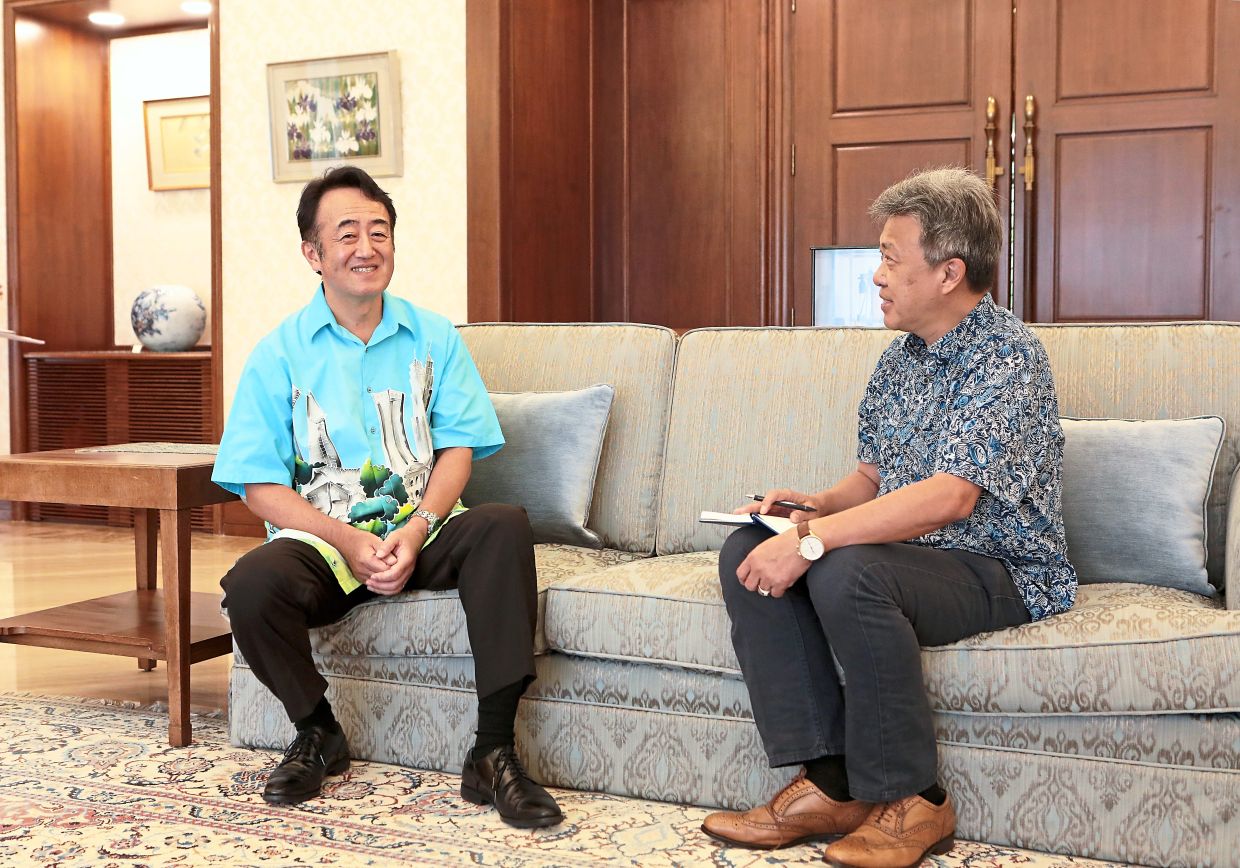
Onward and upward: Onn Hafiz explaining his plans for Johor’s economy to Star Media Group adviser Datuk Seri Wong Chun Wai at his office in Kota Iskandar, Johor. Looking on is The Star’s Johor Bureau chief Nelson Benjamin. — THOMAS YONG/The Star

Q: How about investments coming into the state?

A: We are happy to note that the International Trade and Industry Ministry (Miti) has announced that Johor topped the list by receiving the highest amount of foreign direct investment (FDI) amounting to RM60.9bil this year. The country as a whole received about RM120bil, half of which came from Johor.

I personally feel that people and investors realise the importance of stability in the country. After Barisan won 40 of the 56 state seats during the March elections, I sense that people want all this politicking to stop and focus on making money and profits.

Without this political stability in Johor four years ago – since GE14 – Johor’s FDI ranking dropped six or seven spots. But now, after the state elections, everything is picking up and we are on an upward trend.

Investors see Johor as an important economic zone or hub to expand, especially with what is happening in the United States, Ukraine and China. In terms of investment coming into the country, we are happy with the figures.

Q: When you meet potential investors, what are your key selling points to lure them to Johor as they have a choice of investing in other places, namely the Klang Valley or Penang?

A: Johor has a lot of advantages. First, we promote our strategic location in the southern part of the peninsula next to Singapore. We also have four major ports, a well-trained local workforce and an abundance of land. As for education and healthcare, we have many international schools and private hospitals.

Q: Is there a specific sector you are looking to develop, such as food security or the digital sector?

A: We are looking at investments that can increase the people’s income. We are looking at petrochemicals as one such area and working with oil and gas companies.

We are also looking at information technology companies. The bulk of the FDI comes from this sector. We are presently working with the federal agencies and Singapore to look into food security.

All this is in the pipeline and we see a lot of interest from Singapore. We do not see them as a rival but as a strategic partner in a win-win situation.

Q: Presently, most sectors are experiencing a shortage of manpower. Johor also faces a unique situation as most Johoreans will want to work in Singapore due to the good currency exchange. Do your potential investors ask if you have enough manpower, such as engineers, to meet their needs?

A: Yes, they do ask that. That is why when we took office, our state executive councillor for investment, Lee Ting Han, and myself decided to engage with all the stakeholders, businesses and factory owners, to find out about their needs.

They expressed concern about the brain drain, especially in terms of technical skills. So, we formed a committee to look into and resolve these issues. We are working with agencies such as polytechnics and universities to do job matching.

For example, if a factory needs 500 technicians, we will work with Universiti Teknologi Malaysia and Universiti Tun Hussein Malaysia to address their needs.

Q: Johor is located strategically next to Singapore and Indonesia. It has potential, especially in property. However, the Federal Government’s policy of setting a cap on properties that foreigners can own or also policy changes involving the Malaysia My Second Home (MM2H) programme has put many foreigners in a fix and resulted in a glut of homes in Johor. How is Johor resolving this problem?

A: Things have started picking up in Johor, especially after the reopening of the border in April. People are buying houses, but these issues have not been resolved. We will definitely need help from the Federal Government.

Policies need to be friendlier towards Johor. That is why the Federal and state governments need to collaborate. We need alignment, stability and a government that will look into the best interests of Johoreans.

That is what the people want. They see the importance of that, or else we will suffer for the next four to five years, and not just in terms of housing.

When the High Speed Rail project was cancelled, it affected the state’s economy. The new government also changed the MM2H policies.

In 2018, there was a pledge to upgrade the North-South Expressway, but that also came to a stop after the change of government. Now there are traffic jams daily on the expressway between Sedenak and Johor Baru.

These things should have been resolved in 2018. But when a change of government happens, policies are also changed. We cannot afford that anymore, so I appeal to Johoreans not to make the same mistake twice. We have already suffered and lost four years. We cannot lose another four years after GE15.

Q: How is your team of state executive councillors performing, and do you anticipate any reshuffle after the elections?

A: I am young and 70% of the exco members are younger than me. I expect them to work just as hard as me or even harder than me. If I am up by 5am, I expect them to be up early too.

So far, I am happy as they are committed and, in terms of getting things done, they have delivered. Lee has done a fantastic job in bringing in investments while our health exco Ling Tian Soon has been managing the hospitals well.

Our youth and sports exco Mohd Hairi Mad Shah has also done well along with our tourism exco K. Ravin Kumar, as tourism has been booming since the borders reopened. The hotels in Desaru are happy as they are recording an average occupancy of 70%.

Q: How is your working relationship with Johor’s civil service?

A: It was a shock for a lot of people initially, especially when I started carrying out spot checks. Now a lot of directors are doing their own spot checks.

One such person is the director of public transportation, who has been going on buses to see their conditions for himself as a consumer. Many city council presidents are also doing these checks. For me, this is leadership by example.

The intention was never to penalise anyone, but to make things better for the people. One example was during my visit to the Johor Baru CIQ complex, where 1,200 job orders were pending. That issue has since been resolved and there are now less than 100 job orders pending.However, certain things require Federal assistance. That is why political alignment between the state and Federal levels is crucial.

Q: You said that you wake up as early as 5am. What is your work schedule like? How do you separate state government duties from political work?

A: I start with my prayers. Then, I will look at what is pending for the day. Basically, I enjoy going to the ground and meeting people to find out about their problems and find ways to help them.

As for my political work, it usually happens after office hours. I reserve half days on Friday mornings to be with my family. My hobbies include running about 5km three times a week, cycling and playing badminton.

The great DPM poser


The more the fairer?: The suggestion is for a DPM each from Sabah, Sarawak and the Peninsula.

‘Good intentions’ aside, three is a crowd in an already bloated administration.

WHY do we need two or three Deputy Prime Ministers? Aren’t we drowning with Ministers, Deputies and Special Envoys who barely make a ripple in the already bloated Cabinet?

Both the Barisan Nasional and Pakatan Harapan are unabashedly attempting to out-do each other in securing their share of DPMs.

The suggestion is for a DPM each from Sabah, Sarawak and from Peninsula.

The two competing coalitions are aware that no side will have the edge to form the next federal government without the support of parties from our two largest states.

At stake are 31 parliamentary seats in Sarawak, where the Gabungan Parti Sarawak (GPS) is expected to unleash a tsunami, with at least 26 seats in the coming federal elections.

The GPS comprises Parti Pesaka Bumiputera Bersatu (PBB), Progressive Democratic Party (PDP), Sarawak United People’s Party (SUPP) and Parti Rakyat Sarawak (PRS).

The DAP has six seats, but it’s Stampin, Lanang and Sibu that will be in the crosshairs, where SUPP has a chance of snatching it back from the DAP. However, much hinges on the candidates it fields.

But PH has sounded a warning against the early optimism of GPS, pointing out that there are 600,000 new voters, whose allegiances are unknown. How wonderful for them to experience voting for the first time and be able to choose the best future for the country.

In Sabah, 25 Parliamentary seats are up for grabs, but don’t expect a scrap like in the Peninsula because the state is governed by Gabungan Rakyat Sabah-Barisan Nasional.

Barisan comprises Umno, MCA, MIC and Parti Bersatu Rakyat Sabah (PBRS), while GRS is made up of Bersatu, Parti Solidariti Tanah Airku (STAR), Sabah Progressive Party (SAPP) and Parti Bersatu Sabah (PBS).

In Sabah, where politics is always complicated, 25 seats are at stake, but the perception now is that the state would be shared by Barisan, GRS/Bersatu and Warisan, with its six seats and DAP with its few.

Again, there are many variables, and the scenario will only be clearer closer to polling day. There are half a million new voters there.

It’s realistic to believe the promise of a DPM from the two states will be bandied to gain votes during the campaign.

These Peninsula politicians may have overshot in their promises, but it doesn’t look like they’ve tuned in to the sentiments of the rest of Malaysia, either.

Even Sabah and Sarawak have given lukewarm responses to the promises by these two coalitions, so far.

So, on one hand, we hear Datuk Seri Anwar Ibrahim pledging to whittle the allowances of the PM and shrink the Cabinet, and in the same breath, says he will have more DPMs.

Writing in Sinar Harian, its editor-in-chief Rozaid Rahman said, “the irony is Anwar made the promises after giving the assurance to reduce the size of the Cabinet and would perform salary and allowance cuts for the prime minister if they successfully formed a government.

“The question we have is how would these savings be achieved if he intended to create the DPM positions?

“Together with the positions would be additional salaries, allowances, special privileges such as a residence, additional police escorts, personal guards, and exclusive usage of aircraft during visits and official work domestically or internationally.

“This is before considering the added support staff they require as well as being given the title becoming the ‘Yang Amat Berhormat’ (YAB) Deputy Prime Minister.

“In our country, there are only four positions that hold the title YAB – the first is the Prime Minister, followed by Menteri Besar, Chief Minister and lastly, the Deputy Prime Minister. Along with the YAB title, there are benefits that come with it, as stated above.

“So, where would this Cabinet focus on cutting down and saving if they intend to add positions not written down in the Constitution and want to declare that DPM has not received any privileges they enjoyed – for the people, for the country.”

Believe it or no not, there was a time when police outriders were purely for the PM and DPM, besides the Sultans and Yang di-Pertua Negeri, of course.

But now, certain ministers and even officials have earned these privileges.

In fact, the Federal Constitution is bereft of provision for the position of a DPM, but first PM Tunku Abdul Rahman picked Tun Abdul Razak to assist him, and the tradition has remained.

But as Rozaid pointed out, when Tan Sri Muhyiddin Yassin was PM, he only elected a DPM – Datuk Seri Ismail Sabri Yaakob – a month before he resigned, but before that, he had only elected senior ministers.

Ismail Sabri replaced Muhyiddin’s position in August 2021, thus, the DPM seat was vacant, and he maintained the senior ministers until Parliament’s dissolution on Oct 10. Hence, Muhyiddin was the last prime minister to appoint a DPM.

Having three DPMs would merely be symbolic. Authority would be diluted, and, in the end, it would have been pointless.

If the GPS delivers 26 seats or more and is the key to forming a federal government to ensure stability, then Sarawak deserves to get the DPM post. In fact, it should demand that post as a condition.

Sarawak should also demand equal partner status and rights under the Malaysia Agreement of 1963 (MA63) – in the formation of Malaysia – be fulfilled.

A lot of Malaysians would prefer to see a DPM from Sarawak for a change. Perhaps more Sabahans and Sarawakians in a lean Cabinet?

Young & Hopeful


Bumpy ride ahead


Long process: Election Commission staff preparing election materials to be delivered to various parliamentary constituencies in Sarawak for the 15th General Election. — ZULAZHAR SHEBLEE/The Star

IT’S going to be a protracted process. In fact, the 14-day campaign period is among the longest in the nation’s electoral history.

Predictably, many Malaysians were hoping for an 11-day runup, and the most popular date for polling was Nov 12. The date would also avoid coinciding with the wet season predicted to arrive by the middle of November.

So one wonders about the factors deliberated on by the Election Commission (EC) before deciding on Nov 19 as the polling day.

The longer the campaign stretches, the more it costs the candidates, workers, the EC officials and the media, too. The 15th General Election (GE15) will set taxpayers back RM1bil, and that doesn’t even include spending by the respective political parties and other stakeholders.

With most states opting to dissolve their state assemblies only when their terms end in July 2023, more expense will be incurred for another round of polling then.

The endless politicking in our country has become the bane of most Malaysians’ existence, so the last thing we want is another round of elections within a calendar year.

The same narratives will likely be rolled out, along with the same personalities leading the campaigns. So how many new sales pitches will we hear at state levels?

The Penang DAP got it right when it said that the sentiments of Penangites was to have the state polls concurrently, but unfortunately, the national level Pakatan Harapan leadership shot it down.

DAP national legal bureau chief Ramkarpal Singh correctly said Pakatan shouldn’t burden the people by holding separate parliamentary and state elections. His first-hand knowledge of word on the street is that the people aren’t keen on separate elections.

Describing GE15 as a forced election, he said there is nothing unprincipled in holding concurrent elections.

Unfortunately, national Pakatan leaders view it differently from Penang leaders.

There’s the impression that these state governments under Pakatan and PAS merely want to cling on to being in government.

In fact, the Opposition had previously pushed for an early election with the argument that the present Federal Government had no mandate from the people, given that it was a “backdoor government” born from the Sheraton Move.

But it has been reluctant to take on Barisan Nasional, and the Opposition – be it Pakatan or PAS – has used the monsoon to justify not having the general election this year.

Logically, with the conviction of Datuk Seri Najib Razak for corruption still fresh in the minds of the people, it would be easier for the Opposition to take advantage of the situation.

It should be claiming credit for the anti-corruption rhetoric against Najib and other Umno leaders.

The Opposition is convinced that the issue will continue to be effective.

If Najib and the 1MDB financial scandal were successfully “used” during GE14 campaigning in 2018, they will definitely factor in now as well, since he remains a major talking point. This time, the Opposition’s argument would be that if Barisan wins, Najib could be freed.

The former PM may be in prison, but he remains a dominant figure.

It’s still premature to predict GE15’s victor, but that hasn’t stopped chat groups, teh tarik sessions and family discussions from going into overdrive now that the dates for nomination and polling have been announced.

The campaign hasn’t started and until we know the line-up of the candidates, it will be hard to make an educated assessment.

The consensus this time is that it could be another round of inconclusive and fragmented results, with the various parties not securing enough numbers to form a government.

Then there are also those who have confidently predicted that Barisan will have an edge by highlighting the failures of the 22-month Pakatan government tenure, and that’s one reason for GE15 being called.

But hardcore DAP and PKR supporters claim there will be a repeat of GE14, where a 30% to 35% of Malay votes was enough to overthrow the Barisan government of 60 years. However, the parties and candidates will only really be tested in the coming weeks.

GE15 will be really rough. Those without the stomach and wits to bear the harrowing two weeks will falter.

No one should take anything – especially the voters – for granted.

Forget the old and jaded spiels, and don’t make assumptions either, especially when there will be 5.8 million new voters in this general election.

Vote for Malaysia


Rakyat vs Rasuah