



Unnecessary fuss: This Malaysian-made whiskey gained attention after winning an international award only to become embroiled in a supposed ‘controversy’ over its name. — Handout
MOST of us are guilty of making assumptions in some way. Even a name can cause controversy, which must have baffled many foreigners reading the recent news in Malaysia.
In the past fortnight, we’ve been in the news for all the wrong reasons. Again.
Celebrity entrepreneur Nur Sajat, who now resides in Australia, made it into the influential New York Times.
Despite being hunted by our authorities, she has found her way to Sydney. Her story has given the impression that we’ve treated her harshly, and for further national humiliation, it’s claimed that she was groped by religious officers.
They remain allegations, but it hasn’t helped Malaysia’s PR one bit, let’s be honest.
It cuts both ways with perceptions. It’s harmless, but it can also wreak unnecessary havoc.
When Sarawakian Tan Sri Idris Jala was announced as the chief executive officer of Malaysia Airlines, I’m quite certain many Malaysians in the peninsula – both Muslim and non-Muslim – assumed he is a Muslim.
The trouble with many of us in the peninsula is that we are rather ignorant, what with our baggage of racial and religious prejudices, a weakness often amplified by opportunistic politicians.
But they’ve succeeded in exploiting this narrative because there are enough voters who believe in them. Don’t only blame the politicians, though.
It’s common for Sabahans and Sarawakians to have Muslim names but be devout Christians. Idris is a Kelabit from Bario, which is known for its evangelical Christian activities.
Then there’s Datuk Seri Nancy Shukri, the Tourism, Arts and Culture Minister, also from Sarawak. It would be hard to find a Muslim in the peninsula named Nancy. Johan or Liza, maybe, but Nancy isn’t widely used. Neither is Selina, for example.
It took a long time for me to realise that Idris isn’t an exclusive Malay or Muslim name.
My good friend, Sarawakian Zahir Kelvin Ong Abdullah, gave me a lecture last month, just ahead of Malaysia Day.
He told me that Idris is a Welsh surname, too. How foolish I’ve been all this time. While Idris is spelled identically in Welsh and Arabic, they mean different things.
Idris is the Muslim prophet mentioned in the Quran, a name associated with being righteous, studious, smart and learned in Arabic. In the Bible, he is called Enoch. In Welsh, Idris means “ardent lord”.
This ignorant writer had assumed all this while that the famous British actor Idris Elba is Muslim.
Following the recent controversy, I finally did some research. Idris isn’t even religious. He has declared himself to be someone of no faith.
Then there is Omar. Following the contention over the name Timah for a Malaysian-made whiskey, some people have also been irked by a whiskey named Omar available for sale here.
These critics claim Muslims would be confused by the Malay name and buy it.
Well, I know for sure that my many Muslim friends and family members would know they were in a liquor section if they strolled into one.
But here’s what my simple research has unearthed: Omar, Umar, Omer or Umer is widely used by Muslims, Jewish and Christians, especially in Spain. Admittedly, it’s a name used more by Muslims.
But the word “omar” also means “amber” in Gaelic, and the whiskey in question is owned by a Taiwanese distillery in the county of Nantou.
In Ireland, “omar” simply means “merry”, which is derived from the Gaelic word “meadhra”.
So imagine how stupid Malaysia would look if we listened to those pushing for a ban on this whiskey with an Irish name. Why can’t basic research be done before chucking a fit?
It’s good to know that some common sense has prevailed over the use of the name Timah for the award-winning Malaysian whiskey. Credit must go to PAS deputy president Datuk Seri Tuan Ibrahim Tuan Man for putting an end to the issue.
He said that Timah was neither a Muslim name nor a person’s name but a type of metal, adding that there is no man named Timah.
He also said that while liquor is prohibited in Islam, the rights of non-Muslims must be considered.
Timah’s manufacturers have explained that the name is derived from the Malay word for tin and the man pictured on its bottle is Captain Tristram Speedy, an English officer in Malaya during the British colonial period.
And correction, even “timah” is a Sanskrit word. The other word “bijih” comes from the Sanskrit root word “biji,” which, like many Malay words, originates from the ancient Indian language.
There’s even a brand of red wine named Hadi that’s bottled in Australia. You must have seen it on social media.
It’s incredulous how some politicians tried to justify corruption with points involving religion but, ironically, got riled up over a name for a whiskey.
Malay words such as “raja” (king), “putera” (prince or son), “puteri” (princess or daughter), “asmara” (love), “anggota” (limb or member), “angkasa” (space), “angsa” (goose) and “janda” (widow), for example, are rooted in Sanskrit.
It looks like all the hours spent reading Sejarah Melayu (The Malay Annals) has helped me a little in understanding and appreciating the beauty of Bahasa Malaysia, which has also adopted many English words and even Chinese ones.
Let’s not raise a fuss for the sake of it. Kacip Fatimah, a popular herb used to improve women’s health, including enhancing sexual function, has long been in use yet no one has objected to it.
What’s the root cause of these issues, really? It’s understandable if some people genuinely feel that Islam and Muslims are being threatened, but it’s a concern if it’s used as a tool by Malay-Muslim actors to outdo each other or create an illusion of a crisis to sell the cause of Muslim unity, as political scientist Dr Wong Chin Huat concluded.
As he said, it doesn’t help when such issues are countered with ridicule, which seems to be the hallmark of comments posted in social media, instead of intellectual arguments. Many of us are, regrettably, poor in civil discourse.
As Wong rightly suggested, issues need to be explained to debunk propaganda, and responses must be measured and calculated to avoid fuelling the sense of entitlement or insecurity.
He even went as far as to suggest that it’s Amanah/Pakatan Harapan operators who are attempting to weaken PAS by accusing the Islamist party of compromising its previous stands on many issues.
The bottom line is this: So long as politicians continue to play up race and religion, Malaysia will remain a dream unrealised after 64 years of independence.
We are also sending the wrong message to the world, especially since Malaysia needs more foreign direct investments. Please spare a thought for our country’s economy.
Malaysia is a modern, moderate and plural country. We are not a Taliban state.
The world will just move on and focus on improving while we continue to bicker over unproductive and inconsequential issues.
Unfortunately, all this has done is left us with a bitter taste.

Positive message: A complex drama like Squid Game is about more than just killing. Through its flawed main character, Seong Gi-hun (pictured), it shows what happens when greed overcomes human values – not exactly an incitement to suicide is it? — Screenshot
PAS politicians never cease to amaze many Malaysians. From attempting to justify the act of corruption to blaming God’s wrath for flooding, they seem to have the most incredulous responses to issues.
Last week, PAS senator Mohd Apandi Mohamad blamed Korean dramas for teenage suicides in Malaysia.
After bingeing the nine-episode Korean drama and global blockbuster Squid Game, this writer only lost a night’s sleep, and didn’t end up a “blur sotong” (a Singlish phrase meaning someone who is clumsy or confused). I haven’t heard of anyone, teenage or warga emas, who was driven to suicide because, well, they are desperately awaiting season two.
If we go by Mohd Apandi’s logic, and had he watched the series, he probably only saw all the killings. He wouldn’t have seen its message – that greed should never overcome human values.
Life isn’t necessarily entirely black and white. So the main character, Seong Gi-hun (played by Lee Jung-jae), may have plenty of flaws, being a gambler, a failed father and an alcoholic, but he is also generous and helpful.
His main rival, childhood friend turned failed investment banker Cho Sang-woo (Park Hae-soo), even reminds Seong that his biggest failing is that he “cares too much about others”. By Cho’s deduction, this is a weakness – presumably worse than an addiction to alcohol and gambling – because in a world of conformity, success is measured by how much a person is valued or what institute of education they attended.
So I would not be surprised if politicians from PAS, who play to their audience, have a script to appeal to their voter base. They couldn’t care less what urbanites think about them. Why should they when they don’t contest in urban constituencies, where the people find them an odd bunch?
Apandi, who was apparently surprised by the brickbats he received from social media users, quickly clarified in the Dewan Negara that there were other factors that lead to suicide, and that he was not singling out Korean shows. Still wanting to stand his ground, though, he reportedly said “I am not saying Korean dramas or dramas trigger suicides, but they play a part.”
Oh, seriously – “a, jin-jja!” Still stubborn? After the fiasco, he tried to squirm his way out. Luckily, he didn’t blame the media for taking his words “out of context”, a line often used by inane politicians.
Earlier, Apandi had reportedly told the Dewan Negara that almost every South Korean film or drama incorporates elements of suicide, and Malaysian teens were aping that culture. He said many of the teens who took their own lives were “too influenced by films and dramas from Korea”.
According to the study “Youth Suicide in Malaysia” by Chua Sook Ning and Vaisnavi Mogan, during the period of March 18, 2020, when the first movement control order came into effect, to Oct 30, 2020, there was a total of 266 people who died by suicide, equivalent to around 30 suicides a month – almost one a day.
About one in four of these preventable deaths were adolescents aged between 15 and 18 years. The reasons in the suicide cases included debt issues, family and marriage problems, relationship breakdowns, and work pressures.
The study also found that younger individuals were at the highest risk of suicidal behaviour, with individuals between 16 and 24 years old being 4.8 times more likely to attempt suicide compared with people 65 years and above.
In 2017, suicide attempts were highest among Indians (17.9%), followed by Chinese (10.7%) and Malays (4.6%), with over 10% of suicides among bumiputras in Sabah and Sarawak.
Social factors attributed include unemployment, stress, social crimes, poor physical health, and social media, with Internet addiction especially increasing the risk of suicide attempts.
Still, let’s give credit to Apandi for bringing this up. It is an important issue. In the spirit of Squid Game, let’s not eliminate him but let him continue to play the game and move on to the next round. Every-one must be given a chance.
Perhaps he was merely trying to draw attention to his otherwise mundane speech, or he didn’t inform himself enough.
Depression is a cry for help, even if the person experiencing it doesn’t know it. So being receptive and offering a listening ear are the simplest things we can do to help someone ailing from it. Offering a support network comprising family and friends is crucial.
Mental health is a dire problem in Malaysia. The Covid-19 pandemic has generated a hike in suicide cases, no doubt about it.
Just look at the figures. The police recorded 468 suicides in the first five months of 2021 compared with a total of 631 in 2020 and 609 in 2019. On average, at least two suicide deaths occurred daily from 2019 to May 2020. In that time, at least 281 men and 1,427 women committed suicide, with 872 aged between 15 and 18, the police said.
Instead of blaming Korean dramas, we hope that PAS can draw up ideas and proposals on how we can thwart this malaise by identifying family members and people around us who could be suicidal.
The last thing we need is for PAS politicians to moralise and lecture Malaysians, and tell young people to stop watching Korean dramas after a day’s hard work.
Some entertainment won’t hurt lah, even if only to release pent up tension.
An interesting character in Squid Game is Player 244, played by Kim Yun-tae, who always seems to be on the right side of the Lord but who turns out to be brutal as the game progresses.

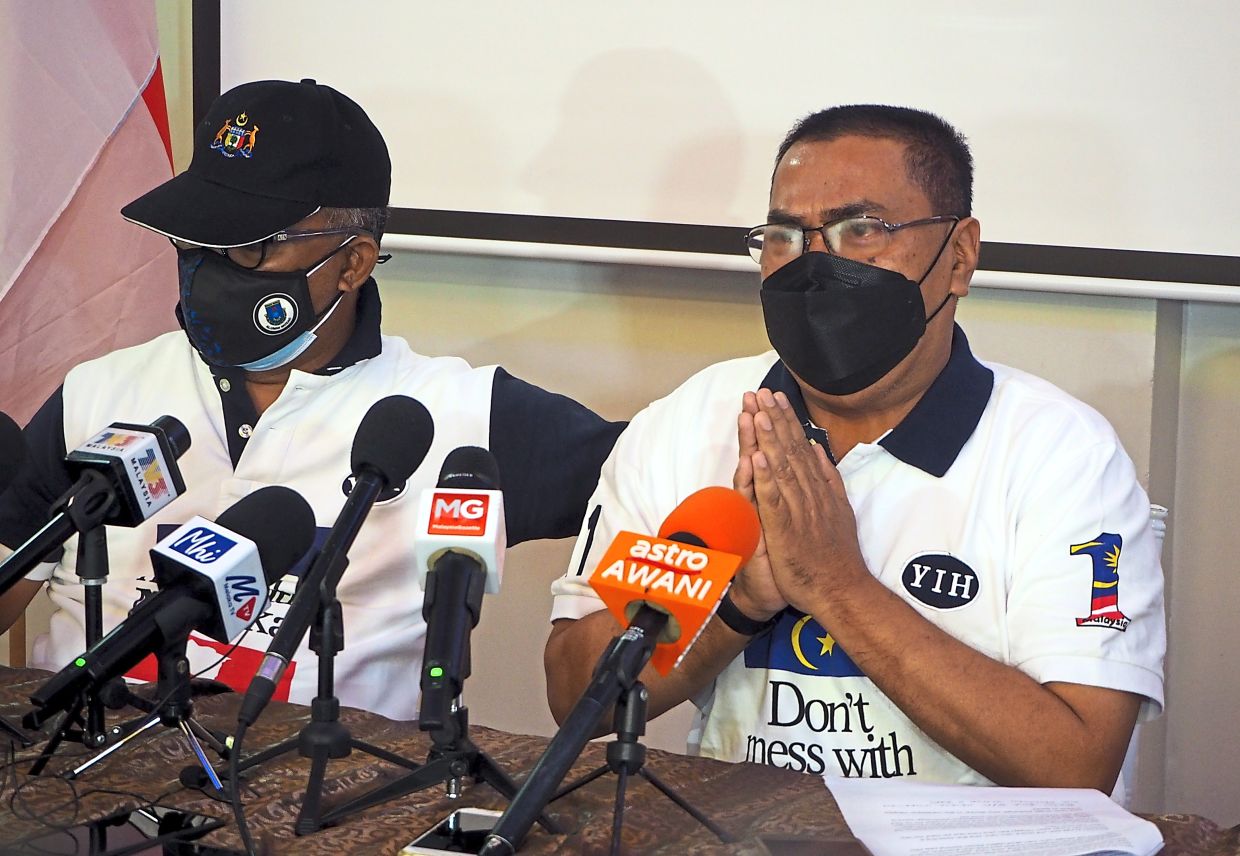
Oscar-worthy performance: At a press conference last week, Pantai Kundor assemblyman Nor Azman (right) broke down in tears while apologising to the people for his actions. – Bernama
THE politicians probably think voters in Melaka are gullible enough to believe their triggering of the state government’s collapse was done in “the interest of the people.” What nonsense!
Pantai Kundor assemblyman Datuk Nor Azman Hassan, who was one of the four assemblymen who defected from the Barisan Nasional state government, said his withdrawal of support for Chief Minister Datuk Seri Sulaiman Md Ali was made with that drivel.
He announced that he and Sungai Udang assemblyman Datuk Seri Idris Haron were left with “no choice” but to save the state from what he claimed was “incompetent leadership.”
In an Oscar nomination worthy performance at a press conference last week, Nor Azman broke down in tears while apologising to the people for his actions.
“I want to seek forgiveness from the people in Melaka. I am sincere and our actions were for the sake of the people,” he said, with the customary waterworks as he put his hands together in a gesture of apology.
The takeaway from the Melaka episode is a bunch of squabbling politicians jostling for positions and trying to take control of the state government.
They didn’t even have the patience to wait until the next general election, possibly concerned that the state assembly wouldn’t be dissolved, and that the GE would only involve federal seats.
The two co-stars in the plot are Telok Mas assemblyman Noor Effandi Ahmad from Parti Pribumi Bersatu Malaysia and Independent lawmaker Datuk Norhizam Hassan Baktee.
Let’s look at the track record of Norhizam, an independent, who was a former DAP man. He won the Pengkalan Batu seat in 2018 and then quit the party two years later to be an independent.
The former bus driver turned politician is well-known for his hot temper, if not, uncouth behaviour, and had reportedly even quarrelled openly with his constituents.
The Melaka saga started when the Perikatan Nasional government came into power in March 2020 following the defections of four assemblymen, which led to the fall of the previous Pakatan state government in 2018.
The four were Paya Rumput assemblyman Datuk Mohd Rafiq Naizamohideen and Telok Mas assemblyman Noor Effandi Ahmad – both from Bersatu – as well as Rembia representative Datuk Muhammad Jailani Khamis (formerly PKR, now Umno) and Norhizam.
Basically, Effandi and Norhizam caused the previous state government to collapse and now, they have repeated their performance with the Perikatan state government.
Going by their strange script, they also did this in the state and people’s interests.
In 2020, when Norhizam quit the DAP, he said he was doing it in the “interest of the Malays,” and that he no longer wanted to be a lackey, adding that “I am going back to the right path.”
Honestly, nobody cares if they’re quitting for the Malays, Chinese, Indian or the Portuguese communities because no one in their right mind would believe their spiel.
It’s no stretch of the imagination to say Malaysians are sick and tired of these politicians.
If only they had shown as much urgency in serving us than to scheme and counterplot and craft that scrap they call a statutory declaration. And do they expect the people of Melaka to now face a fresh state election?
After the fiasco in the Sabah state elections, which were held following the collapse of Datuk Seri Shafie Apdal’s government in 2020, no one is going to risk their health to help politicians fulfil their ambitions.
The state polls set the timebomb off for that Covid-19 explosion in Malaysia, a pandemic we had controlled so well till then.
So, the four who betrayed Sulaiman were hoping to waltz into the state government, particularly for the CM post. However, the rug was pulled from under their feet with the dissolution of the state assembly, approved by the Governor. Now, the four want to appeal to the King to stop it.
So, it’s a catch-22 – no one wants a coup or a state election.
Why would we want to go through this political insanity again, just when we’ve saved the situation and vaccinated nearly 90% of the adult population?
Of course, those who advocate a state election may say Sabah can’t be benchmarked because vaccines weren’t ready then. But even if people are fully vaccinated, the numbers can shoot up instantly, as Singapore saw.
Since Datuk Seri Ismail Sabri Yaakob became Prime Minister, he has cooled down the political temperature and balanced the seesaw between the opposition and government to strike a truce.
There may be some who will question the effectiveness of the memorandum of understanding (MOU) between the Opposition and government, but at least it’s a stride towards a mature democracy.
It’s the start of bipartisanship and finding common ground for initiating reforms in Malaysia, which the country is crying out for.
The only way now is for the Federal Government to turn to the legal and health experts to find an acceptable solution, as rightly suggested by Defence Minister Datuk Seri Hishammuddin Hussein Onn.
The millions of ringgit potentially spent can be put to better use instead of having the state election.
But for a curtain raiser, let’s have solutions that genuinely benefit the state and people.


WE really need to take stock of the situation because Malaysians should be looking at the big picture.
Many of us have delved into issues seriously impacting our economy and its competitiveness, without deliberating on the long-term effects.
We get carried away by the race narrative, which is often emotional and political.
Piling on the woe, most of us barely bother researching the topics we talk about.
Unfortunately, this includes some of our decision-makers, lawmakers and even journalists, who appear to only have scant knowledge on the subject they discuss, which includes the logistics sector, now a burning issue.
It’s heart-wrenching that it has degenerated into race related equity control when it needn’t have.
Let’s look at the transport sector, which had a gross added value estimated at about RM57.3bil in 2019. It hired over 700,000 people and represented about 5% of the employed population then.
Malaysia has done exceptionally in the port sector, which is an integral part of the logistic sector, with Port Klang and Port Tanjung Pelepas ranked 12th and 18th in the world in terms of throughput.
Logistics have been classified as a priority industry by our government, and rightly so, too.
Generally, when we talk about logistics, it involves freight transportation, freight forwarding, warehousing, small package delivery services and value-added logistics.
In a way, it doesn’t involve food delivery, although some commentators have assumed otherwise in their remarks. This sector is an important part of the economic ecosystem.
So, when the numbers are viewed on the surface, we assume that e-hailing and e-commerce must be in the same pie.
Now, there’s a vision of a 51% take over by bumiputra companies, which involves the blood, sweat and tears of non-bumiputra entrepreneurs.
Let’s not forget that these are all Malaysians who have played a vital part in building the logistics industry. They are also members of Keluarga Malaysia, which is currently being raved about.
But while we’re busy talking about taking a slice of the pie from the baker, our competitors have overtaken us, according to the World Bank’s Logistics Performance Index (LPI).
Malaysia is now ranked 41 out of 160 countries – a drop from 25 in 2014 and 32 in 2016, when we were the second best performing Asean country after Singapore.
But in the LPI 2018 report, we were behind Singapore (2), Thailand (32) and Vietnam (39). Just behind us was Indonesia (46).
Malaysia lost out in efficiency (or clearance processes), quality of trade, ease of arranging competitively priced shipments, competence and quality of logistic services, ability to track and trace consignments and punctuality of arriving shipments.
A strong and competitive logistics sector will benefit the country and its people if we take a broader view of the gains.
We shouldn’t focus on wanting to impose a 51% bumiputra equity on Malaysian freight forwarders.
The Covid-19 pandemic may have led to a sharp increase in the use of e-commerce but it disrupted global supply chains in unprecedented ways. This will lead to GDP contractions in Asean including Malaysia.
The decline in supply, consumption, investment and trade will have a severe impact on the logistics sector, coupled with huge financial losses. So, contrary to ill-informed comments, the logistics sector isn’t making a killing.
The enforcement of the condition has now been postponed to Dec 31, 2021.
This is ironic because the condition won’t affect the international integrated logistics services (IILS), where foreigners have majority control, but will trouble majority owned Malaysian IILS providers, who are neither listed nor bumiputras.
There are obviously many consequences, and it will really hurt non-bumiputra owners – both emotionally and financially. It’s also illogical and impossible to find bumiputra buyers prepared to buy and pay a fair price when the market is so weak.
They know that it’s one thing to own a company and totally another to run it with the skill and expertise it requires. After all, it could also end up like the Ali Baba scenario.
Adding insult to injury, domestic IILS providers will simply pack up and head south to Singapore, for example, where no such condition exists.
Even for foreign-owned IILS owners, a 51% -equity criteria will spook them because it could hit them similarly if Malaysia is known for shifting goal posts. Likewise, talk of a retrospective decision is even worse.
No businessperson who wants to commit huge investments in logistics will set up their holding company in Malaysia if we have such a criterion.
Putting barriers of this nature will send the wrong message when the world is promoting competition, liberalisation and reviewing archaic laws. Protectionist barriers for political and nationalistic reasons will hurt Malaysia in the long run. That’s a fact.
The Customs brokerage licences sector, meant to assist bumiputras, is only estimated at about RM204mil from the imports and exports through Port Klang.
Currently, 80% of the freight forwarding companies with the Customs Department brokerage licences are already bumiputra companies – what’s left is the remaining 20%.
Surely this 20% shouldn’t be rushed to sell off their stakes so quickly, as per the Federation of Malaysian Freight Forwarders Association.
Malaysia’s logistic sector will blossom from a growth of RM53bil in 2020 to an estimated RM180bil in 2030 – and we are squabbling over RM204mil in customs brokerage fees to fit into a proposed 51% equity.
We should be planning together, as Malaysians, how we can take over the top spot from Singapore. We shouldn’t even be surprised if most of the workers in Singapore are Malaysians.
If we get our act right, we are even capable of hosting Japanese distribution hubs, including automotive manufacturing ones.
The 51% equity proposal has also caused much uneasiness among foreigners since many local freight forwarders currently have agreements with foreign principals who own shares in the companies.
They may not have to dispose of or take over the shares of Malaysians, but many multinationals don’t abide by a 51% bumiputra ownership in their corporate guidelines.
Recently, industry players wrote to the government asking for clarification on the quota of bumiputra representation needed for companies to renew their Customs brokerage licences.
They said it would be difficult to meet the 51% mark given that there were only a few months left for the licences to be renewed. Subsequently, the Finance Ministry postponed the deadline to December 2022.
The reality is that the world has become a global market. A domestic decision will have a global impact.
If we continue to take the katak di bawah tempurung (frog under the shell) approach, we will lose out. In the end, Malaysia will continue to slide, and it will affect all Malaysians in the family.
In many families, there is always the favourite, but it should never be at the expense of the entire family.



PENANG'S HISTORY, MY STORY
Click on image to purchase book

A COLLECTION OF WONG CHUN WAI'S JOTTINGS
Click on image to purchase book