



IT’S miserable to be in Selangor because we’ve now transitioned into the dreaded enhanced movement control order (EMCO). This will have a serious economic impact since the state has the highest number of factories, being the largest contributor to the country’s gross domestic product.
Although manufacturing plants producing essential items are allowed to operate, that’s still not good enough. Many of these factories rely on supporting materials, so, even if they’re allowed to open, they’re not operating at full capacity.
Succinctly put, the country’s economy has already been decimated, so shutting down Selangor will only send it closer to the grave.
The question now is, if the 6,000-odd figure continues after the EMCO ends, will we have to extend the MCO, EMCO, or whatever phase of the National Recovery Plan (NRP) we could be in then, if certain thresholds aren’t met?
Perhaps we need to use new approaches and strategies. Let’s not worry about what we need to call it, though.
These terms and acronyms are couched by politicians and bureaucrats, but as far as we’re concerned, it’s just a lockdown.
So, spare us the political semantics for wanting to be politically correct – put it on a t-shirt. As Malaysians, we only care about daily case numbers and whether we can get back to work.
How many stimulus plans need to be unveiled when we know the assistance won’t come tomorrow because it will take time to validate applications?
The people, especially daily wage earners, just want to work and put food on the table. That’s all and it’s that simple.
After two lockdowns and yet struggling to reach Phase Two, I’m not sure if the country can handle the colossal losses from this economic meltdown.
Just look at the numbers and charts. It’s obvious Kuala Lumpur and Selangor make up half of the total number of daily Covid-19 positive cases. This is because of the Klang Valley’s demographic enormity.
Many people are moving and gathering at workplaces, and even neighbourhoods. The density in low-cost flats and apartments is high.
There are also areas with large congregations of immigrants, who have yet to be vaccinated and are possibly even illegal.
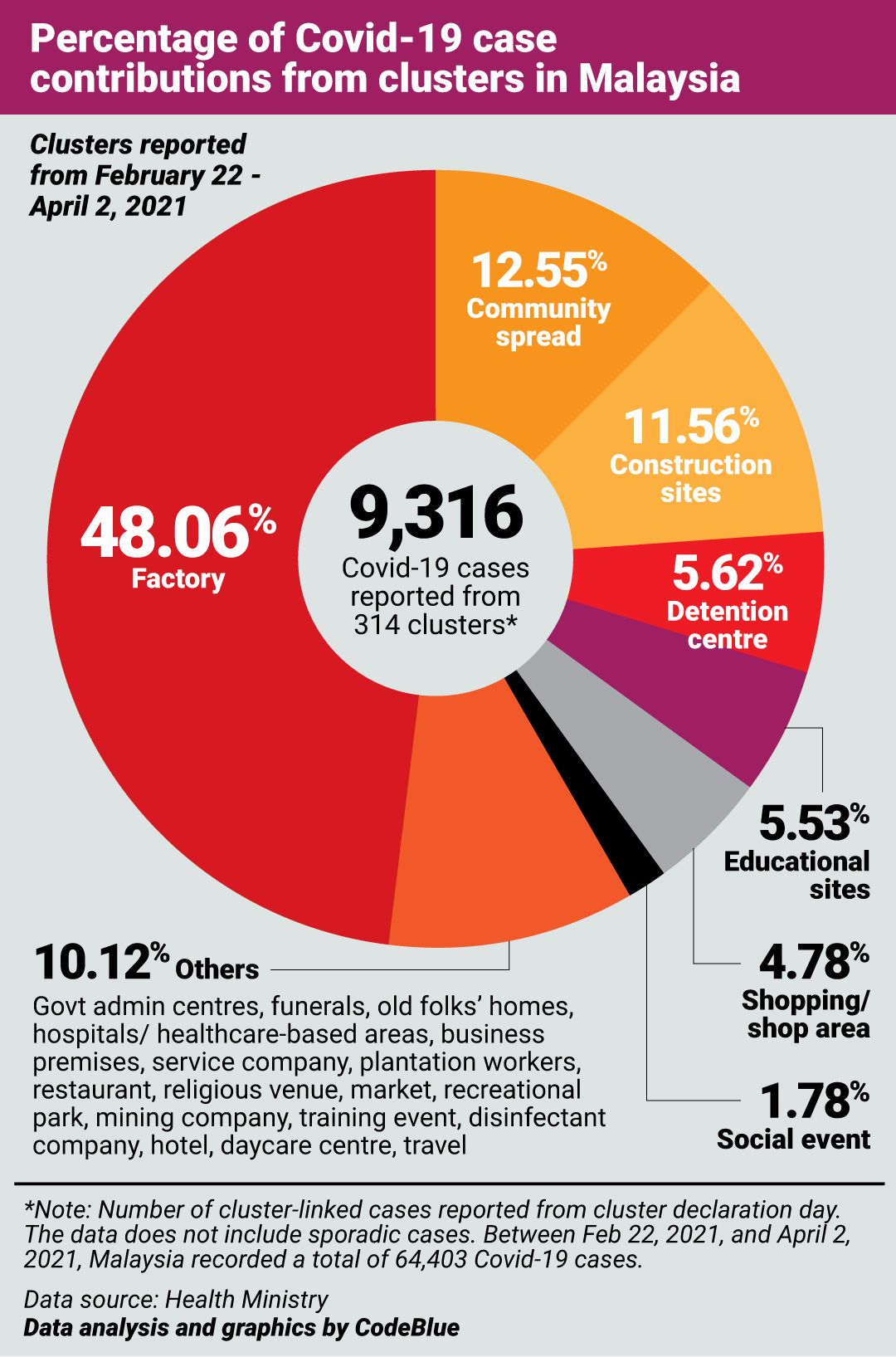
Last week, Mentri Besar Datuk Seri Amirudin Shari said 91% of clusters in Selangor were workplace related, with a whopping 80% from factory clusters and 11% from construction. He said they encompass part of the 125 active clusters in the state.
In contrast, Senior Minister and International Trade and Industry Minister Datuk Seri Azmin Ali said it was inaccurate to blame factories and the manufacturing sector for the surge in Covid-19 cases.
He had also previously said that the numbers from factories were small compared to community transmissions.
Such seemingly contradictory statements aren’t going to help the country, or Selangor.
But we can’t lock down the entire country because of the Klang Valley. Honestly, it doesn’t make sense.
The federal government has appropriately allowed Pahang, Perak, Terengganu, Kelantan and Perlis to move on to Phase Two of the NRP. While this caters to states opening, they’re still barred from organising large meetings and social events. Sabah has insisted on allowing dine-in at restaurants, with many caveats, of course.
The intention may be to help eateries. However, according to a report on Covid-19 epidemic management that was submitted to Bank Negara, the huge number in April was attributed to higher transmission at social, religious and restaurant premises. Workplace negligence was another reason for the spike in cases.
By late April, the Ramadan bazaars contributed to the surge with 28 bazaars identified as potential hotspots, while interstate travel, done illegally, exacerbated the situation. Interestingly, the report calls for interventions aimed at breaking Covid-19 transmissions and minimising economic disruptions.
It can be done with strict SOP, Hotspot Identification for Dynamic Engagement (HIDE) and on the ground enforcement, sans shutting down businesses.
If factories are a major contributor, that means transmissions remain highly concentrated.
Pre-emptive and targeted interventions can be administered speedily by sending mobile vaccination teams to factories.
In Selangor, over two million employees from 50,000 companies have signed up for the state vaccination programme. Other states should also do the same.
Early this month, MITI also announced Phase 4 of the vaccination programme for the manufacturing sector.
So, vaccinations are being conducted. At this stage, it’s a moot point deliberating whether we should have placed our vaccine orders earlier or taken the ideal course of action. It’s easier to speak in hindsight, of course.
This ranting and whining, mostly with political prejudices, are good sound bites in social media talk shows, but they don’t help unless practical and well-conceived ideas are contributed.
Having allowed the four states to move on to Phase Two, other states should now be allowed to ease out of the lockdown based on the improvement of their own Covid-19 numbers. It’s illogical and unfair to keep the country under lock and key.
Instead of the national infection rate, which is now being referenced to justify the current nationwide MCO, it’s time for other reviews to indicate if states are recording different levels of infections, hospitalisation and vaccination rates.
Besides mass vaccinations at factories, mass testing, tracing and treatment must be done in tandem.
We keep getting that scary 6,000-odd figure, but how many of these are mild or asymptomatic cases? How many of our cases are severe enough to require ICU-level care, or are at stage three or four?
Going forward, we need to grapple with certain realities – lockdowns can buy time to strengthen other interventions, but we should know that they are detrimental to both livelihoods and lives.
We have tried these lockdowns, but the numbers have not gone down. In fact, it has only worsened, so that means they don’t work.
Let’s not forget, the Delta variant will increase infectivity and even leave the vaccinated susceptible.
The bottom line is, we can’t have endless lockdowns. It’s time for a completely fresh and effective approach to defeat Covid-19, and once our numbers come down, we need to learn to live with it.


EYE-brows were raised when Science, Technology and Innovation Minister Khairy Jamaluddin lambasted rich countries for vaccine hoarding, describing the act as “cruel and unjust” against poor and less developed countries.
The Covid-19 Immunisation Programme coordinating minister drew similarity to the act with a scene from the Titanic where the ship was sinking and the rich people in the first class had the priority boarding the lifeboats.
”Poor countries, less developed countries, are left to drown. That is what is happening today,” Khairy said at the launch of Malaysia Aviation Group’s (MAG) sustainability blueprint here on Wednesday (June 23).
But in a highly charged political atmosphere, Khairy found himself under fire, with his detractors saying he was merely shifting attention from the criticism against him for the slow rollout of the vaccination exercise.
The National Pharmaceutical Regulatory Agency (NPRA) was also rapped for its giving conditional approval for the CanSino vaccine and not approving Sinopharm and Sputnik vaccines. In reality, Singapore has also not approved these vaccines.
Singapore is only providing Pfizer and Moderna while the private sector is allowed to give Sinovac, which comes from government stock purchases some time ago.
The European Union Ambassador to Malaysia Michalis Rokas was quick to refute Khairy’s statement, saying the EU (European Union) had shipped 4.087 million Pfizer-BioNTech vaccine doses and approved the export of another five million doses for Malaysia.
”By June 21, five million doses have been approved for exportation and 4,087,000 doses have been effectively transported already by June 15.
”These numbers concern doses manufactured by Pfizer, and to these exports, I should also add that the EU has already manufactured and already shipped 560,000 doses of the AstraZeneca vaccine through the Covax scheme,” Rokas said.
But Rokas wasn’t addressing the statement made by Khairy, who was talking about poor and less developed countries as a whole.
Is it merely the politicians capitalising on public anger without providing real answers? Let’s look at the facts and figures.
Khairy isn’t wrong.
The Covid-19 Immunisation Programme coordinating minister isn’t the only politician who has complained about vaccine hoarding. On Wednesday, Bangladeshi Foreign Minister AK Abdul Momen also expressed the same sentiment.
Even the rich nations were putting conditions for supplying vaccines to other countries, Momen reportedly told journalists at his ministry office in Dhaka after a weeklong visit to the United States.
Without naming any country or the conditions, he said, “They’re seeking this or that in return.”
In March, The Guardian reported that rich countries with 14 per cent of the world’s population had secured 53 per cent of the best vaccines.
Almost all Pfizer/BinNTech vaccines will go to rich countries, the United Kingdom newspaper reported.
”The Moderna vaccine will go to rich countries exclusively; it is not even being offered to the poor. In fact, nine out of 10 people in poor countries may never be vaccinated at all. Washington is sitting on vaccines making sure no one gets any while the US needs them. The European Union has exported 34 million doses to, of all places, Singapore, Saudi Arabia and Hong Kong – countries that have no problem sourcing or paying for vaccines.
”In fact, the EU sent about nine million doses to the United Kingdom, a country which, no longer in the EU, also has what amounts in practice to an export ban of its own, official denials notwithstanding,”
It’s unlikely that Moderna’s chief executives feel bad about the unvaccinated poor. The company forecast sales of over USD$18bil (RM74.96bil) for 2021, pushing Moderna into profit for the first time since its founding 11 years ago. Pfizer hasn’t done too poorly either; they’re expecting a cool USD$15bil (RM62.47bil) in sales.
South Africa, the African continent’s worst-hit country, is buying AZ (AstraZeneca) at nearly two and a half times higher than the per-unit price of European countries.
In short – the vaccines are not being sold at standard prices. It also depends on the volume that a country has ordered, which will, for example, put Malaysia having less bargaining clout with our small population.
The Guardian reported that European countries were buying doses below the supposed cap of €2.50 (RM12.43) and “African countries far above it”. In contrast, Canada has purchased more doses per head than anyone else – enough to vaccinate every single Canadian five times over. But the entire continent of Africa – home to 1.3 billion people – has been allocated a total of only 300 million doses.
As of the first week of January, only 25 vaccines had been administered in all of sub-Saharan Africa. Yes – dua puluh lima (twenty-five).
While many Malaysians were praising Israel for administering 150,000 doses of vaccine a day, it was not widely reported that the Palestinians, whose land it occupied, were left out.
Last week, it was widely reported in the Arab media that the first batch of Pfizer vaccines that the Palestinians received did not conform to specifications. The 90,000 doses that were supposed to expire in July or August turned out to expire in June.
The BBC has also reported about the predicament faced by the poor countries.
Since December, it has been reported that rich countries are hoarding doses of Covid vaccines and “people living in poor countries are set to miss out”, according to a coalition of campaigning bodies.
The People’s Vaccine Alliance, a movement of health and humanitarian organisations, says nearly 70 lower-income countries will only be able to vaccinate one in 10 people.
This is despite AZ pledging to provide 64% of its doses to people in developing nations, it said.
”And even though rich nations represent just 14% of the world’s population, they have bought up 53% of the most promising vaccines so far, according to data from eight leading vaccine candidates in Phase 3 trials that have done substantial deals with countries worldwide,” it said.
What about the EU? Well, it has secured 900 million doses of Pfizer’s vaccine and reserved an option to buy 900 million more to be delivered by 2023.
In short – while most developing countries are struggling to give the first jab, the EU is ready for the booster jabs, in case the third shots are needed.
That gives the EU as many as 3 billion secured doses, or 6.6 per person, without accounting for the optioned ones,” Quartz reported.
It said, “excess vaccines give wealthy countries power over those dependent on donations in order to immunise their citizens. Many countries are using vaccines as a diplomatic tool, donating them in order to strengthen—or form—international alliances. China has excelled at this but the United States is catching up.”
So, Taiwan – the US ally – snubbed China-made vaccines and waited for the vaccines, and naturally, Taiwan got what it wanted for being supportive of Washington DC.
Meanwhile, Singapore’s Temasek-led investor group injected USD$250mil (RM1.04bil) into the German biotech firm through a private placement last June. In short, it has a stake in the vaccine manufacturing company.
Yes, Malaysia should have done better in procuring the vaccines and even expedited the vaccination exercise.
But countries are at the mercy of the manufacturers and the rich countries. They decide who should get it and how much.
If there is any comfort to the European countries, which have been accused of hoarding, they, too, have taken legal action against AZ for failing to deliver the vaccines on time.
Still, while developing countries struggle to give their people the first vaccination, the rich countries hoard the vaccines for booster shots. The third injections are needed to fight the different variants.
THERE is a lot of unhappiness on the ground. The extension of the lockdown has not surprisingly gone down badly, with most Malaysians grappling with the raging Covid-19 pandemic.
Many have lost their jobs or will lose them soon. Their loan-servicing has gone bad, and putting food on the table has become increasingly difficult, especially for daily wage earners.
For many small businessmen, their businesses have folded up and it can only get worse.
It’s a tough call for the Prime Minister. He is caught in a perfect political storm as his opponents step up their criticism of his handling of Covid-19, which continues to hover at around five thousand cases a day.
If he had decided to be a populist by ending the lockdown, he would have been attacked viciously for being irresponsible.
His decision has also been greeted unhappily, but I am sure he would not want Malaysia to go the way of India where the health system collapsed.
It’s a lousy time to be a Prime Minister everywhere, but those who have managed to take their countries back to normalcy will earn political dividends even though they started badly, like in the United Kingdom.
The key here is vaccination. Malaysia needs to achieve this as fast as possible. The government needs to set their target ahead of time, and it’s best we hit herd immunity before the year is out.
We can’t afford to have more lockdowns. Malaysia will crumble because we do not have the financial means to cushion our economy. For example, those who have lost their jobs will not get paid benefits for furloughs, unlike rich countries.
Singapore has taken the right approach – the Covid-19 pandemic is here to stay, and we must learn to live with it.
But it has been able to do so because it has successfully won the fight, and most Singaporeans and expatriates have been vaccinated.
The island republic’s plan is simple. Get vaccinated and live with it, but no date has been fixed for this plan. Officials also plan to loosen travel restrictions, gathering limits and social distancing requirements to fully vaccinated individuals. In addition, it has been reported that Covid-19 testing will shift from being used for quarantines to being used for ensuring social activities can happen safely.
Singapore is a disciplined country, it is run systematically. Its politicians don’t run foul by breaking standard operating procedures (SOPs) which they are supposed to uphold.
What is not said is that Singapore is preparing itself for the reopening of the country and the plans are being laid out now.
It has a plan, for sure, but a few details are being floated to see the reactions to the move. Singapore does not talk first and work out the plans later.
Their ministers have also written carefully crafted opinions in newspapers to share their plans instead of speaking off the cuff, unlike some of our ministers, and sometimes, making a mockery of themselves.
We do not need a political science professor to tell us there is a trust deficit among Malaysians.
And while Singapore has devoted itself to reopening the economy, our politicians are devoted to the reopening of the Parliament. Most of us have suddenly become Constitution experts, rightly or wrongly.
So, if we are unhappy with the nationwide lockdown, what do we want the government to do? Shooting off toxic messages in social media, with name-calling, will help release steam, but it won’t help.
Maybe for a start, we should suggest that the government allow states which have seen a drop in the number of cases to move on to phase two of the National Recovery Plan (NRP).
Half of the daily Covid cases are from Selangor, but it has also taken a slight dip as of Monday (June 28). Perlis has five, Terengganu 23, Penang 88 and even Kelantan has 101.
Yes, we cannot take our foot off the brakes, but a more flexible approach needs to be considered.
Businesses regarded as non-essential need to be reopened as the owners are in danger of losing their contracts and even sued if they cannot fulfil them. The losers will be the factory workers.
Our governments have not explained well why some factories are allowed to operate and have caused questions to be raised, even of a racial tone.
The reason is simple – our country’s exports are at risk, and these factories employ hundreds of thousands of workers, both Malaysian and foreign.
To encourage vaccinations and for the economy to reboot, those who have had the two doses should be allowed to travel out of state without permits and attend places of worship.
The most asked question is this – after a lockdown of two weeks, the number of infections has not gone down. After the extension, what happens if the numbers remain the same and even if it hovers around 4,000, it is not something to celebrate.
According to the NRP, we will then proceed to phase two, where some sectors will reopen although large gatherings will still be banned.
Seriously, it’s time we look at the worst-case scenario and prepare for that situation.
Perhaps, it isn’t easy to make the forecast even though there are projections. That also explains why announcements are made late.
Japan has found itself in the same predicament.
Case numbers in Tokyo have been creeping up over the past week since Japanese Prime Minister Yoshihide Suga lifted the state of emergency imposed to rein in infections. Any sharp increase could mean the emergency is reintroduced, further restricting residents’ activities even while the Olympics are taking place.
He reportedly said the government must be on high alert as cases begin to rise in the capital, about three weeks before Tokyo hosts the summer games.
”While there is a downward trend across the country as a whole, there is a slight upward trend in the capital region,” Suga told reporters Monday (June 28).
”We must be on a high state of alert in dealing with the virus.” He added that he would be nimble in adjusting policies to deal with the situation.
The seven-day moving average of new infections recorded in Tokyo rose to 477 on Sunday (June 27), compared with 388 the previous week.
In Sydney, millions of residents began the first full day of a two-week coronavirus lockdown on Sunday as Australia imposed new restrictions to contain an outbreak of the highly contagious Delta variant.
Australia’s northern city of Darwin also entered a separate snap 48-hour lockdown on Sunday after a handful of cases were linked to a coronavirus outbreak at a remote gold mine.
In Jakarta, there have been calls for a lockdown after 30 doctors died of Covid-19 this month as the country battles a second wave of the disease driven by the Delta variant.
This last lockdown should have ended, but it hasn’t. Let this one be the last by working hard on it.
If the pandemic doesn’t kill us, our politicians will.
There was never going to be a quick fix, so what we should do now is buckle down and sit tight for the rest of the ride.
WITH the current phase of lockdown coming to an end tomorrow, every indication points to an extension, unless something dramatic happens soon.
Nothing extraordinary is on the cards though because the number of daily positive cases continues to hover at 5,000. We can’t afford to rejoice even if the cases drop to 4,000-odd a day because that’s still a scary number.
It would be foolish for our politicians to be casual with the SOP just because case numbers have dropped a little.
Yes, there could be adjustments, where operating hours and re-opening of some sectors are concerned, but there shouldn’t be major changes for the sake of providing breathing space to businesses.
We ought to know by now that we’re poor with self-regulatory approaches, and we have taken advantage of the leeway, thinking it’s a sanctioned return to normalcy.
And we must still be able to recall the flip-flop decisions and contrasting statements which have made the government look incompetent in tackling the Covid-19 pandemic.
There have been improvements in recent weeks though, but attention is now focused on stepping up vaccinations. The way things are looking, this could be the only effective course of action.
If we can cover 70% of the country by September, then the government must be commended for succeeding despite the many obstacles.
Amazingly, we have evaded the exponential surge of cases with the lockdown. Otherwise, we would have had 13,000 cases by June 14, and then 20,000 and perhaps 30,000 to 40,000 later. We managed to flatten the curve, but we need to do more to reduce the numbers. We may have averted the disaster of a tsunami, but the ripples are still there.
So long as there’s still movement and congregation in some sectors, we’ll be where we are now. We could avoid that by stepping up enforcement and monitoring, closing all non-essential services and increasing vaccination for the economic sector immediately.
Half of 2021 has passed, and it looks like another year of poor economic growth for most businesses. With just months to go before the year ends, there isn’t much we can catch up on.
But we do need to end the year with the best vaccination results by December, so that we can reopen and re-boot Malaysia in 2022. And then hopefully, we can return to some sense of normalcy.
The squabbling politicians can do what they want then, and that includes pressing for a general election. Right now, with only about 10% of the population vaccinated, the people aren’t interested in fulfilling politicians’ ambitions.
Yes, we have an unstable government, but why should we endanger our lives for these Members of Parliament so they can be in power through another back-door entry?
Politics in Malaysia has become so toxic and ridiculous that we only hear of politicians who think they are entitled to be the prime minister, or politically expired politicians and former Cabinet ministers who desperately want to retrieve the power and its perks.
Then, there are those who think they can use religion and race to convince their supporters, which includes those who appear to be using religion to justify corruption even.
A few just want to stay away from jail and know that a new government would be their only path to redemption.
But the worst kinds are those who are now ready to throw away political ideologies so they can form a new government, be it before or after the general election.
So, one wonders if our politicians are even trying to find new approaches and ideas to help fight the pandemic, which is threatening to become endemic – meaning it’s here to stay.
We can’t continue imposing lockdown after lockdown because there’s a need to balance between health safety and economic security.
When Parliament reconvenes, we should judge the performance of our MPs. Let’s see how many of them will ask sensible questions and offer credible solutions, instead of just sitting there and playing dumb while collecting their attendance allowances.
Hopefully, it won’t be another shouting match to get media attention and display bravado, so they can tell their hardcore supporters they have the guts to stand up against their opponents.
It would be great if the Parliament secretariat could provide data to the media on how many from the 222 MPs ask oral and supplementary questions, and the time they spend inside the chamber.
As taxpayers and the rakyat, we’re surely privy to this information to see how they perform. If working folks have to be measured by KPI, then surely they should be assessed by merit, too.
Malaysians, in general, are sick and tired of the level of politicking by our elected representatives.
Politics may be loud in social media and chat groups because many people are bored working from home, and probably because they have the time to keep forwarding political information.
However, most Malaysians are still worried about putting food on the table.
Many food stall owners can’t understand why their operating hours are limited to between 8am and 8pm. Many of us are awake by 6am and already buying food at that time.
If you are operating a “dai chow” food stall in the evening, how can you run a three-hour business?
The Cantonese term “dai chow” translates loosely to “big fry”, which essentially means a wide variety of stir-fried dishes, and it’s mostly for dinner. In Penang, the hokkein equivalent term is “chu char”.
Their customers usually turn up at 6pm. So how can they possibly end at 8pm? Previously, they served the supper crowd until midnight, but of course, this is no longer possible. One can “ta pau” (take away) dinner, but not supper.
Politicians should listen to the plight of the people especially the B40, which includes many Malays. Try listening to the people living in the low-cost flats in Kota Damansara, Selangor, for example.
Many have lost their jobs, daily meals are uncertain, single moms are struggling, drug abuse is prevalent, and Covid-19 positive cases are running high.
With more than 1,100 units, and with at least four in a unit, no form of social distancing is sufficient if someone contracts Covid-19.
Last week, the Economic Action Council executive director Tan Sri Dr Noor Azlan Ghazali said 600,000 households from the M40 (middle income) group had slipped into the B40, or bottom 40.
He said the figures were based on a 2019 survey by the Statistic Department, so we can be certain that number has risen by now, based on how bad things have become from 2020 to 2021.
Sadly, 80% of Malaysian households are in M40 and B40, so why should we even care about helping these politicians keep their positions when our jobs are barely secure?
With just 48 hours to go before we are officially informed of the government’s decision, I’m resigned to facing phase two of MCO 3.0, where we hope to see the re-opening of some economic sectors.
It’s conclusive that mass gatherings and physical meetings will still be banned, and the Health Ministry will still have its hands full because the numbers aren’t coming down to acceptable levels.
So, let’s all pool together to do our best to recover from this global disaster.



PENANG'S HISTORY, MY STORY
Click on image to purchase book

A COLLECTION OF WONG CHUN WAI'S JOTTINGS
Click on image to purchase book