Author Archives: wcw
Biting the bullet

Just take it: Now is not the time to be choosy about vaccine ‘brands’. The reality is that the odds of someone dying from Covid-19 is high.
FINALLY! Sense has prevailed and something’s being done about the skyrocketing numbers. It’s taken longer than it should have, but that’s likely because of the solution’s expected deep impact to the economy. Are we in a position to choose, though?
Every other day is a new record. While we’re awaiting further details, this time around, the government has announced the next two key phases, along with the timeline.
The 2 + 4 weeks means lockdown can potentially be lifted only by July 13.
We must be prepared for a two-week extension until July 28. That’s nearing Aug 1 and the end of the Emergency declaration.
So, playing it safe, it’s best we condition ourselves for a two-month lockdown for it to be worthwhile this time.
Yes, it will impact businesses and people, with dire consequences, but it’s time we bite the bullet because we need to hit the brakes hard again.
We shouldn’t be surprised by these escalating figures, especially following the huge crowds at Ramadan bazaars and Hari Raya celebrations, where we know rules were broken.
The number of non-Malays, especially the Chinese, has also been glaring. So, we’re all guilty.
Restaurants were packed, and roads jammed up daily.
These aren’t the only reasons, of course. We pulled our foot off the brake in December, when we were let loose.
Many of us went on holidays, and judging from pictures of street parties, especially in Penang during Christmas and New Year, we were clearly headed for trouble.
This brazen flouting of SOP and the lack of enforcement – including pathetic workers dormitories and double-standard practices – are all well-documented.
Now, here’s the crunch. Malaysia is now in the Intensive Care Unit. We either go under the knife and slice off the cancerous cells, and spend two weeks in hospital for a complete cure, or pretend all is well and simply stick to taking pain killers and steroid jabs.
It’s a given the numbers will hit new records. We don’t need to be experts to forecast the projections. Perhaps, it’s time for us to listen to health experts instead of politicians, who will always look at short-term plans.
But we’re to blame, too.
I’m not sure if this is a Malaysian quirk, but it’s certainly perplexing.
I have family members, friends and colleagues who have passed on the AstraZeneca vaccination programme because they don’t rate it.
Curiously, they think AZ will kill them. They fear getting blood clots.
So, they’d rather wait for Pfizer. Nothing but only Pfizer. In their own words, “it’s branded, you see”.
Then, those frequenting China are terrified at the thought of getting vaccinated by the American made Pfizer because they can’t imagine being denied entry into China.
Pfizer’s Viagra is okay, but not Pfizer’s vaccine. I was told that one elderly man stormed off from a vaccination centre when he found out he was getting Pfizer.
There are also the absolutely bizarre theories from some Chinese friends of mine who believe the China-made Sinovac works better in Chinese bodies, including Malaysian Chinese.
They told me this with straight faces, which means they assume their theories have sound scientific basis.
So, when I told my circle of friends that I was indeed honoured and pleased to be selected for AZ early on, they were aghast.
I was given several lectures on the dangers of potential blood clots from well-meaning people.
From the expression of concern on their faces, I could tell they feared I could drop dead anytime.
Let’s not even mention the many chat groups we’re in, where experts have surfaced. Strangely, they aren’t disturbed by the daily jump in new Covid-19 cases.
Every other day is a record smashing day over the past few weeks, yet still, they’d rather wait.
But prejudice has begun to concede to fear. Suddenly, I can sense a shift among these vaccine snobs.
Following the first round of AZ vaccine offers, which were snapped up within an hour in April, more Malaysians have realised that while they continue procrastinating over AZ, many others are expectantly waiting in line.
Many young friends of mine, who would often wake up late, were waiting eagerly to register themselves for the first round of AZ vaccines.
With phone in hand, it was a race to the finish to get themselves registered. As expected, those who tried logging in only at 2pm or 3pm found out that registration had closed.
So, most did the next thing Malaysians do best – blame the government. Reasons included, there were no reminders, they missed the announcement and the system sucks. Maybe a look in the mirror was in order?
Last week, a classic scenario played out. The system unsurprisingly crashed, leading many Malaysians to vent their frustration.
With more than 100,000 entering the system per minute, many fairly contended how 100,000 Malaysians could compete for bargains on Shoppe and Lazada while their systems worked perfectly well.
And just when everything had failed, many Malaysians woke up to two pieces of good news. They received a date for their first dose of vaccination and recalcitrant Member of Parliament Datuk Seri Tajuddin Abdul Rahman had been sacked!
It was dramatic! Datuk Seri Najib Tun Razak aka Bosku advised his Umno MP, Tajuddin, to apologise, but it was the Prime Minister aka The Real Boss, who gave Tajuddin the sack from Prasarana – via Finance Minister Datuk Seri Tengku Zafrul Abdul Aziz.
Talk about a classic cucuk. That was a painful one, although he tried to put up a brave front and denied he had been hit by a train or thrown off one.
If our politicians are stubborn, so are most of us. Many of us simply can’t follow rules and SOP.
Unless you’re a celebrity proudly posting pictures of yourself on social media breaking SOP, the chances of getting booked by the authorities are near nil.
Let’s face it, enforcement is almost non-existent in Malaysia, and we know all those rules only look good on paper.
If you don’t believe me, ask the delivery boys to tell you if they’ve ever been caught for beating traffic lights.
So, if you really believe Malaysians have the discipline for a self-lockdown and will only spend two hours shopping at the mall, you’re probably from Mars.
We haven’t even come to the 20,000 people from Kelantan and Kedah who didn’t turn up for their vaccination although they registered.
Even traditionally influential PAS officials are bewildered that their loyalists are not subscribing to these vaccines.
And finally, the government should seriously re-think its proposal to allow people to choose their vaccine in MySejahtera. Never promise something you can’t control.
For starters, the supply of vaccines is at the mercy of the manufacturers from the United States, Europe and China – namely Pfizer, AZ and Sinovac.
We should never encourage Malaysians to be selective because when the government fails to deliver, it would be criticised, and we don’t need our frontliners at vaccination centres to be at the receiving end of irate countrymen.
Malaysians must learn to just accept the vaccine they receive because there are many, many others who are prepared to embrace any kind of vaccine.
If the choosy wish to reject what’s prescribed to them, then it’s their choice to walk away. However, they must be warned that they would be bumped to the bottom of the pile, and only get their vaccine if they’re lucky, or still alive.
The reality is that the odds of someone dying from Covid is far higher than someone succumbing to blood clots from AZ.
And don’t worry about not being able to enter Europe, US or China because of the kind of vaccines that would eventually be sorted out. In any case, we won’t be travelling anywhere for a while.
Worry more about your trip to the quarantine centre, hospital or mortuary.
As my colleague, Brian Martin, wrote in his column, On Your Side, the best vaccine is the one in your arm.
Indeed, I feel thankful, privileged and secure that I had #CucukMyAZ.
Is Covid-19 to blame or our apathy? The answer is glaring.
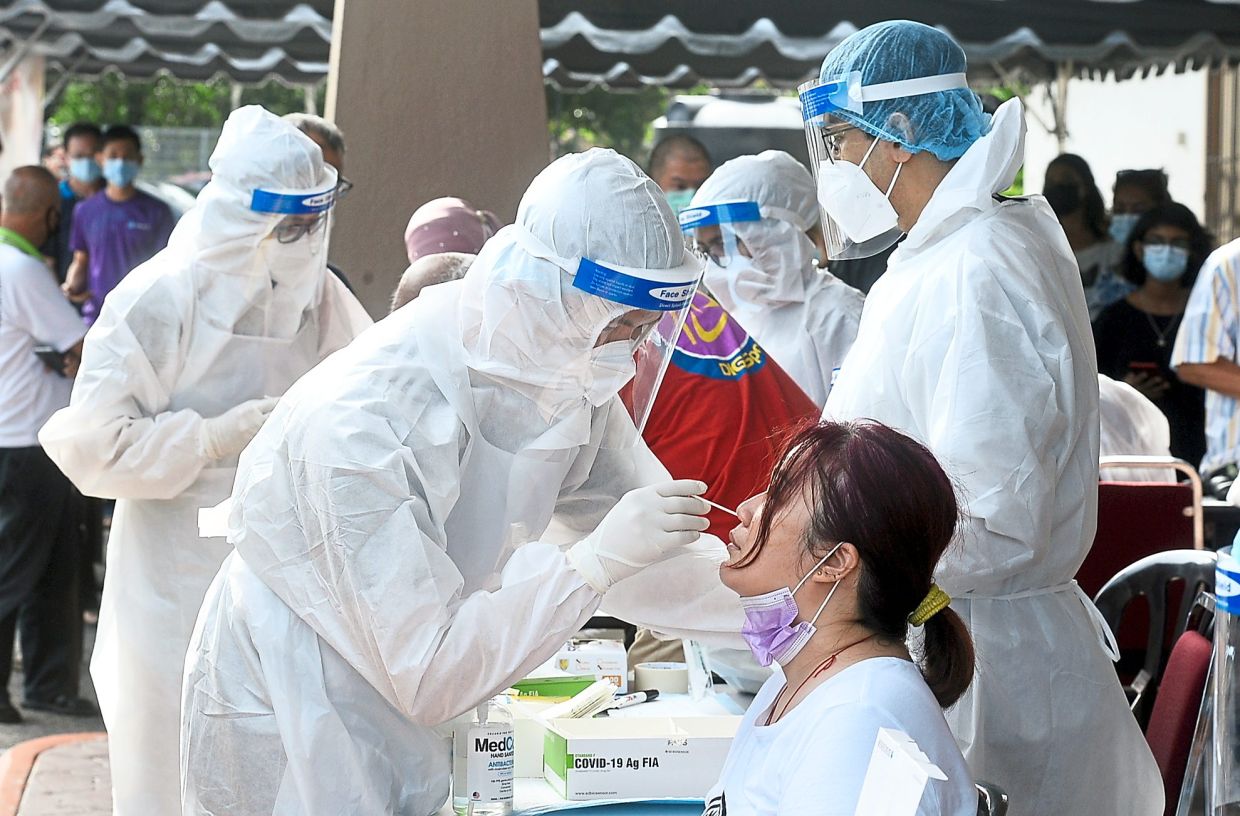
Tougher measure: It should be mandatory for employers to enforce mass targeted testing so that infectious contacts can be rapidly identified, since cases are increasingly asymptomatic. — AZHAR MAHFOF/The Star
IT has been a pretty depressing few weeks for me. I lost a former schoolmate and friend to Covid-19. Two former colleagues from The Star also succumbed to the dreadful virus.
Prominent surveyor and real estate expert Michael Geh became another casualty a week ago from complications arising from Covid-19.
His condition deteriorated 10 days after being admitted into intensive care for testing positive. He had to be intubated after his heart and kidneys weakened.
Geh was just 57 years old. The last time we met was when he attended my late father’s wake services in Penang last July.
Hardly a day passes by without me hearing news of someone I know testing positive or being admitted to the quarantine centres or private hospitals.
Friends and neighbours have also asked me to help get their acquaintances into private hospitals after they were turned away by these overflowing medical facilities.
I have only succeeded once with such requests, after a doctor friend of mine told me that the friend who sought my help “just won a lottery ticket”.
The doctor managed to get my friend a place despite hospitals brimming with Covid patients.
The harsh reality is that Malaysia is now at a truly critical stage. The opportunity for long deliberation and debate is over because we’ve wasted enough time pandering to political and economic demands.
Adding to the dire situation has been horrendous flip-flop calls and contradicting statements which have made our leaders look incompetent. If that’s not bad enough, there were big-shots and celebrities who flouted the law and unabashedly posted pictures of their dubious acts on social media.
But our healthcare system is now severely strained. Forget populist measures because we really need decisive and measured decisions to put an effective action plan together.
Flexible rules, which call for self-discipline, won’t work in Malaysia.
After all, it should be mandatory for employers to enforce mass targeted testing, so that infectious contacts can be rapidly identified, since cases are increasingly asymptomatic.
Never mind if they are just the cheaper RTK-Ag tests, so long as results are received quickly.
Malaysians seem reluctant to get tested unless they’ve come in contact with someone who tested positive, or when they need to prove they’re safe for travelling or for procedures in hospitals.
Many assume we are safe unless we have a bad fever, cough or symptoms of infection.
We also like to think that our family members are safe, so when we eat at the same table, we fail to practise the etiquette of placing a designated spoon or pair of chopsticks on every dish.
Family members, friends and colleagues are “red flags”, but because we are culturally always polite, we try to avoid this delicate and sensitive subject.
We forget the people closest to us go out to work, or to populated places like the supermarkets, and like anyone else, risk being exposed to an infected person.
Malaysians should be encouraged to stay isolated at home if they only display mild symptoms.
There’s little point in shipping asymptomatic people to Sungai Buloh and Serdang and further stretching these centres.
These medical facilities are not hospitality or catering services. Sure, the toilets can be cleaner, but stop whining about the food and services.
Our frontliners have been tasked with saving lives, and they are risking theirs daily when they go to work at these healthcare centres.
Given the Emergency powers the government wields now, it’s imperative we increase Covid-19 beds and ICUs by integrating the public and private sectors, and government-linked companies.
But these facilities amount to nothing if we’re short of doctors and nurses. Private medical personnel need to be conscripted into a national army of medical Covid-19 fighters because we’re at war. This is national service, so we must call on them.
Malaysia also needs to scale up vaccination exercises by incorporating the army, fire brigade and non-governmental organisations in affected areas, including the small towns and rural areas.
In Britain, these service men and women have also been roped in. Places of worship have even served as vaccination centres to cut down travelling and costs for people.
This is a long-haul situation which needs proper strategy. The problem won’t go away even if we impose a few rounds of lockdowns. It will only reduce the numbers momentarily, until the entire nation is vaccinated, of course.
New strains are emerging, and people who have completed their vaccination have even been infected, so these cases should serve as lessons to our planning because we all need to take care of ourselves.
There’s a lot of anger with the government because of the increasing numbers, but we share the blame, too.
We couldn’t obey two simple but effective measures – wear a face mask and avoid crowds.
Instead, we continue with unnecessary physical meetings and get-together meals. We also go shopping to kill the boredom, visit friends, and adamantly insist on Ramadan bazaars while our populist leaders accommodate demands.
But when we lose our dear ones to the pandemic or find ourselves admitted to hospital, we begin to understand better that strong measures are necessary.
It’s time to wake up from our slumber of indifference because Covid-19 cases are now affecting people we know personally, and they’re no longer mere statistics.
Voice of A Palestinian with Habib Boutros

Sampaikan Salam Aidilfitri with David Arumugam

Standing with the Palestinians
HAVING lasted 70 years, there’s every chance Israel will continue with its institutionalised violence against Palestinians, yet the United States continues to look the other way.
Even some of the most powerful countries in the Organisation of Islamic Conference are remaining silent as Israel continues to drop bombs on Palestine.
They’re simply too afraid to earn the wrath of the US. There is no Arab unity, really.
US President Joe Biden has said that Israel has the right to defend itself when “you have thousands of rockets flying into your territory, ” clearly ignoring that hostilities began following Israel security forces storming the compound of the Al-Aqsa mosque, which left many injured.
The security forces fired stun grenades and used tear gas in clashes with Palestinians.
News bytes reveal it was also the Israelis who sent an air strike which felled a 13-storey tower block in the Gaza Strip.
It was only then that the Palestinians retaliated by firing 130 missiles at Tel Aviv. Now, that’s the right to defend themselves, too, Mr President.
I’ve taken a personal interest in the plight of Palestinians since my pilgrimage to Jerusalem in 2005, which opened my eyes to what’s been happening there.
There’s an unfortunate religious misconception. Malaysians view Palestinians as Muslims. Yes, predominantly, but there are also many Christians.
Here’s another curve ball – most of the Biblical sites are in Palestine-controlled areas, including Jericho and Nazareth.
They depend on religious tourism for a living, which makes them receptive to Christians and informed of the Bible, so naturally, they welcome Christian pilgrims.
It’s normal for Palestinian leaders to attend church services on Christmas to display unity and solidarity.
My guides were a Muslim driver, Ahmad Badawi, and an Arab Christian, Jeries Farra. The latter spoke excellent Bahasa Indonesia as he often had to chaperone Indonesian pilgrims, the largest number of visitors from South-East Asia to Jerusalem. Obviously, Farra also knows the Bible well, quoting verses in Bahasa Indonesia even.
For the Malaysians, the trip was a lesson because it allowed us to draw a clearer distinction between Judaism-practising Jews and Christians.
Despite certain similarities, Jews don’t accept Jesus Christ as the Messiah. In fact, ultra-Orthodox Jews openly dismiss Christ, and they often brazenly mock Christian pilgrims, as my group and I experienced.
At the Jordan-Israeli border, young gun-toting Israeli soldiers made us wait for hours and laughed at us when we prayed for safety and easy entry into Jerusalem.
As a Christian, I hope my fellow Christians do not get carried away with believing that Jews are God’s chosen people.
My contingent became emotional when Farra spoke about the Israeli occupation of Palestinian Territories as he shared his personal experiences. When I was there, the wall separating the West Bank and Israel was being built. But what we saw broke our hearts.
As I had written previously, at checkpoints on our journey, I saw how many Palestinians, including those with babies, were sometimes made to wait for hours under the scorching sun while their documents were inspected.
Most of the time, they were openly humiliated. Hence, the simple process of re-entering their hometowns could become a six-hour ordeal, affecting their productivity, and hampering their movement.
The minority Christians also share the same anger as the Muslims because the issue isn’t about religion, but land and resources. Christians from Palestine suffer the same injustices as their Muslim brethren.
Palestinian Christians have seen their land robbed from them and they get the same treatment as their Muslim brothers when they enter Israeli-occupied areas.
And Jews are not Christians, and not all Israelis or Jews are Zionists – many are secular Jews who don’t practise Judaism and detest the way their country is run.
The danger here is that many Malaysians lump all Israelis under the category of the “hated orang Yahudi”, like how some evangelical Christians typecast all Israelis as God-fearing and righteous “God’s chosen people.” But welcome to the 21st century, where the situation isn’t that straightforward.
Rev Mitzi Raheb, a Lutheran pastor in Bethlehem, said, “The Bible originated in Palestine, not in the Bible Belt, but people in the Bible Belt read the Bible in a way that really makes our lives difficult.”
It’s disappointing that the Western media has typecast Palestinians as militants, radicals and terrorists – terms judiciously used by many news organisations.
Unfortunately, most of the world believes them because they’re supposed to be credible sources of news.
So, even when genocide is practised in eradicating Palestinians and driving them out of their land, none of these media agencies uses appropriately sensitive words like “genocide” and “forced labour” like it uses against China on the Uighur issue.
Palestinians from the West Bank cross daily into Israeli’s Green side via a barrier wall erected by the latter, in what it claims to be a protection against terrorism.
It’s the ultimate humiliation for thousands of these workers as they line up patiently to be checked and body searched before being allowed into the Israeli side for work.
In 2003, the United Nations General Assembly adopted a resolution finding the barrier to be a violation of international law and demanded its removal by a vote of 144-4 with 12 abstentions. But Israel snubbed the world.
Last week, the US blocked the UN Security Council from issuing a statement regarding the dramatically escalating violence in Israel and Palestine.
It was reported that the nixed statement followed a second council briefing from the UN’s Special Envoy for Israeli-Palestinian Peace, Tor Wennesland. It “expressed deep concern about the latest situation in Gaza, and called for an immediate cessation of hostilities, ” and further “expressed concern about the tensions and violence in East Jerusalem, especially in and around the holy sites.”
“Council members demanded immediate cessation of all acts of violence, provocation, incitement and destruction. They called for respect for international law, including international humanitarian law and the protection of civilians, ” it said.
Diplomats speaking on condition of anonymity, said the US blocked the statement because it said it wouldn’t “help de-escalate” the violence, and added Washington wouldn’t officially address the spiralling violence.
The clashes between Palestinians and Israelis will peter out simply because the latter has all the power and might. However, this turmoil is an undying flame.
To The Point with Liu Xin (Part 2)

We can run…
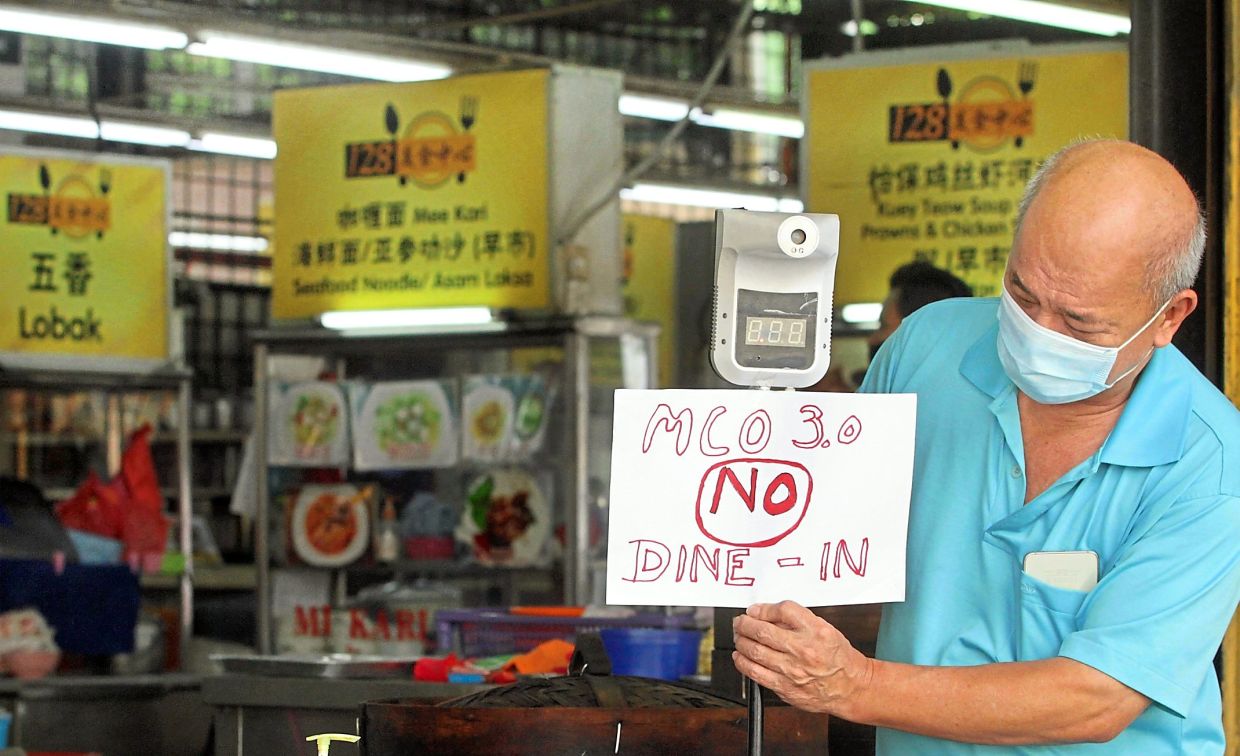
Tapau only: Under MCO 3.0, dining-in at retaurants and food courts are not allowed. — KK SHAM/The Star
IN the past week, I was invited to two government agency media dinners and meetings with two corporate figures who insisted on physical sessions.
It was just ridiculous. While I’m grateful for the thought, I had to politely decline the offers.
These meals and meetings were inconsequential. Nothing could change even if they were cancelled.
So, it was a relief when the movement control order encompassing the entire Kuala Lumpur, parts of Johor, Perak, Kedah and Terengganu was enforced from May 6 to 17.
Many of us would have preferred a much tougher measure, like the first MCO in March last year, to counter the raging Covid-19 pandemic.
The MCO 3.0 seems like a questionable measure, and it hasn’t helped assure Malaysians when our ministers make conflicting statements.
They’re at sixes and sevens, with just no coordination. What’s going on here? Come on!
By now, after a year, we would expect announcements to come with details and guidelines, but instead, we had to wait for the following day to learn how business activities would be affected.
The newsrooms of most media were flooded with enquiries from people wanting to know more.
Curiously, why should the MCO in states be made separately?
The MCO won’t get the red carpet from the business sector, particularly when it’s just finding its feet again from the last round. But this round for a clampdown is grossly overdue.
The uncontrolled crowds at some Ramadan bazaars – which were subsequently closed in many parts of KL, and elsewhere – were a recipe for disaster. The management of these bazaars certainly failed to do their jobs and must be held accountable.
The traders, including many from the low-income group and even those who lost their jobs, were only trying to make a decent living in these tough times.
But it doesn’t help that the crowds that thronged some of these crowded bazaars violated SOP, and the pictures, if they’re real, show plenty of potential for body contact.
Where were the Rela and City Hall officials meant to man the exit points?
The truth is, we have all let our guard down. As the government relaxed the rules, many of us returned to normalcy thinking the pandemic has been kept at bay.
Instead, the figures shot up, and even more disconcerting, our public hospitals have run out of beds for Covid-19 patients.
Until last week, at least, I find that many Malaysians are not taking the pandemic seriously despite the spike in the number of infections.
For whatever reason, we’re still insisting on unnecessary physical contact. I’m bewildered at all the whining because of a stricter lockdown.
When the number of positive cases shot up previously, some complained that they were inflated for “political reasons”.
With the jump this time around, some have, instead, questioned if these figures had been downplayed, and queried if the media has been ordered to tone down the issue.
But our patience is wearing thin. Our poor frontliners have been fatigued all this while because they’ve been working non-stop since last year. And still, the numbers are not coming down.
There have been so many different orders that we’ve lost count of the acronyms.
I had a close call recently. Some media friends had a buka puasa do with Communications and Multimedia Minister Datuk Saifuddin Abdullah.
I have traditionally hosted it, and those in the group have had such gatherings for years with Saifuddin, too, who has been involved in the moderation movement with other like-minded people.
Saifuddin was the chief executive officer of the Global Movement of Moderates in 2013 and I, a trustee of the government-formed foundation, have spent much time engaging with youth in promoting interracial and religious harmony.
Over nasi kandar, we asked Saifuddin why he had yet to be vaccinated like other ministers and Members of Parliament.
His reply was that he was waiting to do it together with journalists, who have been pushing for priority as frontliners.
He must have regretted his noble intention because he was found to be positive a few days later, the dreaded news coming to us via his ministry.
We all rushed to be tested, and unfortunately for one guest, he was snagged by the virus. While the prominent moderation advocate was found to be asymptomatic, he was hospitalised as he’s elderly.
Saifuddin is recovering and still texting and updating us on his condition. We pray for his and his wife’s speedy recovery at the Sungai Buloh hospital.
In Saifuddin’s case, he was infected by a staff member at his ministry, which reveals how it can be passed around so easily.
Kudos must go to Selangor Mentri Besar Datuk Seri Amiruddin Shari, who had the political will to recommend for the MCO in six districts in the state, and for ceasing the Ramadan bazaar.
We can surely expect a backlash, but he has done the right thing. It’s a warped argument for those who want the bazaars to continue because factories and bazaars can’t be compared.
Data doesn’t lie. The infections in factories have dropped with the situation contained, but the spread has been at the bazaars.
In any case, they have operated for more than 25 days, and this is the final week of the fasting period.
Amiruddin has clearly placed the safety and health of the people above personal and political popularity, unlike other politicians.
We all know we can be exposed at the Ramadan bazaars or at meetings, but we never imagine getting infected by our family members, colleagues or close friends at meals.
It’s time to be reminded to jangan ke sini, ke sana again. Let MCO 3.0 be stringent, like a real one with no flip flop decisions or flexibility. And then, we can stop singing that lockdown blues.
To The Point with Liu Xin

Smooth criminals

New rule book: Enforcement agencies and regulators, including the police and MACC, need more budget and staff to fight complex crimes involving criminals of a different kind.
THE most highly publicised crimes these days are not robberies or murders but money laundering, scams, tender rigging, corruption and financial manipulation.
Throwing the rule book out the window, the police must now investigate complex crimes involving criminals of a different kind.
Many are politicians and corporate figures highly qualified and well acquainted with the law. Yet somehow, they still got caught.
Financial crime in the last few decades has increasingly unsettled governments worldwide.
The prevalence of economically motivated crime is no doubt a serious threat to the development of economies and stability. In fact, it has even crumbled governments.
The obvious case is 1MDB, which robbed Malaysia of a colossal amount of money and made our country an international disgrace.
Almost every financial crime, in whatever guise, now has a titled person connection.
Many of these crooks obviously used their positions to participate in activities that dishonestly generate wealth. These crimes aren’t just simple corrupt practices. Some even happen in the boardroom, where exploiting insider information or acquiring another person’s property by deceit is practiced for securing material wealth, reveals the International Compliance Association.
“… there are also financial crimes that do not involve the dishonest taking of a benefit, but that protects a benefit that has already been obtained or to facilitate the taking of such benefit. An example of such conduct is where someone attempts to launder criminal proceeds of another offence in order to place the proceeds beyond the reach of the law, ” it says.
Enforcement agencies and regulators, including the police, the Malaysia Anti-Corruption Agency, Securities Commission and now the Malaysia Competition Commission, are at the forefront of the battle with these financial foes.
The police and MACC have requested more budget and staff. They need officers who understand accountancy, economics and corporate law.
When a syndicate headed by a Datuk got smashed for cornering RM3.8bil in government projects since 2014, it exposed the scale of corruption in procurement exercises.
The mastermind reportedly controlled over 150 companies that were rotated to submit tenders and quotations to government agencies.
It’s hard not to be tempted by these profit-sharing jobs when the contract includes getting a luxury car and driver thrown in, club memberships and entertainment accounts.
But for the good guys, muscle alone won’t help in apprehending devious corporate figures who know all about shell companies and, manipulating accounts and hiding vital details.
Unfortunately, experts won’t join our authorities to thwart this malady because they can get better salaries and perks in the private sector. One can only fulfil national service up to a point.
Still, we need the expertise of officers who can understand the complexities of government projects, tenders and shell companies in this corruption menace.
MACC has a staff strength of only 2,800, the lowest among enforcement agencies in the country. A bigger budget is surely in order.
MyCC is still relatively unknown to most Malaysians, and even government officers, who are unaware of the concept of bid rigging. It has around 70 officers, 30 of which are investigators. News reports reveal that almost 3,000 bidders involved in tenders worth RM5.8bil are currently under scrutiny.
MyCC is now working closely with MACC on the recent cartel case. It actively carries out operations in many states, too. Its latest success is coming down on 90 companies engaged in tenders worth almost RM30mil.
The body also busted a bid rigging cartel colluding with seven IT companies in 2019. MyCC has been touring Malaysia since 2012 to advocate the dangers of bid rigging to the public and private sectors, while also publishing many guidelines for reference.
And to make its work that much more difficult, it also faces insufficient cooperation from certain groups to provide complaints, and is forced to deal with the lack of cooperation during inquiries and investigations. So, MyCC is due greater resources, too.
While it doesn’t strike the fear the police and MACC do, MyCC targets and investigates bidders and not the organisations which issued the tenders.
The beauty of MyCC’s system is that everything is handled under one roof. It investigates, decides and punishes the infringing enterprises in the bid rigging cartel, making it a quasi-judicial body.
MyCC has the authority to dispense with enterprises part of the bid rigging cartel and affect their finances through financial penalty. Without the companies and/or sufficient money, the owner(s) will not have a vehicle to rig or manipulate tenders. And MACC can penalise the person who accepts or offers the bribe, too.
MyCC can be as effective as MACC in plugging the leak of procurement in, not only government tenders, but also private tenders. It goes after enterprises which enter or manipulate the bidding process of a tender. MACC, on the other hand, focuses on elements of vertical corruption arrangement between the government officers and bidders.
Crime fighting is completely different these days, so our enforcers deserve all the support they can get. And with their hands so full, is there even time to tackle cybercrimes?