Author Archives: wcw

Churning up political mud

THE characters in the latest, widely circula­ted sex video could have been irrelevant.

But the facts provide a different twist to the tale, especially since a federal minister and a senior political aide of a deputy minister have been implicated.

It’s no longer just another serving of pornography, especially since there’s a political plot to the script.

For most Malaysians weaned on gutter politics, this is just another reboot of a bad B-grade flick.

From a stained mattress dragged to court as evidence, to the storage of semen, and right down to the sexual prowess of politicians in “home movies”, the onslaught of filth is unending.

The only difference between then and now is that such indiscretions are now shared with a global audience because of social media.

And unfortunately for the players involved, sex sells, so all news outlets have reported heavy traffic on their portals since Muham­mad Haziq Abdul Aziz uploaded his confession on his Facebook, barely 24 hours after the explicit content singed networks.

For a while, there were attempts by an unknown group, Research Intelligence Unit, to quell the “rumour” by claiming on social media that the two men in the video were, instead, Filipino actors.

But Malaysia woke up to news of senior private secretary to Deputy Primary Industries and Commodities Minister Datuk Seri Shamsul Iskandar Mohd Akin professing he was the person in bed with the said minister.

Not long after, Datuk Seri Azmin Ali broke his silence on the allegations that he was involved in the video, calling it defamatory and an attempt to assassinate his character and destroy his political career.

Malaysians, especially from the older generation, are no longer stunned by poorly produced porn though.

In recent years, Datuk Seri Anwar Ibrahim did time for sodomy charges, which he insisted were trumped up by Prime Minister Dr Mahathir Mohamad during his first round helming the country.

Not once, but twice.

So, we had Sodomy One and its sordid sequel, Sodomy Two.

And like an unfathomable script, the two have miraculously become allies.

As a newsman, I was covering Parliament in 1992 when then Dewan Rakyat deputy speaker Datuk DP Vijandran was (pardon the pun) exposed by the late DAP MP Karpal Singh for being involved in a “blue film”.

This was in the era of the bulky video cassettes, when viewing was largely via multiple generation transferred copies.

And of course, I had Vijandran pleading to me not to run the story, and Karpal Singh telling me he was looking forward to the page 1 news.

Obviously, it ended up on the cover.

That was just the beginning, and in my 30-plus years in the newsroom, similar claims have always proliferated.

I recall camping outside Anwar’s home in 1998, against the backdrop of a soggy day and reformasi street protests, all because of that initial round of sodomy allegations.

The only straight forward incident, as I recall, was former MCA president Tan Sri Dr Chua Soi Lek’s case, in which he duly pleaded guilty.

He was bold, and man enough to take it on the chin, and admitted to the Prime Minister and Malaysians that it was him.

The rest have all embraced the proverbial vow of silence, opting instead to claim that the characters may look like them, but wasn’t them.

They probably hoped that the controversies would blow over, believing they could ride through the storm, too.

But Malaysians have now taken a different approach to such tasteless tactics.

It may have worked effectively previously, but we are also tired of these shenanigans.

After all, the pursuit is for competent lea­ders, and we are not voting for a Pope, Dalai Lama or some religious leader, who demands morality of the highest order.

Without doubt, Malaysia remains a conservative country. Many would say we are increasingly religious, or to be more precise, progressively Islamic.

Adultery is still unacceptable by all faiths, what more getting caught on video, with the person in question a politician.

The line is irreversibly crossed when it involves homosexual acts.

What people do behind closed doors is really their prerogative.

Politicians, too, are human beings, and they are, likewise, entitled to privacy.

The only difference is politicians are public figures.

They demand and enjoy the limelight, and they must also live with the bad publicity that comes with the job.

The late Singapore premier Lee Kuan Yew famously said that public figures have no private lives.

In 2012, a man resembling Azmin was front-paged with a woman having oral sex in a toilet and on a sofa, in what looked like an apartment.

Azmin, who was then Selangor Opposition Leader, flatly denied it was him.

In 2015, then PAS secretary-general Mustafa Ali, also denied that he was the person in a widely circulated video, which depicted sex with a woman.

It was much harder for this PAS lawyer as his Islamist party preaches morality, unlike other parties which don’t adopt the holier-than-thou approach.

There is also another significant difference – some of the politicians implicated then were not rising stars for bigger positions, if not, the highest office.

Their parties were not severely split because of their indiscretions, and they were merely careless individuals who literally got caught with their pants down.

So, if one aspires to hold the country’s highest post, then there are considerations.

The gravity of the issue is far greater for any federal minister who aspires to be a prime minister, because surely, his party would not accept this poor judgment call, and likely hinder his ascent.

Finally, the answer to the most asked question – is the sex video real?

Well, Haziq has admitted that he is the man in the video.

He must tell the police who was the man he had sex with.

He will be expected to divulge the time and place of the incident on May 11.

Was it at his or the other person’s room, presumably at Four Points Hotel in Sandakan?

Was it in the wee hours of May 11 before the said minister left the Sabah town, where many party supporters bid him farewell?

Then, of course, the police would want to get relevant CCTV footage from the hotel, as it would show the movements of these two people.

That would verify or kill Haziq’s claims.

Importantly though, does the police even need, or want, to investigate this matter?

Ultimately, this wreaks of a setup, since no one would believe that the video was taken or used without Haziq’s permission.

That’s the least of his worries, though, because he had better be able to back his claim.

Welcome to Bolehland, where a new day drags a new face through the political mud, even if looks can be deceiving.

One for all and all for one


THE controversy surrounding the appointment of Latheefa Koya as the new Malaysian Anti-Corruption Commission chief commissioner isn’t going away soon and can only lead to waves of discontent and suspicion.

Within the rank and file of the MACC and other government agencies, the staff is grumbling about why none of them were deemed fit to helm this very powerful body, and why a politician was, instead, picked.

Former MACC chief Tan Sri Dzulkifli Ahmad wasn’t a product of the institution either – he was from the Attorney-General’s Chambers.

Basically, an active politician has been selected to helm the position, who was a former PKR central committee member. That surely sounds like somewhere high up the pile, doesn’t it?

While some PKR leaders now in the government are tempering the issue by claiming she hadn’t been an active member, the public won’t buy this. The feisty human rights lawyer has, in fact, been very outspoken on numerous issues.

The MACC has been struggling to regain public trust and confidence, and after the general election last year, there appears to be a ray of hope.

To many sceptical Malaysians then, the MACC was dismissed as a tool of the government, which executed selected prosecutions. They saw it as an instrument to punish political opponents.

And as if to prove the naysayers right, in the investigations of the 1MDB scandal, the crime-busting body dragged its feet and even came up with justifications, in different forms, to avoid charging certain people.

It took the formation of a new government for the corruption and money-laundering charges to see the light of day. And in that process, MACC’s cleansing exercise yielded a truly professional setup.

Without doubt, public faith has been restored and the recent number of arrests and charges involving high level politicians and government officials have raised the MACC in the popularity stakes.

It’s not compulsory to select an MACC official to succeed Datuk Seri Mohd Shukri Abdull, but given her credentials, Latheefa wouldn’t struggle to learn the graft busting ropes.

It’s also a moot point in selecting a trained MACC official who lacks the gumption to take on offenders.

After all, there are Cabinet members – past and present – whose qualifications don’t match what they were or are doing. We have a dropout, and at least one deputy with dubious, or fake qualifications, holding government posts.

So, the question isn’t about Latheefa’s competence or integrity. It’s her impartiality that has come under scrutiny.

She has done her duty without fear, even when involving her party bosses. Not every budding politician, who aspires to be an elected representative, would do that, so her bravery is surely an asset.

Also, like many politicians, she seems to have hedged her bets on the faction opposing Datuk Seri Anwar Ibrahim.

The fact is, PKR is now a deeply divided party. And unfortunately, she’s not helping by training her guns on Anwar. Naturally, her appointment has led to a ruckus.

Politicians see political ghosts lurking where there could be none, and they talk of political agendas to make themselves relevant and important, when this could all just be a figment of their imagination.

But that’s how politics works. So, in a world of cloak and dagger, when Tun Dr Mahathir Mohamad said he made the appointment on his own but revealed that he did so after taking in the advice of some people, the WhatsApp service of many politicians and media went into overdrive. There was much speculation about the personalities who offered “advice” to the Prime Minister.

And this is where Latheefa must prove she is neither tool nor party to any purported scheme to stop the PKR president from succeeding Dr Mahathir as the next PM.

Let’s give her the benefit of the doubt, though, because surely she means well, and like it or not, her appointment has already been made. She knows she is being watched so she would want to live up to expectations.

There’s also another lesson here. Yes, Dr Mahathir has the authority as PM to make the appointment, but Malaysians also want to see the end of unilateral and arbitrary decisions in the new era.

Keeping Cabinet members and component leaders in the dark doesn’t reflect transparency or respect.

Dr Mahathir may be the boss, and he may not need to seek the consensus of the Cabinet, but it doesn’t hurt to at least inform its members.

Anwar revealed he only knew about Latheefa’s appointment from the announcement, just like the rest of us. It wouldn’t be wrong to conclude that the Deputy Prime Minister Datuk Seri Dr Wan Azizah Ismail was also left clueless.

According to Anwar, clearing of the air was needed for why the Cabinet was not informed. Also, the appointment was allegedly not in line with the MACC Act and violated the Pakatan Harapan election manifesto.

“Of course, clarification is required as this is what we promised, but we should only use proper forums such as in the Cabinet or the Pakatan leadership council if we want to raise and seek proper clarification.”

While Anwar has routinely said that Dr Mahathir must be given the “space and latitude” to administer his duties (and the latter has likewise constantly reassured that Anwar would succeed him), the appointment of Latheefa will certainly be a bitter one.

It’s off-putting because Latheefa has been a thorn in Anwar, Dr Wan Azizah and their loyalists’ side. Unfortunately, Anwar has no choice but to make his unhappiness known openly through the media because his faithful would expect him to do so.

Hari Raya is a season for seeking forgiveness in the true spirit of “maaf zahir dan batin”, but the appointment will leave plenty of misgivings.

We could be heroes

Everyday people do everyday things for the greater good, especially when a blind eye is cast on race and religion.

A SIMPLE story can sometimes be heart-warming and uplifting, especially when it ends happily. More so when it’s real and not a fictional video, such as those created by advertising agencies for the festive season.

Just recently, my friend Vivienne Wong and her parents, including her 87-year-old father, went shopping at Suria KLCC.

She ushered him to a seat in the Isetan department store, and reminded him not to stray, as they wanted to browse around for a bit. They were merely 9m away, and he was well within their watchful sight.

But all it took was five minutes, and he disappeared. It was the beginning of an unending, agonising day in the sprawling Suria KLCC, amid its sizable crowd.

At 4.40pm, her heart sank when she took in the empty seat where her father had been sitting. She made frantic calls to the security team, the sales assistants and friends to no avail, but fortunately, she had the presence of mind to turn to social media to seek help.

She urged the sales assistants to post the picture of her dad she had supplied, to share it with other outlets in the shopping complex. The odds were stacked against them given that her dad doesn’t use a mobile phone and is developing memory loss.

I was in Sibu when her call for help came in. She was worried that she wouldn’t be able to make a missing person’s report at the police station since it was less than 24 hours.

As the hours passed, the security supervisor, Masjelan Halim, took over the situation to support the team. He helped comb the entire KLCC, the nearby Mandarin Oriental and KL Convention Centre – all done while time had elapsed into the buka puasa hour.

He decided to forgo breaking his fast to spend the next three hours looking for my friend’s dad. For him, as the hours ticked away, and with no sign of the elderly man, the situation was becoming progressively critical.

Then, there was Andy Goh Leng Poo from Isetan’s task force department, whose duty officially ended at 7.30pm but didn’t walk away from his job.

He searched every inch of the department store – his area of jurisdiction – as well as the KLCC perimeter, including every male toilet.

Likewise, there was Annie Tee from Ecesis, a range under the Isetan Ladies brand, who made every effort to search for him, and who finally found him at the nearby six-storey Avenue K shopping mall.

It was already 9.15pm when the distressed man was spotted, and as expected, he had no recollection of why he walked away, and neither could he explain why he veered off so far.

Vivienne couldn’t have been more thankful for the good deed and sense of responsibility displayed by these three people. Likewise, her gratitude goes out to the other security guards and sales promoters who didn’t give up till the elderly man was reunited with his wife and daughter.

In the aftermath, Masjelan only managed to have a proper meal at 9.30pm, Goh found himself working past his shift and Tee had gone as far as the opposite building to look for the elderly man.

Perhaps there was nothing dramatic or even heroic in their acts, and some may even say it’s their responsibility. However, it’s still a good story to share, especially at a time when many of us prefer to talk negatively about race and religion. Surely, the onus is on us to provide a positive narrative.

There are plenty of such do-good and feel-good real-life stories involving true-blood Malaysians. These are the unsung heroes who never think their good deeds deserve mention and would be embarrassed if told.

Without politicians spewing toxic racist and religious remarks, ordinary Malaysians coexist and display great respect for each other, although we still need to work at promoting moderation and better understanding.

For the past few years, I have made it a point to host a buka puasa dinner to bring my friends and colleagues together.

Every year, my guests, Muslims and non-Muslims, look forward to this special Ramadan get-together, where we break fast and enjoy each other’s company and friendship.

My good friend, veteran journalist Datuk Kadir Jasin, also hosts a Chinese New Year open house at his residence. In a way, we’re all attempting to start new trends in making Malaysia more open, so that all ethnic festivals are truly Malaysian ones.

For the past four years, The Star Media Group, along with its partner, Yayasan Gamuda, have held The Star Golden Hearts Award (SGHA), and 2019 marks the fifth year running in honouring unsung Malaysian heroes.

The award is aimed at selecting more Malaysians who make positive contributions to the nation, particularly, helping the poor and underprivileged, though what’s more important is the fostering of unity.

The awards are handed out irrespective of colour or creed, bringing recipients together and recognising Malaysians from all walks of life for their dedication in helping those in need.

Having sat in the committee as a judge for the past four years, I have heard so many wonderful stories of how Malaysians help each other.

The Star began handing out these awards to honour those who acted heroically and/or selflessly, building bridges between different communities along the way and in doing so, promoting racial harmony and unity.

Previous winners include Sabahan Marie Christie Robert, a Kadazan who donated her liver to her former teacher, Cikgu Cheong, and Rishiwant Singh Randhawa, who sent food to orang asli affected by floods in remote areas. He also never thought twice about going off to help Syrian refugees.

Then there was Dr Rusaslina Idrus, who provided clothes and toiletries to the homeless and urban poor in the capital through Kedai Jalanan. She aided everyone regardless of their race or religion. But more importantly, she helped people in a dignified way.

Another was Kong Lan Lee, who was actively involved in helping special needs children through Persatuan Kanak-Kanak Istimewa Kajang.

Equally touching is the tale of boilerman Mohd Yusuf Rohani, who cared for his childhood Indian friend for 15 years, sending him to hospital and simply helping him out, even when he himself was not financially secure.

Fishermen Saari Mohd Nor and Low Kock Seong, who rescued eight Royal Malaysian Air Force men from a plane crash, were two other recipients of the award.

And these are merely some of the identified, and as we went through the nominations, there were just too many wonderful Malaysians from every ethnic group and religious persuasion.

I’d like to sign off this week’s column by wishing my favourite aunty, Sharah, her son Abu, my wonderful relatives in Tawau, Sabah – Fauziah and Nizam – especially, and all Muslim readers, Selamat Hari Raya, Maaf, Zahir dan Batin.

Visiting the interesting Teresang Market in Kapit, Sarawak


The Teresang Market in Kapit is where one goes to find jungle produce, local vegetables, freshwater fish and freshly-hunted game. — Photos: GLENN GUAN/The Star

There is only one practical way to reach Kapit from Sibu – a three-hour ride on the bullet-shaped express boats that streak across the waterways of the mighty Rajang, the country’s longest river. The other is to hire a light aircraft to get to this truly sleepy town in Sarawak.

No one goes there unless visiting family or conducting simple trading, farming or logging.

Kapit, a district of 15,595sq km in size, is the riverine town synonymous with Iban cultures and traditions, being Sarawak’s largest ethnic group, which makes up more than three-quarters of the state’s population.

My Sibu-based colleague said he has only been there twice, and he didn’t volunteer to accompany me on this trip up the 563km river.

“Have a good trip to Kapit. Call me when you are back in Sibu, boss. By the way, you need to wake up by 4am, as you need to be at the pier by 5.15am,” he reminded me on the eve of the excursion.


The Rajang River as seen from the Kapit Ferry Terminal.

His facial expression spoke volumes of his unwillingness to join in, and he must have wondered why on Earth would I want to make this journey to this remote place.

I have thought about visiting Teresang Market for almost a year now. I have surfed the Net and watched many videos on the exotic meat sold openly by the native traders.

Most of the footage were posted by western backpackers fascinated by the strange jungle products and animal meat on sale there.

The world-famous travel guide reference, Lonely Planet, put Kapit on the world map and recommended the market as one of the interesting places to visit.

This orang Semenanjung, whose marketing is confined only to the supermarkets in the Klang Valley, was just as intrigued.

The ride up the murky river, passing by longhouses and logging camps, was nothing to write home about. Forget about seeing crocodiles by the edge of the river. As my nephew expected, soon, all of us fell asleep.


Modern longhouses along the Rajang River.

But the excitement was reignited when other passengers woke us up when we arrived at Kapit and informed us that the famous Teresang Market was just 10 minutes away from the pier. We were advised to buy our return tickets before venturing farther. This was sound advice because if we missed the 2.30pm trip back to Sibu, we’d be staring at the prospect of putting up a night there, which didn’t have me jumping for joy.

Our chaperones probably didn’t expect us to stay for long at the market, knowing we’d complete the walk in an hour at most.

The market, which opens at 4am, sells a variety of daily necessities, but it was the wild meat which caught our attention (and the reason for the trip).


A young trader arranging locally produced beaded necklaces at the Teresang Market.

Wild boar meat sellers openly hawk their fare, although I had read that the Kapit District Council had imposed a ban on them trading within and outside the Teresang Market. But I suspect it was only a loose ban which was barely enforced. There was plenty of fresh wild boar meat on sale, as well as those that appeared to have been smoked.

Wild boar meat is a delicacy for locals, and they are allowed to hunt the animals for their own consumption, though it’s illegal to sell the meat.

Under the Wildlife Protection Ordinance 1998, it’s an offence to sell or buy wildlife or wildlife products hunted anywhere in Sarawak.

The penalty for selling wildlife products or wild meat without a licence is RM5,000, while buying wildlife trophies or wild meat comes with a RM2,000 fine.

But no one raises an eyebrow over the sale of wild boar meat as the species is not in danger of extinction, and so, is openly sold in most parts of Sabah and Sarawak.

Unsurprisingly, the local market crowd didn’t look excited, even with a stall selling two mouse deer (kancil), two swamp otters, a porcupine, and what appeared to be two sun bears.


Heartbreaking: Exotic meat – mousedeer, swamp otters, porcupine and something that looks like sun bear – being sold at the market.

I was also told that bats – live and smoked ones – were often sold at the market but I didn’t see any this time.

The animal lovers in us were seeping out of our pores – we were horrified and quite alarmed, but we didn’t want to show it.

Seeing the remnants of a wild boar is one thing, but the availability of sun bear meat (or what looked like it) is surely crossing the line.

The seller could tell from our conversations and dressing that we were from out of town. He appeared friendly and tried to explain to me what these animals were, but I barely understood him.

It didn’t help that my photographer began snapping away, unsettling the seller to the point he demanded for him to stop.

Close by was another trader selling chopped up pieces of the Borneo short-tailed python, which the Iban call ular ripong. It’s known as python breitensteini or blood python, a sub-species of the python.


A trader was selling ripong snake meat at the market that day. According to the natives, it tastes like chicken.

I have never eaten any exotic meat, and neither do I intend to, but I have also learnt not to be judgmental of natives who venture deep into the jungles to hunt for such animals for their own consumption.

And certainly, engaging in anthropological and sociological discourse is beyond me, but the sale of such meat is common in the native market.

In fact, a friend told me that I need not travel all the way to Kapit for a wild experience – I would just need to drive for 40 minutes from Kuching to the Serian market, where I’d be able to see live pythons for sale!

I saw plenty of river fishes, including the semah, lanjong and patin, but not the pricey empurau. I honestly thought I saw the biggest catfish there.

There were also stalls which sold the soft-shelled turtle or labi labi, and frogs caught in the jungles.

The Teresang visit was an eye-opener, since I also tasted some jungle fruits I had only seen for the first time.

The dabai is considered the black olive of Sarawak, but they seemed tasteless to me, although others said they taste like avocado.

Its scientific name is Canarium Odontophyllum and they grow abundantly along riverbanks in Sibu, Kapit and the Sarikei divisions of Sarawak. It’s a seasonal and highly perishable fruit with a shelf life of two to three days.

I also found plenty of mata kucing – the local variety of longan – which tasted better than the ones I plucked from the trees in Belaga, Sarawak.

Another fruit which caught my attention was the belimbing merah, the Baccaurea Angulata.

“Belimbing Merah derived its name from the colour and shape of the fruit. This red starfruit is also called ‘red raspberry’. The whitish content of the fruit is the same colour and taste as the rambai fruit,” writer Lindsay Gasik has aptly described.

Like her, I was also searching for the wild durians, durio dulcis, or the red durian, but it was not yet in season.

While I didn’t get to see and try all the jungle produce, this was certainly an amazing journey for me.

It was my first boat trip along the Rajang River, which I had only read about in my Geography textbooks in school. So, to experience the sights and smells of this unique market was almost surreal. It was also my first trip to Sibu, the famous and predominantly Fuzhou town, which has produced so many rich men in Malaysia.

My greatest takeaway is witnessing how other Malaysians live, especially those off the beaten path, ultimately providing me an enriching experience like never before.

The passing of a great singer

THE phone call came from Datuk DJ Dave at about 11pm.

He wanted to share with me the sad news that popular 70s singer Datuk Dahlan Zainuddin (pic) had died at the Selayang Hospital.

The man who sang the popular hit, Kisah Seorang Biduan, died at 9.48pm on Tuesday. He was 78.

Dahlan, was hospitalised after a stroke on May 25. It was his second time after the first in 2016, which resulted in paralysis on his left side.

I have never met Dahlan, who used to work at the marketing and advertising department of the New Straits Times, but Dave probably thought he wanted me to know about it as a newsman.

He also knows that I am a big fan of Malay songs of the 70s and 80s era. And Dahlan was certainly one of our top singers then.

Like Dave, a Punjabi, this was a time when there were many non-Malay singers, individually or in groups, who had hit songs in Bahasa Malaysia.

They sang their songs well, and more importantly, they sang it with passion and with style, as required by artistic standards.

Dave, or Irwan Shah, is now 71 years old and is superbly fit with his endless rounds of badminton. He does not take cold drinks, eats lots of fruits and vegetables and starts his day with 50 push-ups.

He calls and texts me regularly, as we share common views on moderation, and about the Malay entertainment business.

Then there is Freddie Fernandez, who used to be with the Revolvers, with their magical hit Perpisahan and Namun Ku Punya Hati.

The band comprised Halim Shahsudin, Razak Rahman, Hamid Rahim, Manan Ngah, Lim Voon Chong, Nordin Anwar and of course, Freddie.

I must have played their songs non-stop on my cassette player in my hostel room in my dorm at Universiti Kebangsaan Malaysia. It probably drove my room-mate, Calvin Kan, crazy, but I introduced him to good Malay songs.

Freddie was a Universiti Malaya economics graduate and he could sing. He looked fantastic in his white jacket and he was my hero. Incredibly, from a student fan, he is now a friend decades later.

But growing up in Penang had its privileges, so to speak. I had the opportunity to listen to legendary groups like the Alleycats and Sweet September up close and personal. They used to play at a nightspot called Carmen’s Inn at the then Hotel Merlin.

The hotel was just located directly opposite my school, St Xavier’s Institution, and even as school boys, it didn’t stop some of us from frequenting the club occasionally. We were then Fifth Formers, and we thought we were already adults.

Datuk David Arumugam and his brothers went on to produce hit after hit such as Hingga Akhir Nanti and Sekuntum Mawar Merah, and again, the band was multi-racial. There were continuous changes to the line-up but the core team were David and his brothers, Loganathan and Shunmugam, and drummer Tan Chin Hock, as well as guitarist Nazaruddin Abdullah.

Of course, Sweet September had many Xaverians in the band. They did perfect cover versions of songs by The Stylistics, in their trade mark falsetto, and naturally, when they did their Malay hits, they started a new trend – Malay songs in falsetto such as Hatiku Kau Guris Luka.

The line-up included Antonio Vincent, Dean Yusoff, Ignatius James, Adrian James and Ronnie Ng.

And how can anyone of us forget the incredible hit song Mulanya Di Sini by Freedom, and its line-up of Seha, Shuib Shaari, Abdul Ghani Karim, Mohd Nor, Richard Gomis and Mohd Nor Shariman?

Anyone growing up in the 70s, 80s and 90s, wouldn’t have missed the duo of Roy Sta Maria and Francissca Peter, when they rocked Malaysia with hit songs like Siapa Dia Sebelum Daku and Tak Kenal Maka Tak Cinta.

Another band, Headwind, headed by Zainal Abidin Mohamad – who will forever be known for his monstrous hit song, Hijau – had a line-up with Zulkifli Kasim, Nicky Ooi, Kudin and Abdul Razak Salleh.

And there was Singapore’s Flybaits, with their hit song Kenangan Lalu with band members Atan Ahamad Osman and Horace Hutapea as well as Villenguez Alfredo Valentino aka Fredo.

Some of the members now perform and live in Malaysia.

And we cannot talk about multi-racial bands of the retro era without talking about Carefree, with hits like Belaian Jiwa and Rindu Bayangan in the late 70s.

The fact that Belaian Jiwa was made a hit again in the 90s with Innuendo proves the enduring melodic quality of the songs.

The founding members were Simon Justin Leo, bassist/singer Jay Jay (Ahmad Fauzi Darus), keyboardist Charles Paiva; drummer Raja Rahman (Boy) and saxophonist/flutist Raja Rasid (Wan). The band, keeping its name, has a new line-up now.

There was Kenny, Remy and Martin – the Chinese trio that recorded songs in Malay. Kenny Tay was the choirboy-faced singer and guitarist, while Remy Loh played bass and his brother Martin played the keyboards.

In the 1980s, the trio gave us melodic, evergreen ballads such as Ku Petik Bintang Bintang and Suratan Atau Kebetulan. The melody for their monster hit Ku Petik Bintang Bintang had been written by Tay in his early 20s, and was just waiting for lyrics. And just last week, as I spent my time on YouTube on a nostalgic trip of the Malay retro era, I saw a video clip of the late Dahlan, singing with a busker outside the Sogo mall in Jalan Tunku Abdul Rahman.

Looking much older than the old pictures that I remembered him from, the video showed the busker calling out to Dahlan, who was standing in the crowd.

The busker cajoled and begged him to sing his hit song, and he sportingly agreed. As he started singing, we could see that he had not lost his passion and ability to deliver his song.

He truly enjoyed singing and got even more excited when he realised that the small crowd could actually sing along.

They recognised his hit song. It would probably be the last video clip recorded of this great singer singing.

The demise of Dahlan is not just the passing of a great singer but also the passing of an era, of a time when many non-Malay singers could deliver hit songs in Bahasa Malaysia, and bands had multi-racial Malaysian line-ups. And we actually had real good songs.

Pride and prejudice

THE United States ranks low in the credibility stakes. It can no longer wax lyrical about free trade and fair play because the world now knows that when it finds itself facing stiff competition, it uses a ruling the magnitude of a nuclear bomb to retaliate.

Firstly, US president Donald Trump declared a national emergency and barred American companies from doing business with companies deemed a national security risk.

Then, companies like Google and Microsoft stopped making software and services available to Huawei, China’s biggest smartphone vendor.

The ban essentially means that future Huawei phones will no longer get Google play apps, YouTube, and almost certainly no updates to Android Q or other platform-level upgrades since these would require Google’s sign-off, too.

Sure, you can still make calls or use WeChat and other Chinese platforms, but for users in most parts of the world, the phone is pretty much useless.

Word is that Huawei poses a security risk, but no clarification has been forthcoming to what these threats include exactly.

There is a sense of déjà vu here.

The world was once told by the US and its allies that Iraq had weapons of mass destruction, but we learnt in the end there were none. Now, we have the Iran threat, but that’s another story all together.

From what little info has trickled into the worldwide web, the suggestion is that Chinese-manufactured devices have hidden back doors that could potentially allow an attacker to gain special access.

It sounds like a script excerpt from a James Bond movie, with spooks using a master password to break into high security facilities.

But incredibly, Huawei and ZTE Corp, another telecommunications equipment manufacturer, were cleared by the US House of Representatives permanent select committee on intelligence.

The two had been accused of providing “incomplete, contradictory and evasive responses to the committee’s core concerns” during their year-long investigation on the threat they supposedly pose to American interests.

In the end, the committee found no concrete evidence of infringement. But that didn’t stop the two companies from being labelled a national security risk and getting kicked out of the US.

IS, the German internet security watchdog, inspected Huawei laboratories in Germany and found no evidence of espionage, and The New York Times quoted American officials saying that the case against the company had “no smoking gun – just a heightened concern about the firm’s rising technological dominance”.

Rightly or wrongly, in the game of perception, the US has lost its moral ground. Thanks, in many ways, to an impulsive president.

Most of the world’s population thinks the bullying of Huawei is simply Trump’s hallmark. It isn’t about a security risk, but an economic threat.

Outside China, Huawei is arguably the most successful Chinese consumer brand so far. Thanks to a good and relatively cheaper product, it is now the second largest phone vendor in the world.

One strong accusation levelled at Huawei is that it enjoys Chinese government backing, and that China uses its spies to steal US technology for these private companies.

It’s a really warped perspective because, using the same logic, why is the US president taking such a hard line against a private company that’s merely selling phones?

The answer could well lie in the technology race.

Now, it’s about who launches 5G first, the next generation of mobile broadband imminently replacing 4G.

With 5G, we will see exponentially faster download and upload speeds. Huawei is widely renowned for being 12 months ahead of its competitors in the 5G race.

It began to develop its own 5G technology as early as 2009. In 2013, Huawei hired more than 300 top experts from the wireless industry around the world and announced that they had invested US$600mil (RM2.5bil) in 5G research.

In 2016, Huawei set up a 5G product line for such devices.

What started as a three-man company now has thousands of employees engaged in 5G product development. Following this, in 2017, and then in 2018, Huawei invested almost US$1.4bil (RM5.8bil) in 5G product development.

The South China Morning Post has, however, also reported that apart from its tremendous commercial benefits, 5G – the fifth generation of mobile communication – is revolutionising military and security technology, which is partly why it has become a focal point in the US’ efforts to contain China’s rise as a tech power, and the Western nation’s allegations against Chinese companies is simply symptomatic of its insecurities.

“The future landscape of warfare and cybersecurity could be fundamentally changed by 5G.

“But experts say 5G is more susceptible to hacking than previous networks, at a time of rising security concerns and US-China tensions on various interconnected fronts that include trade, influence in the Asia-Pacific region and technological rivalry.

“These tensions provide the backdrop to controversy surrounding Huawei, the world’s largest telecoms equipment supplier.”

It’s also a fight between China and the US on who leads the artificial intelligence domain, as with 5G advancements, it means “whereas existing networks connect people to people, the next generation will connect a vast network of sensors, robots and autonomous vehicles through sophisticated artificial intelligence.

“The so-called Internet of Things will allow objects to ‘communicate’ with each other by exchanging vast volumes of data in real time, and without human intervention.

“Autonomous factories, long-distance surgery or robots preparing your breakfast – things that previously existed only in science fiction – will be made possible.

“Meanwhile, though, it is being identified by many military experts as the cornerstone of future military technology,” the newspaper reported.

As TV personality Trevor Noah says, humorously, in his show, the 5G war isn’t just about “loading an entire movie in three seconds but about the Chinese spying – which the US also wants to do.”

He sarcastically added that “the US is losing the 5G race and luckily, we have a maniac in our team who’s willing to play dirty.”

As the battle rages on, spilling into the already acrimonious US-China trade war, the controversy has become more bitter, and complicated, with the US egging its allies to ban Huawei from building its next generation of mobile phone networks. So far, Britain, Germany, Australia, New Zealand and Canada have either banned Huawei or are reviewing whether to do so.

Japan, a US ally, seems to have been dragged into the propaganda of persecuting Huawei, too.

In China, the actions against Huawei have stirred a storm of nationalism, with the Chinese calling for a boycott of iPhone, a reaction which could eventually affect other American and European products, at the rate things are escalating.

Even within the Chinese diaspora, the messages of unequivocal support for Huawei have gone viral in the world’s social media sphere.

The irony is that the iPhone is not only assembled in China, but its very inception starts in that country at a much earlier stage, and from a much deeper part of the earth, too.

At least 90% of rare earth minerals – naturally occurring solids whose combination comprises essential iPhone parts – are mined in China, notably in Mongolia, it’s reported.

“Lanthanides, scandium, yttrium and some other alien-sounding names at the bottom of the periodic table (remember your secondary school?) make the iPhone ‘light, bright and loud.’ Its colour screen, glass polishing, circuitry, speakers and vibration unit come from a mix of these rare earth minerals,” it says in Finances Online.

The report added that where American companies would take months to pool thousands of industrial engineers, and even more months to construct new assembly lines to accommodate a trivial but urgent change in an iPhone spec (say, its glass panel needing to curve to hatch on the body six weeks prior to launching), it only takes 15 days in China to do the same.

“To put it in perspective, one production line in China can assemble 72,000 iPhone 5 back plates daily; one factory can have four to five production lines and China can have as much as a hundred of these factories, opening or closing a few of them depending on the current demand.

“The last part – opening and closing plants like a mom-and-pop store – is almost impossible in an American economy.

“It is no longer a city counting the number of manufacturing plants it has, but the manufacturing plant can be counted as a city in many Asian economic zones.”

And it’s common knowledge that Mickey Mouse merchandise is made in China, and likewise all the branded sportswear sold globally. The profits these companies are raking in are simply down to the low cost of operation.

Trump should know and do better. Instead of threatening and bullying Huawei with trumped up charges, he should urge American companies to be more competitive, make better products and keep prices low.

I am dumping my iPhone, upgrading my South Korean Samsung and for the first time, getting myself a Huawei. I hear the camera is really good, and it doesn’t even need a zoom lens for magnification. And that sophistication comes from a license to thrill.

Perilous pile of plastic

AS my plane began its descent onto the runway of Rwanda International Airport in Kigali, the East African country’s capital, a crew member advised passengers to leave their plastic bags on board.

Plastic bags have been banned in Rwanda due to environmental reasons. It’s illegal to import, produce, use or sell plastic bags and plastic packaging, except within specific industries, such as medical (hospitals) and pharmaceutical.

As I lined up to have my passport checked, a large sign, which read “Use of non-biodegradable polythene bags is prohibited,” greeted me. It was the second warning.

After collecting my luggage, it was the Custom officers’ turn to search my bags, to see if I had broken the law. And if I had, the plastic items would have been confiscated and coupled with a fine of US$65 (RM271) per item.

And get this – Rwanda has implemented this law since 2008, a good 11 years ago!

Last month, Tanzania announced that polythene bags would be stripped from commercial use and household packaging from June 1, warning producers and suppliers to dispose their stock in the process.

The ban on plastic means that Tanzania will join the ranks of Kenya, Rwanda, Uganda and Burundi in mitigating the effects of plastic waste.

Meanwhile, here in Malaysia, we are grabbing international headlines for all the wrong reasons.

We rank among the top 10 worst countries for plastic waste pollution, with “most of our plastic waste dumped, a small portion burned, and an even smaller fraction recycled,” according a report.

Malaysia is also the preferred destination for dumping plastic waste, with imports from countries like the United States, Britain, Australia, Germany, France, Switzerland and New Zealand, littering our land. Ironically, these are nations which righteously and proudly lecture the world on environmental cleanliness.

It was reported in 60 Minutes that Australia had more than 71,000 tonnes of such waste shipped to Malaysia in just 12 months.

This scourge began when China, which had been importing and recycling much of the world’s plastic waste for the last 20 years, started to ban such imports at the end of 2017, citing environmental concerns.

To put it bluntly, Malaysia has earned notoriety as “the dumping ground for plastic waste” on a global scale.

Thanks to greedy Malaysians and lax enforcement, this filth has been dumped in rural areas including Jenjarom, a town in Kuala Langat, Selangor, which is now home to 17 million kg of dumped waste.

So, what are we doing about the plastic waste in Malaysia? Last October, Energy, Technology, Science, Climate Change and Environment Minister Yeo Bee Yin said Malaysia was pushing towards becoming a zero single-use plastic country by 2030.

No one expects Malaysia to impose an overnight and arbitrary decision, but the deadline is more than 10 years from now, giving the impression that there’s no great urgency in solving the problem.

It will be even harder for Yeo to push for a complete ban on plastic waste, since too many ministries and authorities are involved.

This is big money business and powerful lobbyists are at work here because the plastic waste industry is worth a staggering RM3.5bil.

Even Housing and Local Government Minister Zuraida Kamaruddin has been quoted saying that “it is rather challenging for the government to ban it entirely.”

She said ministries including Energy, Science, Technology, Environment and Climate Change; International Trade and Industry; and Water, Land and Natural Resources, had collectively agreed on the direction of the plastic waste import conundrum and its business potential.

“We cannot take this matter lightly as it provides a huge contribution to this country’s revenue,” Zuraida told the Dewan Rakyat, in response to a question by Klang MP Charles Santiago, who asked if the ministry would alter the National Solid Waste Management (SWM) Policy to ban all imported plastic waste.

However, she said there were no plans to change the SWM policy for now. In response to Santiago’s claim that there were 100 illegal plastic processing factories still operating in Klang even after the local council revoked their licences, Zuraida said a circular had already been issued to local authorities – notably those in Selangor and Penang – to shut down illegal factories.

“Since the incident was exposed, we have frozen licences to import plastic.

“Each licence application to process these plastic materials needs to get a consent letter from the ministry, and we have not approved any application since then,” she added.

Let’s not count on any swift action to reduce, if not completely ban, plastic waste from our shores.

In China, the stroke of a pen implemented the ban, so shipments were re-routed, and they are now in Malaysia.

And here, we are still hibernating and pondering how “we can phase out the import”.

Of course, no one can instil a time frame. So, for all the rhetoric and bravado, the bottom line is this – we can’t be sure if the government has the willpower to impose such a ban.

The official figures are alarming. Between January and July last year, Malaysia’s plastic waste import from its 10 biggest source-countries jumped to 456,000 tonnes from 316,600 tonnes in the whole of 2017, and 168,500 tonnes in 2016, it was reported.

In the same period, the country imported 195,444 tonnes of plastic waste from the US alone, the synthetic substance’s biggest exporter. This is double the 97,544 tonnes it took in for almost the whole of last year. Singapore exported about 19,000 tonnes of plastic waste to Malaysia last year, too.

So, what did our government do after the public outcry and international condemnation from environmental groups?

In late July, the government imposed a three-month freeze on existing approved permits (AP) for plastic waste imports, following feedback regarding their improper usage and air pollution caused by illegal plastic recycling factories.

A total of 114 recyclers with APs had their revenue stream jeopardised.

And then what happened?

Three months later, the ministry lifted the ban, citing a fear of losing out on economic benefits – and of course, now, we know more than RM3bil is at stake. Never mind its disastrous effects on the health of the people and environment.

Presumably, in a bid to display that action was taken, the government introduced tighter regulations: recyclers had to fulfil 18 new conditions before securing APs, and they’ve been forced to pay a levy of RM15 per tonne of imported plastic waste. It’s hilarious because this is chicken feed to these importers.

Legitimate recyclers – whose services are truly helping the environment – exist, but it’s unfortunate they have been lumped together with the ugly importers, and this is where the authorities must be more consistent in their enforcement efforts.

So, the harsh reality is that we are sitting on top of the world’s largest pile of plastic waste, and we don’t have the gumption to ban it, or ship it to its countries of origin because we stand to lose RM3.5bil.

The most likely outcome from all of this is, we will merely impose a higher levy, and struggle to decide on a timeline for it. And to encapsulate such inaction in an age-old phrase – this stinks!

S.M. Idris, the man who stood up for all of us

HE was simply S.M. Mohamed Idris to everyone. He didn’t need to be addressed as Tuan Idris. He didn’t even believe in being titled; he was happy being referred to as just S.M. Idris. In fact, to many, he was Uncle Idris.

The country’s iconic consumer advocate was always seen with his trademark songkok and white beard. I used to tease him about it, asking him if he slept with the headgear on as well.

He was also usually dressed in his traditional Indian dhoti and as far as I know, he was never seen in a suit and tie. If there was one other trait he was known for, it was his consistency. He drank only plain water and never touched coffee or carbonated drinks. He never smoked either. He had a disdain for modern gadgets, including the ubiquitous mobile phone. All calls to me were always made through his secretary via a landline. I have known the country’s greatest consumer advocate for more than 30 years. My relationship with the Consumers Association of Penang (CAP) president began when I was a junior reporter in Penang.

He was already known to many students then as he had the foresight to set up consumer clubs in schools to plant the seeds of the consumerism movement, at least in Penang.

There was also a special relationship bet­ween The Star, which was born in Penang, and CAP. The editorial staff of Utusan Konsumer, the CAP newsletter, shared our facilities, especially the library, and our paper also printed the newsletter. Mohamed Idris and the staff of CAP treated The Star’s office on Pitt Street (now Jalan Masjid Kapitan Keling) as their second office.

CAP had never been a one-man association, although he was the face of the movement. It was a well-staffed organisation and it wouldn’t be inaccurate to say it had more workers than some private companies.

His quest was simple – transform mindsets, especially those who chased material things – and indeed, he adopted a simple lifestyle.

“I have never celebrated my birthday but if you ask what my birthday wish will be, it’s for everyone to change the way they think.

“I hope everyone can transform their mindsets. Don’t be enslaved by materialism,” he said in an interview with The Star.

Mohamed Idris, who was born in a village in southern India on Dec 6, 1926, always highlighted everything from consumer to environmental issues, even before becoming president of the association in 1969.

He received his early education at a madrasah and Tamil school in India before accompanying his father to Penang at a young age.

He attended a Christian mission school here, but did not finish his education because of World War II.

A former Penang municipal councillor, Mohamed Idris was a respected NGO activist but said he had been involved in serving society in various political and welfare bodies since the 1950s, adding that the term NGO only became widely used in recent decades.

And long before climate change became a buzzword, he was already warning of the detrimental effects of destroying our forests and robbing our natives of their land rights and homes in Sarawak.

While he was better known as a consumer advocate, he was also a leading light in the country’s environment group Sahabat Alam Malaysia, as well as the Third World Network.

He never sought praise, but CAP’s persistent push led to the formation of the Dep­artment of Environment in 1975. CAP’s pressure and environmental work was also instrumental in getting the Penang Hill project cancelled.

CAP also successfully fought for the ban of select toxic drugs, the use of expiry labels for food and the ban on cigarette advertisements.

The association’s legacy includes advocating living an alternative consumer culture and lifestyle, supporting only basic needs, literacy, financial prudence, occupational safety and thwarting wasteful consumption, environmental degradation and unsafe products.

Part of its contribution includes training consumer groups from China, Indonesia, India, Bangladesh, Myanmar, Laos, Cambodia, Viet­nam and many others on building consumer groups and movements in their own countries.

Mostly though, Mohamed Idris will be missed by those of us who are trying to build a new Malaysia, given that his principled stand and personal sacrifices are perfectly worthy of emulation.

He stood up for what he believed in. He fought for Malaysians and never for himself, and he did it in a rational, calm and non-confrontational manner.

“Honours and recognition are not important. Sometimes, they are given for the wrong reasons and people who do excellent work are ostracised instead. Look at the universally respected public intellectual Noam Chomsky and the erudite Professor Norman Finkelstein.

“Both of them have been marginalised and ostracised in the United States by the media and the administration – Chomsky for his trenchant criticism of US foreign policy and Finkelstein, the descendant of a Holocaust survivor, for his brilliant criticism of Zionism, commercialisation of the Holocaust and the state of Israel,” he once said.

Thank you, Uncle Idris, for always standing up for all of us and lending your voice when it was needed, and while we may say farewell here, you and your contributions will never be forgotten.

Call of the wild in Uganda


The writer saw a lioness so up close he could see her ears twitch, a rare encounter even for the local guide. – Photos: WONG CHUN WAI

It wasn’t part of the plan. We were merely supposed to sit in a safari jeep and cruise on a designated path through the sprawling Queen Elizabeth National Park in Uganda.

My group of Malaysian travellers were promised the abundant sights of hippopotamus, antelopes, kob, chimpanzees, buffaloes, elephants and baboons.

The ranger said that if we were lucky, we might even see tree-climbing lions, but conceded that chances were slim. Understandably, he didn’t want to raise our expectations.

This is, after all, Uganda, not Kenya or Tanzania where the safari is much bigger and has more animals. Basically, Uganda is always under the radar when it comes to African safari game park. But we certainly got more than we bargained for.

My travelling companion, Rong, must have super bionic eyes. While travelling on the dusty trail, with most of us drowsy in the afternoon heat, he suddenly asked the ranger to stop the vehicle. He thought he’d seen a lion in the distance.


There’s nothing like seeing elephants in all their majesty in the wild.

None of us saw anything. But thanks to technology, I could snap a picture using my mobile phone. When I enlarged the picture, we could clearly see the head of a lioness, eyeing an unsuspecting animal close by. She was well camouflaged amidst the thick scrub and long grass.

We urged our ranger to drive down the slope and head towards that direction.

We were in luck, because after driving a short distance, we chanced upon the female lion. Her “meal” looked like a warthog, and it was still fresh meat.

There were no vultures or hyenas to pick on the leftovers yet. The ranger speculated that she was pregnant, trying to sound authoritative and knowledgeable, but we were thrilled out of our minds to bother listening.

The encounter was just too close and too spectacular. We could see her breathing heavily as her ears twitched to our presence, and of course, we saw her large, vigilant eyes.

She wasn’t perturbed as she sensed she wasn’t being threatened, and it helped, too, that she had just eaten.

She didn’t look intimidating, but we knew better than to push our luck. We were so close to her that we didn’t even need zoom lenses to capture this magical moment. Our handphones were good enough to take pictures and videos with.

She was a real beauty, and we instantly understood why lions are the symbols for power, aggression and might. However, the big cat displayed no intimidation tactics or growls of threat, and merely gazed at us.


The elegant kob at the Queen Elizabeth National Park in Uganda.

After being glued to the spot for a good 25 minutes, we decided it was time to leave this beautiful animal before we test her patience with our intrusion into her territory.

As we excitedly compared pictures and patted ourselves on the back, we had to tell the equally excited ranger to keep his hands on the wheel. He had earned his bragging rights, as he quickly called the other rangers to tell them what he had just seen. We were sure other vehicles would be headed in our direction.

But there was more excitement in this part of Uganda, although the 1,978sq km park is lesser known than others. The park extends from Lake George in the north-east, to Lake Edward in the south-west and includes the Kazinga Channel, which connects the two great lakes.

It’s home to 95 mammal and more than 500 bird species, and the 32-km long Kazinga Channel is the habitat to the world’s largest concentration of hippos and many Nile crocodiles, which are easily spotted along the banks.


One of the most memorable sights is the herds of elephants at the Kazinga Channel.

I took a two-hour boat ride along the edge of the channel and saw some of the most amazing and incredible scenes I have ever witnessed in my life.

I saw the giant Nile monitor lizard, said to be one of the biggest lizards, along with a wealth of bird life. The rangers patiently pointed out the different species of the feathered creatures, telling us about their unique calls. These animals were in abundance along the river.

While Queen Elizabeth Park isn’t in the same league as Masai Mara in Kenya, or the Serengeti in Tanzania, it’s home to about 2,500 elephants, 5,000 hippos and more than 10,000 buffaloes.

According to writer Matthias Mugisha, the area was first declared a game reserve in 1906, to prevent unregulated hunting, but was later gazetted as a National Park in 1952.

“Animal species such as chimpanzees and more than 600 species of birds compose a section of the large animal varieties in the park.

“Nowhere in the country can one find a park dotted with numerous craters than this park,” he wrote.


The hippopotamus is one of the most aggressive creatures in the world and is often regarded as one of the most dangerous animals in Africa.

Driving past the open fields, on the road to the channel, I lost count of the number of huge elephants we saw, their huge and mighty tusks sadly still a source of poaching.

Then, there were the olive baboons. Unsurprisingly, we were advised to keep our windows shut when we met them.

There’s no way visitors to this place could ever miss them. They were walking in groups along the stretch of road heading to the park, even coming close to the lodges where tourists stay.

They were big and they looked mean, and no one forgets their glare! Seen in packs like that, they reminded me of the nastier-looking extras from the Planet of the Apes series of movies. We were rightfully advised not to feed or be friendly with them. While they may resemble humans, they’re as wild as they come.

“Named for their green-grey coats, Olive baboons (Papio anubis) are among the most wide-ranging of the Old World monkeys, found in a strip of 25 African countries that stretch along or near the equator, nearly coast to coast.

“They can live in groups of 15 to 150, and are made up mostly of females and their young. Over a half mile stretch of road, we probably encountered at least 80 or so; most didn’t seem as excited to see us as we were to see them, but quite a few played along, posing for photos before disappearing into the forest or, at the very least, like this trio, sitting and moping in the slight but steady rain,” according to the Piran Café site.

The visit to Uganda’s Queen Elizabeth Park was supposed to be the sideshow to our main event – seeing mountain gorillas at the nearby Bwindi Impenetrable National Park, where we tracked up the dense, volcanic mountains and its rough terrain to reach these gentle giants. This is the home of the world’s remaining mountain gorilla population.

But our chance encounter with the lion, which was nothing short of up close and personal, was equally exciting and memorable.

Now, I can truly say, in the jungles, I hear the lions sleep tonight.

Paving the way ahead


Tun Dr Mahathir Mohamad

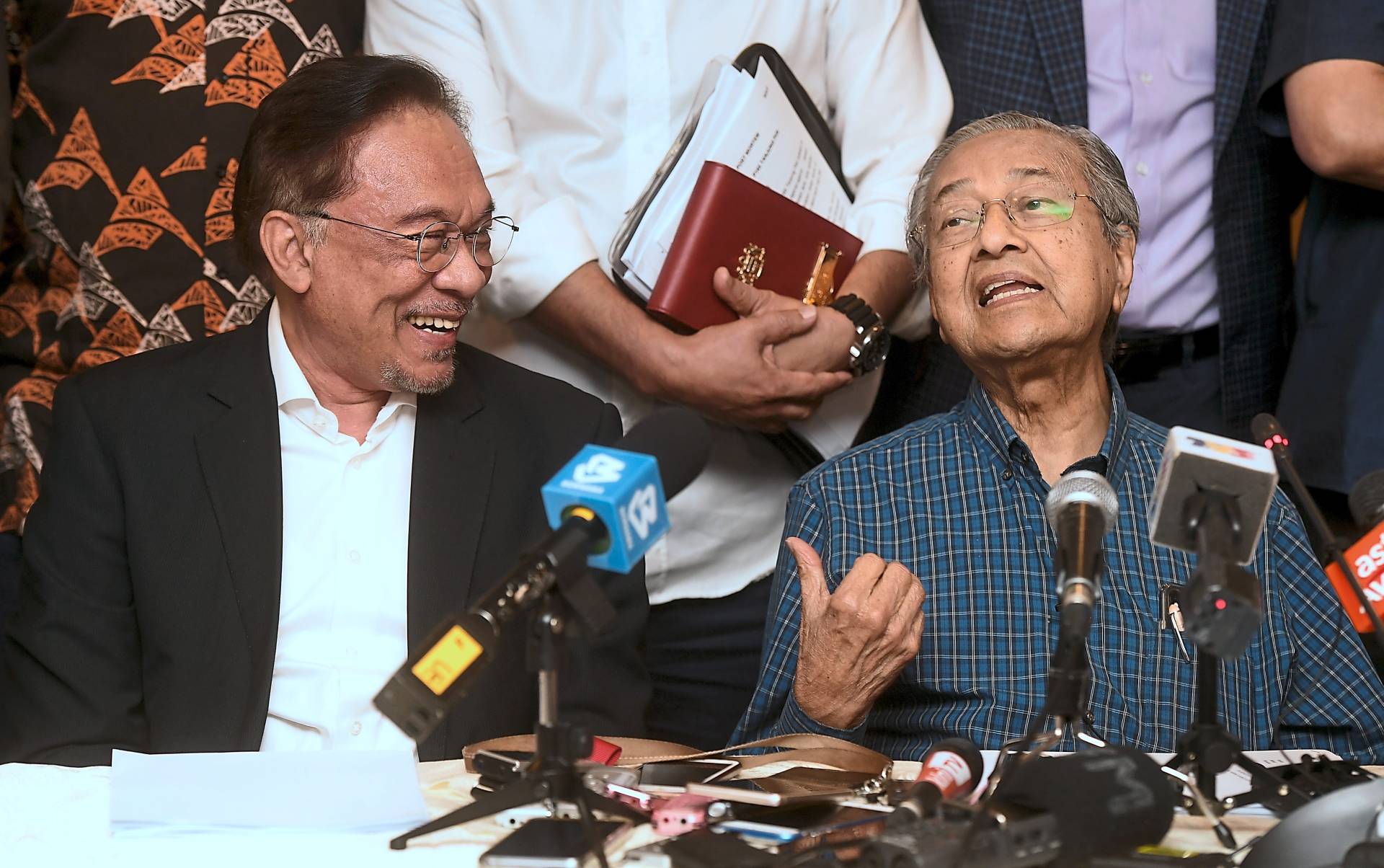
TUN Dr Mahathir Mohamad has said many times, and in different ways, too, so the message is clear and consistent – Datuk Seri Anwar Ibrahim will be his successor and there should be no doubt of this.

But for whatever reasons, the Prime Minister is constantly grilled about this by the media. Will the PKR president succeed him as Prime Minister, and when will the world’s oldest prime minister step down? This is the regular line of questioning.

It’s incredible that he has never lost his cool answering these two questions, and neither has he directed his press officers to tell the media not to bring the subject up.

So the press keeps bringing it up, and, for even stranger reasons, these repeated news reports still grab an audience.

Perhaps, many aren’t prepared to whole-heartedly embrace politicians’ sales pitches, because they often lack value in truth. There is also the little detail of the two men’s past record of bitter acrimony that still haunts their most loyal supporters.

The only thing that brought them together was their determination to end Barisan Nasional’s 60-year stranglehold, to topple Datuk Seri Najib Razak and haul him and Datin Seri Rosmah Mansor to court to face multiple charges of corruption and money laundering.

It’s no secret that the component parties made a written pact that Dr Mahathir would be PM following the May 2018 general election victory, and that Anwar would eventually take over. The only thing that wasn’t put in black and white was the time frame leading to the hand-over.

Anwar, the PKR leader with no Cabinet post, has been patient, and has kept repeating the near-obligatory line, “Dr Mahathir must be given the latitude and space”. The truth is, he has little choice but to remain the PM-in-waiting.

The speculation – resulting in perceived uncertainties – is also due to the open differences between Anwar and Datuk Seri Azmin Ali, his deputy in PKR.

But last week, Dr Mahathir Mohamad said in clear terms that he would step down as premier after two years to make way for Anwar, although in a subsequent interview, he added that it could be three years.

Dr Mahathir said that anyone who takes over from him isn’t required to adhere to his instructions or follow his example.

“He is free to do what he thinks is best as prime minister. I have no say on what happens after. My job is to prepare the country as much as possible,” he said in a special interview in conjunction with the first anniversary of the Pakatan administration on Wednesday.

Of course, those aligned to Anwar – who was sacked as deputy prime minister in 1998 by Dr Mahathir and then jailed – are insistent he take over the reins in a year.

However, there is no time frame, and curiously, this is all turning into Anwar’s advantage that Dr Mahathir be allowed to fix the many economic headaches battering the country.

Besides the eye-watering amount of money looted from the coffers, the country is facing a multi-prong attack of falling commodity prices, a shrinking ringgit, poor consumer sentiment, the outflow of funds and a weak stock market.

Adding to his plate, Dr Mahathir is forced to grapple with the inexperience, and perhaps, incompetence of some of his ministers, a mutinous civil service and a security force that has kept supporting the opposition in a series of by-elections.

If that isn’t enough, Umno and PAS have successfully played up the purported loss of Malay supremacy to the DAP – a euphemism for the Chinese – when ironically, it was the Malay leaders who stole from government bodies.

Billions of ringgit have gone missing from the Federal Land Development Authority and Lem-baga Tabung Haji in what can only be described as “jaw dropping losses”.

Those entrusted with safeguarding these assets, unfortunately, squandered them despite professing to protect the Malay race and Islam.

With a line-up of greenhorn Cabinet members, Dr Mahathir is the most likely person to fix these problems. There is the consensus that he is the only one who can reign royalty in and openly oppose them. The rest of us ordinary Malaysians may face sedition charges for posting disparaging remarks on social media.

A few days ago, Dr Mahathir reiterated that he would not see out a full term and will step aside after fixing problems his PH coalition claims it inherited after forming the federal government.

PM Mahathir, who turns 94 in two months, told a conference with the foreign media: “We will make most of the corrections within a period of two years, and after that, I think the others will have less problems to face.”

When pressed on whether he meant two years in power or from now, he replied: “I don’t know whether it is three years or two years, but I am an interim prime minister.”

As much as many Malaysians want Dr Mahathir to continue as PM, given his spike in popularity compared to his previous run as PM, we need to be realistic. Even he is realistic.

He turns 95 next year, and he’s only human. So he is subject to the same biological and ageing processes as any one of us, although at 94 now, he can put many 49-year-olds to shame.

If he completes the full five-year term, he will be 98 years old, and I don’t think anyone in his right mind expects him to serve the full five years, or even four years.

Next year is Malaysia’s turn to host the Asia Pacific Economic Cooperation (Apec) summit, where the world’s most powerful leaders, including US President Donald Trump, Russian president Vladimir Putin and Chinese premier Xi Jinping, will attend the historic meeting in Kuala Lumpur.

Dr Mahathir will play host, and certainly, we expect him to want to take centre stage at this global event with these giant figures and revel in the moment. It will be decades before KL has another chance to welcome this economic showpiece, which takes place in November this time around.

Many events are lined up for the run-up to the Apec summit, and 2020 is certainly a year to galvanise the country as it’s also Visit Malaysia Year.

The only nagging question is how much has been done to prepare ourselves for the Big Show. It’s also one befitting Dr Mahathir, as he prepares himself to pass the baton to Anwar.

Dr Mahathir has said that he will not reshuffle the Cabinet. He should have though, as he would be able to better use the expertise, talents and skills of his ministers. Some are not cut out for certain portfolios, because of their personalities, lack of social and linguistic skills, and even interest.

The Cabinet was hastily cobbled together, and surely a year later, it has become obvious to Malaysians who the performers and non-performers are. We may be wrong in our evaluations, but politics is all about perception.

The surveys so far conducted are based on public sentiment, even if many members of society lack the full details of the back stories.

In any company, the probation period for a new employee is anywhere between three and six months, but politicians seem to have special rules. After all, this is the only profession where no experience or proof of education is required. The public gets arrested and jailed for using fake qualifications, but that conveniently doesn’t apply to ministers.

Every company has a succession plan where potential candidates are named to take over a position, and if that doesn’t pan out, the company then looks for one, even if that means turning to head-hunters.

The risk management team reports the implications of not having clear lines of leadership.

But in Malaysia, we have a 94-year-old leader, with a mixed line up ministers, some would say, motley and mismatched, right down to a 26-year-old serving his first term as MP.

And the designated successor has no Cabinet post or key role in the federal government. In Malaysia, the strangest things can be made to make sense.