Monthly Archives: April 2008

Perk up service with better perks

The parliamentary committee on corruption, to comprise representatives of the Barisan Nasional and Pakatan Rakyat, is also moving in the right direction.

Beefing up the ACA workforce and adding another 90 lawyers as Assistant Public Prosecutors to assist the Deputy Public Prosecutors to expedite the handling of cases in the lower cases all help in the quest for justice.

But at the same time, the Government must seriously look at the salary structure of our civil servants, especially the law enforcement agencies such as the police, army and Customs department.

The extra allowances, especially for the police constables, have helped them meet the increasing cost of living better but they do not make up part of the fixed salaries, so when these officers retire, the allowances don’t count.

For high-ranking officers, their salaries are decent, even comparable with the private sector, but given the tasks they handle, it is, again, nothing to shout about.

The Inspector-General of Police Tan Sri Musa Hassan almost never has a day off, even on Hari Raya, and has had his leave forfeited for years.

For many police constables, it is a struggle to feed the family. Some, which we have become familiar with, resort to lurking behind trees and setting up questionable roadblocks with speed traps to pounce on unsuspecting errant motorists.

Many in the Klang Valley and Johor Baru take up part-time jobs and become taxi drivers, security guards, bodyguards and pasar malam traders. That’s the reality.

For clean cops, taking their children to fast-food outlets is a luxury, they will tell you.

Of course, there’s another group of corrupt officials – those who want to live lavish lifestyles, even excessively extravagant lives, and have more than one family.

Their living standard is incongruous with their pay scales – unless they are so good at the stock market.

For the ACA to work effectively, the Government needs to review the salary structure.

Good salaries attract good officers; right now, many are not civil and neither do they see themselves as servants to the public.

Make it financially attractive for Malaysians to serve the Government and it will cut down financial costs that are often passed on to the taxpayers as projects are delayed and become expensive.

The culture of kickbacks, essentially bribery, between the public and private sector has become entrenched with many foreign investors openly running us down, with disdain, at our shameful practice.

Cabinet Ministers, too, deserve better pay – like their Singaporean counterparts – to encourage good, qualified, ethical and decent people to take part in politics.

Of course, there will always be greedy people. For them, no amount of money is sufficient but, generally, professionals would not risk their reputation and dignity by being corrupt if they are comfortably off.

In Hong Kong, Taiwan and Singapore, the civil servants are well paid and the punishment for those caught is severe. That’s a good deal.

The fight against corruption has to run parallel with a better salary scheme for civil servants, especially the law enforcement officers.

The latter is a special category; no other civil servant should compare himself with those in these high-risk jobs.

An amnesty period may not be popular with most Malaysians but a fresh start, instead of a witch-hunt, would be more effective.

We want politicians to commit themselves to this initiative to fight corruption.

Many are no doubt feeling uneasy with Datuk Seri Abdullah Ahmad Badawi’s reforms but the Prime Minister needs the backing of his party leaders to make it work. Unfortunately, the perception is that many Umno politicians lack the credibility to fight bribery.

Cafe Latte with the Home Minister: Homing in on Home issues

Sunday April 20, 2008

Datuk Seri Syed Hamid Albar is responsible for one of the most important, if not powerful, ministries in the Cabinet. Speaking to The Star’s Group Chief Editor Datuk Wong Chun Wai, the senior politician talked about his tasks from heading law enforcement agencies to deciding on the role of the media, his upcoming plans for the ministry, Umno, and the country's political outlook.

What are your plans for the Home Ministry?

Syed Hamid: The Home Ministry is the second biggest with a staff of 159,000. I think the most interesting part of it is bringing it into its original state. We are undertaking the merging exercise of both the Internal and Home Ministries. Now we are more open to public scrutiny. This is a challenging and interesting ministry and it’s close to the people's hearts.

If you talk on matters of immigration, visas, passports, the National Registration Department, permanent residence and citizenship status, all are in the limelight.

In the case of newspapers, you have the licensing. I'm conscious of a lot of things that need to be adjusted. A few people have spoken about our successes in implementing the delivery system. One thing that is crystal clear about the Home Ministry is that things are moving very fast now, like the issuance of passports. The ministry is like a ministry of “till death do us part” – from the registration of death in one section, the other section is freedom.

You are holding the portfolio of one of most powerful ministries. In the changing political scenario in Malaysia, how do you see yourself handling this portfolio?

Since Pak Lah came to power, there has been a paradigm shift. We try to be more liberal and free, but at a cost, because our intention of creating a harmonious and peaceful society is still in the process of being moulded. It's tough. I consider it challenging because as a person who believes in due process and freedom, whatever I do, I will search my conscience first.

Public rallies or demonstrations create public debate and excitement. I will not interfere. I will ask the police to access it and see the perception of their threat to national security, peace and public order. We are just like being on a trapeze. We provide the balance and we do want freedom. But we also fear the consequences if we keep on inciting and adding fuel to the fire and that will not help. My thinking is that we are not going to control you (media).

One factor behind why the Barisan Nasional did badly in the recent elections was the issue of the Government not being able to tackle crime. Even as the police want to hire more personnel, the Government needs to race against time to stop this problem. It's still a lingering concern of the Government.

It's a question of whether you believe in absolute numbers, whether you believe in percentages or in relative comparison with other countries. On that score, we have done very well. We need the public to have confidence in the police. Most importantly, the force must be more visible and be seen as a protector of the people. The thing that jeopardises our efforts is the question of high-profile cases. We need to solve them.

We have improved anti-crime efforts through Rakan Cop and community policing at the police station or district level. These have produced results. I want to see the police improve their overall performance through better pay, welfare and assets. The police don't even have enough MPVs. I’ve told the ministry to get these things done.
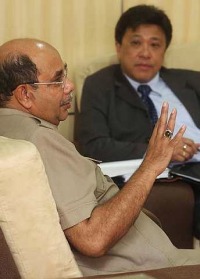
No holds barred: Syed Hamid expressing his thoughts freely with Wong during the Cafe Latte Chat last week.

For KL International Airport, security is under the Malaysia Airports Bhd. I’ve decided that this place is an important target area, which the ministry has gazetted, so we want to be involved. On the recent robbery there, the transfer of money to the moneychangers is being done in the millions, they’ve been doing it quietly. This time it’s an inside job. The worst part of it, for example, is that only 30% of the CCTVs are working. You can’t have that. The static CCTVs were also not turned on and you cannot replay the recordings. I said this is ridiculous. I’ve given instructions. We are going to have special units at the airport. It's done that way all over the world. I've also asked for a discussion about this with the Transport Minister.

The Chinese community is not happy with the police. We need to have more Chinese officers. We have asked, but not many want to join. We have to go on another campaign. We asked that we take action on secret societies. I said I don’t like detention orders. I want them to be charged in the courts. But they told me the witnesses are not willing to talk. Now we taking in retired soldiers. The police are doing many things including moving people to fill up the posts. I told them it’s still not enough. Let’s try and see how we can revamp and see how to give the best service.

One way for the Government to lighten the burden of the police is by employing volunteer policemen to do simple crowd control like they do in the United Kingdom, where the community police are involved in crowd control. Can that be done here?

It’s not as simple as that. For example, people who have been placed under restricted residence for drug offences are being put under observation by the police, especially by the anti-narcotics department. The police have to do that. I’m trying to get the anti-narcotics agency to study this. Our drug problem is that we have 10,000 undergoing rehabilitation while 300,000 are in the anti-drug community programme. The police have to observe all these people. We need to get more volunteers. We are utilising Rela and Immigration Department officers along with the police.

But many Rela officers are not well trained, as seen in several negative incidents reported in the past.

We have got 500,000 Rela members. The Rela is a good concept because it is a multi-racial organisation. We now use smaller trained units, not the ordinary Rela personnel, because of a lot of complaints before this. We are giving a lot of emphasis on training. We still need a lot of public feedback on how to improve Rela.

What are you going to do about the influx of illegal foreigners in Malaysia?

Malaysia cannot take more foreign workers. There are three million of them here and at least one million are illegal. Everyone is asking for new workers to be brought in. I think it’s wrong. People are complaining to me from all sides. I think we must have a certain minimum wage for workers. Otherwise we will continue to see foreigners as security guards, lift attendants and restaurant workers. I asked (MIC president) Datuk Seri S. Samy Vellu why so many young Indians are unemployed, but yet there are young barbers coming in from India? Can’t you train Malaysian Indians? He got angry with me. The Indians have a lot of social problems because they are unemployed. So why can’t we train our own people? Have we actually searched enough for our own people?

Is there a timeline for these plans?

Taiwan has a population of 23 million, whereas the number of foreign workers is only 400,000, and it's a very competitive country. We need to look at our salary structure. Part of the problem is also our political problem. You must think of your country, we are our own stakeholders. We must stick to the rules that professional foreign workers work here for 10 years and five for unskilled workers and not more, and they should be sent back. In Singapore it’s two years. Sometimes these foreign workers leave their children here. We have stateless persons –people without documents – and their country of origin don't want them back. We're stuck. I'm addressing this. Malaysians must recognise that.

Public perception about the huge number of illegal immigrants here is it’s due to corruption and bad enforcement. What's your take on this argument?

That is a possibility. We have long maritime borders, over 3,000km long, and the land is porous. I've asked all our enforcement agencies to look for the source and kill the demand, which means that we can tackle the illegal immigration problem from both sides. Otherwise we cannot succeed. We need public cooperation too. A lot of people use shortcuts (in employing illegal foreign workers) because they can pay low wages; they don't have to pay Socso or EPF benefits. The matter of tackling illegal immigration should be made a Malaysian agenda because it's for the good of the country.

Does the experience of having served in so many ministries make you more than qualified to become Home Minister?

Usually this portfolio is held by the Prime Minister and the Deputy Prime Minister because the ministry handles a lot of sensitive issues. The foreign diplomats met me recently and said the thing that kept people very happy and that the country is okay is when I was appointed Home Minister. That is quite nice to hear. People see that I'm a tough person but at the same time I’m fair. I've never taken emotions or sentiments into my decision-making process.

You are the first Home Minister who is not Prime Minister or Deputy Prime Minister since Tan Sri Ghazali Shafie held that post.

He was the last Home Minister. The other part is that I also don't have political ambitions. I'm not an Umno vice-president and I don't seem to be aspiring for anything. I've never considered a job as part of the party position. I'm in the old school mould – I think people should recognise me for what I can do. Pak Lah sees me and thinks: “This guy works hard.” My wife always tells me that I'm a workaholic.

One month after the general election, the public perceive, rightly or wrongly, that Umno has not changed in the way it tackles issues.

Umno has not found its direction. It's still in a state of shock and there's the infighting within the party. We have produced different cultures and values. I'm not surprised the public is watching with dismay the squabble in the party and calls for the leaders to step down, which is not the Umno style. If there is any problem and when one wants to bring down the leaders, it's done very subtly. It's a new culture.

People must recognise that we have moved away from the elections. We have to start doing something that the public wants, and we have quite a number of issues that we need to tackle. It should be that Umno leaders are serving the public; we don't want abuse of power and we are not corrupt. When we talk about corruption, we must be whiter than white.

The message is to teach us a lesson. The non-Malays were dissatisfied with Umno; everyone is blaming Umno. But everyone has got a share in tackling these things, especially in the Barisan.

The Barisan has not come together cohesively because the component parties suffered badly.

The Pakatan Rakyat governments have introduced a lot of populist decisions. How does Umno intend to counter these with its own reforms?

On the giving of land titles in Perak, we have issued over 50,000 titles but that is actually an accumulation over time. You don't see that but when it's a new thing, people can see straight away and pick these things up. It's because you're not being judged yet. You are starting on a clean sheet.

We have done so much and yet the people rejected us. We planted the trees and now they are bearing fruit and other people are plucking them. Our problem is that we didn't package ourselves well, and in this election, there were a lot of issues that we didn't address properly, like crime, tackling corruption and countering allegations of bloggers, where all sort of things tend to become the truth.

The sentiment is that Umno as the biggest party has a chance to represent Malaysians. Why does it choose to talk about Malay issues only, when it can talk about Malaysian issues and represent everyone?

Since independence, Umno has always represented everyone. It has done very well for everybody – the current policies; the economic growth of non-Malays has been very good. Sometimes when we emphasise things, it's as if it's for the Malays.

During the NEP process, for example, the economic growth rate and equity ownership of the non-Malays was bigger than during the British administration period. We need to realign our policies. We need to help the people who are left behind. I feel Umno has done so much to create a multi-racial society. Otherwise this country will be in turmoil and it will become a failed state. The Chinese schools are better now than before.

The industries are controlled by non-Malays, but the non-Malays have not taken their money out. Instead they have reinvested into the country. They are Malaysians. Let's make the country grow. Unfortunately, when you start to talk of the NEP, it's about the Malays. No, NEP is for everyone – problems affecting the Malays, the Chinese and Indians are a national problem.

Don't you think that now is a good chance to overhaul and repackage the policies?

They have to repackage. An example such as the eradication of poverty has succeeded across racial lines. We can say that we have a national economic policy or the Wawasan economic policy. People say it's only the Malays who are benefiting, that the ketuanan Melayu (Malay dominance) concept is a Malay concept. My Chinese friends told me: How can you say ketuanan Melayu when they were born and lived here for 50, 60 years.

I think we need to mould the concept properly that this is Malaysia and it should be recognised that they are indigenous and we have built the country together. When we want to move forward, we have to work together. But we cannot work together from a racial perspective. My idea, and I told (Deputy Prime Minister) Datuk Seri Najib Tun Razak the other day about this, is that we need to reinvent or revisit the ways that we do things as a political party.

Do you see Barisan becoming a single entity gradually?

We need to, but we need to also revisit the power-sharing concept. The Pakatan Rakyat used our concept. But they are a coalition formed after the elections. They are not bound by strictures of accommodation and compromises, which will make everyone unhappy. The only compromise they made was not contesting against each other – a PAS or PKR candidate for a Malay area, the DAP for Chinese area, the Indian representatives go to mixed areas. They are improvising what we have done.

But what you are suggesting is very difficult (to implement). You need to introduce a new way of looking at things. The role of the media is also important. The media is still arguing on the basis of race. It's very difficult – the media is saying that this community is not benefiting. I read the Tamil papers: it's terrible. I was looking at the number of arrests – there are quite a number of Malays who have been put to trial for treason, put under the Internal Security Act and hanged because of extremism.

There is no place for extremism in this country. Of about 50-over ISA detainees, over 40 of them are Jemaah Islamiah members and some have been held for six years. This is not about an ethnic issue. It's because of what extremism can bring. Extremism is like a spark – when you cannot control it, it will become very bad.

The game of politics is about presenting populist ideas. So far I've not been successful in bringing forward my suggestions. I've suggested that the Government should give this or that. I'll also suggest that the bottom 15% of the poor should receive free schooling and university scholarships.

I once suggested that we should have an anti-corruption body like Hong Kong's Independent Commission Against Corruption, and judges should be given back their integrity and credibility. – Transcribed by ZULKIFLI RAHMAN


Time for all of us to move on

ON THE BEAT with WONG CHUN WAI


THE general election results would have been very much different if the Barisan Nasional government had acted on certain matters earlier.

Last week, the Prime Minister announced the setting up of a Judicial Appointments Commission.

Promising reforms in the judiciary, Datuk Seri Abdullah Ahmad Badawi also said ex-gratia payments would be made to the judges who were sacked or suspended in the 1988 judicial crisis.

The decision will certainly help to restore confidence in the judiciary, maybe not overnight, but important steps have been taken.

It was also the closure of one of the darkest chapters in our country’s history. It’s now time to move on.

Surely it has not been easy for Abdullah as there were leaders who expressed their reservations, if not disappointment, at his decision.

There were concerns, even within the Cabinet, that the decision could split Umno further as supporters of his predecessor would not be comfortable, and even alienate Abdullah further.

Even some of his supporters asked if this was correct, given the massive loss in votes during the polls when voters punished Abdullah’s administration over the V.K. Lingam video clip issue. It was the Prime Minister who allowed the public inquiry and he paid heavily for the decision.

Then, there are those who feel the announcements were no more than “political cosmetics” by the Barisan to make up for the loss in the polls.

But the move to reform the judiciary must go beyond politics. DAP chairman Karpal Singh said the Opposition was prepared to support the Government in providing two-thirds majority required to amend the Federal Constitution.

The Bar Council and Government have also rightly invited Opposition Leader Datin Seri Dr Wan Azizah to the dinner last week.

But there will be plenty of work to do. The criteria and scope of the judicial commission would have to be drawn up and made known.

While legal experts, judges and lawyers would make up the board, the Government should also pick representatives from non-governmental organisations.

Minister in the Prime Minister’s Department Datuk Zaid Ibrahim said consultations would possibly involve former Lord President Tun Salleh Abas.

There was also another piece of good news – Datuk Seri Mohamed Nazri Abdul Aziz reportedly said the Anti-Corruption Agency wants to be independent and has suggested it should operate like the Hong Kong Independent Commission Against Corruption.

It was reported that the Minister in the Prime Minister’s Department and ACA director-general Datuk Ahmad Said had seen Abdullah over the proposal.

There is no reason why the Government should not support the proposal. The leaders have nothing to worry about if they are clean.

The public has long called for the independence of the ACA and that is what a credible anti-graft agency should have. Its work in weeding out corruption should not be meddled with by politicians.

Malaysians are not impressed with statements like the ACA also probed a RM9.90 bribe. Please! We are more interested in bribes ranging from RM9mil to RM90mil and more.

One popular dinner conversation among businessmen in Malaysia is why certain projects are allegedly over-priced and why taxpayers should be burdened with these extra costs from kickbacks.

Down the line, among ordinary wage earners and traders, we hear about corruption involving enforcement workers from the Customs and police to the local councils.

These lower rung government officers feel they should ask for some coffee money if the “jaws” are getting away with it.

And among Umno delegates, the word often used is money politics but seriously, it’s just a euphemism for corruption. Let’s not kid ourselves with the juggling of words for vote buying.

Malaysians also want to see a pro-active ACA which does not wait for reports to be lodged before it carries out investigations. And certainly broad terms like “abuses of power” have long confused Malaysians, who see them as punitive action against political rivals.

Abdullah needs to carry out these reforms quickly if the Barisan is to stay relevant in the next four years.

The pledges to reform the judiciary and to fight corruption were part of his 2004 election promises.

Malaysians are glad that he has finally started to carry them out.

Like a bull in a china shop

IT’S a terrible loss of face. For the Chinese government that is preparing for the biggest celebration of the New China, it must surely have felt the protests as an affront to the country.

The protests against China have certainly hurt the mainlanders but it would not be wrong to suggest that Chinese all over the world suspect that the demonstrations are planned to humiliate China.

Singapore Prime Minister Lee Hsien Loong said whatever the intentions of the demonstrations, the people of China believed that the protesters wanted to inflict the maximum humiliation on China and the Chinese people more than the Chinese government.

He warned yesterday that the recent protests along the Olympic torch relay had angered the Chinese people and would create “consequences” beyond the Games themselves.

Lee said it was a pity that the West could not understand the postings on the Internet from young Chinese, that “these displays of contempt for China and things Chinese” would have its impact well beyond the Games in August.

It doesn’t help that most countries depend on Western news agencies and news network for their coverage of the torch relay, and the sentiment is that the coverage is seemingly anti-China. The interviews have always been with pro-Tibetan protesters and hardly, if any, with pro-China protesters. Likewise the visuals on international news network, especially the CNN and the pro-right Fox News.

It doesn’t help that China seems unable to come up with a sophisticated public relations exercise, relying mostly on its Foreign Ministry spokesperson who has failed to project a refined and mature side of China.

Speaking entirely in Chinese at press briefings, surely Chinese leaders should realise that the rest of the world also want to hear directly from them, not via the translation of the newscaster.

China has its own CCTV station and those who had followed the protests in Tibet would have caught footages of riots, including attacks by Tibetans on Chinese, which have somehow been omitted by the Western media.

And it doesn’t help that the coverage by China on the Dalai Lama has been biased, emphasising too much on physical development without tackling the issues of the disappearing Tibetan culture, with allegations of a cultural genocide.

Neither has China helped its cause when its people resort to racial tones with criticisms that Tibetans are unproductive, aggressive and unappreciative of what China has done for them or high-handed talk of “crushing the rioters”.

One Australian journalist, Michael Backman, writing in The Age, said he received threats for “providing viewpoints that run counter to prevailing wisdom”.

He had highlighted some aspects of the Dalai Lama that most media reports ignore: the fact that in running his government in exile, he has been extraordinarily nepotistic by appointing many relatives to senior positions. He went a step further, accusing the Dalai Lama of being on the CIA payroll.

The murders of Chinese by Tibetans, he argued, were racially based attacks, comparing it to the 1998 riots in Jakarta. He said in Lhasa recently, four Chinese girls were burned alive when a clothing store in which they worked was set alight by Tibetan protesters.

The article, written in conjunction with his visit to Australia last year, was to counterbalance “the huge uncritical media coverage given to the Dalai Lama” at that time, which Backman said “has been excessively favourable and uncritical”.

In an article which the Western media missed – the real Tibet story on April 9 – Backman wrote that “China genuinely believes that Tibet has long been a part of China. The Tibetans genuinely believe the opposite.”

He argued that many rich Western travellers would prefer Tibet to stay stuck in the Middle Ages for their own personal enjoyment, “much in the same way economic sanctions have preserved Burma as the world’s largest living museum”.

He commented that “the vested interests that surround the Tibet issue are many and make it a great deal more complicated than simple slogans such as ‘Free Tibet’ suggests”.

It is not incredulous that Backman has been threatened. The mood, especially in Western countries, is against China and it has been never been easy to go against the flow of public sentiment. It is normal for people to hear what they want to hear and Backman, as a Western journalist, does so at the risk of being unpopular.

But the fact is that China has opened up to the world in recent years. By all purposes, it has embraced the capitalistic system.

For most Asians, the mainlanders have become overly materialistic and the manner some of the rich Chinese flout their wealth has irked many Asians.

With the explosive expansion of the middle class, it would only be a matter of time before the young demand democracy. Communism has to end in China eventually but certainly not the Russian way, as the West would want, which has disintegrated the Soviet Union.

China also cannot run away from the Tibet issue and, at some point, it should offer Tibet autonomy status, at least, as it has done for the predominantly Muslim province of Xinjiang.

As the saying goes, be careful what you wish for. In the case of China, the opening ceremony on Aug 8, 2008, at 8 minutes, 8 seconds to 8pm, does not seem too prosperous now.

The old ways must go

LET’S give credit where credit is due. With a stroke of the pen, Perak Mentri Besar Mohammad Nizar Jamaluddin has approved permanent land titles for new villages and planned villages.

True, the villagers may not get their titles overnight because surveys have to be carried out to determine land size before the titles can be issued. But the point is the people will be more secure now that the new state government has made a decision about their homes, which they have lived in since 1948.

The populist move by the Pakatan Rakyat government will surely make the fight for the hearts and minds of Malaysians with Barisan Nasional more competitive.

The new governments of Perak, Selangor and Penang, in particular, have also given power-sharing a new dimension among the major races.

The three parties of Pakatan Rakyat have come out with well-accepted line-ups, reflecting representation of the main ethnic groups. In one or two instances, the formula was more meaningful than under the previous Barisan state governments.

Fair decisions

In Penang, an Indian state assemblyman is a Deputy Chief Minister and there is talk that a Chinese may even be made Speaker of the Selangor State Legislature.

In Perak, PAS has been given the powerful Mentri Besar’s post although the other two parties have more seats combined.

In short, if these new state governments continue to make fair and popular decisions, the task of wresting these states back will become more difficult for Barisan, especially when there is no racial backlash to these decisions.

The March 8 election results serve a lesson not just for Barisan, which suffered a massive setback, but also to Pakatan Rakyat.

One, PAS has now adopted a more realistic approach by putting aside its agenda of setting up an Islamic state and implementing hudud laws.

Younger leaders such as party secretary-general Datuk Kamaruddin Jaafar are good moderating forces, and would wrestle with the party elders to meet the new demands of Malaysians.

Given the acceptance of the Islamist party by non-Muslims and vice-versa, and the Malays to the DAP, these opposition parties would have to adopt politics of accommodation, which Barisan parties have long practised.

For Barisan, the three main parties of Umno, MCA and MIC must accept the fact that they can no longer be too fixed on communal interests.

Umno, for example, should not be too constrained with Malay concerns to the point that its other loyal partners in Barisan are put in a spot. Sometimes, these concerns are merely imaginary.

Take the case of the Perak new villages, which was a bold decision by Nizar. In a pre-March 8 scenario, Umno could possibly be reluctant to be so generous and would have taken into account Malay concerns on such concessions.

The result is that the Barisan parties ended up tying themselves in a knot for being over-sensitive for no reason.

PAS MP for Shah Alam Khalid Samad, for example, reportedly visited the Church of Divine Mercy in Shah Alam to thank the congregation at the community hall and promised that PAS would be fair to all.

The challenge now is whether Umno politicians would be open-minded enough to do the same, as Prime Minister Datuk Seri Abdullah Ahmad Badawi has done.

Of course, these could be dismissed as mere political expediency by PAS, especially to project a moderate approach. But Barisan leaders can no longer assume it is business as usual. These are unusual political times and the ruling elite had better wake up.

Young Malaysians do not find it appealing when parties merely champion the rights of their communities. They prefer a Malaysian response to issues that affect everyone.

Perceptions matter

The days of fiery speeches – with politicians expounding their narrow communal stance and pushing the political temperature with subtle threats – are over. The racial bogeyman no longer exists.

That’s why Barisan politicians must be careful when they focus their time and attention on their internal party polls so soon after the March 8 results. They must realise that Malaysians will question their commitment to the people.

Instead of rebuilding and reinventing their parties to meet the challenges ahead, some party members are only talking of contesting in polls that are scheduled for the end of the year.

These politicians should not portray themselves as being merely interested in securing party posts. Perceptions of the ordinary folk are equally important.

With PKR, DAP and PAS having already announced the formation of an alliance, Umno as the backbone of Barisan cannot afford to remain in a situation of perceived uncertainty.

Umno must reinvent itself and reinforce its leadership role in Barisan because the political equation has changed.