Monthly Archives: November 2014

Setting the right example

The trouble with most politicians is that they lose the connection with the people after a while. They forget the people who put them in their positions in the first place. 

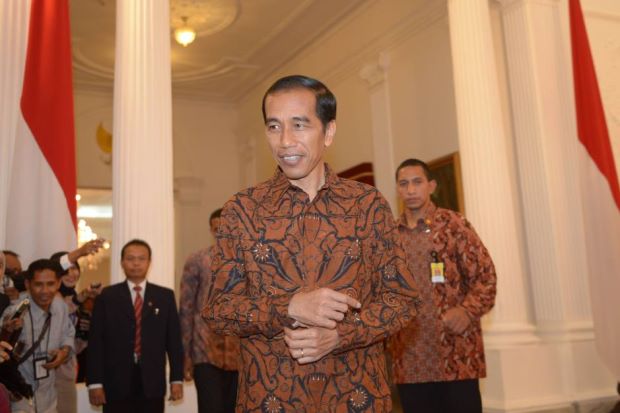
IT is the kind of news that is guaranteed to go global. Reports of Indonesian President Joko Widodo (pic), or Jokowi as he is more popularly known, and his wife Iriana queuing at the Jakarta airport like ordinary passengers before taking their seats in economy class have become world news.

The Indonesian people have been given yet another moment to savour – and their new president has certainly endeared himself to the voters with his modest lifestyle.

The couple was taking a short flight to Singapore to attend the graduation ceremony of their 19-year-old son from the Anglo-Chinese International School, a Methodist secondary school.

Jokowi did not exactly make a big fuss about travelling economy but his publicists certainly did a good job in making sure the Indonesian people, and the rest of the world, knew about it.

As Jokowi explained later, this was strictly a private affair and there was no need to make use of government facilities for what was essentially a personal matter.

Jokowi, of course, is still on what is known as the “honeymoon phase” of his presidency.

The Indonesians find him refreshing. He is the direct opposite of many of the Indonesian politicians who are seen as corrupt, arrogant and patronising.

The news of Jokowi travelling economy class has gone viral but, as to be expected of social media, there are also many counter reports that question his motive and play up the fact that the couple stayed at an expensive five-star hotel along Orchard Road.

Some viewed it as nothing more than a publicity stunt.

“Why should he go through the metal detector, join the queue, etc? Sir, stop polishing your image, just act natural,” Rangga Aditya commented on news portal Detik.com.

Harry Azet tweeted: “Living a fake life is difficult: Jokowi went to Singapore flying economy but slept in an expensive hotel.”

Well, that’s social media for you. Everyone has an opinion and is more than happy to share it with the rest of the world.

As a journalist who has seen enough of politicians and their publicity-seeking stunts, I often observe such news with a healthy dose of scepticism. But seeing the approach that Jokowi has adopted since taking over the presidency, I do hope that it can be sustained.

Not only will it be good for his country, but he can also be a good example to other world leaders who sometimes forget the very people who voted them into power.

Actually, in Malaysia, it is rare to see our politicians doing things like the common people. Where they go, they are usually accompanied by some form of entourage. They never seem to walk alone.

For example, our politicians just love to have an entourage to send them off at the airport for their travels, and an equally big-sized crowd to welcome them back.

This is perhaps some kind of assurance that they still have power, although the people who are part of the crowd may also want to be seen to be there for different reasons.

What is clear is that when they lose power, their supporters are usually nowhere to be found. Many of them will probably think it is a waste of their time and money to go to the airport to see a former powerful politician off.

The same rules also apply to the corporate world, I am sure.

Interestingly enough, we now have budget airlines like Air Asia and Firefly, and it is normal for the politicians to be together with the other passengers on short flights from the capital to their respective hometowns.

But their aides surely make a big fuss of how these politicians, from both sides of the divide, are so in touch with the common people and are prepared to make such sacrifices.

Anyone who enters the political arena must be prepared to take the good with the bad.

It is a matter of time before Jokowi’s opponents may want to question him on why he sent his son to study in Singapore instead of letting him study at home.

The Anglo-Chinese International School was recognised as an International Baccalaureate (IB) World School in 2005. It is consistently ranked among the top three schools worldwide that offer the IB, with score averages as high as 42 out of a total of 45 points, according to one report.

In Malaysia, there are politicians who love to attack Malaysians for sending their children to vernacular schools instead of national schools.

Then they quietly send their own children to international schools or even boarding schools in the United Kingdom and Australia.

And these are often the same politicians who wax poetic about the importance of the national language and criticise those who want to promote the wider usage of the English language.

But back to air travel, we have to get real about how our high-ranking political leaders should travel.

Going economy on short flights may be fine, but I don’t think they should fly economy if they are on a 14-hour long haul flight to London, or a 22-hour journey to New York.

While we can cope with a non-stop crying baby a few seats away or, horror of horrors, next to us, we wouldn’t recommend it to a head of government who needs to read up on his working papers ahead of an important meeting.

There would be serious implications for the nation if he were to arrive in a foreign capital exhausted after a long economy-class trip.

For sure we do not want our Prime Minister to be forced to make small talk with a busybody fellow passenger or take pictures with everyone on the plane over the next 14 hours.

That’s not how a clever leader should operate even if we want him to be down-to-earth.

But we must salute Jokowi for saying that he did not use the presidential private jet or the VIP terminal because he was travelling for personal reasons, adding that “I am going for family matters, a private agenda, not a state visit – so why should I use the facility?”

We’ve got to love him for that, don’t we?

Other populist buttons pressed by Jokowi included, as reported by Tempo.com, both he and his deputy Jusuf Kalla wearing shoes ordered from a local producer in Cibaduyut – a district in Bandung famed for producing leather goods, including shoes – for the swearing in ceremony. It wasn’t Italian made, for sure.

Rather than revelling in her new status as Indonesia’s first lady, Jokowi’s wife was also quoted as saying that she would maintain her current style, except on formal occasions when she needs to coordinate with her husband.

The trouble with most politicians is that they lose the connection with the people after a while. They forget the people who put them in their positions in the first place.

No one would begrudge them the perks and privileges that come with the office, but many of them just get too used to such benefits and do not know how to draw the line between what is official and what is personal.

And we certainly will not appreciate the pompous display of extravagance, especially in tough economic times when the people struggle to pay the bills.

We also need to cut down on unnecessary practices each time the political elite are in attendance.

Granted that we respect titled people, but ordinary Malaysians often wonder why we need to devote so much time to address the many Tan Sri and Puan Sri, Datuk Seri and Datin Seri, Datuk-Datuk and Datin-Datin in the salutations before every speech.

And the VIPs also like to be kept in a “holding room” before the function, which, of course, needs to be paid for by the organisers.

This is where all the small talk is carried out until such time as when they make their grand entrance to the function room. If it’s a dinner, the guests are sometimes subjected to horribly long speeches before dinner starts at 9.30pm.

In many countries, especially in Europe, the guest of honour arrives on time and simply proceeds to the function room without any need for such formalities.

The person delivers the speech, do what’s necessary and then just depart to save everyone’s time, so we can all get back to work.

The world has changed. The old ways don’t work anymore because every word and action is being scrutinised in real time, and flashed to the world instantly.

All politicians will get a better report card if they are serious about their work and are able to get the job done well for the benefit of the people.

If not, they will only be remembered for putting their country in the news, for all the wrong reasons.

Barking up the wrong tree

Our real problem isn’t Bahasa Malaysia but English and it is incredible that so many of us have refused to acknowledge this or even want to address it.

THERE have been so many silly remarks and statements by some Malaysian politicians and one-man show non-governmental organisations that it is becoming impossible to keep track of their comedy acts.

There is a saying: “There are people who are only good at making the news but cannot make a difference to the wellbeing of society.”

Well, in Malaysia, there are certainly many of them.

Last week, Johor state assemblyman Datuk Dr Shahruddin Salleh suggested that students who fail to master the national language be stripped of their citizen­ship. Yes, revoke, lucut, tarik balik, batal!

The Barisan Nasional representative for Jorak alleged that many students were not able to master the language, and this was even prevalent among the Malays. He didn’t say how many. Like one, 10, 20, hundreds or thousands, but was quoted as saying “many”.

“Even my own neighbour, whose father and mother are Malays, but because their child goes to international school, the child is unable to converse in Malay,” he said, adding that students were now more interested in mastering English and do not take the learning of Malay seriously.

The situation was prevalent in the vernacular schools, he added, because the use of Mandarin and Tamil made the students weak in the Malay language, which was further compounded by the fact that many of the teachers there are also not well-versed in Malay.

We’d like to think that Dr Shahruddin has a sense of humour but, seriously, what does he really mean when he said students who do not master the Malay language should be stripped of their citizenship?

How does one define mastery at the school level? Is it by the grades they score at the public examinations, like the UPSR, PMR or SPM? We know that these are just examination grades. A student can score a distinction or even fail miserably, but that in itself does not reflect his language proficiency in the real world.

To take an extreme example, some foreign workers who are in the country for just a few months can speak like a Malay, but do you think they will be able to pass the BM paper at SPM level? Or that they should therefore be accorded citizenship because they have mastered our national language?

We are not sure if Dr Shahruddin is having a bad patch with his neighbours because I do not think that his neighbours, who would have read his remarks by now, would be amused.

The reality is that there are many Malay households where English is prominently used because of a variety of reasons.

The children of diplomats, for example, because they are schooled in international schools, will definitely be more comfortable in English.

What about the children of politicians, especially those who send their children for better education overseas and then make a lot of noise about our local education system?

The assemblyman may want to project his nationalistic credentials ahead of his party general assembly, and he has conveniently used his whip at English and, of course, vernacular schools, the current flavour of the month.

There are enough statistics to show that many of our students and teachers are struggling with English in schools, especially those in the rural areas. Just Google.

The Malaysian Employers Federation secretary Datuk Shamsudin Bardan reportedly said that a survey a few years ago among its members found that 60% of them identified low English proficiency as the main problem with young recruits.

A similar survey in September last year by online recruitment agency JobStreet.com found that 55% of senior managers and companies considered poor command of the English language among graduates to be the main reason for their difficulty in finding employment.

Sabah Tourism, Environment and Culture Minister Datuk Masidi Manjun had said that 70% of Malaysian graduates are having a hard time finding jobs in the private sector due to poor command of English.

Citing his past work experience with a multinational company in peninsular Malaysia, Masidi said 70% of those interviewed did not make it through to the second round as they could not converse well in English.

Second Education Minister Datuk Seri Idris Jusoh had said that about two-thirds of English Language teachers in the country have been classified as “incapable” or “unfit” to teach the subject in schools. These teachers, he said, have been sent for courses to improve their proficiency in the language.

It has also been reported that about 70% of the 60,000 English Language teachers who sat for the English Language Cambridge Placement Test performed poorly.

Granted that there are students who fare badly in Bahasa Malaysia, but we do not think the numbers are big. Instead of making such a generalisation, we expect the Jorak assemblyman to back up his claim with more substantial findings and figures.

Neither has he been able to support this pathetic claim that “the use of Mandarin and Tamil by teachers in vernacular schools is another reason for students being weak in Malay, adding that the teachers are also not well-versed in Malay.”

Our real problem isn’t Bahasa Malaysia but English. It is incredible that so many of us have refused to acknowledge this problem or even want to address it, lacking the political will, unfortunately.

There is no point in deceiving ourselves by allowing our children to easily pass the English tests in schools and in public examinations.

There may be a huge number of students scoring distinctions in English at the SPM level but their real ability is revealed when they enter tertiary education and, later, the working world.

The MEF’s Shamsudin told a news portal in April that there are those with As and Bs in English at the SPM level who cannot even hold a conversation in English.

“Which is why we were excited when the government decided to teach Mathematics and Science in English (PPSMI), as we felt this could boost their command of English. Unfortunately, it was cancelled after seven years when we should have allowed it to continue for 14 to 15 years to see the results.

“The inability to converse and understand English (among young school-leavers) is a constant complaint among our members,” said Shamsudin. The MEF has 4,800 direct members and 21 affiliated trade associations.

In the end, it will be the rural students who will suffer the most. These are the very people that our elected representatives claim to represent and fight for their rights and interests.

Do we need to check how many of our Honourable Members are sending their children to private and international schools even as they wax eloquence about the importance of the national schools?

Actually, we should all be concerned about proficiency in English, an issue that has also been recently taken up by Tun Dr Mahathir Mohamad and Tengku Razaleigh Hamzah, who can see the value of the English language without undermining the stature of the national language.

As Dr Mahathir rightly pointed out, the rich go to private schools while the poor go to national schools at home, adding that “I must confess that although my children all went to national schools, my grandchildren all go to private schools in the country and abroad. They do speak the national language but their kind of schooling widens the gap between races as well as between the rich and the poor.”

Well, it looks like the only thing that we have fared consistently well in is the comic relief provided by some of our politicians. And we can be sure the curtains will never come down on these comedians as they continue to seek out non-issues to put themselves in the spotlight.

A right royal resolution

All ironed out: Mais chairman Datuk Mohammad Adzib Mohd Isa (second from right) returning copies of the Bibles to Association of Churches in Sarawak chairman Archbishop Datuk Bolly Lapok at Istana Alam Shah in Klang. Looking on are Sultan Sharafuddin and Mentri Besar Azmin Ali.

All ironed out: Mais chairman Datuk Mohammad Adzib Mohd Isa (second from right) returning copies of the Bibles to Association of Churches in Sarawak chairman Archbishop Datuk Bolly Lapok at Istana Alam Shah in Klang. Looking on are Sultan Sharafuddin and Mentri Besar Azmin Ali.

The return of the seized Bibles has proven that rational Malaysians are still the majority, and there is no place for extremists who call for the burning of Bibles, or any holy book for that matter.

COMMON sense has finally prevailed with the return of the Bibles to the church, the rightful owner of the Holy Book.

It may have taken a longer time than it should, and there are still questions as to whether the Bible should have been seized in the first place. But that’s a moot point now. 

The pertinent point is that the issue has been resolved through reasoning, compromise, patience and tolerance – which are surely the values of both Islam and Christianity. 

The announcement is certainly timely as the world marks International Day for Tolerance today. It is a significant day, more so for a country like Malaysia.

The 351 copies of Al Kitab and Bup Kudus, the Bahasa Malaysia and Iban Bibles, were seized by the Selangor Islamic Department (Jais) from the Bible Society of Malaysia (BSM) office in Damansara on Jan 2.

More than 10 months later, on Friday, these Bibles were returned to Christians in Sarawak through the Association of Churches in Sarawak (ACS) in a formal ceremony at the Selangor palace. 

As part of a compromise deal, the Bibles were handed directly to Sarawak (where the Bibles were meant for in the first place) and not to the peninsula-based BSM, and with the understanding that such material were not to be distributed in Selangor, especially among Muslims.

The public debate over the issue was intense as everyone – politicians, religious authorities, lawyers and the common practitioners of both faiths – wanted to have a say.

Unknown to most people, there were plenty of behind-the-scenes steps being worked out to ensure that the parties involved were amicable and able to accept the final solution.

As in most organisations, there would always be those who were more prepared to compromise while there would be strong personalities who would insist on holding to what they perceived as their rights and principles.

Months earlier, even when Tan Sri Khalid Ibrahim was still the Selangor Mentri Besar, various approaches were made to the BSM, Jais and the Selangor Islamic Religious Council (Mais).

The most trusted aides and friends of His Royal Highness Sultan Sharafuddin Idris Shah worked, without the glare of publicity, to prepare the ground to end the impasse.

No politicians were involved, for sure. It was the wisdom of His Royal Highness who initiated the reconciliation process.

The proposal to return the Bibles was made known to the stakeholders but they were also told that a third party should come into the picture – in this case, the Sarawak Christians.

The Malaysian Bible Society, it was learnt, did not have a branch in Sarawak or Sabah. If there was one, the return could have been expedited.

There was scepticism and even signs of hostility towards those who moved quietly to work out the solution. So much anger had surfaced publicly that it would be difficult for those who were vocal to make the necessary compromise. 

There were doubts over the clout of the “emissaries” and whether they represented the palace.

Understandably, there was also the question of wounded pride involving all sides.

But they had to be impressed upon that the prolonged crisis needed to end. Rightly or wrongly, the fact remains that in the state of Selangor, the distribution as well as the printing of Bibles that contain the word “Allah” is an offence under the Non-Islamic Religious Enactment (Control Development Among Muslims), 1988.

But the Attorney-General had also said there was no basis to charge BSM as the Bibles were not a threat to national security.

It made little sense for Jais to defy the orders and not return the Bibles. The two religious bodies, Jais and Mais, may be able to ignore the state government and the former mentri besar but when the palace came into the picture, the mood changed dramatically – or to put it in a better perspective, more positively.

The church groups were also advised about the futility of pursuing any form of legal action, which would not help resolve the issue.

The BSM and the Association of Churches in Sarawak chairman, Archbishop Datuk Bolly Lapok, worked hard to ensure the formula worked.

The Archbishop is a highly respected church leader. He is the acting president of the Council of Churches in Malaysia and a member of the Anglican Community’s Team to the Christian Muslim Dialogue at Egypt’s Al-Azhar University.

Jais and Mais, too, understood the significance of the compromise.

In the meantime, the Chief Minister’s office in Sarawak was kept informed of the matter so that the return of the Bibles could be smoothly carried out.

It has taken almost a year to close this chapter but it is important that the controversy has come to a harmonious end.

There is a lesson to be learnt here – moderation works. This episode has proven that rational Malaysians are still the majority, and there is no place for extremists who call for the burning of Bibles, or any holy book for that matter.

The role of the palace, especially the wisdom of the Sultan of Selangor, must be recorded. Without his intervention, all this would not be possible. 

And it should also be put on record that the support of Mentri Besar Azmin Ali made this whole endeavour a real success. Azmin had earlier made clear his administration’s stand that the Bibles belong to the Christians.

At the same time, we must not forget the role of Khalid as it was during his tenure that he made the decision to let the Sultan decide.

There are issues that we still need to resolve, of course, such as the huge number of Sabahans and Sarawakians who work or study in the peninsula, especially in Kuala Lumpur and Selangor.

They attend church service in Bahasa Malaysia, where the word “Allah” is used, and they cannot be expected to use the English Bibles. For them, it would still be the Bible in Bahasa Malaysia or in Iban.

In fact, the Al Kitab is available online, so how does one ban the Internet version?

These are realities which all sides must learn to accept as Malaysia evolves. The growing use of Bahasa Malaysia is also the result of the education system where most people, especially the young, prefer and are more comfortable with the national language.

We cannot now tell them that when it comes to the Bible, they have to read it in another language.

What is important is the respect and sensitivity we must have for one another, so that in fully practising our faith, which is a right extended to all citizens under the Constitution, we do not intrude or cause consternation among our fellow citizens of different faiths. This has always worked well in our country where places of worship can co-exist side by side without any problems.

All Malaysians, regardless of race and religion, have a stake in this beautiful country. Let moderation prevail.

Stop the circus acts

WE have got to get used to it – a real democratic society can be a noisy one as each and every one of us has the right to speak and is free to exercise this right.

And this is something that some of our politicians and self-proclaimed race and religious champions need to also understand, and accept.

A true democratic society is never quiet, unlike authoritarian and theocratic societies where only the leaders have the right to speak.

But this is Malaysia. We may not yet be a shiny example of a democracy but it is maturing. Malaysians have become more educated and are not only more exposed to differing opinions and information, but know how to seek them out. We are no longer like the proverbial katak di bawah tempurung but have travelled far and wide to see the world. And we are certainly better off.

No one should expect middle class Malaysia, especially, to pay homage and reverence to politicians, as in a feudalistic society. Our leaders should no longer think they are all mighty and powerful, where the people must submit to their every command, and that no one can have an opinion except themselves.

In a true democracy, we should respect, and accommodate, every view even if they are in direct contrast to our own. That’s how democracy works and it is still not too late for some of our politicians to accept this new reality.

As The Nation’s columnist, Supalak Ganianakhundee, rightly wrote, “A society in which people have to comply with their leader’s commands is an authoritarian one.

“The process of reform towards demo­cracy needs to be an inclusive one and for this process to be efficient, it should allow every faction in the system to participate.”

In his message to the Thai military govern­ment, Supalak reminded them that “maybe the junta should stop and realise that bringing about reform will be very difficult if it forces all the citizens to have just one political opinion”.

Meanwhile, in our own backyard, we are still grappling with certain personalities who cannot articulate and argue their case convincingly to win over the electorate. The easiest way out, to make up for their lack of grey matter, is to continually spew remarks that intimidate or instil fear among the people.

In any democracy, we can expect such an approach from the really fringe groups or ultra lunatics whose views are often ignored. But it is sad that in our country, political bullying gets national prominence, whereby certain groups and individuals with their political links not only shout down those who do not share their views, but also play the race and religious cards to threaten them.

The country’s political future is determined by Malaysians of all races and religions. Politicians who think they are the only ones who shape and decide Malaysia’s future need to see their shrinks quickly. They need serious help.

All of us have the right to speak up and tell our politicians and government officials what we desire for our country now and in the future.

We have the right to tell leaders, politicians, officials, and journalists off if we think they are not doing their jobs right. It is fundamentally wrong to think that elected representatives and civil servants cannot be told how to do their jobs.

Our job, as concerned citizens, is not just to mark a cross on the ballot paper. The people we vote into power must be held accountable all the time. The civil servants may be unseen but they exist to serve the people in the correct manner, all the time too.

For sure, the media has a right to comment on current issues and to also allow ordinary Malaysians to articulate their views – so long as it is within the boundaries of the laws.

They must be responsible for what they write or say, and if it affects the nation’s security, then they must be prepared to face the consequences, be it via the Sedition Act or other laws. But expressing an opinion is surely not seditious.

Opinions need not be right, or popular. And even if it is the opinion of one person, it is still his right within a democracy. Because of the ever-changing scenario, especially in the political domain, the media has to allow room and space for decent and rational debate. Views from opposing sides should be encouraged, provided they are not racist or extremist.

Some of the politicians in our country have still not woken up to the reality that “government” and “opposition” are no longer labels that apply only to specific parties. Barisan Nasional, for example, is the federal government, but in Selangor, Penang and Kelantan, Barisan representatives are in the opposition.

There are still politicians from the Pakatan Rakyat coalition parties, even though they are now government leaders in the respective states, who are still talking like opposition underdogs in a ceramah.

But more worrying is the increasing number of voices outside the mainstream political arena who are challenging the accepted norms of public discourse with their strident and extremist views.

These uncouth personalities may not be directly linked to any political party but their antics occasionally give some politicians aspiring to be noticed by their party leaders the opportunity to jump onto the bandwagon.

In the process, these individuals actual­ly make the few MPs who are known for their controversial outbursts in the Dewan Rakyat look like harmless angels. At least, their circus acts are good for laughs in the sombre settings and they get their two minutes of fame to justify their MPs’ allowances.

But the increasing number of personalities and ordinary Malaysians, of all races, spewing hate comments is seriously worrying.

Some have argued that it is better to ignore these political weaklings but many Malaysians are worried over where the country is heading, where seemingly powerful characters who taunt the public with their skewed racist and religious remarks seem untouchable.

The country’s leadership is sending the wrong signals to the people.

To be moderate, open minded and liberal seems to be politically incorrect now. How things have developed in Malaysia.

Malaysia’s democracy is growing up fast with some of us even arguing that it is maturing. But we hope some of our politicians would start growing up equally fast, and stop throwing tantrums like spoilt kids.

A mind-boggling spin

IT smacks of double standards and no one can fault moderate-minded Malaysians, who have some sense of justice and fairness, to feel that the statement from the Attorney-General’s Chambers lacks any conviction.

The ordinary Malaysians are finding it difficult to be convinced by the legal arguments put up by the Attorney-General on why Perkasa chief Datuk Ibrahim Ali, who had called for the burning of the Bahasa Malaysia Bible, has not breached sedition laws.

We are now told that Ibrahim was merely defending the sanctity of Islam. No one can accept this mind-boggling spin, more so when it comes from the principal legal adviser to the government.

It is appropriate that former Court of Appeal judge Datuk K.C. Vohrah and the former head of the prosecution division of the AGC, Datuk Stanley Isaacs, have put forth their views (The Star, Oct 23, Oct 31 and Nov 1) on why the A-G’s legal reasoning cannot stand. Vohrah had also served in the AGC and is fully aware of how the system works.

The A-G’s decision not to file charges against Ibrahim based on “context” and “intention”, which are actually matters for the court to decide under the Sedition Act, is a dangerous precedent.

In future, any extremist, of whatever faith, can call for the burning of any holy book, and then cite the same pathetic reason that he or she was merely defending the sanctity of his or her religion.

It is simply unacceptable for anyone to belittle another religion, and worse still, in this particular case, even calling for the burning of a holy book.

We were already shocked by the reply from the Minister in the Prime Minister’s Department Nancy Shukri in Parliament and the A-G’s statement justifying Ibrahim’s action certainly made matters worse.

We are now told that we must read Ibrahim’s remarks “in the entire context”. Going by the same argument, how then does the A-G justify the other recent sedition cases?

Tun Dr Mahathir Mohamad has also weighed in with a comment that Ibrahim “was giving an opinion that could be accepted by Muslims as it was not seditious”.

Those of us who have followed closely the political career of the former prime minister would know that he has always stood by his supporters, in this case, Ibrahim. But with due respect to Dr Mahathir, we believe he should and would also stand by the side of justice and fairness, as we are sure he would oppose any form of extremism.

But the statements from the A-G and Dr Mahathir are unacceptable because what they are saying, in short and simple layman’s language, is that Ibrahim has done no wrong and they wonder what the fuss is all about.

Ibrahim can actually now say that he can carry on with what he has said. After all, the A-G, who is the sole authority in deciding who to prosecute, has not only let him off, but given us reasons that basically open the door for similar actions in the future. And it certainly does not help that Dr Mahathir, with his own way of reasoning over the burning of holy books, has stood by him.

The A-G’s argument on “context” and “intention” sounds more like what the defence counsel for Ibrahim would say if he had been charged. And even then, going by the provisions of the Sedition Act, such a defence would probably be struck down.

So we are to believe that Ibrahim is merely expressing an opinion which is not seditious. How convenient.

My fellow columnist in The Star and Universiti Malaya law professor Azmi Sharom has been charged with sedition for expressing an opinion which is not even about religion or race.

Many Malaysians are still wondering how Azmi’s opinion could have caused offence or threatened national security, while a number of high-profile and consistently recalcitrant extremists continue to get away with their offensive statements.

Who can blame Malaysians if they deem that the authorities are being selective in who they haul up for sedition.

If anyone dares to call for the burning of the Quran, I am confident that all rational-minded Malaysians will rise up and ask for the person to be arrested immediately and be charged with sedition.

If there is any non-Muslim stupid enough to make such a call, then all the non-Muslims in this country must speak out. No non-Muslim should remain silent if such an offensive remark is made to cause offence to their fellow citizens who are Muslims.

Likewise, I think Malaysians expect the same response from non-Christians when someone calls for the destruction of the Bible.

And the ordinary people’s response must be supported by the politicians and the leaders. It is very sad for Malaysia when politicians keep a deafening silence when gross injustice is done.

We expect our politicians to be the leaders of all Malaysians, regardless of their race and faith, and not to merely represent the interests of their own race.

No one should have the suspicion or perception that only the feelings of one race matters in Malaysia.

All it takes is for one individual or one NGO to express a negative view on the activities of another community, be it with regard to Oktoberfest, Halloween, Valentine’s Day, a concert or whatever, and suddenly the whole nation is engulfed in a major debate which takes up so much valuable time and resources, especially from the authorities who have more serious matters to deal with.

In a maturing democracy, we cannot prevent anyone from articulating their views and beliefs, even those that we find most objectionable.

Our challenge is to remind ourselves that while they do not represent the majority view, they must not be allowed to gain ground because the majority has chosen to remain silent. The voices of moderation must ring out loud and clear, all the time.

In a plural society like ours, everyone has the right to practise and celebrate any occasion. It is certainly far-fetched and even laughable to suggest that there are atheists and non-Muslims who want to weaken the faith of their fellow Malaysians.

Events like Halloween and Valentine’s Day do not even have any religious significance. In fact, they are nothing more than commercially driven opportunities for the entertainment and food outlets.

We should be thankful that we are a nation where religion is paramount. The first principle of our Rukunegara espouses our “Belief in God”.

But our faith is not just about religious rulings and paraphernalia. It is in the way we live our lives – how we exhibit compassion, mercy, justice for fellow human beings, and in our concerns over what is wrong and unjustifiable in our country, be it with regard to corruption, intolerance, violence, and the growing divide between the rich and the poor.

These should be the concerns of all religious leaders in their sermons and statements, instead of dwelling on petty issues. They should focus on common values shared by all Malaysians instead of dividing us further.

The Kelantan PAS state government is now determined to go ahead with the implementation of hudud law and again, non-Muslims are expected to believe that they would not be affected by these Islamic laws.

Whatever our faith, we are all closely linked in our daily lives. The laws peculiar to one faith, if implemented in a plural society, will have implications for everyone. To even suggest non-Muslims are not affected is laughable but there will be non-Muslims, because of their anger towards the federal government, who would actually want to believe so and even vote for PAS, which has never hidden its Islamist plans and ambition.

Let’s get our priorities and bearings right.

Malaysia is at the crossroads. We can, as a united people, go straight and take the middle path, and be sure we are on the correct track where we support one another.

Or we can allow ourselves to be divided and take different roads, which will mean we no longer believe in a common destiny.

Our choice is simple — we must all fight to keep Malaysia moderate and inclusive, and fully embrace the vision of our founding fathers.