Monthly Archives: November 2018

Treading the path of moderation

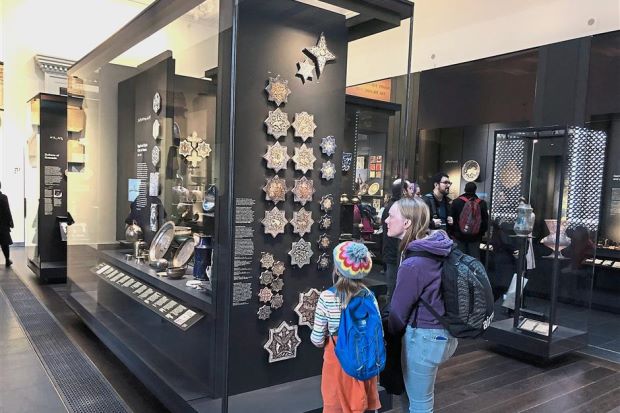
Bridging cultures: Walking through the gallery, the writer saw mostly non-Muslims, including Chinese and Japanese, who seemed genuinely interested to learn more about the beauty and diversity of Islam.

An eye-opening exhibition in London is cluing visitors in to the accepting and harmonious ways of Islam. 

AT a time when our narrow-minded politicians are thumping their chests proclaiming themselves champions of Malay rights and Islam by threatening others, it was refreshing to visit the Islamic World exhibition in London and view the religion in a positive light.

It was a proud moment to see Malaysia’s Albukhary Foundation financially supporting a gallery of the Islamic world at the prestigious British Museum and finding itself a permanent feature there.

A large inscribed panel on the entrance of the exhibition relays how the foundation has been promoting goodwill through education and cultural heritage for the past 40 years. The foundation has also been “promoting scholarship amongst Muslims and non-Muslims alike” and aspires to “bridge further understanding between cultures and faiths.”

And certainly, the exhibits at the gallery fit the bill – in numerous parts, it sets to emphasise how Islam values “compassion, tolerance and co-existence”, which the foundation reminds visitors of at the two-room gallery.

Staging these exhibits in London is appropriate, especially when Islam is perceived negatively, no thanks to reports of beheadings, suicide bombers and the seclusion of women, all in the name of the religion.

Well, that’s not very different from some in our own backyard who wield their racial and religious intolerance like a weapon. 

This exhibition has been an enriching experience for me as a student of Islam.  I saw an incense burner and Torah Pointer (a pen-like accessory used by the Jews when they read their Holy Book), but they were made by Turkmen silversmiths.

But it was the accompanying card which read “recognised in Islam as People of the Book, are Jews and Christians, who were granted special status” that caught my attention. For non-Muslims, it’s lessons like these, even if small, which help us develop a deeper appreciation for the religion.

Of course, this is a far cry from hysterical Muslim individuals calling for the blood of Indians, Chinese and Christians, with images of silat exponents holding keris, and intimidating antics on social media.

And in this frenzy of piety, they forget that “in the name of God, the Most Generous and the Most Merciful” is the phrase recited before each chapter of the Quran.

It’s always in the name of the Most Compassionate, and certainly not the propagation of violence in the name of religion – that’s the genuine Islam.

At the gallery, I learnt how Muslim and Christian noblemen in Syria enjoyed the past time of hunting, depicted on a earthenware bowl and fragmentary flask.

It was common to see people of the two great faiths across the Middle East coming together to celebrate.

And of course, Islam spread because of the trade routes, which brought people from all around together. So, had Muslims been reclusive then, or kept to themselves by refusing to interact with people of other races and faiths, Islam would never have flourished.

The global trade took luxury items as well as raw materials from Middle Eastern cities, as far as those bordering China, all the way to the west. These included incense and spices such as “the cinnamon and sandalwood of India, incense of Arabia, star anise of Southeast Asia and date molasses of Iraq”.

The gallery has many pots which were discovered in Iraq, and though native to that country, is in the shape of imported Chinese jars, evidence of the crossing of cultures along the trade routes. And we all know that Islam was introduced to Melaka, especially in the 15th century, through the influx of foreign traders.

At the gallery, I read about how the markets in the cities of Cairo and Damascus, between 1250-1517, sold almost anything and everything. And that extended to glassmakers designing flasks of different influences, including warrior saints from Christian imagery, replete with their Crusader-style garments and head dress, and even turbaned men in medieval Islamic societies.

There was even a dish with the image of Mary, as she was the most prominent female figure in the Quran and the only one identified by name. Both the annunciation and virgin birth are mentioned in sura 19, surat Maryam, which is named after her.

Interestingly, the dish, depicting the Virgin and Child framed by sprays of tulips and carnations, is believed to be made in Ottoman Turkey.

I had come to the gallery expecting only works of the Islamic World, so, I was surprised to see so many exhibits with intricate elements of Christianity and Islam.

With Muslim and Christian extremists remaining at loggerheads, who would have thought that at one time, believers of these two great faiths lived side by side and respected each other.

The exhibition has received acclaimed reviews from major British media, with The Standard reporting “you get games, amulets and charms, astrolabes, costumes (fabulous) and shadow puppets, as well as the tiles and calligraphy you would expect.

“Obviously the British Museum already had a gallery devoted to the Islamic world, but this is a reordering and expansion of it thanks to a large donation from the Malaysian Albukhary Foundation.”

The Guardian wrote that “the cliche that Islam forbids all representation is demolished: there are human as well as animal portraits throughout this gallery.

“This gallery is a kind of miracle. It sees beyond individual objects to grasp and communicate the principles and intellectual power that give Islamic art its infectious harmony and abundance. Yet it does that without oversimplifying. “

And indeed, visitors can experience a chronological journey of the Islamic world through artefacts, tiles, sculptures, paintings, textile, engravings, art, music and literature.

For the first time, I could see the works of all schools – Sufism, Sunni and Shiites sects were all acknowledged as are the mix of influences that accompany the spread of Islam through both war and trade.

Walking through the gallery, Britons apart, I thought I saw mostly non-Muslims, including Chinese and Japanese, who seemed genuinely interested to learn more about Islam in greater detail, especially the beauty and diversity of the religion.

Non-Muslims should learn more about Islam, and likewise, Muslims should not fear knowing more about other religions. There are plenty of commonalities, especially positive values, in all religions.

Certainly, no religion teaches its faithful to be corrupt, or use race and religion to stoke the fires of controversy when they have lost their moral standing. I simply can’t imagine any religion teaching such values.
Service with a smile

CHINESE tourists aren’t exactly shining examples of well-mannered and law-abiding visitors in any country, and because China is so big, we’re forced to deal with everything from the high-heeled rich tourists down to the peasant types making their first overseas trips.

But every nation wants a piece of the Chinese tourist pie, despite the occasional bad press involving host countries and these mainlanders.

The number of Chinese making their way abroad will more than double to 259 million in 2030 from 97.5 million this year, said a study by Euromonitor International. This was revealed at the World Travel Market in London. The number will far outweigh second-placed US with 159 million outbound trips and Germany with 138.6 million. So, the attention is surely on cash-loaded Chinese tourists with the appetite for branded luxury goods and fine dining.

Thailand made headlines for introducing special immigration lanes dedicated to them to extend goodwill. Chinese passport holders are now able to utilise any of 18 Chinese-only lanes at Suvarnabhumi. Don Mueang, Chiang Mai, Phuket, and Hat Yai airports will soon have dedicated lines for Chinese tourists as well. The pursuit of Chinese wealth has made things that competitive.

Our government must understand that they are our customers. We are selling Malaysia as a product. They are here to spend, meaning they should be treated as customers, and shouldn’t be made to feel unwelcome. In my years travelling overseas, I’ve found most immigration officers can never put on a smile, and they look as if they are doing visitors a favour by stamping their passports.

Deputy Tourist Police chief Pol. Maj Gen Surachet Hakpal said the VIP lanes, staffed by Chinese-speaking immigration officers, were meant to display Thailand’s “hospitality and sincerity” towards Chinese tourists. In the past six years, China has become Thailand’s top tourist provider. In 2017, more than a quarter of Thailand’s 35 million tourists were from there. The swift action by the Thai authorities was taken after a boat mishap off Phuket in July, which saw 47 Chinese nationals killed. It led to 600,000 Chinese tourists cancelling their trips there, setting Thailand back US$1.11bil (RM4.65bil) in revenue lost.

In September, Thai Prime Minister General Prayut Chan-o-cha ordered concerned agencies to speed up restoring the confidence of Chinese tourists after a mainland visitor was assaulted by a security guard at Don Mueang International Airport. Prayut’s instruction came after a video clip showing the guard briefly scuffling with and then hitting a Chinese man received wide coverage in the Chinese media.

Getting to the point, Malaysia should be worried, or more appropriately, alarmed!

Tourist arrivals from mainland China to Malaysia dropped by an estimated 30% to 35% during their National Day break in October, compared to last year. Industry players said this was the first time Malaysia posted a dip in tourist arrivals from China during their “golden week”, or peak tourism season in the Middle Kingdom. China’s “golden week” last year, from Oct 1 to 7, saw about 180,000 Chinese tourists coming to Malaysia.

“Inbound tourism from China was very weak this time. The special feature I noticed this time around was that local tour guides went overseas for holidays during this golden week,” said Datuk Keith Li, who owns the GTC Group travel agency jointly with the Chinese government and is also president of the China Entrepreneurs Association in Malaysia.

For Chinese tourists, the first consideration when choosing destinations is whether the host nation is friendly to China. The others are security, attractions and shopping.

Although Chinese tourists love Malaysia’s beaches, culture and food, Li said he is “not optimistic” about Malaysia getting three million arrivals from China this year, saying his sentiments are echoed by Mint Leong, deputy president of the Malaysian Inbound Tourism Association.

Remarks made by Malaysian leaders are crucial to how Chinese tourists perceive our country as a destination choice. If seemingly anti-China remarks are made, whether real or otherwise, that won’t help the cause. But there’s more, obviously.

According to a research by ForwardKeys, countries need to remember four important factors if they are to secure a larger share of the Chinese outbound tourism pie.

They include the development of direct flights, visa convenience, sensitivity to the Chinese holiday calendar and a reputation for being a safe place to visit. ForwardKeys predicts future travel patterns by analysing 17 million flight booking transactions a day. According to its report, the increase in Chinese travel to Ireland during May to August this year illustrates the value of new direct flights. Ireland experienced a negative 2017 and a decrease of 7.8% in the number of Chinese arrivals during January to April 2018.

“However, three new routes reversed the downward trend and resulted in a 4.1% uplift in Chinese visitor arrivals during the May to August period. Other examples include Belgium and Greece, where new direct routes led to growth in Chinese visitors during May to August 2018. The benefits of visa reform were particularly notable in Serbia, which experienced a 173% increase in flight arrivals from China in 2017, after the country waived visas for Chinese tourists.

“Serbia also saw triple-digit growth in Chinese arrivals during the first eight months of 2018. ForwardKeys previously reported other substantial increases in Chinese tourism due to visa relaxation policies, most notably to Morocco and the UAE.

“Sensitivity to the Chinese calendar is important because holidays such as the Chinese New Year and National Day Golden Week see very large numbers of people seeking overseas trips. A good understanding of the subtleties of Chinese holidays will greatly help the industry to plan, anticipate and capitalise on demand. Destination marketeers can better time their campaigns, hotel managers can better prepare to make Chinese visitors feel welcome and retailers can stock items more likely to appeal to the Chinese tourist.”

The report states that security concerns are crucial too as “after a wave of terror attacks afflicted Continental Europe and the Eastern Mediterranean in 2015 and 2016, Chinese visitors stayed away.

“However, as those destinations have been seen to be safer, the Chinese market has recovered. For example, Turkey, which is benefiting from the China-Turkey Tourism Year 2018 and an improved security image, has seen a 69% year-on-year spike in arrivals between January and August this year.”

As a seasoned traveller, I have concluded that we have lagged behind other Asean countries like Thailand, Singapore and Vietnam in wooing tourists, and as more Chinese tourists travel, they will make comparisons of the best service provided.

Sabah has become a favourite destination for younger Chinese tourists, who have better income, because of the direct flights and crystal-clear seawater. They like Sipadan, but look at Semporna, the gateway to the best islands in the world. Let’s be honest, Semporna is a gigantic rubbish dump and the huge presence of foreigners, presumably illegals, hardly makes visitors (Malaysians included) feel safe. It’s pathetic that such deplorable situations can remain unchanged despite a deluge of complaints.

Hopefully, our Tourism, Arts and Culture Minister, Sabahan Datuk Mohammadin Ketapi, will order a clean-up. Despite the fatalities involved, I’m not sure if we have learnt from boat mishaps that we, too, have experienced in Sabah.

Last January, a tourist boat ferrying 28 Chinese tourists and three crewmen from Kota Kinabalu to Mengalum island capsized. Malaysians have always taken safety lightly and we’re no different from the Thais. And if we aren’t careful, we will have to deal with the same issues again unless there is constant enforcement by the authorities.

Malaysia has declared 2020 Visit Malaysia Year and that means the Tourism Ministry, as a revenue earning body, must get its act together to hit its projected target. The question is, how much has been done so far?

And certainly, the ministry should seek the help of stakeholders to make 2020 a hugely successful event.

And for a start, let’s send the message down – tourists are pelanggan (customers) and not merely pelawat (visitors), and those using our airlines aren’t just penumpang (passengers), so paying customers must be treated like royalty, and that service is the best advertisement for our country.

Beaming bright star

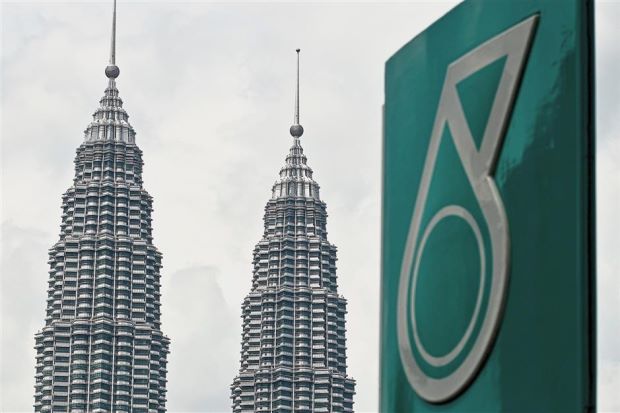
Eye on oil revenue: Petronas has proven it is world class because it has adopted global standards.— AFP

If there’s one brand that has kept Malaysia gleaming in the spotlight, then it must surely be Petronas. 

AT a time when some of our institutions have been tainted with suspicion, if not investigated for discrepancies, there is still a hero that can be counted upon to deliver – not once, but over and again.

We must rely on Petroliam Nasional Bhd’s reserves to settle some of our government’s outstanding tax refunds amounting to RM37bil via a special dividend next year.

It would be a one-off payment from Petronas to nullify the debt to improve cash flow of businesses and households, thus helping stimulate economic activities.

However, it’s important to note that while Petronas is subjected to such periodic financial SOS calls as part of its national service, it’s also a reflection of its solid financial position. This simply re-emphasises the need for ownership control by the government.

In many ways, despite the pessimism for the country’s economic outlook for the next two years, Malaysia is lucky.

Just four years ago, the nation was grappling with the declining price of oil, but now, we are expecting higher prices.

In 2016, when Datuk Seri Najib Tun Razak was tabling the Budget, he shared that crude oil prices had fallen more than 50% from US$100 per barrel in 2014.

Justifying the need to implement GST, he said Petronas contributed to part of the dividend to Treasury each year, the amount depending on global crude oil prices.

For example, when crude oil averaged US$100 per barrel, revenue from Petronas dividends and petroleum tax totalled RM61.5bil.

However, the scenario changed when crude dipped to around US$50 per barrel. The contribution from Petronas and oil-related sectors was RM41.9bil in 2015.

As oil prices were expected to remain low in 2016, oil-related revenue was estimated at RM29.4bil.

Fast forward 2018 – the price of oil has gone up, with Tun Dr Mahathir Mohamad, in explaining the support given by Petronas, saying, “You must remember the price of oil has gone up quite high.

“Of course, if it is at US$40 per barrel, it is not possible to give that kind of money, but now, it is almost US$80,” he told reporters after the tabling of Pakatan Harapan’s first budget in the Dewan Rakyat recently.

While a bulk of us don’t expect the price to hit US$100, it could well shoot for the skies if the embargo on Iran by the United States is fully enforced soon, with no waiver for selected oil importing countries. Political events in the Middle East have serious implications on the price of oil.

While the RM30bil amount is bandied, the precise figure Petronas must fork out next year to cover the acute shortage in the Government’s revenue is RM54bil. These are big bucks, but without them, Malaysia could risk its current credit rating because of the national debt and insufficient revenue collection to finance the Government’s operations.

The dividends from Petronas were surely a better option than an earlier proposal for the government to issue the RM2bil Treasury bills to provide additional liquidity with financing costs higher.

Ratings agency S&P said it is maintaining Malaysia’s credit risk ratings at A, given the country’s stable outlook based on steady economic growth and the new government’s emphasis on strengthening its fiscal position.

It also commended Petronas for how its “solid balance sheet, sizeable net cash position and ample liquidity provided ample buffer against the payment.”

“The financial impact of a one-off dividend of this size is moderate for Petronas’ cash position and balance sheet quality, in our view,” the agency reported.

It’s a welcome change, really. By now, Malaysians have become immune to reading embarrassing news articles about the 1MDB.

We have become international fodder for the wrong reasons. So, trickles of good news, like this, help lift our confidence when we go abroad.

I was in Hong Kong last week to attend a media conference, and when an Australian journalist began querying me about Malaysia, I was prepared to shoot from the hip with my views on the two trending issues – 1MDB and the new government.

Instead, though, I was asked about Petronas, as he proceeded to commend the national oil and gas company for being an efficiently run institution.

Indeed, as Finance Minister Lim Guan Eng rightly pointed out in his Budget 2019 speech,

“Petronas, as a company, has been run in an extremely prudent fashion and has been able to accumulate the reserves which can be shared with the Government, without jeopardising its ability to invest for its future growth.”

Credit must go to its president and chief executive officer Tan Sri Wan Zulkiflee Wan Ariffin and his leadership team.

Wan Zulkiflee’s is not a household name here. The chemical engineering graduate is unassuming and keeps a low profile, but he gets the job done efficiently.

Through his stewardship and prudent management, the company can contribute to the Government’s efforts in managing the nation’s budget.

He took over Petronas’ reins in 2015 following a severe downturn in the oil and gas industry caused by the collapse in crude oil prices.

It wasn’t the best time to take over the top job, but he dared do it. I remember having lunch with him and speaking about the volatile oil price.

But he then instituted successful measures to achieve better cost efficiency in a harsh operating landscape. His transformation efforts led to the company’s strong fundamentals and liquidity position. It rallied staff in the areas of operational excellence, cost reduction and portfolio optimisation, all of which will secure the company’s ability to service its debts, fund its ongoing operations and invest in future growth.

The Petronas CEO’s job has always been tough with having to ensure results to keep a tight control of finances as the custodian of Malaysia’s wealth, while at the same time, be expected to play the rescue role.

In 2011, Petronas was requested to even shoulder part of Tenaga Nasional Bhd’s (TNB) higher operational costs caused by gas shortage. Petronas, TNB and the government had to evenly share the reported sum of RM3.07bil the utility company incurred in cost overruns from Jan 1, 2010 to Oct 31, 2011.

A lifeline was cast to TNB, which posted a net loss of RM453.9mil for 4QFY11 ending Aug 31. If there is a lesson to be learnt here, it’s that Petronas is listed among the top 500 companies in the world, and it has worked well because it adopts global standards.

Politicians like to use phrases like world class and world standards to a point it becomes meaningless, but Petronas has proven it is and has remained in the global rankings for good reason.

Same ol’ song and dance

OUR people generally have short memories. There was a time when many of us were outraged at elected representatives from any one of DAP, PKR, PAS and PBS for defecting to the Barisan Nasional.

All kinds of nasty names were hurled at them, with insinuations that these unprincipled and dishonourable politicians were paid to be political frogs, all of whom contributed greatly to the collapse of two state governments.

In 1994, the Parti Bersatu Sabah (PBS) – which pulled out from the Barisan in 1990 – won the state elections with a slim majority of 25 seats against Barisan’s 23.

But the fourth-term PBS government lasted only about two weeks before it was ousted following defections of some of its state assemblymen.

Some of these former PBS leaders went on to set up their own political parties, while Joseph Pairin Kitingan had to resign as chief minister on March 17, 1994, before a shocked Malaysian public.

This was unprecedented in Malaysia, and it swung the doors wide open for Umno to set up shop in Sabah, taking with it its race and religious-style politics.

Then, in 2009, when the Pakatan Rakyat (PR) formed the state government, three of its state assemblymen defected to Barisan, causing the PR government to collapse. Naturally, there was plenty of resentment at what was viewed as classic treachery and immorality.

Prior to the defections, PR had 32 representatives while Barisan 27.

The ship-hopping meant that the state then had 28 PR representatives, Barisan likewise, and three independent representatives who pledged confidence with Barisan.

But the movement began with PR because Barisan’s Nasarudin Hashim decided to cross the floor to join PR. Its leaders then jubilantly claimed more Barisan lawmakers would join in an exodus.

Instead, Nasarudin returned to Barisan, accompanied by Deputy Speaker Hee Yit Foong of the DAP, and senior state executive councillors Jamaluddin Mohd Radzi and Osman Jailu of the PKR.

A year later, Malim Nawar assemblyman Keshwinder Singh quit the DAP to become a Barisan-friendly independent assemblyman.

Many political leaders, who are now Pakatan Harapan figureheads, mouthed off angrily then, but now, have seemingly gone mum at the latest round of camp-switching involving Barisan politicians to PH. Just Google if you want a quick history of who these politicians are and what they said then, and importantly, when they were at the receiving end.

That probably explains how although many of us felt cheated and demanded an anti-hopping law be enacted, everything invariably died under a deluge of excuses.

Is it surprising that nothing happened?

Of course not, because politicians have always known that defections make for handy tools.

For them, it’s all about power, and how the end justifies the means, so the people’s mandate counts for little. It could seem a betrayal of our trust, but defections will likely be justified as freedom of association, and something perfectly natural.

In 1978, DAP supremo Lim Kit Siang attempted to move a motion in the Dewan Rakyat to introduce a Private Member’s Bill, the Members of Parliament (Prevention of Defection) Act, which would require an MP to vacate his seat within 30 days and have a by-election upon his resignation or expulsion from the party on whose ticket he was originally elected.

When Lim was queried by readers of a newspaper about the effective measures that could be taken to prevent such opportunistic political betrayal of the people’s confidence, he replied saying the best way was for the enactment of such a law.

Following Datuk Mustapa Mohamed’s defection to Parti Pribumi Bersatu Malaysia (Bersatu), DAP chairman Tan Kok Wai voiced the party’s discontent, saying it was “unhealthy” for PH component parties, including his own, to accept former Umno MPs.

Tan’s comment came two days after Umno veteran and Jeli MP, Mustapa Mohamed, joined the party.

Now, talk is rife of a massive switch over of Umno MPs and members into Bersatu, with the party’s supreme council member, Datuk A. Kadir Jasin, conceding to a possibility of up to 40 MPs being involved in the mass exodus.

He revealed that the 40 Umno MPs met with Bersatu chairman Tun Dr Mahathir Mohamad and president Tan Sri Muhyiddin Yassin.

What happens next could well see PKR and Bersatu competing for the entry of elected representatives to alter the equation in PH.

With Tok Pa now in Bersatu, its numbers have gone up to 13 while PKR has 48, DAP 42, Amanah 11 and Warisan 8. If indeed 40 MPs were to join Bersatu, the total could swell to 53, making it the biggest component party in PH.

And assuming there are disgruntled PKR MPs who leave the party after its internal elections, it could put Datuk Seri Anwar Ibrahim in an uncomfortable position, even if these turncoats don’t join Bersatu and remain independents.

It doesn’t help that the Setiawangsa Bersatu division is rooting for Dr Mahathir to complete his five-year term as Prime Minister, ending next general election. The Setiawangsa division, headed by Dr Mahathir’s political secretary Zahid Md Arip, passed the proposal unanimously last week.

The remarks by Kadir and the motion by Setiawangsa Bersatu have spooked many supporters of Anwar and PKR, and they don’t find this funny at all, especially during the Halloween.

Certainly, supporters of Anwar now expect him to make a similar move to get Umno MPs, or those from Gabungan Bersatu Sabah, to join PKR to “neutralise” Bersatu. The names of several Sabahan MPs have been bandied.

The Prime Minister has repeatedly said he would pass the baton to Anwar, with the latter insisting the PM should be given time and space to govern effectively to steer the country back on track. The PKR leader said this was the reason he refuses to specify a time frame for him to succeed Dr Mahathir as the next prime minister.

“Some people see this transition as fragile, but I don’t. The fragility will come about only if there are major battles waged between me and Mahathir, but I have made it very clear. Number one, he is the Prime Minister, and number two, I refuse to give a time frame,” Anwar said.

It’s obvious Anwar doesn’t want to appear a man in a hurry, while repeating the same assurances. However, without a time frame and being the president of the biggest component party in PH (so far), the partnership in PH will be tested.

No one can deny that the three leaders – Dr Mahathir, Anwar and Lim Kit Siang, and to some extent, Mohamed Sabu, came together with a single aim – to topple Datuk Seri Najib Tun Razak and the Barisan.

However, none of them had any real love for Dr Mahathir, but they knew he was key to winning the general election.

Let’s not forget that at one point, Dr Mahathir came close to walking out of the electoral pact, and Nurul Izzah Anwar flew to London to convince him to stay on amid tensions over PH’s hierarchy.

Dr Mahathir and Anwar may have their interpretation of succession, but as with all parties, there will always be over-zealous leaders with their self-interests of ensuring their masters remain in power to allow them to continue enjoying the powers and privileges of being in government.

And on the flipside, others can’t wait for their masters to be installed.

The two must now manage the push and pull because once the floodgates open, they won’t be able to stop the one-upmanship for more members, especially elected representatives who could boost their standing.

It’s beside the point whether Dr Mahathir or Anwar genuinely trust each other, the reality is, only either of them can hold the coalition together.

But the new government shouldn’t forget the people who put them there for a New Malaysia.

If PH leaders can’t respect and uphold this democratic right of the people, then what’s the point in holding elections when all we see is more of the Old Politics?

Getting spooked in Shibuya, Japan

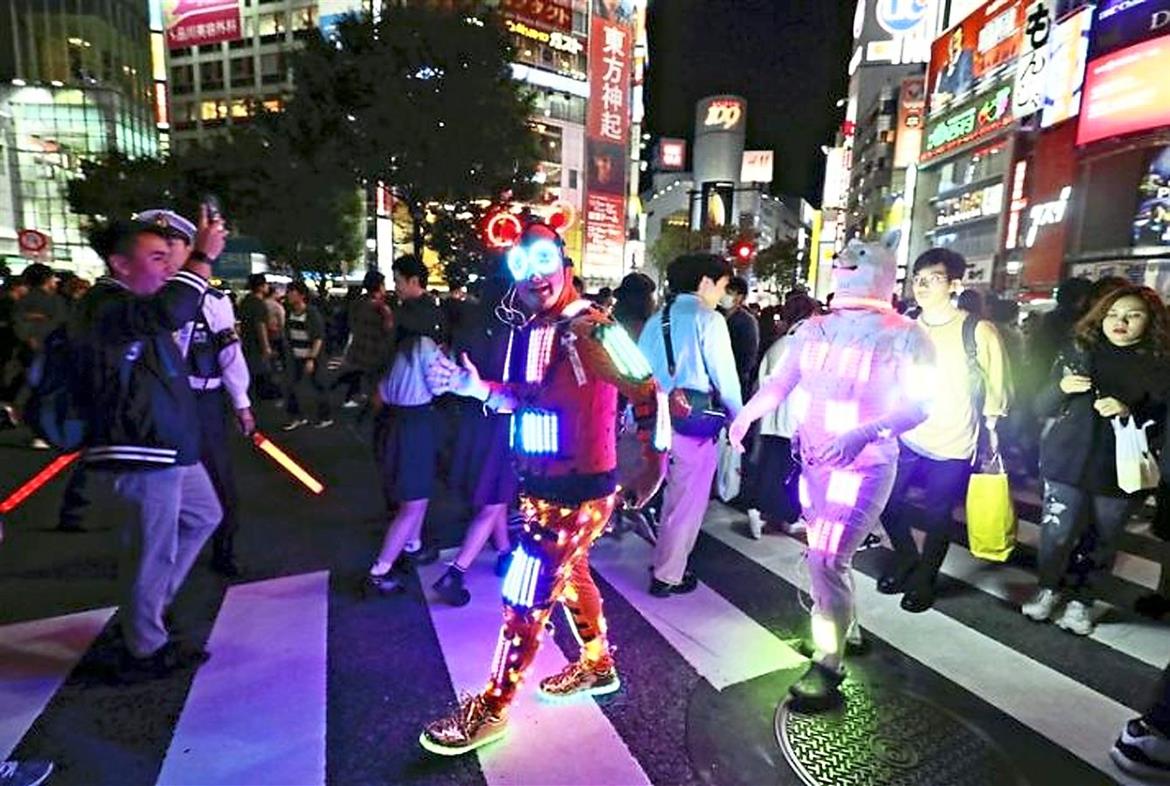
The Japanese take their Halloween seriously – no, dead seriously! The world’s biggest Halloween celebration isn’t in the United States but in Tokyo, where the world converges in Shibuya for the annual street party.

Through four nights, Oct 25 to 31, Shibuya, a major commercial and business centre, turns into Zombie Land as thousands of revellers spook the narrow streets.

More and more people are descending upon the city each year and this time, it was by far the most chaotic and, well, demonic. Last week, five people were arrested for offences including fighting, groping, taking up-skirt photos and even flipping over a truck.

Three men, in their 20s to 50s, were arrested near the train station on suspicion of assault, including one man who allegedly kicked another on the street, a report quoted the Metropolitan Police Department.

Two others were detained for causing a public disturbance, including one man in his 30s for taking up-skirt photos of a woman and another in his 20s for touching a woman’s breasts.

The past Saturday, the devils literally took over Udagawacho’s popular entertainment hub of Shibuya Center-gai street, where several people climbed onto a light truck which got stuck in the crowds.

Halloween in Japan is a fun and spooky affair. Photo: The Japan Times

Scenes of individuals dancing on the vehicle and then overturning it have gone viral. Fortunately, the driver wasn’t hurt because he had fled the scene to seek police help.

All these devilish acts are very un-Japanese because they are, by nature, a very civil society. For two nights, Oct 25 and 26, I joined in the street parties, which surprisingly, were free of cigarette smoke. No matter how “wild” these parties seemed, with the outlandish and garish Halloween dressing, smoking is strictly banned.

I didn’t notice anyone holding liquor bottles either, unlike in Europe or the US, where drunks can turn unruly.

From my hotel room, I could hear the merry-making and look down to see it too, as I wanted the convenience of being close to the action.

I heard a siren at around 1am, but this uncle, who was already in dreamland (or experiencing a nightmare), could never imagine those super-polite Japanese going on a rampage. I can only conclude that they must have been possessed! Honestly, what the hell were they doing?

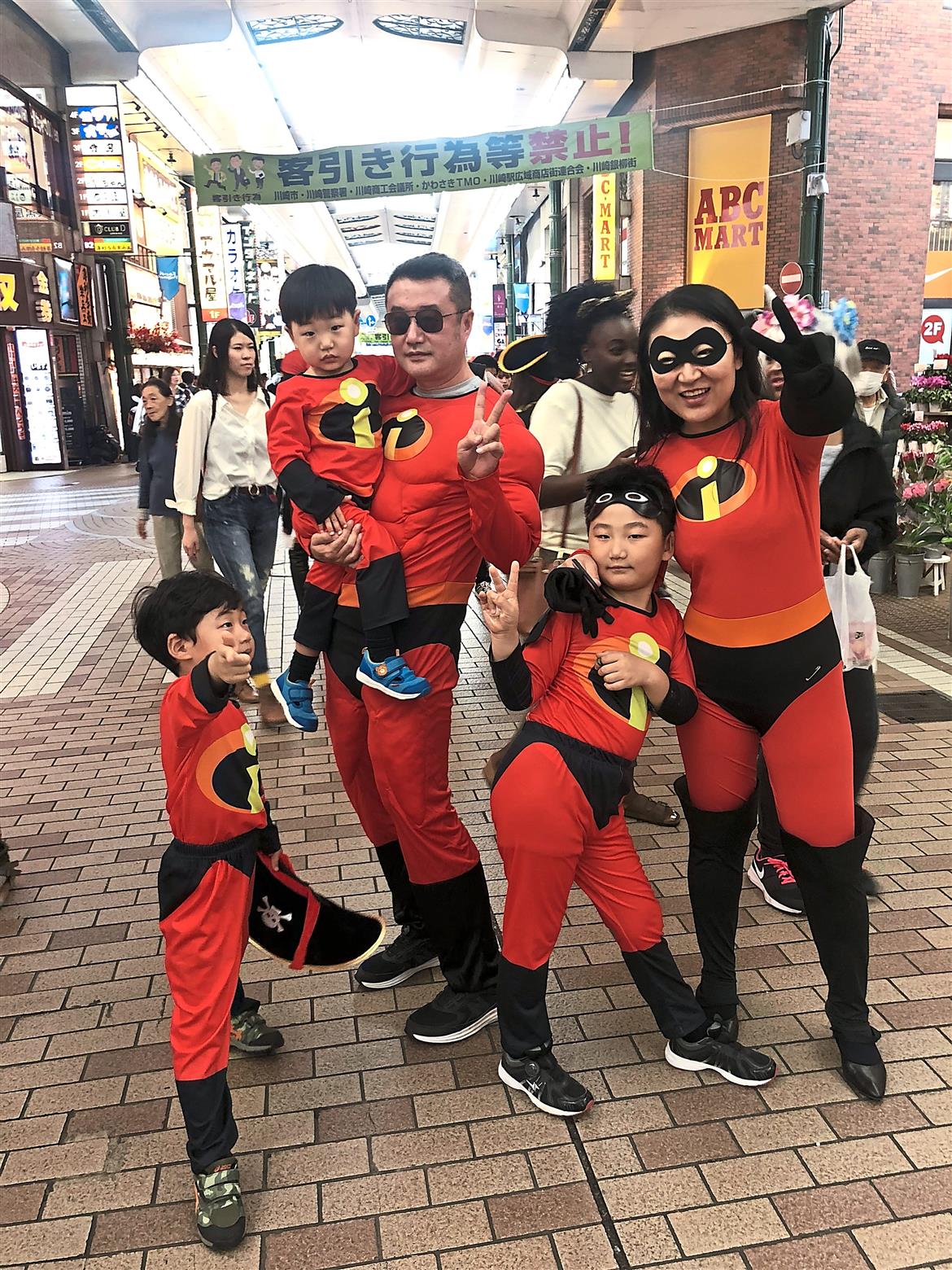
A sporting family dressed up as The Incredibles at a Halloween party in Kawasaki, Japan.

Halloween in Tokyo isn’t just about dressing up grotesquely, though – it is also an occasion for cosplay, which has become a Japanese sub-culture.

So, it’s common to see people dressed as Captain Jack Sparrow, Batman, Sailor Moon, Spider-Man, Samurai and all kinds of comic characters. But this is tame stuff compared to some of the other things that went on.

I saw three men dressed up as dinosaurs, along with spooky Nuns, and even two Chinese “hopping” vampires, all competing to see who would be the most photographed. If that wasn’t enough of a spectacle, imagine the dinosaurs rushing across the Shibuya interchange, said to be the busiest intersection in the world.

The Shibuya Crossing is described as a giant beating heart, with people heading in their desired directions according to the pulse of the light changes. Apparently, at peak times, more than a 1,000 people cross the interchange without running into each other.

But unlike normal days, during Halloween, you get to see young adults (some even with their pets) in all kinds of costumes and makeup running across the busy street.

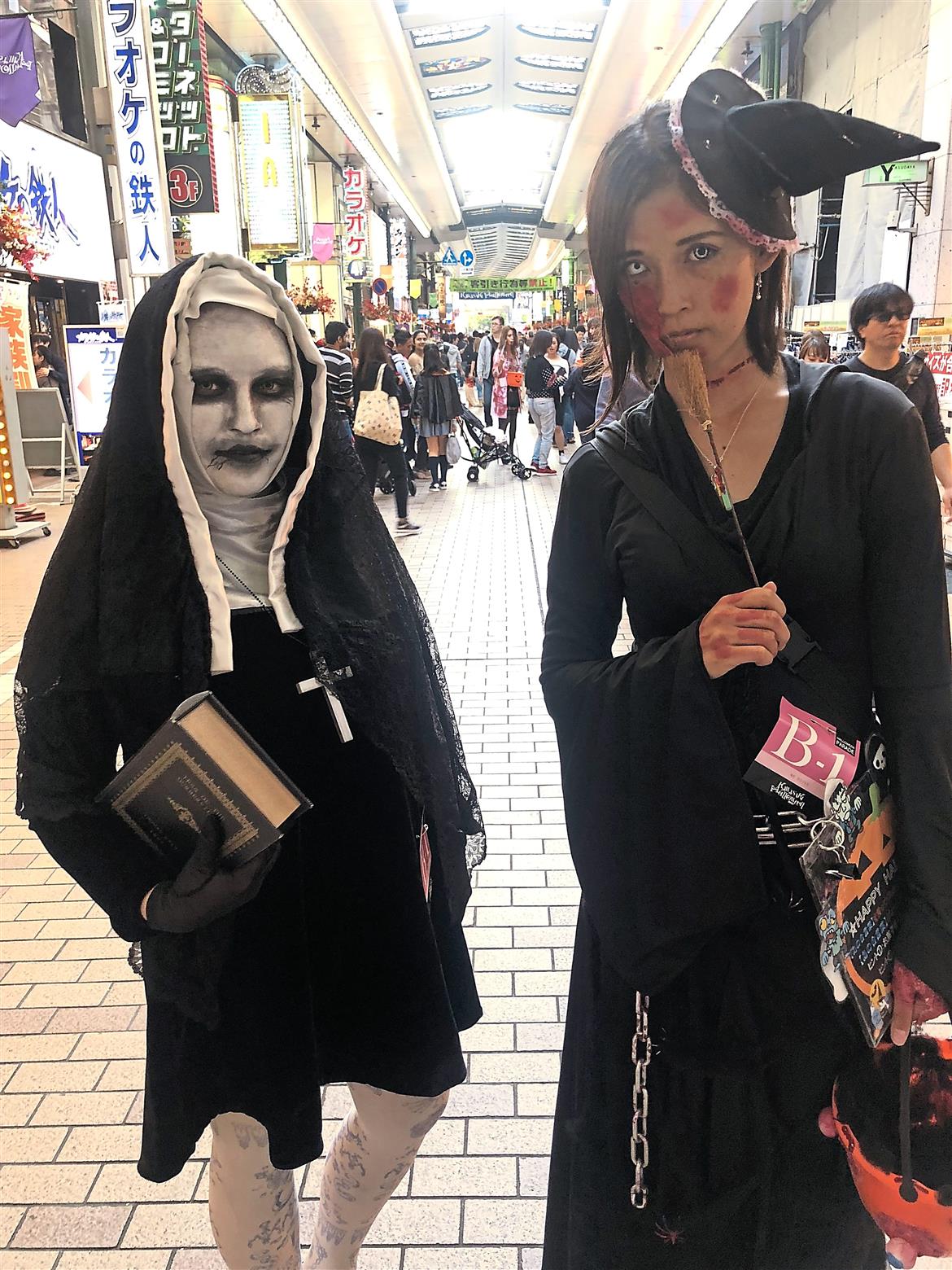
This year, the most haunting theme must be the demonic nuns, clearly inspired by the horror movie The Nun. It is, without doubt, the most popular Halloween dress theme at the minute.

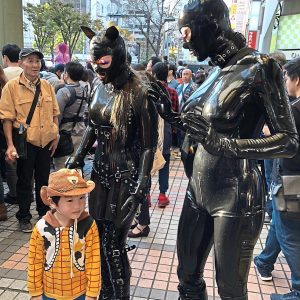
What happens when The Nun meets a witch?

But the celebration isn’t confined to just Shibuya. Kawasaki, in the south of Tokyo, has a Halloween parade which has run for years.

Although it is tailored to families and children, this one has a different dimension – the LGBT component.

The Kawasaki Halloween event is the most famous of its kind in Japan, and the inclusion of the Pride Parade barely raises contention, or eyebrows.

Families (their children included) sportingly join LGBT participants in the parade which runs along a 1.5km course in the JR Kawasaki Station locale and the nearby La Citadella shopping centre.

I intended for this trip to coincide with Halloween after watching videos of this macabre celebration on YouTube. There was no way this was going to wriggle out of my “off the beat” bucket list.

It was as bizarre, grisly, ghastly and loathsome as I expected, but in a fun way, and it certainly lived up to my expectations.

This was Halloween beyond the realms of kiddie trick or treats. This was a purely adult, bonkers Halloween street party for four nights.

It was an incredible experience to see the narrow streets around Shibuya filled with people in strange costumes and makeup, having the biggest and craziest party. It completely altered my perception of the Japanese being traditional and conventional.

They certainly know how to party and do it in the manner they know best – combining their passion for cosplay and the Halloween theme. I have never seen that many “nuns” (in their traditional frocks, no less) in my life!

Shibuya, at its decadent and morbid best, is not recommended for the family or those with a serious disposition. It is preposterous and wacky, but then, that’s what Halloween should be about.

For those who still want a dash of Halloween, but in a more conventional and predictable way, there’s always Disneyland, with Mickey Mouse and the many villain characters. And if that fails to excite, there’s even the Hello Kitty theme park, both of which sit just outside Tokyo.

But I recommend trying something devilishly impulsive and reckless, just for one night. All right, that’s a lie – it’s in fact, four nights. So, for a walk on the wild side, Shibuya is the answer.