Monthly Archives: December 2021

Floundering in the flood


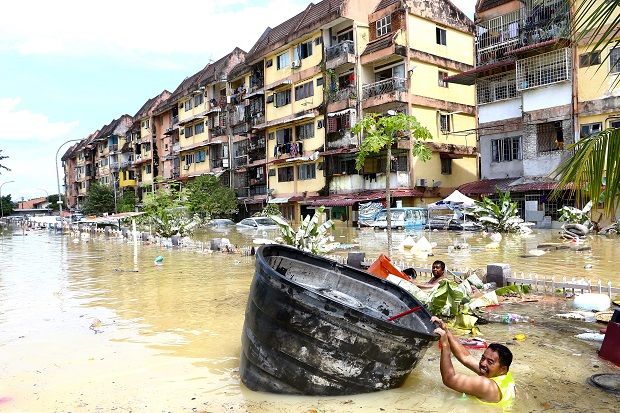
SOCIAL media has been a boon and bane to those stricken by last week’s floods, which crippled many parts of Selangor, especially ground zero Taman Sri Muda.

Affected residents took to various platforms to capture their plight and desperation while stuck on the rooftop of their submerged homes.

Many shared their details on WhatsApp to seek help as it began to dawn on them that help from the authorities wasn’t forthcoming.

I received an SOS from a family of seven who had run out of food and feared their phone battery would soon go flat.

As darkness fell, their worries turned to desperation as many of us in the media collectively sought ways to rescue them.

I called up an official of the Selangor state government and was told about the “shortage of assets” of the authorities. That simply meant there weren’t enough boats and personnel.

But non-governmental organisations and the public seemed to be able to swing into action as they mobilised themselves effectively, despite having less resources than the government.

That these volunteers could react faster probably angered most Malaysians over the disorganised, if not incompetent, operations of the various government agencies.

Adding insult to injury, the heads of some agencies sounded defensive and insisted they had done their work.

Their indifference probably made matters worse for those who have lost their belongings, and even loved ones.

Social media has enabled us to be at the scene of affected areas, and it helped the media understand the predicament of the victims, with one or two people even displaying their anger at certain politicians.

The antics of some politicians – including those travelling in convoys with accompanying police outriders blaring their siren – were all captured on videos that went viral.

The best part of it was the clear audio of the residents making their cynical remarks on these politicians. It was all raw and brutal, and Malaysians enjoyed every bit of the sound bites.

I don’t think our television stations could manage these uncensored and unfiltered footage.

The floods must have been a nightmare for our elected representatives. If they showed up, they were accused of seeking glory, especially those accompanied by the obligatory entourage of reporters and aides.

If they didn’t, they risked being accused of having gone missing in action. And if they had been working at ground zero from day one without registering their presence, they’d end up being branded absentees.

Then, those who sent boxes of food and other essential items with pictures of their faces pasted on them became the favourite targets of Malaysians, with many expressing their contempt on social media.

The lesson for elected representatives is there’s nothing wrong with them registering their charity, but it’s a big turn off when their A3 size picture is on every package.

But most politicians are narcissistic as they love the sight and sound of their own faces and voices, so it’s most unlikely that they’ll learn from the resentment on the ground. In the first place, are they even aware?

To be fair, some Yang Berhormat have proven that they’re Yang Bekerja, particularly those who got down and dirty to clean people’s homes, with one or two even going barefoot.

A few were clearly photo opportunities set up by their media officers for the benefit of their two-minute appearance on television. By now, many Malaysians can gauge the sincerity of these politicians. Truth be told, they looked out of place and even awkward.

Thanks to Tik Tok, Facebook and Instagram, Malaysians have been able to share these video clips as well as express their views without the necessity for media coverage.

From nitwit politicians to religious bigots, no one was spared as Malaysians poured scorn on them while heaping praise and encouragement on their countrymen and women who rose to the occasion to help each other, regardless of race.

Indian youths turned up to clean a mosque, an Indian family cooked for the residents and Malay women joined Sikhs to prepare vegetarian food at a temple. And Malays helped an old Chinese aunty from a roof while Chinese volunteers helped mop up the homes of the predominantly Malay families at Taman Sri Muda.

But the best visual was of an Indian woman who posted a video clip expressing her admiration for fellow Malaysians as the Negaraku played stirringly as background music, which made for an uplifting experience.

The message of Malaysians is loud and clear – the politicians and authorities let us down badly.

Instead of bickering about who should take charge of the respective committees, the politicians should be aware that the public couldn’t care less about this. And so far, these MPs haven’t executed their responsibilities effectively.

It’s obvious that the army must now be mobilised and deployed in greater numbers when such disasters happen again. In many countries, the army is plainly visible in these areas.

The weather has changed dramatically because of climate change. Only an inefficient minister can tell us that Malaysia is one of the few countries in the world not affected by climate change.

The fact is that temperature records in Malaysia have indicated a spike, resulting in precipitation that may cause droughts and floods in various coastal areas as well as threaten Malaysia’s natural resources.

Malaysia remains vulnerable to floods, landslides, haze and water pollution, and the statement by our Environment and Water Minister Tuan Ibrahim Tuan Man is totally off the mark.

And for sure, last week’s floods, while more devastating than usual, was not a once-in-100 years incident. Just look up the number of similar excuses offered by officials in previous floods.

It’s also foolish to delete critical comments on Twitter since the government should be using this popular platform to disseminate information and help the people.

Our politicians and officials need to come up with better and more convincing lines, or er, excuses.
Once in 100 years flooding? It has become too frequent


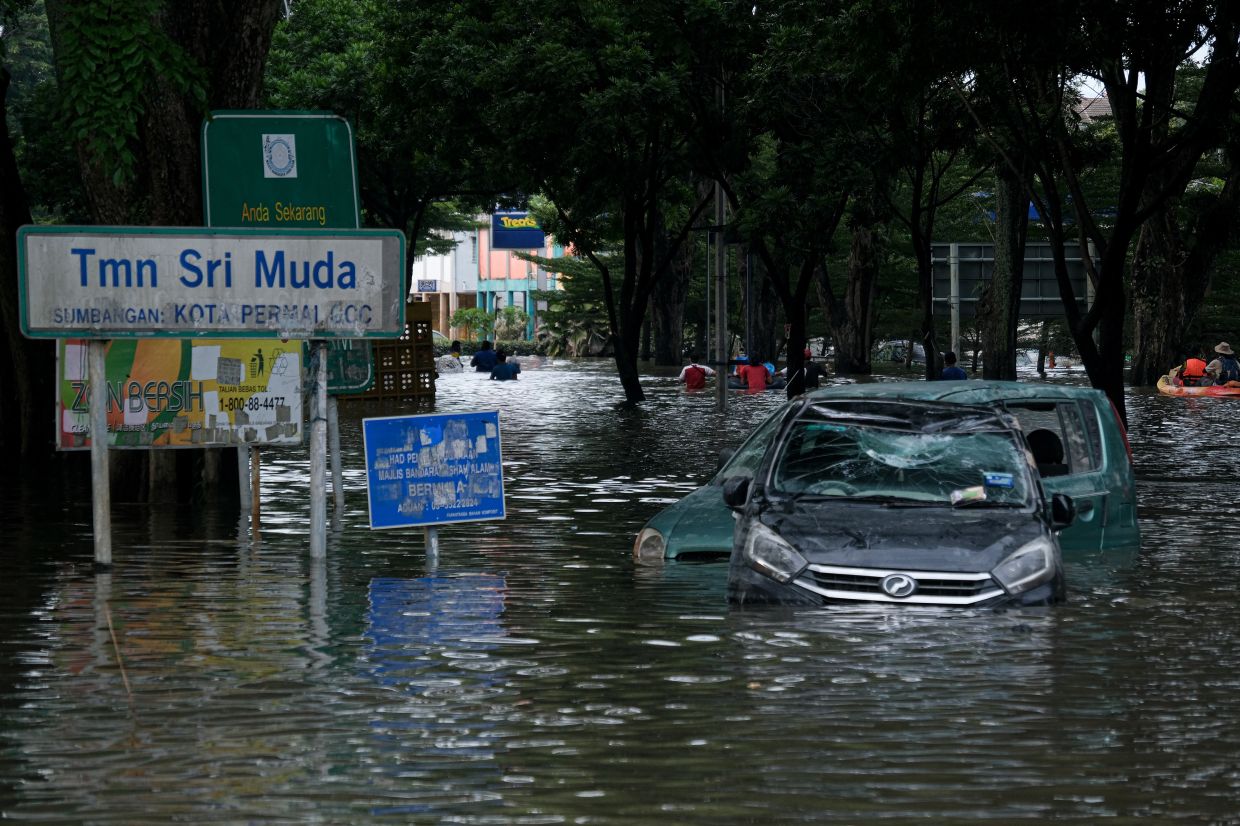
TAMAN Sri Muda is just a barely 15 minutes drive away from Shah Alam, the capital of Selangor. It is a major township located in the Klang district where, by logic, immediate help should have been efficiently swift to rescue the stranded flood victims.

It is not an isolated rural enclave, where accessibility is difficult, but a modern suburb with easy access to three highways. There is even a KTM station located about 2km away from Taman Sri Muda.

So, the range of excuses that has cropped up is hard to accept. It is pathetic, really. Not just to the affected residents but the whole of Malaysia.

Cries of help were still ringing even 48 hours after the floods hit the area, with victims having to spend overnight on rooftops without water and food in the cold.

Some were trapped on the top floor of their submerged homes or in stranded cars, but it made no difference. They had the same predicament, too.

There were many cases of calls for help, especially from families with children and old folks, and in one case, purportedly, the person had died in the home. When the power of their mobile phones died out, they became more desperate and frightened.

So, we are now told that this was an unexpected flood, which had caught everyone by surprise. A month’s rain in one day, we heard.

But for the residents of Taman Sri Muda and surrounding areas, they have been complaining of floods for over 20 years.

The elected representatives have come and gone, but nothing has changed, despite their electoral promises. They certainly have the right to be furious at the authorities – whether federal or state.

When floods hit the place on Dec 25, 1995, the residents took to task the authorities over the lack of planning and failure to render efficient rescue services.

Mind you, it was then on a much smaller scale compared to the one on Sunday (Dec 19), which was exceptional.

Then, on Dec 14, 2021, Malaysia was hit again by Tropical Depression, with Pahang and Selangor being the hardest hit. The media reported that government officials described it as “once in 100 years”. Well, the same excuse has now been given again.

And of course, Taman Sri Muda wasn’t spared in those floods, where damage was reported in Shah Alam.

While the floods in Malaysia are due to its geographical location, with cyclical monsoons characterised by heavy and regular rainfall from October to March, inadequate drainage in many urban areas has worsened the effects of heavy rain.

There have been consistent reports of floods in Klang Valley for areas along the Klang River, Gombak River, Kerayong River, and of course, Damansara River in Shah Alam, where Taman TTDI Jaya Giant Hypermarket and Shah Alam Stadium are located.

On Sunday, all these areas were the worst hit, and it doesn’t take an expert to tell us, given the notorious history of flooding in these areas, that we should have been better prepared – even if it wasn’t as bad as this latest one. Were we even prepared in these areas?

According to the authorities, 60,000 personnel from the police, army and fire department were mobilised nationwide. But ask the ordinary rakyat, they probably think differently and public perception is everything, like it or not.

What was glaring has been the lack of coordination and readiness to respond to a big disaster. What would have happened if there was something more massive than last Sunday’s flood?

But let me salute our rescue operations personnel for doing the best, in whatever circumstances, for their work. After all, they merely take commands.

Flood occurrences have become more frequent in recent years in urban areas because of the loss of flood storage due to development extending into and taking over flood plains and drainage corridors.

Then, there are inadequate drainage systems, or failure of localised drainage improvement works extended insufficiently downstream, according to www.water.gov.my.

There is also constriction at bridges and culverts that are either undersized or partially blocked by debris build-up or other causes.

To be fair, since 1971, following the setting up of the Permanent Flood Control Commission, to take various steps for flood control and to reduce the occurrence, including even flood forecasting and warning, but all failed last Sunday and in previous years.

Our politicians’ visits to these disaster areas have been dismissed cynically by Malaysians, especially in Selangor, and some have not even been seen in their constituencies.

It was a point made by His Royal Highness the Sultan of Selangor, Sultan Sharafuddin Idris Shah, in an interview with The Star recently – before Sunday’s floods – of some elected representatives in the state who only “talks a lot on social media and in Parliament but in reality, there is nothing done” and he was referring to flash floods which hit an area in Selangor a few months back.

Selangor’s biggest problem is the frequent water supply disruptions and constant floods. That’s bad.

Selangor is the most important state in the country, being the most industrialised, so it needs all the backing at all levels, including the Federal Government.

The rakyat is sick and tired of excessive politicking, finger-pointing, photo ops involving politicians, big ceremonies and finally, stop blaming God. It is neither God’s wrath for our purported sinful ways nor that Shah Alam has a brewery.

Please. It is no longer once in 100 years flooding anymore; it has become too frequent.

Food for thought

THE issue that matters most to Malaysians now is the skyrocketing price of essential food items, but it doesn’t seem to be of concern to our politicians.

So a few opposition politicians raised it, but they took it as a political scoring point, blaming the government and failing to offer real solutions or even proper understanding of the grave issue.

The government tried to appease the struggling public by assuring them that the price of essential goods are expected to stabilise and recover by early next year.

Prime Minister Datuk Seri Ismail Sabri Yaakob said that when most countries reopen their borders, economic activities will slowly return to normal.

Yes, it is no doubt a global problem because the Covid-19 pandemic not only cost lives and livelihood, but has placed unprecedented stress on the food supply chain.

In Malaysia, a study by the Malaysian Agricultural Research and Development Institute (Mardi), revealed that 91.1% of entrepreneurs in the agri-food sectors have been affected by the pandemic with crops left unharvested due to the lack of manpower.

Globally, there is a similar bottleneck in the farm labour, processing, transport and logistics sectors as well as momentous shifts in demand, according to the Organisation of Economic Co-operation and Development (OECD).

Even construction materials, petrol and animal feed, among others, have been impacted.

“Most of these disruptions are the result of policies adopted in containing the spread of the virus. Food supply chains have demonstrated remarkable resilience in the face of these stresses,” it said.

While the impact of Covid-19 is still unfolding, experience so far has shown the importance of an open and predictable international trade environment to ensure food can move to where it is needed.

“The biggest risk for food security is not with food availability but with consumers’ access to food: safety nets are essential to avoid an increase in hunger and food insecurity.”

As the world grapples with the uncertainties of Covid-19, no one can be sure of how it will move from here. Just when we thought that the world has become safer, a new strain of the virus suddenly emerged and put us back to square one.

It is shown that even if the richer countries can successfully vaccinate their citizens, we won’t be safe if poorer countries, especially those in Africa and South America, are not given access to full vaccination.

Only 4% of Africa’s population are fully vaccinated with current data showing that only 20 African countries have vaccinated at least 10% of their population.

There are 54 countries in Africa with Nigeria being the continent’s most populous country of over 206 million.

But while Covid-19 remains a massive headache, what our lawmakers do not seem to be concerned about is our gigantic food bill.

In 2020, our food imports amounted to a record RM55.5bil, to meet our needs and demand.

According to the Department of Statistics Malaysia, we are highly dependent on the import of mutton (RM879.4mil), mango (RM87.9 mil), coconut (RM266.1mil), and beef (RM2.2bil) – from Australia, Thailand, India and Indonesia respectively – to meet domestic demand.

The data also showed a staggeringly high import bill for chillies, ginger and round cabbage.

As a regular hypermarket visitor, I can testify that we are even buying cili padi from Bangladesh and Thailand, although we assume it is an easy crop to plant in Malaysia.

Malaysia only produces 71% of rice, fruits (66%), vegetables (40%) and ruminants (29%) of what we need, according to a Mardi report.

The Malaysian Competition Commission (MyCC) has even reported that we are importing ikan kembung, the so-called poor man’s fish, from China, Yemen, Pakistan, Myanmar and Indonesia. The import of these Indian mackerel included frozen ones.

It’s very simple – this is clearly unsustainable.

We can bet that for 2021, our food import bill will be another record, especially with the currency exchange, which is seeing a weaker ringgit.

The food import bill has been climbing over the years and it is most unfortunate that our Members of Parliament, regardless of their political parties, have shown little interest.

It reflects the quality of many MPs we have, unfortunately, and we are expected to place our future in their hands. The trivial matters they are raising are simply cringeworthy.

One would have expected a former prime minister like Tun Dr Mahathir Mohamad to set a better example but he is caught in a time warp with his racial prejudices and failed formula.

Worse, his recent controversial remarks have further eroded his legacy.

Love him or loathe him, he has done so much for Malaysia but he must learn to leave the stage.

Dr Mahathir should be giving advice and support to the new crop of leaders with his vast experience and knowledge, and not undermine them.

And the point is really this – Dr Mahathir neglected agriculture and food production under his 22-year tenure with him prioritising manufacturing, including car making, which turned out to be a disaster.

There has never been any serious focus on agriculture and aquaculture to rejuvenate our food-based sectors, even now, with the digital and technological adoption of drones, precision farming, sensors and other tools.

Only 28% of our population are involved in agriculture and they are, on average, 60 years old, according to Mardi.

We can and will do well if there is the right level of investment and support. Malaysia will only slide if we tie everything to race, because everything will fall into place if there is good business, and everyone will benefit.

The Sekinchan padi farmers in Selangor are certainly a fine example.

Where once there was only empty land, its vast, well-irrigated and organised paddy fields now produce one of the highest yields of rice in the country.

It is a good study of how government agencies and farmers have worked well together for Malaysia, proving agriculture is possible, and Sekinchan has even pushed up the value chain, throwing in tourism as a product.

Malaysia may be a small country, with precious land already taken up by palm oil and now, durian plantation, but there is nothing stopping us from investing in food production in other countries, which is what China is doing.

Between 2000 and 2018, China purchased an estimated 3.2 million hectares of land abroad for food production including cattle businesses, making it one of the largest buyers in the world.

It even invested in food production in the United States, including in one case, a US$1 trillion takeover of the American Smithfield Foods.

The reality is that food crops are a lot harder to plant and maintain compared to oil palm with a 25-year life span tree, while most food crops take only a few months to a few years.

But our population will hit 37 million by 2030 and alarmingly, our self-sufficiency level (SSL) of food crops has continued to drop drastically, and it will take its toll mostly on the B50 group.

Our politicians need to wake up, stop focusing on inconsequential issues and unnecessary mega projects that cost billions, when there are plenty of urgent matters that need our attention.

And food security is really top priority.

Getting affordable homes plan moving


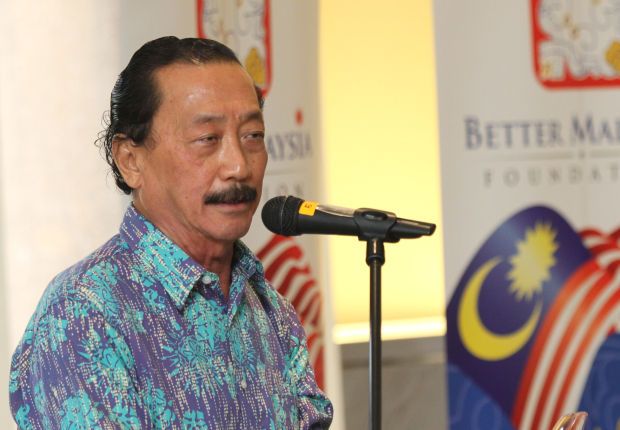
Businessman Tan Sri Vincent Tan (file pic) wants to push his ambition of making homes possible to the low-income group as the size of the B40 group has reportedly grown to become B50 now.

IT’S been 10 months since tycoon Tan Sri Vincent Tan announced his affordable home project for low-income Malaysians, notably the B40 (bottom 40% or poor) group.

“In just that short period, we now hear reports that it is now B50 because the middle class has slid down.

“M40 has reportedly deteriorated to now M30, according to some news reports because of the impact of the Covid-19 pandemic.

“It has become more urgent that the affordable home project for the lower income gets going soon,” the Berjaya Corp Bhd chairman said, over a vegetarian lunch interview.

The B40 are Malaysians who have a combined household income of less than RM5,000 per month.

Vincent, who heads the Better Malaysia Foundation (BMF), has launched a new social enterprise programme to assist the government in addressing home ownership aspirations.

He has done his homework, evaluated the costs and learned that loans are a major stumbling block for the B40.

Other related issues can only be ironed out by the government and banks.

Vincent is pushing the concept that BMF, in collaboration with Berjaya Land Bhd, has designed a 900-sq-ft five-bedroom, four-bathroom show apartment specifically for this initiative.

The Batu Pahat born self-made billionaire said he was “extremely disturbed and sad” that almost half of Employees Provident Fund (EPF) members have less than RM10,000 in the accounts and that only 3% of these low-income Malaysians can afford to retire at 55-years-old and sustain it with their savings.

Vincent understood what it was like to be poor, as he had to forgo a tertiary education because his lorry driver father could not afford it.

There were eight siblings in the family, and eventually he found work as a bank clerk instead and then sold life insurance.

Both he and his businessman brother, Tan Sri Danny Tan, had to share a rented room when they first came to Kuala Lumpur to work.

Danny, who had only a kap cai motorcycle, even travelled to villages to sell encyclopaedias, before joining his elder brother to sell insurance.

Looking at the plight of the B40 now, Vincent said: “The pandemic has made it worse for many Malaysians. Many are still struggling as businesses have closed and wages slashed.”

The EPF has warned that this could have huge socio-economic implications following the Covid-19 pandemic and stressed the importance of adopting a holistic approach to address the issue.

EPF, in its latest findings, reported that most of its members in the low–and middle–income groups are likely to live in poverty in old age unless mitigation measures are taken.

The data showed a 60% decline in median savings among the 5.05 million EPF members in the low-income group (Bottom 40) from RM2,434 (RM10 per month for 20 years) to RM1,005 (RM4 per month for 20 years) post-pandemic.

Vincent said these developments had made it even more urgent that these households have a roof over their head and there was validity for his proposal.

The situation in Klang Valley and major cities are grim. For every 1,000 units launched in the Klang Valley, it is said that between 10,000 and 60,000 applicants apply to purchase them.

According to Khazanah Research Institute, current trends indicate that both the B40 and a segment of the M40 of income earners require some form of social housing or assistance in buying their first home.

Vincent said he hoped to meet the various stakeholders and key figures at the federal and state governments to explain to them the significance of the proposal.

The 69-year-old philanthropist understands fully that advocacy isn’t enough and as a businessman, who likes to pride himself for being practical and results-oriented, he wants to make the idea work.“I hope they (the politicians) will still open their doors for me because I don’t want them to get frightened by my persistence,” he laughed.

Vincent shared that his idea of a five bedroom, with four toilets, in a 900 sq feet flat had been mocked.

“Come to see the model flat at Berjaya Times Square. It can be done. Can you imagine a family of six? The father and mother take one room.

“If there are three girls and one boy, how do they share the remaining one room, as it is now with low-cost flats?

“Many live in the tiny hall and sometimes, brothers and sisters share rooms. It’s not conducive. Many low-income families may be poor but they are blessed with many children.”

Tan said he had also met two banks to work out a good housing loan proposal for the low-income home buyers.“I trust that the less privileged will be good at servicing their loans. Better than the rich,” he said, citing the experience of the Grameen Bank’s microcredit project in Bangladesh with a 90% recovery rate.

BMF identified that high land prices in urban areas is one of the key current issues.

It suggested that land be provided on lease by the government or be subsidised, with an assurance that the lowered cost be translated to the lower house prices for the B40.

It said the government can offer land at subsidised prices or leased for a 99-year period to property developers catering to the B40 sector.

Apartment sizes and selling prices should be controlled as per those in the affordable housing guidelines, it added.

“There is potential for the B40 home prices to be lowered when land cost is taken up by the government. Homes cost can be lowered from the original RM300,000 for a 900 sq ft unit in Kuala Lumpur and RM250,000 in Selangor when land cost is taken out of the equation via a 99-year government lease.

“This will allow for lower monthly mortgages, close to current rentals, thus improving the eligibility for the B40 to purchase.

To tackle the issue of the B40 group unable to apply for housing loans due to financial difficulties, the BMF has suggested innovative finance solutions.

It has put forward two key proposals for lenders to provide 100% financing for the 35 year or extended loans among family members and for the government to guarantee a portion of those loans.

“The affordable housing shortage for the B40 group must be addressed urgently. Those who are now able to rent their properties may not be able to keep up with their rental payments when they retire or are no longer gainfully employed for whatever reason,” Vincent said.

He said for the idea to come to fruition, several conditions have to be in place, including the government support to charge lower land premiums and nominal development charges for affordable housing projects. By doing so, the government will help to give affordable housing a shot in the arm.

Vincent urged the federal and state governments to sell development land at a low cost to developers to build affordable housing projects, especially in urban locations close to transport hubs.

BMF’s second proposal is for lenders to provide 100% financing to B40 house buyers.

The foundation’s research has shown that several banks are already offering 100% financing to house buyers with a minimum income of between RM2,000 and RM3,000 per month, including RHB Bank, Malayan Banking Bhd, CIMB Bank, OCBC Bank, MBSB, Bank Rakyat, AmBank and Affin Bank.

However, it states that 60% of loan applications by prospective buyers of affordable homes are rejected due to age or poor credit scores.

Vincent said rejecting a housing loan is akin to a life sentence for the B40 applicant, adding that many first-time house buyers are unable to come up with the down payment required for buying a house.

This will be resolved if lenders provide 100% financing, he pointed out.

He urged the government to implement strategic initiatives for banks and financial institutions to provide 100% financing to B40 house buyers with two-generation home loans of between 40- and 60-year duration so that loan repayments would be affordable and manageable.

He has even suggested that the government guarantee the home loans of B40 house buyers so they can be offered at a lower interest rate.

According to the BMF, banks and financial institutions must also play their part by providing loans with 100% financing to the B40 house buyers.

“We understand that the loan applications of 60% of buyers of affordable homes are rejected by banks and financial institutions due to age or poor credit scores.

“The key problem is the rejection of loans, which has also affected property developers who want to build affordable homes in allotted areas.

“So, even well-meaning developers have found this to be a major hurdle as they, too, need to pay the banks when construction begins for these affordable flats.”

But Vincent can’t pull this off unless the government extends support in terms of charging lower land premiums and nominal development fees for these housing projects.

The federal and state governments must also be willing to sell development land cheaply to developers to build affordable houses, especially in urban locations close to transportation hubs, which would translate to lower purchase prices for low-income house buyers.

The BMF believes that affordable housing can be realised with pricing going from RM120,000 to RM300,000 for an apartment in the Klang Valley, with sizes starting from 450 sq ft, 600 sq ft, 750 sq ft and up to 900 sq ft.

The foundation also conducted a survey on 1,700 employees of a private business organisation who fall within the income range of the B40 group,

The survey’s focus was on the amount B40 employees were paying for renting a room or a house.

From the survey, it was ascertained that the B40 employees were paying an average rental of RM900 per month for housing in the Klang Valley. That means the RM900 rental paid each month covers the monthly loan repayments of RM899 had the employees been able to obtain a 100% financed, 60-year loan of RM300,000.

“The key takeaway from this is that the monthly rentals can be “converted” into monthly loan repayments, so a B40 person can buy his own home. It is imperative that housing loans for the B40 group are 100% financed for a term of 40 to 60 years, so that monthly repayments are affordable, and the two-generation feature is adopted.”

Many wealthy Malaysian parents have begun buying homes for their children because they know it will be tough for them.

For those renting homes, it gets more difficult to secure bank loans when they grow older. It could get even worse when they can’t afford rent because they’ve retired.

But for the B40, they may end up homeless. And that could take us from enduring social and criminal problems, right through to navigating past a political storm.

“Investing in people, especially homes for the lower income, is a good thing. Malaysia can afford it if we review whether we need some of the mega-projects.”

Nothing else matters

At a time when lives and livelihoods are priority, we could do with staying focused.

THE rakyat is surely wondering if some of our politicians are worth their salt given the pathetic issues they’ve raised in Parliament when there are clearly bigger concerns.

Malaysians are struggling with matters like rising food prices, job loss, minimum wages, and affordable homes, and then, we have a Member of Parliament who wants to talk about the uniforms of Malaysia Airlines’ air stewardesses.

What’s wrong with PAS MP Abdul Latiff Abdul Rahman? He seems to be misplacing his priorities when his own Kuala Krai parliamentary constituency has more pressing problems.

He can have his pick from illegal logging, murky water supply, floods, pollution, and telecommunications, among others, yet, what he wants to bring to the attention of top lawmakers is the uniform of MAS crew, which he claims is revealing.

I don’t know what he sees each time he goes on board the airline. I only see our busy cabin crew. I see them in their beautiful batik-print uniforms, which represent the tradition and culture of Malaysia.

I see the batik with traditional floral motifs derived from Malaysian flowers including jasmine, cempaka and the leaves of the hibiscus, the national flower. There is the element of the Nyonya kebaya, and if you look a little closer, one can even see the geometric motif inspired by Sabah and Sarawak.

And of course, when we travel on Malaysia Airlines, nothing is more comforting to our ears than the announcement that goes, “to all Malaysians, selamat pulang ke Tanah Air (welcome home).” When the MH crew smiles, I know it’s genuinely warm and Malaysian.

It provides a homey feeling, especially for tired Malaysians who have been away from the country for too long. It’s the sense of home and seeing the crew, with their batik motif uniforms, which is so pleasing to the eyes.

Our MH crew is certainly one of the best in the world, unlike the grumpy looking, and even rude, flight attendants of many Western airlines. As a seasoned traveller, I have even seen food thrown at a passenger (me) by an attendant of a European airline.

There are only good things to remember about our MH crew, although there would also be one or two unpleasant memories.

So, how would we know what’s on Abdul Latiff’s mind when he sees the female attendants? We’re not mind readers, but I have a suspicion. It’s revealing. Not the uniform, but of him.

I would even go a step further. I think he needs help. He’s seeing things the rest of us aren’t. He has a magnitude of problems in his backyard, yet he’s worried about the attire of our national airline’s staff.

At a time when Malaysia Airlines is struggling to execute its five-year turnaround plan aimed at making its cash flow positive by 2023, by slashing costs while growing revenue, our lawmakers can certainly do their part in making positive suggestions to promote our national carrier.

The Covid-19 pandemic, which decimated the aviation industry, has put the airline in the red, what with its huge liabilities. So, the last thing it needs is a trivial, unconstructive comment from this PAS MP, who had previously called for the prohibition of all entertainment events that breach Islamic laws.

In his 2020 statement, he did not spell out what he was referring to, except to say that such entertainment activities were inappropriate and outrageous, amid the economic effect on most Malaysians due to Covid-19.

At the height of the pandemic, with all cinemas, restaurants and clubs closed, one wonders what he was on about in Parliament, without specific details to his broad remarks.

All this isn’t remotely amusing. After Timah, Nur Sajat, ban on gaming outlets in Kedah, liquor sale prohibition in traditional Chinese shops, added rules on the sale of beers in coffee shops, many Malaysians are wondering if this is the result of pressure exerted by PAS because of its place in the ruling Federal Government, despite having only 18 MPs.

The Islamist party doesn’t even command 10% of the 222-member Dewan Rakyat, and yet it is supreme because it’s an essential cog in the Federal Government wheel. It has almost no known policies on important issues relating to the economy and how to move the country forward. Its role is to highlight religious issues, according to its interpretations and justifications.

Unreasonable restrictions on alcohol sale have suddenly surfaced when there were none before. For non-Muslims, the perception is that this flurry of rules has impinged on their constitutional freedom and lifestyle choices.

And because of this, the government has unwittingly allowed illegal syndicates to become bigger. For example, illegal betting syndicates have been stealing large chunks of legitimate Number Forecast Operators (NFO) business and robbing the government of some RM3bil in tax revenue annually.

It is naïve of the Kedah PAS government to say that non-Muslims can travel to Penang to roll the dice because Kedahan non-Muslims would simply text the illegal bookies to place their bets.

Ultimately, the winners will be these criminally-linked organisations and corrupt police officers. Does PAS believe that gaming would disappear overnight with more regulations and bans?

Legal NFO operators can’t accept bets online, but illegal bookies can. That’s another irony because the technology allows users to place bets from their cell phones easily, and adding to that, illegal gambling can now be conducted in cyberspace and beyond national borders.

Then there is contraband beer, which makes up 70% of the total beer volume in Sabah and Sarawak. For Peninsular Malaysia, it represents about 14% of the total volume, according to industry estimates.

That means the Malaysian government loses over RM1.1bil in annual revenue to the illegal alcohol trade, a figure part of the RM300bil shadow economy of the country, reveals a report in The Edge.

And we are vying for beer licences from coffee shops, which will be a pittance in the collection when compared to this huge loss of duties because of the illegal trade. Aren’t we getting our priorities all wrong simply because some policy makers want to flex their muscles to control the consumption of liquor – which is the right of non-Muslims?

If only PAS speaks up just as loudly on issues concerning corruption, accountability, governance, and abuses of power. Now, that would be more revealing.

But the obsession over attire doesn’t just involve PAS. Why should former Johor DAP leader Dr Boo Cheng Hau question Segambut MP Hannah Yeoh for visiting a mosque wearing a baju kurung and tudung?

It’s mind boggling for Dr Boo and some non-Muslims to criticise Yeoh for her decision to display modesty and respect. I’ve visited many mosques in the Middle East, where no such rule is imposed on women, but if Yeoh chose to wear a tudung, that’s her choice and right.

Likewise, when one visits a Sikh temple or gurdwara, it’s mandatory for them to cover their heads. It’s that simple.

I wish more non-Muslims would stand up to defend Yeoh, instead of offering lame suggestions like she could have just worn a headscarf and not a tudung. Again, we seem fixated on inconsequential issues.

Let’s just address what matters.

It’s A Durian Life!


Panas Banget Di Indonesia


Validating vacations


Own goal: It was a big win for the KL City Football Club when it clinched the Malaysia Cup for the first time in 32 years. Unfortunately, not so for our leaders who granted the Federal Territories a public holiday for the victory.

FIRSTLY, let me extend my congratulations to the KL City Football Club for winning the Malaysia Cup for the first time in 32 years. It’s an outstanding achievement, no question about it.

A celebration is certainly in order! Well done! Congratulations! Bravo! Because we are the champions, we are the champions!

But that’s it. That’s all. By right, we should get back to work after the party. And surely an unscripted and sudden public holiday isn’t necessary. Most city folks, blighted by the economic downturn from the effects of the pandemic, are clearly not in the mood for another off day.

Many of us have stayed at home for long enough during the Movement Control Order and subsequent measures over the past two years. Businesses have crumbled, jobs have been lost and we’re slowly trying to get back on our feet. So, we don’t need this unplanned holiday.

The Federal Territories Minister Datuk Seri Shahidan Kassim must have thought he made a popular decision. But instead of being praised, the Perlis veteran politician is getting hammered.

That’s simply because he is not reading the mood on the ground well. In fact, we wonder if our politicians know what the rakyat feels. We aren’t sure if he had thought this through properly or considered the economic disruption from this sudden shutdown because hundreds of millions would be affected.

KL may have reasons to celebrate because it involves KL Football FC. I’m not sure if the people in Labuan or Putrajaya have the same enthusiasm for the victory. Had Sabah won, there could have been greater joy in Labuan.

Shahidan has now said that his decision to declare the holiday was referred to the Prime Minister and the Chief Secretary to the Government. Now, we also wonder why the two gentlemen agreed to the holiday, or if they merely found it hard to say no to him.

Malaysia has one of the highest numbers of public holidays in the world, just behind Thailand, Indonesia, India and Hong Kong. Our public holidays are federally gazetted, and some are observed by the respective states.

As of 2020, each state and federal territory has designated four to six state public holidays, bringing the total number of (federal and state) public holidays to 20 days in Sabah and Terengganu, 19 days in Labuan, Penang and Sarawak, and 18 days throughout the rest of the country.

If that’s not enough, these holidays often take place near the weekends, resulting in at least 12 long weekends, which Malaysians have come to identify as extended holidays.

My foreigner friends have often asked me why there are still race issues after 60 years of independence, with politicians competing to prove how much more racist one is over the other. But to our credit, when it comes to off-days, we all agree that every race and religion deserves a public holiday to mark their festivals and auspicious occasions.

Even more incredible, as a news journalist, I’m often asked whether there’d be a public off day each time a VVIP dies. I’ve never asked whether they need a day to mourn the passing of a supposedly great person, or if there’s a need to “celebrate” silently.

But the most outrageous public holiday was the one Kelantan declared to boost attendance at the protest of the proposed implementation of the International Convention on the Elimination of All Forms of Racial Discrimination (ICERD) in Kuala Lumpur in 2018. Luckily, the PAS state government didn’t declare a holiday when the Taliban took control of Afghanistan this year.

So, the PAS state government initiated a new form of public holiday – cuti protes (leave to protest). We’ve heard of cuti sakit (medical leave), cuti kahwin (marriage leave), cuti bersalin (maternity leave) and compassionate leave, but now, there’s even cuti menang bola (leave for winning a football game).

Every time there’s a shut down, there’s cost involved, especially for manufacturing, with deadlines to be met. Malaysia is already a high-cost country for basic manufacturing because we are short on labour. If investors move to Indonesia, Vietnam and Cambodia, it’s not because they love these countries more than Malaysia, but purely for business reasons.

Indonesia has 300 million people, and their workers don’t whine or complain about working conditions. They are tough people who aren’t afraid of difficult work, so, it’s easy to hire them.

Vietnam and Cambodia aren’t the most democratic countries in Asean. Nor are they known for established legal institutions. Transparency isn’t high up in the rankings either, but they will beat Malaysia. Again, it’s all about cost – the basic rule for a manufacturer pumping money into a country.

It doesn’t help when our politicians, in trying to be populist, decide to declare holidays at their whim and fancy, without carefully deliberating the implications of their decisions.

It might come as a surprise to most Malaysians, but the United States is one of the few countries with only 10 days of public holidays, while Germany only has nine. China, which is known as the factory of the world for producing almost everything, has only seven declared holidays.

Just do a quick search on countries with the most holidays, especially in Europe, and see how they fare economically. One European country even had to be bailed out by international financial institutions.

In the case of FT, the holiday threw the medical specialist professional exams, clinics and operating schedules in disarray while banks decided to ignore the order and continued to operate.

So, if we win our first Olympics gold medal, it looks like we will have more than just one public holiday. We will need at least a month! That Malaysian gold medallist will need to be taken on street parades, with lengthy speeches by politicians, and then there will be the visits to 14 states and territories. Of course, the mandatory Datukship is necessary, too. No, one month isn’t enough, come to think of it. Now, you know why it will soon be called “Cuti Cuti Satu Malaysia.”