Monthly Archives: January 2023

Still serving the people


THE past two months have been particularly tough for PKR leader Nurul Izzah Anwar.

A hectic 15th General Election (GE15) campaign in November took a toll on her, and culminated in her unexpectedly losing in her constituency of Permatang Pauh, Penang.

As Prime Minister Datuk Seri Anwar Ibrahim set off to form the Unity Government, Nurul Izzah was also busy working behind the scenes to put the foundations in place. This included crisscrossing the country to talk to people to plan for the Budget. But she paid a heavy price: she suffered a miscarriage.

In an exclusive interview with Sunday Star since that personal tragedy, Nurul Izzah, 42, talks about what she’s been doing and how she will continue to serve the rakyat in her new role in government.

First of all, I wish to say I am sorry to hear the news of your miscarriage.

Thank you kindly. I felt by sharing I could somehow lend a voice to so many other women and their loved ones who shared similar experiences.

Naturally, I am sad, but God always has better plans for everything. So we soldier on, remain hopeful and grateful for all the wonderful blessings in life.

How has the GE15 loss affected you?

I have been in politics for a while now – as my friends say, I’m an “old” young face! I was first elected as MP back in 2008 at the age of 27 but was involved even earlier during the setting up of PKR in 2003.

It’s been more than two decades since my involvement in activism and later politics proper began, and since then I’ve participated in four elections.

What started as a journey to seek justice for my family evolved into a mission to bring justice to all Malaysians. So as disappointing as it is for me personally, it doesn’t matter if Nurul Izzah loses, it’s more important that Malaysians win.

If anything, my electoral loss in GE15 has only strengthened my resolve to serve the people and work on reforms for better governance across the board. To me, I regard it as a temporary setback.

Will you remain active in politics?

Of course! I am currently serving my fourth stint as a VP of Keadilan. I’m still very much involved in serving my party.

But leadership is more than just about partisan politics – it is about service.

There are other avenues to participate in to bring about reforms. While I may not be in Parliament to serve the rakyat, I am now serving the government in shaping public policy and putting policy into practice.

What have you been doing after GE15 as it appears that you have stayed away from the limelight?

I have been serving as Senior Advisor to the Prime Minister on Economics and Finance effective Jan 3, 2023.

It is my fervent hope that my past experience in the legislature as an MP, work on poverty and technical and vocational education, and service on the Public Accounts Committee can be leveraged in my engagement with experts in navigating economic governance, accountability, and evidence-based policies.

One of my goals is to channel and leverage the talents of Malaysia’s best and brightest, both within and outside the government, to add value to the ongoing efforts to improve the rakyat’s economic situation.

I am also a firm believer in listening to people directly. As part of our Budget preparations, we have not only been meeting business groups and the usual stakeholders, but we have also been seeking input from the people, especially those in the B40 group, and not forgetting the M40 group.

The instruction from the PM was clear: talk to the rakyat and listen to their ideas, concerns, and expectations. They are the most important stakeholders of all.

In the years that you have been in politics, you have emerged a leader in your own right. Tell us about your journey in leadership. How do you see this evolving in your new role?

Since my first stint in politics during the spark of the Reformasi movement, to the present day, I have had the opportunity to learn a lot from various leaders whom I look up to.

Values are important. An effective leader espouses compassion and humility, while at the same time being able to make tough decisions and never losing sight of the bigger picture.

Leadership is not about personal glory or seeking glory, leaders must recognise and nurture talent and connect these individuals to opportunities to further improve their skills and abilities for the sake of society.

My new roles will allow me to take on new responsibilities that are no doubt challenging given the economic headwinds we are facing. However, I am confident of being able to contribute to the evolution of a Malaysia that not only seeks growth for growth’s sake, but one that elevates all strata of society and provides equity in opportunities.

Our youth must have hope in Malaysia. Things may not improve overnight, but the decisions we make today will determine the Malaysia that they inherit tomorrow.

The Prime Minister recently spoke of Malaysia Madani*, what is your personal view about what he has articulated? Is Malaysia ready for this?

At its core, the concept of Madani is a call for a “civilised” Malaysia – entailing the rejection of corruption and of disharmonious or undemocratic practices.

It is not an idea alien to Malaysians; these concepts are already embodied by our national philosophies and values, including the Rukun Negara.

As you have written in a recent article, the PM has been talking about Madani since the early 1990s. It simply boils down to good governance, embracing diversity, and creating a fair and just system.

But it’s important that all of us – not just the government – must make this a reality and not just talk. Not mere slogans and big words. The people must be able to relate to it and benefit from it.

So how does the Madani policy benefit the people?

This philosophy is not new – the masyarakat Madani concept was discussed by Anwar 26 years ago. Kemasyarakatan, or community empowerment and inclusiveness, remains the core.

This is the philosophy used during my years as an MP. Projects must be sustainable and centred on community empowerment instead of just being one-off projects. The Permatang Pauh Social Impact Agenda, for example, focuses on empowering the community, that is why many projects include collaboration with local universities and experts to empower the community.

Malaysia is blessed as we have a caring and compassionate society. One need only look to the recent pandemic and floods to see how we banded together to help each other during times of crisis.

However, there are efforts to disrupt the harmony by politicising differences rather than celebrating togetherness. It makes it all the more important for us to ensure that our communities are empowered and driven by the right socioeconomic agenda to face further challenges.

Many Malaysians are concerned by what has been termed the Green Wave, with PAS making gains in the Malay heartland. What is your view?

The results of GE15 have proven that no political party can form the federal government without the other key components, especially from Sabah and Sarawak.

No one party can do without the other parties. That was why the Unity Government was formed.

Malaysia is multiracial and multi-religious. This is why Keadilan is open to all races. For the first time in our history, the country’s PM is from a multiracial party and that is significant.

I won’t go into the hypocrisy of politicians using religion to justify poor governance. Most Malaysians want a PM and a government that embraces diversity and practises good governance.

It is incumbent upon us to demonstrate that we have the will to govern in a manner that is just, progressive and fair both in social and economic terms.

*Madani is an acronym for a policy under the Malaysia Unity Government that embraces six core values: keMampanan (sustainability), kesejAhteraan (prosperity), Daya cipta (innovation), hormAt (respect), keyakiNan (trust) and Ihsan (compassion).

Aptitude for ineptitude


Education Minister Fadhlina Sidek, when contacted by the media, said that the matter should be handled by the district education office. – Bernama

THE controversy surrounding allegations that only Muslim students from an all-girls school were invited to an SPM workshop has naturally raised conjecture.

Let’s assume that it was a simple communication blunder and that there was no ill intent or malpractice. If indeed the workshop was meant for all students, regardless of race or religion, then the school could have announced the names of the participants for the two separate sessions right off the bat.

It would have evaded a torrent of accusations and misunderstandings. It would surely be helpful if an advisory was handed to students and parents, too, about another workshop dated Jan 26 and 27 scheduled for after the Chinese New Year celebrations.

If these details were announced, then it would enable the next batch of students to prepare.

It would also immediately dismiss allegations made by disgruntled parents. They would have no reason to make an issue of this.

But now, the second workshop, which should include non-Muslims, would seem like an afterthought or worse, a damage control exercise even if it wasn’t the case.

Last week, the Education Ministry issued a statement that there was no discrimination involved in the SPM workshop organised by SMK Infant Jesus Convent.

“Initial investigations found that the workshop was part of the many initiatives of the relevant parties to ensure that students, regardless of race, were able to make the necessary preparations for the SPM exams.

“The first of the workshops was held earlier on Jan 19 and 20 in a hotel and involved some 30 SPM candidates who had failed their Bahasa Melayu and History subjects as well as those who received ‘gagal-lulus’ (fail-pass) in some other subjects.

“The workshop was held separately based on sessions to avoid disturbing candidates who were preparing for CNY.

“The ministry was informed that the follow-up session for other students was slated to be held between Jan 26 and 27 at the same hotel,” the ministry said.

The Education Ministry is right to state that the school needs to improve communications to prevent such incidents from happening again.

But it shouldn’t just be the school that takes the rap for poor communications. Education Minister Fadhlina Sidek, the State Exco member for education, information and communications, Norliza Nor and the state education department could have easily done a better job. What’s glaring is they need better crisis management skills and response time.

None of them responded to the issue effectively until His Majesty Sultan Ibrahim Ibni Almarhum Sultan Iskandar made a statement soon after the controversy went viral.

By then, the tweet had made its rounds on social media, garnering more than 800 retweets and over 1,000 likes in less than 24 hours.

While our politicians kept mum and allowed the rumours to flourish, His Majesty the Sultan of Johor swiftly intervened and said no one should be left out of any public programme because of their race or religion.

“If it is true that there was racial segregation, then action must be taken against the organisers,” Tuanku said, adding that “the same can also be said if it is found that these allegations are proven false and spread by irresponsible parties.”

“This is also a lesson to all parties who must deal swiftly and firmly to quell public dissatisfaction,” said His Majesty via the Royal Press Office.

Fadhlina, when contacted by the media, said that the matter should be handled by the district education office.

It was a disappointing statement because it gave the impression that she was passing the buck to the state officials.

In the age of social media, where issues travel fast, we expect our officials to provide quick and convincing responses, and not merely sit on the issues believing they will resolve themselves.

Unfortunately, these issues won’t, and as the Sultan said, they must be dealt with to pacify society’s ire.

The four-paragraph statement posted by Norliza provided no worthy information except to display pictures of herself and officials huddled in a meeting.

If there’s a lesson to be learnt from this episode, it’s the need to be transparent, accountable and to be forthright in providing information, and the importance of engaging with stakeholders, which, in this case, include the students, parents, and the media, too.

In fact, some novice ministers regrettably still remain incommunicado to the media.In 2023, there’s just no excuse for inept communication given the available platforms.

Beautiful Padar Island is a sight for sore eyes


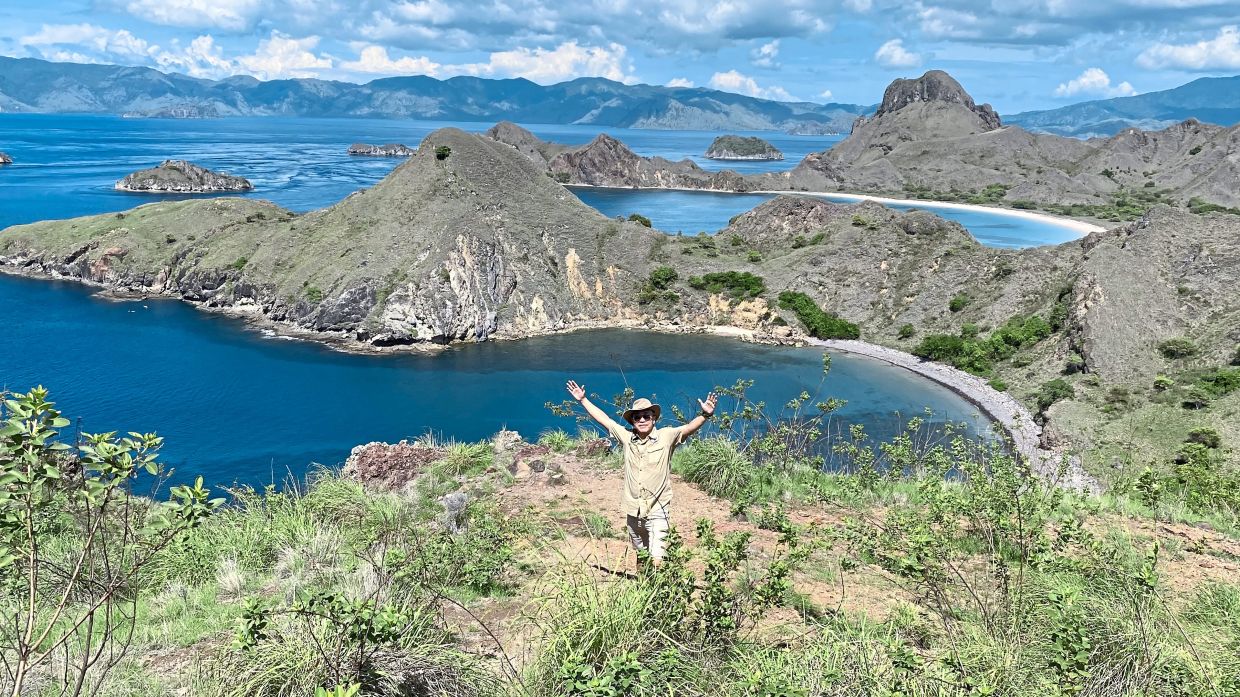
The columnist was inspired to visit the island after seeing beautiful pictures of the place on social media. — Photos: FLORENCE TEH

It’s easily one of the most Instagram-worthy spots in Indonesia and Padar is also arguably the most famous island among that nation’s many land masses.

I must admit that my decision to visit this place was driven by the desire to have my picture taken at the stunning spots captured in innumerable photos on social media.

Influencers on these platforms certainly live up to their name. They have helped tourism in many ways.

Padar Island is simply out of this world. Visitors heading to Komodo Island to see the legendary dragons are invariably drawn to Padar.

The island is the third largest of the Komodo archipelago, neatly nestled between Komodo Island and Rinca Island.

All three-form part of the Komodo National Park famous for its Komodo dragons, from which the park earns its moniker.

Padar is located about 30km from Labuan Bajo, a small fishing town on the westernmost part of Flores.

Getting to Komodo Island constitutes an hour’s flight from Bali to Labuan Bajo and then a three-hour boat ride to the islands.


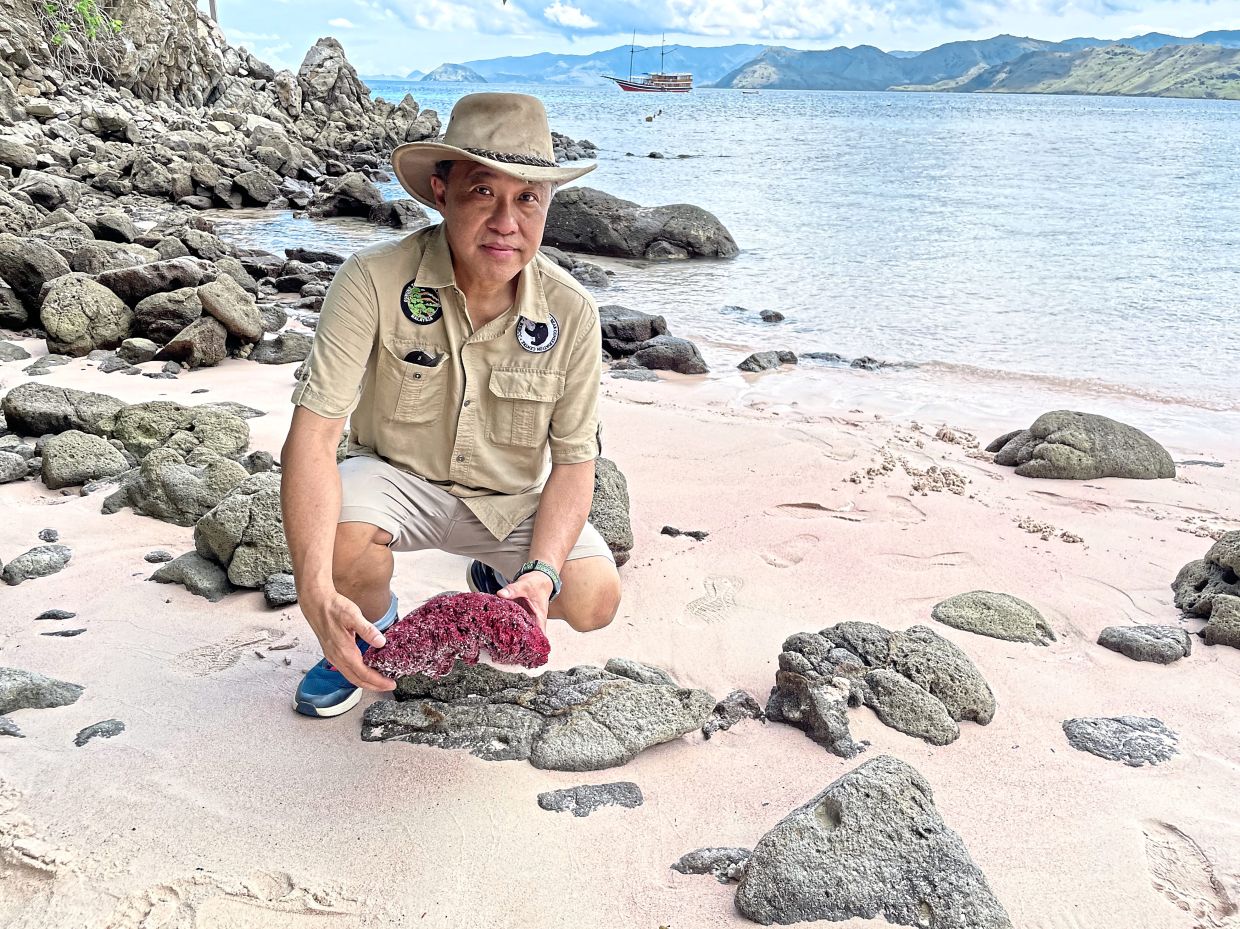
Holding a red colour coral that was washed ashore at the Pink Beach in Padar Island.

It belongs to the Lesser Sunda chain of Indonesian islands in the Province of East Nusa Tenggara.

Padar is an uninhabited island with a setting quite like Jurassic Park. Those giant reptiles used to roam the island but have since been declared extinct. However, some websites insist that they still exist on the far north of the island that’s inaccessible to tourists.

Padar is reportedly one of the only places in the world where you can find pink, black and white sand beaches all on one island.

Dive Concepts diving centre describes the three colours of the beaches aptly – “one is pearly white, another charcoal black and the third is the very rare pink.”

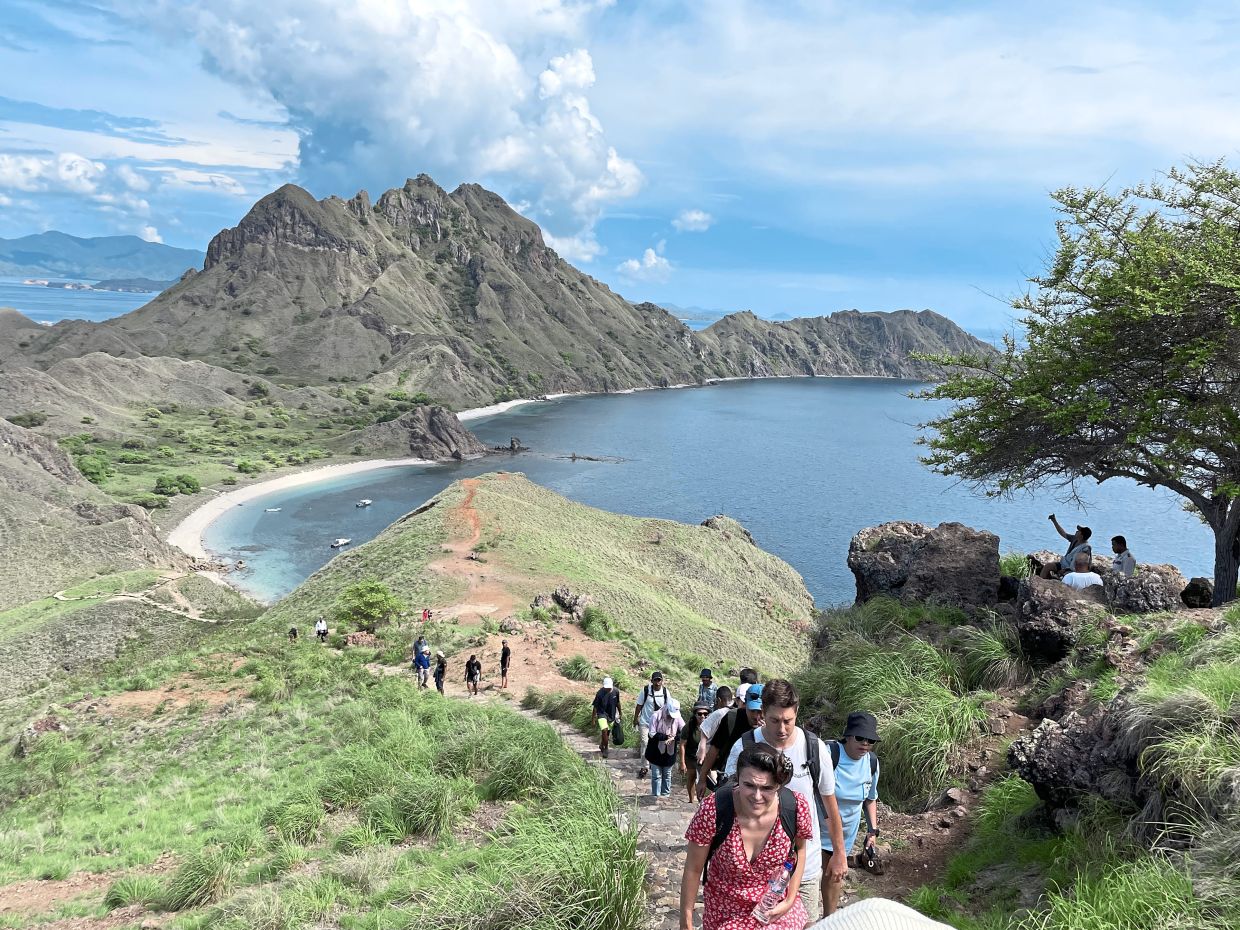
What inspires every visitor to make the 45-minute hike up to the top of Padar is a majestic view of the island, with its rustic red volcanic hills, savannahs and the turquoise-coloured sea of the three bays surrounding the island.

The scenery defies description – it’s just a sight to behold.

The trek up the summit is not extremely difficult but no walk in the park either. There’s no prize for reaching the top first.

So, I took quick and short stops to regain my breath as I trudged up the path. There are no slippery slopes, so there’s little chance for mishaps.


It’s a 45-minute hike up the hill at Padar Island, but the view from the top is spectacular.

It also makes sense to enjoy the incredible scenery from both sides of the climb since neither trees nor bushes obstruct the view.

Divers can hire boats to search for sharks, manta rays, dolphins, green turtles and even whale sharks, which Padar is also famous for.

My boat man took me to the pink beach, but I was bummed that the colour of the sand was no longer as vibrant. I hope I was just taken to the wrong side.

According to reports, the beaches apparently get their colour from foraminifera, microscopic red organisms that live in the coral reefs and get washed up onto the beach.

A pink sand beach in general is very rare, and there are only a handful of them in the world.

The Pink Beach is one of seven pink beaches on the planet and is merely one of the many amazing features of Komodo Island that make it truly a natural wonder of nature.

The excursion to the Komodo islands is a day trip, and depending on your preference and budget, you can opt for a group or private boat tour.

Look for a speed boat with good amenities and comfortable seats. I didn’t ask questions and trusted my agency, and then I found myself in a slow wooden boat. An unhurried ride simply translates to less time on the islands.

The tour I went on covers the top locations in Komodo National Park such as the hike to the famous Padar viewpoint, Pink Beach Komodo, seeing the famous Komodo dragons, and swimming at Kelor Island.


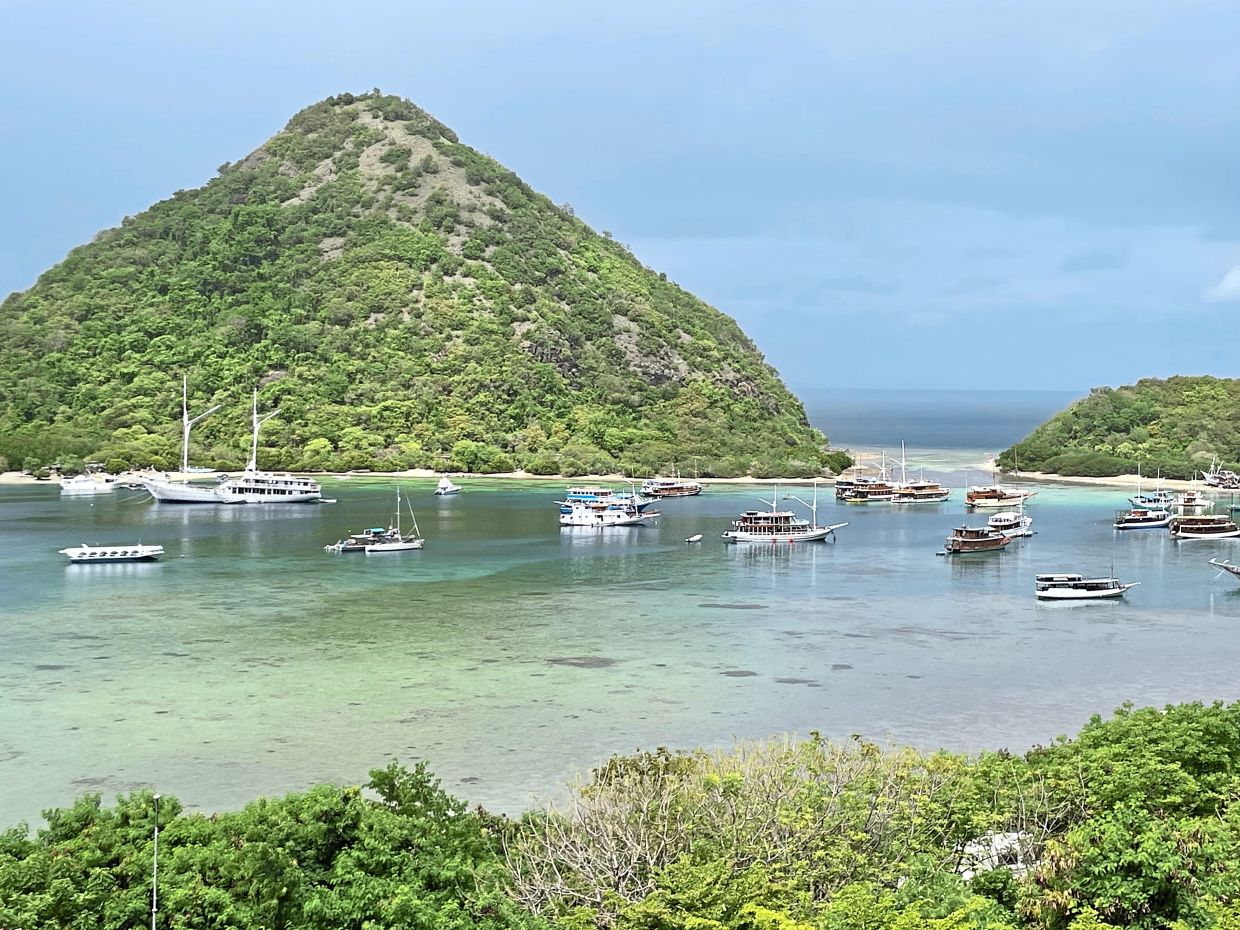
A view of one of the islands in Labuan Bajo, the gateway to the Komodo Island in Indonesia.

It also includes hassle-free pick-up and drop-off from your hotel in Labuan Bajo, return boat transfers, and a guide.

And please ensure the trip includes entrance tickets to the islands.

Bring along some cash for tips, drinks at the islands and buying souvenirs such as T-shirts, stickers, cloth badges and carvings.

My advice to older Malaysians is, see all these exciting places while your knees and heart allow you to climb.

More importantly, take a deep breath as you enjoy these incredible sites and appreciate God’s creations.

PAS needs more than CNY greetings, open house visits to convince majority of M’sians

LET’S give Tan Sri Abdul Hadi Awang marks for trying. He has posted at least three pictures of himself and family, dressed up in red Chinese New Year costumes, for the festival.

The PAS president spoke of his ties with the Chinese community including his daughter-in-law and many other family members adopted by his grandfather – whom he regarded as his blood uncles.

To be fair, this is not the first time that he has posted pictures of himself and family members for CNY and shared stories of how he attended meals hosted by Aisyah Lim, his daughter-in-law.

In his Facebook post on Sunday (Jan 22), Abdul Hadi wrote of how his grandfather provided refuge to non-Muslim Chinese refugees, who arrived at the East Coast during the Second World War.

But the comments on news portals from netizens have drawn more sarcasm than praise despite his efforts, which included attending CNY open houses in Kuala Lumpur.

PAS secretary-general Datuk Seri Takiyuddin Hassan, a lawyer, who is regarded to have a moderate image, also uploaded a CNY greeting.

The MP for Kota Baru was the only PAS leader to carry a Merry Christmas message last December, as in previous years.

Perikatan Nasional leaders especially those from Parti Pribumi Bersatu Malaysia and Gerakan have heard much criticism and feedback from Malaysians, including even Malays, on how they feared the “Green Wave”, which has seen huge gains for the Islamist party in the recent general election.

From insisting on a beer promoter covering up beer bottles at a mall in Seberang Jaya, Penang, for CNY to shutting down betting shops in Kedah and previously, calling for Muslims to stay away from a Japanese cultural festival in Selangor, their actions have spooked Malaysians.

Worse, many have the impression that Abdul Hadi is an apologist for corruption, rightly or wrongly, because it fits his political expediency.

His past irrational outbursts which included blaming non-Muslims as the root of corruption in Malaysia have not endeared him to Malaysians either, who find his politics disturbing in a multi-racial country.

But PAS politicians are seasoned, don’t underestimate them. Despite their religious dress and serban, they remain politicians, who are prepared to compromise their principles and positions.

They have worked with Umno, whom they had once declared as infidels, and even with DAP, which they have branded as communists, among others.

If it suits them politically, these theologians will sing differently to their hardcore listeners, who believe everything they say, including passages to heaven for voting for them.

PAS leaders have big ambitions. Their final game plan is to be in the Federal Government again, and they know it is not possible without their PN partners, and Sabah and Sarawak.

They will bite their teeth and do what is necessary to win the votes from non-Muslims to achieve their ambitions.

Recently, Abdul Hadi met Gerakan leaders in Penang to take on questions from their partner, in which he conceded his readiness to adopt a softer approach, but he drew the line – PAS is determined to finish off gaming and liquor businesses – not even being limited to non-Muslims.

Selangor PAS has also announced the appointment of a Chinese special officer to the state commissioner, to assist him in reaching out to the non-Malays, especially non-governmental organisations including Indian groups.

Selangor has almost a 40% population of non-Malays and their votes are crucial in the coming state elections, expected by June.

One top Bersatu leader said he had spoken to PAS leaders and pointed out that during the swearing-in of PAS MPs, only two MPs including Abdul Hadi were in serban, saying the rest wore the songkok and suits.

”We understand the optics and narrative. It’s not easy for these PAS leaders but they understand. Many Malaysians missed that subtlety in Parliament,’’ he said, and took a jibe at the Prime Minister, saying he became the first PM to deliver a New Year message at a mosque.

At the private meeting, the Bersatu leader listened to journalists, including Muslims, who spoke of their fears of PAS.

It will take more than just CNY red costume pictures and open house visits to convince the majority of Malaysians.

Again, PAS has always been more interested in form than substance. Prime Minister Datuk Seri Anwar Ibrahim’s Malaysia Madani concept, with its emphasis on compassion, tolerance and embracing of diversity, sounds like a better narrative.

But Malaysians want more than just words and slogans from politicians regardless of their parties. Talk is cheap, walk the talk.

Mother’s nurture

Losing our parents is easily one of life’s most traumatic experiences, so treasure their time with us.

I’VE always left early for my hometown Penang to avoid the festive season snarl, and this Chinese New Year is no exception.

The state, particularly the island side, literally comes to a standstill because the streets are choked with traffic.

It’s not just the returning Penangites living in other states, especially in the Klang Valley, but a flood of tourists, too.

So, last week, taking advantage of a work engagement in Penang, I visited my 92-year-old mother, who lives in our family home in Ayer Itam.

I’m blessed to have my beloved nieces care for her, and we have a good Indonesian maid to cook and clean the house. I’m thankful that my brother has chosen to live next door as well.

Every journey home is an emotional one for me because my mother is visibly ageing. She has become more forgetful, as expected of someone her age, of course.

We just need to summon that much more patience because she would ask the same questions again and again.

Her hearing is another issue, but I’m grateful that she’s healthy for an elder.

A recent fall has forced her to move around the house with a walker.

She complains that the maid “is always with me” and “I don’t have any privacy”. Having her privacy invaded like that is certainly something most of us can understand because the maid is “in her face”. However, she simply must be watched over round the clock at this point to be sure she doesn’t fall once more.

I sincerely hope I won’t be as grumpy as my mother when I reach her age – if I’m even privileged to live that long in the first place.

My wife and I had to coax the maid to be patient and not get upset by her grumblings.

My mother has stopped cooking the past few years and this time, she was in no mood for an early CNY reunion dinner at a restaurant, saying she preferred not to leave home.

My two sisters-in-law are also unwell, which has rendered them unavailable for a meal outside, even though this is the all-important reunion dinner.

Naturally, my dad’s passing in 2020 when he was 95, affected my mother.

Like many women of her generation, she has few, if no friends, and the home has always been her only refuge. Mum has been a housewife all her life.

She’s lonely and the maid says she often gazes out the window, lost in thought of her beloved who’s in a much better place now.

I’ve tried persuading her to live with me in Kuala Lumpur, even if it’s for a short while.

My powers of persuasion haven’t worked, and I’ve also been frequently dealt the last-minute excuses in the instances she had agreed to come.

Previously, it was “you don’t have a room on the ground floor” or “I need a maid” and “I can’t hold my bladder for the long drive to KL.”

Those of us with old folks would understand that it’s the familiarity of the family home that provides them the many memories and comforts. Leaving Penang must be unimaginable to her.

My mother is Peranakan and I miss her cooking the most. She used to take great pride in passionately serving things like curry, jiu hu char (fried jicama with shredded cuttlefish), pork belly soup, perut ikan (pickled fish stomach curry) and other wonderful dishes for CNY. And she made a mean sambal belacan, too.

My dad, although full-blooded Cantonese, lived the life of a Baba because he was born and grew up in Kuah, Langkawi.

We never used chopsticks or common cutlery at home, so we mostly ate with our hands.

Our loved ones, especially our parents, will leave one day, but my greatest fear is that without their presence as our patriarch and matriarch, there will be no one to hold the extended family together. The reunion dinners will then just be with my own family unit.

The CNY get-together is more than just a celebration of spring, but the tradition of giving ang pow to our parents and grandparents and is a gift to display respect and a grateful heart.

As Asians, we are uncomfortable with obvious displays of affection, unlike Westerners, but we have our ways of showing our love and appreciation to our parents who raised us, while they’re still around.

As the saying goes, home is where the heart is.

Wishing everyone celebrating CNY a Happy New Year.

Gong Xi Fa Cai!

Making civil society real

IT would not be wrong to say that of all the Prime Ministers that we have, Datuk Seri Anwar Ibrahim is probably the one who is most philosophical.

He has taken more than 20 years to officially launch a vision that he has always talked about.

The Malaysia Madani concept has now become a policy, but he first spoke about these values at the Festival Istiqlal Jakarta in 1995.

That was when he proposed the idea of masyarakat madani (civil society), or “mujtama al-madani,’’ in Arabic, following the stream of awareness and revival of Islam in Southeast Asia.

Historian Syed Muhammad Naguib Al-Attas, who pioneered the concept of Islamisation and knowledge, has been credited for introducing the term ‘’mujtama madani.”

But the discussions by Anwar, as the then president of Angkatan Belia Islam (Abim), began in the 1980s with Malaysian and Indonesian thinkers.

Universiti Pendidikan Sultan Idris academician Dr Norazlan Hadi Yaacob, shed more light on this in his paper “Muslim Intellectuals and the Idea of Madani (Civil) Society Formation in Indonesia and Malaysia 1990s-2000s.

Following Anwar’s Jakarta visit, the idea was given a more thorough follow-up at Universiti Kebangsaan Malaysia where the then deputy prime minister provided more details.

Fast forward 2023, Anwar has given a fresher perspective to the concept, where he envisages a Malaysia that believes in humanity and values like fairness, justice and effective governance.

He spoke of an equitable economy as well as good governance where core values of ethics and morality are accepted and propagated by all religions.

The six core values of the Malaysia Madani policy are sustainability, prosperity, innovation, respect, trust and compassion.

To put it in simpler terms, these are shared values and commonalities of all religions.

The contentious element in Malaysia is when religious figures prefer to talk about the opposing and differing ideas of each religion instead of talking about common ideals, with one scholar rightly saying that ‘’the application of Islam in Malaysian politics and its implementation is not thorough and for political polemics only.’’

Islamic politics in the eyes of Malaysians, especially from PAS, seems to be confined to only forms such as dressing, gender, rituals and strict morality. Unfortunately, controversial statements by politicians and ulama over-shadow more substantive matters.

The reality is that Islam will remain a matter of importance as the fight for the predominantly Malay votes is already taking shape and will become more intense in the years to come.Anwar has sent a message to the Malay voters – his Malaysia Madani is more encompassing, universal, holistic and integrated.

There is also a balance between those who feel that Western secular political practices must be retained while the opposite side wishes to push a hard-line Islamist way without considering that Malaysia is a multi-racial country.

In a paper on the “Concept of Madani Society as A Manifestation of Human Rights In Islamic Life” by Indonesian scholars Ahmad Mukri Aji, Havis Aravik and Nur Rohim Yunus, they wrote that Madani society referred to a society built by the Prophet Muhammad located in the Medina city and that ‘’this society has become the best example of the fulfillment of human rights.’’

The Prophet Muhammad formulated the Medina Charter which binds all communities across groups, religions, ethnicities, races and skin colours.

Anwar’s challenge will be to put into practice this policy and that it does not merely remain another slogan put up by every PM that comes into power and to be thrown out and forgotten once a new one comes along.

Malaysia Madani has to be put in simple words that ordinary Malaysians can understand and feel that it is relevant to their daily lives.

It has no meaning and a waste of public funds if they are merely confined to intellectual discourses in campuses and self-serving forums.

But finally, Malaysians get to hear a PM talking about the spirit of freedom, self-independence and restoring the value of humanity, and importantly, to make it real.

A dog’s life


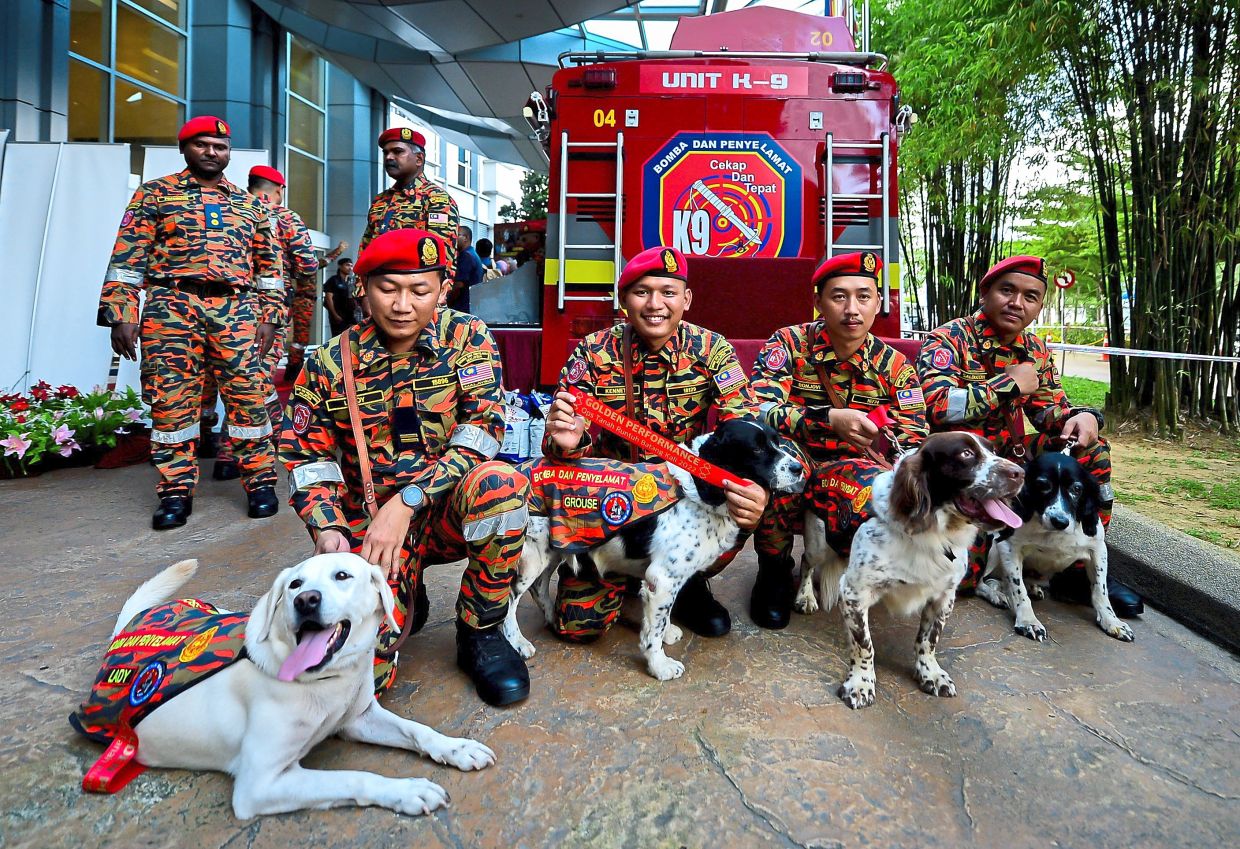
Four of the six dogs from the Fire and Rescue Department’s K9 unit – Blake, Lady, Grouse and Pop – that have been awarded the ‘Golden Performance’ medal for their role in the Batang Kali landslide SARS operation. – Bernama

But it needn’t be, certainly not for the furry friends who were left in abysmal conditions at a shelter recently.

EVEN in ancient times, they were treated better. Here we are in 2023, as sophisticated as mankind has ever been, yet compassion is neither compulsory nor a courtesy. It’s simply unacceptable. Even convicted murderers and rapists in prison are treated better than the dogs at a shelter.

Photographs and videos have gone viral on social media depicting scrawny dogs in unhygienic conditions at a dog pound, which is supposedly under the supervision of the Kuala Langat Municipal Council (MPKL).

Would it be wrong to think that these dogs were left to starve?

Questions have rightfully been raised on whether these canines were even properly fed and cared for.

They may be stray dogs picked up by the council, but these animals surely shouldn’t be left in such a pathetic and deplorable state.

Last week, the MPKL, which earned the public’s ire following the video, said the dogs at its pound were fed daily.

It said contrary to the images in the video and pictures, all the dogs, which were captured and kept at the pound, were fed twice a day, and given special food as well as placed in a suitable place.

“The dog pound is cleaned on a scheduled basis to prevent flea infection among the canines there.

“MPKL has also improved the management of the pound so that it is more organised in terms of the cleaning schedule and handling of the feeding procedures for the captured dogs.

“In fact, it also cooperates with non-governmental organisations (NGOs) to take in and care for the canines,” it said.

Let’s give the MPKL the benefit of doubt but its statement is unlikely to paint a different picture for many dog lovers.

The terrible treatment of the dogs in the pound clearly appalled Melaka Chief Minister Datuk Seri Sulaiman Md Ali, who has now ordered local authorities to inspect all animal shelters in the state.

Sulaiman, clearly upset and disappointed with the way the dogs were allegedly left to starve, noted: “It’s not the way to treat God’s creations.” He also sent a personal donation to the Malaysian Dogs Deserve Better (MDDB) NGO to buy food for the dogs.

“This is a small contribution from me, and hopefully my gesture will inspire more people to help these poor dogs.”


God’s creatures too: Questions have been raised on the condition of the canines at the MPKL dog pound. – Photo courtesy of The Star reader Austin

MPKL has now promised to review the management of the dog pound under its supervision following criticism over its unhygienic conditions, saying a review would be carried out by the vector unit of the department of solid waste management and environmental health.

It’s good that the public has exposed such purported poor management of the dog shelter, which has, unfortunately, given the impression that MPKL has mistreated, neglected and mismanaged in its duties, even if that’s not the case.

It has correctly earned the attention and rebuke of the Tengku Permaisuri of Selangor.

Expressing sadness and disappointment, she directed authorities, especially the municipal councils, to improve and upgrade management procedures.

We need to remind ourselves that dogs are God’s creations. He surely has a reason for putting them on earth. They aren’t dirty animals that should be culled or mistreated, as some would like to think.

Dog lovers would know the undivided loyalty of their pets. They are known as man’s best friend for good reason.

The recent Batang Kali tragedy displayed their kindness and dedication, as the canines worked to the point that a couple collapsed out of sheer exhaustion in the gruelling and treacherous search operations.

Besides our front-line officials – including one who lost his life and another who had a mild stroke – these dogs were also part of the team of unsung heroes.

It was these highly trained tracker dogs from the Fire and Rescue Department which located the bodies of almost half the victims who died during the catastrophic landslide just last month.

The undeniably cute and lovable purebred dogs garnered much attention from Malaysians for their heroism, but mongrels, abandoned or strays, are just as precious and loving creatures, which ask for nothing but a little kindness from us. After all, they wouldn’t hesitate to come to our aid, given half a chance, as history has shown many times over.

At a media high-tea on Thursday, Local Government Development Minister Nga Kor Ming duly paid tribute to the rescuers and the now-famous tracker dogs, saying dogs should be properly cared for and loved.

Perhaps the hands-on minister should order an audit of all the animal shelters under the local authorities and find out their shortcomings, such as lacking trained personnel and funds, and come up with ways to prevent abuse and cruelty.

There’s obviously a need to encourage spaying or neutering of abandoned animals. Not just dogs, but cats as well.

There should also be an SOP which reflects compassion when council workers conduct stray dog catching exercises.

It’s important for Malaysians to champion the rights of animals and that value must be instilled from a young age.

The way we treat animals reflects our own humanity and who we are as people.

As the late great Indian leader Mahatma Gandhi said – the greatness of a nation can be judged by the way its animals are treated.

The writer has three dogs and is proud that he has always had dogs in his life, from the time he was a child.

PAS’ chilling message on beers

While PAS has promised partner Gerakan that it is committed to multi-racialism, its actions seem to show that recent election victories have gone to its head, with the tirade against alcohol and gambling.

This is not good for Malaysia’s international image.

WHEN PAS president Tan Sri Abdul Hadi Awang met Gerakan leaders at their headquarters in Penang on Monday night, he told his Perikatan Nasional (PN) coalition partner that the Islamist party was committed to a multi-racial Malaysia.

He reminded them that both parties, which were in opposition during the 1969 general election, had brought stability to the country following that year’s racial riots.

Then, Gerakan wrested control of Penang and PAS captured Kelantan.

Both parties later joined the newly-formed Barisan Nasional led by UMNO, which replaced the Alliance.

PAS left the coalition in 1997, with Gerakan following suit after the 2018 General Election.

Hadi reassured Gerakan leaders that his party was prepared to improve its image and soften its stand, including allowing Christmas greetings, something that its leaders had frowned upon.

But there was a red line – it would never compromise on issues regarding liquor or gaming.

Meeting the media after the meeting, the hardline leader blamed Islamophobia for the fear of PAS and warned that the green tsunami that swept through much of the country in the 15th General Election would continue in the coming state elections.

Hadi can say what he wants, but if he really understands and appreciates Malaysia’s diversity, he wouldn’t be constantly making harsh and outrageous statements.

In fact, his party has also single-handedly demolished many Malay cultural practices, citing adherence to Islam.

As Terengganu Mentri Besar in 1999, Hadi’s first regressive act was to demolish the giant turtle replica at a Terengganu roundabout. He claimed it was a form of idol worship.

Instead of reassuring Penangites, PAS has pushed its agenda further in that state as well.

For the first time, a PAS Member of Parliament from the state has marched into a mall and insisted that a beer promotion, held in conjunction with Chinese New Year (CNY), be covered up.

The video of the march in Seberang Jaya by PAS theologian Muhammad Fawwaz Muhammad Jan has gone viral.

The poor Sunway Mall executives who met the Permatang Pauh MP, who beat Nurul Izzah Anwar in the recent elections, looked nervous. Who could blame them for seeming timid?

The people of Kelantan and Terengganu may be familiar with PAS leaders playing moral police, but not those in Penang.

He has no business imposing his wishes on the beer promoters, as it is not his jurisdiction. As an MP, he has no authority, for sure.

And please do not tell us that other religions also forbid drinking and gambling – the standard PAS narrative in justifying such actions against others.

If beer sales are doing well during CNY, it simply means there are good sales. It’s a question of demand and supply.

It is also standard practice for many to receive CNY hampers with a bottle of whiskey or brandy.

Many families also play card games during the festival, with some wagering small amounts of money.

The huge win in the general election has perhaps gone to the head of the theologian politicians, bringing about such actions by PAS.

But this has not helped Malaysian tourism. A series of statements on clamping down on bikinis, booze and gambling have made it to the international media, including in Hong Kong, Singapore and across the globe via Bloomberg.

The South China Morning Post, for one, said PAS was sending a ‘’chilling signal of creeping religious conservatism.’’

Call it political bravado or whatever, Hadi had told his Gerakan partners and the media that Perikatan – which also includes Bersatu – was confident it would sapu (sweep) the state seats under the parliamentary seats won by PN in the 15th General Election (GE15).

He claimed that PN did not just win Malay votes but also non-Malay votes.

We do not know what Hadi is taking, but he should know by now that Malaysian voters are surprising our politicians.

After winning handsomely in Melaka, Sabah and Johor, a confident Barisan Nasional pushed for GE15 only to find itself humiliated.

I do not know if Gerakan leaders were convinced by Hadi’s assurances. If they do, they need help.

It’s a dirty job…


On a mission: Nga hopes to flush out dirty and out of order public toilets. —Facebook

… but somebody’s gotta do it. Malaysians must make sure that our kids are taught the importance of cleanliness from young.

STAND-UP comedian Marissa Wong is known for her jokes on the state of Malaysian toilets. In fact, she’s probably the only one who reviews toilets and shares her findings on social media. Believe it or not, at last count, she has conducted over 100 inspections.

Some find her toilet jokes off colour, but they hit the spot for most of us. The truth sometimes hurts, and in this case, it’s really no laughing matter. Unfortunately, we have many bad public toilets and equally bad personal practices.

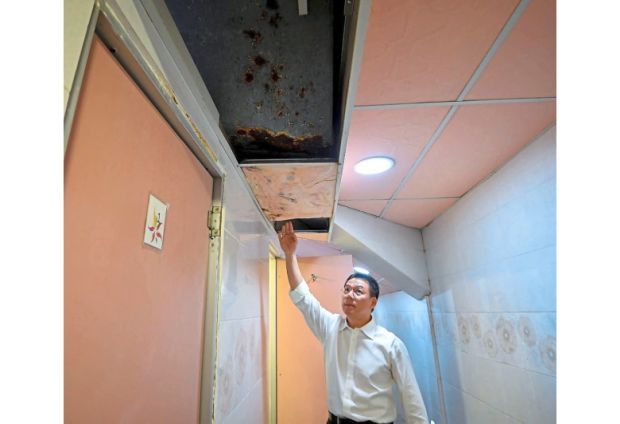
Newly-minted Local Government Development Minister Nga Kor Ming appears to have endeavoured to push for clean public toilets and has even conducted checks on these basic amenities. It’s hard to ignore it seeming like a personal crusade.

His first stop was Dataran Merdeka, soon after clocking out from his office on Jan 3.

The Teluk Intan MP deserves praise for his efforts, but we hope he has the stamina, determination and drive to persevere through his campaign.

It looks daunting because he will need the support of the local authorities, which comes under his purview. Those of us who’ve dealt with powerful bodies will know how difficult it is to move them.

There are more than 200,000 public toilets under the jurisdiction of the local authorities.

This initiative could be dead in the water should the Malaysian public not have good practices. Nga could be taking on Mission: Impossible.

For success story references, we don’t need to look too far. The toilets in Taiwan and, naturally, Japan, are always clean and dry. The amenities work perfectly, and cleaners take pride in their jobs.

It wouldn’t be fair to merely pin the blame on local authorities because many of our restaurants and coffee shops have filthy toilets, too.

For reasons only known to these outlet owners, many don’t have toilet rolls either. Disturbingly, sometimes, toilet rolls are placed on tables in some eateries to be used as serviettes. It looks like these food operators can’t tell the difference between them.

Airports, railway and bus stations would probably come under a different jurisdiction, and these are also gateways for tourists.

We wish Nga the best for his noble plan, but he isn’t the first to harbour this desire.

The DAP national vice-chairman is right to say that the cleanliness of public toilets is closely related to the image of Malaysia, especially at prime tourist destinations or gateways to our country.

“Doubtlessly, ‘BMW’ standard public toilets, namely Bersih (clean), Menawan (attractive) and Wangi (fragrant), will go a long way to increase the positive perception of the people towards the local authorities.”

Nga hopes that all the 155 local authorities across the country can establish public toilet hygiene monitoring units to conduct scheduled maintenance work to ensure that public toilets nationwide are always in a clean, well-functioning and orderly condition.

In the early 2000s, the late Deputy Housing and Local Government Minister Datuk Robert Lau Hoi Chew had the same intentions. He was even nicknamed Malaysia’s “toilet king” and until he became Deputy Transport Minister in 2004, his tireless effort for clean public toilets was described as “unfinished business”, in his own words to the media.

Lau, who was the MP for Sibu, is best remembered for setting up the first toilet association in Malaysia – Quality Restroom Association Malaysia (QRAM) – of which he was chairman since its inception in 2005.

Nga has said he would meet Kuala Lumpur mayor Datuk Seri Mahadi Che Ngah, saying he is committed to finding the best solution so that infrastructure or public facilities built with the people’s money can be looked after and maintained properly.

But he might want to seek support from the Education Ministry too because, ultimately, the education process starts with students in schools.

School toilets are atrocious, so students must be taught from an early age about the importance of cleanliness to instil proper habits. In fact, it should even begin at the kindergarten stage.

That’s how Japanese kids are taught – to be orderly, queue up, and make sure to put your eating trays in the designated spots once you’re done with your meals.

It’s imperative to align with the respective religious bodies because cleanliness is a vital component among all religions.

There’s also no reason why our toilets must always be wet – stop at any rest and recreation area along the highways and the toilets always seem to be wet.

YB, since housing is also under your jurisdiction, Malaysians have often wondered why our toilet faucets have no handles or levers. It should really be compulsory for all developments.

We hope his efforts will put a shine on our water closets, otherwise everything will just get flushed down the toilet.

Caught in a predicament

IT WOULD not be wrong to suggest countries, which have been waiting for the Chinese tourists to arrive, are caught in a predicament.

No country would want to be seen as offending the powerful Chinese who spent US$255bil (RM1.12 trillion) a year in 2019, before Covid-19.

In 2019, Malaysia welcomed 3.11 million Chinese tourists who spent RM3.7bil.

It won’t be wrong to say that the entire world is waiting for the return of the China market.

For sure, Malaysia would not want to be accused of imposing discriminatory measures on Chinese arrivals.

Let’s not forget that China has been the number one trading partner of Malaysia for the last 13 consecutive years.

But Malaysia wants to be cautious. Rightly so, too. Many of us have just started to do away with face masks.

We are beginning to watch football matches in stadiums and attend concerts again.

It came as no surprise that Datuk Seri Anwar Ibrahim announced that the tightening of the nation’s border security was to protect its people from Covid-19 and “will not discriminate against any particular country”.

The Prime Minister said every inbound traveller will be monitored, particularly those coming from countries with high infection rates including “China and the United States”.

He didn’t spell out what measures that the government intended to take.

Perhaps the Health Ministry is still assessing and looking at how the other Asean neighbours, which are eyeing the lucrative Chinese tourism markets, are handling the delicate situation.

A huge influx of tourists is expected after China lifted its travel restrictions on its citizens recently.

But Sabah – which enjoys its immigration autonomy – has ordered that visitors from China will have to provide a negative Covid-19 pre-departure test results before entering the state, effective Jan 1.

The precautions are understandable as it is meant to protect Malaysians but whether it is practical is being debated.

Many Malaysians travelling to London have been infected because the Brits do not wear face masks, not even on public transport, and they throw caution to the wind.

Some of my friends returning to Malaysia from Australia believe they caught Covid-19 during the flights.

The new variants of Covid-19 will travel in airports and planes, and it certainly does not choose the nationalities of the travellers.

Knee-jerk reactions, because of news reports, with re-instatement of measures would not really be effective except to provide some form of assurance to the people.

It really makes no difference putting up barriers in the way of travel, in dealing with continuous new variants.

Last week, the Australian media reported that the country’s decision to impose Covid checks on travellers from China was against the advice of its top health official, Prof Paul Kelly.

The health department, in an advisory on Dec 31, stated that Kelly ‘’did not believe that there is sufficient public health rationale’’ for any additional requirements, labelling any additional requirements for Chinese tourists “disproportionate to the risk”.

Its Health Minister Mark Butler reportedly avoided questions from the media, except to say the pre-flight checks were being imposed ‘’out of an abundance of caution”.

Kelly stated that ‘’the BF.7 Omicron sub-variant that appears to be a key driver to the outbreak in China has been present in Australia for some time”.

The BF.7 has also been reportedly detected in Malaysia since August and September last year in Selangor, Pahang and Melaka.

Universiti Sains Malaysia virologist Dr Kumita Theva Das told Free Malaysia Today that ‘’based on current evidence, there is no indication with BF.7 in comparison with other variants’’ and that even the World Health Organisation (WHO) did not place this Omicron sub-variant under monitoring.

What has caused uneasiness among many of us is the kind of frenzied anti-China news reporting by the Western media.

Of course, the sheer number of possible China tourists, following three years of travel bans, would worry us.

Then there is the abrupt reversal by China on its citizens after imposing a strict regime of lockdowns and relentless testing. For sure, it will not inspire confidence building.

Interestingly, the Tourism Minister Datuk Seri Tiong King Sing, who has in the past been known for his shoot from the hip responses, has called for caution on comments regarding the impending arrival of Chinese tourists, a major source of income.

In a Facebook post, he advised Malaysians not to make unfriendly comments before “you know the full picture’’ and ‘’don’t create the impression that we don’t welcome tourists from China”.

Let’s rely on sound advice from health experts, and not just impose populist political decisions.

For now, we have handled the situation well. Let’s continue to do so with updates for the public to understand better and be reassured that our interests are protected – and not lose our competitiveness at the same time.