Monthly Archives: June 2023

Convenience’s sake


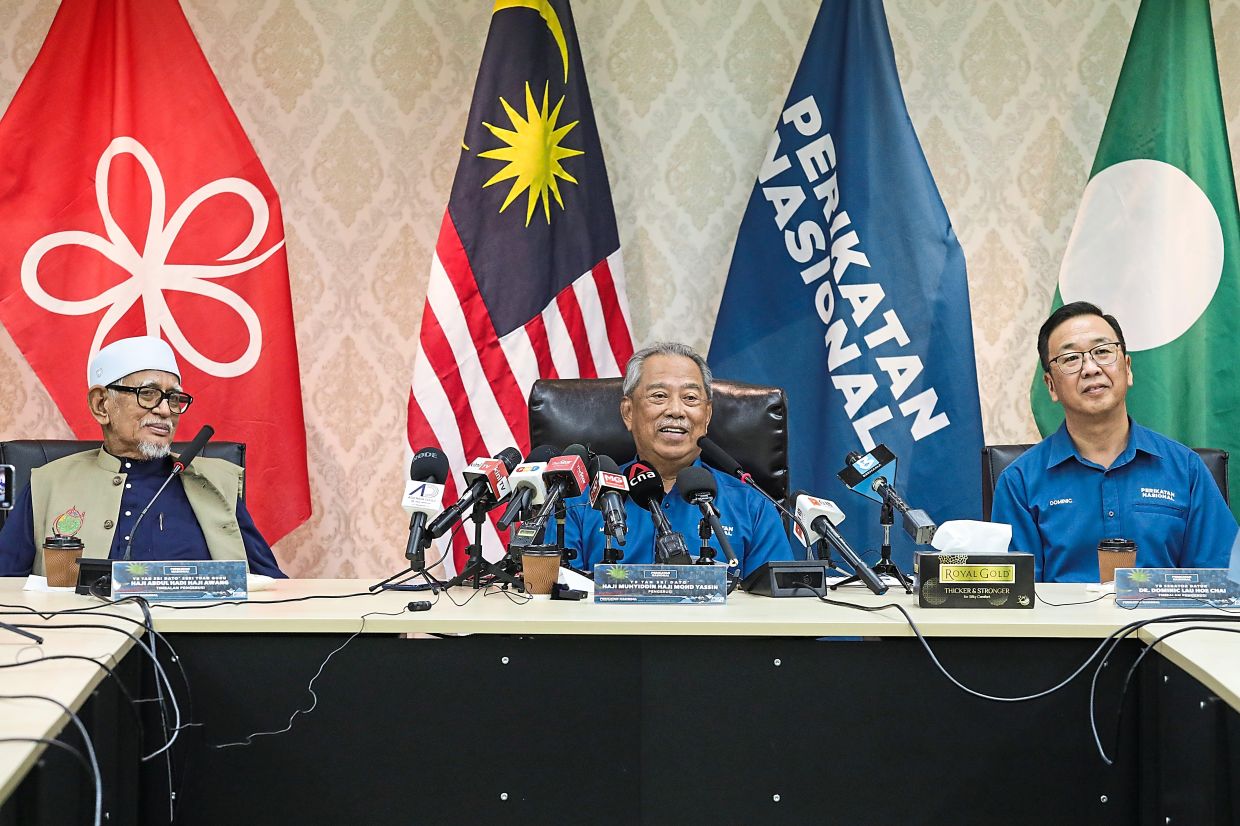
Equal partners?: (From left) PAS president Tan Sri Abdul Hadi Awang, Bersatu president Tan Sri Muhyiddin Yassin and Lau holding a press conference after the coalition’s meeting on seat allocation for the upcoming state elections at Perikatan‘s headquarters. Gerakan can only bargain if it has sufficient clout to balance out PAS, says the writer. — YAP CHEE HONG/The Star

IT’S going to be a tough state election for Gerakan, the only multiracial partner in the mainly Malay-Muslim platform Perikatan Nasional, since the two main partners, Bersatu and PAS, are mono-ethnic.

Gerakan looks like an odd bedfellow. Its philosophy and principles contrast with what Bersatu and PAS preach.

When its party president Datuk Dr Dominic Lau sits among PAS leaders decked in their robes and skull caps, he must surely feel out of place.

He will be testing his luck in the Bukit Tengah state seat of Penang in the coming state polls.

It’s a racially mixed seat with a composition of 47.33% Chinese, 35.5% Malays, 16.7% Indians, 0.8% East Malaysians and 0.18% constituting others.

In the 2018 state polls, Pakatan Harapan’s Gooi Hsiao Loong from PKR won the seat with a 8,558 majority in a five-way contest. PAS managed only 2,355 votes.

In 2013, PKR’s Ong Chin Wen beat Barisan Nasional’s Teng Chang Yeow of Gerakan with a 5,190-vote majority.

Lau will be vying to get all the votes from PAS, the discontented Malay votes and the disgruntled Umno ballots, who can’t accept working with DAP. If he succeeds, then he may just pull through.

The strong showing of Perikatan, especially PAS, in the predominantly Malay electorate on the mainland in 2022, must have emboldened him, with all the expectations of a green wave continuing its course at the state polls.

After all, if a big name like Nurul Izzah Anwar can be defeated by an unknown PAS ulamak, Muhammad Fawwaz Mat Jan, with a majority of 5,272 votes, Lau must be hedging his bets on having a fighting chance with the Malay votes.

As political analyst Mustafa Anuar rightly wrote, “Lau’s confidence also seems to derive from the personal conviction of Perikatan chairman Tan Sri Muhyiddin Yassin that the opposition could win ‘nearly 20’ state seats to gain a simple majority in the 40-seat Penang state legislative assembly.

Lau has nothing to lose except his image and pride. After all, he has lost twice consecutively, while trying to capture the Batu parliamentary constituency in Kuala Lumpur in the 2013 and 2018 general elections.

Those old enough to have seen Gerakan trounce the Alliance in 1969 through the dynamism of the late Tun Dr Lim Cheng Eu, and the eventual end of Gerakan by DAP in 2008, would know the reign of the Penang-based party is over.

Lau is almost anonymous in Penang, a state where voters expect to always see and hear their politicians. It’s not a walk in the park, but that’s how it works in parochial Penang.

Gerakan not only lost in the polls, but also failed to challenge DAP imports like Lim Kit Siang, Lim Guan Eng and Dr P. Ramasamy, who aren’t even Penangites. At least Penang Chief Minister Chow Kon Yeow studied and worked in Penang.

Chow studied at Universiti Sains Malaysia and worked as a journalist in the now defunct English daily National Echo in Penang, before taking the plunge into politics full-time in the 1990s.

Gerakan has yet to produce a leader capable of making a dent in the DAP armour. Even less enviable, it must now play a token presence in Perikatan with emphasis on race and religion. When PAS lawmakers make the most outrageous remarks, Gerakan seems prepared to look the other way, and pretend the cat was never put among the pigeons, and if it were, would slink away.

There are the obligatory responses to PAS, mostly by insignificant Gerakan leaders, whose voices are invariably meek. None of them are prepared to oppose the extreme stand taken by PAS leaders. Put simply, Gerakan has lost all respect and dignity from its base, likely also including its members in Penang who’ve seen better days.

The party is adrift and rudderless. It serves only Bersatu and PAS, who want to project some semblance of a multi-racial Malaysia.

Some have justified that PAS isn’t extreme and that the green wave isn’t real, but merely a manifestation of a discontent Malay electorate which has no one to vote against Barisan.

While there may be some truth, it’s hard to convince non-Malays and progressive Malays that PAS isn’t bigoted since its pronouncements and stand on religious and racial divisiveness are clearly against plural Malaysia. As some PKR and Umno leaders say, it isn’t Islam, but PAS.

Yes, it’s true that politics is about winning power. Gerakan can only bargain if it has sufficient clout to balance out PAS.

But Gerakan should start earning respect and stand up against race and religious narratives which are tearing up Malaysia.


Scripting their love story for the big screen


Life on the big screen: Rachel (left) with Condor.

KUALA LUMPUR: She has been away in the United States for the last 12 years raising a family, but Malaysia remains in the heart of Rachel Tan who is now a producer of the romantic comedy Worth The Wait.

She is back in Malaysia to wrap up the production of the movie which was filmed in Vancouver and Kuala Lumpur.

The cast included Lana Condor (To All the Boys film series), Ross Butler (Shazam! franchise), Sung Kang (Fast and Furious franchise), Andrew Koji (Bullet Train), Elodie Yung (The Cleaning Lady), Tan Kheng Hua (Crazy Rich Asians) and multiple Golden Horse Awards winner Karena Ka-yan Lam (Zinnia Flower, The White Storm).

“I am truly privileged to be one of the producers together with my husband, Dan Mark,’’ she said in an interview.

The movie features the story of a long-distance relationship that spanned Kuala Lumpur and the United States, as experienced by Rachel and her American-born Chinese boyfriend, now her husband.


Rachel at 20 when she was newly-crowned Miss Chinese International. — Photos courtesy of Rachel Tan’s Instagram and AP

She said Condor and Butler were brought to Kuala Lumpur to take in the sights and sounds of the city to ensure authenticity.

While Vancouver was picked as the setting for Seattle, the American city in the movie, the team insisted on a Kuala Lumpur location.

“Our stories are inspired by our experiences in love as teenagers, in our 20s and 30s, and trying for a baby after marriage. It also involves my sister’s story,’’ she added.

Rachel, a University of Cambridge-trained lawyer, was also a beauty queen, winning the Miss Chinese International pageant in Hong Kong in 2003.

The Seremban-born entrepreneur is now settled in Los Angeles, running an entertainment law firm with her husband Mark, who was previously an attorney at Warner Bros.

Rachel and Mark wrote the preliminary script of the movie. They are both “thrilled to pieces that our names are on the credit line.’’

Kheng Hua, a Singaporean, introduced them to award-winning Taiwanese director Tom Shu-yu Lin.

“We raised the funds for the movie from Asian Americans in Silicon Valley and also on Wall Street with our producing partners.

“We brought in this amazing talent who loved the script and shot most of it in Vancouver and wrapped up the shooting within five days in KL,’’ she added.

Rachel and Mark said they have always loved romantic comedies like Love Actually and were excited to share their own take on the genre with an all-Asian cast and script “inspired by our own love story, our family and different stages of our lives.”

“We feel honoured for our labour of love to be part of this incredible moment that Asian Americans are having in cinema right now.’’

Rachel said she looked up to Oscar-winning actress Tan Sri Michelle Yeoh, adding that she was pleased to see a Malaysian triumphing at the Academy Awards.

Malaysia, she said, is etched in her heart.

In fact, the country is a compulsory stop for her family especially for her children, aged eight and one-and-a-half, during summer holidays.

“We just spent time in Langkawi,’’ she said.

Waste of time


Don’t lose the plot: Singapore-born stand-up comedian Jocelyn Chia has certainly offended most Malaysians with her off-colour remarks, but we may be going too far by asking Interpol to locate her whereabouts. — The Star

IT’S one thing to be critical of Singapore-born stand-up comedian Jocelyn Chia, but it’s another when Malaysia puts itself in a position of losing the plot and becoming a real joke now. Why would we want to get the Interpol involved?

She has certainly offended most Malaysians with her off-colour remarks, but surely we have gone too far by asking Interpol to locate her whereabouts. And even if they did find her, what can we really do?

Inspector-General of Police Tan Sri Acryl Sani Abdullah Sani said the application to obtain Chia’s identity and her present location will be made as soon as possible to enable investigations to start.

Recently, he told reporters that the case is being investigated under Section 504/505 (c) of the Penal Code and Section 233 of the Communications and Multimedia Act.

Section 504 of the Penal Code addresses intentional insult to provoke a breach of peace, which is punishable under Section 505 and carries a maximum jail sentence of two years, a fine, or both.

Honestly, it’s not hard for the police to produce a profile of Chia with her personal details.She is said to have performed in local stand-up comedy premises previously and since she has entered Malaysia before, the Immigration department would have her details at a click.

The easiest response by Malaysia is to simply ban her from entering the country to share her “humour”.

If she has nothing good to say about our country and remains unrepentant about her choice of words, then there’s no reason to welcome her here, whether for work or vacation.

Our police would also be able to look up her social media postings for more clues, even if she has taken many of them down. We have sufficient digital forensics experts in the police force to do the job easily.But beyond that, surely the United States can’t be keen to have Chia extradited to Malaysia if we choose to file an application. The idea itself sounds ridiculous.

I hope our Foreign Ministry won’t entertain such requests, even if the police recommend it.

We will end up being the butt of jokes if we do that, although the police have not confirmed taking action.

Having her investigated is protocol because reports have been filed against her, it seems.

Chia, who was unheard of in Malaysia until recently, drew controversy on social media recently for her disparaging cracks about Malaysia in a stand-up comedy skit on The Comedy Cellar, a US-based show that was aired on the Internet recently.

Her remarks about the missing Malaysia Airlines flight MH370 that disappeared on March 8, 2014, en route from Kuala Lumpur to Beijing, created a storm with Singapore apologising for her jokes – even though she’s now an American citizen.

Chia’s performance has been condemned by Malaysian comedians as well as Singaporean artistes, who also said sorry to Malaysians.

In an Instagram recording, Singaporean comedian Kumar told Chia, “If you’re watching this, I really think you (should) seek help, because you really got issues.”

Kumar added how Singaporeans often visit Malaysia for leisure and work, and in his caption, likened both countries to being “brothers and sisters” and that “animosity created is not good for us.”

He’s dead on the money. There are bigger fish to fry for the police, instead of focusing their resources and attention on Chia, who’s hardly a top-notch criminal.

It’s better for Wisma Putra and the police to work on extraditing Jho Low to Malaysia for stealing billions of ringgit from us.

We truly need Interpol’s help for this, as well as handling delicate negotiations with the Chinese government if he’s indeed hiding in Macau, Shanghai or Beijing, as claimed, to get him home to face his charges.

That’s what Malaysians want. Why would we want to have anything to do with Chia?

Time to nurse that sick obsession

OUR Malaysian nurses are overworked, underpaid and underappreciated, but all PAS MP Wan Razali Wan Nor cares about is their attire, which he claims is too tight and not syariah-compliant.

That is the problem with PAS leaders and their deep-rooted obsession with dressing.

In the past, they berated our airline crew’s uniforms, which they claimed were too provocative.

But this is probably the first time that the nurse’s uniform has become a point of contention with the party. Never mind that our nurses no longer wear skirts but only slacks. That is still not enough for the Kuantan lawmaker.

Most of our nurses already wear headscarves and all are certainly modestly dressed. They don’t need PAS to lecture them on donning the burqa like they do in Afghanistan.

Wan Razali should also do his homework. There is an unprecedented shortage of nurses in Malaysia.

There are already calls from the Association of Private Hospitals Malaysia (APHM) to liberalise the nursing labour market and bring in foreign nurses amid the shortage in both public and private hospitals.

The reality is that other countries within the region are offering better packages to Malaysian nurses to work in their countries, and the brain drain will affect our healthcare, said APHM president Dr Kuljit Singh.

It is said that when Malaysian nurses sign up to work in the Middle East, their employers welcome them by making sure they are picked up at the airport with chauffeur-driven limousines.

There have been news reports that Johor is facing a severe shortage of nurses, estimated at between 15,000 and 18,000, following an exodus to Singapore.

Last year, Johor health and unity committee chairman Ling Tian Soon was quoted as saying that he knew of a friend whose salary as a nurse in Singapore was equal to that of a specialist doctor in Malaysia due to the currency exchange rate.

According to Homage Malaysia, fresh graduate nurses in Malaysia are paid RM1,500 a month while in Singapore, the average pay is about S$2,500 (RM8,500) a month. In Dubai, new nurses can earn 5,000 dirham a month (around RM6,800).

It said nurses often need to work two eight-hour shifts in a day (which translates to 16 hours). This means they are stretched thin, putting a toll on their mental and physical health.

It also means that these nurses would end up with little chance to upskill or pursue further education due to a lack of time and energy.

According to Segi College, citing data from the Health Ministry, Malaysia had 113,787 registered nurses in a country of over 32 million people in 2021.

This means that the nurse-to-population ratio is 1:454, which falls short of the 1:300 ratio recommended by the World Health Organisation.

Indeed, Health Minister Dr Zaliha Mustafa has said that steps have been taken to remedy the situation, including expediting the appointment of doctors and nurses.

But we need more than just politically-correct promises from our leaders.

As pointed out by Homage Malaysia country manager PC Gan in a write-up last year, “Nurses are not just administration staff or clerks, but highly trained medical professionals, often the first responder and the last barrier between life and death.”

She said that Homage, which operates in Malaysia, Singapore, Australia and Japan, has observed differences in the way nurses are treated.

“It is with regret that Malaysia is one of the worst offenders in the ill treatment of and discrimination against nurses,” she claimed.

And certainly, PAS MP Wan Razali needs to accord a high regard and appreciation for the work of these health workers.

Many of them risked their lives, as frontliners, especially during the Covid-19 pandemic.

Wan Razali seems to have forgotten their contributions as all he could notice, in his warped mind, was that their uniforms are apparently too tight.

This is the same MP who had to retract his claim that a women’s rally in Kuala Lumpur in March was an “LGBT march”, which he could not prove when demanded to do so by Dewan Rakyat Speaker Tan Sri Johari Abdul.

Wan Razali’s incoherent outbursts in Parliament are sickening. He needs to be nursed back to health.

Tapped out


Environmental threat: Struggling to source revenue for the state, Kedah has recklessly turned to logging, resulting in massive deforestation. — Filephoto/The Star

IT would’ve been natural to expect Kedah Mentri Besar Datuk Seri Muhammad Sanusi Md Nor to kick off his campaign by convincing his voters with reasons for his re-election.

That would include listing achievements as well as those pending.

He’s there as the state’s head of government to improve Kedah’s economic performance and the livelihood of the people, many of whom are caught below the poverty line.

Kedah has one of the lowest average incomes and highest incidences of poverty. Likewise Kelantan, which continually struggles to measure up to the economic success and resilience of other states.

So it’s baffling to hear Sanusi dwelling on the purported ownership of Penang by Kedah, driven by half-baked historic arguments with little basis.

It reeks of a red herring, a distraction from the real problems. It may be good rhetoric at the party’s rallies but in the end, everything boils down to data and statistics.

Just look at Kedah’s Gross Domestic Product (GDP) performance in 2021, where the state recorded only 3.2% in revenue.

In comparison, other states in the peninsula have soared with impressive figures. Penang achieved the highest GDP performance at 6.8%, followed by Selangor (5%), Terengganu (3.6%), and Perak (3.5%).

Struggling to source revenue for the state, Kedah has recklessly turned to logging, resulting in massive deforestation, which has threatened the Ulu Muda rainforests. According to the report revealing this, satellite data also indicates forest loss has been accelerating since 2022.

The 1,600sq km Ulu Muda rainforest is one of the last ranges of continuous tracts of forest in the peninsula, which provides a vital habitat for countless species as well as water for millions of people in the northern states.

The report divulged that “between 2002 and 2021, the greater Ulu Muda landscape lost 82.8sq km of forest,” saying the satellite data was collected by the University of Maryland and visualised on Global Forest Watch.

The staggering deforestation has led to serious flooding and clean water supply issues.

The worst flood was in 2022, when three people died and more than 3,000 were displaced when sludge, debris and flood waters buried several villages in Baling, one of the poorest districts in Malaysia.

Like Kelantan, which has failed to provide basic clean water supply for decades, Kedah is starting to face the same issue, except that the economic consequences are greater since Langkawi is a vital tourist spot while Kulim is home to Malaysia’s first fully integrated high-technology industrial park, covering 208ha.

Kulim is the beneficiary of Penang’s industrial expansion, as it’s just 46km away from the island state.

Kedah needs a long-term strategy to resolve its critical water problems, which includes the construction of a new water treatment plant.

When there are frequent massive floods and water supply cuts, politicians like Sanusi are to blame because they failed to do their jobs.

That’s the harsh reality of their irresponsible actions. Don’t blame God for these and certainly, don’t point the finger at non-Muslims. Who’s been running these two states, especially Kelantan, for 33 years? Surely not non-Muslims.

Visitors to Kelantan would know that PAS has failed to supply basic treated water from the pipes, and Kota Baru is poorly managed, too.

Against the backdrop of Kedah’s massive economic issues, the last thing it needs are harebrained projects like the expensive racing circuit resort project planned for Langkawi.

The project, Open Road International Circuit (ORIC) and Integrated Resorts, will be developed by state-owned company Permodalan Kedah Bhd (PKB) and Open Road Asia Sdn Bhd.

But the train has yet to leave the station, and that’s just as well.

It’s also good that the proposed RM7bil Kulim international airport championed by Tun Dr Mahathir Mohamad, has been scrapped because it seemed counter-productive.

The quickest way to travel to the Penang International Airport from Kulim takes only about 40 minutes.

That RM7bil could be put to better use to improve the road and transport facilities between Kulim and Penang, instead of building an airport in Kulim. In fact, the upgrade would have cost a fraction of that gargantuan sum.

Then there’s this big announcement of building the RM40bil Widad Langkasuka mixed-used development in Langkawi, purportedly to be a tourist destination “built on the paradigm of the Malay vernacular architecture,” revealed news reports.

Taken straight from press releases with big words, these news reports intimate “it will establish a smart city using sustainable technology that preserves the island’s geographical nature.”

I bet reporters who filed their stories didn’t even know what they wrote, which the MB said was part of the state’s development plan for 2023. Well, we’re already mid-way through 2023 and there hasn’t been a peep since. Again, it’s good, although it was reported that the earthwork package was targeted to be completed by Aug 3, 2023.

Then, there was also the media-rocking announcement by Sanusi for rare earth element (REE) mining activities in Kedah. Once, an overly excited Sanusi told the media that it would earn Kedah RM43tril, which was later corrected to RM62bil.

Until now, no environmental impact assessment (EIA) report has been submitted to the Department of Environment (DoE).

Kedahans can’t continue to live on pipe dreams when their taps are running dry.

Kedah is a poor state like Kelantan, with PAS politicians continuing to use religion and race to keep themselves in power.

In both states, the non-Muslims are almost insignificant, and with its Malay-majority areas, it’s a given that PAS will retain its stranglehold on these states in the coming state elections.

In GE15, Perikatan Nasional swept all but one parliamentary seat in Kedah and even performed well in areas with tiny non-Malay presence, including Alor Setar, Kulim Bandar Baharu and Padang Serai.

So why does the government, state or federal, continue to keep these flops in power despite their comprehensive failure in supporting us?

Fair game without crossing the line

NOT many Singaporeans are going to admit it, but I have personally experienced many cases where Malaysia has been talked down to because our neighbours feel they are better off.

Indeed, they are way ahead of us. As much as we hate admitting it, we are the losers.

That’s a fact. We can see the massive differences the minute we cross over to the island republic from Johor Baru.

Their infrastructure is world-class, their leaders have impressive credentials, and corruption is arguably non-existent.

And as long as the Singapore dollar continues to be three times more valuable than our ringgit, they have reason to thumb their noses at us. They have earned the right to brag.

But let’s be frank. Many Singaporeans carry a chip on their shoulders and actually think they are superior.

Let me share a story. I am currently on a tour of a few European countries organised by Trafalgar Tours. They are reliable and I am always among guests who are usually over the age of 60. Peers, I guess.

They tend to be from English-speaking countries like the United States, United Kingdom, Australia, Canada, New Zealand and South Africa.

Most of the time, the Asians are from Malaysia and Singapore. Occasionally, there are Indians too.

But it’s the Malaysians and Singaporeans who are often happy to be in each other’s company since, after all, both nations have so much in common.

We were in one country once, remember?

Negaraku existed long before Majulah Singapura. While both nations adopted the Malay language as their official language, Malaysians can actually speak Malay while many Singaporeans are unable to do so.

Travelling together, we laugh at ourselves when we confess that we were actually carrying chilli sauce and cup noodles.

But the little rivalry, cynicism and disdain eventually crop up, most of the time in an innocently natural way, without even my newfound Singaporean friends realising it.

This trip, a very sweet aunty asked me if it was really true that the SMART tunnel in Kuala Lumpur was a stormwater bypass tunnel and able to alleviate traffic jams.

“The taxi driver who took me to KLIA (Kuala Lumpur International Airport) told me it can stop floods and divert traffic jams. I didn’t believe it, of course, how can Malaysia be so ‘kheng’ (awesome in Cantonese) one?”

I had to disappoint her and tell her that it was true.

Next, she asked why the Malaysian government was “so stupid” as to build KLIA so far from the city, “unlike Singapore, where the airport is really in the city and so convenient.”

I had to remind her that it’s because Singapore is just a tiny city. Sure, it’s a country, but it’s really a city and so, anywhere you build an airport or facility, it will be in the city.

But having said that, who can we blame when our KLIA has lagged so far behind the award-winning Changi Airport?

Our aerotrains at the 25-year-old KLIA, which ferry people between the main terminal and the satellite building, have broken down completely, which is surely a national disgrace.

Luggage takes ages to arrive at the carousel in comparison with busier airports, including even Heathrow Airport in London.

Any seasoned traveller can give a longer list of better airports.

KLIA, which opened in 1998, was ranked among the top 10 airports in the world on four occasions – in 2001, 2010, 2011 and 2012 – but has since seen a steady decline in rankings.

It was down to the 44th spot in 2018. In the latest World Airport Survey, it was at No. 67.

The airport is under the jurisdiction of Malaysia Airport Holdings Bhd and not Malaysia Airlines, as many travellers assume.

If it was in the private sector, heads would roll, but a government-linked corporation works differently, with a high level of tolerance for incompetency.

And still on airports and planes, this Singaporean aunty has never flown on Firefly, the Malaysian airline that operates out of Sultan Abdul Aziz Shah Airport (better known as Subang Airport).

According to her – and my relatives in Singapore – they just don’t feel safe flying on turboprop-powered planes.

I can never comprehend why propellers frighten so many Singaporeans. At least those I have encountered.

Every time I take a taxi on arrival in Changi – Firefly now flies to Seletar – the taxi drivers would confess they have never heard of Firefly.

And then, like a recorder, they would start telling me how sorry they are that I am from Malaysia.

But over the past two years, I have noticed a phenomenal change.

These self-appointed political analysts now train their guns on Singapore instead of Malaysia as they whine about the high-cost of living, increasing utility bills, their toilet-sized flats and how grandfathers must still work until they drop dead when they should be enjoying their golden years.

They curse their government leaders and PhD-holder ministers who are cut off from the realities of the working class.

This does not surprise me as my journalist friends in Singapore tell me that their ministers do not take phone calls or even text messages, unlike politicians in Malaysia.

So, I tell these grumbling cabbies that I feel sorry for them.

Their million-dollar flat would easily get them a three-storey house in Malaysia and two cars, at the least.

If they have a lot of time to kill, like many Malaysians, they can just go on social media and scold their ministers.

But nothing will happen to us in Malaysia for running down our politicians unlike Singapore.

So no need to be “kiasi” (afraid to die or to be afraid in Hokkien) of “jeng hoo” (government in Hokkien).

Well, it’s good to be hard-working and competitive in Singapore, but I am enjoying my much laid-back lifestyle in Malaysia. What a beautiful place.

Sure, Malaysians of various races may complain about each other behind their backs, but we are decent enough to never to cross the line.

We hold the peace.

And for sure, we won’t be offensive like stand-up comedian Jocelyn Chia, who sings her praises about Singapore and tells off Malaysians, but has disposed of her Singapore passport for the United States.

Any worthy comedian can tell you that it’s fine to take a dig at any nationality or ethnic group.

Even our Malaysians poke fun at Singaporeans, but most of these jokes are never offensive.

Chia has now become famous for being a bad comedian. She is supposed to make us laugh and not make us angry.

Of course, we can laugh at ourselves – we are not that immature.

I am sorry, Jocelyn, but you would never make it in Malaysia, or in Singapore and Batam, unlike Singaporeans Gurmit Singh aka Phua Chu Kang or Michelle Chong aka Ah Lian.

Besides, you can never compete with our politicians.

We have too many of these jesters in Parliament who drive us hysterical daily.

And I am sorry that you had to pack up and leave Singapore, presumably because you cannot change your government.

Over here, we have had three prime ministers in five years.

And there is even another round of elections, albeit at the state level state, after about seven months ago when we last voted.

Err, Jocelyn, I am just trying to be funny, in case you didn’t get it.

Rinse and repeat

IT’S tragic that many Malaysians are forced to be concerned about the political narrative being consumed by race and religion in the years to come as our demograpic landscape changes.

The spiel to defend the Malay race and religion because they’re purportedly under threat, is simply preposterous.

There are 77 Muslim, 16 non-Muslim bumiputra, 43 Chinese and 15 Indian MPs supporting the Pakatan Harapan government.

In Parliament, out of the 222 MPs, 131 are Malays and 24 are Muslim bumiputra MPs.

From the 1.7 million working in the civil service, almost 90% are Malays and bumiputra. The same ethnic make-up can be said of the army and police forces.

Then, there are the King, respective Sultans and Tuan Yang di-Pertua, who are all Malays.

Only the Penang Chief Minister is Chinese, while the rest are all Malays.

How on earth is Malay power under siege and requires protecting?

Unfortunately, this tale is already past the brewing stage. Ahead of the state elections in July, we will see our politicians trying to outdo one another.

The state assemblies of Selangor, Kedah, Terengganu, Negri Sembilan, Penang and Kelantan will surely be dissolved simultaneously within the third week of June.

In Selangor’s case, the state assembly automatically ends on June 25, so that means a few days before that, royal consent will be needed to dissolve the state assembly, probably by June 19.

Penang’s state assembly ends in August, but the state government has decided to dissolve around the same time as the rest, too.

All these six states are now predominantly Malay in make-up. Even in Penang, the Malay population is currently nearly on par with that of the Chinese.

According to 2022 figures, the state’s population comprises 42.57% Chinese, 41.40% Malays, 9.92% Indians and 6.12% constituting other races.

The reality is that the Chinese and Indian populations have irreversibly plunged.

As of July 2022, 69.9% of the Malaysian population was classified as bumiputra, 22.8% Chinese and 6.6% Indian.

Figures in 2021 indicated that the bumiputra share of the population in Sabah was 84.15% while in Sarawak, 75.9%. The bumiputra category includes the Orang Asli in the peninsula and indigenous people of Sarawak.

Perikatan Nasional comprises Bersatu, a Malay-based party, PAS, which has advocated for Malaysia to be an Islamic state, and multiracial Gerakan, seen as a token presence.

Bersatu, despite its Malay rights platform, however, has not spooked non-Muslims, unlike PAS, because many Bersatu leaders are from Umno and PKR, meaning it has more public engagement with non-Muslims.

Pakatan, which leads the unity government with Barisan Nasional and other Sabah and Sarawak parties, can’t afford to compete with Perikatan on religion, especially with PAS.

Yes, many sections of Malays, including grassroots Umno members, are uncomfortable with DAP. That is a reality, and it will take time for Umno members and supporters to get used to this relationship.

After all, it was only five months ago, during the general election, that Umno leaders hammered PKR, DAP and Datuk Seri Anwar Ibrahim. Who’s to blame if Umno leaders now sound hypocritical?

But it will be disastrous if the Prime Minister tries to trump PAS on religious issues, and neither should Pakatan try to match or outdo Bersatu or Umno in aggressively defending Malay rights.

Instead, find common ground with the Unity Government delivering on the economic front by bringing tangible investments and introducing sound policies.

What Pakatan can do is help the true Malay entrepreneurs, contractors and traders in business awards, and not political businessmen.

The ringgit’s value isn’t going to go up if our Malay politicians only care about race and religion.

Why would foreign investors want to pump money into Malaysia if we keep grabbing international headlines for all the wrong reasons?

Confiscating Swatch watches which supposedly feature the term LGBT is surely an over-reaction. These timepieces aren’t going to trigger a mass buy. Have we come down to this level?

And after these confiscations, do we expect PAS voters to actually give their votes to Pakatan despite its attempts to tread the moral high ground?

Instead, all it has done is angered progressive Malays in urban areas, especially in Lembah Pantai, and traditional non-Muslim voters.

Worse still, the PM issued a non-committal remark on the raids to justify the action, while Home Minister Datuk Seri Saifuddin Nasution Ismail seemed to have taken a long time to clarify the controversy, which gave the impression that he wasn’t updated on the raids, rightly or wrongly.

How these watches can cause public disorder is baffling and adding insult to injury, Malaysia is reportedly the only country that had ordered the confiscation of these “risque” watches!

At the same time, the government has confirmed that it aims to table the contentious amendments to the Syariah Courts (Criminal Jurisdiction) Act 1965 – also known by its Bahasa Malaysia initials RUU 355.

Previously, PAS had attempted to table the Bill seeking harsher punishments for Syariah offences, raising the Syariah Courts’ maximum sentencing limit to 30 years’ jail, RM100,000 fine and 100 strokes of the cane.

Sketchy, best describes the details of the unity government’s version of the RUU 355 and the difference from that proposed by Marang MP Tan Sri Abdul Hadi Awang. The timeline for when RUU 355 will be tabled is equally vague.

But the announcement by the Minister in the Prime Minister’s Department (Religious Affairs) Senator Datuk Dr Mohd NaĆ­m Mokhtar – a respected former judge – at this juncture, seems to give the impression the government wants to reaffirm its stand on Islam.

We need leaders who promote compassion and acceptance, not those fanning the flames of controversy and even threatening Malaysians of other races.

I think logical Malaysians, regardless of their faith, would not accept such a narrow political direction for this country.

Non-Muslims don’t deserve to be eyed with suspicion after more than six decades of independence. Please don’t use us as whipping boys in the quest for political power.

While politicians know the game better, let’s not run away from the bigger reality and responsibility that a strong nation is also run on strong economic and business foundations.

Malaysia needs to convince the world that it’s a progressive and moderate country.