
Malaysian hospitality: Let’s make all our visitors feel welcomed and appreciated as we kick off our VM2026 campaign. — RAJA FAISAL HISHAN/The Star
IT still remains a raging issue in social media although it’s already almost three weeks old. The case of an irate, Chinese-speaking customer who angrily threw a cup of coffee at a barista is still a hot story.
The viral video drew over two million views with Malaysians throwing their support behind the barista involved in the confrontation.
In a separate incident on Nov 17, an Indian tourist exploded and threw a tantrum when she was served a non-vegetarian burger at a McDonald outlet in Kuala Lumpur.
She claimed she was served a beef burger without clear labelling, saying it conflicted with her dietary restrictions.
In both cases, the videos led to heated discussions online with some arguments turning unnecessarily racist.
It’s true that mainland China tourists have had bad press in Hong Kong, Japan and South Korea. Some Indian tourists meanwhile have reportedly irked not only people in Hong Kong, Japan, South Korea and Singapore, but also Thais, especially in Pattaya and Phuket, with their behaviour.
However, what took place at Zus Coffee and McDonald have been hugely amplified – it involved just two persons.
The reality is that in the first five months of 2025, Malaysia recorded nearly 1.8 million tourists from China, a significant increase driven by a visa waiver policy. Last year, 3.4 million Chinese tourists visited, a sharp jump from 1.6 million in 2023.
It is not by chance that Malaysia has become the number one tourist destination in Asean in 2024 with 38 million foreign arrivals, even surpassing Thailand.
This trend continued into early 2025, with Malaysia welcoming over 10.1 million international visitors in the first quarter while Thailand received 9.55 million, according to reports.
These China tourists spent an average of RM7,000 per person on a single trip, with overall Chinese tourism expenditure potentially surpassing RM30bil in 2025. Let the facts speak for themselves.
It is thus preposterous of PAS Arau MP Datuk Seri Shahidan Kassim to ask in Parliament why Chinese tourists were given “preferential treatment”, even claiming that they get through the country’s entry points with little hassle.
Debating at the Dewan Rakyat on Aug 14, he claimed tourists from Pakistan, Bangladesh and Indonesia “were questioned extensively”.
Besides Malaysia, countries like Thailand and Singapore offer the same visa-free travel for China tourists as these Asean countries compete for the tourism money.
It has been reported that as of 2025, Chinese citizens have visa-free or visa on arrival access to 85 countries and territories.
In Thailand, special fast track immigration counters for Chinese tourists have been set up at major airports like Suvarnabhumi, Don Mueang, Phuket and Chiangmai, with 79 Chinese-speaking tourist service centres.
Let’s be real. We cannot expect these Chinese tourists to speak to us in English or Bahasa Malaysia, when they order food or e-rides.
Likewise, when we visit the United States or Arab countries, they expect us to speak in English and we shouldn’t be upset if they don’t understand Malay or Chinese.
In fact, it is to our advantage if our travel guides, immigration and police are able to speak major languages proficiently, and they deserve to be rewarded for their efforts as they will make tourists feel welcomed – and become return customers.
It’s simple business sense. If you want their business, speak their language and capture their hearts – and pockets.
In 2023, Chinese travellers made roughly 101 million outbound trips abroad, according to reports.
The same year, expenditure by Chinese tourists abroad reached US$196.5bil (RM811.9bil), making China the top global spender in international tourism for 2023.
The outbound tourism market from China has seen rapid growth over the past decade – a doubling or more compared to 2010, according to older analyses.
Several factors explain why Chinese travellers often dominate global tourism spend:
- High total volume + frequency: With over 100 million outbound trips a year, even modest per-trip spending adds up to very large numbers.
- Strong spending per trip and on shopping: Many Chinese travellers spend generously on luxury goods, shopping, experiences – which drives up average spend abroad. According to some sources, Chinese tourists’ luxury goods purchases accounted for a large share of global luxury-market sales.
Then, there are the Indians. Growing affluence and consumption power over the last two decades has seen greater travel.
According to recent data, in 2024, a record 38.9 million Indians travelled abroad – a substantial increase over previous years.
This reflects a significant rebound from the pandemic slump, and marks a continuation of long-term growth in outbound travel from India.
Figures showed that in 2024, Indians spent about US$31.7bil (RM131bil) on international travel with Indian travellers increasingly drawn to South-East Asia, Middle East, and countries offering easier visa or travel arrangements – which also makes countries like Malaysia an attractive destination.
India is now considered one of the fastest-growing outbound tourism markets globally.
Like the Chinese, Indian tourists can enter Malaysia for tourism, business, social and transit purposes for up to 30 days under a visa waiver programme.
Malaysia welcomed over a million Indian tourists in 2024, with specific data showing 1,009,114 visitors between January and February 2024, according to reports, representing an increase of 71.7% from 2023 and a 46% jump compared to the same period in 2019.
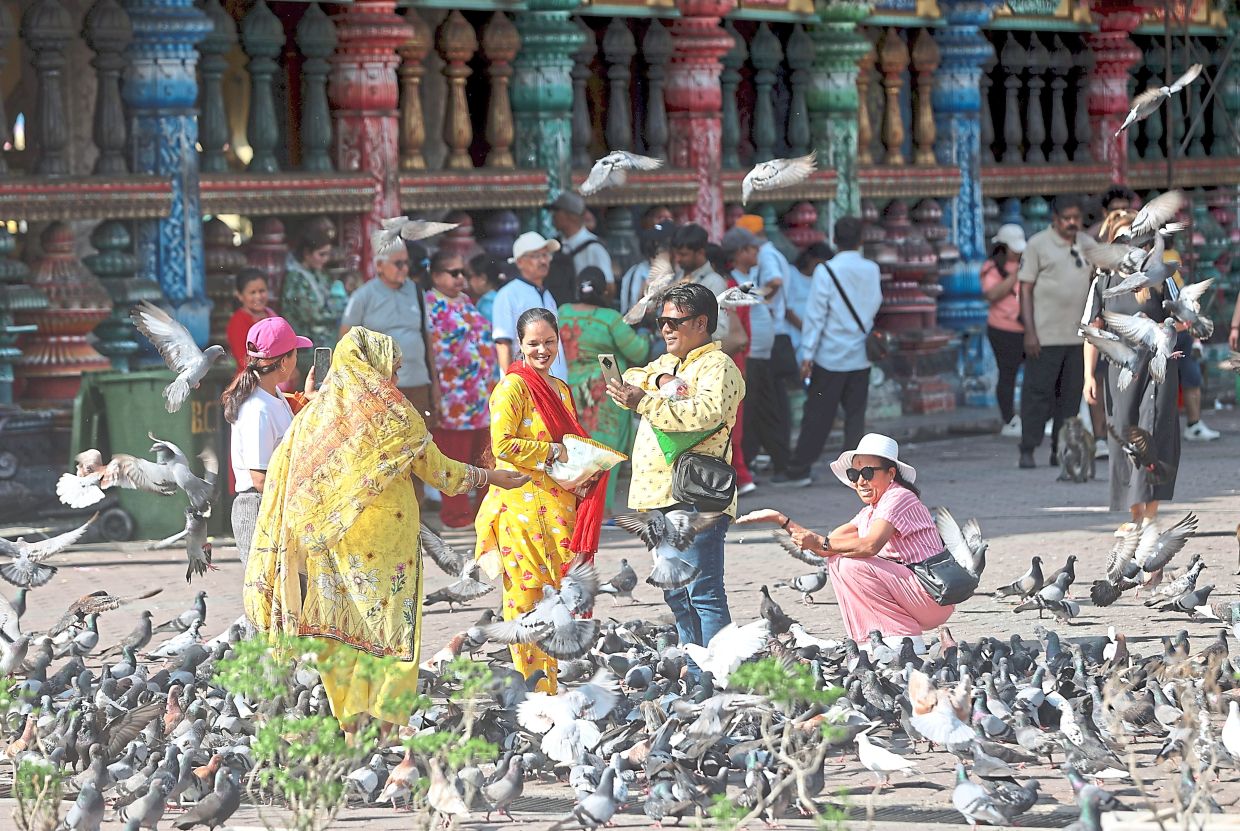
India is now considered one of the fastest-growing outbound tourism markets globally.— ART CHEN/The Star
China’s population is roughly 1.41 billion while India is now the world’s most populous country with about 1.46 billion.
There will be well-heeled urban elites from cities like Beijing, Shanghai and Guangzhou as well as poorer ones from less affluent cities regarded as third-tier cities in China. It is the same with India.
If more and more hot pot restaurants have been set up in Kuala Lumpur, it is because there are entrepreneurs – Malaysians and mainland Chinese – who see the opportunities from these China tourist arrivals.
Cantonese cuisine, which used to be the preference of Malaysian Chinese, is now making way for the northern taste buds – with spicy and numbing seasoning of “Ma lat” – of mainlanders who come from colder parts of China.
If there are more and more arrivals from India, then there will be businessmen who will see the need to set up vegetarian restaurants at KLIA1 and KLIA2. It’s that simple. There is no need to make derogatory and racist remarks against Indian tourists, which does not help us a bit.
Tourists have a choice on where they should spend their money and whether they will feel welcomed.
Many tourists, including Malaysians, have talked about how unsafe Europe, including Paris and London, has become and grumbled about how we are subjected to unending questioning by US immigration despite being money spending tourists.
Let’s make all our visitors feel welcomed and appreciated as we kick off our “Visit Malaysia Year 2026” in around 31 days.
Let’s show them our Malaysian Hospitality.