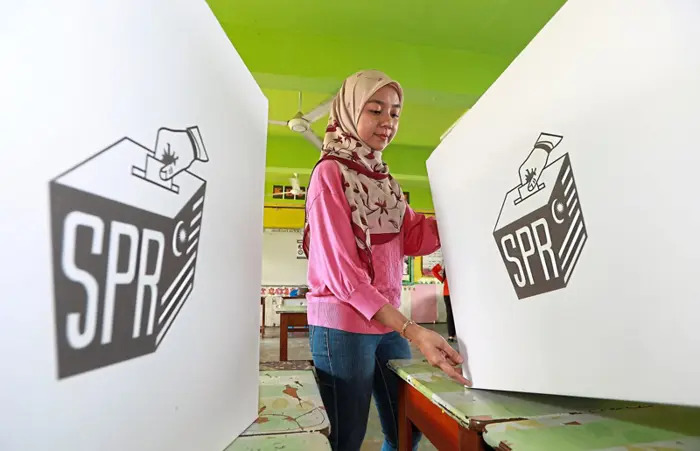
Unnecessary distraction: Having an election in these times of global turmoil is not prudent. — Filepic/The Star
DESPITE continuous speculation that the general election could be held soon, there is actually no urgency for the unity government to call for one. Its full term ends only in December 2027.
Even then, the prime minister has another 60 days before polling day. Assuming that Datuk Seri Anwar Ibrahim wants to serve a full term, he has more than a year from now.
He has already emphasised that politics needs to take a back seat as Malaysia, like the rest of the world, grapples with the oil crisis and the escalating cost of living every day that the Iran conflict goes on.
No one knows how long this will drag on. The Strait of Hormuz remains shut and the supply of oil is slowing to a trickle.
The PM faces a familiar but increasingly urgent political dilemma: whether to call for fresh elections now, amid gathering economic headwinds, or to hold the line until conditions are more favourable.
This debate is sharpened by the reality of a looming oil supply crunch, rising global tensions, and the knock-on effects that will inevitably be felt at home – from inflationary pressures to fiscal strain.
On the one hand, there is a compelling argument for seeking a fresh mandate sooner rather than later.
Periods of crisis demand clarity of leadership and many Malaysians would put their faith in Anwar.
Many of us are baffled by PAS president Tan Sri Abdul Hadi Awang who questioned the necessity for a fuel price hike. Surely he should know better – unless he has no idea that global prices are fixed and that Malaysia is a net importer of oil.
Then there is Perikatan Nasional chairman Datuk Seri Dr Ahmad Samsuri Mokhtar, who proposed the setting up of a non-partisan national council comprising representatives from NGO, academia, industry and civil society to develop strategies to handle rising energy prices and supply and logistics disruptions.
The Terengganu Mentri Besar surely means well, but with the extremely fluid situation daily, there is really no time for a talk shop.
It is best to leave it to PETRONAS, the Finance Ministry and the experts with oil industry background to decide on the measures, which would include seeking oil supplies from alternative sources.
A government that goes to the rakyat and secures a renewed endorsement can govern with stronger legitimacy, make difficult decisions with greater confidence, and rally the nation around a coherent plan.
In times of economic uncertainty, hesitation can be costly. Markets, investors and ordinary Malaysians alike value decisiveness and stability.
An oil crisis is anticipated, and it is not a distant threat. Any sustained disruption to supply will push up fuel prices globally, affecting everything from transport costs to food prices.
For a country like Malaysia – an oil producer but which provides subsidies on fuel at RM7bil a month – the policy choices will be politically sensitive and economically painful.
Rationalising subsidies, managing public expectations, and cushioning vulnerable groups will require firm and trusted leadership.
An election, if won convincingly, could provide that political capital.
On the other hand, calling for polls in the midst of such uncertainty is not without risk. Elections are, by nature, disruptive.
It is also a highly expensive exercise. The last general election, in 2022, cost taxpayers nearly RM2bil.
The Melaka state administration’s term ends in December while Johor’s ends in April next year. A Sarawak state election could be held by this year, too, although its administration’s term only ends in 2027.
Former Elections Commission deputy chairman Datuk Seri Wan Ahmad Wan Omar reportedly said that, from an election management perspective, holding state and general elections simultaneously is the best method to save funds, manpower and resources.
He said that if state and general elections were to run concurrently, it would cost up to RM1.3bil, saving up to RM200mil in gross budgeted costs.
But money aside, when we are facing a serious economic problem, including cutting costs, it is hard to accept our politicians crisscrossing the country spending huge sums of money on political events – and burning fuel for unproductive reasons.
Politicking can also distract from governance at a time when full attention is needed on managing the economy.
Campaign rhetoric may over-simplify complex policy choices, with populist promises over-shadowing fiscal realities. Worse, a fractured or inconclusive result could produce political instability – precisely what the country cannot afford in a crisis.
There is also a matter of timing from a political stand-point. Delaying elections until next year may allow the ruling coalition to consolidate its position, strengthen internal cohesion, and improve its standing with voters.
Given time, economic condi-tions could stabilise, and the government may even be better positioned to mitigate the worst effects of the oil shock. Political sentiments, often fluid, may shift in its favour.
The biggest concern for many in Putrajaya is this: If the oil crisis deepens and the cost of living rises even more sharply, public frustration could harden into disillusionment.
Although the price of fuel in Malaysia is second lowest in Asean, locals still complain about the increasing cost of fuel. It is hard to talk logic when pockets are empty and jobs may be lost.
It is easy for the opposition to make empty but populist promises. Governments are rarely rewarded for presiding over hardship, even when the causes are external.