Author Archives: wcw

Discourse vital in democracy

We don’t have to agree with each other but we must have meaningful discussions to have a healthy exchange of opinion. That’s how we learn.

FINALLY, we get to see some common sense and sanity. Malaysians certainly welcome the decision of Attorney-General Tan Sri Mohamed Apandi Ali in dropping the sedition charges against Dr Azmi Shahrom.

It’s better late than never. Enough time and energy have been wasted by the authorities and the Universiti Malaya law professor in having to deal with the charges.

Azmi is a law professor and he is expected to give his opinion on legal issues. That is what lawyers and law professors do.

But to accuse Azmi of sedition is way off tangent and to haul him to court seriously smacked of absurdity. It was completely ridiculous. For many, it seemed like a poor attempt to suppress criticism.

Last week, Apandi used his discretionary powers to withdraw the charges against Azmi under Section 4(1) of the Sedition Act.

Azmi was charged on Sept 2, 2014 under Section 4(1)(b) and alternatively under Section 4(1)(c) of the Sedition Act for remarks made in an Aug 14 news report titled “Take Perak crisis route for speedy end to Selangor impasse, Pakatan told”.

The trial in the Sessions Court only began in January after the popular don sought unsuccessfully to move it to the High Court to challenge the constitutionality of the Sedition Act, during which his lawyers argued that the law was invalid as it was not passed by the Malaysian Parliament.

Azmi, who is the son of former Universiti Sains Malaysia deputy vice-chancellor of student affairs Datuk Dr Sharom Ahmat, thus became the first academician to ever be charged with sedition in Malaysia.

Since 2014, at least 13 people comprising politicians, an activist and a journalist have been charged or arrested under the Sedition Act. If previously the Internal Security Act – which was repealed in 2012 – was used against those accused of threatening national security, the Sedition Act, introduced by the British during the colonial era to fight the communist insurgence, seems to have been given a new lease of life.

Politics is all about perception and it won’t be wrong to say that many Malaysians believe that the Sedition Act is now used against dissidents. But what is more upsetting for many fair-minded Malaysians is that a few characters, who have a reputation for instigating racist mob behaviour, have yet to be hauled to the courts to be charged with sedition.

We are often told of the purported lack of evidence when these serial offenders are so blatant with their rowdy behaviour, which clearly violates the Sedition Act.

Malaysians know who I am talking about, as these serial offenders appear to have made a career for themselves by becoming racist rabble rousers and proclaiming themselves to be leaders of one-man non-governmental organisations.

There is a difference between making seditious remarks that can threaten order and security and those who make criticisms against political leaders and court decisions.

Court decisions are subject to criticism but that is different from criticising judges, which may make one being cited for contempt of court.

We must not forget that our legal system is adversarial, and even if a decision has been made by the courts, there will be differences of opinion over its judgment. We should encourage a healthy exchange of opinion in the public sphere.

On Nov 23 last year, Parti Sosialis Malaysia (PSM) leader S. Arutchelvan was charged under the Sedition Act over remarks made on the judiciary and a court ruling. This was based on a statement he made in February in response to the Federal Court’s decision on Datuk Seri Anwar Ibrahim’s case.

Arutchelvan, popularly known as Arul, also claimed trial to an alternative charge under Section 233(1)(a) of the Communica­tions and Multimedia Act 1998 for allegedly posting a statement on Facebook with the intention to injure the feelings of others.

While there are those who share Arutchelvan’s opinion, it may be better to argue that Anwar had his day in court, and the fact that he chose not to take the stand did give rise to many questions.

Like it or not, lawyer Tan Sri Muhammad Abdullah Shafee, who represented the ­government in the sodomy trial against Anwar, did – he went on a roadshow to give his views, in simple ordinary man’s language, to his listeners.

His move was subjected to much criticism by the Bar and some said he did so with the aim of getting the Attorney-General’s job. But we have to admit he had the guts to take on the criticism.

We are sure his actions, too, “injured the feelings of others”, but it would be ridiculous to charge him with sedition. Likewise, it is hardly convincing to charge the PSM leader with purportedly “injuring the feelings of others”.

With due respect to Arutchelvan, he is really a small fry in Malaysian politics. To be blunt, he is a nobody and it is a waste of taxpayers’ money to bring him to court.

The series of charges, using the Sedition Act, won’t benefit the leadership one bit. No matter what argument is used to cushion public criticism, it would be seen as a tool to suppress dissent by the opposition.

In a democracy, we must provide space for a meaningful political discourse. We don’t have to agree with each other but that is what democracy is about – to offer contrasting solutions to the voters so that we will make a wise decision on polling day.

Likewise, we expect teachers like Azmi Shahrom (who writes a fortnightly column in this newspaper called Brave New World) to share with his students and us, ordinary citizens, the different views on contentious issues. We want to listen to clever, rational, ­moderate and convincing voices, certainly not ill-educated, racist goons who create fear in the streets or run havoc in malls. Now, that’s seditious!
Another year, another reunion

The modern Malaysian Chinese family has come a long way. Many practices have been ‘adjusted’ but some things never change.

NOT many families want to talk about it openly. But the all-important Chinese New Year reunion dinners have become more complicated and in recent years, more stressful for sure.

It is almost impossible and even unfair to expect the patriarch and matriarch of the family to cook the meal, traditionally sumptuous and heavy in some cases, especially when they are getting along in years.

Mum’s cooking sounds good everywhere but in many cases, this has become a fond but distant memory. The maid has taken over this role and of course, our expectations have also become more realistic.

The world has changed. The women family members, whether daughters or daughters-in-law, are part of the work force now.

It is wrong to expect them to take over the kitchen duties. In fact, don’t even expect them to do the dishes. Don’t even think about it if you know what’s good for you especially during the festive season.

Cleaning up the house after a feast is a daunting task. All of us understand and accept the fact that we cannot overwork the maid, who are already grumbling about the weaker ringgit.

So, the modern Malaysian Chinese family settles for a compromised position – have the reunion dinner at a hotel or restaurant. Never mind if the food might be crappy.

For a Penangite like me, where Perakanan dishes are compulsory in the reunion meal, I resign to the fact that I won’t find my favourite jiu hoo char (stir-fried turnip with dried cuttlefish) and lobak (meat rolls) at any hotel banquet.

But you know that’s not all. The family member – perceived to be the most successful in life – always ends up paying the hefty bill. It’s only expected.

And we all know that hotel food, like those served on planes, is bad. But telling the person footing the bill that the meal is “lousy” right after dinner is not exactly the appropriate CNY greeting ….

Next, the giving of ang pow for the kids. While no one wants to admit that the amount in these red packets matter, it does!

It’s not going to look too good on you if the ang pow is small – and I mean the money inside, not the size of the packet – and especially if you are perceived to be better off.

Then, the conversation after the reunion dinner. And that is the most sensitive which can cause friction and great unhappiness.

I am not talking about the 1MDB and the RM2.6bil donation issue but explosive questions to family members, who are past 30 and still unmarried.

Yes, these purportedly choosy types, who think their partner, especially if you are a woman, should have better degrees, bigger car, a house, a club membership, a steady job with hopes of further promotions and of course, good looks, a great sense of humour as well as soft skills. By this, I mean having the ability to appreciate fine food and wine.

For the guys, they expect their partners to be able to cook like their mothers, be as good looking and curvy as the celebrities they see in heavily photoshopped pictures in magazines and of course, have a good career to help pay for the household bills.

But that’s not the end of it. If you are married and have not started a family, you would be offered many unsolicited solutions from busybody aunties – from artificial insemination to eating bull’s penises. Of course, there are subtle accusations of dangerous liaisons in China, what with the frequent business trips there.

No wonder the Chinese population in Malaysia is shrinking fast. But of course, like many Chinese voters, the blame has to fall on the Government. Their failure, or inability or refusal, to start a family, is the fault of the government entirely.

And if you happen to work in the media, all eyes will be on you. In this case, it’s me. With Google and news portals with anti-government slants easily available these days, everyone is now an expert on every issue. We have all become instant analysts and opinion shapers.

Yes, yes, of course, Malaysia’s temperature during the CNY will drop to as low as 16°C and will be the coldest CNY ever.

“That’s what the social media said what, so must be true mah!”

But it’s a reunion dinner. After the interrogation of the poor singles, it undoubtedly has to come to politics. I am not sure if this is a Malaysian thing, like the open house, but do people in other countries whine too?

Probably they do, and by now politicians in modern democracies would have realised that they have to earn their respect.

Don’t expect the people to pay homage to you because no one told you to stand for election and for sure, don’t expect us to be eternally grateful to you because you came begging for our votes with plenty of promises.

They have to learn that they will be belittled, ridiculed and criticised. So don’t run to the powers that be to shut anyone up with sedition charges. Get used to it.

I expect the grumbling and cynical remarks to be louder this year at gatherings with family and friends. There are a lot of unhappy people around.

But politicians do not have to worry too much as the louder yam seng will drown the complaints. To all Malaysians celebrating Chinese New Year, I wish you all Gong Xi Fa Cai!

Kedah’s ‘cursed’ position

The state has a record number of mentris besar who could not hold on to their seats till the end of their term.

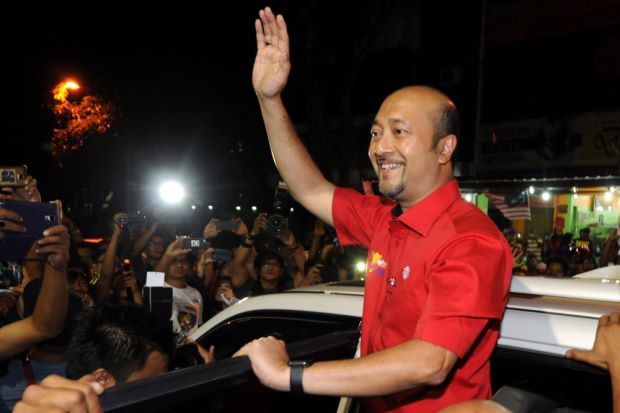
THE removal of Datuk Mukhriz Mahathir (pic) as Kedah Mentri Besar has been described as extraordinary by some analysts and politicians.

But the reality is that it isn’t. His sacking should come as no surprise to anyone who has been in politics or has been observing Kedah politics.

Kedah has a record of mentris besar who found themselves kicked out of their jobs. It happened even when PAS was in power in the state.

The fact is that Mukhriz had continuously joined his father Tun Dr Mahathir Mohamad in criticising Umno president Datuk Seri Najib Tun Razak over the 1MDB controversy.

While Mukhriz has never openly called for the removal of Najib as Prime Minister, his constant harping on the issue was as good as asking Najib to go.

At the Umno general assembly in Kuala Lumpur last month, Mukhriz hosted a dinner at Saloma Bistro for Kedah delegates.

With deputy president Tan Sri Muyhiddin Yassin and vice-president Datuk Seri Shafie Apdal present, Mukhriz made a blistering speech – just hours after a clear endorsement by delegates that Najib be given time to tackle the 1MDB issue.

Many said it was the last straw for Najib. In simple analogy, no employee can expect to keep his job if he spends time running down the boss and is seen to have even plotted for his downfall.

In this case, the irony is that Najib picked Mukhriz to be the Mentri Besar against the wishes of the Kedah division heads after the 2013 general election. Some said Najib had to please Dr Mahathir then.

Mukhriz has now joined the ranks of his predecessors who had to leave before their term ended.

The fifth mentri besar, Datuk Syed Nahar Syed Shahabuddin (1978-1985), had to step down after he was secretly filmed dressed as Mexican character Montoya del Monte at a party hosted by the Kedah Shooting Association.

While such costume party would hardly raise any eyebrows in the federal capital, the video was used against him by PAS and in conservative Kedah, it was difficult for him to stay on. Syed Nahar then offered to step down.

Tan Sri Osman Aroff took over in 1985 and stayed till 1996, when Dr Mahathir wanted him replaced by Tan Sri Sanusi Junid. The accusations went from being a weak leader to being overly generous with Chinese tycoons. Osman could not fend off the attacks.

Both Syed Nahar and Osman were told to step down in a subtle manner, and they did not resist or rebel openly.

Like Mukhriz now, Osman had his band of loyal and angry supporters but they eventual­ly went along with what Dr Mahathir wanted. In short, Dr Mahathir did it his way and had it his way.

The eighth mentri besar, the late Datuk Seri Syed Razak Syed Zain, also ended his term prematurely in 2005 after a stroke.

In the 2008 general election, his Kubang Rotan state seat, which he had held since 1995, was taken over by PAS.

When PAS took over the state government that year, Datuk Seri Azizan Abdul Razak was made mentri besar and when he got sick, he, too, refused to budge and actually ran his office from the hospital bed.

The younger PAS state exco members rebelled against him but the in-fighting cost PAS the state in the 2013 elections.

The Kedah mentri besar’s post is truly a cursed position and records have shown that many have failed to hold on to their seats for long.

It’s odd that PKR should raise questions on the disposal of Mukhriz when the party also removed Selangor mentri besar Tan Sri Khalid Ibrahim, who was mentri besar from 2008 to 2014.

He said the same thing, too, like all ousted leaders – they had done no wrong and that the people were behind them. And like every politician, everything they did, or did not do, was for the people’s interest and never their own.

There would always be the token protests and show of force but we all know they never last long in Malaysia.

Like Mukhriz, Khalid also went against his party bosses – Datuk Seri Anwar Ibrahim and his wife Datin Seri Dr Wan Azizah Wan Ismail – and he found himself sacked.

Don’t be obsessed with titles

Malaysia is in danger of becoming a laughing stock because of our fixation with titles. We must not forget that respect and honours must be earned.

A FEW months back, I had the honour of being appointed an adjunct professor at the School of Business Studies in Universiti Utara Malaysia. It is a two-year appointment which allows me to use the academic title.

But I have not used it and I do not intend to do so. For sure, the title will not appear on my business cards as it will not be appropriate and might even be an affront to the many who have toiled to get their well deserved doctorates.

I am happy to be able to share my working experience with the students and in the process, also learn from the experienced lecturers at the university. That is sufficient enough for me.

I also made another decision late last year – I will drop my Datuk Seri title from my business cards as well. I do not have any intention to cause any embarrassment or to appear ungrateful to the royal houses that have bestowed the titles on me.

Certainly, I am truly proud and honoured that my work, in particular as a journalist, has been recognised by the King.

I have the highest respect for the Sultan of Selangor, His Royal Highness Sultan Sharafuddin Idris Shah, in particular, for his leadership and his refusal to have a long list of award recipients. The state constitution actually stipulates the maximum number of awards to be bestowed each year.

In the case of Johor, His Royal Highness Sultan Ibrahim ibni Almarhum Sultan Iskandar has expressed his frustrations openly, saying sarcastically “that it has come to a point that if you throw a stone, it will hit a Datuk and when the stone rebounds, it will hit another Datuk”, to illustrate the point that Malaysia is in danger of becoming a nation with the most number of decorated people.

It’s not wrong to say that the Johor palace has the distinction of awarding the least number of titles.

It has been aptly pointed out, in an article, that these titles were given only to ageing civil servants, ministers, judges and businessmen in the past. In fact, our first Prime Minister Tunku Abdul Rahman was never a Datuk, Datuk Seri, Tan Sri or a Tun.

Our former deputy prime minister, the late Tun Ghafar Baba, was just plain Encik, until he retired from office.

In Tunku’s first Cabinet, after we achieved independence, only five of 15 ministers were made Datuks. The finance minister at the time, Tan Siew Sin, only held the title of Justice of Peace – which is recognised in Commonwealth countries.

Penang’s first Chief Minister, the late Wong Pow Nee, had no title until he retired, when he was made Tan Sri. Another was the late Gerakan president Dr Lim Chong Eu who only became Tun upon retirement.

In short, things were pretty simple then, with proper methodology when it came to according decorations, medals and titles, but that is not the case these days.

We seem to be too quick to award individuals, including young recipients who have yet to prove their mark and mettle, with Datukship titles. To put it bluntly, such gene­rous dispensing of awards and titles, with no control in sight, has cheapened these otherwise prestigious decorations.

We are in danger of becoming a laughing stock or have we already reached that level? Certain states are now perceived to be too generous in giving out awards and titles, and we hope these states would be more sensitive to public perception.

The biggest grumbling on the ground is that unheard of individuals with a questionable track record, or rather no record to speak of, have become Datuks, and the ease in which they secured these titles has led to unkind speculation that they had in fact bought them.

If this is not bad enough, we now read of news reports that some desperate Malaysians are buying or accepting Datukships from bogus sources.

Recently, MCA Public Complaints Bureau chief Datuk Seri Michael Chong urged the Government to keep a record of legitimate Datuks who received their titles from the Yang di-Pertuan Agong, Sultans or Governors, and that fake ones be exposed.

For the record, Selangor has a website which lists down the names of recipients to enable the people to counter check and verify.

Chong also revealed that fake titles, often purchased by foreign businessmen or awarded by bogus royals such as the “Malacca Sultan”, were becoming rampant.

The Council of Federal Datuks Malaysia deputy president Tan Sri M. Kayveas had already brought the matter up to Minister in the Prime Minister’s Department Datuk Seri Azalina Othman Said, and was told that a law is already in the works to address the issue, Chong said.

Azalina, who is in charge of parliamentary affairs, reportedly told Kayveas that her predecessor Datuk Seri Shahidan Kassim brought the matter up in Parliament last year and enacted a law to log all title-holders.

That is at the federal level. What about the state awards? Surely, a similar proposal can be brought up and discussed at the Conference of Rulers, which would want to uphold and protect the prestige of awards given by the respective Sultans and Yang di-Pertuan Negeri, before they continue to lose their shine.

The obsession with titles and honours is not just confined to royal titles but also business awards for purported achievements as heads of companies.

The appetite of Malaysians for awards have given rise to a lucrative industry. However, it must be pointed out that there are genuine awards for businesses organised by some reputable media groups in Malaysia where money cannot be used to buy these awards.

Honours and respect must be earned, there should be no short cuts, as the saying goes.

Winning not one but all the races

We need to accept the fact that ours is a plural society – with all its good and bad. Our leaders must remember that they are leaders of all Malaysians. They must win the hearts of all races, not just one.

NOT many Chinese in Malaysia would want to hear this, nor can they accept this reality, but it is a fact that the community by itself cannot overthrow the Barisan Nasional government or more precisely send Umno into the opposition.

After failing to capture Putrajaya in the 2013 general election, there are many who now think the Sabahans and Sarawakians will deliver the votes to the opposition, which the Malays in the peninsula did not and probably will not in 2018.

It is wishful thinking that is based on an unrealistic dream. No matter how many planeloads of Chinese voters return from overseas to support the opposition, there can be no change unless the predominant Malay electorate goes along.

The 2013 election clearly showed that the majority of Malays kept their faith with Umno and last year’s Bersih rally was clearly dominated by the Chinese. In short, it was a yellow affair.

Sure, many diehard protestors would still insist there was a Malay presence and of course, there was, but the numbers were so insignificant they hardly stood out.

The lesson was clear enough – the absence of Malay protestors was because PAS stayed away and PKR could not deliver the numbers.

The demographic reality in Malaysia is that the Malays will never lose their grip on political power and Umno will remain to strengthen that hold.

Out of the 222 parliamentary seats, 166 are in the peninsula of which 70% are Malay-majority seats. There are only 22 Chinese-majority seats or merely 13% while there are 29 mixed seats. There is no Indian majority seat.

But even the demographics may change over the next two general elections in these 22 Chinese-majority seats.

In simple mathematics, even if every Chinese in Malaysia voted for the DAP, they can never make the party rule Malaysia.

And if we think that all the Chinese are so politically keyed-in, the latest statistics by the Election Commission on unregistered voters are an eye-opener. There are more than a million Chinese who have yet to register.

Of the 4.2 million unregistered voters, the Chinese account for 1.2 million and the Malays 1.8 million.

Malay politicians who create the fear that the Chinese will rule Malaysia via the DAP are also talking rubbish, creating a scenario that will never take place.

While the DAP has tried very hard to sell its multi-racial platform, it is essentially a Chinese party. That is not different from the Gerakan, which is Chinese majority, although its membership is open to all.

Amanah, the splinter group of PAS, may want to see non-Malays as members, but we can be sure the party won’t see any traction from the non-Malays.

As much as DAP strives to get more young Malays into the party, it does not help when Malay entrants are not voted into the party’s state committees except for a few.

The grassroot members in the DAP are still unable to see the value of these Malay members nor do they know how to work with their Malay partners. They kicked out PAS, quarrelled with PKR and harsh words were used by the DAP against Amanah over some pathetic councillor seats.

Such brashness and even arrogance is something the DAP leaders need to work on if they want to be part of an opposition pact to topple the Barisan.

Some of the DAP leaders, who are already in state government, still use the language of street fighters, forgetting that as state government leaders now, they need to speak with some finesse and decorum, befitting their status.

There is little wonder why a recent study by the Darul Ehsan Institute revealed that the Malays, especially in the rural areas, perceived the DAP as anti-Malay.

The study revealed that after the break-up of the Pakatan Rakyat coalition in June, the campaign to demonise the DAP as anti-Malay has become more effective, with Umno and PAS working together in the anti-DAP campaign.

In the survey by the institute conducted between Nov 13 and 15 last year, involving 1,716 Malay respondents throughout Selangor, almost two-thirds of respondents (72%) agreed that DAP was a racial party and that it was only looking after the interests of the Chinese community. Only 12% disagreed, while 16% said they were “unsure”.

More than half (64%) also agreed with the statement that “DAP is an anti-Malay and anti-Islam party”. Some 18% disagreed while 19% were unsure.

To be fair, the DAP has fielded more non-Chinese – Malays, Indians, Kadazans to Portuguese – which no other party can claim to. It has also contested in non-Chinese majority areas.

But the inability to change the perception after its formation in 1965 and having contested its first elections in 1969, is also a big failure the party must admit.

The DAP can blame Umno and PAS for its campaign but that’s what politics is all about.

The party leaders have to look at themselves and perhaps also measure the degree of interaction with the Malay community including how much they understand the Malay language, Malay customs and Islam as a pillar of the community.

Perhaps, they can take a leaf from Selangor Mentri Besar Datuk Azmin Ali, who has displayed courtesy and respect when he talks to federal leaders and the royalty.

Against this backdrop, the DAP must surely realise that it will never be able to win Malay votes on its own, if it lacks and fails to appreciate the Malay voters sufficiently.

When Malaysia achieved independence, the Chinese population stood at 45% but it now stands at 24% and the prediction is that in the next decades, it will go down to 10%.

The Malay fertility rate is at 2.8 children per woman against the Chinese’s 1.8 children per woman and Indian’s 2.0 children per woman.

It is reported that Malay fertility rates are 40% higher than Malaysian Indians and 56% higher than Malaysian Chinese. In 2010, the Malays and Bumiputras were 60.3%, Chinese 24.6%, and Indians 7.1%.

Sin Chew Daily, the country’s biggest Chinese newspaper, has correctly reported that “Chinese Malaysians will be reduced from a minority to a very small minority in the long run. And demography is all about politics and economics.

“The drastically reduced population ratio of the Chinese means their political power is poised to take a further beating and this will also have some bearing on its economic strength. In short, Chinese Malaysians must brace themselves for eventual marginalisation.

“On the one hand, Chinese families yearn for smaller household sizes in a bid to maintain the quality of their spiritual and material lives; on the other hand they must also come to terms with the possible consequences of marginalisation.”

In short – the lack of strategic political behaviour and voting, fanned by emotions and unrealistic hopes will put the Chinese in the back seat of power, or worse, totally out of government with Penang as the only base.

The Chinese daily further added, “we can no longer expect ourselves to compete with the mainstream community on an equal footing in numbers, especially when it comes to politics.”

“Chinese Malaysians must learn to get along peacefully with the majority community in this country, trying to understand their insistence on their ethnic attributes and religious faith, as well as their sense of insecurity towards the existing living environment. We have to learn to accept our common grounds in reducing exclusionism and confrontation as we attempt to make up for the broadening number gap.”

Politics can only work if there is consensus and readiness to share power, and to accept the fact that this is a plural society, with all its strengths and weaknesses.

If Malaysian politicians want to consider themselves leaders of all Malaysians, they have to win the support of all races, and not just one ethnic group.

Then there is hope for Malaysia.

Islamic law affects all of us

The Indira Gandhi case has broken the hearts of many Malaysians, including many Muslims, who understand what justice is all about.

I HAVE always thought that the court is one place where we can seek redress and justice. Where righteousness, uprightness and compassion flow alongside the stream of justice, even as the law is interpreted in ways the common people may not fully understand.

How naïve I have been. This could be the result of watching too many Chinese dramas on the life of the legendary Justice Bao, more commonly known as Bao Gong.

The judge was an honest and principled judge during the reign of Emperor Renzong in China’s Song Dynasty.

His court decisions included sentencing his own uncle, impeaching an uncle of Emperor Renzong’s favourite concubine, and punishing powerful families.

According to one article, his appointment from 1057 to 1058 as the prefect of Song’s capital Kaifeng, where he initiated a number of changes to better hear the grievances of the people, made him a legendary figure.

Justice Bao was always available at all times to the downtrodden and he stood up against the powerful landlords.

Their political connections meant nothing to him as he dispensed justice – as what judges are supposed to do. He was only fearful of God and certainly not ordinary men, no matter how influential they were.

Common sense, compassion and justice are surely noble values that we seek from our men and women on the bench.

Surely, not those who are fearful of making decisions, preferring to pass the responsibility to another court, especially when it involves matters of the faith, or at least that’s the perception of many Malaysians now.

Let’s deal with the M. Indira Gandhi issue as sensible human beings. Imagine the kindergarten teacher as your daughter, your mother or simply as your neighbour. Imagine her pouring out her frustrations to you as a listener.

It’s a case which can happen to any of us, and if the Federal Court – her last hurdle – upholds the Court of Appeal’s decision, then that’s the end of the road. Not just for Indira Gandhi, but it would have an impact on all future cases.

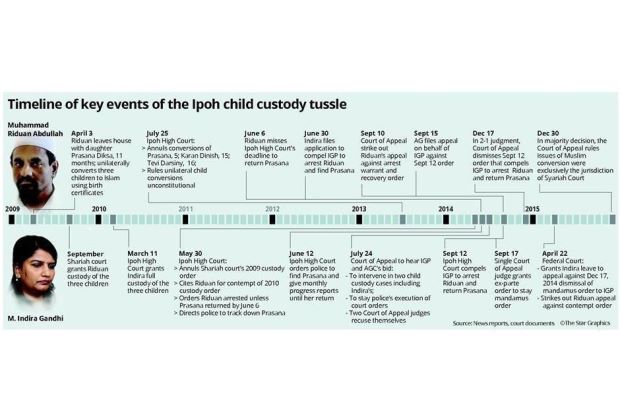
She married her husband K. Patmanathan, in a civil marriage, like most Malaysians and then in 2009, he decided to convert to Islam. This is not a disputed fact: Theirs was a civil marriage. She didn’t marry a Muslim.

Upon his conversion, he unilaterally went to the Islamic authorities to convert their three children – Prasana Diksa, then barely a year old, Tevi Darsiny, then 12, and Karan Dinish, then 11 – to Islam. The two older children have, however, remained with their mother.

Prasana turned seven last year. But the mother has only seen her once, since she was taken away, and that was at a court hearing at the Ipoh High Court in 2009 when the toddler was one year and six months old. The High Court had ruled in her favour, but the Court of Appeal by a majority of 2-1 has overturned that ruling.

She has been unable to speak to the child and her text messages to the estranged husband’s phone have been left unanswered.

Just for a second, think about it. A mother suddenly loses contact with her child for seven years. No one seems to be able to find the husband. It’s a classic case of abduction, as far as she is concerned, and she can’t seem to get any help.

This is Malaysia. No one just disappears into the thin air and we cannot be expected to believe that Patmanathan, now known as Muhammad Riduan Abdullah, cannot be found.

And now Malaysians are told by the learned judges of the Court of Appeal that this is a religious matter and that issues regarding Muslim conversion are exclusively the jurisdiction of the Syariah Court.

Now, you and I don’t have to get a law degree to know that non-Muslims cannot appear in the Syariah Court, so how on earth is Indira Gandhi going to seek redress in the Islamic courts?

Malaysia hasn’t become an Islamic State and the people, especially non-Muslims, can still challenge contentious matters in the civil courts.

So, this is a lesson for non-Muslims who actually believe that Islamic laws won’t affect non-Muslims and are meant only for Muslims.

We live in a plural society and even as Malaysia becomes more Islamic and mono ethnic, non-Muslims still have their rights, as guaranteed in the Federal Constitution.

The people also have the right to question the decisions of the courts including the Indira Gandhi case. That is surely not contempt of court and for sure not seditious.

We have not gone the dictatorial way. Our leaders can be criticised in a democratic society. Even ridiculed.

The case has broken the hearts of many Malaysians, including many Muslims, who understand what justice is all about.

Now, Indira Gandhi has her final shot – she will be appealing the Court of Appeal majority decision, and is expected to file the appeal within the next two to three weeks or sooner.

The Federal Court should expedite the hearing and empanel a full bench to hear this appeal as any decision it makes will have far-reaching consequences on the nation.

The majority decided that from a subject matter approach whether a person was a Muslim or not was only to be decided by the Syariah Court.

In his dissenting decision, Justice Hamid Sultan Abu Backer said the Administration of Religion of Islam (Perak) Enactment 2004, the law that allowed for the conversion, could be questioned by a civil court.

The panel set aside the Ipoh High Court’s decision to quash the conversion, and made no order as to costs.

Both the majority and the minority decisions (the full judgments are available at www.kehakiman.gov.my) will be heavily scrutinised in the days to come, and we should be thankful that we are also allowed to have our say as the common people.

In the court of public opinion, this is not just about lawyers slugging it out in the courts. With respect, this is not just a matter of religion. It is a case of whether non-Muslims can find a competent, fair and suitable court to hear their cases involving unilateral conversion.

Malaysians, especially non-Muslims, have a right to ask why they should be subjected to the jurisdiction of a Syariah Court and why are the rights of a non-Muslim not protected under the Federal Constitution?

More importantly, when it comes to the conversion of minors without the parents’ consent, should the court, in such circumstances, restrict itself in the interpretation of the word “parent” in the singular to a narrow interpretation when the results can be unjust?

Our judges and leaders cannot run away from their responsibilities. They have been put in places of responsibility and accountability to make sure justice is done. We will all be answerable to the Almighty in the end.

Say ‘no’ to extremism

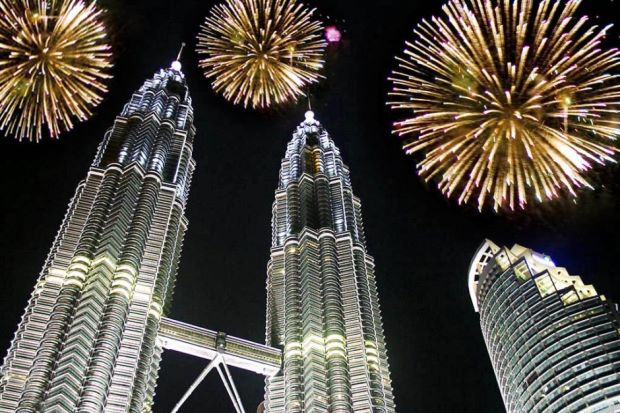
Fireworks light up the sky over KLCC during New Year celebrations in Kuala Lumpur on January 1st 2016.

Fireworks light up the sky over KLCC during New Year celebrations in Kuala Lumpur on January 1st 2016.

As we look forward to 2016, we should remember to support voices of moderation. Malaysia needs it.

I AM an optimist by nature. Most of us, in fact, are traditionally optimistic and hopeful at the beginning of a new year.

But I cannot help having apprehensions about the coming months. It will be a rough ride ahead with too many external factors beyond our control.

The price of crude oil, which is a dominant factor on our economy and ringgit, is likely to continue to be volatile. There are fears that it will continue to plunge.

Who would have thought that just 18 months ago, it was US$100 (RM430) a barrel and now it is hovering at around US$40 (RM172) a barrel?

The knockdown effect on our ringgit has been tremendous and 2015 will be remembered as a year when our ringgit was the worst performing currency in Asia.

It is humiliating but more than that, it means that the cost of doing business in Malaysia has become extremely high. Against the backdrop of a falling ringgit, weak market sentiments and escalating operating costs, most companies saw the need to reduce staff as a way out.

It will be the same scenario this year. It’s not just the price of oil, but also China’s economic pace which began to slow down in 2015 and will continue the same downward trend this year.

Malaysia, like other Asian countries, is more reliant on China than ever before. China is, after all, the second largest economy in the world and the top destination of exports from Malaysia. Any slowdown in China will have a negative impact on us.

The good news, as we wrapped up 2015, was the ringgit had strengthened as much as 3% since September, and as the year ended, it was trading about RM4.32 against the dollar.

Europe is still trying to recover while Japan remains technically in recession, and the value of the yen has also dropped against the dollar.

In short, the combined effects of the US interest hike, economic slowdown in the region and the instability of the oil price will all make 2016 a difficult year.

These are the external factors. As far as domestic issues are concerned, the 1MDB rationalisation exercise is near completion.

The issue has dogged the leadership and the country for the entire year. It has to end and we need to move on.

Be that as it may, there are still answers that Malaysians seek and if the authorities are not forthcoming, the 1MDB issue will continue to haunt the leadership into the new year.

It is clear by now that Malaysians will not accept failed standards and the violation of rules in institutions. We should be protecting these principles and we cannot accept excuses made to defend these violations.

Those who have spoken up have paid the price but we must also be apprehensive of those who pursue their political agenda in the name of justice and other purported noble values. These include people whose background needs plenty of explaining.

As we face the challenges this year, we must do away with some of the political and religious controversies.

Why should even a roof structure that resembles a cross be an issue and the developer ends up having to cover them up? It is plain ridiculous.

The cross is the symbol of Christianity, yes, but it has no supernatural powers. Even Christians will tell you that and, for sure, it won’t shake anyone’s faith, if that is the reason.

Some of us must have watched too many Dracula and Frankenstein movies to believe that a crucifix is enough to disfigure and disintegrate these characters with acidic effects. The problem with most of us is that we see too many ghosts when there are none.

We should be more worried about politicians who use race and religion. They are more devilish than dead people.

As Hyacinth J. Tagupa of The Inquirer of the Philippines wrote, in reference to such figures in her country, the people must not remain “zealous, unquestioning and defensive” about them.

“That’s the kind of blind devotion for which we have always criticised the Nazis, and eerily, the kind of devotion we have started to display here.

“And though we could never imagine ourselves letting another Holocaust happen, if we continue to venerate our champions without scrutiny, we may already be tolerating too much.”

What she has written certainly fits into the Malaysian context too. Many of us turn a blind eye to personalities who use race and religion, for fear that speaking up against them would appear that we are acting against the interest of their communities.

Deep in their hearts of hearts, they know these characters are tearing Malaysia apart with their continuous ranting of race and religion in social media and certain newspapers, but many have chosen to remain silent.

We are on a slippery path to a nation torn apart if they are left unchecked and unpunished. A couple of days in remand, without any formal charges, won’t deter them.

In fact, they will appear more heroic in the eyes of their misguided supporters. Their indefensible actions will cost us dearly. We cannot let this continue in 2016.

More than 50 decades after independence, we are now told that being liberal is politically wrong. In fact, faithfully wrong, Muslims are told.

More frightening, some Umno leaders are saying the same thing, as the party gets cozy with PAS.

In the preamble to the Rukun Negara formulated in 1970 by the late Tun Abdul Razak, it is clearly stated that our nation nurtures the ambition “guaranteeing a liberal approach towards her rich and varied cultural traditions”.

Besides Sarawak Chief Minister Tan Sri Adenan Satem and former deputy prime minister Tun Musa Hitam, many of our politicians are fearful of declaring themselves as liberals. A few have become more outspoken after they retired.

In flirting with PAS, we should not be surprised if there were no dissenting voices when leaders of the Islamist party suggested that the best way to resolve cases of minors being raped would be for their perpetrators to marry them.

Yes, they are saying that rapists should marry their victims and that all will be well and fine. How brilliant but in the name of political expediency, many politicians, who claim to speak up for our interests, are strangely silent.

Perhaps, they have been away during the holiday season, but voters and politicians will be tested in 2016, as PAS pushes its agenda knowing that their suitors are currently unable to see, or chose to ignore their blemishes, in the heat of the courtship.

But remember, just three years ago, many Chinese voters were also infatuated with PAS, with many making excuses to defend them, looking the other way, or even closing their eyes to their transgressions.

The same apologists are now the same angry voices who pushed PAS to be kicked out of the now defunct Pakatan Rakyat.

The hudud laws were defended because they were purportedly suited for Barisan Nasional leaders, and that everything was allowed in Kelantan, as trips were organised for voters to see how exemplary “liberal” Kelantan has been under PAS rule.

Those who warned against working with PAS were scolded, even threatened for being political alarmists, in the heat of the 2013 polls but suddenly it has all changed now.

The very same DAP politicians who supported and worked with PAS are now asking why Umno is working with PAS. Politics makes strange bedfellows, and it’s all about common interests – all politicians should know that.

But the sad part is the voters, who have sacrificed much of their time and money, as well as loss of friendship, will continue to be influenced by the same politicians, peddling unrealistic hopes, feeding on fears and emotions.

2016 is a crucial year – thanks to the Internet, we have become experts on all issues, and as Tagupa wrote aptly, “it’s time we practised being more rational and analy­tical when faced with what others have to say about our heroes”.

Please stop giving saintly status to some of our politicians. They are fallible human beings, so there’s no need to be their echo chamber, accepting everything they say, and blindly rejecting other views and facts.

We need to support the voices of moderation more ever than before. And to do so consistently this year.

Moderate is the way to go

MALAYSIANS whine and complain a lot – it’s both good and bad.

The good part is that we obviously want the country to improve, to set new benchmarks so that we can match the best performing nations globally. And we want our leaders to be accountable and to have integrity.

The minus side is that we take many things for granted and we seem fixated in our perception that we are only going in one direction – downhill. We refuse to acknow­ledge even the positive traits around us.

We jump to conclusions, often coming out with the worst scenarios possible. We forward messages, in text or video, without thinking – a simple car fire, the vehicle set alight by a jealous husband, is the work of extremists for sure.

These cynics do not, for a second, ask themselves why a terrorist would choose an ordinary stop on the LRT route to set off a bomb.

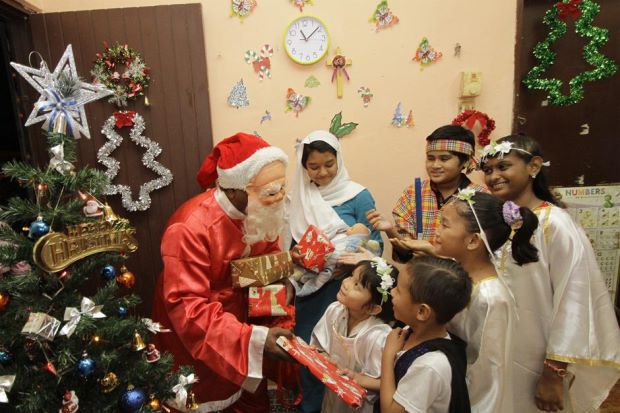
But that’s Malaysia. I have enjoyed my Christmas celebrations and I am certainly happy that it is recognised as an official public holiday.

In fact, Malaysians – despite their many different and divergent views – all seem to agree that we must celebrate every festival of every community. Malaysia is among the countries with the highest number of holidays, at state and federal level, which often lead to extended weekends.

So, even the small groups of Muslims who feel that they should not wish their Christian Malaysians a Merry Christmas, supposedly on religious grounds, are happy not to have to report for work on such days.

While there are fears, among non-Muslims, that this country is turning more conservative and puritanical, this writer remains optimistic that most of us remain tolerant, respectful and moderate.

I do not believe we will go the Brunei, Tajikistan or Somalia way – countries which have banned Christmas celebrations and decorations in public.

For the tiny Christian community in Brunei, mostly expatriates and foreign workers, they can only celebrate within closed doors, such as churches and homes, and they must also reportedly alert the authorities ahead.

The Ministry of Religious Affairs said in a statement, “These enforcement measures are … intended to control the act of celebrating Christmas excessively and openly, which could damage the aqidah (beliefs) of the Muslim community.”

Sultan Hassanal Bolkiah’s decision to ban the public celebration of Christmas in his country has received worldwide attention but the media have also pointed out that the ban does not extend to his business interests outside of Brunei, including the historic Beverly Hills Hotel, part of his Dorchester Collection with branches in London, Paris, Milan and Rome.

International media continue to show pictures of these hotels fully decked out with Christmas decorations.

Punishment for violating the ban is a five-year jail sentence, and the government warned last year that Muslims would be committing an offence if they so much as wear “hats or clothes that resemble Santa Claus”.

It has also been reported that Somalia issued a ban on Christmas and New Year celebrations in the Muslim country, saying the festivities “have nothing to do with Islam.”

“We warn against celebration of Christmas, which is only for Christians,” Sheikh Mohamed Kheyrow, director of Somalia’s ministry of religion, reportedly said on state radio on Wednesday.

“This is a matter of faith. The Christmas holiday and its drum beatings have nothing to do with Islam.”

He was quoted as saying that the ministry had sent letters to the police, national security intelligence and officials in the capital Mogadishu instructing them to “prevent Christmas celebrations”.

In Indonesia, police had to be stationed at some churches to provide security with 13 areas identified as vulnerable to attack by extremists.

On Christmas Eve in 2000 a series of co-ordinated attacks on churches in Jakarta by al-Qaeda and Jemaah Islamiyah killed 18 people.

Despite the display of racial and religious extremism by some local personalities, who seem to enjoy press coverage without fear of being charged in the courts, Malaysia has been spared from such fears and unrealistic state actions.

The Prime Minister and our leaders have, without fail, issued statements wishing Malaysians of all faiths during each festival.

Christmas is openly celebrated, and our malls are wonderfully decorated to reflect the holiday season. It must be noted, however, that this is more for commercial reasons than of any religious significance.

Be that as it may, Christmas is an occasion to be happy and to spend time with loved ones, especially our families. That is surely a noble reason.

The Johor Sultan has taken to the social media to send out his wishes and has even publicly told Muslims that they should not fear that their faith would be threatened if they celebrate alongside their Christian friends.

I am glad that Malaysians continue to attend the unique open houses of fellow Malaysians, even donning the costumes of each ethnic group to reflect the occasion. No one has talked about their faith being shaken until now because of the actions of some ill-informed individuals who stir up issues of race and religion for their own agenda.

Globally, we have right-wingers and extremists like Republican presidential candidate Donald Trump, the French right wing party Le Pen and Swedish Democrats with neo-Nazis, whose actions fan up Islamophobia.

Muslims who push for into­lerance in Malaysia must see for themselves how vulnerable their fellow Muslims in these countries are to understand the predicament of minority communities.

Trump has insanely called for a ban on Muslims entering the United States and soon, some pea-brained extremists in the Bible belt would say mosques must be shut down or that Hari Raya must be banned because it would purpor­tedly weaken the faith of Christians.

It is a reminder that all of us must learn to put ourselves on the other side of the equation when we speak or take certain actions.

The office Christmas parties, yes, it’s a plural, have been the best so far! We have reminded ourselves that as we open our presents, we must also never forget to open our hearts and minds. That’s our mode­ration reminder!

I wish all Malaysians a Happy New Year!

Let’s rise above racial rants

We must stick together to face challenges of the new year. Malaysia needs us.

IT’S wishful thinking, perhaps, but then it’s still a wish that many Malaysians, we are sure, would cherish for Malaysia.

Wouldn’t it be nice if some of our politicians would stop talking about mono-ethnicity and in some cases, openly saying the community, which they claim to represent, should just disregard the interests of other races?

When these politicians sow distrust and suspicion among Malaysians, using race and religion, it can only spell trouble.

Worse, when low-level party apparatchiks stir these racial rants, and actually get away with it, without even a slap on the wrist, then we know that the wrong signals have been sent.

Something is fundamentally flawed when we cannot differentiate between right and wrong.

When public institutions of higher learning are allowed to hold seminars questioning the faiths of other Malaysians and no convincing explanations are forthcoming, can we be blamed if we feel there is a sense of injustice, and for that matter, lack of protection for the minorities?

For sure, we can do without such issues in the coming months when Malaysians need to come together, as one nation and one people, more than ever.

Malaysia needs the reconciliation of all races, all religions and all cultures. We need to pull back and ponder the meaning of power sharing – the very basic political principle that has glued this wonderful nation together.

The majority community has to reaffirm the plural fabric of Malaysia and to reemphasise that a multi-racial society is an asset. The continued push for mono-ethnicity and mono-religion will destroy this nation.

On the flip side, the minority Malaysians have to appreciate that power sharing is two-way. They have to accept the political reality. The fact is that the Chinese and Indian communities are shrinking fast while the Malays have grown swiftly.

To put it bluntly, the day will come when the Chinese community drops to 20% and less. When this country achieved independence, the number stood at over 35%.

With 222 parliamentary seats, there are only 35-38 Chinese-majority seats, and no Chinese tsunami is sufficient to overthrow the ruling party.

Without Malay support, any plan to dump Umno will never work, and anyone harbouring that hope should just wake up.

That could be clearly seen at the Bersih 4 rally when the majority of Malays stayed away. Those who strenuously pointed out the presence of Malays were merely lying to themselves, with their unconvincing spin.

Without PAS, the harsh reality is that PKR and Amanah could not rally the Malays. That is certainly telling how these parties would fare, except perhaps for Selangor and Penang, in the coming year.

And when the Chinese voters chose PAS candidates, including even personalities with extreme stands, they probably did not expect PAS and Umno top leaders to sit together on the same stage.

How can Chinese leaders in the Barisan Nasional now tell Umno not to work with PAS when in the 2013 general election, a huge number of Chinese voters supported PAS, at the behest of the DAP?

After kicking PAS out of the now defunct Pakatan Rakyat, PKR is scrambling to woo PAS in the presence of DAP.

Both Umno and PAS are now looking inward at their core supporters, and the other communities are now perceived as being less impactful in the numbers game where Muslim voters will increase in the coming years.

The country could well become more conservative and Islamic, let’s be frank, and certainly for liberal and progressive Malaysians, it is a disturbing trend.

The moderate forces have to step up to push back the waves of right-wing nationalism and religious forces.

It may seem like a paradox but Umno leaders are saying they have no choice but to look for alternate political support elsewhere, if they are spurned, and this can only lead to a more fragmented plural Malaysia.

If the political trend is gloomy, many of us are looking at the coming economic year with some apprehension. After all, we have been cautioned that the challenges for 2016 would be even tougher.

The price of oil has already dropped below US$40 and this certainly spells trouble. The Minister in the Prime Minister’s Department Datuk Seri Wahid Omar has said the Government will review Budget 2016 if oil prices continue to stay low.

The Government had planned for the Budget based on the assumption that Brent Crude would average at US$48 per barrel for next year but at midday on Thursday, it was trading around US$37 per barrel.

“The Government will need to optimise the country’s expansion plans if oil prices continue to stay low,” Wahid said. That includes reviewing some of the projects it has announced.

I remember asking a top official in October when Malaysia would be in trouble, and he said, if the price of oil reached US$43. Well, we have now gone below that.

To put it simply, if you are the head of the household, you now have less money to spend. Obviously, you have to review your family needs and that is precisely what the nation is going through. We cannot live like we used to, whether at the level of a family or as a nation.

Malaysia won’t suffer an economic crisis but we are in for a tough time as we face the impact of the continuing oil price slide and its effect on the value of our ringgit.

Most companies in Malaysia have remained operational and people continue to have jobs but operating costs have to be cut as revenue and profits tumble.

Employees can help to keep their jobs by postponing demands and being more productive. We all need to help ourselves.

All this may sound gloomy, as we celebrate this holiday season, but we need to keep our wishes in check.

IS no friend to Muslims

Bangladeshi and Yemeni Americans join supporters to protest against Islamic State and political and religious extremism during a rally in the Detroit suburb of Hamtramck, Michigan December 11, 2015. -  REUTERS

Bangladeshi and Yemeni Americans join supporters to protest against Islamic State and political and religious extremism during a rally in the Detroit suburb of Hamtramck, Michigan December 11, 2015. – REUTERS

DONALD Trump is a serious mental case. It will not be wrong to label the front-runner Republican presidential hopeful as an extremist.

He is no different from the other religious extremists, whether Muslim, Hindu or Christian, who use religion, fear and ignorance to pursue their political ambitions.

His call to ban Muslims from entering the United States of America is the most outrageous suggestion I have ever heard.

It is one thing to be racist but how on earth is the United States – should Trump, God forbid, become the president – going to enforce such a ruling?

Since religion is not stated on the passport, is he going to ban travellers on the basis of their Arab sounding names? Trump would be surprised to know that most West Asians have similar sounding names, even if they are not Muslims.

Or he is going to identify the Muslims by the way they are dressed, with their headgear and robes, or simply because they keep a beard or goatee?

It may be news to him but many Arab Christians do wear traditional garbs. They cover up themselves for simple practical reasons – to protect themselves from the sand in the desert as well as to follow the dictates of a conservative society.

I have travelled extensively to Arab countries and even to Jerusalem and as such, I am able to share some educated opinion from my observations and conversations with the people.

And let’s not even talk about Muslims from other parts of the world who do not fit into the typical Muslim image of the West. China has an estimated Muslim population of more than 20 million and the US immigration will surely have a headache if even a fraction of them decide to go to the US for a holiday.

And what about the Western-educated, English-speaking Muslims, who can easily fit into US society?

Last week, Trump became a global news item when he called for the barring of all Muslims from entering the United States.

“Donald J. Trump is calling for a total and complete shutdown of Muslims entering the United States until our country’s representatives can figure out what is going on,” a campaign press release said.

Trump, who has previously called for surveillance on mosques and reportedly said he was open to establishing a database for all Muslims living in the US, made his latest controversial call in a news release.

His message comes in the wake of a deadly mass shooting in San Bernardino, California, by suspected IS sympathisers and the day after President Barack Obama asked the country not to “turn against one another out of fear”.

The problem with the likes of extremist politicians like Trump is that each time the IS terrorists carry out a brutal campaign, such remarks are a form of oxygen to these people. It is the kind of reaction that they are looking for, which gives their campaign a far wider reach than they could hope from a localised attack.

The coordinated Paris attacks in Novem­ber involving three suicide bombers saw 130 people killed and 368 others injured. IS has claimed responsibility.

The attacks, which saw seven attackers killed, have been described as the deadliest on France since World War Two. In January, also in Paris, 17 people were killed in an attack by terrorist groups.

The saddest part of these IS attacks is that they give rise to Islamophobia, which leads to anger and suspicions against innocent Muslims.

It also provides right-wing politicians a fresh voice to pursue their campaigns while moderates find themselves losing their appeal as the latter would be perceived as being too ready to compromise and accommodate.

Individuals in Europe who have been sympathetic to the refugees have suddenly found that their citizens want the borders closed and that the refugees are no longer welcomed.

This may be something that IS wants. An analyst in the Wall Street Journal said IS’s objective is clear: to try to bait Western societies into an indiscriminate backlash against millions of Muslims living in Europe and the US. It is a backlash that, if successfully provoked, would disrupt these Muslims’ bonds with their countries of citizenship and residence and – as is it happened with Iraq’s Sunnis – validate the Islamic State’s claim to be their only protector.

“IS thrives on polarisation,” Hassan Hassan, an expert on the group at the Royal Institute of International Affairs in London, was quoted as saying.

“They want people to say they hate us, and so we hate them. This is the foundation of their success.”

If Trump’s call has gained traction, in France, the far-right National Front has reportedly received a major boost following the Paris attack, becoming the country’s ­largest party in regional elections. Reports have said that it is no longer beyond the realm of possibility that the Front’s leader, Marine Le Pen, may become president in 2017. Some opinion polls have placed her ahead of the incumbent.

The emergence of such rightist leaders in Europe against equally Islamist groups in West Asian and other Muslim countries can only spell trouble for the world.

If the IS succeeds in carrying out more attacks in the West in the coming months, something that terrorism experts and counter-terrorism officials say is a near-certainty, such polarisation is only likely to intensify, the report pointed out.

Extremist Western groups and individuals will become more popular while the moderates will find themselves discredited, and that will be sad for the world.

The voices of reason and compromise will be drowned out if Western countries conti­nue to be targeted by IS.

The saddest victims will also include Muslims who have assimilated into these Western countries and have accepted the Western way of life.

IS does not help Islam and Muslims one single bit.