Author Archives: wcw

A small road stands to remind Penangites of Abdoolcaders

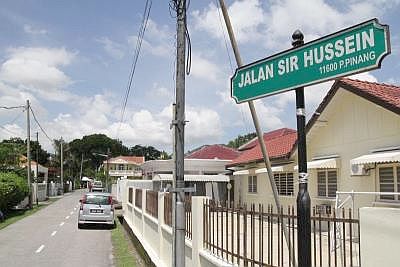
Remembered: Named after Sir Hussein Hasanally Abdoolcader who is also known as Malaya’s First Indian Knight, Jalan Sir Hussein is a quiet road off Jalan Mesjid Negeri. Remembered: Named after Sir Hussein Hasanally Abdoolcader who is also known as Malaya’s First Indian Knight, Jalan Sir Hussein is a quiet road off Jalan Mesjid Negeri.

Jalan Sir Hussein

IT IS one of the least known roads in Penang. After all, it is just a minor road, hidden from the busy Jalan Mesjid Negeri and further blocked from public view by several bungalows and government quarters.

But there are plenty of stories behind Jalan Sir Hussein, which is named after Sir Hussein Hasanally Abdoolcader, a prominent Penang lawyer in the early 20th century.

Before I go further, I would like to relate a most recent incident which prompted me to write about this particular road.
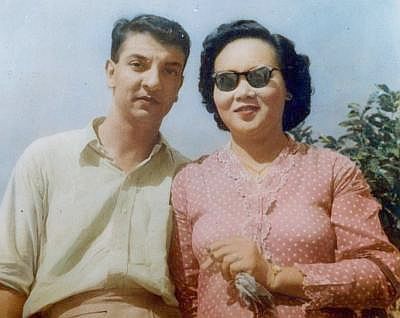
Lovebirds : Eusoffe and Haseenah in their younger days Lovebirds : Eusoffe and Haseenah in their younger days

I was in Kota Kinabalu last week and stayed at the Sutera Harbour Hotel. I met up with the food and beverage director, who introduced himself as Salim.

When I told him that Penang is my hometown and that I work in The Star, he got very excited.

In his very fluent Hokkien, he told me that he has been following MyStory and I should write about his grandfather’s road.

I looked a bit startled and he reiterated that the small road named Jalan Sir Hussein is named after his grandfather.

“I can really say it is my grandfather’s road,” he said.

We had a good time after that as he shared with me the stories of the Abdoolcaders, giving me personal anecdotes of the legendary family.

Sir Hussein was born in historic town of Surat, India in 1890. He was brought up in Malaya, where he received his early education at both the Raffles Institution in Singapore and the Penang Free School in Penang.

He went on to read law in Cambridge and soon returned to Penang to become a prominent lawyer, a community leader and politician.

Hussein was a member of the Straits Settlements Legislative Council and a member of the Advisory Council to the Governor of the Malayan Union.
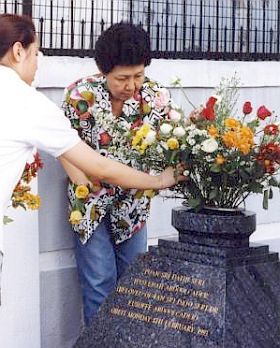
Saying goodbye: Haseenah’s granddaughter Christina (left) and daughter Julie placing flowers on her grave on the third anniversary of her death. Saying goodbye: Haseenah’s granddaughter Christina (left) and daughter Julie placing flowers on her grave on the third anniversary of her death.

He held positions in various organisations, including the Association for the Prevention of Cruelty to Animals and the Mohammedan Football Association of Malaya.

Historian Tan Sri Khoo Kay Kim, in an article about the Indian Muslims, wrote that the Abdoolcaders were one of the most prominent families in the state. Others included the Ghulams and the Ghows, while in Singapore, they included the Munshis.

Their strong presence matched that of the Arab clans which included names like Alsagoff in Singapore and Hashim, Merican and Ariff, all prominent Jawi Peranakan families in Penang.

Hussein also made a name for himself in the Straits Settlement as the first Malaya Indian to be knighted by King George VI in 1948.

While the present generation of Malaysians, including those in their 50s and 60s, are unlikely to have met Hussein in real life, many would have come across, or at least, read about his son — the late Tan Sri Eusoffe Abdoolcader.

There is a book written on the legacy of the Abdoolcaders entitled Malaya’s Forgotten Sons: The Abdoolcaders of Hindostan in Malaya.

Like his father, Eusoffe also went to London to read law, graduating with a first class honours, before returning to Malaya to practise for 24 years before he was appointed as a judge. Salim, the Abdoolcader I met in Kota Kinabalu, is a nephew of the judge.

A former president of the Malaysian Bar, Hendon Mohamed, wrote: “The late Tan Sri Eusoff lived up to all that he promised. His years as a Judge brought an added, indeed glorious, dimension to the judicial pronouncements of the Court. His judgments were often hailed as literary works, his mastery of the English language, and of Latin, enhancing his deep but clear, lucid reasoning, no matter how complex the issues litigated before him. His life was one complete and total commitment to the law.”

As a reporter, who occasionally had to attend court hearings, I had the opportunity to follow some of cases presided over by Eusoffe.

Like everyone else, both lawyers and reporters, we were awed by his brilliance and intellectual prowess. But it was the aura behind the man that made him larger than life.

We are talking about an era when lawyers and judges still wore the horse-haired wigs and they all spoke impeccable English.

I can safely say these lawyers and reporters were terrified of Eusoffe as he would openly admonish anyone who failed to perform their duties.

In the case of reporters, anyone who did not report accurately the proceedings of the court would have to face his wrath.

The errant reporters, cringing in embarrassment, would be asked to stand up in open court and given a lecture in front of everyone.

In the case of lawyers, if they did not prepare their cases properly, “we would be chewed up alive by Eusoffe” as one lawyer recalled.

But there was a sad ending to his life and career. He is best-known as one of the five senior judge who were suspended in the 1988 judicial crisis as they crossed swords with then prime minister Tun Dr Mahathir Mohamad.

To many, their suspension was seen as an end to Malaysia’s judicial independence although supporters of Dr Mahathir claimed they were not impartial in the first place.

In 2008, in what was seen as a step to heal the wounds, then PM Tun Abdullah Ahmad Badawi announced an ex-gratia goodwill payment to those judges suspended or sacked during the crisis.

Sadly, Eusoffe was no longer alive. In 1996, he committed suicide, apparently because he was profoundly depressed following the death of his dear Chinese wife, Haseenah in 1993.

Many of us would recall that Eusoffe used to place full-page advertisements in newspapers dedicating love poems, often in Latin, to his beloved wife.

But there is another well-known Abdoolcader — in this case, the infamous Siroj Hussein Abdoolcader, the late judge’s brother.

Like Eusoffe, he was sent to London to read law but Siroj ended up being arrested by the British for spying for the Russians, supposedly providing details of vehicles used by diplomats.

Siroj, who was working as a clerk at the Greater London Council, was accused of leaving messages at a tombstone in Portsmouth, England, for a Russian.

Siroj was jailed for three years and is said to be the first Malaysian to be jailed for espionage.

When Penangites pass by the minor road, they should take a second look at the road sign because Sir Hussein was certainly a major character in the history of Penang and the country.

Readers write

YOUR article on Pulau Jerejak revived memories of my working days there. Allow me to add a few interesting points. Although the inmates were of dubious background, I must stay they were generally a well-disciplined lot and followed the rehabilitative programme with much enthusiasm.

Tan Sri Ong Ka Ting made an official visit to the centre during my tenure there, when he was then the parliamentary secretary with the Home Ministry.

Volunteers from various religious bodies came passionately week after week to ensure inmates receive spiritual guidance. In hindsight, I wish to thank them for their valuable and often unnoticed contribution in this area.

The black dot of its penal history occured on Jan 5 and 6, 1982 when the inmates went on a rampage and burnt several dormitories. But, the riot was successfully quelled with the quick help from the police.

The centre was closed sometime in early 1992 when the inmates were transferred to Batu Gajah and Simpang Renggam Detention Centres to make way for tourism.

It is regretted that in their haste to develop Pulau Jerejak as a tourist resort, they neglected to preserve a portion of the said penal colony for future posterity. Hence, Malaysia has lost an important chapter of its penal history.

Donald Wee May Keun
P. P. A. Pulau Jerejak director
(January 1989 – December 1991)

Unifying Gimmick

Comedian-singer Hilmi Gimmick is able to bring the message of unity, love and peace in one evening more effectively than what our politicians can do in their lifetime.

HE calls himself by the stage name Hilmi Gimmick and while he is not a household name, he is a familiar face in the Klang Valley entertainment circuit.

Whether it is at a fund-raising concert or a dinner performance, this comedian-singer sure can hold his crowd, and has them cheering for more.

Now, what has made this entertainer so outstanding is that he is able to bring the message of unity, love and peace in one evening more effectively than what our politicians can do in their lifetime.

While racist talk, threats, rumour-mongering and outrageous claims seem to be dominating our political scene, here is someone who assures us that among us, ordinary Malaysians, there is still hope.

Hilmi was the main entertainer at the fund-raising dinner of the Emmanuel Methodist Church at the Yuk Chai school in Petaling Jaya last week. Although he is a Muslim, he told the audience that he has no problem performing at a church event.

Turning to the cameraman, he jokingly challenged him to upload the clips on YouTube, as he loudly proclaimed that those who make racist remarks should have their heads examined.

He certainly struck a chord among us when he said it was more important to think and do good. A good heart, he declared, is what matters the most.

Comedian-singer Hilmi Gimmick is able to bring the message of unity, love and peace in one evening more effectively than what our politicians can do in their lifetime. Comedian-singer Hilmi Gimmick is able to bring the message of unity, love and peace in one evening more effectively than what our politicians can do in their lifetime.

The 52-year-old, who hails from Kampung Datuk Keramat, Kuala Lumpur, always kicks off his performance with the popular Cantonese song, Friends, made popular by Hong Kong singer Alan Tam.

Hilmi’s pronunciation isn’t perfect but it’s about 60% accurate. Certainly he can put many of the Penangites who still struggle with speaking Cantonese in Kuala Lumpur to shame. His voice isn’t exactly Akademi Fantasia standard but it isn’t bad. His strong point isn’t his singing prowess but his ability to bring the house down.

He told his audience that Malay­sians, regardless of race, are all pang yeow, or friends in Cantonese, and that they should disregard all the disruptive noises from the politicians.

Later on, he donned a Chinese costume, very much like Justice Pao, complete with head gear, to sing the popular Cantonese folk song, On The General’s Order, which has been adopted as the theme for the movies on Wong Fei Hong, the legendary kung fu master.

Captivated by his rendition of the classic Chinese song and mesmerised by the striking red flowing gown, the surprised audience was told that they should not look so stunned.

And he had all of us in stitches when he said, “From the head to my abdomen, I am a Chinese but from my pants downwards, I am a Malay. But I don’t think there is a need for me to prove that to you.”

Walking from table to table, he held the hands of the elderly, addressing them as “ah pa and ah ma” (father and mother) – as he extolled the importance of filial piety to his listeners, telling that such values cut across all racial lines.

It was at this point that one wondered why such an inspiring approach to life is not present in many of our lives. Instead, we have allowed divisive and pointless political talk, which only serves the selfish interest of the politicians, to take control.

As part of his repertoire, he next appeared on the stage impersonating Datuk David Arumugam, complete with a fake Afro and beard, and he kept saying “terima kasih” in the manner the Alleycats lead singer is famous for. And the audience joined in.

Saying thanks with a sincere heart certainly beats all the terima kasih tiruan that politicians dish out every so often, especially when they want your vote.

From the popular Malay tunes of the Penang pop group, Hilmi then switched to a combination of Tamil and Hindi songs.

And he brought Bollywood to the hall when he invited a female member of the audience to join him in a sing-and-dance routine. The Chinese girl was asked to put on a shawl to partially hide her face, in a modest way, “but not to the point of looking like a Taliban”.

Well, Hilmi may be regarded as merely a singer and comedian but, seriously, having followed many of his shows, which are actually repeated acts to me, I have found him to be consistent and, more important, he is genuinely comfortable in a multiracial gathering. He interacts with his audience well and his repertoire of songs has endeared him to his audience.

If only our politicians could emulate half of what he has done, maybe we wouldn’t be laughing so much at their political antics.

Malaysians want to hear more stories of unity after a bruising general election. It is time to heal and not to hurt further. It is time to show reconciliation, not retribution.

It’s worth talking about

TO MANY Penangites living on the island, Penang simply means the island. The sad truth is that many islanders lose their way when they are on the mainland.

This writer pleads guilty to such ignorance. But we must acknowledge that the mainland is very much part of Penang state.

I have been reminded by several readers of this column that I need to write about the names of streets on the mainland, too.

Butterworth, the main town of Seberang Prai or previously known as Province Wellesley, is named after William John Butterworth. He was the Governor of the Straits Settlements based in Singapore from 1843 to 1855.

Butterworth was set up in the mid-19th century as a landing point across the channel from George Town.

The scene back then would probably be of boats and sampan criss-crossing the sea.

In 1920, the ferry service was started. The Penang ferry is the oldest ferry service in the country and some Penangites who have moved on to stay in other states, especially in the Klang Valley, will still say that it is more meaningful and nostalgic to enter the island by ferry.

The ferry rides across the north channel back then were quite an experience. The waters were clearer and we could see fishes and jellyfish swimming by. On lucky days, we would be able to spot dolphins or even flying fish above the water, which created great excitement.

Long before the Penang Bridge was built, taking the ferry was the only option.

Come the festive periods, the long queues that built up were a real test of one’s patience.

After all, there was a limit on the number of cars that could be ferried across on each ferry.

Butterworth was a major transit point and transportation hub. Although express buses can now head into the island using the bridge, it was here at the very busy bus terminal that the Penangites would catch a bus to go to other states.

And of course, from the ferry terminal is a direct link to the iconic railway station, where we go to board the train.

When Penang was a free port, Butterworth was, by extension, an extremely busy place. The free port status was revoked in 1969 by the Federal Government after Penang was lost to then opposition Gerakan.

Cars leaving Penang for the mainland had to be inspected by the Customs at the checkpoint near the pier to ensure no one was carrying duty-free goods.

To the local Malays, Butterworth was always referred to as bagan or jetty. It is still called by that name and the parliamentary constituency held by Penang Chief Minister Lim Guan Eng has rightfully retained the name.

Butterworth also gained regional prominence when it was home to the Royal Australian Air Force base.

While Seberang Prai or just Prai it is better known to Penangites, the older generation still remembers the mainland as Province Wellesley.

It was named after Richard Wellesley, the Governor of Madras and Governor General of Bengal in India.

A distinguished character, he was also an Anglo-Irish Member of Parliament, but some reports had it as he would not hesitate to use force and annexation to enlarge the British Empire.

In Penang, there is a primary school named after Wellesley at Jalan Sultan Ahmad Shah, formerly called Northam Road.

While the Wellesley Primary School does not enjoy the kind of prestige that other premier schools in Penang have, it is interesting to note that during the early days, the school was one of the main feeder schools for the well-known Penang Free School.

More interestingly, the school had a reputation then for its many Eurasian teachers, who were most certainly proficient in the English language.

According to Eustace A. Nonis, the Eurasian teachers included names such as Tony Foley, Barbara Robles, Glen Johnson and Alexander Nonis.

Nonis, a retired economist and a prominent member of the Eurasian community, wrote that his father later went on to become the headmaster of the Ayer Itam English School and then, Glugor English School.

The Wellesley school surely has one of the best colonial styles in the state.

The state registration department used to be located in the building next to the school.

It was there on Feb 14, 1990, that I officially registered my marriage. By a twist of faith, it was witnessed by the registrar, Michael Ng, who was my mate at Universiti Kebangsaan Malaysia.

It was a day of joy for me and my wife, but it also was a fiasco of sorts. I turned up with a camera but forgot the film! The special occasion was never recorded.

Those were the days before the digital cameras and smartphones with built-in cameras that could easily capture such precious moments as photographs and video clips.

Prai has today continued to be the gateway to the northern states of Kedah and Perlis, keeping its standing as a transportation hub.

But I wish more efforts are made to educate, rather than to simply remind Penangites, of who Butterworth is, at least.

Wellesley is not much used by Penangites and for the younger Penangites, Province Wellesley would not even ring a bell.

But the various Penang groups, which still continue to preserve our heritage, must find ways to keep the streets of Penang, on the island or on the mainland, alive by telling the stories behind the names of these roads.

Bring back English schools

It is unhealthy for race relations when the student population in Chinese schools is 99.9% Chinese, Tamil schools is 100% Indian and national schools, dubbed Malay schools, is 80% to 90% Malay.

SERIOUSLY, the government should allow the use of English as a medium of instruction in schools again. If there are Chinese and Tamil primary schools alongside national schools, there is no reason for Malaysians not to have other options.

At present, the other option for better English proficiency is in private schools, which allocate more time for the teaching of English despite following the national school syllabus. However, it is an expensive option that only a few can afford.

Why should the right of Malaysians to study in English-medium schools be enjoyed only by those who can afford to study at international schools?

There are many good reasons for English-medium schools to be reintroduced, chief of which must surely be the language’s neutral status whereby no one can claim ownership to it.

Older Malaysians who went to English-medium schools can testify that it was in such an environment that they made many friends of all ethnic backgrounds.

The English schools, as they were popularly referred to, were neutral grounds and were real cultural melting pots.

Friendship cultivated at primary school level among Malaysians of different races and religions would always be strong and deep. Our current primary school system basically does not provide such opportunities for our young ones to mix.

We do get to mix with one another later on in life, but working relationships that are untested or superficial are not true friendships.

Older Malaysians can narrate long stories of how they used to sleep over at their friends’ homes, eating with their friends’ families and parents of their friends treating them like their own children. These friendships continued even after they went to university, entered working life, and got married.

These are the kinds of friends who would be part of the wedding entourage, either on the side of the bride or bridegroom.

I am now 52 years old. I believe I was among the last batch of Malaysians who had the privilege of being taught in English.

While some may dismiss what I have said as elitist or an attempt to glorify English at the expense of the national language, let me set the record straight. In Form 6, I opted to study Malay Literature and sat for the exam in Upper Six, which was then called Higher School Certificate and is the equivalent of the STPM today. It was also the entrance exam into local universities. I also studied Islamic History.

During my first year at Universiti Kebangsaan Malaysia, I also chose Malay Letters as one of my three majors. At UKM, it is also compulsory to pass the Islamic Civilisation course, which was a basic course on Islam. I have also amassed a huge collection of books on Islam in my private library, and the works of Malay artists like Yusuf Ghani and Ismail Latiff continue to inspire me.

I dare say many of our politicians and leaders of so-called non-governmental organisations, who loudly make statements with racial overtones, do not even have such credentials.

But the point I am making is that more and more Chinese parents are sending their children to Chinese primary schools because they believe the standard of teaching and discipline in these schools is better. For the same reason, the number of Malay students at such schools has also increased.

But most Malay parents send their children to national schools where they form the bulk of the student population. Over the years, the national schools have been seen by many Chinese as becoming more religious in nature.

It’s a Catch 22 situation. If the Chinese are shunning national schools, then the students in these schools would be predominantly Malay.

The Federal Constitution guarantees the position of Chinese and Tamil schools. No politician, whether in Barisan Nasional or Pakatan Rakyat, would dare to make any statement against these vernacular schools.

But the reality is that it is unhealthy when the student population in Chinese schools is 99.9% Chinese, Tamil schools is 100% Indian and national schools, dubbed Malay schools, is 80% to 90% Malay!

It is meaningless to talk about 1Malaysia when our children have no friends of other races in their formative years! Many Malaysians in their 30s and 40s now are already in this situation.

Just ask Malaysians at random how many real friends of other races, not colleagues, customers or bosses, they have. Be honest.

Is it any wonder then that the Malays are incredulous when they see Chinese Malaysians who can’t speak Bahasa Malaysia well or even refuse to speak Bahasa among themselves?

The Chinese, on the other hand, still wonder why some Malay quarters continue to ask what else the Chinese want when they find that some policies are working against them and make them feel discriminated.

This is happening because race relations have taken a beating. The various races are not talking or trying to understand one another. Each side only sees its own viewpoint without appreciating that in a complex and plural society like ours, no one group can have its way completely.

We have churned out bigots in our schools. It also doesn’t help that the various races are only watching channels in their own languages on Astro. The only time they probably watch the same channel is when an English Premier League football match is on.

If we are serious about restoring the standard of English in schools and improving race relations in this country, bring back the English-medium schools. Let Malaysians choose.

Jerejak — the forgotten isle

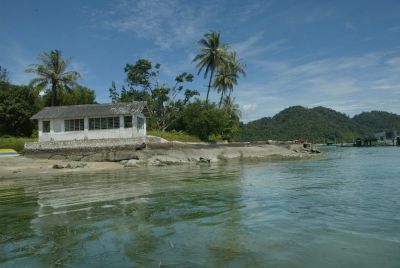
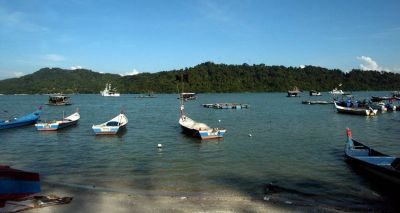
Many tales to tell: Despite its potential today, Jerejak is viewed by many as simply an island where people were once sent to because they were either lepers or hardened criminals. Many tales to tell: Despite its potential today, Jerejak is viewed by many as simply an island where people were once sent to because they were either lepers or hardened criminals.

IT IS an island that is just a short ferry hop away. Along the promenade fronting the very busy Queensbay Mall — flanked by the Penang Bridge to the left and the almost completed Second Bridge to the right — one can practically reach out and touch the island.

Almost every Penangite is aware of Pulau Jerejak but among the older generations, it is spoken about in whispers. Even among the young, few can find good reason to go over to the island, even though there is now a recreactional and spa facility there.

One can imagine how the Singaporeans might look at this 362ha island and transform it into another Sentosa island. But for Penangites, perhaps the stigma associated with the island still remains strong after all these years.

Many of us still associate Jerejak with the leper colony and later on, as a detention centre. It is simply viewed as an island where people were sent away to be out of sight, and out of mind, either because they were lepers or because they were hardened criminals.

Construction of the leper colony started in 1868 and the centre was opened in 1871. The patients came from the Straits Settlements but in the 1960s, the centre was closed down.

I came across an interesting account of Jerejak, once named the Leper Island, by George Bilainkin, the British editor of The Straits Echo.

He recalled “the sound of the Tamil lepers’ band” when he arrived to witness the consecration of a Hindu temple for the islanders there.

It must be understood that leprosy was a much dreaded disease at that time and due to a lack of understanding, the patients were treated as “outcasts”. We still recall stories of how the lepers had to wear bells so that the people could hear them coming and move aside.

A short ferry hop away: Pulau Jerejak seen from the Bayan Lepas coastal road. A short ferry hop away: Pulau Jerejak seen from the Bayan Lepas coastal road.

Today, of course, we know that leprosy is not a contagious disease and cannot spread through contact.

But at that time, all leprosy patients were literally isolated and kept away from society, with little forgiveness and understanding from the public.

“Much could be said, of course, of the revolting side of the affliction, consisting as it does of the putrefaction of the extremities. It affects the head, hands and all parts of the body. If the disease is caught in the early stages, the treatment may bring about a cure,” wrote Bilainkin.

But what caught his attention were an English woman and her Australian husband who had dedicated their life to care for the lepers.

When Bilainkin met the couple, they spoke of having to chase away snakes which often entered their compound, including “one that measured 16 feet”.

They had lived in Malaya for 10 years then and even though work had kept them busy, loneliness crept into their life, according to Bilainkin in his book, Hail Penang!

The leprosarium was closed in 1960s and the inmates were transferred to the Sungai Buloh Leper Settlement/Leprosarium. This has also closed down and today, people go to that part of Sungai Buloh mainly to buy plants and other nursery items.

But after the lepers left the island, the sad story continued with the opening of the Jerejak Rehabilitation Centre as a maximum security prison, earning the island the moniker, the Alcatraz of Penang.

The prison was only closed in August 1993.

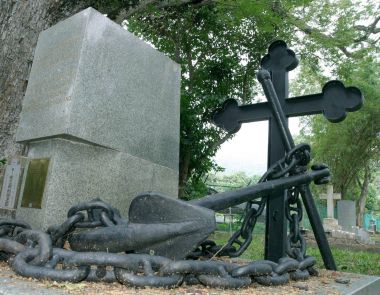
In remembr ance: The monument for the Russian sailors, who died when their cruiser ‘Zhemchug’ was sunk by the Germans in the Battle of Penang, at the Western Road Christian cemetary. In remembr ance: The monument for the Russian sailors, who died when their cruiser ‘Zhemchug’ was sunk by the Germans in the Battle of Penang, at the Western Road Christian cemetary.

Because it was a penal island, security was tight and entry was forbidden except on special grounds. Which is why I am thankful to lawyer Karpal Singh for bringing me along to visit Pulau Jerejak.

I had joined The Star office in Pitt Street, Penang then and was covering Karpal both as a lawyer and politician.

One day, I told him that I had never visited the island. He offered me an opportunity to visit the place on condition that I carry his bags, posing as an assistant from his legal firm.

Interestingly, the boat that was to ferry us across broke down and we had to use another boat, loaded with watermelons, for the inmates of the centre.

In the boat were a few inmates, who happily cut the fruits and offered them to us as we travelled to the island.

On the island, we had to wait at the visitors section, where inmates could meet their relatives or lawyers. We later adjourned to an office — and there I saw what must be the most perfect office administrator.

Each time, the officer stood up and walked off, the inmate would push the seat in. He would carry out this task without stop, like a robot, in a mechanical fashion but always with a smile on his face.

But like the infamous Alcatraz of San Francisco, Jerejak also had its list of attempted escapes. Until its closure in 1993, there were seven inmates who reportedly escaped.

In the racial riots of May 13, 1969, those who were caught taking part were arrested and detained in Jerejak.

But I do wish I could come up with some stories about the island that would bring smiles to readers.

Much earlier on, Jerejak was the scene of a fierce sea battle between the Russians and the Germans in what is dubbed as the Battle of Penang on Oct 28, 1914.

A memorial was built on the island for two crew members of the Imperial Russian Navy who died when their cruiser Zhemchug was sunk by the cruiser SMS Emden belonging to the Germans. There is also a monument for the Russian sailors in the Western Road Christian cemetery.

Just outside the Penang Museum is an anchor which belonged to the French destroyer Mousquet, which stands as a memorial to the dramatic sea battle.

Not many Penangites, including the older ones, are aware of the sea battle which saw the Mousquet sinking off Muka Head after being attacked by the Germans.

There is no mention of this historic event in our history schools, at primary and secondary level, and nor did I learn about this as a history student in university.

It was only much later, as a working adult with a great interest in the history of Penang, that I picked up details of this historic event.

The Battle of Penang, written by J.R. Robertson, is certainly one of the best works available.

The book offers a detailed story of how the global imperial forces of Russian, French and German warships fought each other in Penang in 1914.

Jerejak has so many stories to tell. They may not be happy tales but Penangites must know more about this island.

It was also reportedly Captain Francis Light’s first stop before he landed on Penang island proper. That itself is a story worth exploring.

A welcome break

While some politicians are still indulging in racial remarks, young Malaysians were celebrating their icon Datuk Sudirman Haji Arshad at the preview of ‘Chow Kit Road! Chow Kit Road! The Musical’.

I ATTENDED the preview of Chow Kit Road! Chow Kit Road! The Musical on Thursday. It was such a refreshing change after the prolonged and practically endless talk of late about politics.

Compared with the heated, and sometimes destructive, political discussions that tear people apart, this musical will do the opposite and bring people together. One could definitely feel the positive vibes generated at Istana Budaya where the show will run until May 26.

While some politicians are still indulging in racial remarks, young Malaysians were celebrating their icon Datuk Sudirman Haji Arshad at the preview.

It was really an eye-opener because most of the performers and reporters present probably were not even born when Sudirman was at the height of his popularity.

But they have read about, as well as heard and watched the pint-sized singer on YouTube, and they are mesmerised by him, as we older Malaysians had been in our time.

That was the magic of Sudirman – he could bring Malaysians of all races together. He didn’t need to make a speech. All he did was sing and that was enough.

His songs, now classics, were all in Malay but every Malaysian regardless of their ethnic background could identify with them.

Thanks to the efforts of a group of talented Malaysians, we are now able to re-live our memories of this singer.

The musical is written by Amry Ruhaiyat and Saw Teong Him, and Jamie Wilson of Akash is the music director. The hugely talented Saw, as we all know, is the famed director of the movie Puteri Gunung Ledang.

The Penang-born filmmaker also directed the musical Hoore! Hoore!, a film that was also based on the songs of Sudirman, last year.

Chow Kit Road! producer is Sabera Shaik, founder of the Masakini Theatre Company.

It has been an expensive journey for the people who produced this musical simply for the love of theatre. The production cost alone is RM1mil and they are doing this without any support from corporate sponsors.

The timing, from a fundraising point of view, could not have been worse. Yes, the general election is over and the musical may be a welcome break after the exhausting campaign period. But I doubt the corporate sector is in the mood to listen to the producers’ pleas for financial support.

The feel-good musical features 20 of Sudirman’s songs, including Pesta Dunia, Basikal Tua, Milik Siapakah Gadis Ini and Langit Petang.

The story revolves around the life of a brash, jobless young man named Ilham, played by Anding Indrawani (Akademi Fantasia alum and actor), who grew up in the notorious neighbourhood of Chow Kit in Kuala Lumpur. He becomes involved in a bet where a snobbish socialite is challenged to turn him into a gentleman.

Three mak Datins have thrown each other a challenge – if Datin Jamilah (Adibah Noor) manages to transform Ilham into a well-mannered youth with a proper job, they will fork out the money to build a community centre in Chow Kit.

She is successful but in the process, her daughter Maya (Nadia Aqilah) falls in love with Ilham, much to Jamilah’s chagrin.

But I wouldn’t want to spoil your interest by revealing how the story ends.

I believe all Malaysians should support this show, so bring the whole family to watch with you. If you found time to listen to political ceramah and donated to political causes, whether at the ceramah or directly to the parties, it’s time to lend your support to the arts.

The artistes, through musicals like this one, have succeeded where politicians have failed in bringing joy, inspiration and greater meaning to our lives,

There’s also a personal interest here: Saw is a former schoolmate of mine at St Xavier’s Institution and Adibah is a colleague at Suria FM, a radio station under the The Star Media Group.

Incidentally, the opening day this month of Chow Kit Road! Chow Kit Road! almost coincides with the date of the late Sudirman’s legendary concert in Chow Kit Road on April 14, 1986.

A cosmopolitan city since its early days

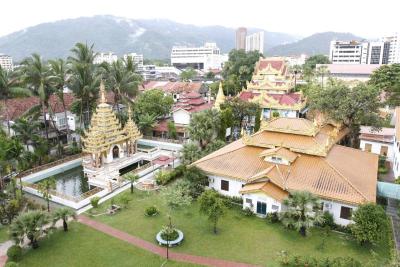
Long-standing: The Dhammikarama Burmese Buddhist Temple was founded in 1803, making it a prized historical site. Long-standing: The Dhammikarama Burmese Buddhist Temple was founded in 1803, making it a prized historical site.

AT 3.7km, Burmah Road is one of the longest roads in Penang, and surely one of the best-known routes on the island.

It begins at the junction of Penang Road and runs north-easterly towards the coastal road, until the junctions of Gottlieb Road, Bagan Jermal Road and Mount Erskine Road.

It is also one of the earliest roads, cutting through plantations and Burmese villages which surrounded the Pulau Tikus area in the old days.

One of the landmarks along Burmah Road is the 210-year-old Dhammikarama Burmese Buddhist Temple, which is the first of its kind in Malaysia.

The iconic temple, which is actually in Burmah Lane, a sideroad, provides historical evidence of the Burmese enclave in Penang.

Interestingly enough, another famous temple in the same area, but of Thai origin, is the Reclining Buddha Temple (Wat Chayamang-kalaram) famed for its 33m-long reclining Buddha statue.

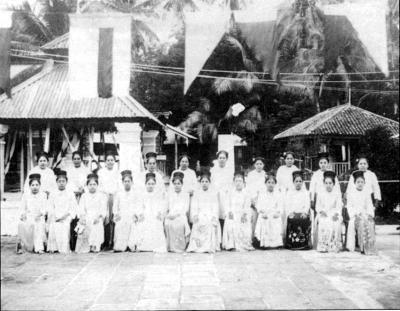
Early faces: The “Cheroot ladies” in 1930s. A large number of Malaysian Burmese are descendants of the ‘’Cheroot ladies’’ — the 300 Burmese female workers who were brought to Malaya in the 1890s to work in the cigar factories of Burmese Chinese Sin Yew Kyong. Early faces: The “Cheroot ladies” in 1930s. A large number of Malaysian Burmese are descendants of the ‘’Cheroot ladies’’ — the 300 Burmese female workers who were brought to Malaya in the 1890s to work in the cigar factories of Burmese Chinese Sin Yew Kyong.

Another iconic building, which is relevant to me, is the Wesley Methodist Church — the oldest Methodist Church in Malaysia, situated right at the junction of Burmah Road and Larut Road.

The Burmese presence, under the British, is still evident in Penang. Besides Burmah Road, there is Rangoon Road, which is off Burmah Road.

Burmah Road was spelt with an “h” instead of simply Burma Road because of the somewhat unusual British spelling of the early days.

Rangoon is simply the old name of Yangon, the former capital of Myanmar. Although the capital has been shifted to Naypyidaw, Yangon continues to be regarded as a main city. Naypyidaw remains much an administrative town, just like Putrajaya.

Mandalay Road, of course, is named after the second largest city and the last royal capital of Burma.

It is also known as the economic hub of Upper Myanmar and considered the cultural centre.

It is regarded as one of the best tourist spots, particularly those looking for gemstones.

Irrawaddi Road is named after the Irrawaddy River and the Irrawady Delta, where Myanmar’s rice-growing delta is located.

Then there is Tavoy Road — which is actually a reference to the Dawei, an ethnic group found in the Taninthary Region, about 600km away from Yangon.

Tavoy Road is a minor road off Burmah Road and it connects to Irrawaddi Road.

Situated right at the junction of Tavoy Road is the Seventh Day Adventist Church.

Facing the junction is the Penang Union Primary School, where the famed Penang banana pancake or apom is sold.

There are two push-carts sellers operating here — Ah Chooi and Ah Guan — and they are located about 20m away from each other.

They are actually siblings but the irony is that they do not talk to each other, at least not in public.

Ah Guan seems the more popular of the two, probably because of his public relations skills although many Penangites say their apom taste about the same.

He used to sell pisang goreng (banana fritters) in Jalan Air Itam Road, near the Jalan Kampung Melayu-Boundary Road junction, until his doctor told him that he should stop his trade if he wished to live longer.

Salween Road, meanwhile, is named after the mighty Salween River that flows through China, Myanmar and Thailand. It is one of the longest free-flowing rivers in the world.

Salween Road is home to a leafy residential area with many double-storey houses built in the 20th century and the road connects Irrawaddi Road and Arratoon Road.

Moulmein Road is named after Mawlamyine or Moulmein, the third largest city of Myanmar.

There is also Moulmein Close or Lengkok Moulmein, located opposite the Pulau Tikus police station.

The Swee Kong coffeeshop located at the road junction, serves decent Penang hawker fare.

Today, the Myanmar people are part of our foreign workforce and there are also those who are here as sojourners pending their attainment of refugee status to move on to recipient countries.

But not many are seen around the Burmah Road area, unlike in the early days when they were a common sight at the Weld Quay area, landing with goods at the shore, near the jetties.

They were easily distinguished from the other seamen because of the sarongs they wore and the language they speak.

Waiting for the bus at Weld Quay to take me home, we would often rush to the jetty just to catch a glimpse of these boats from Myanmar.

One of the best parts of growing up in Penang was the cosmopolitan nature of the state as a port. We were exposed to foreign culture and foreigners at a very early age.

From the American marines who stopped by George Town for their rest and recreation during the Vietnam War in the 1960s to the flower children or hippies who set up communes in Batu Feringghi, to the huge ships from India and the boats from Myanmar, it made growing up so much more exciting and interesting.

If The Lady, Aung San Suu Kyi, makes a trip to Malaysia, our diplomats should ensure that this enclave is part of her tour. She will surely feel very much at home.

GE13: Caught up in the frenzy

Over the past two weeks, perfectly rational people appear to have lost their sense of logic and are unable to differentiate between rumours and the truth.

THE general election this time has been fiercely fought with both Barisan Nasional and Pakatan Rakyat predicting victory.

Datuk Seri Najib Tun Razak has said his coalition will retain power at the federal level, with Selangor and Kedah possibly returning to Barisan. Meanwhile, his opponent Datuk Seri Anwar Ibrahim is already talking of declaring Monday a holiday after Pakatan’s victory.

Talk to Barisan leaders and the prediction is a victory of 130-138. The more ambitious ones say it could reach 140. But no one has dared to commit themselves to a two-thirds win of 148 seats. The simple majority is 112.

Barisan seems convinced that Sabah and Sarawak remain as “safe deposits” although it has conceded that the going is tough in a few Kadazan constituencies in Sabah’s urban areas.

Pakatan leaders, on the other hand, have also said Putrajaya will be theirs. They claim that Pakatan will govern in seven states, and that a few extra seats from Sabah and Sarawak will be enough to let them win narrowly at federal level.

Supporters of both sides have been psyched up to believe that victory is theirs. And that’s the danger. Expectations are so high that anything below what they believe is theirs would be met with tremendous disappointment.

The losers on either side will find the results unacceptable and unbelievable simply because their expectations have not been fulfilled.

Over the past two weeks, perfectly rational people, including my friends, appeared to have lost their sense of logic. Caught up in the emotional frenzy of the campaign, many could not differentiate between rumours and the truth.

No one has taken the trouble to verify any information, including obvious fictitious allegations, before they happily pass it on to their friends via their Facebook and other social media platforms. And, of course, they will embellish the stories with their own comments.

Many Malaysians who talk only to friends and relatives of their own race begin to believe that these views are an accurate repre­sentation of Malaysia.

The middle-class Chinese, of whom at least 80% are likely to vote Pakatan, in particular DAP, believe that Barisan will collapse. They are sure that they are the kingmakers in this election and all they want to do is to vote Barisan out of power, period.

Unfortunately, many of us do not see the bigger picture because we do not read the news, whether mainstream or alternative, in another language. In fact, many of us choose to read newspapers or online portals that suit our political sentiments and we expect them to resonate with the overall political sentiments of the nation.

It is ironic that while The Star has been accused of being pro-Barisan by DAP, there is a pro-Barisan blogger who has dedicated herself to bashing The Star on a daily basis as she counts the number of DAP news items and pictures that appear in this newspaper!

Then there is a news portal that is 100% slanted to the opposition but its contents are regarded as the Biblical truth, objective and fair.

In the rural heartland where the bulk of seats are located and where the winner will be decided, the warfare seems to be fought in a much quieter way. Without any mega ceramah to indicate the size of their support, their preferences will only be known tonight.

Will the Malay votes swing to Pakatan this time or will they remain faithful to Barisan and thus seal in another win for Barisan?

Non-Malay voters who want to see change need to follow closely the results in these 100-odd seats out of the 222 available.

There are at least 50 constituencies covering Felda schemes. The settlers are traditionally Barisan supporters but will their children, many of whom are coming home to vote, be as well?

Talk about electoral fraud. There have been reports that foreigners are coming in from Bangladesh, Indonesia and Pakistan by the planeloads to vote here. According to these reports, some 4,500 Bangladeshis and Indonesians, as well as some China dolls, landed at KLIA on 16 flights in one day. That means 281 passengers per flight although a MAS Airbus can only take a maximum of 220 passengers.

Then there is this talk that 40,500 of the so-called foreigners have entered Malaysia in just seven days, which works out to 5,785 of them arriving per day. The figure must have included people coming in boats from Chittagong or trekking down from the Himalayas past the border, because the earlier figure was 4,500 via 16 flights.

To get 4,500, one needs 20 flights a day on an Airbus A320, and this also means KLIA and LCCT would resemble Dhaka as these groups of arrivals pass through. Even though it is mathematically mind-boggling, these reports may still whip up anger.

But emotions and anger have got the better of us, even at places of worship where these rumours and tall tales are being happily shared with the faithful.

The propaganda is convincing because an e-mail, purportedly leaked from AirAsia, telling of top officials being summoned to the Prime Minister’s Office is being reproduced on Facebook.

Yes, AirAsia is being implicated as well, besides MAS. So Tan Sri Tony Fernandes has to make sure none of his AA flights is delayed to enable these Bangladeshis to vote on time!

On Facebook, foreign workers dressed up in their uniforms have been labelled as voters while a few construction workers wearing Barisan T-shirts have also been similarly accused.

Someone has even posted a video of his Indonesian maid repeating that she “heard” her friends have been given identity cards to vote. There’s plenty of “heard’’ in the video but it has nonetheless been posted as yet another “evidence” of electoral fraud.

Malaysians on both sides must be vigilant but our foreign workers should not be unnecessarily manhandled today. Barisan believes it has enough Malay votes to retain Putrajaya and does not need foreigners.

Furthermore, a victory that involves cheating brings no honour. It is unacceptable and fair-minded Malaysians will not accept it.

When the last votes are counted tonight, we hope the winner is Malaysia. We may have grown more divided politically over the past few years but we are all growing up politically. The days when Malaysians have no political views are over.

In any growing-up process, there will be pains. Many of us are still on the rough edge, judging from the nasty and childish postings on Facebook, but we will get over that eventually.

We are now able to articulate our views. The next maturing process is to make sure we are able to look at things in a more rational, mature manner and to accept that everyone is entitled to his political choice.

That’s what democracy is about – making a choice. Democracy has many flaws and sometimes we end up making a wrong choice but it is still the best political system.

To be able to choose whether it’s the devil we know or the devil we don’t know is still the best way. We must learn to respect choices and to accept the decision of the majority of Malaysians tonight.

Godspeed and good luck, Malaysia!

Several Penang roads named after distinguished Scotsmen

Prominent feature: Angsana trees line Scotland Road and Macalister Road. Prominent feature: Angsana trees line Scotland Road and Macalister Road.

THE role of the English in Penang’s history is so well-documented it has given the impression that no one else in the United Kingdom has a role besides the English.

Well, reader Andrew Blackadder Wilson from Glasgow, Scotland, who is a frequent visitor to Penang, has written in to remind me of the contributions of the Scots in the development of Penang as well as the Straits Settle-ments.

To the Penangites, there might not be any difference between an Englishman and a Scot, but there is nationalistic pride to it!

One of the major roads in Penang is Scotland Road, which begins from the junction of Western Road and ends at the interchange with Jalan Air Itam and Green Lane, now Jalan Masjid Negeri.

There are no available reports as to why the road has been named Scotland Road. There is a likelihood that it could be connected to the nearby Penang Turf Club which was set up in 1864, where a number of prominent Scots were early members.

Logan Road may not be known to most Penangites, as it is a road off Anson Road, but James Logan was surely a big name in early Penang.

A monument, erected in 1869, in honour of this Scotsman, still stands at the grounds of the Penang court complex.

James Richardson Logan and his brother, Abraham, studied law in Edinburgh. At Duns Academy, James was a classmate of David Brown’s son — Forbes Scott Brown.

The Logan legacy: The new Penang court complex in Light Street includes the Logan Memorial. The Logan legacy: The new Penang court complex in Light Street includes the Logan Memorial.

The Logans came to the Straits Settlement around 1840 after a brief stay as planters in India, according to local historian and publisher Khoo Salma Nasution.

In Penang, James made a reputation for himself as a lawyer who dared to take up cases of injustice against non-whites, including an Indian sireh planter’s appeal against the East India Company.

It must be recognised that the powerful and influential white men in Penang then were linked to the Company. Essentially, Logan was taking on the elites in Penang.

According to Khoo, when the British tried to stop all secret societies activities, James acted as the legal adviser to the Chinese merchants, which resulted in the British giving official recognition to certain organisations and festivals.

In 1842, the Logans started their practice in Singapore as well as a newspaper, the Singapore Free Press, which Abraham also edited, from 1846 until several years before his retirement in Penang in 1868.

James was both an academician and a journalist. He founded the Journal of the Indian Archipelago and Eastern Asia in 27 volumes of which he was the writer, editor and publisher. In Penang, he took over a newspaper, the Pinang Gazette.

Because of their eloquence, legal and journalist background, the Logans were opinion shapers on the island as well as the Straits Settlements.

On the memorial, it is inscribed “He (James) was an erudite and skilful lawyer, an eminent scientific ethnologist and he has founded a literature for these settlement.”

At Beach Street, there is the Logan’s Building, a two-storey block of shops, within the core zone of the heritage site.

In one website on Penang heritage, it has been described as “one of the most charming buildings with its central arch defining a granite-paved porte-cochère, which in the old days led to a courtyard for carriages.”

For this writer — my memories of this road went back to my teenage years as a scout. The troop leader of my school scouts in St Xavier’s Institution was a chap named Lee Boon Pin, a serious and disciplined boy.

I was a patrol leader heading a team called “Bat’s Patrol” and we often congregated at this house in Logan Road, which has a big field, for our after-school scout activities.

Sometimes, all we did was just kick the ball around for fun.

Just a stone’s throw away is Vermont Road, off Macalister Road, where I would cycle to all the way from Air Itam to visit my good friend, Choong Keng Hooi.

A schoolmate since Standard One, he is today the only hairstylist I trust to cut my hair, what more with a receding hairline that needs to be carefully covered up!

One of the most recognisable roads named after a Scot must be Macalister Road. Colonel Norman Macalister was the Colonel Commander of the Artillery Detachment, who later became a Governor of Penang (1807-1811).

It is said that the present structure of Fort Cornwallis was built by convict labour in 1810 during his term as Governor. He was reportedly lost at sea, in the South China Sea, while on the ship “Ocean” back to Scotland in the same year.

Then, there is Campbell Street named after Sir George William Robert Campbell, who was acting Lieutenant governor of Penang from 1872 to 1873.

He was also Inspector-General of Police. His family roots can be traced to Roseneath, Strathclyde in Scotland.

Two roads in the Seven Streets Precinct of George Town were also named after civil servants with Scottish roots — McNair Street and Macallum Street.

McNair Street starts at the junction with Magazine Road and ends at Sandilands Road.

It was named after Major John Frederick Adolphus McNair, the acting Lieutenant Governor of Penang between 1880 and 1884. McNair, who was born in England in 1828 became an employee of the British East India Company in 1845, at the age of 17. He was posted to Madras, India, where he became fluent in Hindustani.

It is reported that in 1853, McNair was posted to Malaya, where he was stationed in Malacca and Singapore.

He was also the Superintendent of Convicts in the Straits Settlements, with responsibilities over Penang, Malacca and Singapore.

Macallum Street, or the Fifth Street (goh tiau lor to the Penang Hokkiens) was named after the engineer of the Straits Settlement between 1884 and 1889, Colonel Sir Henry McCallum.

McCallum, through his many years of service, left his legacy in other parts of the world too.

There is a Macallum Street in Singapore, Macallum City in Canada and Macallum Road in Sri Lanka.

As reader Wilson has pointed out to me, while many road names of British colonial officers have been renamed, the Scots seem to have done better — they have remained honoured!

Readers write

Patrick N: In your article, “Reliving London in Penang” (StarMetro, April 27), you stated that the immediate neighbour of the British Prime Minister at 11 Downing Street is the First Lord of the Treasury. This is incorrect. The resident at No 11 is the Chancellor of the Exchequer, equivalent to the Finance Minister. The First Lord of the Treasury is actually the official title of the Leader of the Government. Since all modern prime ministers have simultaneously been First Lord of the Treasury, 10 Downing Street has come to be identified closely with the prime minister.Other than that, the article was an enjoyable read. Keep it up.

Chun Wai: Thank you for pointing this out.

Andrew Wilson: It is always refreshing to read your articles about the history of Penang and how certain streets got their names. As a Scotsman who is often in Penang (in fact, I am here right now) I have noticed that many streets here have names with Scottish connections.The most famous and important being of course Jalan Scotland, though it seems most people still refer to it as Scotland Road. Then there are McNair Street, Logan Road, Campbell Street and Macalister Road. I have also noticed that many of the Anglo street names were changed to local names but not the Scottish ones, which gives me pause to think perhaps we were better thought of than the English as we Scots were always famous for “going native” as it was referred to as, and still is.

Chun Wai: Thank you for inspiring the article for today.

If you have queries on the streets of Penang, or want to share your own snippets, email to mystory@thestar.com.my

GE13: Felda scheme with a potent voice

Meeting the people: Liow speaking during an NGO dinner in Bentong. Meeting the people: Liow speaking during an NGO dinner in Bentong.

Lurah Bilut stands tall as the nation’s first Felda scheme, pioneered by settlers from all races from different parts of the country.

LURAH BILUT is just about 19km away from Bentong. It is a huge piece of fertile land located near Sungai Bilut and the Kelau forest reserve.

It is safe to say that most Malaysians, especially those staying in the cities, have never heard of this place and have no reason to come here.

But Lurah Bilut is not only the first Felda scheme in the country but one that was pioneered by settlers from all races after independence.

In this 12,920-acre (5,228ha) enclave, located within the Bentong parliamentary constituency, there are Malays, Chinese, Indians and the Orang Asli, and their children can go to either the national school or the national-type schools where the medium is in Chinese or Tamil.

The scheme was opened in 1957 and each settler was given 10 acres (4ha) of land. According to records, the first batch of settlers who entered the scheme on Aug 2, 1959, was from Datuk Keramat, Kuala Lumpur. They were brought into the area by bus and were shocked to find themselves in a jungle.

One Chinese settler, who arrived here in 1959 from Negri Sembilan with just his clothes on his back, was given tools to hack away at the dense growth, according to one report. There is one road here called Jalan Pulau Pinang, because the settlers came from Penang.

As with everything that is new and untested, the settlers had to be imbued with a sense of adventure. Certainly they could not foresee the success that Felda would turn out to be eventually. Thus these early settlers in Lurah Bilut came to be known as the Pioneering Bulls and have become some kind of a legend in this Felda scheme.

Felda was set up to eradicate rural poverty through the use of effective agricultural methods to cultivate cash crops such as rubber and oil palm. In recent years, there has also been special emphasis on diversification to deal with the fluctuations in commodity prices.

On my visit to this Felda scheme, it was clear that many were eager to share their experiences with me. There is a sense of pride over what has taken place here.

Strategising: Wong meeting with his team of campaigners at his service centre in Bentong. Strategising: Wong meeting with his team of campaigners at his service centre in Bentong.

I am sitting at a restaurant opposite the Lurah Bilut Chinese school where the Barisan Nasional campaigners are having their lunch break.

A vegetarian meal has been prepared for incumbent MP Datuk Seri Liow Tiong Lai and as he sat down at the table, the MCA deputy president invited those at the table to share his vegetarian dishes.

But many jokingly told him that they would take his share of meat instead, a joke which he has heard many times.

The Bentong parliamentary seat which Liow won with a 12,585 majority when he polled 51,340 votes against his PKR opponent R. Ponusamy’s 12,585 votes is regarded as a safe seat for the Barisan Nasional.

The current electorate of 62,400 voters comprise 43.9% Chinese, 44.6% Malays, 9.4% Indians, 0.5% Orang Asl and the rest, others.

Liow is expected to deliver this seat to the BN but no one is taking any chances this time because of the perception that the Chinese sentiments against the BN are very strong, even in Bentong where they have always been traditionally pro-BN.

Even the Bilut state seat, held by the MCA, is under threat from the Pakatan Rakyat. Liow has to work extra hard to campaign for 36-year-old Leong Kim Soon, who is contesting this seat. Leong’s grand uncle is the late Tan Sri Chan Siang Sun, who was the legendary MP for Bentong.

Leong, who is the political secretary to Liow, is facing DAP’s Chow Yu Hui.

In this rural setting, the two have gone from door to door, under the hot afternoon sun, to shake the hands of every voter.

Said a campaigner: “This is a crucial area as it is racially mixed and we want to cover as much ground as possible.”

Unlike the Felda schemes in Johor, especially, where Pakatan Rakyat candidates are literally chased away by the settlers, the PR workers have been able to put up their flags and banners, an indication that a fight is at hand.

In the Bentong town centre, Liow’s challenger is Wong Tack, who made a name for himself as the anti-Lynas campaigner. In his green T-shirt, Wong was raising environment issues but his credentials have taken a knock after he was exposed as the owner of a 1,000-acre (404ha) oil palm estate in Sabah.

Wong also had to fend off the revelation that he held Canadian permanent residence status, explaining that it was cancelled by the Canadian authorities because he did not go back to the country.

But the BN campaigners have been hammering on that issue, questioning why there was a need for him to collect donations at every ceramah when he is pretty well off financially.

They asked how many of the voters, especially settlers, could even dream of owning 1,000 acres of land and if they knew how much money had been collected so far.

But Wong seems undeterred by these issues, saying he was well-prepared to challenge Liow for Bentong, and also Mentri Besar Datuk Adnan Yaacob, who is contesting in the Pelangai state seat, under Bentong.

Wong’s campaigners, mostly youngsters, are visibly seen in town, especially at the market, where they aggressively tell voters to go for change.

One Universiti Malaya student said she had volunteered to canvass votes for Wong because she had been actively involved in the anti-Lynas campaign.

“My belief in him remains the same. I will still support him and the DAP, nothing will change my stand,’’ the third-year student said. She said her parents knew that she was campaigning and wholeheartedly supported her.

Her friends, many eager to express their views, said they were using their own expenses to stay in Bentong.

At the Bentong Jaya coffeeshop, the discussions focus on the sentiments of the Chinese, swayed by DAP’s talk that Pakatan Rakyat would take over the Federal Government. Only a few were cautiously warning about the implications of the Chinese voting themselves out of the government.

A businessman from Kuala Lumpur said he had been trying to explain to some Chinese voters that while their sentiments are pro-Pakatan, the majority of Malays would be backing Barisan.

“The huge crowd at DAP ceramah can be deceiving because the Malay style of campaigning, in Felda areas, is to have small get-together sessions, prayers at the suraus and house to house visits. As these are not visible, the Chinese think the huge crowd means PR would take over,” he said.

In Bentong, the local dialect is Kwong Sai, which originates from Guangxi province in southern China. As we continued with our drinks, the locals at the neighbouring tables were listening attentively.

The politicians and campaigners have been doing all the talking so far but come May 5, the voters will be doing the talking via the ballot box. The stand of the majority in Bentong would be known then.

For more election stories, please visit The Star’s GE13 site