Author Archives: wcw

Do more to combat crime

The last thing our police force would want is to have headlines of high-profile crime cases splashed across the newspapers. But perception is everything. Malaysians, especially those living in major cities, feel insecure and what is more worrisome is that women and the elderly seem to be easy targets.

The statistics show that in Selangor, there is a 19.4% drop in the crime rate since 2009 and overall, the nationwide figure dipped by 24.7%.

The Home Ministry has said the crime level fell from 211,645 cases in 2008 to 157,891 last year.

No one is spared. Even the home of former Malacca Chief Minister Tan Sri Rahim Thamby Chik was broken into recently and his gun was taken away.

More disturbing are the constant reports of women being robbed, or nearly robbed, in or outside malls in the Klang Valley.

They may be run-of-the-mill crimes but such incidents are now posted on all the social media platforms like Facebook and Twitter by the victims, complete with photographs, and they go viral in an instant. Eventually, these incidents are picked up by the newspapers and online news portals.

Crime takes place daily and police have often regarded such cases as petty crime as they deal with thousands of cases.

The police often update the media daily with more serious crime cases such as murder, abduction, drug seizures and armed robberies. When there is a shoot-out, the media is quickly alerted by their contacts. These are followed by on-the-scene reports.

In the news

Daily petty crimes such as break-ins are often relegated to the bottom but now the public have better access to reaching out to others. If in the past, victims did not even want to let their neighbours know of their misfortune, younger Malaysians want to share their experiences with the world.

Thus, when Nayati Moodliar was abducted outside his school on April 12, it was known around the world swiftly. The news was reported in his hometown in South Africa about the same time as in the Malaysian media.

Our government officials and police would surely not want to see such cases highlighted but no one should be in denial mode. Yes, there is no need to sensationalise such reports but they must certainly be published and discussed.

Politicians only want to see their own pictures in the newspapers or their state bulletins but the reality is that crime has become a hot dinner conversation topic.

There is another issue that has cropped up. Now that the Emergency Ordinance has been abolished, there is fear that former detainees are now roaming free and have gone back to their bad old ways.

Last year, more than 700 people were detained under the EO but the law has since been repealed. Although the police have justified the use of the EO to bring in criminals that they cannot charge in court due to insufficient evidence, they have also been accused of abusing the EO.

Some of these ex-EO detainees have now been blamed for the recent spike in crime although there is no real data to back this argument.

But fighting crime isn’t the job of the police alone. Bashing the Government and the cops is easy but public apathy has also been identified as one of the reasons why criminals have become more brazen in committing crimes.

There is reluctance among the public to come forward to give evidence after they lodge police reports. Not wanting to testify in courts because of the lengthy court process would not help the police and prosecution send these crooks to jail. Then there are also those who fear repercussion for their personal safety.

The police also cannot be everywhere. Mall managers, for example, cannot expect policemen to be stationed in their buildings. It is their responsibility to hire more security guards and work with the police to enhance safety.

Over the years, security has become a major concern but it is such an irony that from shopping malls to gated communities and secured neighbourhoods, the guards hired to take care of Malaysians are mostly foreigners.

Business will always look at costs when hiring but we should be equally concerned about their backgrounds and be prepared to pay more for good workers.

Pay security guards well and our employers will get Malaysians to work for them. Now, some of these foreign guards cannot even give directions to customers at malls.

And why not keep some levels of parking lots in malls for the elderly and women? Or install press alarms at every level of the parking areas. Let us see the management of malls do something concrete.
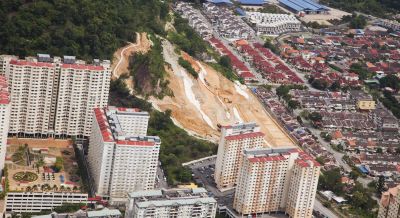

Stop rape of our beloved hills

I recently got a copy of an email that was addressed to Chief Minister Lim Guan Eng and several state executive councillors. The writer, having just read the latest issue of Buletin Mutiara, did not mince his words when he slammed the government for misleading Penangites with its front page report stating that “the hills are alive”.

He wrote: “… a view from the hilltop of Penang Hill showing green uncut foliage does not mean our other hills in Penang Island are safe.”

Balding top: Penangites are incensed over the wanton destruction of hill slopes in Penang.

He then went on to reveal that there are many patches of hills that are being cleared at this very moment.

“One of them is the township of Sungai Ara. You cannot miss it when you are passing PISA on the way to the airport, on the right. Go closer and you will be shocked at how bad the situation is.”

Overall, the content of this email clearly shows that this Penangite is very angry over the wanton destruction of hill slopes and is not amused that every time the issue is brought up, the current government keeps throwing the buck back at the previous administration.

As he puts it, “You are the current government, address and close this current issue.”

It serves no purpose to organise a climb up Penang Hill and then claim everything is fine. Seriously, with due respect, the state officials were just looking at the wrong side of the hill. It was nothing more than just a publicity stunt in the hope that the issue will go away.

Penangites care as much about their hills as their beaches, and also every social and civic issue in town. It has always been so although they may appear louder these days simply because there are more platforms and social media channels for them to shout through.

But why is it that any genuine airing of grievances, like the hill issue, is perceived as “politically motivated”?

And why is the state always going after journalists who, because of their connection to the ground, are but mere messengers in airing these concerns?

It is so convenient to blame everything on “media lynching” and to call journalists all sorts of names, including being tools of Barisan.

The DAP did well in the March 2008 political tsunami because Penangites wanted change. They were fed up of the Koh Tsu Koon government and wanted a strong leadership for the state. No one was surprised when Lim Guan Eng cruised to such a convincing victory.

But with the current term almost at the end, the DAP-led government is still singing the same old tune of claiming credit for itself when things go right and shifting blame on others when things go awry.

The writer of the email cited development in the Sungai Ara area and challenged the CM to get the state executive councillor Abdul Malik to show him around.

“Come after a heavy downpour or rain and you will see the clear streams from the hills turn RED … it’s bad,” he wrote.

“Most of us residents and rakyat here are executives in the Bayan Lepas industrial zone. We are happy and support our current government, but please bear in mind, we will not tolerate further scavenging and rape of our beloved hills. They must be preserved at all cost, kept on behalf of our children and returned to them in the future.”

Strong words indeed. But that’s how Penangites are. However, instead of understanding and listening to them, the state leaders prefer to talk down to them or, worse, label them with all sorts of names.

At the end of the day, we should all agree that there is a need for a comprehensive urban planning policy with clear focus on sustainable development. The hills are choking, and there is no need to engage in political semantics over whether a project is above or below 76m, or whether a project is deemed “special”.

Will there be more high-rise condominiums on the way, as a DAP assemblyman has revealed?

Confusion can arise when there is lack of clarity. The ordinary Penangite, without access to the files, will comment on what is apparent before his very eyes.

Listen. And listen hard to the Penangites who still care.

Pastors are mere mortals

But it would appear that religious figures are fast catching up when it comes to having their day in court. Religious establishments have increasingly found themselves in the news for the wrong reasons, from allegations of child sex abuse and corruption to leaking documents.

Closer to home, the news of Pastor Kong Hee, founder of the City Harvest Church (CHC), one of Singapore’s richest churches, being charged for allegedly siphoning off nearly S$23mil (RM57mil) has shocked many, including Malaysians.

Hee is alleged to have misused the money to support his wife’s singing career in the United States. His wife Ho Yeow Sun is also a pastor at the mega church. The non-denomination church is said to have net assets worth RM257mil in 2009, according to official estimates. It has affiliate churches in a number of countries, including 11 in Malaysia.

The investigations on the church came just after another high-profile case in 2009 when a prominent Buddhist monk was jailed for six months for misappropriating hospital funds and lying about it to the authorities.

Kong, 47, and four other church executives, who were charged with aiding him, are now out on bail. All have said they will fight to clear their names.

The Singapore authorities have stressed that the charges are against the individuals and not the church.

But the CHC leadership will need to re-evaluate themselves as there is no denying that the church with its 30,000-strong congregation has been under the scrutiny of the authorities, the media and other churches.

Kong, according to reports, lived the lifestyle of a chief executive officer rather than a pastor. According to the church website, he withdrew from City Harvest’s payroll in November 2005 and started his own business.

His emphasis on pop concert-style services seemed to work as many young professionals in the secular world flocked to his church.

It has been reported that 47.4% of its members are below 25 years of age and that the average age of the congregation is 24. The majority of the members are young professionals aged between 25 and 35 and the church endeavours to “build an ultra-modern, energetic and upwardly mobile image”. It has 25 full-time pastors and assistant pastors.

Certainly, it is no easy task for any church in this age of materialism and consumerism, especially in Singapore, to draw in the young people. So credit must be given to Kong.

But there has been mounting criticism over the last few years as the church grew. Its ultra-modern titanium-clad church complex, which includes a RM1.45mil fountain feature, was built at a cost of RM120mil. The toilets, by the church’s own admission, are said to be “the very meaning of style”.

Kong seems to have convinced his congregation that the church’s “Crossover Project”, which included supporting his wife’s singing career in Hollywood, aimed to expand Christianity in the United States and Taiwan through her secular music.

Living in a Hollywood mansion that cost RM63,390 a month to rent, she had an album produced by famed rapper-producer Wyclef Jean and reportedly won some awards. In an entertainment city where money can buy anything, such achievements have been questioned by the cynics.

She has appeared in videos wearing sexy outfits gyrating to rap music and, in one video, even stripped down to her bikini. It is debatable how these videos would convince the secular to find God and flock to churches.

But it would appear, from reports in The Straits Times and based on comments posted on Facebook, that many of the members are prepared to give Kong the benefit of the doubt and are standing by him.

Although we should allow the trial to take its course and wait for the verdict, it is clear that in the court of public opinion, the people view politicians and government officials in a totally different light from religious figures. Caught in a similar situation, most people would have found the former guilty from day one, but not the religious figures.

Many are reluctant to accept that religious figures are also mere mortals. They can put on their religious garb but they are still sinful human beings with their own frailties. In some cases, they come across as just plain greedy and selfish.

In the worst category are those religious figures who interpret the holy books to justify their political ambitions in the name of God. Many of the faithful are caught in a dilemma when they assume that disagreeing with these human beings means questioning God. Nothing could be more wrong.

The faithful should stand firm in their belief in God, but they must not be afraid to question or even challenge their religious leaders if they are wrong.

Not music to their ears

But the protest that took place on Friday certainly went too far. The group calling itself Pancasila Youth had marched to the embassy in Kuningan after Friday prayers. They then headed for Malaysia Hall and began acting more violently, causing damage to the building. Their grievances were over Malaysia’s purported decision to declare the Tor-tor dance and Gordang Sambilan music as part of our national heritage.

It seems to be just another excuse for this bunch of jobless youths, who are probably too lazy to be construction workers in Malaysia, to stage another demonstration.

Various groups in Indonesia have staged protests against Malaysia on practically every issue, which includes even the arrests of certain Malaysian politicians. The only thing they have never protested about is the perennial haze problem in Malay­sia, which is the result of forest fires in Sumatra.

In 2009, a nationalist group calling itself Bendera claimed to have signed up 486 volunteers who were ready to wage war against Malaysia. Its spokesman Mustar Bonaventura claimed the group had stockpiled medicine, food and “samurai swords and ninja-throwing stars” for the fight.

The dispute started after word spread that Malaysia had promoted the traditional pendet dance of Indonesia’s Hindu-majority Bali in its tourism drive. It turned out that the advertisement was part of a Discovery Channel programme on Malaysia, and the Malaysian authorities had nothing to do with it at all.

But of course, the Indonesian rabble-rousers were not going to let the facts spoil the story or they might risk not getting paid for another outing. We are not sure if the 486 are now illegal workers in Malaysia.

We have also been accused of plagiarising the Rasa Sayang song, which is widely used in our tourism promotions, because it purportedly originated from Indonesia’s Maluku Islands.

Last week’s protest, however, seems to have taken a different twist. First, they hurled eggs and stones into the embassy’s compound. Then they torched the Jalur Gemilang, which were all part of the script. But this time, they became more aggressive and violent by attacking a security personnel who, fortunately, only sustained slight injuries.

Malaysians must be left wondering where the Indonesian policemen were during the fiasco. Surely it is their responsibility to dispatch a team of anti-riot police there to protect our embassy and its staff. But from the violence carried out by these Indonesians, it would appear the police did a lousy job.

The temperature had already gone up a few notches when the Indonesian government demanded a written explanation from Malaysia. Deputy Education and Culture Minister Windu Nuryati was quoted by Antara, its national news agency, as saying that “Indonesia’s stance is clear, we demand a written explanation.”

The Indonesian media seem to be also enjoying themselves and have aggravated the issue by giving space to those bent on bashing Malaysia. For example, there have been pretty hilarious remarks from a certain Hikmahanto Juwana, an international law professor at the University of Indonesia, in his response to our Consul-General in Medan. Juwana, too, wants a written explanation from our government.

But seriously, we know the reasons for such purported pent-up frustration from the Indonesian side. Indonesia has done well on many fronts but the poverty level has not been fully addressed. They may complain about a lot of things but Malaysia remains the land of opportunity for many of its citizens.

We cannot deny that there have been stories of mistreatment of Indonesian migrant workers by their Malaysian bosses. But really, if we are that inhumane and cruel, we wouldn’t be seeing the influx of Indonesians into Malaysia.

In fact, many Malaysians are terrified of the many Indonesians who come not only to make a living but also to indulge in crime. And when they are arrested, our police would diplomatically refer to these criminals as coming from “a neighbouring country”. Not only are we diplomatic, we also do not want to embarrass our neighbour.

We have been too nice for too long, preferring to be the submissive little brother to the abang (big brother) across the Straits of Malacca in this saudara charade.

The brouhaha over such issues is pretty ludicrous. Such flag-waving exercises are sometimes good in bringing the nation together, for both sides, but let’s not get entangled in narrow-minded nationalism that is nothing but a façade to justify violence or juvenile delinquency

A boost for diplomacy

The universally loved pandas are regarded as national treasures and certainly deserve to be given the royal treatment.

Taking a snooze: A giant panda resting on a tree stump in a giant panda research centre in Wolong, China’s Sichuan province. The universally loved pandas are regarded as national treasures. — Reuters

On Friday, an agreement was signed by the China Wildlife Conservation Association and Malaysia’s Wildlife and National Parks Department. It is certainly a feather in the cap because the panda loan request was made by Prime Minister Datuk Seri Najib Tun Razak to his Chinese counterpart Wen Jiabao during his visit to Nanning in April.

Besides Malaysia, only eight other countries have reportedly been given the honour of hosting these giant pandas, including Thailand and Singapore. In the case of Malaysia, the loan is to mark our 40th anniversary of diplomatic ties with China.

Singapore’s panda pair of Kai Kai and Jia Jia are due to arrive in September, about six months later than the originally planned date.

Their new home is River Safari in Mandai, which is slated to be open by the year’s end. It has been reported that the pandas will be placed in a 1,500 sq metre enclosure that will cost Singapore S$8.5mil (RM20.9mil).

The enclosure, which includes an outdoor area, a walkway that allows visitors to view the pandas up close and an air-conditioned exhibit area, will be ready by the end of this month.

Wildlife Reserves Singapore (WRS) chairman Claire Chiang was quoted as saying that the environment had to be at its best when the pandas arrived.

“The pandas are a precious gift from the state, so we are exercising the highest level of prudence and a heightened sense of responsibility,” she said.

When the panda loan to Singapore was first announced, a television crew was sent to Sichuan Province for a sneak preview of the pandas at the Bifengxia base.

The authorities went on a public relations campaign to boast of its “eco-friendly” food for the two pandas, pointing out that a special bamboo plantation covering 8,000 sq metres had been created to grow bamboo for the endangered animals.

In Thailand, Chiangmai Zoo has been home to panda couple Lin Hui and Xuang Xuang, on loan from China since 2003. The zoo has been really lucky because Lin Hui gave birth to her first baby in May 2009.

The panda birth created such a global sensation that visitors waited in long queues just to catch a glimpse of baby Lin Ping through closed circuit television during its first three months.

Shortly after the birth, The Nation newspaper quoted zoo director Thanapat Pongamorn as saying that the zoo had clinched a deal with cable television True to broadcast the life of Lin Ping and other animals at the zoo for two years.

At the time of the report, Lin Ping had already raked in 10 million baht (RM1mil) for the zoo, with half of the zoo’s daily income of 100,000 to 200,000 baht (RM10,000 to RM20,000) coming from tickets for the panda section.

For Singapore and Thailand, the authorities and the public wasted no time in exploring the numerous opportunities available from the loan of the pandas instead of engaging in time-consuming unproductive debate.

That aside, it is important for us to note that diplomatic ties between Malaysia and China are at its peak today. According to reports, bilateral trade volume is set to hit US101bil (RM319bil) this year, after reaching US$91bil (RM287bil) in 2011.

We are also reportedly the third country in Asia to hit this milestone after Japan and South Korea. Malaysia benefited from a surplus of US$30bil (RM95bil) last year, with IT products making up 40% of bilateral trade and palm oil being the biggest commodity export to China.

Relations with China received a further boost when both sides launched the China-Malaysia Qinzhou Industrial Park. There is already talk of setting up an economic and trade cooperation zone in Malaysia.

The panda loan is more than just a visit by two cuddly animals – its significance goes beyond that as far as diplomatic and economic relations are concerned. A lot is at stake, thus the pandas deserve nothing but the best during their stay here.

Howls against hill projects

The late Tun Dr Lim Chong Eu had to fend off accusations of plans to develop Penang Hill and even the late Datuk Ooi Ean Kwong, the State Assembly Speaker, was not spared. Following allegations of bribes being given for a project that would have blocked the view of the Kek Lok Si temple, he had to allow a motion to proceed in the State Assembly.

The allegation was unproven but the fact is that an ugly apartment block now stands on the foothills of the world-famous pagoda.

No sane local authority would have allowed such a structure to be put up but it did, and the state government came under shelling.

There was also a battle during the 1980s between non-governmental organisations and the state government over the loss of a heritage building belonging to the Christian mission to a prominent developer.

All these issues were prominently carried by the media and one only has to look up the archives to understand the passion of Penangites, who feel they should have a say in how the state is developed.

Penangites prefer a healthy balance between development and their leisurely pace of life. They do not want Penang to be like Kuala Lumpur but neither do they want George Town to be like Kota Baru or Shah Alam, where there is little night life.

As the Chief Minister, Lim Guan Eng must expect to come under scrutiny over how development in the state, especially on the island, is shaped.

There’s no need for him to be defensive and claim that he is facing a “media lynching”, assuming there is always an agenda behind every criticism.

He only located himself to Penang after the 2008 general election and it is understandable if he is unaware of the many issues that have been fought in the past between the Penang-based non-governmental organisations and the previous state government leaders.

Some of the current senior state assemblymen and Members of Parliament were not even born in Penang and neither have they stayed long enough there to have a sense of belonging and history of the state.

There are two issues here – apart from what they see as insensitive development, many Penangites are feeling the pinch from the increasing cost of property in the state, especially on the island.

Lim has said that this is also a problem in the Klang Valley and Johor Baru but he must understand that there are differences.

In the Klang Valley, for example, the return of investment from the purchase of properties is better because there is a large pool of out-of-state workers and expatriates who make up the rental market. Penang, however, does not have that – you are likely to buy an apartment to live in rather than to let out.

Yes, Penang does attract its share of Malay­sia My Second Home residents and also wealthy investors but the increasing number of high-end development projects does not match the real demand. But such projects do result in corresponding hikes in entry-level or mid-level properties that the majority of Penangites need.

Many Penangites living in the Klang Valley have found that prices of apartments, especially the middle and upper range, have shot up so much that their dreams of retiring in the state have become near unachievable.

Their only option is the mainland and this writer has many ex-schoolmates who have been forced to move out of the island so they can balance their household budget better. Some have children studying in Kulim – where Friday is a holiday – while they continue to work in Penang, and juggling this difference over family life has itself become a challenge.

Penangites understand perfectly that land is limited in Penang and reclaiming land is highly expensive. With the cost of raw materials like cement and steel on the rise, developers will try to squeeze as much into a good location to maximise profits.

In terms of location, places like Batu Ferringhi, Tanjung Bungah and Gurney Drive are highly attractive and putting up high-rise apartments seems to be a cost-efficient way for developers. And when these projects are not on reclaimed land but are hugging the surrounding hills, whether at a slope below or higher than 250ft, the impact on the hills will still be there.

You only need to compare the Google Earth pictures of the hills in Penang to see how much damage has been done.

The previous Barisan Nasional state government cannot escape criticism but the present government can revise or stop more of such projects. There is no need to be defensive and argumentative over these issues.

Penangites have always been independent-minded and have a reputation of knocking off every single Chief Minister. They are also among the most outspoken activists around, so do listen well and hard.

Distorted facts and figures

Take, for example, the case of Australian Senator Nick Xenophon. In a move to discredit him, a Malaysian newspaper reported, inaccurately, that Xenophon had made an anti-Islam speech in the Australian parliament. The report also carried comments on the issue from independent MP Datuk Seri Zahrain Mohamed Hashim (Bayan Baru, Penang).

Actually, in the 2009 speech, the South Australian had criticised Scientology.

An apology had to be made by the newspaper which had published the story without checking the facts and Xenophon, who was being criticised for defending the Bersih 3.0 protest, walked off smugly. He even arrogantly threatened to sue the newspaper.

If Zahrain had done his homework properly, he would have identified Xenophon for his long-standing and active campaign against Malaysian palm oil. He is hardly the hero that some Malaysians want to make him out to be.

Malaysians just need to Google to find out the number of economic sabotages Xenophon has carried out against the Malaysian palm oil industry.

The fact is that palm oil is the backbone of Malaysia’s commodities sector, earning a revenue of RM80bil last year alone, and 150 countries are using it in food and non-food products. This miracle tree puts food on the tables of over half a million workers, mostly in the rural areas where there are few or no alternative employment opportunities.

The rivals of our palm oil industry, especially US-based soy bean groups, once claimed that palm oil products were bad for health.

When that campaign flopped, they turned to purported deforestation and the killing of orang utans, which would surely have better emotive impact.

Web magazine Libertiamo.it has exposed European governments funding NGOs on environment issues, particularly those against palm oil producers. Never mind the fact that Malaysia has set aside more than half of its natural forests for conservation.

The study was aptly titled “Disarming The Green: Taxpayer Funding, NGO Collusion and Manufactured Crisis – A Case Study of Malaysia and Palm Oil”.

“EU-funded NGOs have elected to portray Malaysia and other developing countries as purveyors of environmental destruction, distorting facts and figures to suit their ambitions of complete dominance over economic development – establishing themselves as de facto regulatory bodies,” the study reported.

Rainforest Action Network and Greenpeace, for example, reportedly called for a complete end to the use of palm oil products.

A 2003 study found that RM16mil (US$5mil) was secured from major, principally US-based, foundations, to fund an NGO campaigning against biotechnology in Malaysia. The same NGO is said to be now campaigning against palm oil.

NGOs have also made claims that the palm oil industry is responsible for orang utan deaths. The World Wildlife Fund (WWF), for example, is claiming that 1,000 orang utans are dying each year as a result of deforestation. None can produce the evidence, however.

Australia has been active in the orang utan campaign although it should be worried about what’s happening in its own backyard. The International Union for Conservation of Nature has said that Australia has the highest number of endangered animals in the world. In Australia, two-thirds of original forests have vanished, according to the Granby Zoo website.

The fact is that WWF International received RM140mil (US$44mil) in government grants and contracts, according to its 2010/11 financial year report. It received nearly RM20mil (US$6.5mil) from the European Commission.

A Malaysian environmental group was also named by the website as having received RM3.2mil (U$1mil) in 2011.

The reality is that trade wars are being waged in various forms now and heavily-financed NGOs along with their local affiliates are being roped in to fight the battles because the economic stakes are high.

Speak up against disgraceful behaviour

For that matter, none of the protesters outside Ambiga’s house would be amused if they woke up one fine morning to find over-weight people doing butt exercises outside their gates.

If these protesters believe they have helped Barisan Nasional with their silly antics, someone had better tell them they haven’t.

So, BN secretary-general Datuk Seri Tengku Adnan Tengku Mansor understandably condemned these protests, describing them as unbecoming of Malaysians, and urged authorities to put an immediate end to them.

“We understand that you are upset because of Bersih 3.0 but this country has laws. You want to sue Ambiga, go ahead, but gathering in front of her house to cook things she doesn’t eat (beef burgers), showing your backside, then organising a pasar malam – what is all this?” he asked.

MCA president Datuk Seri Dr Chua Soi Lek said such protests were wrong and that although these people were affected by Bersih 3.0, it did not give them the right to harass Ambiga.

We need to stand up and speak up against what is not right. It has nothing to do with politics, but respect for plain decency and privacy.

I think the protesters have made their point and they should now stop troubling City Hall and the police with plans for more protests.

Ambiga, I am sure, has many admirers for standing up for what she believes in. However, there are also many who do not share in her political enthusiasm.

While the majority of those who took part in Bersih 3.0 were peaceful and law-abiding, a large section was also rowdy and out to create havoc. Ambiga should have come down harder on such rowdiness but she didn’t.

It is clear that the actions of the protesters outside her home cannot be defended. Likewise, those who attended Bersih 3.0 with the intention of starting a street battle do not deserve to be defended.

Malaysia, unfortunately, has become so politically divided that we do not see right and wrong in the correct perspective. Blind loyalty rules the day and we are in danger of sliding down its slippery slope. Many of us who may be highly vocal against one side are not prepared to register our unhappiness over what is wrong when it does not suit our political palate.

It is wrong to beat up Bersih 3.0 protesters, wrong for protesters to beat up policemen and certainly wrong to beat up journalists on duty.

Let’s stop assuming that every protester wearing a yellow T-shirt or a law enforcement officer in a blue uniform is an angel.

Stone-throwing and disrupting the ceramah of a rival political party surely cannot be right. It should not be tolerated and the police must not allow this trend to continue. This is just plain rowdiness. It does not matter whether Barisan members have been provoked; surely, there must be a better sense of restraint.

Similarly, why have Ambiga, the opposition politicians and their supporters been silent on the heckling of Prime Minister Datuk Seri Najib Tun Razak when he spoke at an investment promotion event in London?

It was wrong – plain and simple – but yet they seem ready to overlook such uncouth behaviour because it involved Bersih 3.0 supporters.

Or are we going to hear that they are government agents and planted by the Special Branch, which now seems to be another excuse to defend bad behaviour?

The political temperature has hit near boiling point. The sooner the general election is called, the better it will be for all of us.

Let’s get it over and done with. The silly season, as newsmen call the election period, has come earlier than expected. Let Barisan and Pakatan Rakyat settle this once and for all so that we can all go back to our normal lives.

Condemn unruly behaviour

They could have protested loudly outside the 02 Arena on Najib’s arrival or departure but they chose to heckle him inside.

I do not think Datuk S. Ambiga would appreciate it if she gets booed or heckled while giving a speech on law at an international event when she does not touch on Bersih 3.0.

Likewise, I believe most Malaysians did not appreciate the “burger stall” protest by members of the unheard of Malaysia Small and Medium Entrepreneurs Alliance outside Ambiga’s house last week.

Its president Mohd Ridzuan Abdullah had threatened to return with more stalls but he has wisely called it off, saying: “We are afraid that if a large group was gathered outside Ambiga’s house, provocation may occur, resulting in fights.”

Their protest was then followed by a group of army veterans who, in a bid to show they were turning their back on Ambiga, did “butt exercises” in front of her house. This is intimidation, it is as simple as that.

The police and City Hall have done the right thing by sending officers to her house to prevent such protests. Certainly, she is entitled to her privacy and none of us would be amused if someone did the same thing outside our house.

Another group calling itself WargaAMAN had also planned a “thosai” protest outside the house of Deputy Inspector-General of Police Datuk Seri Khalid Abu Bakar but it was called off.

Just weeks earlier, Perkasa had staged a noisy protest outside Penang Chief Minister Lim Guan Eng’s residence and scattered posters featuring Lim with the Nazi sign.

They also hung on the gate a framed picture of Lim with a garland, resembling a picture for a funeral.

This has happened to other leaders, too. Last year, students of Universiti Pendidikan Sultan Idris in Tanjung Malim carried out a mock funeral for the government with “funeral pictures” of the PM and Higher Education Minister Datuk Seri Khaled Nordin.

In the 2008 elections, Penang Wanita MCA leader Tan Cheng Liang found her picture being used by Pakatan Rakyat members in a “funeral rite”.

It is time for rational political leaders, regardless of their allegiance, to condemn such unruly and despicable behaviour. This is not our Malaysian culture and we should not allow such practices to flourish by keeping silent because the target is not in sync with our political belief.

So when Najib was heckled, the only ones to chastise such rowdy behaviour were from Barisan Nasional and when Perkasa members held the mock funeral at Lim’s house, the DAP members angrily reacted.

Umno Youth chief Khairy Jamaluddin must be commended for voicing his objections against the “butt exercise” protest.

So should Tan Cheng Liang and Wanita MCA national vice-chairman Heng Seai Kie, who expressed similar sentiments about such events including the protest outside Lim’s residence.

This has to cut across political lines. A wrong is a wrong but when we compromise our principles for political expediency, then we are going down the wrong way.

Politics and religion a bad mix

Last week, a Gallup Poll Survey showed that 50% of Americans supported gay marriage while 48% opposed it. What Obama hopes to do from his announcement is to win over the younger voters who are more open to this subject. His rival, Republican’s Mitt Romney, has come under attack from the Obama camp for being out of touch with his anti-gay marriage stand.

Obama also believes that blacks will still stick with him even though opposition against gay marriage among black church-goers is the highest among all the racial groups in the US. He retains the black votes and wins extra votes from the white liberals, and he knows he’s into his second term.

But I do not think it is necessary for Obama to invoke his Christian faith as well as Scripture in his defence of gay marriage.

He is not only the first American president to reaffirm same-sex marriage but must also be the first one to quote from the Bible to justify his decision. In this instance, he quoted Matthew 7:12, known as the Golden Rule from Jesus’ Sermon On The Mount.

The Sermon On The Mount is a collection of sayings and teachings of Jesus that emphasises moral teaching in the Gospel of Matthew. The Sermon is the longest piece of teaching from Jesus in the New Testament.

In a nutshell, the Golden Rule states that one should treat others the way one wants to be treated. My Bible states the Golden Rule paragraph as: “Do to others whatever you would like them to do to you. This is the essence of all that is taught in the law and the prophets.”

What Obama has done, like many politicians and their supporters including those in Malaysia, is to read selectively a passage or chapter from a holy book to back their political arguments – political expediency, in other words.

Worse still, some Obama supporters have written about or appeared on TV to point out how some figures in the Bible were polygamists or adulterers while conveniently leaving out the parts that these people eventually repented and found God. They can get away with this because most of us feel inadequate to take on a debate on theology.

Holy books are supposed to be read as a whole, not as a chapter or two, to enable us to have a complete understanding.

Obama, for example, has even implied that the Apostle Paul’s objection to homosexuality in the Bible “is less than transparent” and perhaps even at odds with Jesus. I am not sure if Obama, whose campaign theme is Change, is planning to change the Scripture.

In Malaysia, we are used to reading and hearing PAS leaders – politicians masquerading as theologians – quoting from the Quran to justify their political positions. Umno leaders are often criticised as “pharaohs” from the Age of Ignorance – kejahilan – before the age of Islam.

But now there is a trend among some Malaysian church leaders and Christian-based writers, who support Pakatan Rakyat, to quote from Scripture to justify the need to vote against the government in the coming general election.

This is done during Sunday sermons and via email, and those who are uncomfortable with this religious push are being made to feel guilty or not in sync with the rest of the church. Likewise, nobody wants to listen to a priest or pastor on a Sunday heaping praises on the Barisan Nasional or telling us about the coalition’s transformation plans. We will leave that to the Prime Minister and Datuk Seri Idris Jala.

Politics and religion should not be mixed. People who go to places of worship are united in their faith and never for a particular political party or politician. That’s why we are in a democracy and that’s why we have elections – the right to differ and the right to choose.

The lesson to learn from the Obama controversy is this – the first time around, he was a fresh personality and people around the US wanted change. They were fed up with anything conventional and mainstream. Obama represented hope and ideals.

But the fact is, he is not a Saviour. He is just another self-serving politician who will do anything for self-preservation.

First, it was same-sex civil union. Now it’s same-sex marriage and once that’s legal, same-sex couples would have the constitutional rights to adopt babies from orphanages, and churches will break the law if they reject performing wedding rites for them.

Well, that’s change for you from Obama.