Author Archives: wcw

Winds of change sweep Malaysia

The Women, Family and Community Development Minister said she had tried her best but gave an assurance that she was calm. 

From Penang, my colleagues sent messages that Gerakan acting president Tan Sri Dr Koh Tsu Koon was trailing newcomer Dr P. Ramasamy in the Batu Kawan parliamentary seat.  

The Gerakan, MCA and MIC were all wiped out, they said. 

It became clear by 9pm that the Opposition had snatched the state from the Barisan, sending shockwaves throughout the country as Malaysians braced for more shocks. 

In Sungai Siput, MIC president Datuk Seri S. Samy Vellu put on a brave front as feedback came from his supporters that he had lost his parliamentary seat.  

He told them he was going home for a bath and did not return. 

In the words of many politicians, it was a political tsunami.  

There was more, Kedah also fell to the Opposition, then Selangor and Perak. 

The wounds inflicted by the Opposition were easily the worst for the Barisan.  

Even in 1969, the then Alliance only lost Penang and Kelantan.  

In Penang, the then opposition Gerakan, together with DAP and Parti Rakyat, won 20 seats against the Alliance’s four.  

In Kelantan, PAS had 19 and the Alliance 19. 

The People’s Progressive Party could have formed the state government if it had decided to forge a coalition with Gerakan, PAS and the DAP but the PPP refused. 

The PPP was just two seats short of forming the government but it refused to work with Gerakan, DAP and PAS.  

Even in that onslaught, Kedah remained safely in the hands of the Alliance with 14 seats against PAS’ eight and Gerakan’s two. 

Last night’s results stunned Barisan leaders and the media.  

They expected the winds of change to come to Penang and Kedah but they missed out on Selangor, certainly the jewel in the crown for the Opposition this time around. 

Barisan had focused its attention on the anti-establishment sentiments of the non-Malays but overlooked the mood of the Malay voters in some states.  

There was even a sense of denial in some ways. 

For Barisan, they had expected some dents in the predominantly Chinese areas and a serious challenge from PAS in the east coast states but certainly not in Selangor and Perak.  

While the non-Malays had their share of unhappiness, there were issues that cut across all races such as the cost of living, corruption, mismanagement and security. 

At the grassroots level, there were perceptions that Barisan, following the massive win in the 2004 polls, had become too strong and that there was a need for a strong check and balance.  

In 2004, the Barisan had 198 seats against 21 for the Opposition. 

The voters, especially those in the urban areas, obviously wanted to send a strong message to the leadership.  

They wanted their MPs to be more humble and certainly more careful with their choice of words, whether at their party assemblies or in Parliament. 

But there is a big mess to be cleared – new state governments will be formed in Penang, Selangor, Kedah and Perak.  

As at press time, PKR secretary-general Tan Sri Abdul Khalid Ibrahim is expected to be made the new Selangor Mentri Besar and almost likely, his predecessor Datuk Seri Dr Mohd Khir Toyo, the opposition leader.  

In Penang, DAP secretary-general Lim Guan Eng will likely be the new Chief Minister.  

But federal-state relations will never be the same again.  

With the Barisan still in control of the Federal Government, it may even review its numerous projects in states lost to the Opposition.  

As the most industrialised state in Malaysia, Selangor will be affected in many ways. 

At local government level, there will be massive changes as politically-appointed councillors will have to make way. 

At 12.30am, the Barisan had secured a simple majority to form the government although there were neck-and-neck races in many seats.  

At the end of the day, however, the clear winner was the democratic system in Malaysia.  

Despite claims to the contrary, the 12th general election proved that democracy was very much alive in the country.  

Don’t let anger cloud judgment

LET’S be frank. If you are living in Kuala Lumpur, Penang or Perak, there is a high possibility that you are an angry voter who wants to put a cross on the ballot paper for the Opposition.

Some are so upset with the Government, that it doesn’t really matter whether the candidate is from the DAP, Parti Keadilan Rakyat or PAS as long as he or she is in the Opposition.

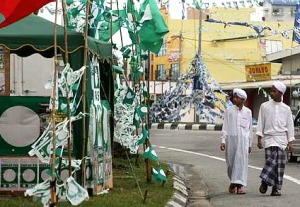
Tomorrow’s leaders?: Turbaned teenaged boys walking past PAS banners and flags on Jalan Kuala Krai in Kelantan.

But this is what democracy is all about. Elections are about making a choice and essentially, in Malaysia, the voter votes for either Barisan Nasional or for the Opposition.

In middle-class urban Malaysia, it would seem that the fastest way to be popular these days is to ride the anti-establishment mood.

As for a journalist, he is deemed credible, courageous and objective when he takes a swipe at the leadership and backs the Opposition.

Those who talk about freedom of speech can be incredibly intolerant of contrasting viewpoints. Some resort to name-calling and personal attacks instead of trying to convince or debate a point.

Let’s put it this way. We know the current system is flawed. Many of us are unhappy with our institutions and certainly much more should be done.

The system needs an overhaul and much of the mismanagement and inefficiency is intolerable, but the question is whether there is a better alternative.

But when non-Muslims talk about wanting to vote PAS, which has no qualms about changing our way of life, then we need a serious re-think.

For the past two weeks, statements by PAS leaders have shown that they have not changed, not that they ever promised that they would change in the first place.

PAS spiritual adviser Datuk Nik Aziz Nik Mat told his listeners at Nikko Hotel that those who vote for PAS would go to heaven. I guess that will not include many non-believers like me.

Turbaned PAS president Datuk Abdul Hadi Awang said it was perfectly acceptable to character assassinate political rivals. Before that, he refused to shake the hand of his Barisan Nasional challenger on Nomination Day.

But that’s nothing unusual.

In 2003, I had my first taste of Hadi’s wrath when my colleague crime desk editor Lourdes Charles and I wrote about the meeting that the fiery PAS leader had with radical Indonesians like Abubakar Ba’asyir and Agus Dwikarna.

These figures are classified as terrorists by many countries because of their links with al-Qaeda and Jemaah Islamiah.

Agus, who heads the militant Laskar Jundullah (Army of Allah) in Makassar, Sulawesi, is known for targeting American tourists in hotels. He is serving a 17-year jail term for illegal possession of explosives and suspected involvement in bombings in Manila and Jakarta.

The meeting, according to Indonesian academicians Dias Pradadimara and Burhan Junedding in the respectable magazine Inside Indonesia (October-December 2002), was a follow-up meeting of mujahidin in Yogjakarta to “integrate the aims and actions of all mujahidin to implement Islamic law.”

According to the writers, quasi-military groups from all over south Sulawesi were present.

The report irked Hadi, who admitted being at the meeting but said the Indonesian and Malaysian governments were aware of the three-day meeting and there was nothing sinister about it.

That’s fair enough.

But at a stadium in Terengganu, in front of thousands of supporters, he decreed that Charles and I were “anti-Islam” and “infidels”.

We subsequently received death threats and police reports had to be made. To be labelled “anti-Islam” is certainly serious. The police traced some of these calls but we decided not to pursue the matter, even though the culprits (PAS members) were identified.

Fast forward to 2008. Have things changed? No. There is still no place for non-Muslims in PAS, not even as associate members.

Incredibly, there are non-Muslims who are shamelessly contesting as members of the so-called PAS Supporters Club, not realising they have joined in to advocate the orthodox Islamic system being pursued by PAS.

That would mean more gender segregation in supermarket checkout lines, concerts and, of course, at swimming pools.

Yes, that would also mean watching movies with the lights on. If that is fine with you, then go ahead and vote for PAS.

Today, there are well-intentioned but misguided non-Muslims who are helping to campaign for PAS. Some even endorse the party even though it has a long history of criticising other religions.

The only excuse given by those who back PAS is that in Kelantan, there are temples and churches. What a pathetic argument because these places of worship exist in other states, too!

The PAS government removed deer statues in a Kota Baru roundabout when it took over Kelantan because it was unIslamic. Next, Hadi ordered the statue of the giant leatherback turtle in a Kuala Terengganu roundabout removed.

Yes, Kelantan has one of the biggest Buddha statues at Wat Machimaran in Tumpat but it has remained untouched because it has been there for a long time. Still, we remember how PAS cheered when the Taliban destroyed the giant Buddha carvings in Bamiyan, Afghanistan, deemed a World Heritage Site by Unesco.

True, there are local authorities in states controlled by the Barisan that have been unfair to many temple and church groups. Certainly, no one can deny that many of us cannot accept the ban on Christian books in Bahasa Indonesia.

But the action of certain extremist officers, at the lower level, should not be lumped as a policy endorsed by the Government. In these cases, the Government has intervened to put things right.

But we agree that these stop-gap measures cannot continue. There must be a clear and firm policy against officers who put non-Muslim religious groups in a fix.

And, yes, the local authorities should know better than to demolish a Hindu temple before Deepavali. It is simply wrong, and there are no two ways about it, even if it sits on illegal land, as Deputy Prime Minister Datuk Seri Najib Tun Razak has conceded.

When such things happen, the Government gets the blame. These officers can only be regarded as saboteurs.

From supporting the blasting of the Buddha statues in Afghanistan to calling Umno “infidel” for working with non-Muslim political parties and to the late Shahnon Ahmad’s book, SHIT, PAS has consistently demonstrated what it wants to pursue.

There are new and moderate leaders like Datuk Kamaruddin Jaafar and Datuk Husam Musa, but unfortunately, they are outnumbered by the likes of Hadi.

Let’s not send the wrong message to PAS by giving the impression that we endorse its agenda.

At a time when there is increasing conservatism in this country, with Muslim-based parties competing to show their religious fervour, it would be strategically wrong to endorse an Islamist party, simply to punish Umno.

The fact that PAS has stopped talking about implementing syariah law, for political expediency, doesn’t mean they have given up.

We must keep our liberal way of life. This is Malaysia, not the Middle East.

PAS’ Controversial Statements

Aug 15, 1997: Former Prime Minister Tun Dr Mahathir Mohamad was labelled murtad (apostate) for his remarks over three Muslim contestants prosecuted by the Syariah Court in Selangor for taking part in a beauty contest.


July 16, 2002: PAS reportedly distributed posters depicting Dr Mahathir as a Catholic priest, labelled “Mahathir Paderi Besar Gereja”.

Aug 1, 2002: Former PAS MP Bunyamin Yaakob was investigated by police for alleging that Dr Mahathir had watched a pornographic video with his grandchildren.

Aug 12, 1999: The late PAS president Datuk Fadzil Noor allegedly linked Prime Minister Datuk Seri Abdullah Ahmad Badawi's family name with taking care of pigs. Fazdil later said he had no intention of insulting Abdullah but maintained his remarks were factually right.

March 3, 2004: PAS reportedly questioned Abdullah's integrity as a man of religion and attacked his late wife, Datin Seri Endon Mahmood, for not wearing the tudung.

July 7, 2006: PAS Dewan Ulama chief Datuk Harun Taib labelled Umno as kafir (infidels). He said he was merely following PAS president Datuk Seri Abdul Hadi Awang's fatwa (decree) on April 7, 1981, that Umno was an infidel party.

Feb 18, 2008: PAS spiritual adviser Datuk Nik Aziz Nik Mat said Umno members were orang utan as they did not know Islam or anything about the law.


Into the second half of the fray


WE have now entered the second half of the fight. The general election is exactly seven days from now and Malaysians can expect the battle for the hearts and minds by our politicians to be tougher, if not, dirtier. 

The battlegrounds are in Penang, Terengganu and Kelantan, where the hardest campaigns are being fought. 

There is no place for slip-ups as the contest in the 2008 general election enters into the most crucial period. 

In Penang, the Barisan Nasional, especially the MCA and Gerakan, is taking on one of its fiercest fights against the opposition led by the DAP.  

The DAP is on the offensive by fielding its top guns in the state. Riding on the anti-establishment sentiments of the predominantly Chinese areas, the DAP has attracted large crowds to their ceramah but whether this would be translated into votes would be another thing. 

DAP secretary-general Lim Guan Eng, with much help from de facto opposition leader Datuk Seri Anwar Ibrahim, is heading the battle here. 

But Barisan top guns, including Datuk Seri Abdullah Ahmad Badawi and Gerakan president Tan Sri Dr Koh Tsu Koon, are also taking them head-on, well aware of the stakes at hand. 

MCA deputy president Datuk Seri Chan Kong Choy, who is not seeking re-election, will spend the next few days entirely on the Penang campaign. 

While no one expects the state to fall into opposition, the Barisan also does not want to lose its two-thirds majority. 

Learning from the past when Penangites rejected the DAP for attempting to wrest the state from the Barisan, the opposition has stopped talking of coming into power but they certainly hope that Penangites would go overboard by tilting the power structure. 

The DAP has cleverly played to the emotions of Penang voters by hammering away at Umno and even ignoring traditionally hot issues like Chinese schools because the federal government has announced huge pre-polls allocations, which is the effort of the MCA. 

Still harping on the keris issue, they hope to sway the Chinese voters. But any political adventure by the Chinese voters could end up with the Chinese power within the system eroded.  

The Malay votes, on the other hand, are likely to be solidly behind Umno. 

So, instead of wanting to punish Umno for the statements by one or two leaders, the community could end up punishing political parties representing their interests in government. 

The same predicament is faced by the MCA and Gerakan in Perak, Selangor and Kuala Lumpur, where the same fights are being fought. 

Like the Indian population, which stands at 1.6 million, the Chinese community is also shrinking and it now stands at around six million of the 25 million population in Malaysia.  

In Kelantan, the state is another battleground, where PAS has found its power being chipped away strongly by Umno. Although the Islamist party still has its grip on the state, reports says that the Barisan is not far behind in the race. 

The Barisan is turning its guns to 14 PAS state seats that were won by a majority of less than 10% in 2004 while it is confident of retaining its 13 seats. 

Both sides are racing against time to woo Kelantanese voters who work in other states to return home to vote on March 8. 

The Barisan has even named a Mentri Besar designate, Datuk Awang Adek Husin, to show its seriousness. 

In Terengganu, the fight between PAS and Umno has continued with PAS hoping to end the five-year rule by Barisan. 

But after having tasted the development brought by Barisan, the voters may not want the state to return to the opposition which ruled it for 18 years. 

The Barisan has transformed the once sleepy fishing state into an international arena, where world-class events are being held. 

The state is now led by a more dynamic leadership under Datuk Seri Idris Jusoh, a former corporate figure, who is being challenged by the turbaned Datuk Seri Abdul Hadi Awang, who is known for his religious ultra-conservatism. 

Over the next one week, it could well be the longest period for these contenders. In past elections, the campaigning period would have ended by now but this time around, we are just entering the second half. 

Hoe leow, boh hoe leow?


COMMENT BY WONG CHUN WAI

BANGKOK Lane is famous for its mee goreng, with its tasty prawn-stock gravy and fritters, but on Wednesday night, Penangites were flocking to that narrow street for a different reason.

The road was packed with voters to listen to a DAP ceramah with state Opposition Leader Phee Boon Poh holding court. By Penang DAP standards, the size of the crowd would not be considered big.

But the mostly Chinese crowd was captivated with the incumbent Sungai Puyu state assemblyman's eloquence. His witty remarks, in Penang colloquial Hokkien, were greeted with laughter and applause.

“When you buy a car, motorcycle or even a bicycle, you get a geran. But in Penang, so many of us stay in flats and yet, it is so difficult to get a strata title. I brought this up at the state assembly, the government promised me that perkara ini sedang di beri perhatian dan tindakan akan diambil.

“They promised to send an official to look into the matter. But this chap, what can he do? He is not like the Goddess of Mercy who has 16 arms,” he said, as the crowd laughed along.

The seasoned politician took potshots at various targets, especially Umno Youth leaders. Often, he exaggerated his argument to emphasise a point. By the time he finished, the crowd was cheering wildly, asking for more.

When his Sri Delima counterpart R.S.N. Rayer took over the microphone, it was a tough act to follow. The lawyer’s “correct, correct, correct” joke, in reference to the V.K. Lingam inquiry, fell flat. It was a case of a joke being told too often.

Blogger Jeff Ooi, who is contesting the Jelutong parliamentary seat, had an even tougher job with the crowd when he decided to use Bahasa Malaysia and English. He focused on economic issues and this did not go down well with the mostly working-class crowd who wanted to be entertained rather than be informed.

Welcome to Penang – where Hokkien is the preferred lingua franca among the predominantly Chinese islanders. Even Malays and Indians, especially traders and hawkers, can converse reasonably well in that dialect.

The use of Mandarin, particularly in debate, is to emphasise one’s educational background but in the streets of Penang, it does not connect to the listeners. Even southern Hokkein, as spoken in Klang, Malacca and Johor, is regarded as crass and unrefined among Penangites.

When long-term Penang resident Datuk Seri Chia Kwang Chye found himself out of the race for the Penang Chief Minister’s post, supposedly because he could not speak Chinese well, he was understandably irked.

The Johor-born Gerakan leader, who is English-educated, can deliver his speech in Chinese and certainly in Penang Hokkien.

Penangites are well aware that the whole country is watching them. The state has become the focal point, where all the big fights are taking place. It is also the home of Prime Minister Datuk Seri Abdullah Ahmad Badawi and his nemesis Datuk Seri Anwar Ibrahim.

As Penangites compared notes the following morning over breakfast at coffee shops, they were aware of the responsibility they carry. They talked about which politician speaks better and whether the previous night’s gathering was hoe leow, boh hoe leow? (good or not, a term which could also mean delicious or not, in reference to food).

In my midweek foray back to my hometown, I noticed that while the crowds are large, they are nowhere compared to 1990 when Lim Kit Siang knocked out then Chief Minister Dr Lim Chong Eu by 706 votes and retained his Tanjung parliamentary seat by 17,469 votes.

That was not all. The DAP won 14 state seats, denying the Barisan Nasional its two-thirds majority, and was only three seats short of taking over the state.

But the DAP gains were all wiped out in 1995, when it only got one seat. Tan Sri Dr Koh Tsu Koon beat Lim in the Tanjung Bungah state seat by 7,497 votes. In 2004, Lim decided to move to Ipoh Timur and the Penang DAP still had only one state seat.

The DAP is understandably more cautious, having learn the lessons of the past debacles. With Lim Guan Eng leading the charge now, the DAP has stayed away from any talk of forming the state government and instead only called for a stronger check-and-balance.

But no matter how the politicians strategise, the reality is that Penangites are highly unpredictable. Their political fickleness is well-known and it is this scenario that the DAP is hoping for – just by some luck, with more checking than balance, the DAP may just end up with a repeat of 1990.

The Barisan, particularly the MCA and Gerakan, has harped on the importance of keeping intact the political structure of Penang, where the state is the only powerbase of Chinese politics.

They have warned against the community shooting themselves in the foot and strengthening Malay-based parties like Parti Keadilan Rakyat and PAS at the expense of the Chinese community.

“I hear church groups telling their congregation to vote anything opposition including PAS, which is simply naive and emotional. Whatever the flaws of the system, it still works, despite some occasional hitches,” said one Penang Barisan leader.

MCA and Gerakan campaigners are racing against time to tell their listeners that the statements of one or two Umno leaders, which smack of racism, do not reflect the entire government and that representation in the government is crucial.

Said MCA Youth vice-chairman Chew Kok Woh: “You can shout and bang tables but the fact is that the voices of the community can only be heard inside the Cabinet or state executive council meetings. Parliament only meets a few times a year but the Cabinet meets every Wednesday. The community must understand the realities.”

But no one dares to predict the mood of Penangites. They remember the gigantic crowd at Macallum Street, on the eve of elections in 1995, when Kit Siang basked in all the glory only to be unceremoniously dumped the next day.

At the end of the day, the argument for Penangites could well be, which party oo leow ah si boh leow, which means which party has the substance in the elections.


* Hoe leow, boh hoe leow means Good, or not so good, in Hokkien.


Making our institutions strong

IT has gripped the attention of the nation. So much dirty linen has been washed, so much mud thrown and so many amazing tales told that Malaysians must be wondering who to believe.  

Now that the Royal Commission has completed its investigations into the Lingam video clip affair, let’s take a step back and assess what the mass of evidence, allegations and disclosures really mean for us, Malaysians.  

Was it necessary for the dirty linen to be washed in public over 17 days? How much of it was the truth?  

Was it necessary for some sorry episodes in the history of the judiciary – former Chief Justice Tun Eusoff Chin’s holiday in New Zealand with lawyer Datuk V.K. Lingam certainly falls into that category – to be dredged up and dissected?  

What was the point in reproducing old pictures, where family members who have no part in the controversy, found themselves named and their photographs published?  

Was it necessary to embarrass the august institution of the judiciary with allegations of case-fixing and other improper behaviour?  

Was it necessary for the Government to push for a commission hearing that seemed, at times, to cast a shadow of shame over the whole country?  

Yes. Yes. Yes. Yes.  

Despite the misgivings of some Malaysians, the inquiry has given us a chance to come clean about an institution that has been manhandled over the past two decades.  

How can we even begin to rehabilitate this so important body if we do not understand the battery of illnesses that affects it?  

The whispering campaign about judge-shopping and other allegations of wrongdoing has been building up over the years to the point that it has prompted some foreign companies to insist that their legal disputes be settled through arbitration outside the country.  

This trend is more shameful than any mud that was flung during the commission hearing.  

It would have been easy for the administration to pay lip service to concerns about the Lingam video clip.  

It could have made the right noises and switched the channel after a week or so. We have to admit that it is the news cycle, which often dictates our attention span on an issue.  

Also, by and large, Malaysians are more interested in bread-and-butter issues.  

But the video clip issue did not disappear because Datuk Seri Abdullah Ahmad Badawi knows that a Malaysia without strong institutions will be a country without a soul.  

After all, the courts provide the public with their only chance of seeking justice. It is their last refuge in the face of oppression and when wronged.  

Abdullah has tried to protect the institutions by appointing straight shooters like the late Tan Sri Abdul Malek Ahmad as the Court of Appeal President.  

Datuk K.C. Vohrah, a retired Court of Appeal judge, noted recently that Abdul Malek should have been made Chief Justice for his principles and steadfast adherence to fair play and justice.  

“The late Malek was an uncommon Malaysian, whose most important characteristic was his natural and tremendous sense of fair play and his unquestioned integrity.  

“He was the Chief Justice that this fair country should have had but never did,” he said at a remembrance event organised by Universiti Malaya and the Malaysian Inner Temple Alumni Association in memory of the former President of the Court of Appeal who died on May 31 last year.  

Similarly when Abdullah appointed Datuk Abdul Hamid Mohamad as the Chief Justice late last year, it was evident that he was interested in restoring order and credibility to the judiciary.  

Only if good people are put at the top of an institution, will it flourish and give confidence to Malaysians and investors. 

Don’t take my word for it. Let’s just turn back the pages of history and recall some of the illustrious names who led the Malaysian judiciary during its days of glory – the late Tun Mohamed Suffian Hashim and Sultan Azlan Shah to name a couple.  

It is not only the judiciary that will benefit from having good men and women at the helm. Even the reforms in the police force and the civil service have a better chance of succeeding because Tan Sri Musa Hassan is the Inspector-General of Police and Tan Sri Mohd Sidek Hassan is the Chief Secretary to the Government. 

There is much truth in the saying that the fish starts rotting from the head.  

For the Royal Commission members, the hearing is over but their work is only beginning. Over the next few weeks, they will receive written submissions from various parties, deliberate over the information given by 21 witnesses and then get down to the serious job of making their findings.  

Anyone following the inquiry can tell you that some individuals were sparing with the truth.  

They huffed and puffed and even made light of the situation. But this was no laughing matter. At the centre of this hearing was the credibility of an institution that all Malaysians have a stake in.  

It is hoped that the panel will not only be clear in their views about the video clip and the main actors but also recommend suggestions on how the selection and promotion of judges can be strengthened.  

Only by doing so can it help an administration that is keen to improve the health of the judiciary and all other institutions here.  

Only by doing so will it prevent a future generation of Malaysians from having to sit through another session of painful revelations years down the road.  

Keep politics fresh and young

On The Beat


FOR a brief moment, the crowd was clearly stunned. Even the Penang reporters covering the MCA dinner at the Esplanade on Friday night could not believe what Datuk Seri Ong Ka Ting had just said.  

The MCA president had told the crowd that this would be the last time he was contesting in the general election.  

With his youthful appearance, not many people could believe that the 51-year-old politician wanted to limit his political career.  

But Ong had begun his helm in the MCA by limiting the terms of the party president to only nine years or three terms. It was a dramatic move to ensure that a leader would not cling on to power forever.  

A strong advocate of party rejuvenation and giving new talents a chance, Ong wanted to make himself an example.  

Taking a jab at the opposition, he said, “In the opposition, a candidate can keep contesting until he is old” – an apparent reference to DAP veterans approaching their 70s.  

Ong was appointed party president in 2003 and retained his post in 2005. He has been Housing and Local Government Minister since 1999.  

He has also brought into the party’s fold many aides and researchers who are in their 30s and 40s, believing that they will introduce fresh directions and new ways of doing things.  

It is a bold but calculated move to ensure that the MCA remains relevant at a time when the voters have become younger and surely more demanding.  

In the United States, presidential hopeful Barack Obama is 47 years old and for many college-educated voters, he is their man.  

They see in him their call for change and his lack of experience an advantage as they shun the old politics of the establishment.  

His opponent in the Democratic Party is Hillary Clinton, 60, and should Republican John McCain make it to the White House, he would be 72 by then, making him the oldest president.  

Within the Barisan, there are also incumbent MPs, some in their 60s, who still find it difficult to retire.  

Some have been reluctant to announce their readiness to make way for younger candidates, hoping against hope that they would still be given another shot.  

A few seem to imply they are indispensable and that they will only be able to retain the seats for the Barisan Nasional, using anti-establishment sentiments as their argument.  

It is a problem that Barisan chairman Datuk Seri Abdullah Ahmad Badawi has to deal with in every general election.  

Worse, he cannot interfere in the running of component parties, where some of their party chiefs, in their 70s, put their names on their lists. And they themselves cannot hear the loud voices from the people that they should go.  

Shockingly and hypocritically, they talk about bringing in “new blood” and of their “unfinished work”. Of course, it is always for the country and the people. Haven’t we heard that before?  

Used to the perks and power that go with the job of an elected representative, many find it hard to let go.  

Using all sorts of tactics, they get their supporters to hold press conferences to announce their support for them, ambush their party bosses at airports, send their wives to meet their bosses’ spouses and some even break down and weep shamelessly.  

But this is part of the melodrama that builds up during every election, where politicians so often put their ambition first before ideals and principles.  

It is the same in the opposition, where statements have been issued against their party leaders and tantrums thrown because they have not been picked to contest the elections.  

And of course, they, too, say that their entry into politics is to fight for justice, against abuses of power and to strive for accountability. Never personal glory, naturally.  

In a survey conducted among young people in the United States, many said they could not recall then presidential-hopeful Bill Clinton appearing in a talk show, wearing dark shades, playing Heartbreak Hotel on his saxophone.  

Clinton’s cool appearance won him support from the young and minority groups, as with Obama now. But that was 16 years ago and now, the young do not even know the show’s host Arsenio Hall, who remarked, “It is good to see a Democrat blow something beside the election.”  

In this age of YouTube and Facebook, Malaysia is not doing justice if we still have to have those from Jurassic Park lead us.  

By the way, it was a blockbuster movie and it was 15 years ago. Never heard of it, our young will tell us.  


Delivering the bread and butter

In short, political and economic stability will always be the priority of the middle class. The street protests may be about the right to demonstrate, but is also the quickest way to lose votes. 

For Middle Class Malaysia, these protests equate to traffic disruption, loss of business, inconvenience and chaos. 

An opinion poll conducted by the International Islamic University has revealed that the cost of living, social issues, the crime rate and illegal immigrants are issues that worry Malaysian voters the most. 

Despite loud criticism by the opposition against the leadership ahead of the polls, Malaysians are generally satisfied with the leadership. Only 1% of the 2,930 respondents polled in 13 states took issue with it. 

But the food bill issue, however, is not just a Malaysian issue. It has become a global issue. The Singapore Straits Times of Feb 4 front-paged Prime Minister Lee Hsien Loong's call to Singaporeans to adjust. 

He said the concerns of Singaporeans had been heard and were being addressed, but Singaporeans needed to work together to tackle the fears. 

The opposition here in Malaysia has promised to lower the prices of essential goods, and even of petrol, if it captures the government. 

But what has driven prices up? The global price of crude oil is at a record high and this has pushed up transportation charges; the drought in Australia and snowstorms in China have affected food production; and farmers have dumped food crops for plants that cater to petrol-substitute ethanol. 

China and India, which have become more affluent, are consuming more, with food producers preferring the two gigantic markets. 

Still, even in China, overall inflation is running at a 10-year high – around 6.9% in November year-on-year with pork, a staple meat, spiking to 60% year-on-year.  

Worldwide, the financial markets are in turbulence, and the United States, the world’s largest consumer market, is heading into a recession, if it is not already in one. 

Companies listed on major stock markets, which rely heavily on the US market, find their prices dropping massively. 

Datuk Seri Abdullah Ahmad Badawi has taken early steps to plug the holes. These include the setting up of the National Price Council, which has announced a national stockpile of essential goods, such as rice and cooking oil, to ensure that prices and supply remain stable at all times. 

The council, chaired by the Prime Minister himself, will monitor, advice and oversee the Government’s price policy, competitive market structures and the efficiency of subsidy schemes. 

Not many people shared Pak Lah’s agriculture policy, which he mooted when he took over the leadership, as we are so used to fast-paced industrialisation. 

Now, he has been proven right. “Agflation”, referring specifically to rises in prices of agricultural commodities, has suddenly become a buzzword. 

Last week, he did justice in ending the decades of uncertainty faced by 913 farmers in Perak, giving them 30-year leases to the 2,903ha land they had been toiling on. 

In Kuala Kluang and Kanthan, these farmers produce some 60,000kg of vegetables a day for the folks in the Klang Valley, while in Ladang Bikam and Coldstream New Village, the mangoes, papayas, starfruit and guavas they harvest are exported to Singapore, Hong Kong, Dubai and Europe. 

It is a recognition of these farmers, who make our lives easier and better with these fresh supplies of greens to our markets. 

It may seem a cliché, but Malaysians really are much luckier than many others. The cost of living is certainly almost the lowest, but the standard of living are among the highest, in the region. These two terms are often mistakenly used by many. 

Subsidies are provided for the people, from fuel to flour to education, which now make up RM40bil of the bill, which for Malaysians have become the norm.  

In other countries, including Singapore and Thailand, petrol prices often fluctuate, depending on market prices of crude oil. Again, not many Malaysian motorists are aware of this. 

It must be noted that 30% of the items used to measure inflation are priced-controlled or subsidised. More importantly, the Malaysian economy has remained healthy, helped by revenue from oil, while continuing efforts to reduce the budget deficit are on track, and external reserves remain healthy. 

Crime, as expected, ranked high on the survey. Some of the measures taken by the Government may not take off immediately, but short- and middle-term actions have been taken. 

On the Government’s part, RM8bil has been allocated to fight crime, which includes the purchase of a high-technology integrated communications system, 3,000 patrol cars and 4,000 motorcycles.  

The Government has also approved the recruitment of 60,000 police personnel over the next five years. 

The fight for the votes in the elections will be about which political party can assure the Malaysian Middle Class that it can deliver the bread and butter. 

All for the sake of winning votes

On The Beat

IT doesn’t look like it will happen in Malaysia for a long, long time. The world is currently glued to the US presidential elections where the front-runners in the primaries include an African-American and a woman.  

The Americans do not care if their candidate is black, yellow or white as long as he or she is the right person. Their supporters comprise Americans of all races and gender. Throughout the campaign, candidates have so far managed to stay clear from race and gender. 

More important, Barack Obama and Hillary Clinton, both Democrats, have debated in a civil and intelligent manner, focusing on substantial issues.  

Young Malaysians following the race must have surely asked when our politicians would live up to such qualities.  

For a start, those who have overstayed must know when to leave.  

Most of the voters are finding it difficult to swallow the argument put up by these leaders that they still need time to carry out their work.  

Surely, they can’t expect us to believe them after holding on to their posts for decades.  

Used to walking the corridors of power and enjoying the prestige and perks that come with their positions, many find it hard to be like us, ordinary Malaysians, again.  

The thought of not seeing their names and pictures in the newspapers must be difficult to fathom.  

By clinging on to their posts, it is also an insult to their party members because the impression, which they like to create, is that no one else is suitable to take over.  

No one else seems good enough to fill their shoes. You find these politicians on both sides of the political divide; they seem to be there forever. 

Then there are those who have had their chances. They had served in various capacities but had to quit in the most controversial situations.  

Now in their 60s, the age when most Malaysians are thinking of spending time with their grandchildren and watching the sunset with their loved ones, they dream of staging a comeback.  

Some of these figures do not even know how to surf the Internet and have no inkling of what young people are saying about them in cyberspace.  

They probably assume that the new voters, like their grandchildren, have forgotten the trouble they had landed themselves into, or the huge embarrassment they had caused their party.  

Their renewed ambitions must be difficult for the younger leaders in the party, especially those in their 40s and 50s, who have worked faithfully and are waiting in the wings.  

Then there are one or two Mentris Besar or Chief Ministers.  

It’s amazing how some of them seem to assume that their respective states are their personal fiefdoms.  

They show their displeasure at even the slightest suggestion that they ought to contest a parliamentary seat. 

They lobby to remain at their posts but then advise the other state assemblymen that they must abide by what their party bosses tell them to do.  

Also, there are those who still continue to play the race card, in this age and time. 

At their party conferences each year, they play to the gallery by projecting themselves as the communal heroes.  

But during the general election, they shamelessly become the true Malaysian leaders we dream of. 

They greet their voters in Malay, English, Mandarin and Tamil; and if they can speak all these languages fluently, they would do so.  

But for the rest of the five years until the next general election, they would insist only on one language for us.  

Never mind if we all know that they send their children to boarding schools in England or Australia. 

Some, it is said, have homes there, too.  

Of course, they are upset if we do not send our children to national schools, questioning our loyalty to the country.  

Suddenly, all these languages are used in posters, bunting and advertisements, and you wonder why Malaysia cannot be like this every day. 

Why can’t we embrace such Malaysian features and why must multi-culturalism be acceptable only during election campaigns?  

Such an unusual degree of tolerance and flexibility seems almost unbelievable. 

Even PAS is prepared to stop talking about an Islamic state during the elections but throughout the next five years, we can be sure they will tell us how certain principles cannot be compromised on religious grounds.  

Politicians are also busy visiting places of worship and meeting religious leaders, including those of other faiths.  

Yet we know we will continue to grapple with various bureaucratic problems relating to faith issues because these same politicians will struggle to stand up for the rights of all citizens once the election season is over.  

Fortunately, there are many who take their positions as MPs and assemblymen seriously. They work hard, help their constituents and speak with decorum.  

They are a credit to their party and the people who voted them in. 

How we wish we could have elections more regularly instead of just once every four or five years.  

But hey, good things don’t happen every day.  

Let’s enjoy all the attention while we still can. 

It’s good to tell the politicians what we want once every four or five years and do our best to hold them to their promises – every single day. 


Cafe Latte Chat: What the Indians want

THE Malaysian Indian community is at a defining moment. Comprising just 1.8 million or roughly 8% of the country’s 26 million population, it has never been so politically divided. Although the MIC – the third largest component party of the Barisan Nasional – represents the community in the Government, the political allegiance of Indians is split.  

The Gerakan, PPP, Indian Progressive Front, DAP, Parti Keadilan Rakyat and Democratic Indian United Party have their share of Indian members and supporters.  

The recent street protest led by the Hindu Rights Action Force (Hindraf), sparked by perceptions that Indians have been marginalised, has led to the community becoming a focus of the national political debate, with the MIC and its leadership coming under intense scrutiny.  

The debate revolves around the community’s lack of a meaningful stake in the economy, opportunities to progress in education, employment and business and its disproportionate representation in crime statistics.  

Are the grievances affecting the Indians real? What are the solutions? What needs to be done to move the community forward? Have the more successful members of the community played their part? Cafe Latte discusses the topics. 

The Indian community and politics 

Wong: In the coming general election, various political parties will represent the Indian community. The community is small yet it is fragmented into so many different groups. What is your take on this, Dr Denison? 

Dr Denison: If you take the political parties – MIC, PPP, IPF, Gerakan – it might seem fragmented, but they are all invariably pro-Barisan Nasional and cohesively part of its framework. But if you look at opposition parties such as DAP, Parti Keadilan Rakyat and Parti Sosialis Malaysia, there is also quite a number of them there. But the central issue is the composition of the constituencies. No Indian can win just on the Indian ticket. The community needs the support of other communities. An example is the case of the Sreenivasagam brothers who won in the 1959 elections for the Socialist Front. Back then, we had more Indians in the Opposition than in the MIC. Having said that, the fragmented parties that we see (now) will have a major impact on the general election. For example, the Merdeka Poll survey conducted recently found that since September, there has been a 44% drop in positive views towards the government. There were also other indicators showing the people’s unhappiness towards the government and its policies. The question here, however, is whether such findings will impact the outcome of MIC candidates who hold nine parliamentary seats and 19 state seats. The MIC is sure that it will retain the nine parliamentary seats.  

Dr Ramasamy: Going back to the 1990 elections, I think that a slight majority of the Indian community voted for the Opposition. But in the subsequent election, it was back to status quo. I think the difference this time around is the mobilisation created by Hindraf. Based on the turnout of the event that day, it would be safe to say the Indians know they can be king-makers in particular constituencies. There are also indications that the popularity of the ruling government has gone down. But then again we must ask whether the Indians will remain faithful to Barisan Nasional.  

Wong: There’s talk that because of the Hindraf issue, many controversies have arisen. As a result, is there a fear in the community that its representation in Government may decline because of the anti-establishment sentiments? 

Devakunjari: We have to go back into history where the initial premise of Malaya was power-sharing among the races. This was needed back then to show the British that we could, and deserved, our independence. But here we find a situation where the government relies on MIC to produce feedback and solutions to the community. And there are perceptions that MIC is not being given enough airplay within the government, and that it has not really done its job. Neither perception assists BN in securing the Indian votes. The reason why Hindraf received such popular response was because the Indians, at least at the grassroots level, believed that no one else speaks for them and highlights their grievances.  

Dr Denison: Indian votes make a difference in 62 constituencies, and we will be king-makers if there is a split in the Chinese and Malay community. You might be the most hardened Indian candidate but you cannot win the seat because you do not have 100% Indian voters in the constituency. But the shift, I would say, based on the survey is that the people are unhappy. But whether this will translate into votes is a different matter altogether. This is because Hindraf is not aligning itself to any political party.  

Wong: What about the perception that MIC has not done enough for the community, as stated by Devakunjari? 

Devakunjari: Only now are there so many groups talking about the Indian problem. Suddenly, there is interest in the community. I’ve sat in various forums and the pertinent question that always arises is 'What is the available aid being given by the government now?' In one particular forum the Domestic Trade and Consumer Affairs Ministry informed us that there is a 3% allocation on every initial public offering for the Indian community. Sadly, it didn’t filter down because there is no methodology. So the question that some people are asking is why certain things such as this, which is available within the system, are not given a delivery route to the poor Indians.  

Dr Denison: I think, in terms of perception, the documentation of Indian problems, even from the start, focused on plantation difficulties and related issues. Things like salary, housing and working conditions centred on this premise. The more recent ones have been analysis on the urban trends and shifts. If one were to look at documents presented by Mapen 1 (the first National Economic Consultative Council), the analysis of problems and issues are there. If you take OPP 3 (Third Outline Perspective Plan) for example, it begins to recognise, for the first time, the Indian issues on public policy agenda.  

Wong: But you have said before that the system is such that there’s nothing you can change because the community is small. 

Dr Ramasamy: You must agree that the Hindraf gathering shook the ground, no? They made a huge impact by coming out together.  

Dr Denison: I think we still have to go back to the core of the problem, whereby under the Federal Constitution, it is stated that the special privileges of the Malay community is balanced with the legitimate rights of other communities such as freedom of religion, positions in the civil service, right to education and so forth. Now, if we take it into more recent policy discussions such as the New Economic Policy (NEP), we see more of a re-structuring of society by addressing issues such as poverty. But when we come down to OPP 3, I think there are enough resources and agencies to cater to Malay needs. This is highlighted by Mapen 2 in documents on crime, housing, urban poverty and education issues.  

Wong: These documents are all fine, but the bottom line is the perception that not enough is being done by the MIC. They are being compared to Umno and MCA where they can see proper structures for development and education, such as universities and skills development institutions.  

Dr Denison: MIC has done its best within the power-sharing basis and it has extensively contributed in terms of education and skills development. We have sent many students abroad on scholarships and even prepared the necessary avenues for those interested in skills training. Micro-credit financing for small businesses have also been made available. However, the problem is that the outreach is inadequate. We have not had the necessary interventions from the states, which is pivotal to addressing these problems. There needs to be an increased participation through the relevant agencies too. 

A national problem 

Wong: Plantations used to be the forte of the Indians, but foreigners have replaced them. Due to this, they have migrated to the towns and because of the lack of skills they have resorted to small businesses such as car washing and scrap metal.  

Dr Ramasamy: The problems faced by the community are not an Indian problem but a national one. We are all Malaysians. This is why when there is the mindset that it is an Indian problem, it will be germinated into the political pillars that MIC can and is responsible to handle the problem.  

Dr Denison: But this is where the OPP 3, 8th Malaysia Plan (RMK8) and RMK9 development plans recognised the low-participation of the Indians in the economy and looked at skills training for the youth. I would say that such policies have been properly outlined and written. 

Devakunjari: I agree that the Indian problem is a Malaysian problem. The source of many of the problems we see now arose from the fact that when the estates were developed in the late 70s there were no proper programmes to resettle, rehabilitate or assist this community. So they lost this 'community' when they relocated them and there were no opportunities in terms of education or profession. Even today, 75% of Tamil schools are not affiliated with the government. However, we must agree that when problems arise out of government policies, should not the government take ownership of the solutions and not just delegate the whole exercise to MIC?  

Dr Denison: When we look at the national economic council and the development plans, it needs aggressive state intervention because no one individual or political party can do it. We are doing the best we can.  

Dr Ramasamy: If we go back to Hindraf and take a survey of the people who came, we will find that it was not just the poor plantation people but rather professionals such as lawyers and businessmen who felt they were short-changed. The question here is, can we brush away all these things?  

Self-help 

Wong: There’s this perception that there is no self-help in the community despite the emergence of many successful Indians and many in the upper-middle class. There is no reaching out to the grassroots. 

Dr Shanmuganathan: We must realise that there is no solid middle-class for the Indians. It is hollow. For example, if one were to go to Masjid India and check their financial statements, it is very weak. But people perceive that just because it is a big shop they must be making a lot of money. They are hollow businessmen because they are not fundamentally strong financially. In addition, as of 2004, Indians were said to have 1.5% equity in the economy. I would not be surprised that as of this moment, the figure stands at just 0.9%. And from this, if you take away the slice belonging to the top five Indian tycoons like Ananda Krishnan and Air Asia's Tony Fernandez and others, there is just 0.2% for the rest.  

Education  

Wong: We’ve mentioned the state of Tamil schools. Is it true that they are losing their appeal? 

Dr Ramasamy: I disagree with you. Tamil schools have actually out-performed national schools in the last five years. The problem with Tamil schools, however, is that they need more facilities and infrastructure. This is caused by the current system of education because there is less focus on them. Despite this, we find that in the last 10 years more and more parents from the middle-class are sending their children to Tamil schools. 

Dr Shanmuganathan: That’s true. This year the intake for Tamil schools increased by 30%.  

Dr Denison: Although the number of Tamil schools has dropped, the number of students has gone up. The discrepancy is where the schools are located and where the people are living. Almost 70% of the schools are in estates, but the majority of students are in urban areas. There is a major difference between the Indian and the Chinese community. The Chinese buy the land, build the school and then get the licence transferred whereas the Indians ask the Government to provide the land in the urban areas. Therefore, schools in the rural areas have less density.  

Devakunjari: In the last five years, Indian parents have found that their children were not being given enough attention at the national schools. The balance has tipped and Tamil schools have become more alert to the needs of the children. This is why more people from the middle-class prefer to send their children to Tamil schools. They want them to have this attention and a sense of cultural identity. 

Dr Denison: The government has also said it would allow Tamil to be taught in SJK schools. I think these policies would take quite a while to sink in. But while there is a major increase of students in Tamil schools, the resources required by the schools are definitely more. There are about 7,000 teachers employed now. So, if infrastructure is improved, I’m sure that the disgruntled feeling among Indians would be alleviated. 

Wong: I can’t help but notice that we have kept on referring to asking the Government for help. I know this is a Malaysian problem but surely there must be some kind of self-help. 

Dr Shanmuganathan: There are. Several of my close friends and I, for example, have adopted many schools. We are paying tuition fees for the students. After school, we conduct training for them to get better results. We are also paying the teachers and even giving them two months' bonus but we cannot afford to do the same for all Tamil schools.  

Dr Denison: When we talk about rebuilding Tamil schools – the bantuan modal schools – they are largely being rebuilt through community funds because the state does not provide that. Even in the RMK8 allocation of RM86mil, it was for the bantuan penuh schools. So, currently, they have allocated about RM60mil for bantuan modal schools, and the requirement is quite huge. MIC for example has allocated student loans for up to 7,000 students at RM85mil.  

MIC and its leadership 

Wong: I think it is on the minds of many Malaysians that the MIC has a leadership problem. 

Dr Denison: In terms of determining the MIC president, the decision is in the hands of the MIC delegates. Regarding the candidates for the general election, we have been informed that a sizeable change would be made. This is a step forward to newer faces.  

Devakunjari: Regardless of the MIC and its leadership, as mentioned earlier, the problems faced by the community is still a Malaysian problem. Let us look at the example of single Indian mothers and the problems they face. The poverty line index sets at least RM661 per month as the minimum to sustain one’s self. Most of the single mothers earn RM550 or less. They have two to three children and have no housing programmes. How are they going to live? We are not even talking about food. And as far as self-help goes, it would not make much of a difference if the government does not step in.  

Solutions 

Wong: We know the cause and the grievances but what can be done?  

Dr Shanmuganathan: Requests and proposals have been made to the Prime Minister seeking his approval to set up a special team under the Prime Minister’s Department or the Economic Planning unit to come up with a guideline to develop Indian businesses. The Malays, for example, have the Perbadanan Nasional Berhad to assist them. All we are asking for is 10% allocation of the same aid. From that allocation, the community can automatically develop for the next 10 years.  

Wong: I’ve heard talk about affirmative action for the Indians. Do you think this is practical? 

Devakunjari: It depends on what you mean by affirmative action. My concern is that the existing policies are not being filtered into something tangible that can be delivered. There is a Minimum Standards Act, for example, to regulate the welfare of the plantation workers and yet it is not being enforced.  

Dr Ramasamy: It is very simple. Indians want the opportunities and equal rights.  

Wong: But isn’t there an Indian quota prepared for university entries?  

Devakunjari: It does not seem that way.  

Dr Denison: University admission issues aside, we have to look at the fundamentals of education first. We have to look at the grassroots – the pre-school and primary school. And as we move along, we have to consider business windows and other opportunities for the community. What I’m saying is that what has been promised by the government in OPP 3, RMK8 and RMK9 must be delivered. And one of the suggestions that Mapen 2 requested was for an independent monitoring mechanism.  

Wong: Who would run this mechanism? 

Dr Denison: Representatives from civil societies. We need such mechanisms to make sure the process is one of transparency.  

Wong: What type of programmes would you all like to see to address all these grouses? 

Devakunjari: We would like to see excellent education opportunities from pre-school right up to higher education and more skills training.  

Dr Shanmuganathan: Going back to single mothers, in my office I have set up a training centre for them. We teach them marketing, business, hands-on work and so forth. After training, we find jobs for them and then we monitor them for at least a year. At the time they come to us, they earn on average about RM550 but we have assured them that if they follow our advice, they can make up to RM5,000 per month. So far we’ve helped about 225 single mothers.  

Dr Ramasamy: Fundamentally, if the Government is serious about it and makes it a national commitment to resolve the issue, Indians will feel that they have a place in society. 


Time to drop the jesters


ON THE BEAT
By WONG CHUN WAI


CREDIBLE candidates – that’s the key phrase in the coming general election. That means those whose names have been tainted should be dropped as contenders.

We know who they are with their off-colour and controversial statements, often racist and sexist, but they would probably believe it is their right to be retained.

Their disregard for parliamentary decorum in the Dewan Rakyat and inability to be civil has shamed their party and surely their constituents. To put it bluntly – they have no class.

Then, there are one or two who have made news headlines for the wrong reasons, simply by flouting their wealth.

Their outrageous behaviour, including those of their supporters, have made many Malaysians question if they have any right to keep their Yang Berhormat (Right Honourable) titles.

In short, Malaysians would like to see them retired off in the coming polls. If not all, at least most of them, and it would not be wrong to suggest that it would be the wish list of many Malaysians.

There is no reason why the likes of Port Klang assemblyman Datuk Zakaria Deros, Datuk Bung Moktar Radin (BN-Kinabatangan) and Datuk Mohd Said Yusuf (BN-Jasin) should still be retained.

Their constant appearance in the Roll of Shame for 2007 is sufficient reason to have them removed; surely Umno has enough talent to fill their places.

Some Umno officials have admitted their dilemma – some of these jesters have political clout at the division level in their parliamentary constituencies.

Given the rural or semi-rural set-up of their areas, they have performed well for their voters but the urban voters, who read the newspapers, on the other hand, are not amused.

Given the structure of Umno, where division chiefs are powerful figures who can decide the fate of party leaders, these culprits have often escaped with a slap on the wrist.

Take Datuk Badruddin Amiruldin (BN-Jerai). He had to retract his remarks at the Dewan Rakyat twice last year, including attacking Karpal Singh (DAP-Bukit Glugor) who is on a wheelchair “as a punishment from God” and for using a vulgar word.

He provoked a woman MP by asking “what type of a woman would last with someone like the MP from Batu Gajah” but he holds a powerful position in Umno as the deputy permanent chairman of the annual Umno general assembly. A deputy speaker, that is.

Last year at the party conference, he irked Malaysians again with his “tunnel” joke about the tight skirts of Air Asia stewardesses,

Like others, his supporters have defended his record and, in all fairness to Badruddin, he is essentially a very nice person whose sense of humour sometimes goes off tangent. He speaks a smattering of Hokkien and his popularity with his Chinese voters is well known.

He is unlikely to be dropped but he has to be more cautious of his statements in Parliament. Still, he is palatable to most, even his critics.

But there are some who owe their voters plenty of explanation.

Syed Hood Syed Edros (BN-Parit Sulong) suggested that all crosses in missionary schools should be removed and church influence in these schools be stopped – it must rank as one of the most unacceptable remarks.

He later backtracked, realising his mistake, but he has lost plenty of goodwill and respect.

During the debate, he was supported by Datuk Mohd Aziz (BN-Sri Gading), where it was alleged that some schools were open during Hari Raya.

Surely they must be aware that Hari Raya is a gazetted holiday and that the claim has no basis.

The Opposition, too, has its share of controversial elected representatives. Lawyer Karpal Singh has a record of name calling, shouting at his fellow MPs as lembu (cows) and bodoh (stupid).

His detractors say he is politically shrewd and ensures he makes the news with these political fights.

The colourful DAP veteran, who is actually a soft-spoken and polite person, has been blasted in the past for poor constituency work but given the anti-establishment sentiment in Penang, he is likely to be fielded and re-elected.

Then, there is Abdul Fatah Harun (PAS-Rantau Panjang), who described divorcees as gatal (randy), saying that based on his observations at gatherings and parties, he noticed that single mothers were not sad about their divorces.

If he is picked again to contest, it would be a non-issue in his conservative constituency and his voters probably do not even know of this controversy, which was debated mostly in the English newspapers.

The fact that he is from PAS would be sufficient enough for his backers.

Prime Minister Datuk Seri Abdullah Ahmad Badawi has sent an early message – he wants only credible candidates in the elections.

Over the coming weeks, those who put the Barisan in a tight spot last year can be assured that they won’t be asked to join in the campaigning, let alone contest.