Author Archives: wcw

One for all and all for one

IT’S the most important criterion in leadership – the ability to listen to what your workers or voters have to say. It does not matter whether you are running a country or a company. Great leaders are simply great listeners.  

Extraordinary men and women, especially those in politics, solicit feedback, listen to opinions and act on that intelligence. They will tell you that differences in opinion have nothing to do with dissent.  

The younger generation, who are exposed to more information than their parents, would be the first to tell you that they will never accept any leader who talked down to them.  

Today, they want to be asked for their opinions, and more than that, they want their opinions to be heard too. In this age of information overload, listening skills have become even more important because there is a need to discern the gems from the cacophony of noise.  

Surveys have shown that many leaders have been effective, not only because they execute their plans well, but simply because they understand what people want. They may not have the answers but they are there to listen, to hold their hands, and simply by being compassionate.  

Follow-up measures  

It was good to hear the Prime Minister giving the assurance to the people that he was listening with his “big ears” to all complaints and grievances.  

His order to MIC president Datuk Seri S. Samy Vellu to set up a hotline as soon as possible to attend to problems faced by the Indian community is appropriate. Some may dismiss it as too late, but it is better late than never because social problems never go away.  

Datuk Seri Abdullah Ahmad Badawi has also directed that a special committee be set up to analyse and address the socio-economic problems faced by the community.  

But more importantly, these problems should be quickly identified and immediate follow-up measures taken. The problems faced by the two million-strong community is well known – from poverty and neglected conditions in Tamil schools and estates to demolition of illegal temples – and it would be foolish for any politician to be dismissive of these voices.  

The statistics are grim – the community controls only 1.2% of the shares in the local bourse and, in 2005, Indians had the highest suicide rate in the country (21.1 for every 100,000) compared with Malays (2.6) and Chinese (8.6).  

The Prime Minister’s advice is important because the MIC has the responsibility of seeking redress for the problems of the community. The party represents the community in the Barisan Nasional and its legitimacy would be challenged if it were unable to do its job.  

The other Barisan component parties would also be affected if the grievances of this community are not treated with great sensitivity by the politicians.  

The MIC should know the problems at hand and should act quickly on the directive of the Prime Minister.  

Samy Vellu has said that hotlines would be set up and that contact numbers would be published in local newspapers, saying he would bring up their problems with the Prime Minister and Deputy Prime Minister.  

But he needs to do more, much much more. He needs to set up a public complaints bureau in every state to allow the people, not just Indians, to seek the help of the party. Hotlines alone would be insufficient.  

Samy also has to galvanise the support of the business groups to support education programmes for the community because a good education foundation is the key out of poverty. Although the MIC has set up several education institutions such as the TAFE College in Seremban and AIMST University in Sungai Petani, there is a lot more to be done.  

The leadership must also hear the complaints of scholarship seekers and check on the overzealous action of low-level bureaucrats. The MIC also has to carry out an honest and critical self-analysis.  

The party needs to ask itself whether it has worked hard enough, within the existing channels, for those students whose applications have been turned down.  

Listen, and act  

The MIC also needs to look at the displacement of Indian workers in estates by foreigners and the migration pattern of these people to urban centres. Car wash and scrap metal outlets provide some form of income but skills development centres would surely help them in the long run.  

The community needs a strong lifting hand from the federal government and the public sector to create a larger base of the middle class and poverty eradication programmes, by right, should never consider race as a criterion.  

Many of us would not accept the street protest by the Hindu Rights Action Force (Hindraf) and the open calls to Queen Elizabeth II to interfere has invited negative responses among Malaysians. But we must not turn a deaf ear to the loud calls. They have spoken and the point has been made.  

Many of those who took part have been arrested and charged in court. Malaysians hope that this is the end of any protest gathering as we must be mindful that such acts of defiance can also invite counter-protests which can be much bigger in numbers. It is an exercise in futility which would only create unnecessary tension in the city.  

Hindraf does not represent the sentiments of all Indians but we cannot deny its action has struck a chord. The Prime Minister, I believe, has received reports and feedback from more than one source.  

It is important for all of us to treat the concerns of our Indian brethren as a Malaysian problem. It is not an Indian issue but a Malaysian issue.  
A leader who understands China

The 50-year-old Rudd has already told the world that he would position Australia as a Western country that understands China and Asia most, a statement that would certainly make him hugely-popular among Asians.  

While his predecessor John Howard was seen as an old-world leader, still with a 1950s outlook on Asia, Rudd is seen as more positive and forward-looking, sensitive to the fast-changing trends in Asia.  

His party even put up a RM40,000 a month, 7m-tall billboard at Cameron Road in Hong Kong to promote his image and new leadership. The boyish-looking Rudd has given extensive interviews to Chinese television to boost his image, aware that bilateral trade between the two countries has trebled.  

The world is fully aware of his ability to speak Mandarin fluently and his past experience as a diplomat in Beijing.  

Outside of Australia, however, not many are aware that he has a Chinese-Australian son-in-law.  

His daughter, Jessica, is married to lawyer Albert Tse. Both work in the same law firm and the union would certainly have endeared him to the strong number of voters with Asian roots.  

Rudd’s elder son, Nicholas, is studying at Fudan University in Shanghai, while the younger son, Marcus, is still in high school and is studying Chinese already.  

An ardent Sinophile, Rudd’s love of things Chinese started when his mother gave him a book on Asian civilization when he was 10 years old. By the time he entered the Australian National University, his obvious choice was Chinese language and history. One report even claimed that Rudd has the Chinese character “solidarity” tattooed on his arm.  

Chinese Premier Hu Jintao is said to have liked Rudd so much that he invited the latter and his family to be his guests at the Beijing Olympics. And this was even before the election. When the results rolled in signalling the end of Howard’s era, Premier Hu was among the earliest to congratulate him.  

But Rudd, who has also declared his strong Christian faith, must surely be aware that once the honeymoon period is over, the press would be less kind to him.  

He may have his language skills and foreign policy credentials but he is relatively new on the political scene. Howard has led Australia for the past 11 years and the country’s economy has done extremely well under his charge.  

Nicholas Stuart, a journalist and author of a recent Rudd biography, said few people “even within the Labor Party” know what the new Prime Minister really stands for.  

“Rudd is like a glass and we’re pouring our hopes and our ideas into him,” he said.  

Others said Rudd’s policies would not be any different from Howard’s, especially those linked to Australia’s current economic boom.  

In fact, Australia’s media reported that not only were the two contenders similar, they even shook the hands of the same voters, kissed the same babies and appeared at the same places.  

But while Howard, 68, enjoyed his cowboy image as the deputy sheriff of George Bush, Rudd can be expected to take a softer stance on international issues, given his diplomatic training.  

Rudd has also put environment on his priority list, reflecting his clear understanding of the sentiments of the younger voters. And his “bring the boys home for Christmas” announcement, in withdrawing the Aussie troops from Iraq, certainly struck a popular chord.  

Rudd has no doubt studied Sun Tzu’s Art of War well, given his interest in Chinese history, and is surely charting his next moves. The world, especially China, will be closely watching. 

Mission impossible

IT’S mission impossible – to seek RM14tril from Britain for bringing indentured labourers to this country and exploiting them for the last 150 years. 

And there is the promise that every Indian in Malaysia will get RM1mil through this class action suit filed by the lawyers of Hindraf, the Hindu Rights Action Force. 

Logic tells us that this is unlikely to work out but the organisers probably assume that this is an ingenious way of attracting attention. 

More interestingly, or outrageously, they want to gather at the British High Commission to seek the Queen’s help to engage a counsel to defeat her own government in the courts. 

Until last week, when the key players of the planned illegal gathering were arrested, most Malaysians had not heard of this group. 

But they have been working up the crowd for months, especially in the rubber and oil palm estates in Selangor. 

On Friday, lawyers P. Waythamoorthy, his brother Uthayakumar, and V.S. Ganapathi Rao were charged with uttering seditious words in Tamil at a gathering in Batang Berjuntai, Kuala Selangor, on Nov 16. 

The police have also served on Hindraf a court order against holding or taking part in the rally. 

Close watch 

The Special Branch has obviously been watching the group’s movements while the lawyers seemed prepared for the consequences. 

Hindraf has its own website and the staff posted pictures of a smiling Uthayakumar being handcuffed at his office to the media within hours of the arrest. The lawyer’s staff also handled questions from reporters on the arrest efficiently and politely. 

Uthayakumar has always enjoyed living up to the image of fighting for the downtrodden and at one point reportedly claimed he had to go into “hiding” in the United Kingdom – the country which he claims has given the Indians a raw deal – because his life was purportedly in danger. 

On the flipside, Putrajaya is obviously losing its patience on organised demonstrations following the illegal gathering by Bersih in Kuala Lumpur recently. 

The police have said it involved 4,000 people while the organisers have put it at 40,000, although it was touted at 100,000 initially. But the protest was essentially a PAS show, although there were non-governmental groups, and no one can deny that it was predominantly Malay. 

While there are many who insist that such gatherings can be peaceful and should be allowed, there are probably a larger number who are feeling uneasy with such street politics. 

Some have called for tougher actions, even the use of the Internal Security Act, against the organisers, but the leadership seems to have exercised restraint. Still, the warnings have been made. 

Business groups are obviously disturbed that millions of ringgit would be lost because of these protests. With the holiday season now on, traders are not in the mood for anything that drives away business. 

The Government is understandably unhappy with Hindraf but it should listen to the calls of the Indian community. 

The majority of Indian voters, although their size is shrinking, have been loyal supporters of the Barisan Nasional.  

A hand in progress 

Malaysia would not be where it is today if it was not for their contributions to the rubber boom and the civil service. 

Today, many have their quarrels with the MIC but, like most Malaysians, they prefer the status quo for political and economic stability. 

Still, there is this sense of alienation and of being marginalised even as Malaysia prospers. Issues such as poverty, lack of educational opportunities and temple demolitions have serious impact on the community. 

There are serious social problems affecting Indians – they make up a large number of the inmates in our prisons and detention centres. 

Gangsterism has become a major concern, and it’s not just the influence of Tamil movies. Some would say it is a question of being disenfranchised. 

Poverty affects all communities – from the rural Malays to the Chinese in urban and new village areas and Indians in the estates. 

But the leadership, it should be stressed, has always been committed to power sharing among the various ethnic groups. 

The Indians do not have a single predominantly Indian state or parliamentary seat in Malaysia. But some seats, where Malays make up over 80% of the electorate, have been given to the MIC. 

Those who advocate street protests in the name of freedom of expression may wish to ponder how we should react if every community decides to take burning issues to the streets. 

The mission to help Malaysians, regardless of their race, should be on that which is possible to achieve.  

Let the royal panel do its job

LET’S get on with the job now that the Government has agreed to set up a Royal Commission of Inquiry to investigate the video clip featuring a purported conversation between a prominent lawyer and a senior judge over the appointment of judges. 

The whole world has probably seen the video clip, names have been mentioned and some have even replied to the press, mostly pleading ignorance. 

The Anti-Corruption Agency has also confirmed that statements have been recorded from the personalities implicated. 

What needs to be done now is to appoint the members of the panel, set the terms of reference and get to the bottom of the controversy. 

For most Malaysians, enough time has been spent, if not lost, over an issue that has dragged on for close to two months. 

The three-man committee comprising former Chief Judge of Malaya Tan Sri Haidar Mohd Noor, social activist Tan Sri Lee Lam Thye and former Court of Appeal Judge Datuk Mahadev Shankar had submitted separate reports. 

Although the three have not made public the contents of their reports, talk is that two of them believe the video clip to be authentic while one differed. However, they unanimously agreed that a royal panel should be set up. 

Tough call 

It has not been an easy task for the trio because no one has come forward to provide evidence and, unlike a royal commission, they were not vested with the power to call up witnesses. 

It has been a frustrating month for the panel members and they are justified in wanting to protect their integrity and credibility.  

Their hands may have been tied but due process has taken place. 

They have put in their recommendations and the Cabinet, after having read their reports, has agreed to the setting up of a royal commission. 

There have been insinuations, even allegations, that Prime Minister Datuk Seri Abdullah Ahmad Badawi had been reluctant to set up a Royal Commission of Inquiry, and the calls by lawyers and politicians seem to suggest that the decision was made now because of these demands. 

There should be no such reason, and no political implications from the findings of the royal panel. 

After all, if the brokering of these judges turns out to be true, it certainly did not happen during Pak Lah’s leadership. 

The video clip was recorded in 2001 and the personalities implicated were then powerful and influential people under a different regime. 

No one will argue that the judiciary needs an overhaul because its credibility has taken a bashing. 

From allegations of paid holidays for judges to predictable verdicts, many Malaysians have lost confidence in the judiciary. 

Politicians who claim they have not heard this must be hypocritical or living on another planet.  

The rot, it has been said, began when Tun Salleh Abas was sacked as Lord President in 1988 following moves to subjugate the judiciary. 

Heavy price 

What Malaysians are seeing now is the price we have paid for that fateful decision 20 years ago.  

Worse, the doctrine of the separation of powers has been severely tested – and many see it as a failure on the part of the judicial leadership. 

The Government needs to put things right and we trust Pak Lah will appoint people of integrity and credibility to investigate the video clip controversy, without fear or favour. 

Old wounds may open as a result of this investigation and names of retired leaders and judges may surface but this is a chance to clear up the mess. The first step has been taken. 

I agree with Minister in the Prime Minister’s Department Datuk Seri Nazri Aziz that there is not much wrong with our institutions, except that wrong decisions have been made. 

There will always be good and bad judges but, as an established entity, the judiciary has performed its duties well for this country. 

Let’s give the Royal Commission of Inquiry the support and the power to carry out its job.  

The guessing game goes on

ONE of the hottest topics on the sidelines of the Umno general assembly last week was the next general election. The consensus among the delegates was that it would be held soon. But how soon is soon is everybody’s guess. 

December has suddenly become a popular speculated month for the polls but it is unlikely to happen. It is the haj season, where at least 60,000 Malaysians are expected to head to Mecca to perform their pilgrimage. 

The first flight to the Holy Land is on Dec 1 and, for the following two weeks, they will join the millions of other Muslims there before Hari Raya Haji on Dec 20.  

It is an important event in the Muslim calendar and it is almost definite that the Government will not call a snap election. 

Analysts, including those who work in investment banks, who picked December have obviously not taken into account the haj season. 

It will be a busy month for many government officers, especially teachers and village community leaders, even as the private sector winds up for the year. 

It’s the monsoon season and all schools and community halls have been put on standby, not for election purposes, but for flood evacuees. 

Preparing for floods 

The Meteorological Department has already warned that over the next few months, Malaysians, especially those in the east coast states, can expect floods. 

Deputy Prime Minister Datuk Seri Najib Tun Razak announced that 4,565 centres, which can house up to 1.2 million people, have been set up nationwide for the floods. 

Kelantan, Pahang, Selangor and Johor would have the most number of relief centres, he said, adding that “normally, there is heavier rainfall in the months of December and January”. 

The first week of December is also a busy time. Over 400,000 students will sit for the Sijil Pelajaran Malaysia (SPM) examination at 3,913 centres from tomorrow until Dec 6. 

These schools are often used as polling centres but, with a wet season ahead, even the Malaysian Examination Board has warned candidates to watch out for changes to the schedules of the examination due to possible floods. 

There are also two important dates on the diary of Datuk Seri Abdullah Ahmad Badawi – he has to attend the Asean Summit in Singapore from Nov 19 to 21 before he flies to Uganda for the Commonwealth Heads of Government Meeting between Nov 23 and 25.  

The Prime Minister has already confirmed his attendance for these two meetings and there is no indication of any change of mind. For someone who wants to dissolve Parliament, as predicted by some, then he should not be going anywhere, even for a day or two; he would be fighting a big political battle at home. 

But preparations for the elections have surely started. Umno Youth deputy chief Khairy Jamaluddin has given his movement until the end of December to open their elections’ operation centres. 

Only a few Umno state liaison committees have opened their operations centre, which indicate that there is still some time, thus the lack of urgency. 

But Malaysians can expect the tempo to pick up beginning January. It would be difficult to keep the dates further as there would be possible issues beyond the control of the Government. 

Global woes 

Many Malaysians, long pampered by the subsidies on petrol and diesel, are not aware that the rising cost of living is a global problem and not just confined to Malaysia. The Government had to spend RM35bil on oil and gas subsidies. This is a hefty chunk of the Government’s expenditure.  

Even in Singapore, Indonesia and Thailand, the price of petrol keeps changing daily, something which many Malaysian motorists are unaware of. With global oil price heading towards US$100 a barrel, the social and political impact of the rising cost cannot be discounted, particularly possible creeping inflation. 

Last week, the Singapore Straits Times reported that the central bank projected inflation to rise by between 2% and 3% next year, saying there had been rising living costs for several months now due to the new GST rate of 7%, which took effect in July, with the food component of the consumer price index for September rising 3.7%. 

The New Paper reported that motorists using the Higher Electronic Road Pricing would have to pay more now, besides higher petrol prices and parking rates. 

March has continued to be a more practical date for many but the drum beat will get louder in the first few months of 2008, when the polls would likely be held.  

A voice of reason, moderation

More importantly, it was the voice of reason and moderation that Malaysians are familiar with.  

“We have been independent for 50 years. Those who are born in Malaysia are Malaysian citizens. They were born and have grown up knowing only Malaysia as their homeland,” he said. 

“The time for championing parochial interest is over. Issues must be addressed on the basis of the interest of the nation and the Malaysian people as a whole.”  

Opportunities in Malaysia, he pointed out, were available to all and stressed that there was a future for every Malaysian in this country.  

“Let us all build a nation that enriches every citizen, regardless of race or belief.” he said. 

The Umno president had a reminder: the harmony between the various communities and religions in this country was not a luxury option but a necessity.  

He took pains to remind his listeners, which he was well aware included the rest of the nation, that the views of one or two Umno delegates did not represent the views of the party.  

“In the spirit of building a unified nation, the consensus of moderation and mutual respect outweighs extremist tendencies,” he said. 

He devoted a large part of his speech to power-sharing, religious moderation and racial harmony.  

His speech started with a pledge to power-sharing, saying it has worked successfully for the nation for the past 52 years.  

“This achievement is testament to the party’s wise leadership and its committed wise leadership. It is the result of the cooperation we have with the non-Malay communities on the basis of power sharing and mutual understanding,” he said. 

For non-Muslims, he assured them that Umno would not endorse a narrow interpretation of Islam.  

He said overzealous enforcement would give Islam a negative image, adding that failure to understand the needs of adherents of other religions and denying them the rights would be against the spirit of the Federal Constitution.  

Realising the concerns of many, especially among the urban voters over their rights as guaranteed under the Federal Constitution, he told his party delegates that calls to return to the spirit of the Federal Constitution should be viewed positively.  

Realising that there was still the simmering effect of the keris incident from last year’s assembly, Pak Lah took on the issue directly.  

The act was part of Malay culture but it had been misunderstood and the party’s image had been tarnished overseas, he said.  

“On behalf of Umno’s leaders and members, I give assurance that Umno will never breach the spirit of the understanding that has been agreed with the other communities at the time of Merdeka,” he said. 

But he also reminded Malaysians of the deal made among the various races. The social contract, agreed by the founding fathers, was a sacred issue.  

“By the same token, other communities must appreciate the sensitivities of the Malays. Basic matters relating to the sanctity of religion, beliefs and practices, Malay interests and the social contract between the communities are sacred to us and should not be raised,” he said.  

“Similarly, the basic issues that were agreed upon at the time the Federal Constitution was drafted are non-negotiable.”  

His opportunities-for-all message continued with reassurances that economic development would not just be focused on urban areas but also in the east coast states, Sabah and Sarawak.  

In an apparent reference to PAS-run Kelantan, he said: “We put aside politics to improve the quality of life of the people and to lift them out of poverty. 

“The philosophy behind the development corridors is that no one should be left behind. Economic sectors and geographical regions that are currently lagging behind will be developed quickly.  

“Additional income and new sources of income will be generated and new sources of wealth will be harvested. When our plans succeed, it will transform the face of Malaysia.  

“Development will not just be concentrated to major urban centres, but will instead be spread to every area of our nation. This is our noble ambition.”  

The only thing missing from his speech were hints of the next general election – not a single line. But at the Putra World Trade Centre, it was the biggest talk among the delegates and many want it soon.

A mission for all Malaysians

A visible blot appeared on his shirt but he wasn’t perturbed. He put on a smile before moving on to his next business at hand.  

Pak Lah is aware there are many expectations from his listeners.  

It would not just be the Umno delegates at the Putra World Trade Centre but Malaysians of all races.  

After all, they see the Prime Minister as their leader, not just a Malay leader and the Umno president.  

This would most likely be his final address to the delegates before the next general election is called.  

The buzzword, in his speech, is likely to be the National Mission – the need for Malaysians to look ahead, to be competitive and to always improve ourselves.  

It is important to note that this would be the first time Pak Lah is speaking to party members as the nation celebrates its 50th anniversary.  

For the past months, he has told his listeners that his wish is to see Malaysia achieve the unimaginable. The Malaysian Mission must go beyond 2020 and certainly for the next 50 years.  

If Vision 2020 is about the foundation of a developed nation, 2057 would be what it took “to distinguish ourselves in all fields and the heights to which Malaysians will scale.”  

Pak Lah had first spoken about this long-term ambition in July, prompting W. Chan Kim, one of the co-authors of the international best seller, Blue Ocean Strategy, to find out more when they met in Paris.  

In the words of the strategy management professor, he was “convinced” this was the way forward for Malaysia.  

The thrust was to think global and focus on knowledge, economic growth, political stability and genuine cohesion among the races.  

In the book, based on a study of 150 strategic moves spanning more than a 100 years and 30 industries, the authors argued that tomorrow’s leading companies will succeed not by battling competitors, but “by creating blue oceans” of uncontested market space ripe for growth.  

Abdullah is convinced Malaysia already has the foundation. The institutions are all in place. We have had our problems but we have done well as a country and more importantly, we have learnt from the past.  

He is expected to remind delegates that the Federal Constitution, drawn up by our founding fathers, must be respected.  

We have an established legal system and the Prime Minister is aware of the concerns of the people and the lawyers.  

He is likely to give his assurance that the Federal Constitution has worked well and holds Malaysians together.  

He is also expected to reaffirm his commitment to power sharing among the main communities of Malaysia.  

In fact, Pak Lah wants the power-sharing concept “to last forever” where decisions are made on a consensual basis.  

The Barisan Nasional has worked well. Unlike other coalitions, the Barisan is formed before the polls and not after the elections like in some countries, where no party has a majority to form the government.  

From the Alliance to the Barisan now, the political formula has worked although there is much to improve on and even correct.  

Well aware that some speakers were aggressive in their rhetorics during the debate on the Malay Agenda last year, no one should be surprised if Pak Lah quotes from the Quran that the rights of non-Muslims and minorities must be respected.  

But there would also be a reminder – no one should debate on the social contract, which has been agreed upon, and the special privileges of the Malays.  

At the Kuala Lumpur Business Club in June, Pak Lah said his dream was “100 years of independence, one hundred years of advancement.”  

Regardless of political and religious beliefs, no one can argue about what Pak Lah wants to strive for. It is certainly a National Mission.  

Soothing ruffled feathers

Be mindful – those are the words of caution to delegates attending the Umno general assembly this week as it is almost certain that this would be the last meeting before the next general election.  

After last year’s assembly where certain delegates went overboard in their rhetoric on Malay rights – and sentiments are still simmering among many Malaysians – the party leadership is determined this would not be repeated.  

It is understood that the party top brass has taken stock of the views of other Barisan Nasional leaders.  

Umno leaders are well aware that they cannot afford a repeat of last year with the elections in the horizon. Not that the anti-establishment sentiments in urban areas would hurt Umno. Not even a bit, as Umno is probably at its strongest, despite what has been written in the blogs.  

There is no real challenge from PAS and Parti Keadilan Nasional. If there is any anxiety over how the Umno general assembly would be conducted, it would be on the part of the MCA and Gerakan.  

The 2008 elections would nowhere be like the 1999 polls, where Umno depended heavily on Chinese and Indian votes to pull through.  

This time, the anti-establishment votes would likely only be in the predominantly Chinese constituencies in Penang, Perak and the Klang Valley.  

Over the past week, two senior Umno leaders have advised Chinese voters against voting for the opposition.  

Information Minister Datuk Seri Zainuddin Maidin said the Chinese voters would only be shooting themselves in the foot if they voted for the DAP or PKR as the community would only reduce its representation in government.  

In short, the Barisan government isn’t going to collapse and Umno is not going to lose seats in the 219-seat Dewan Rakyat.  

With only about 25 to 30 parliamentary seats with a strong Chinese electorate, the hardest hit would be the MCA and Gerakan if there is a swing to the opposition while Umno with its dependence on the rural heartland would win hands down.  

In an interview with Nanyang Siang Pau last week, Umno information chief Tan Sri Muhammad Muhammad Taib urged the Chinese to look at the big picture.  

He said they should not vote against the Barisan because they were unhappy with certain policies and wanted to “punish certain parties”.  

Muhammad said the community should not harbour the notion of teaching the Barisan a lesson.  

If the Chinese were to reject the Barisan in total because of certain policies, it would be akin to not seeing the forest for the trees, adding that it would affect their own interest in the long run.  

What Muhammad did not say bluntly was this – if you want to teach Umno a lesson, forget it, you can’t and, instead, you would just end up punishing the MCA or Gerakan.  

With the Chinese population dropping to 25% and likely to shrink further, Chinese voters are at a crossroads, as the Malay community is likely to grow up to 80% in the coming years.  

The Indian population has also continued to drop and, at present, there is not a single Indian majority parliamentary seat.  

Prime Minister Datuk Seri Abdullah Ahmad Badawi has given his commitment on power sharing but it cannot be denied that politics is also a numbers game.  

The MCA’s biggest challenge this election would be to convince the voters that their representation in government is crucial for the community.  

It would have to deal with the grouses of the community, many of which are not the doing of the MCA, but these issues would nevertheless have an impact on the voting trend.  

The Chinese community has always wanted the best of both worlds – the MCA to represent them in government and to handle their problems and the opposition to shout for them.  

The MCA’s method of resolving issues behind closed-doors, despite its effectiveness, does not seem sufficient.  

But at the Umno general assembly, where the largest attendance would be seen, it will be a show of unity this week.  

Ready to face the polls, the issues that would concern the delegates would be the political and economic rights of the Malays, and religion.  

The majority of the delegates are not going to be riled up over unhappy lawyers or a video clip.  

For the non-Malay voters watching from the sidelines, it would be an important lesson in “realpolitik”, a German political term which means practical considerations are more important than ideological notions.  


Shattered peace on the hill


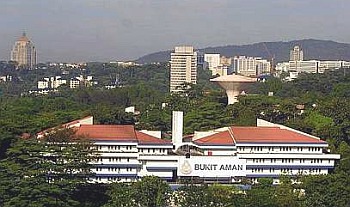
Peaceful surroundings: The goings-on at Bukit Aman can only be described as unprecedented and a scary development.

On Tuesday, Ramli came out in the open and admitted that he was the so-called RM27mil cop that the media had kept referring to in their reports on the probe. 

Clearly angry and even bitter, Ramli, 55, who is set to retire in March, blasted the ACA, the Attorney-General and the police for the manner in which they had carried out their investigations. 

Ramli knows the law well. He has a law degree from the International Islamic University and a Masters law degree from the University of London. He is also married to a Sessions Court judge. 

Ironically, Ramli who rose from the ranks of a constable, was at one time the boss of the current Inspector-General of Police Tan Sri Musa Hassan. But they are now engaged in an open feud. 

Sitting with a group of senior officers, Ramli said he had nothing to hide and that his sources of income – buying and selling properties including shares – were all declared under oath.  

There is more than this dramatic revelation. On Oct 25, Sergeant-Major Hasan Aman, 49, and ASP Hong Keng Hock, 42, were charged at the Malacca Sessions Court with falsifying witness statements. 

Hong and Deputy Supt Baharin Mohd Rose, 52, were charged in Kuala Lumpur, also with using false documents, against businessman Goh Cheng Poh @ Tengku. Two days later, the duo, who are with the CCID, were charged with falsifying a witness statement in Pulai on June 5.  

Again, the charges have been unprecedented and some security and political analysts have even described the developments in the police force as worrisome with talk that there are factions supported by different powerful political personalities. 

Deputy Security Minister Datuk Fu Ah Kiow has dismissed talk there is a “war” between the police and the Internal Security Ministry, in replying to Opposition Leader Lim Kit Siang who said from press reports, it sounded as if there was a power play between the ministry and the police. 

Fu’s statement, in downplaying the issue, is understandable, as the stability of the institution needs to be protected. It is the job of the police to maintain the security and peace of the nation.  

After all, the police headquarters is located at Bukit Aman and as the name suggest, the Government and the people have high expectations of the police force, particularly in keeping the country safe. 

But in August, IGP Musa startled the country when he revealed that he had been framed by his own men and warned his colleagues not to abuse their powers. 

It was a loaded remark from the top policeman and on the same day he spoke to the media, two packages containing 12-gauge shotgun cartridges were found addressed to him. The parcels, which also contained a threatening note, were discovered by workers at the Bintulu post office. 

No one is sure whether the so-called efforts to topple him and the parcel were related but one thing is for sure, the IGP's post is a hot seat. And no one can deny thetalk of disunity within the top brass of the force. 

Many policemen have found it hard to deal with Musa – he has cracked the whip, declared war against graft and transferred certain senior officials.  

He has also insisted that all policemen wear the Saya Anti-Rasuah badges on their uniforms. 

Musa has also made it compulsory for all policemen to declare their assets every six months and the lifestyles of his officers have also come under scrutiny.  

If they were to buy or sell property, Musa has ordered them to update their records.  

The sentiment is that Musa has been over-zealous in his task with some openly making known their displeasure of the regular transfers.  

Others said there can never be a quick-fix solution in the police force, where corruption has been long been an issue. It is well known that angry letters have been sent to Musa. 

His actions have hurt him, and he has been subjected to all kinds of allegations on the Internet. But the ACA has cleared him. 

More important, he has the Prime Minister’s backing. Musa has to accept the fact that in any organisation, there will always be resentment, jealousy and envy.  

Still, the power play is somewhat scary, if not macabre, to most Malaysians who have never witnessed such open tension within the police force.  

Maybe it’s Halloween but the can of worms being opened is disturbing, nevertheless.