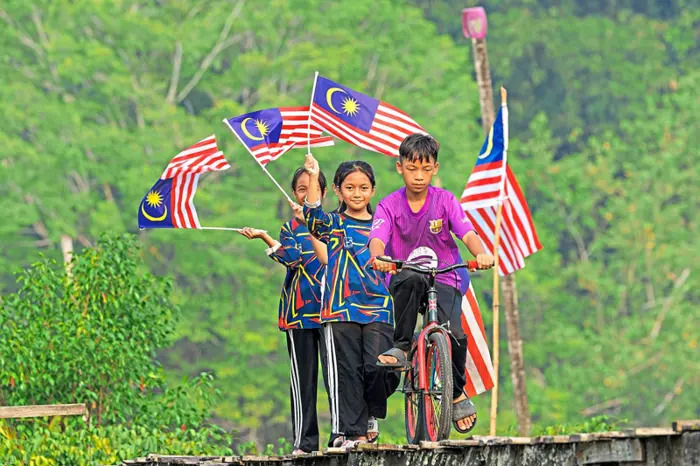
Friends proudly waving the Jalur Gemilang as they make their way around their village near Bako, Kuching. — ZULAZHAR SHEBLEE/The Star
NATIONAL unity may not be high on the agenda of some politicians these days who continuously play the race and religious card – but Tunku Abdul Rahman was clear about it.
The country’s first prime minister and Bapa Malaysia championed national unity as the core strength of a multiracial nation.
He understood and practised what he preached about the need for all Malaysians to stay together. Unity, he felt, was our fundamental strength as a people and as a nation.
“Every one of us must respect each other’s rights and feelings, be tolerant of each other’s religion, customs and habits, for in diversity we can find real unity,’’ he said in one of his many unforgettable quotes.
As a young reporter starting my career in The Star’s Penang office in 1984, I was indeed privileged to be able to see him up close.
He was our company’s chairman and he also wrote a popular column, Looking Back, and sometimes I was asked to go to his house to collect his work. They were typed in huge letters, owing to his diminishing eyesight.
He often used a magnifying glass to read his writing before passing the articles to me.
Sometimes I would have to wait a little longer as he would be busy with his poker games.
I will never forget his family members. They included adopted children who were Chinese. His staff was multiracial. So was his retinue of friends.
He was never afraid to say that Malaysia was established as a secular state with Islam as the religion of the federation rather than as an Islamic theocracy.
It’s there in the Hansard report of May 1, 1958.
In an interview published on Feb 9, 1983, he said it again. This time, he warned against turning the multiracial nation into a strict theocracy.
Today, not many politicians would dare make the same declaration as Tunku. After all, PAS is one of the biggest parties in Parliament.
But as we fly the Jalur Gemilang proudly, hear patriotic songs being played and watch Malaysians from all walks of life gathering to celebrate our independence, we should pause and ask ourselves an uncomfortable question: What does Merdeka actually mean to us today?
Is it simply about waving the flag, singing Negaraku and remembering Aug 31, 1957?
Or is it about protecting the Malaysia that our founding generation struggled to build?
The question is particularly important with race and religion being increasingly pushed to the centre of political discourse.
Worse, are we even discouraging Malaysians from flying the Jalur Gemilang with certain politicians indulging in fault-finding against those who make mistakes when flying the national flag? These Malaysians even risk their business premises being shut down as punishment.
Or they may end up being ostracised on social media, with political reprimands and name calling. Worse, they could even be arrested and handcuffed as happened to an editor last year.
The Tunku would never have tolerated such nonsense or allowed it become an annual ritual. He would not have allowed Malaysians to feel marginalised or let bullies go scot free.
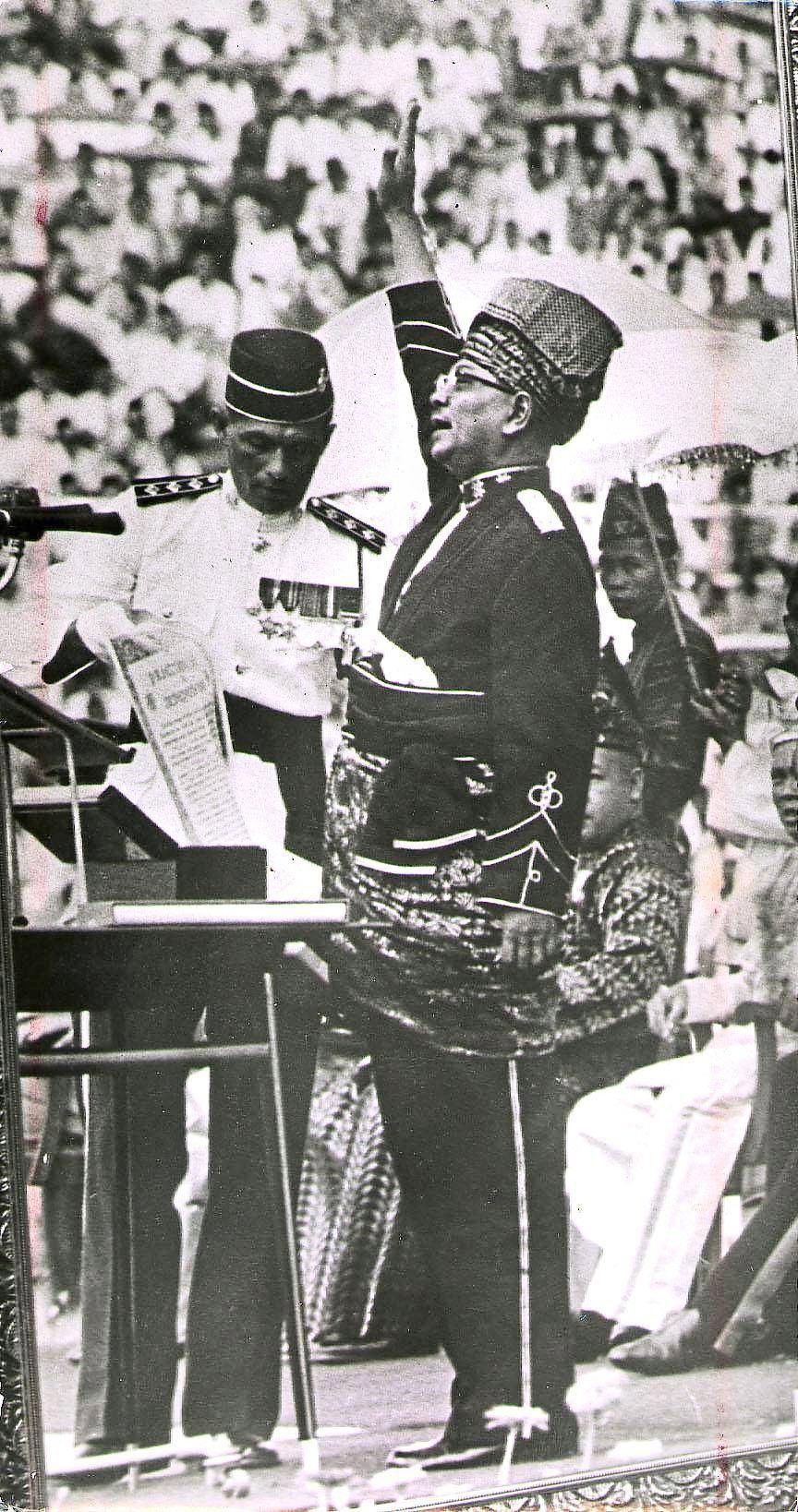
Founding principle: Tunku Abdul Rahman declaring ‘Merdeka!’ to the whole world in 1957. The country’s first prime minister had championed national unity as the core strength of a multiracial nation. — National Archives of Malaysia
There is nothing wrong with being proud of one’s race, culture or religion. These are all important parts of our identity.
Islam has a special position in our constitutional framework, while the Constitution also protects the legitimate interests of other communities and provides for freedom of religion and equality before the law.
The problem begins when these identities are turned into political weapons by politicians who tell Malays that their future is threatened by other Malaysians, or tell non-Malays that their place in the country is constantly under threat.
These people are not strengthening Malaysia. They are weakening it, dividing Malaysians and putting a strain on race relations in Malaysia.
Fear is an easy political currency to wield. It can be collected quickly and spent even faster during elections.
Race and religion become convenient tools to mobilise supporters, silence critics and create enemies where none should exist.
This is not the Malaysia we should be celebrating on National Day. Certainly, this is not what the Tunku would want.
Our founding generation understood that independence could not be built around one community alone.
Tunku Abdul Rahman and the leaders of the Alliance understood the practical necessity of working across communities. They did not have the luxury of pretending that Malaya belonged exclusively to one race or another.
They had to build a country in which Malays, Chinese, Indians and the many indigenous communities could see a future for themselves. That compromise was not a weakness, it was the foundation of our strength.
That is why it is so disappointing to see the word “Merdeka” sometimes reduced to slogans while the spirit behind independence is forgotten.
What did our founding fathers want?
Surely not a country where Malaysians constantly look over their shoulders wondering whether another race or religion is about to take something away from them.
Surely not a country where politicians compete to see who can make the most inflammatory statement about race and religion. And certainly not a country where patriotism is measured by how loudly we condemn fellow Malaysians.
Merdeka should mean freedom from fear, freedom to worship, freedom to speak responsibly, freedom to celebrate our own culture while respecting everyone else’s.
It’s freedom for a Malay Malaysian to be proudly Malay without believing that being Malaysian is somehow less important.
It’s freedom for a Chinese, Indian, Kadazan, Iban, Dayak or Orang Asli Malaysian to be equally proud of his or her heritage while being completely Malaysian.
And it’s the freedom for every Malaysian to disagree with a politician without being labelled disloyal to the country, race or faith.
Then, there is the Rukun Negara which was proclaimed on Aug 31, 1970. It is a reminder of what happens when national unity is allowed to fracture.
Its principles include loyalty to King and country, supremacy of the Constitution, the rule of law and courtesy and morality, while its stated aspirations include achieving closer unity among the people and preserving a democratic way of life.
Our founding generation did not have social media. They did not have algorithms pushing outrage into our phones every few minutes.
They did not have anonymous accounts turning every disagreement into a racial or religious confrontation. But they understood something we seem to be forgetting: a divided society is much easier to manipulate than a united one.
Political toxicity does not appear overnight. It grows every time we tolerate another racist remark because it comes from someone on our side.
It grows every time we excuse religious provocation because it benefits our political camp.
It grows when politicians turn ordinary differences into existential threats.
And it grows when decent Malaysians remain silent because they are tired of the arguments.
This is why National Day should be more than a celebration. It should be a moment of national reflection.
If our founding fathers could speak to us today, perhaps their message would be simple: You inherited a country together. Do not allow political toxicity to make you forget that.
The Jalur Gemilang belongs to all of us regardless of our race or religion, as His Royal Highness Sultan Sharafuddin Idris Shah rightly said.