Author Archives: wcw

Food for deep thought

It is bewildering that there are those who can imagine political motives tinged with religious and racial overtones in small trading enterprises.

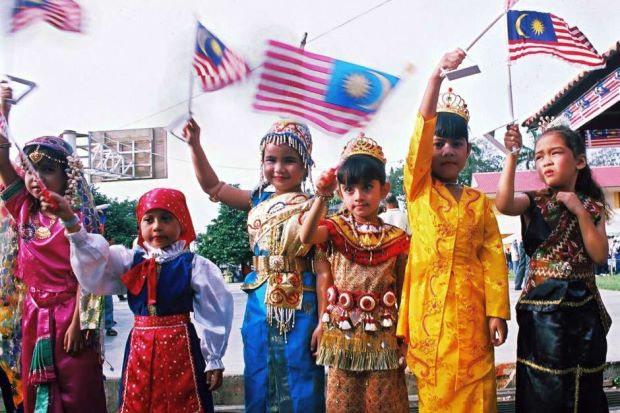
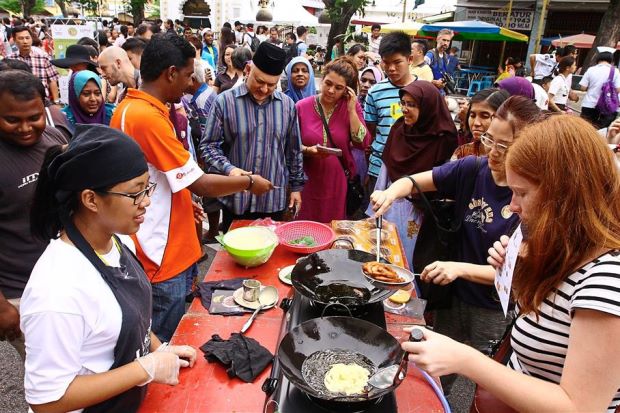
THE joy of being Malaysian must surely be in the immense variety of food, representing the rich diversity of our nation, before us. We Malaysians love our food passionately.

This is a great nation – where else but here in Malaysia do we wake up and can’t decide what we should eat for breakfast? And even as we tuck into our breakfast, we are already thinking about the spread of choices for lunch, and dinner too.

Coming from Penang, I am very selective when it comes to food. It must be nothing but the best.

Before I moved to the Klang Valley some 25 years ago to work, my day in Penang would start with nasi kandar.

It was difficult for friends outside Penang to comprehend why I wanted to eat rice, the dreadful carbohydrate, in the morning.

It seemed awfully wrong for anyone who wanted to stay healthy, but the 7am trip to my favourite nasi kandar stall in Kampung Melayu in Air Itam was like a pilgrimage.

In Petaling Jaya, where I currently reside, I found my nasi kandar at Kayu Nasi Kandar, which had its origins in Penang.

But it was at a small outlet in a coffee shop in SS2 that I first met its owner Burhan Mohamed. I would eat there at least once a week. From a customer to a good family friend, that’s how my relationship with Burhan has developed over two decades.

I also like the char kueh teow served by a Chinese hawker in Kelana Jaya. It is great stuff and her customers are predominantly Malays.

Then there is the nasi lemak kukus outlet in SS2 operated by a Malay. The long queues there each morning comprise mainly non-Malays.

The same scenario is repeated at the famous Jalan Tangsi nasi lemak stall, which used to operate under a huge tree, and also at Nasi Lemak Antarabangsa in Kampung Baru.

Every morning, we are thankful for the many nasi lemak stalls by the roadside that offer us delicious breakfast – the ones wrapped in banana leaf and newspaper! That’s a Malaysian institution and we swear it’s a lot better than the nasi lemak served on a plate!

Halal restaurants have sprung up so that Muslims can enjoy Chinese food but, more importantly, businessmen understand the consumer power of Malays. It is just business sense to cater to a wider market.

By and large, Malaysians have never connected the business of food to a racial angle. It would simply be ridiculous. By extension, we can include other kinds of businesses as well.

None of us really cares about the ethnicity of a trader so long as the price is deemed fair, the quality of goods sold is good and the service favourable.

It would be strange, even stupid, for a Chinese consumer to continue buying from a Chinese trader who continues to raise his price. He would rather buy from a trader of another race if the rival offers a better deal.

That’s common sense and that’s how things work in real life. It is bewildering, to say the least, that there are those who can imagine political motives tinged with religious and racial overtones in such enterprises.

I prefer kopi kaw in a warung or coffee shop, served by the Ah Pek in his Pagoda singlet, simply because I am old school, and I do not want to buy an expensive cup of branded coffee at a fancy coffee chain.

In fact, nowadays, we have a lot of ­modern-day coffee shops that usually ­operate in the malls and try to replicate the traditional coffee shop in terms of the drinks and food they serve.

But I still prefer to eat Ipoh koay teow in Sea Park and have roti canai at the mamak shop near my home. I think the food is more authentic, not to mention cheaper. So the extra money I pay for the air-conditioned comfort and cool ambience at fancy coffee shops is not worth it.

Maybe the younger generation will disagree with me, but never mind. The point is that people still look for good food because it is good food. And they do not even mind travelling great distances to savour a particular dish.

We are now going through a period when people are concerned about stretching their ringgit.

Somehow, they wonder why despite the price of petrol coming down, prices of many things that are part of daily life are still going up. And food is really a big part of the equation.

Recently, we ran a cover story on how a plate of char kueh teow was now not only more expensive, but also came in smaller portions. Many of our readers could identify with that.

Chinese New Year is just around the corner and I am sure many are trying to figure how much to put into the ang pow, especially when their employers have not been generous with bonus and increments.

These are the real bread-and-butter issues that affect everyone. And it will be good if we spend less time arguing with one another over inconsequential matters and concentrate on the bigger picture.

There is a term in psychology called cognitive priming. Simply put, it means that if your mind is currently thinking of something, you will tend to see that thing over and over again.

So, if you are planning to buy a new car of a particular make, it will show up at every nook and corner, as if to confirm that you are on the right track.

Malaysia seems to be going through this phase. Because of those who continue to fan racial and religious sentiments, now even the ordinary people are beginning to see everything through racial and religious prisms.

Even in the most ordinary things, we are too quick to raise the racial or religious angle without getting all the facts.

Social media can be both a blessing and a curse. While information can be quickly shared, comments that are given in an instant, without time for reflection and understanding, can really make matters worse.

We are a diverse nation. And just like the rich variety of food before us, we should rejoice in the diversity of views. We can disagree without being disagreeable.

The nasi lemak may be categorised as one dish, but everyone will tell you that the nasi lemak at one place is quite different from the nasi lemak at another place. So, even within the same category, you will have your differences.

Only politicians and those with certain agendas like to categorise people by race – that because they are of the same race, they must vote in the same way, eat in the same way, talk in the same way, and live in the same way.

It is time for all Malaysians to pause and look closely at how things really are. They should just turun padang and see the real Malaysia. And the best representation of this is when we gather together to eat and enjoy each other’s company.

Deep concern for all

The damaged billboard of the Datum Jelatek Project is seen following a demonstration by a group of residents in Taman Keramat, Kuala Lumpur recently.

The damaged billboard of the Datum Jelatek Project is seen following a demonstration by a group of residents in Taman Keramat, Kuala Lumpur recently.

No one should be allowed to think that race-based protests are tolerated or, worse, encouraged, because the authorities continue to close an eye to such protests.

IGNORANCE, prejudice, politically and racially motivated advice and, worse, economic disparity in an urban setting are a potent, and potentially volatile, combination.

The race-based protest against the Datum Jelatek condominium project in Keramat, Ampang Jaya, is hugely disturbing and it would not be wrong to say that the incident, though local in nature, should be of national concern because of the increasing racial polarisation gripping the country.

Malaysians are by now used to reading about protests by local residents in the Klang Valley and other major urban centres against the construction of apartments, malls, highways and even schools near their neighbourhoods.

The fight by residents to preserve space in their own backyard has never been so loud. It’s simply because residents feel squeezed and, more importantly, they are now more conscious of their rights, more willing to challenge the authorities, more astute at organising themselves, and more clever at using the social media and the press to highlight their plight.

Developers, especially the high-end ones who build exclusive gated properties and charge high maintenance fees, have found that they can no longer increase rates at their whim and fancy.

The residents scrutinise every bill and nothing escapes their attention. Then there are also those residents who are overwhelmed by the rapid changes taking place around them in the name of development.

Many of them stay in areas at the fringe of some of the prime districts that are already bursting at the seams.

For these people in closely-knit communities, there is a genuine fear over the loss of identity and even their homes.

We should look at what happened in the Datum Jelatek protest last Sunday in this context.

The protest turned rowdy when some 100 protestors reportedly turned aggressive and broke into the construction site.

While the police managed to bring the situation under control, what was worrying was that the protestors – and we are not even sure if they are residents – were in a frenzy because they had been led into believing that the project would transform the area into a Chinese district.

They claimed that Malays had been sidelined and that one or two blocks would be sold mainly to foreigners.

The RM1.2bil Datum Jelatek project, which started in 2008 on a 2.4ha land next to the Jelatek LRT station, comprises four blocks of luxury condominiums, a hotel, offices and a shopping centre.

The condominiums are being built on the former site of four blocks of Perbadanan Kemajuan Negeri Selangor (PKNS) flats, owned mostly by Malays, which were demolished in late 2010.

The project received its planning approval in November 2011 from the Ampang Jaya Municipal Council, but actual work had been postponed several times over a variety of issues.

This is normal in any project where the residents in the immediate surroundings have a right to voice their objections, and to point out procedural matters within a specific time period.

It is also common to have public protests but this becomes a problem when other parties get involved.

Whoever had a hand in organising the protest last week certainly did not believe in civil discourse.

Worse, they played the racial card and directed the protestors to vent their anger at the Chinese for daring to enter into the Malay enclave. In this case, the Chinese has become the bogeyman for nothing.

According to a media report, members of the Selangor chapter of Perkasa were seen among the rowdy crowd in the protest that was supposedly under the ambit of the Datum Jelatek Action Committee (BBDJ).

BBDJ chairman Salleh Samad was quoted as saying that the demonstration was organised to warn Selangor Mentri Besar Azmin Ali to stop the condominium project, saying that “it would open the floodgates to other races entering the Malay-majority area.”

Selangor Perkasa chief Abu Bakar Yahya, who was present, allegedly made racially inflammatory and offensive statements, going by a report in a news portal.

It is worth noting that the developer, Datum Corp International Sdn Bhd, is a wholly-owned subsidiary of PKNS and its management team is almost entirely bumiputra.

And we are now told that 1,097 bumiputra buyers had registered their interest to buy the 674 units available.

This means that the condominiums could entirely have only Malay residents although the PKNS quota for the project is 50% for bumiputra and 50% for non-bumiputras.

We can be sure that after this widely reported racially-slanted protest, potential buyers from other ethnic groups will shy away from this project, proudly proclaimed by the developer in its website as “the epitome of luxury in the heart of metropolitan city.

“A sanctuary in the middle of the hustle and bustle of a cosmopolitan city, Datum Jelatek is an oasis of rest and relaxation with world-class amenities and still be a stone’s throw from the excitement of a modern city.”

There is a lot of damage control to be done. According to the developer, the Keramat residents were not directly involved in the protest as the company had already met with them in stages to listen to their grievances.

It has already lodged a police report and is contemplating taking legal action against those involved.

The high number of interested Malay buyers has also proven that the community can afford to buy the apartments despite the high prices, and claims that the project would be swarmed by the Chinese are sheer rubbish and nothing more than a figment of the imagination of racist minds.

With the support and coordination of various stakeholders, local residents can benefit from the economic spin-offs of the projects in the area, even if they cannot afford to buy the units.

Local businesses can bloom and jobs can be created because of the project, and this is something that should be highlighted by the major stakeholders to the residents to counter the outsiders who seek to poison their minds.

The police have said that no arrest has been made so far, but they would investigate reports of trespassing by the protestors. But I think many Malaysians want to know what action will be taken against those who made racially inflammatory remarks at the protest and if they will be able to get away scot-free.

We should all be concerned about any form of racial or religious provocation by any individual or group.

We want the authorities to be fair and firm and not allow any form of race-based protest. Last week’s protest over the Datum Jelatek project is not just a local issue, but a matter of deep concern for all.

No one should be allowed to think that such race-based protests are tolerated or, worse, encouraged, because the authorities continue to close an eye to such protests.

This is not the Malaysia that rational Malaysians know. We certainly cannot allow such extremists to take control of the country’s directions.

Whatever their race or religion, they must not be allowed to grow and threaten the country that we all call our home.

A divisive detail

Filepic: Malaysian multi racial of all background that symbolize Malaysia.

Filepic: Malaysian multi racial of all background that symbolize Malaysia.

Removing the race columns from all forms would be a giant step in achieving national unity, as it would emphasise oneness.

IT’S a small step but the Sabah and Sarawak governments must be commended for their efforts to scrap the term “dan lain lain” or “others” in the race column in government forms.

While the three major races – Malay, Chinese and Indian – have their own columns in these forms, all other minorities in the country simply were classified as “dan lain lain”. It is not wrong to say that the term “dan lain lain” is demeaning and is almost equivalent to the term “alien”.

In fact, after 57 years of independence, it is incredible that we are still asking Malaysians to state their race.

While the Federal Government has insisted that there is a need to keep the race columns to help the government monitor the development of each race, it could certainly emulate what Sabah and Sarawak have done.

Even in the peninsula, putting minorities under the “dan lain lain” column would hardly help the government get an accurate picture of these ethnic groups, who are Malaysians, like everyone else.

Surely, as a responsible government, it would also want to know in greater detail the position of the Eurasians, Portuguese, Siamese, orang asli and other minorities.

Last week, the Deputy Home Minister rightly pointed out that in Sarawak, those classified under the “dan lain lain” group in the state actually outnumbered the Malays, Chinese and Indians. These three races are only distinct under a peninsula-driven classification.

The Sabah government has also decided to follow Sarawak and agreed to remove the “dan lain-lain” option in the race column on government documents. Those filling in the forms can now identify their ethnicity in the blank space provided.

According to Sabah State Secretary Tan Sri Sukarti Wakiman, “the state government will come up with a list of ethnic races in Sabah to be handed to the National Registration Department to reference in processing birth registration applications and Malaysian identity cards for those from Sabah”.

The “dan lain-lain” column in the race category has been a point of contention among Borneo’s native races who are mostly from ethnic communities, with Sabah itself having over 30 ethnic groups.

But it would not be wrong to say that many Malaysians have long questioned the need to state one’s race, and religion, on any form.

The requirement not only creates a deep psychological impact on Malaysians but gives the impression that we are officially divided by our racial and religious identities five decades after independence.

We will continue to be regarded as a country that is obsessed with race and religion when our nationality takes a back seat. We proudly see ourselves as Malaysian when we are overseas but the moment we step back on Malaysian soil, we are reminded about our race and our religion.

In many countries, it has become taboo, even unlawful, to state one’s religion in any official form. Religion is deemed as a private matter which no one, especially the government, has any business to ask.

In fact, Indonesians are required only to state their nationality in official forms, never their racial identity.

It is a diverse country like ours but because of assimilation, one cannot distinguish an Indonesian’s race and religion simply from the person’s name.

Removing the race columns from all forms would surely be a giant step in achieving national unity, as it would emphasise oneness.

While the Federal Government has given various reasons as to why it needs to maintain the race column, it could, for a start, eliminate this column in forms where the issue of race has absolutely no bearing.

As an example, if a Malaysian wants to seek the approval of the municipal council to carry out renovation of one’s property, it makes little sense that he has to state his race in the application form.

This may be a small start, but we need to do away with such requirements, especially if they have no bearing on the collation of statistical data.

This need to identify our race goes beyond official matters. I was at a shopping mall recently and decided to sign up for a discount card which cost me RM15. Guess what? I had to state my race in the application form.

To be fair, in the United States, there are still certain forms which require information about one’s race. The US Department of Housing and Urban Development still insists on racial information, especially when one is seeking assistance, but there is a disclaimer – there’s no penalty if you choose not to fill up the entire form because you do not want to state your race.

The private sector should also remove such columns about race and religion from their job application forms. They should also not state their racial preferences when they advertise their job vacancies.

Employers, both in the private and public sectors, must be able to see the tremendous advantage of having a multi-ethnic and even multi-national workforce.

Sabah and Sarawak have made a bold move which may provide the necessary catalyst for further changes. But as with any change, there will always be fears and concerns.

Those who are against removing the race column have expressed reservations on the loss of rights, privileges and identities. These are sentiments brought up by well-meaning people. We have to respect and understand certain realities.

But at the same time, we must also not be fearful of embracing changes – Malaysia and Malaysians need to grow up.

If we aim to be a developed nation, it is necessary that we also accept values fitting of a developed nation. Narrow sectarian, religious and ethnic issues are hallmarks of a Third World country. What Sabah and Sarawak have done would hardly meet calls to remove the race column but at least, “dan lain lain” has disappeared.

There will still be the need to state one’s race but at least we have given recognition and respect to our fellow Malaysians on how they should be identified in this category. It’s a baby step but we must congratulate the Sabah and Sarawak state governments. It’s a good start.

The importance of being civil

Social Media

Social Media

Today, thanks to social media, just about anyone can now share an opinion in an instant. But Malaysians are in need of clever and intelligent discourse.

IT is a mark of our maturing society that we are now beginning to be able to engage in discourse, even on the most sensitive of issues, without causing offence to one another.

The ability to disagree without being dis­agreeable is to be lauded. Too often, we have seen how individuals or groups prefer to engage in name-calling and verbal abuse, rather than talk rationally about an issue.

I have been a journalist for over 30 years and have also covered the Dewan Rakyat in my earlier years. While there was a fair share of those who spoke just to make sure they got themselves in the news, there were also many outstanding politicians with the gift of the gab who could debate rationally, their arguments punctuated with much wit, and they had the uncanny ability to cool things down when temperatures went up a few notches.

Older Malaysian journalists have told me of their experiences following the great debating skills of our founding fathers like Tunku Abdul Rahman and the earlier Opposition figures like the Seenivasagam brothers, S.P. and D.R., and Tan Sri Tan Chee Khoon.

They were legends who did not have to raise their voices or resort to using racial remarks to make themselves heard. They had class and have deservingly been accorded their place in our history.

Today, we are more exposed to how people engage in civil discourse for a wide variety of issues through different platforms. Democracy has never been so noisy.

Thanks to social media, just about any­one can now share an opinion in an instant. The more savvy politicians too have embraced social media but they are aware that they will never escape scrutiny and, of course, criticism for whatever they say.

But Malaysians are in need of clever and intelligent discourse. They want to read beyond generalised statements found in blogs and on Facebook. Instant responses, often clouded by emotional prejudices, cannot take the place of rational debate.

If anyone, especially a public figure, stands up for something, he must be prepared to square off with someone with a directly opposite view. It’s the same for academics who have to face peer review and cannot simply rattle off their views without being willing to listen, or offer space, to contrarian views.

For Malaysia, we have of late seen an active engagement of views over issues like race and religion. We have seen the emergence of the voice of moderation, as more people, many of them prominent members of society, speak their minds.

I am proud that this media group, which I helm as its chief executive officer, has given fair and equal opportunity to all sides to articulate their views. This is how it should be. So, if we give space to the so-called Group of 25, we have likewise given space to the Group of 32. So long as the debate remains civil, we should allow this to carry on. More importantly, both sides have called for a meeting of the minds on the issues affecting the nation.

It does not matter if even The Star’s Voice of Moderation campaign has been criticised by the Group of 32. We are ready to be cri­ticised by anyone, as long as they back it up with sound and rational viewpoints. We may be on direct opposites but most of us, whatever our beliefs, surely do not subscribe to any form of name-calling and threats.

When 32 men and women with consi­derable knowledge and accomplishments come together to take a stand, we ought to hear them out. Surely they are no different than any of us in wanting the country and its people to continue to do well. Never mind if we may not subscribe to some of their views, but differing views is a basic of democracy.

Let me put on record that I also share some of the views expressed by the Group of 32, such as those about economic disparity and corruption.

Be that as it may, it is unfortunate that there are some who are only able to see the world, or Malaysia, via a racial or religious prism.

The minority groups of different faiths make up a substantial number of this country’s population. They need not be reminded, over and over again, that they have to be grateful and that as a minority, they must be submissive and not speak up.

The Star has been criticised for purportedly using Malay personalities to voice their moderate views against the other Malay groups who do not share their liberal views.

Nothing could be further from these warped arguments. When we first initiated this campaign, ahead of National Day and Malaysia Day, we wanted to emphasise the importance of moderation. It needed to be pointed out that moderation was a key criterion for Malaysia to secure a seat in the United Nations Security Council.

There is also a government-funded Global Movement of Moderates (GMM), initiated by the Prime Minister, of which I am a trustee. Surely, if we talk about moderation on the world stage, we also need to practise it at home. Former MP Datuk Saiffudin Abdullah, another moderation advocate, heads the GMM.

It is also important to note that most of the writers and contributors featured in the campaign have been long-term columnists with The Star. They include Datin Paduka Marina Mahathir, Zainah Anwar, Azmi Shahrom, Zaid Ibrahim, Wan Saiful Wan Jan and Karim Raslan. They were not plucked from the air with no basis. Many of them have long been associated with The Star.

Minister Datuk Seri Idris Jala also writes for us and former diplomat Tan Sri Razali Ismail, who is also the chairman of GMM, is someone I have known for some time. Zainah has been a good friend since 1990 when I first met her as a journalist. And I am privileged to know her other family members as well. I hold her in high regard.

These are the people, who happen to be Malays, who have always been the moderates in our country. They have always been given the space to articulate on issues that they care about, including moderation. What the campaign has succeeded in doing is to make more people aware of the need to speak out if they do not want the forces of extremism to gain ground.

It is an insult to suggest that the Group of 25 and other moderates who support them are being used as pawns in a racial plot. These people have long-established credentials with sterling service records to the country.

Datuk Noor Farida Ariffin, who is the coordinator of the group, is not only a former ambassador but also one of the top legal brains in this country, having served more than 25 years in the judicial and legal service including stints as a magistrate and Sessions Court judge. At Wisma Putra, she handled territorial and maritime issues before her posting as Malaysia’s ambassador to the Netherlands, where she also served as Malaysia’s co-agent to the International Court of Justice on the Pulau Ligitan and Pulau Sipadan case.

Then there is Liyana Khairuddin, who initiated the #iam26 social movement in support of the eminent Group of 25. Unknown to many, Liyana, who humbly prefers to be known as just a scientist, is a virologist who specialises in HIV research.

I agree wholeheartedly that the Malays have been generous and it was the community’s willingness to share and build consensus that chiefly helped us get our independence and build Malaysia to what we are today. But we must not forget that without the support of the other communities, there would be no independence and without the Sabahans and Sarawakians, there would be no Malaysia either. Our founding fathers, who travelled to London for the talks, did so as a multi-racial team, lest we forget.

Every community has its share of extremists. This writer has criticised groups like Dong Zong and Hindraf, with its racist overtones, long before even Perkasa was born.

There have also been personal attacks, almost all the result of racial prejudices, from people who do not know me. But it is worth repeating here that my love for the Malay language and culture was the main reason why I sat for the Malay Literature paper in my Sixth Form examination, when it was called Higher School Certificate. I had to memorise Sejarah Melayu and Tuhfat Al-Nafis. I studied Islamic History as well.

When I entered Universiti Kebangsaan Malaysia, I chose the Malay Letters Department in my first year as an extension of my love for Malay literature. Pantun, Indonesian and Malay literature enriched my life greatly, and I have spoken out many times that there is no basis to the fear of learning about Islamic Civilization in our public universities.

It was a compulsory course in UKM and remains so, and I had the privilege of listening to the lectures of the late Fadzil Noor, who went on to be become a PAS president, and former lecturer Dr Haron Din, who is now a PAS elder.

I find it odd that there are politicians who still attempt to use the teaching of Islamic Civilization as a political issue. I learnt it 30 years ago, and I can’t think of any non-Muslim in my batch who converted as a result!

I have continued to be engaged with the works at the Al-Bukhary Islamic Museum, where I continue to collect some of the best books on the religion by the museum.

In fact, there are family members who have embraced Islam and my favourite aunt is a tudung-clad Muslim who naturally shares my moderation stand.

Many of my Malay friends find the views of certain extreme Malay groups embarrassing but they are caught in a situation where they know they will be criticised if they openly declare themselves as liberals.

All these recent discussions, passionate in many aspects, have helped me to forge a wider world view and have a greater appreciation of our communities in Malaysia. In the process, they have also strengthened my moderation views.

From the start of the campaign, we have emphasised that we wanted to speak about common values of all races and religions such as compassion, tolerance, patience, understanding and mutual respect.

We cannot pretend that religious extremism does not exist in this country. In fact, extremism in all forms can be found everywhere; such is the nature of men.

Religious extremism is not widespread in Malaysia but it is a threat nevertheless because the words and actions grab a lot of attention. They intimidate and agitate and, in certain circumstances, they can quickly spiral out of control.

We cannot afford to be dismissive about something that can potentially wreck our way of life.

God, by whatever name we call Him, has made Malaysia a plural society. He has put colour into our lives. He must have a reason for doing so, and surely if we believe in God, He would want us to live in harmony and to showcase our plurality in our daily lives – not just for show to the tourists!

Killing is not the answer

 French nationals attend a vigil in solidarity with the victims of the shooting at the Paris office of the satirical newspaper Charlie Hebdo in front of the Chiang Kai-shek Memorial Hall to memorize the people attacked by gunmen on French satirical weekly Charlie Hebdo in Paris that killed 12 people in Taipei on January 9, 2015. - AFP

French nationals attend a vigil in solidarity with the victims of the shooting at the Paris office of the satirical newspaper Charlie Hebdo in front of the Chiang Kai-shek Memorial Hall to memorize the people attacked by gunmen on French satirical weekly Charlie Hebdo in Paris that killed 12 people in Taipei on January 9, 2015. – AFP

THERE is outrage sweeping across newsrooms throughout the world over the heinous murder of 12 people, 10 of whom were journalists, in the attack on the Charlie Hebdo headquarters in Paris on Wednesday.

The other two killed were policemen – one was the police guard of the editor Stephane Charbonnier, and the other, who was shot in the street during the getaway, was a Muslim officer of Moroccan descent.

Charlie Hebdo is a French satirical weekly newspaper that pokes fun at just about everything under the sun, including revered religious figures.

We may not agree with the mocking of religious and political figures by this magazine but it is hard to justify any act of terror in retaliation to the magazine’s work. It was just plain murder, but carried out in the name of religion.

These terrorists have done nothing to help non-Muslims have a better understanding and appreciation of Islam, which promotes peace and tolerance.

They have, in fact, caused serious ­damage and have given those who push the Islamophobia agenda an excuse to take their plans a step further.

The world’s media community shares the grief of the families of these journalists who were killed while performing editorial duties.

It is important to note that Muslim leaders including Prime Minister Datuk Seri Najib Tun Razak have come out quickly to condemn this horrendous act.

“Malaysia condemns in the strongest terms all acts of violence. We stand in unity with the French people. We must fight extremism with moderation,” he said in a Twitter posting on Thursday.

Likewise, our Foreign Ministry also said, “Nothing justifies taking innocent lives. Malaysia is united with the families of the victims, the Government of France, and the French people.”

But even as we condemn the killings, there is an important lesson for the world, especially the Western world, to learn from this tragedy.

There may be no sacred cows for the Western media because of their fervent belief in the freedom of expression. But the reality is that not everyone accepts nor appreciates such a principle.

And because we are so globally connected, it is no longer possible to operate just within a particular society that embraces such an approach. The media’s work, from whichever part of the world, has basically become freely available to everyone.

World political leaders and entertainment figures can be lampooned without any major consequences, but like it or not, religion remains an emotionally charged issue.

The demography of many European countries, especially France, the United Kingdom and Holland, has changed drastically with a high Muslim population. In fact, there are six million Muslims in France, making it the country with the most number of Muslims in Western Europe.

While Europe expects all Muslims to accept assimilation into Western values, not everyone can accept the regular mocking of Islam and, in this case, to denigrate and desecrate a Prophet, as Dr Chandra Muzaffar, president of the International Movement for a Just World, aptly described.

Certainly, the right of expression does not include the right to insult what is regarded as sacred and important to any religion and, by extension, the millions of its faithful.

The Prophet, Jesus, Buddha and the Hindu gods cannot be likened to politicians who are merely human beings who can be subjected to scrutiny, which satirical magazines can target regularly.

When it comes to matters of faith, so-called rationality is not something that can be applied nor used as argument for freedom of expression.

It is important that the Western media does not fan fears of Islam following this Paris tragedy. The reality is that many such incidents are perpetrated by evil people with their own agendas, not about their religion.

The recent incident in Sydney, for example, showed us how the authorities and the people of Sydney came together to reassure the Muslims there that although the gunman was a Muslim, the hostage crisis at the café was not about his religion.

There are good and bad people in every faith, as well as among those who do not believe in any religion.

There are, for example, white supremacists among Christians. Have we forgotten the 32-year-old right wing extremist Anders Behring Breivik, who went on a shooting spree in 2012 in Norway?

Certainly, all right-minded Christians did not condone the action of the pastor of the Christian Dove World Outreach Center in Florida who announced he would burn 200 Quran on the 2010 anniversary of the Sept 11 attacks.

His stupidity caused 20 innocent people to be killed as his threat sparked protests in the Middle East and Asia. He later apologised and pledged never to burn a Quran, but that came too late as lives were already lost.

Surely, the action of this man, who calls himself a pastor, is not representative of the religion.

In every religion, there will always be extremists who interpret their holy books to suit their personal or political agendas. There will be people who want to act and sound like religious figures and, likewise, there will be religious figures who want to be political figures. When the line between religion and politics becomes blurred, it becomes dangerous.

Religion can be so easily manipulated because the ordinary adherents of the faith are, by nature, fearful of challenging any religious authority, especially those who dress up to look religiously pious.

I remain a believer that the Sedition Act should be kept intact simply because there should be zero tolerance for anyone whose actions or words can lead to security concerns. But there should be a golden rule – please exercise the powers fairly. We cannot scream for certain individuals to be hauled up for sedition charges and in the same breath call for its abolition. We need to be consistent.

Let no Malaysian have the perception that some individuals or organisations have special protection that allows them to get away with offensive remarks or actions. Nor should the Sedition Act be used to shut up a political opponent or, worse, an academic who cites a case study in an article or gives a view to a newspaper.

But more importantly, the one lesson from Paris for the rest of the world is that we must never let extremists have their way. Moderation must always prevail. And let’s not forget that we must not let evil defeat us but instead conquer evil with good.

Moderates unite

Power in unity: We live in a multiracial and multireligious society, where the interaction between people of different faiths cannot be avoided.

Power in unity: We live in a multiracial and multireligious society, where the interaction between people of different faiths cannot be avoided.

In the coming weeks, more like-minded Malay moderates are expected to step forward to keep the Voice of Moderation alive.

IT’S heartening to kick off 2015 with the Voice of Moderation gaining more momentum. As I write this article, Datuk Noor Farida Ariffin, the former Malaysian Ambassador to the Netherlands, had just sent out an e-mail to the media to inform them that more eminent Malays have joined the Group of 25 to make their stand against extreme racial and religious views.

The latest group of respectable figures to join the Group of 25 are former Public Services Department director-general Tan Sri Alwi Jantan, former Universiti Malaya vice-chancellor Tan Sri Rafiah Salim, businessman Datuk Seri Nazir Ariff, former Ambassador and Asean deputy secretary-general Datuk Ahmad Mokhtar Selat, former Petronas Dagangan Berhad CEO Datuk Anwaruddin Osman, former Defence Ministry deputy secretary-general Datuk Baharuddin Musa, Universiti Malaya Faculty of Medicine dean Professor Dr Adeeba Kamarulzaman, former Universiti Malaya Economics faculty dean Professor Dr Ariff Abdul Kareem, former MP Mohamed Tawfik Tun Dr Ismail and former Commerce International Merchant Bankers Berhad corporate finance executive Shazal Yusof Mohd Zain.

The 10 all share the same concerns over recent developments regarding race relations, Islam and the rise of extremist behaviour in Malaysia. The group of 25 prominent Malays had, on Dec 7, called for a rational dialogue on the position of Islam in a constitutional democracy.

“Given the impact of such vitriolic rhetoric on race relations and political stability of this country, we feel it is incumbent on us to take a public position,” Noor Farida Ariffin, a lawyer, had said in a statement when the group released its letter to the media.

I believe that in the coming weeks, more like-minded Malay moderates will be stepping forward to keep the cause alive.

These are the concerned citizens who will openly make their stand even though they are aware that they will be called all sorts of names for doing so. Many have already declared their support to the group, including CIMB group chairman Datuk Seri Nazir Razak and former deputy Prime Minister Tun Musa Hitam.

Nazir, in an interview with The Edge in its Dec 22, 2014 issue, said, “it was refreshing to read the recent public statement by 25 prominent senior Malaysians calling for a dialogue on religion and political stability. I could not agree more.”

In the article, he was also asked whether there was anything that he reckoned Malaysians should be thinking about more.

His reply: “National unity. Why do we allow the racial paradigm to dominate us when there is so much power in unity and leveraging diversity?”

Meanwhile, Musa, who proudly proclaims himself “always a moderate and proud to be one,” said in an interview with this newspaper on Dec 22, “I was very happy to see the statement made by the 25 prominent Malay personalities. To me personally, that was a very good symbolic statement made by them in that they triggered thinking, arguments and conversations.

“Then there were the responses, which I compliment also because they are not calling names. They are not arguing based on irrationality but arguing on an almost point-by-point basis.”

The highly-respected Tan Sri Munir Majid, a visiting senior fellow at LSE Ideas Centre for International Affairs, Diplomacy and Strategy, wrote in his column in The Star yesterday that “The great – and main – contribution of the 25 prominent Malays who wrote that open letter calling for rational dialogue on the application of Islamic laws in the country, is to highlight there is a serious existential problem over the political system to which Malaysia subscribes – which is being loudly and evidentially challenged.

“It cannot any longer be avoided or swept under the carpet. It could lead to violence and violent change. It needs management through strong political leadership.”

Supporting the calls for dialogue, Dr Munir also pointed out that “In any such discussion, the two groups should be mindful of the sensitivity of re-opening issues in the constitution which touch upon inherent rights, especially of the non-Muslims.

“It has to be borne in mind that the minorities in multiracial Malaysia are not insubstantial and that there is an intermingling among the races which can raise issues – and there are numerous cases of this – which affect fundamental civil rights guaranteed in the Federal Constitution.”

All of them have hit the right chord about the need for rational discourse. This is in fact in line with the politics of consensus that has been pivotal in the governance of this country.

The Alliance and subsequently the Barisan Nasional, by bringing together different political parties representing different interests, has been able to rule this country since independence because it subscribes to the winning formula of consensus-building. Compromises have to be worked out to ensure that all races are represented in the Government to ensure its legitimacy.

It is a winning formula and there is no reason for any party within the coalition, even if it represents a particular group, to only focus on the interest of that group and forsake the interests of others.

What has troubled many Malaysians is that of late, a small group of individuals and a few organisations have been emboldened to make endless racist and seditious statements. They have no credible track record but continue to be in the limelight because they seem to be able to get away with their rantings, giving the impression that they have the perceived approval of the authorities. A terribly dangerous signal has been sent off.

Coupled with this is the insistence of PAS to push for hudud laws in Kelantan and this has put Umno in a spot, with religion now becoming a central agenda in Malay politics. If both parties support it, an unprecedented political development would be set off. It would certainly trigger off reactions from the non-Muslim component parties in both the Barisan and Pakatan Rakyat.

There will be no turning back if Malaysia, starting with Kelantan, takes on a different route – one which was never on the plan of our founding fathers, who clearly stated that Malaysia is to remain secular.

It is the height of naivety for non-Muslim citizens of this country to believe that this is strictly an issue for the Muslims – that hudud laws would not affect them, as PAS wants many of us to believe.

We live in a multiracial and multireligious society, where the interaction between people of different faiths cannot be avoided. How will the laws be applied, say in a rape case where the victim is a non-Muslim woman and the perpetrator is a Muslim man? How do we reconcile the weight of evidence required to prove rape under hudud and our existing Penal Code?

And what about a business contract involving Muslim and non-Muslim parties going awry? Which court will arbitrate and how will justice be dispensed?

Many Malaysians are deeply concerned over the state of the nation and the direction this country is heading towards. In the words of Noor Farida, she fears that Malaysia would end up like Pakistan and Afghanistan, where the religious authorities would reign supreme.

Moderates like Noor Farida and many others have had to pay a price for standing up against the extremists.

Perkasa chief Datuk Ibrahim Ali has filed a suit for RM500,000 against me and Star Publications.

I have no intention of paying him a single sen, and I am waiting for the papers to be served on myself so we can get down to the formal stage of filing my statement of defence. Hopefully, the court will strike off this frivolous suit, which is nothing more than just intimidation.

Ibrahim has also threatened to sue Noor Farida, and it is good that the latter has urged Ibrahim to go ahead with the legal threat, so the matter can be settled in the courts.

Many personal threats and insults have been made against this writer by other like-minded extremists. In their inability to argue their case rationally, they resort to political and racist bullying. By now, most of us are pretty tired by simplistic arguments like, “go back to your country of origin if you don’t like Malaysia.”

This is unlike the rebuttal by the Group of 32 to the Group of 25, whose letter was also published in this newspaper. Their point-for-point response is the kind of civil discourse that we want to see, so that Malaysians can study the views that are put forth.

For the moderates, the biggest challenge has always been about their ability and willingness to point out, even criticise, the flaws of their own communities and religions.

I have been accused of not making criticisms against groups like the Chinese education group Dong Zong and the Opposition, to cast aspersions on me as a true moderate. Can they just Google my past writings? Stop being lazy.

In 2012, in a Tweet, I strongly criticised the Chinese group for their outrageous suggestion that non-Mandarin speaking teachers be transferred out of Chinese primary schools.

Earlier in Nov 5, 2000 I questioned Dong Zong, in my column, on its objection to the Vision School concept, where three schools of different mediums of instruction – Bahasa Malaysia, Chinese and Tamil – would occupy a common compound and share facilities.

“These schools have been totally integrated under the Vision Schools but their characters have remained unchanged. It would do a lot of good to the Dong Zong if it emphasises less on ethnicity,” I wrote. And these are just two examples.

I am a product of the English-medium school system and I will be among the first to tell off groups like Dong Zong that it cannot operate like a communist cell group.

The same line of attack has been made against Noor Farida and other moderates to make them go on the defensive. But the moderation movement does not belong to any one individual or group. It has become the People’s Movement.

Ordinary Malaysians – fresh faces and voices – have emerged. Names like Lyana Khairuddin, who initiated the #iam26 social media movement, and moderate advocates like Hannah Kam, Dina Murad, Firdaus Zulkifli, Alia Aishah Sharir, Michael Teoh, Sunildave Parmar, Tan James Anthony and Kanyakumari Damodran. They may not be household names but they dare to stand up and be counted, and make their voices heard.

If what started as the Voice of Moderates initiative by The Star in August last year – ahead of the National Day and Malaysia Day – has snowballed into an awakening with more moderates joining in, then I believe this spontaneous movement will grow larger, on its own.

Certainly, the court case involving me will add more spark, but more critically, ordinary moderate Malaysians must come together to send out a loud message to our leaders.

We will not let the extremists hijack Malaysia. Let no one be cowed, bullied or intimidated by those uncouth mouths, as we unite to keep Malaysia moderate.

Amazing quotes by Malaysians in 2014

THE year is winding down to a close. In three days’ time, 2014 will give way to 2015. It has been quite a year. As I had to file this week’s column early so as not to interrupt my year-end holiday, I thought it would be fun to reflect on some of the most amazing things said by Malaysians in 2014. The quotes that inspired were few and far between.

Instead, the quotes that got the most attention, not to mention got us into the global press for all the wrong reasons, seem to come one after another.

So, here are some of the most outrageous, idiotic, and humorous quotes (in no particular order) that I have selected that, in my opinion, definitely enraged and entertained Malaysians.

I am sure there will be more to come in the new year, so let us learn to laugh about such verbal antics.

1. Controversial Kinabatangan MP Datuk Bung Mokhtar Radin put his foot into his mouth, yet again, this time linking the German football team to Adolf Hitler.

After Germany humiliated Brazil 7-1in the semi-finals of the World Cup on Wednesday morning, Bung tweeted

“WELL DONE..BRAVO…LONG LIVE HITLER”.

July 9, 2014, The Star

ktbali 4...Perkasa President Datuk Ibrahim Ali during conference with media yesterday/pic by SAZUKI EMBONG/April 10/2013

2. Perkasa chief Datuk Ibrahim Ali, in responding to the open letter by the Group of 25:

“I am a moderate too.”

December 14 at Perkasa’s annual assembly in Kuala Lumpur.

Isma Logo to use for graphics on 10 worst quotes

3. Ikatan Muslimin Malaysia (Isma) international bureau central committee member Dr Norhasliza Ahmad Fauzi, on why “moderation leads to sinful choices”:

“Moderation allows for a wide avenue of freedom of speech, human rights and sinful choices, even though this is prohibited by Islam. That freedom helps people belittle the capability of Islam and its contents and demands. This is why we object to it and we voice out.”

The rakyatpost.com Dec 19

4. Isma has once again stirred up controversy by saying Malays should not wish Christians “Merry Christmas” and celebrate along with them.

Isma activist Abu Ameen:

“In a world which has lost all sense of God and has turned to alcohol and consumerism to drown its sorrows, we as Muslims can show there is a better way of life for all mankind to experience peace — not by kissing under the mistletoe or visiting Santa, but instead by embracing Islam.”

The rakyatpost.com Dec 21

Road Transport Department (RTD) director-general Datuk Seri Ismail Ahmad talking to media after a RTD Northern briefing in Butterworth, Penang.Star pic by Asri Abdul Ghani / October 30, 2014

5. Road Transport Department Director-General Datuk Seri Ismail Ahmad had estimated how many people the Department “wants to see dead” in road accidents approaching 2020.

In an Astro Awani interview, Ahmad can be seen saying “We estimate that 10,716 people will die before 2020 (in road accidents)”.

“Our initiatives are part of the efforts to reduce the number of Malaysians dying on the road because we have a KPI.”

“We want to see only 5,358 people dead approaching the year 2020.” (“Kita nak orang ramai mati 5,358 orang sahaja menjelang tahun 2020”).

Astro Awani, Nov 4

CHONG CHIEN JEN

6. Sarawak DAP MP Chong Chien Jen was slammed, rightly, for his idiotic Facebook posting questioning why the national anthem was played before a movie, during the National Day and Malaysia Day celebrations. The MP later apologised.

In his original posting, not mincing his words, Chong labelled the move to play the national anthem as an “absolute disgrace and ridiculous”.

“Is Malaysia heading towards the communist Mao era where everywhere you go, you must shout out loud and show that you are a patriot?”

Malaysia media in September

Anwar Ibrahim   gestures as he leaving the Palace of Justice  in Putrajaya on 6 November  2014AZHAR MAHFOF/The Star

7. Opposition Leader Datuk Seri Anwar Ibrahim on the missing MH370:

“I can find it in 1 second if I am to be given power. ‘’

Southern Weekly Magazine, April 5

Well-known bomoh Ibrahim Mat Zin who claims to be Raja Bomoh Sedunia performing a prayer for the second time to locate Malaysia Airlines flight MH370 at KLIA, Sepang on Wednesday

8. Bomoh Ibrahim Mat Zin aka Raja Bomoh Sedunia Nujum VIP aka Datuk Mahagury at the KLIA to help locate the missing MH 370, using “Zam-Zam” water, two coconuts, a “magical” walking stick and carpet.

“The purpose of the rituals is to weaken the bad spirits so that the rescuers can find the plane if it indeed had crashed,” he told reporters.

The Star, March 21

Kinabatangan mp Datuk Bung Mokhtar smilling at the swearing  in at Parliament house today.

9. Datuk Bung Mokhtar Radin, again, for claiming that some passengers are being “fondled” (diraba) at Malaysian airports and may be “sexually stimulated” as a result, while undergoing security pat-down checks.

The MP for Kinabatangan asked why Malaysia Airport Holdings Berhad (MAHB) did not use handheld scanners for passengers who had triggered off metal detectors at security checkpoints, but resorted to manual pat-downs instead.

“It makes passengers uncomfortable when they have to undergo such inspections. This is dangerous because it may be sexually stimulating (menaikkan nafsu),” he said, drawing laughter from the floor.

He said that checks conducted on women were gentle, but men had to go through a rougher process.

“They check us all over our bodies and sometimes touch us in places that can cause discomfort,” he added.

The Star, Nov 11.

Ahamad Tarmizi Sulaiman.......PAS N-24 Jeneri state seat candidate.(Captioned by photographer  G.C.TAN / THE STAR -17th April 2013)

10. Kedah PAS Youth leader Ahmad Tarmizi, on the two MH tragedies, saying MAS and the government had earned God’s wrath for “serving alcohol and the dressing of MAS flight attendants, which crossed the boundaries of Islam.

Malaysian media July 22.

Find a middle ground

Happy ending: Sultan Sharafuddin (third from right) and Azmin (right) witnessing Mais chairman Mohamad Adzib Mohd Isa (second from right) returning the Bibles to Archbishop Bolly at Istana Alam Shah in Klang. Also present were (from left) Council of Churches Malaysia secretary-general Reverend Dr Herman Shastri and ACS secretary-general Ambrose Linang. - filepic

Happy ending: Sultan Sharafuddin (third from right) and Azmin (right) witnessing Mais chairman Mohamad Adzib Mohd Isa (second from right) returning the Bibles to Archbishop Bolly at Istana Alam Shah in Klang. Also present were (from left) Council of Churches Malaysia secretary-general Reverend Dr Herman Shastri and ACS secretary-general Ambrose Linang. – filepic

The bridges that connect us as Malaysians are far more important than the walls that some want to build to accentuate our differences. 

WE can all do with a bit of good news, which seems to be a rare commodity these days in Malaysia, where the voices of bigotry and extremism seem predominant.

It is good to read that all the 31 hymn books meant for the orang asli parishioners, which supposedly contained the word “Allah”, have been returned.

We are sure the 100 orang asli members from the Catholic church in Johor would look forward to singing praises to God during the Christmas mass.

In this season of Advent (traditionally, the Advent season lasts for four Sundays leading up to Christmas), it is appropriate that Father Cyril Mannayagam has said he wanted to put the incident behind him.

He has emphasised that the books are meant for the Bahasa Malaysia-speaking orang asli community living in Bekoh.

On a note of optimism, Father Cyril reportedly said there would not be any similar problems with the authorities in the future after explaining to the police the purpose of the books.

Father Cyril also said the parishioners had been using the word “Allah” for more than 100 years when practising their faith.

The hymn books titled Mari Kita Memuji Allah Kita (Praise Be to Our God) contained the word “Allah” and had a picture of a church with a crucifix printed on the front page. They were confiscated from a bookshop in Tangkak by the police following a tip-off on Dec 5.

The seizure of the hymn books by the police – and not the religious authorities – had caused uneasiness among Christians, coming so soon after the closure of the Bible issue in Selangor.

In the Selangor case, which dragged on for nearly a year, the crisis came to an end after the intervention of His Royal Highness the Sultan of Selangor himself to resolve the issue.

What was more disturbing in the case of the hymn books in Johor was that the police had described the books as “sensitive” and classified the case under Section 298A of the Penal Code for causing disharmony, disunity or feelings of enmity, hatred or ill will on the grounds of religion.

The unilateral involvement of the police was most unusual. After seizing the hymn books on Dec 5, the cops could not decide what to do, saying they had referred the case to the deputy public prosecutor on Dec 7.

The use of Section 298A has also been criticised by lawyers, who point out that the apex court had ruled as far back as 1988 that this section of the Penal Code is “unconstitutional” and cannot be used on issues affecting Islam.

It goes to show again how difficult it is when matters affecting the faith are subjected to legal and judicial interpretations.

We can be sure that these two cases in Selangor and Johor won’t be the first and the last because Bahasa Malaysia church services are conducted not only in Sabah and Sarawak, but also in an increasing number of churches in the peninsula.

This is the reality that we cannot avoid as a new generation of Malaysians, schooled in Bahasa Malaysia, would be more proficient and comfortable with Christian religious material in the national language.

It is also a fact that many Sabahans and Sarawakians are working in the peninsula. For practical reasons, we cannot be telling them to pray differently and use other versions of the Bible – those deemed appropriate by the authorities – when they are on this side of the South China Sea.

Let us not forget that many Indonesians working here are also Christians and like ordinary Malaysians, they also have spiritual needs. They too attend church services conducted in Bahasa Indonesia.

We need to find a middle ground that is acceptable to all. Common sense needs to prevail and we must understand and respect the state laws in place. As with any middle ground formula, not everyone would be happy but we would like to hear better solutions, if there are any.

The Bahasa Malaysia Al-Kitab that were seized from the Bible Society of Malaysia in Selangor and the hymn books in Johor have a distinct similarity – they were meant solely for the use of the Christians, and not for propagation to Muslims.

Churches in Malaysia understand the line and they will not cross it – it is an offence to propagate to Muslims and the usage of the word “Allah” by non-Muslims is also prohibited in many states.

But we also must take into account the historical practices of some Christians, especially native groups, and this is where the 10-point solution needs to be better understood and upheld.

It is a Cabinet decision and it is important that Federal and state agencies understand and respect the 10-point solution.

The Cabinet has reconfirmed the validity and its support for the 10-point solution, as was originally announced in April 2011, to manage the polarity of views between the various religious groups, in particular Christians and Muslims, taking into account the laws of the country.

As stated in the 10-point solution, for Sabah and Sarawak, there is no restriction on the import and local printing of Bibles in any language, including Bahasa Malaysia/Bahasa Indonesia and indigenous languages (referred to collectively as the “Alkitab”), as the Government recognises that there is a large Christian community of indigenous origin in these two states.

It is also in line with the spirit of the 18- and 20-point agreements, when Sabah and Sarawak became part of Malaysia. It has been argued these agreements allowed for full freedom of religion in both states.

The 10-point solution states that “as for Peninsular Malaysia, the Alkitab, whether printed in Malaysia or imported into Malaysia, must have the words ‘Christian Publication’ and the cross sign must be placed on the front cover as imposed by the Government in the interests of the larger Muslim community in Peninsular Malaysia”.

The paragraph above is important because in the case of the hymn books, they reportedly carried the picture of a crucifix, which would have clearly denoted that it is a Christian publication.

Sensibility vs sensitivity

There is no need for anyone to feel “sensitive” over a picture of a cross. In fact, churches become “centres” instead of “churches”, with local authorities flexing their muscles to show their displeasure over the word “church” on signboards. What more a cross outside the churches.

But to avoid unnecessary controversy, churches should consider stating boldly on all their Bahasa Malaysia publications that these are meant for non-Muslims.

Once this is explicitly stated, no individual or religious agency should have any reason to seize such publications on the grounds that they are deemed “sensitive”.

To put it in a simple way: it is like movie classifications. You do not go to a cineplex with your young children and choose a movie rated 18 or R because you know what they can or cannot watch.

These issues of seizing religious publications for whatever reason will continue to be with us because everyone will want to interpret the law in their own way. The religious authorities, the police and the Attorney-General can have differing viewpoints, which is why such matters continue to be played up in the press.

And all such reports will go global, giving the impression that Malaysia is becoming intolerant of other religions, even if they are isolated cases.

The 10-point solution, if given proper respect, can surely co-exist with the various state Islamic laws if the stakeholders can work out a practical arrangement, where an understanding can be reached and followed.

Some have correctly argued that the solution cannot have the force of law as it is only a Cabinet decision. But we as a nation have always shown we can agree on many things without them being written down in black and white. It is this musyawarah spirit that we must continue to build on, so we are not caught in legalistic battles over what can or cannot be done.

We, as a people, must love and care for one another to help pull this nation together. The bridges that connect are far more important than the walls some want to build to accentuate our differences.

Religion has never become so contentious in the history of Malaysia. It is frightening as groups seemingly compete for God’s attention and how we should call Him. So much anger has been invoked in the name of God and some of us have also unfortunately resorted to some very ungodly methods to push our agendas.

As we reach the end of the year, let us take the time to ponder and to extend the hand of friendship, to forgive and forget.

Regardless of our difference in religion, we must focus on the commonalities of respect, tolerance, compassion, patience, forgiveness and certainly moderation.

Let us not be afraid of the extremists with their hysterics because all religions teach us not to be afraid of men, whether kings, religious leaders or politicians, because they are mere mortals – but to be afraid only of God.

> This writer is deeply encouraged by the actions of the 25 eminent Malays and those behind #IamNo26 in their attempts to bring moderate Malaysians together. There is hope and we hope 2015 will see moderates make their voices grow louder. I also wish Malaysians a Merry Christmas and a Happy New Year.

Pride and prejudice

New MAS CEO Christoph R. Mueller (inset)

New MAS CEO Christoph R. Mueller (inset)

Our obsession with nationality and race often clouds our judgment when they involve government policies, which include putting the best people to helm our government-linked corporations.

THIS is the reality – our Malaysia Airlines is already in the intensive care unit (ICU) and it desperately needs quick and effective treatment to rescue it from deteriorating further. To put it bluntly, it faces certain demise if a good doctor isn’t found in time.

The last thing we want to do is to argue over the nationality, race or religion of the doctor. What matters most is that we need a qualified doctor who is able to perform the surgery competently and fast enough.

Unfortunately, our obsession with nationality and race often clouds our judgment when they involve government policies, which include putting the best people to helm our government-linked corporations.

The presumption that only a Malay is able to safeguard the country and community’s interests, in this case, MAS, has been proven to be a horribly flawed prejudice.

There is no need to presume that CEO-designate Christoph R. Mueller will not be able to do the job simply because he does not hold a Malaysian passport.

I don’t think we need to even bring up again the scandalous decisions of some previous leaders in the national airline which have led to its present dire financial straits.

Mueller has a Herculean task to not only put the books in order, but also to restore the credibility of the airline that lost two aircraft this year, resulting in the loss of 537 innocent lives.

Flight MH17 was shot down by a missile over Ukraine in July, and Flight MH370, which disappeared in March with 239 on board, remains an unsolved mystery.

Consumer confidence must soar again. And this cannot be accomplished with slogans like MH – or Malaysian Hospitality – or by changing the design and colour of the MAS logo. Unnecessary expenditure at a time like this is simply not right.

It bears repeating that MAS, despite the recent tragedies, is a well-regarded airline globally. But the airline needs to focus on improving its performance and offer better services to draw back its customers. This is the real challenge for anyone willing and able to take the hot seat that not many people want.

Mueller, 52, will learn soon enough that he is not taking on the role of an ordinary CEO who only has to worry about pleasing the shareholders.

Make no mistake about it, he has to learn to navigate the political minefields and cleverly find ways to boost the bottom line and engage in cost-cutting measures without upsetting a myriad of interested parties.

Luckily for him, he does not have to spend sleepless nights flying to Third World countries in Africa and South America, with no potential revenue, in the name of South-South cooperation simply on the basis of government-to-government decisions.

I salute the Prime Minister for having the political will to hire Mueller for the job as he has a proven record of turning around ailing airlines. The notion that Khazanah, the national sovereign fund which owns 70% of MAS, has undermined local talents by hiring Mueller is simply ridiculous.

Mueller will start work on Jan 1 and he will also be nominated to the board as a non-executive director. Let’s give him a chance.

Mueller is credited with turning around Ireland’s loss-making national carrier Aer Lingus within a year.

According to reports, Mueller took over as CEO in 2009, when the struggling airline was facing tough competition from low-cost rival Ryanair. He reportedly steered the company through several difficult battles, including fending off a takeover bid from Ryanair itself, and managed to expand the airline’s trans-Atlantic services and reposition it as a more service-oriented carrier.

Likewise, MAS has to fend off stiff competition from low-cost carriers like AirAsia, and at the same time compete with other airlines which fly here, including Emirates, Singapore Airlines and Cathay Pacific.

His biggest headache would be to cut about 6,000 jobs at MAS, which would be an emotional issue with lots of political baggage. There are 22,000 workers in MAS, and many can be expected to run to the politicians, whether in government or opposition, to take up their case.

MAS won’t be the first company to reduce headcount in a difficult business environment but Mueller will need plenty of support from the government to push this through.

According to reports, when he was at the helm of Sabena, Belgium’s national airline, which was also suffering huge losses, jobs had to be cut too. Bitter strikes followed and, in the end, the airline went bankrupt in 2001.

The good news for the German CEO is that most suppliers to MAS are agreeable to have their supply contracts re-negotiated as part of the restructuring exercise. That’s one headache less.

It has been reported that all the current suppliers under the existing MAS can either migrate or be left out once the new company takes over the airline’s operations.

One of the areas that can help MAS save costs is procurement, as it is said that some of MAS’ supply contracts are way above market rates.

These supply contracts are said to make up 30% to 40% of total costs for the airline. Even if renegotiations result in a 10% reduction, that will translate to millions of ringgit in savings.

It is generally believed that some of these contacts with private firms – supposedly with political connections – should not have been signed in the first place.

How Mueller handles these procurement contracts, some seen as unfavourable, would be a test as to whether he can function professionally. There should be no political interference in his decision-making, or preferred vendors that he has to deal with.

Mueller must be given a free hand to run the company and his priorities include combing through expenses that have dri­ven up the costs for MAS.

Let’s not impose the race agenda on him if we want him to succeed in making MAS healthy again. He does not have much time left as the RM6bil pumped in by Khazanah will burn up very fast. Malaysia needs Mueller to succeed.

There is a lesson to learn from the MAS fiasco. We saw the financial burden building up and we kept trying to postpone treatment, pretending that by pumping in more money, it will be enough.

Sadly, it has to take two tragedies for us to wake up to the reality that we need to cure the illness.

Having expatriate CEOs especially in the financial, telecommunications and media sectors is not unusual for most private companies. Why should GLCs be an exception? Not only should the expatriate option be available, but they must also be allowed to draw on the talents of all Malaysians, regardless of ethnicity.

There should only be one criterion – pick good and honest people, regardless of their race or religion, who have the interest of Malaysians at heart.

We have reached a point in the nation’s history when Malaysians are tired of listening to the overplay of racial and religious sentiments, fanned by extremists, to create fear when there are none.

The reality, if we look hard enough, is that the real treacherous actions against the country are by those given high positions but commit criminal breach of trust and corruption for their own benefit.

Having foreign talents is good – can we imagine watching the weekly Barclays Premier League matches with only British footballers playing? What will the live telecasts be like without Alexis Sanchez, Robin Van Persie and Yaya Toure? It will be utterly boring without these colourful, foreign players.

We should lift a quote from the late Chinese leader Deng Xiaoping, who said, “It does not matter whether a cat is black or white, if it catches mice, it is a good cat.”

Sharing the same destiny

I AM worried about the economy of Malaysia as we head towards 2015, and I am sure many Malaysians also share my concerns over the uncertainties in the coming months.

All the assurances and figures given by our leaders, we are sorry to say, are no longer convincing as they don’t seem to connect with market sentiments and the realities on the ground.

If we only listen to all the glowing official reports, everything is supposed to be all hunky dory. In short, there’s nothing to worry about as the economy is on course and Malaysia is doing everything right.

Rhetoric by politicians and certain individuals, which smacks of racism and political bullying, are not going to help the economy. It can only worsen race relations in Malaysia and make investors think twice about us.

And if you listen to the palaver of some politicians, it sounds as if there are more pressing issues than the state of our economy to worry about.

The impression given seems to be that the mundane issues of the economy should be left to the economists, businessmen and academics.

These are the delegates who see threats and ghosts from fellow Malaysians when there are none, but they are not able to see the huge economic challenges staring them in their faces.

Even if they are not business owners or part of Corporate Malaysia, they should be concerned about how these challenges will affect the ordinary people, including their livelihood.

This is the time when companies have to worry about paying the salaries of their staff, meeting targets, ensuring a clean sheet for the quarterly reports and planning for the next year.

The weak market sentiments and growing inflationary rates, coupled with the already tight wallets of many consumers, are hitting the lives of ordinary people hard. And even politicians too.

When companies don’t do so well, they have to cut down on operating expenses, reduce bonuses – possibly even increments – and do away with certain perks and privileges.

According to CIMB Research, the third-quarter results fell below consensus estimates, which was another reason for the weak overall stock market performance.

Based on the 117 listed companies the research house tracks, the percentage of stocks that missed expectations increased from 30% as at end August 2014 to 36% in the latest quarter.

Kenanga Research, meanwhile, said that during the third quarter, it “saw the highest number of companies under our coverage delivering below expectations results, or 40% of the stocks.”

These samplings provide a fair picture of the general performance of most companies listed on our stock exchange.

And it is, of course, not just the public companies but the private ones too that have to deal with these economic challenges.

In short, ordinary Malaysians have to brace themselves for a tougher year. Other economies like China and Singapore have also predicted lower single-digit growth for next year.

When the going gets tough, we will realise that many of us are living beyond our means, and the accumulated household debt will become problematic.

These are the substantial matters that we should all be talking about, not just at political meetings but also together as a nation.

We should all focus on expanding the economic pie and giving good suggestions on how to overcome these challenges.

It’s absurd to still talk about vernacular schools or sulk over the voting patterns of the Chinese voters in the last two general elections.

We are at a crucial juncture where the price of oil is sliding downwards and the ringgit is getting weaker. These are two factors that will have an impact on our Budget, which may even need to be revised.

The falling oil prices, which shows Malaysia’s exposure to external factors, pushed the ringgit to its lowest level since February 2010 against the US dollar on Thursday.

These grassroots-level politicians should be worried about the price of commodities, especially palm oil, as it would have a deep impact on the rural smallholders whom they claim to champion.

They should be asking our leaders if these would affect our vision to become a high-income developed nation by 2020, which is only just five years from now!

One does not need a degree in economics to know that our heavy reliance on the export of oil, palm oil and rubber for the country’s revenue means the decline in global prices for these commodities will hit us hard.

We are talking about the effects on our half-a-million rubber tappers and smallholders who are already struggling with the daily cost of living, as media reports predict over a 60% drop in earnings since early this year.

Felda Global Ventures Holdings Bhd reported its first quarterly loss of RM12mil for the quarter ending September, with its stock price taking a beating after the announcement.

Worse, the company only achieved 53% of the market consensus full year profit.

Just over the last one month, foreign investors have reportedly taken out over US$3bil (RM10.4bil) from the country.

Among us Malaysians, there seems to be an extreme obsession with politics, and there seems to be no real concern with business and economics.

Reading political blogs and getting into a frenzy over race issues in social media seem to be the preoccupation of many, when we all should be working together to achieve our growth target.

There’s no point talking about how the economic cake should be cut when it is getting smaller and needs to be expanded.

Some of us are remarkably arrogant and think that we are better than our neighbours because they are the ones who supply us with maids and construction workers.

This kind of thinking will be our downfall as these countries, with their bigger markets, quickly put their act together.

The depreciation of the ringgit, while making our exports more attractive in price, will also mean costlier food bills as we are a net importer of food.

All this may sound gloomy and even seem out of place as the year comes to a close and when most of us have to clear our leave and spend time with our families during the holiday season.

But the point to politicians who still live in a world of their own is that they should worry about the economy and how ordinary people live. After all, the reason they are in politics is to seek power and helm the government, which has to be responsible for many of these issues.

American civil rights leader Martin Luther King Jr once said: “We may have all come on different ships but we are in the same boat now.”

Some of us may still want to argue over this saying but make no mistake about it – as Malaysians, we share the same destiny.