Monthly Archives: August 2025

In unity we rise


Kita semua anak Malaysia: Let us honour the sacrifices of all communities in building Malaya and now Malaysia. There would have been no independence if the Malays, Chinese, and Indians did not work together for it, and no Malaysia without Sabah and Sarawak. — FAIHAN GHANI/The Star

LET us all hold our heads high today. It is our National Day and this country belongs to all of us – not just to politicians who tell us what to do, and worse, try to divide the people of Malaysia,

Without us, the ordinary people, these bad actors wouldn’t even be elected.

So on this special day, let us take pride in our nation’s journey.

Let’s ignore the rising use of race and religion as political tools that threaten to undermine the harmony that ordinary Malaysians have worked so hard to build over decades.

Because amid the noise and negativity, one truth shines through: the Malaysian spirit remains strong – resilient, generous, patient, and full of heart.

While a minority may seek to divide us, millions of Malaysians continue to live in unity every single day.

The doctors and nurses in our hospitals do their best to heal us without caring in the least about the colour of their patients’ skins.

Let’s not forget the soldiers, the policemen, and firemen who ensure our safety every day.

Malaysians in uniforms have sacrificed their lives for the country. Many did not hold high ranks when fighting the insurgents in the jungles. Who are these divisive politicians and cybertroopers to insinuate that they were not loyal to Malaysia?

These were the “Type C” (as the Chinese are often referred to online now) who had courage, compassion, and charisma, and were committed to fighting for our country.

Then there are the teachers who work hard to ensure our children get the best education. The majority are Malay and they even teach in vernacular schools, and they deserve our appreciation. They are not the best paid of civil servants and certainly they deserve better.

When we achieved independence in 1957, it was the Malays, with their magnanimity, who accepted the immigrant races to be citizens as our forefathers worked out the social contract. The Malays joined the civil service to administer the country, especially in education and security, and the Chinese played a huge part in the economy to build up the coffers of a young country, which many said at the time did not have a chance of making it.

The early Indians built infrastructure, established rubber estates, built roads, and managed railways and ports.

These are the real heroes of Malaya and now Malaysia; not dim-witted politicians who whip up emotions and anger.

Let us honour the sacrifices of all communities by building a nation that is inclusive, just, and united.

Malaysians work together, study together, pray alongside one another, and celebrate each other’s festivals with genuine joy.

The real Malaysia lives not in the speeches of politicians, but in the small, daily acts of mutual respect and shared humanity that take place in homes, schools, workplaces, and communities across the nation.

This is the real Malaysia that we must celebrate and protect. Let us all remind ourselves of these simple acts that we often take for granted.

Do not let selfish politicians who use race and religion to divide rob us of today’s special Merdeka celebrations.

This year, as we commemorate 68 years of independence, it is unfortunate that some political bullies have stolen our joy. Some of us have lost the enthusiasm to put up the national flag.

But National Day must be about more than just waving flags and singing patriotic songs. We need to reflect deeply on the values that have held us together – and the values we must now reaffirm if we want to move forward as a mature and united nation.

Tolerance, forgiveness, and moderation must be at the heart of our national conversation. Kita semua anak Malaysia.

Let us not allow the actions of a few to define the spirit of the many. Let us champion stories of kindness, courage, and togetherness.

This is our country, and as my journalist friend Leslie Lau put it: “There’s more to life than arguing over who’s right or whether the government is unfair or who’s racist or not.

“But really, I love this country, warts and all, and appreciate the diversity, sights, sounds, and all. So maybe in this independence month, could we just stop arguing for one second and just enjoy our lives lah.’’

That means teaching our children that being Malaysian is a blessing – and with that blessing comes a responsibility to be better citizens, better neighbours, and better people.

Let’s accept what Malaysia is about, and that includes its imperfections, and the many differences.

It means embracing the differences, even when we don’t fully understand them, and accepting the facts, even when we whine and grumble.

In a country as diverse as ours, tolerance is the glue that binds us – it is what allows us to live together, worship freely, and celebrate our differences without fear or prejudice.

We have always forgiven and that, too, is vital. Over the years, our nation has faced moments of tension and missteps.

Forgiveness means choosing healing over hatred. It allows us to move forward as a united people willing to learn, grow, and reconcile.

Perhaps most importantly, we must reject voices that seek to provoke and divide, and instead elevate those who advocate for reason, balance, and unity.

There would have been no independence if the Malays, Chinese and Indians did not work together for it, and no Malaysia without Sabah and Sarawak. Never forget this.

Selamat Hari Kebangsaan, Malaysia.

Use diversity to unite, not hate


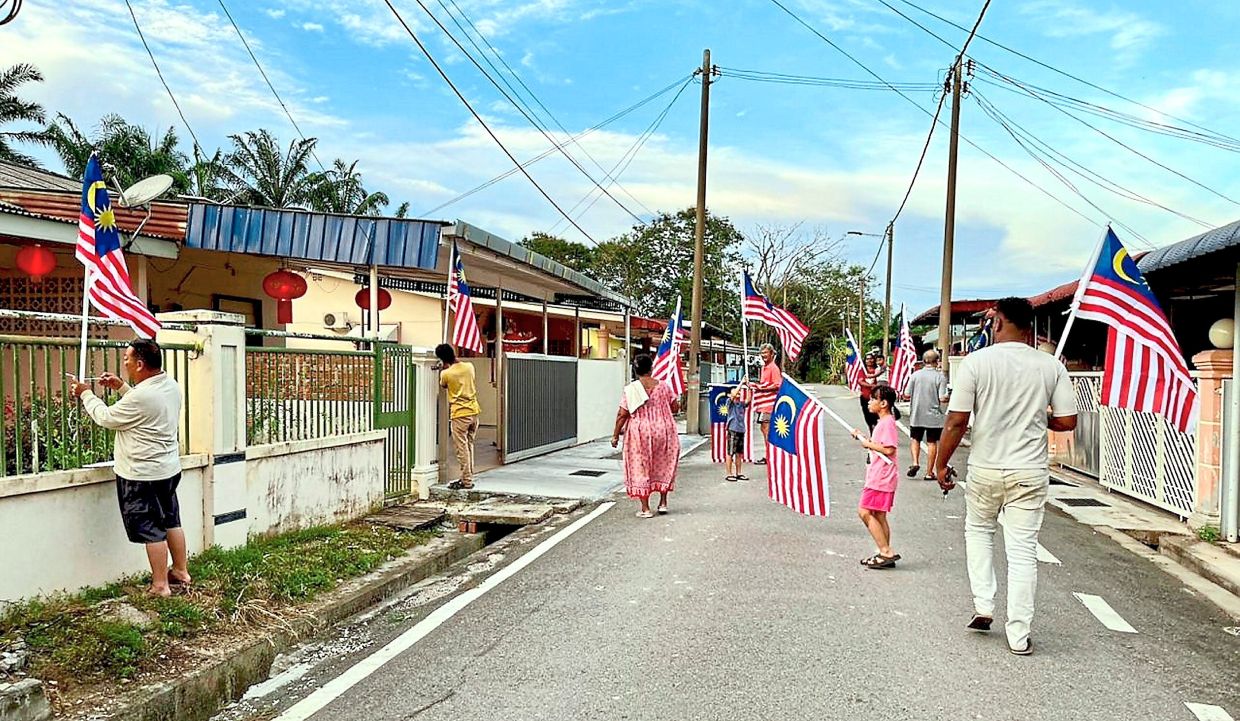
Strength in diversity: There are hundreds of thousands of flags that have been correctly put up across the country, including in Chinese new villages like the Bukit Merah New Village in Ipoh and tourist spots like the Kuala Lumpur Library (below). — RONNIE CHIN/FAIHAN GHANI/The Star

MALAYSIA certainly deserves better as we celebrate 68 years of independence next week.

We remain stuck in the toxic politics of race and religion, with some politicians unable or unwilling to let go of these addictions.

Over the past one month, we have watched sadly deliberate provocations that keep race and religion at the heart of all political discourse.

It is not even subtle but an open incitement mainly aimed at winning the votes of the predominantly Malay audience.

For decades, political actors have skilfully used identity to entrench themselves in power, distract from governance failures, and stir emotional loyalty.

Today, the stakes are higher than ever because the Prime Minister leads a multiracial party, PKR, with the three main races represented in the top echelon. Unfortunately, though, it does not command the majority of seats in Parliament.

Datuk Seri Anwar Ibrahim is stuck in a difficult position of having to deal with partners in the unity government, which includes former opponents, some of whom have now started to test his leadership by taking shots at his government.

There is a general election in two years and these parties wish to remain relevant in the eyes of their members and voters.

There are Umno Youth leaders who have also crossed the red line with their constant intimidating postures and remarks.

The minority races, especially the Chinese and Indians, find these racial actions disturbing.

The series of incitements over upside down Jalur Gemilang in some shops, unfortunately owned by small-time Chinese traders, have marred this year’s celebrations.

Instead of advising these businessmen to put right the national flags, these people chose to confront them aggressively and angrily, to put up videos inviting racist comments, to lodge police reports, and stage protests.

This is not the first time that the Jalur Gemilang has been wrongly put up but this is probably the first time that we’re seeing such bullying tactics.

It is commendable that the Attorney General’s Chambers has warned Malaysians against vigilantism in cases involving the improper display of the Jalur Gemilang, amid the furore over Umno Youth’s protest in Kepala Batas, Penang, over the matter.

The AGC said vigilantism could include raiding premises, spreading personal details, or making unfounded accusations on social media.

The AGC also warned the public against provoking or issuing threats against the individuals or organisations concerned.

There are hundreds of thousands of flags that have been correctly put up across the country, including in Chinese new villages, Chinese associations, and Chinese vernacular schools, yet these political thugs chose to pick on a few wrong ones and amplify it to become an explosive issue.


It that were not enough, last week, we read of a Bersatu leader posting a “delayed” congratulatory post on the appointment of Comm Datuk M. Kumar as the director of Bukit Aman’s Criminal Investigation Department, saying “this shows that Malaysia has started to embrace the Malaysian Malaysia concept’’.

The politician also cited the promotion of Datuk Johnny Lim Eng Seng as a lieutenant general in the armed forces.

He claimed if the concept continued to be accepted by the government, Malaysia could soon have its first non-bumiputra Chief Justice, Armed Forces Chief and Inspector General of Police.

Anwar has rightly rebutted that, pointing out that the majority of high-ranking police officers are Malays, including the IGP, deputy IGP, and other directors of various departments.

Comm Kumar, who has an excellent track record, is just the CID chief and it is bewildering that he has been targeted.

How can we even encourage non-Malays to join the armed forces and police if they perceive that they have few chances of being promoted to a senior post?

In June, a PAS grassroots leader also made a racist statement about the appointment of the three-star lieutenant general in a social media post, warning of “the political rise of the nation’s largest minority group”.

He also wrote in his Facebook posting of a hypothetical news story of Malaysia welcoming its first ethnic Chinese PM.

Both these small-time leaders have the same script and narrative, aimed at insinuating that the PM, the head of a multi-racial party, is compromising with the other races.

Rather than fostering unity in a multiracial nation, identity politics has devolved into a toxic tool for populism.

Every minor issue – from music festivals to retail products – is now open to being framed as an attack on faith or culture.

What should be policy debates are routinely hijacked by identity-driven outrage. The real consequence? A shrinking space for reason and a deepening divide in our society.

Unfortunately, this reliance on racial and religious narratives comes at a high cost.

First, it undermines economic development. Malaysia continues to lag in innovation, regional competitiveness, and talent retention.

A system that prioritises ethnic patronage over meritocracy is simply unsustainable in a globalised world. This is 2025 and we are going to welcome 2026 in a few months but we are still stuck in pre-1957.

Second, it paralyses governance. While the rakyat struggle with rising living costs, declining education standards, and stagnant wages, political attention is disproportionately consumed by manufactured controversies over identity.

Something is hopelessly wrong when PAS’ Kuala Terengganu MP Datuk Ahmad Amzad Hashim was more interested in questioning the PM on his choice of batik when Anwar was presenting the 13th Malaysia Plan (13MP) in Parliament.

The MP posted a message on his Facebook page asking why Anwar chose to wear a batik shirt with an Indonesian design instead of Malaysian batik.

Then, with egg on his face, he had to apologise when it was pointed out by batik entrepreneurs that Anwar had indeed worn local batik attire.

We would have expected the PAS MP to post questions related to the 13MP as well as to make detailed proposals.

Instead, he was more interested in the PM’s shirt. Even if Anwar chose to wear something from Indonesia, should it be an issue?

Then there was PAS president Tan Sri Abdul Hadi Awang, the Marang MP, who implied that Kuala Lumpur’s problems were due to DAP and the unity government, reciting a poem in Malay containing the line: “KL is problematic due to DAP, Pakatan Harapan, and friends.’’

It is most unfortunate that taking simple, lazy political pot shots rather than pushing serious proposals backed with data has become a habit of these incompetent politicians.

Third, and perhaps most worrying, this reliance on racial and religious narratives erodes trust.

The constant emphasis on ethnic and religious differences chips away at the social fabric.

Interethnic solidarity – a strength Malaysia once celebrated – is being replaced with suspicion and withdrawal.

Malaysians are not asking for too much. We just want leaders who prioritise shared progress over communal fear, and a national conversation that values evidence over emotion, ideas over identity.

We need to discard the old narratives and old politicians. But our voices need to be louder so they can be heard. Do not be afraid of political bullies and racist politicians.

Racial division may still win elections, at least in the short term, but we must end it.

If Malaysia is to truly move forward, we must retire the politics of identity as a crutch for power.

Let race and religion be part of our Malaysian identity – but as something that unites us because of common values, not weapons in our politics.

Legacy of warrior kings


Haider Ali (left) and his son Tipu Sultan were part of India’s colonial struggle in the 18th century. — Photos: IAMM

THE textbooks on the history of India’s struggle against colonial rule often begin in the 19th and 20th century national movements. We are familiar with names like Mahatma Gandhi and Jawaharlal Nehru.

But there were princely states and leaders who challenged the European powers, especially the British, long before these better known nationalist Indian figures.

In southern India, two famous names were Haider Ali and his son, Tipu Sultan, the rulers of Mysore in the 18th century.

Their legacies are complex and contested, but they remain symbols of indigenous resistance, innovation, and the assertion of sovereignty in the face of relentless colonial aggression.

The exhibition More Than a Day As a Tiger, The Legacy of Haider Ali and Tipu Sultan of Mysore (1761-1799) is currently being held at the Islamic Arts Museum Malaysia (IAMM) in Kuala Lumpur.

Haider Ali’s rise to power in the mid-18th century is a classic example of meritocratic ascent in a world dominated by hereditary privilege.

Born into a modest background, he rose through the military ranks of the Kingdom of Mysore through sheer tactical brilliance.

Haider Ali was one of the earliest Indian leaders to understand the strategic threat posed by European trading companies, particularly the British East India Company.

He modernised Mysore’s army, employing French military advisers and incorporating European-style training and weaponry, including rocketry, which would later gain fame under his son.

His ability to hold his own against the Marathas, the Nizam of Hyderabad, and the British made Mysore a formidable regional power.

Upon Haider Ali’s death in 1782, his son Tipu Sultan inherited not only a kingdom but a vision – a fierce, unyielding resistance to British encroachment.

Tipu Sultan’s reign was marked by both military ambition and domestic reform. A devout Muslim and deeply committed ruler, he embraced scientific innovation, global diplomacy, and administrative reform.

His court welcomed French engineers and Persian scholars, and his foreign policy included alliances with the Ottoman Empire and France, attempting to create an anti-British axis long before such ideas became popular in India.

Among the most famous diplomatic exchanges of the 18th century was Mysore’s delegation to the Court of King Louis the 16th.

Tipu Sultan is perhaps best remembered for his four Anglo-Mysore wars against the British, particularly his valiant defence during the Third and Fourth Wars.

In 1799, Tipu Sultan died fighting at the gates of his capital, Srirangapatna, a death seen by many as the ultimate act of patriotism.

He was called the Tiger of Mysore by the British for his fierce resistance and he adopted the tiger as his royal emblem as a symbol of courage, strength, and fearlessness.


Rare heritage: A pair of flintlock pistols with a snarling tiger design on their buttcaps belonging to Tipu Sultan are part of the IAMM exhibition. — Photos: IAMM

His now-famous quote, “It is better to live one day as a tiger than a thousand years as a sheep”, has immortalised him as a martyr in the struggle against colonialism.

Yet both Haider Ali and Tipu Sultan’s legacies are not without controversy. Critics, particularly from certain modern political factions, point to Tipu Sultan’s treatment of some Hindu communities and question his role as a “secular” hero.

However, such critiques often ignore the broader context of 18th century warfare and governance, where religious pluralism coexisted with realpolitik.

In truth, Tipu Sultan patronised temples, issued land grants to Hindu institutions, and employed Hindus in high offices – decisions rarely highlighted by his detractors.

What Haider Ali and Tipu Sultan accomplished was remarkable for their time. They envisioned a militarily strong, technologically advanced, and economically independent state.

Their use of rocketry predates its adoption in Europe, and their administrative systems laid the groundwork for future governance models.

Tipu Sultan’s interest in industrialisation – state-run factories, coinage reform, and silk production – shows a ruler thinking far beyond the constraints of his age.

His defeat in 1799 marked a turning point in Indian history. With Mysore’s fall, the British tightened their grip on southern India, paving the way for eventual dominance.

Tipu Sultan’s death was front-page news in the United Kingdom with much of his possessions taken from India immediately after his death for fear they become symbols of a martyr. Until now, the UK government has not let them go.

The legacy of Haider Ali and Tipu Sultan, however, continues to inspire. They remind us that resistance to colonialism didn’t begin with 20th-century nationalism – it was born in the forts and battlefields of Mysore.

The IAMM must be commended for its efforts to hold this exhibition. According to museum director Syed Mohamad Albukhary, it took over 20 years to collect Tipu Sultan’s very rare belongings and to study his achievements.

“Like most people, there was a time when we knew very little about Tipu Sultan, and even less about his father, Haider Ali.

“More than two centuries ago in southern India, there was a Muslim dynasty that lasted for fewer than 40 years but still changed the world,” he said.


The legacy of Haider Ali and Tipu Sultan continues to inspire centuries later. — KAMARUL ARIFFIN/The Star

Tipu Sultan died before he reached 50 at the hands of the British and two centuries later, “It is the artistic legacy that provides the strongest reminder of the two rulers. The artefacts that Tipu Sultan left behind still seem important – the more we see them, the more fascinating their story becomes.”

An object that took the IAMM almost 10 years to obtain an export licence for was an important personal “sporting hunting gun”, which was a favourite weapon of Tipu Sultan’s.


An artefact that took the IAMM almost 10 years to obtain an export licence for is TipuSultan’s favourite ‘sportinghunting gun’ with its intricate tigercarvings. — The Star

Two cannons at the exhibition had been displayed outside Powis Castle in Wales for more than 250 years.

In the words of Prime Minister Datuk Seri Anwar Ibrahim, who opened the exhibition: “Some of the artefacts are on display for the first time since they were looted from Mysore more than 200 years ago. The collection is a rare gathering of his world, perhaps the largest accumulation ever shown.”

Haider Ali and Tipu Sultan remain towering figures in Indian history. They were warriors and administrators, reformers and resistors.

In an age where alliances were fragile and power dynamics fluid, they built a state that challenged the mightiest empire of the time.

Their story is not just about resistance – it is about the assertion of dignity, innovation, and vision in the face of overwhelming odds.

More Than a Day As a Tiger, The Legacy of Haider Ali and Tipu Sultan of Mysore (1761-1799) exhibition is on now at the Islamic Arts Museum of Malaysia in Kuala Lumpur until Jan 11, 2026.

Jalur Gemilang and the rise of political bullies

MALAYSIANS have read a lot about the many bullies in our country, mostly in schools, hostels, and workplaces, as well as online.

But what is less talked about are the political bullies and their disturbing posturing.

If there is a ranking, these bullies, who shamelessly call themselves Yang Berhormat, must be the worst.

We expect elected representatives to bring people together, to mediate disputes, advise those who erred and be charitable.

We would like them to be exemplary role models to younger citizens but many fail miserably.

Instead, they become agitators, issue warnings, are confrontational and intimidating, and, most pathetically, turn into racists as they pick and choose their targets.

All bullies have some common traits: They target people they perceive as weaker, they love to dominate, and feel a need to control others to boost their own self-worth or mask insecurity.

Bullies often target individuals who are different – by race, gender, sexuality, disability, etc.

Needless to say, they have low empathy and probably suffer from some form of psychological problem.

If we dig deeper, it wouldn’t be surprising to learn they had been victims of bullying themselves or suffer from a chronic inferiority complex.

They have difficulty understanding or caring about how others feel; such emotional detachment makes it easier for them to harm others without remorse.

As political leaders, they probably have a dismal record on ideas and achievements, thus bullying gives them a temporary sense of superiority or confidence.

To conceal their poor performance, bullies often act out to impress peers or climb the social ladder.

They may thrive on the reactions they get from an audience, especially from comments sections online.

They really don’t deserve space in the media but social media news portals, hungry for eyeballs, have given these losers generous space to shout in.

These media portals do not even bother to moderate their comments section – by right, those who post nasty, racist remarks should be hauled up to face sedition charges.


Hot political issue: People putting up the Jalur Gemilang in their neighbourhood. Unfortunately, there may be Malaysians who are afraid to put up the national flag this year in case they make any mistakes and do it wrongly. — The Star

In Malaysia, playing the racial and religious cards is the fastest way to become communal heroes.

Those who do so seem to be able to attract many admirers with their aggression and impulsiveness.

They fan a racial angle with their inflammatory statements, postures, and gestures, with warnings of protests, and of course, keep the police busy with their many reports.

In the latest case, this recalcitrant politician has even given the authorities an ultimatum and a deadline to act by.

There must be no space for political bullies with their prejudices and intolerances. We shouldn’t keep silent and let such cowardly behaviour continue.

Many of us are working towards a kinder, progressive, and moderate Malaysia.

How can we recite the tenets of the Rukun Negara when political bullies blatantly disregard “achieving and fostering unity in society’’ and have no “courtesy and morality” as enshrined in the nation’s principles?

As we prepare to celebrate National Day in two weeks, there should be an air of celebration with Malaysians coming together, with reminders that we are one as Malaysians.

In my neighbourhood, I have been taken aback that my household is the only one that has hoisted the Jalur Gemilang and the Selangor flag.

The other houses are devoid of flags for reasons I cannot comprehend. Have my neighbours lost their enthusiasm – or are they afraid of putting them up wrongly?

It will be sad if we have come to a point where Malaysians – especially shopkeepers – choose not to fly the Jalur Gemilang out of fear lest they make a mistake and that mistake becomes a hot political issue.

I hope they won’t emulate my friend, analyst and columnist Prof Dr Mohd Tajuddin Mohd Rasdi, who has said he will not fly the national flag in his home and on his car this year in case of potential sabotage. He does not want it made into a political tool to incite hatred.

“We are supposed to love our flag with pride but the current reactions to those who made mistakes regarding the flag have become a political tool to attack others and incite hatred.”

Flying the Jalur Gemilang upside down is a serious matter, and getting the flag wrong, with missing stripes or points on the crescent are also offensive errors, but they are not unforgivable.

Many of these angry politicians barely squeak when it comes to more serious wrongdoings like corruption.

Why can’t these politicians just walk to these shops or places of worship and just adjust the flags correctly and explain to the people how they went wrong?

Instead, the politicians choose to be arrogant bullies in their videos to prove to their audiences that they have to teach these purported “disloyal Malaysians” a lesson.

The offenders they pick on always happen to be Chinese, and as a minority race, they become perfect targets for bullies.

Yet these self-proclaimed communal heroes quickly hide their tailcoats and do a Houdini disappearing act when their own political party members make the same error.

Can we expect the party members of these YBs to lodge police reports against their own and to insist that an apology is not sufficient?

There is also a need for the police to be seen to be fair or not react because of pressure from certain politicians. We expect our men and women in blue to be fair.

In May, two Sin Chew Daily editors found themselves handcuffed after the paper printed an incorrect illustration of the Jalur Gemilang on the cover, with the police having to call up 42 witnesses for the silly mistake.

Surely the police did not need to handcuff them, giving the perception of an overreaction.

The same month, it was reported that Terengganu PAS had to say sorry for mistakes in the national flag that was part of a logo designed for a gathering.

Around the same time, there was another blunder in an official document which contained an inaccurate depiction of the Jalur Gemilang, resulting in several senior officers of the Education Ministry’s examination board being transferred.

Last week, the same illustration gaffe was made on social media by Terengganu Umno Youth and certainly the apology by its chairman, Tengku Haphiz Tengku Putera, is sufficient.

A viral image showing the Malaysian flag being flown upside down at a district police headquarters also resurfaced last week. The police had to explain that it was a 2016 incident and not a recent one.

The point is, even the police can make a mistake and why not, after all, the police constable responsible for raising the flag is also a human being who can err.

The national flag was, in fact, flown upside down at a National Day rehearsal in 2022 because there was an error in raising it, according to news reports.

There will be such mistakes made by Malaysians, regardless of their race or political affiliations. To err is human, to forgive is divine.

I would be more concerned with Malaysians who fly a tattered Jalur Gemilang.

My friend Anas Zubedy wrote that these errors “are not always acts of disrespect – but are often human error.

“When such incidents occur, especially involving our beloved Jalur Gemilang, our response matters.

“Do we react with anger and suspicion, or do we pause, reflect, and choose to respond with understanding and wisdom?

“This is where we must return to the very spirit of the four colours of the flag.

“Let blue guide us to unity and calm. Let white remind us to be sincere and honest in our assessment. Let red give us courage to correct with dignity, not to shame. And let yellow inspire us to act with grace and respect, as our royal traditions teach.’’

To these bully politicians and those who habitually make racist remarks, my question is: Do you even make it a point to put up the Jalur Gemilang in your homes every year?

Certainly, Malaysia and Malaysians deserve better quality leaders. These bully politicians don’t deserve our votes in the next elections.

Angkor Wat in the wet season is not just cooler, it is less crowded too


The author and his wife enjoying a great view of Angkor Wat. During peak holiday seasons, this may not be possible as there would be more tourists. — Photos: FLORENCE TEH

The trip to Cambodia’s Angkor Wat was unplanned. A Singaporean friend working in the aviation industry had just returned from Siem Reap and said that it was possible again to take a direct flight on AirAsia to the Cambodian city from Kuala Lumpur.

The route had been put on hold during the pandemic, and was reinstated in July 2024, though perhaps not many were aware of it.

The friend said that Siem Reap’s gleaming international airport was near empty and that I should take advantage of the quiet season and visit the place.

However, he did not tell me that it was the rainy season, and I too didn’t do my research before booking the trip.

I blamed myself for the oversight. After all, the heat and humidity in KL in June was unbearable so why would it be any different in neighbouring Cambodia?

When my family and I arrived in Siem Reap, we were greeted by heavy rain. But that didn’t kill my enthusiasm… until I asked my tour driver if we should wake up early to catch the sunrise at Angkor Wat.

“Sir, tomorrow it’s raining, no point waking up early. Tomorrow’s sunset… I don’t know, it’s still raining, maybe,” he said casually. By then, everyone was in complete silence and a little disappointed as we continued our journey to the hotel.


The author taking the chance to pose next to a pool of water showing a reflection of the temple.

After a good breakfast the next day, we were feeling more upbeat, so we decided to still make our way to the majestic Hindu-Buddhist temple complex, regardless of the weather.

Armed with our umbrellas, we chose to get splashed by the puddles or even get stuck in the mud if such a thing would happen, than be confined to our cold hotel rooms.

And it was a good thing we did, too as the rain wasn’t so bad in the end. The rainy season here – usually from May to October – carries a reputation that makes many travellers delay their Cambodian adventures.

But it also means wonderful hikes in the lush green forests, going through uncrowded temples, and enjoying monsoon-soaked sunsets that made my heart pause. Though visiting Siem Reap during this season was unplanned, I can confidently say that it turned out well for us.

Let’s start with the biggest misconception of travelling during the rainy season: that it rains all day, every day.

It doesn’t.

During my stay, at least, most mornings were dry and breezy – ideal for cycling around the temple complex or exploring local markets.

The rain came in the late afternoons or early evenings in dramatic, cinematic bursts. Think tropical downpours that cool the air, rinse the dust off ancient stones, and that last just long enough to finish one drink, before the skies clear again.


The stones at Nokor Thum or Angkor Thom covered in moss.

It may not be a good comparison but to me it was much like the rain in London, where it comes and goes fast.

Visiting the Angkor Wat temple complex in the wet season gives you the feeling of seeing them as they once were – alive with water, wrapped in foliage, and free from camera-toting crowds.

My guide, an avid photographer, kept pointing to the pools of water to remind me to take pictures of the reflections of one of the world’s most famous religious structure for my Instagram.

In the absence of the crowd, Angkor Wat was blissfully quiet in the morning, and we covered many parts of the complex without having to compete with other tourists. The air was cooler and we saw many ponds filled with blooming lotuses, while water buffalo waded through flooded rice fields.

Ta Prohm, the famous Tomb Raider temple, looked especially otherworldly with its moss- covered walls glistening after the rain.

Tree roots shimmered, stones dripped, and the echo of distant thunder made the jungle setting feel more primal than polished.

And let’s be honest – travelling during the off-season was cheaper and better as hotels offered lower rates and you could simply walk into any restaurant without a reservation.

So, I’m glad we embraced spontaneity and booked the trip. In return, we got a Siem Reap that’s softer, slower and soulful, with a more mystical Angkor Wat to boot.


You can catch creatures like this lizard at the complex during the wet season.

Weeding fakes from facts


View wisely: Media literacy is needed especially for older social media users to learn to discern real from fake news, and spontaneous from staged or AI-generated content. This is now part of being a responsible digital citizen.

IT’S deplorable and unacceptable that some Malaysian influencers have become obsessed with numbers rather than values.

Their actions are not just in poor taste but lack maturity, and this has become a disturbing trend of influencer culture.

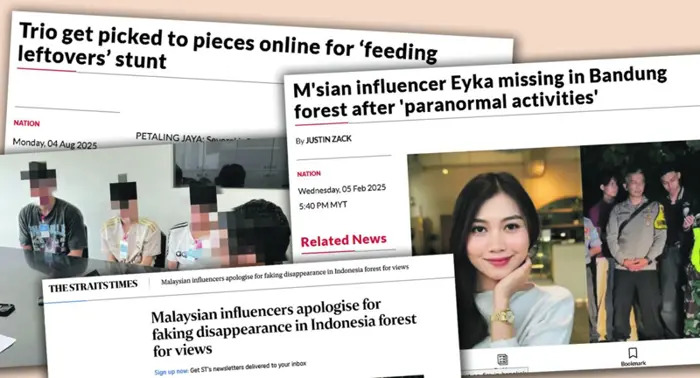
Two recent incidents have sparked widespread public outrage in Malaysia – one group staged a fake disappearance in the jungle, pretending to be lost in the Malaysian wilderness.

Another, in an act masquerading as charity, handed a homeless man food scraps containing mostly bones.

In their defence, one of the three implicated claimed that the man was actually given a proper packet of rice and chicken – and that it was all part of an act.

To most of us, though, it was an act of humiliation. Or, to put it bluntly, it was pure stupidity.

Poverty became a performance. This man’s hardship was co-opted for online clout, his reaction captured for an audience that had no stake in his wellbeing.

In our old school journalism, this would have been categorised as fake news and the book would have been thrown at them.

Now, that comes to the point of the video. Was it a calculated performance to degrade dignity and distort reality, all in pursuit of likes, views, subscribers and followers?

Worse, in race sensitive Malaysia, the actions of the three persons were totally insulting and we assume that they had had no thoughts about the consequences of their actions.

In the case of the influencers who staged their disappearance in the jungle, they didn’t just manipulate their followers – they exploited the public’s empathy and trust.

Search and rescue operations had to be conducted and human resources were basically wasted.

Imagine the consequences if a real emergency had taken place at the time?

The drama built over days until it unravelled. The entire irresponsible narrative had been fabricated.

But such staged actions are not new. Platforms like Instagram and TikTok have long rewarded curated, polished, and highly controlled content.

The rise of artificial intelligence (AI) and an arms race for perfection have pushed this culture into a new realm – one where the boundary between real and fake is almost entirely erased.

There have been many videos with supposedly positive messages which were nothing but just an act.

I am sure many of us have seen videos of so-called kind-hearted food traders who gave free food to someone claiming he was short of money or claimed to have forgotten to bring his wallet.

This template has been re-hashed so many times, in many different ways, but to a seasoned media person, the position of the cameras immediately give away the fact that it’s simply an act.

There are also politicians and religious figures who carry out their charity work with a battery of videographers following them, complete with professional lighting and cameras.

No one stumbles upon a poor homeless person. They have to be contacted and arrangements made.

This is not merely cosmetic editing. It’s the construction of a completely fabricated version of life – one where hardships are dramatised, kindness is scripted, and nothing is left to chance.

Charity often appears suspiciously coordinated. A conveniently placed camera captures the “spontaneous” moment of generosity.

A tearful recipient reacts perfectly on cue. Everything is staged to hit the emotional sweet spots that will drive engagement. But the question must be asked: if you’re scripting kindness for clicks, is it kindness at all?

These celebrities present themselves as saviours while offering little of substance. Their kindness is conditional – visible only when a camera is rolling, performative rather than personal.

Unfortunately, in today’s social media landscape, it is about short videos, quick messages and instant reactions.

The young audience has no time for long text – like this one – and there is little interest in research and sound narratives.

So who cares that it is fake content, AI manipulation, or exploitation as long as it gets eyeballs, is engaging, sensational, dramatic and brings in the numbers. It’s all is fair game.

There are legal consequences, though.

In the case of the jungle hoax, the culprits have been taken to the court as it involves public safety and resources are involved.

Content that uses AI must be required to put a disclaimer that AI has been used in the making of the video.

Finally, media literacy is needed for viewers, especially the older ones. Surely, we should not be so gullible as to believe the Prime Minister and our tycoons would invite you to invest in questionable schemes with unbelievable financial returns?

How many times can the Prime Minister’s Office keep issuing denials that these are fakes as this content keeps morphing? Just stop being greedy.

And stop believing those direct messages from people who want to be your best friends after following just a few of your postings.

Learning to discern real from fake, spontaneous from staged or AI-generated content, is now part of being a responsible digital citizen.

A Defining Week For Anwar Ibrahim’s Leadership


Prime Minister Datuk Seri Anwar Ibrahim (center) during a special meeting with Cambodian Prime Minister Hun Manet (left) and acting Thai Prime Minister Phumtham Wechayachai (right) at the Seri Perdana Complex, last Monday. The special meeting aims to de-escalate the growing armed confrontation between the two countries, with Anwar serving as mediator. Also present Foreign Minister Datuk Seri Mohamad Hasan.

KUALA LUMPUR, Aug 2 (Bernama) — It has certainly been a defining week for Prime Minister Datuk Seri Anwar Ibrahim as he notched double wins at the diplomatic and economic fronts, which even his opponents would find difficult to fault.

He has certainly been in top form as he brokered a ceasefire between Thailand and Cambodia, orchestrating a diplomatic breakthrough, and then went on to make a call to United States President Donald Trump at 6.50 am.

Anwar received plenty of messages from world leaders congratulating him on the handling of the potentially dangerous conflict between two neighbouring countries.

It was a huge test for him as the Chair of ASEAN, but he pulled off magnificently as he brought the leaders of Thailand and Cambodia to Kuala Lumpur for a dialogue.

He also made sure that officials from the US and China, the two important players in the region, were present to observe the talks.

It is also evident that Malaysia’s neutral posture of not taking sides has shown positive results, as that brought the two countries, locked in conflict, to the negotiating table.


Prime Minister Datuk Seri Anwar Ibrahim (centre) witnesses Cambodian Prime Minister Hun Manet (left) shaking hands with Thailand’s Acting Prime Minister Phumtham Wechayachai (right) following a Special Joint Meeting at the Seri Perdana Complex. The high-level Special Meeting was held to ease escalating tensions following an armed confrontation between the two countries.

Trump himself reportedly intervened in the ceasefire negotiations by threatening both parties with heavy tariffs, but Malaysia’s central role in mediating the agreement gave it diplomatic capital.

At the same time, Malaysia scored a much-needed economic reprieve after the US agreed to scale back steep tariffs that had been threatening Malaysia's export-driven economy.

At one point, Washington had threatened Malaysia with reciprocal tariffs of up to 25 per cent in retaliation for what it claimed were unfair trade practices and currency.

This week, the White House agreed to lower the rate to 19 per cent, offering breathing room to Malaysia’s key sectors, especially electronics and palm oil. The sound of relief could be heard across the nation.

Without doubt, Anwar was properly prepared by officials for his telephone conversation with Trump.

But as many world leaders would know, an element of uncertainty can also be expected when dealing with Trump, as some US allies have ended up with high tariffs.

Both cases, which Anwar handled well, demonstrated strategic diplomacy which was carried out with precision and the personal charm offensive, which Anwar is good at.

By now, world leaders would have watched how Anwar has the ability to lift up the phone to call his counterparts.

The world will certainly now see that there is value in Malaysia as a stabilising force and an economic partner.

The week has not just been a personal success for Anwar and his government, but as one analyst put it, they are a reminder that middle powers like Malaysia can shape outcomes when they choose engagement over posturing.

Thai veteran journalist Kavi Chongkittavorn wrote that Anwar has now positioned himself as a peacemaker.

“ASEAN is doing a somersault. It just needs decisive leadership,” he said, pointing out that Anwar got the US and China to be present, which was another coup, as “both superpowers rarely collaborate on anything these days. Yet both sent envoys to support the ASEAN Chair’s initiative.”

These successes are not just wins for Anwar’s government; they are reminders that middle powers like Malaysia can shape outcomes when they choose engagement over posturing.

Writing in the Thai PBS World, he described that on the regional stage, “PMX just had his finest hours.’’

On the economic front, Malaysia has ended up having the same 19 per cent tariff as Indonesia and the Philippines. However, in Jakarta and Manila, there has been reported unhappiness that they have given in too much to Trump.

Malaysia stood its ground that it would not allow the red lines to be crossed, particularly on its Bumiputera policy during negotiations.

To the protestors who turned up by the thousands calling on Anwar to step down, they may not understand headlines like tariffs or ceasefires, but this week’s developments demonstrated the importance of leadership.

PAS still not aligned with non-Muslims


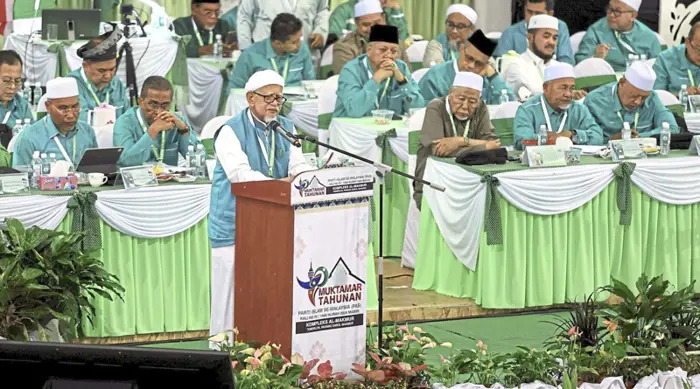
Big challenge: PAS’ ideological stance has made it difficult for it to win the trust of Chinese and Indian voters. —The Star

AS Malaysia’s political landscape shifts ahead of the next general election, PAS continues to face deep challenges in courting support from non-Malay communities – particularly the Chinese.

Take the protest crowd calling on the Prime Minister to step down last week.

It was huge. It does not matter if it was 18,000, as police estimated, or 500,000 as the Islamist party likes to think.

It was still a large presence – but it was also an overwhelmingly Malay crowd, mostly from the east coast states of Kelantan and Terengganu, and of course, Kedah and Perlis in the north.

These are PAS strongholds and even if the states are the worst economic performers, it did not stop the party from questioning Datuk Seri Anwar Ibrahim on his handling of the economy.

What was glaringly missing from the protests were Chinese and Indian participants, except for the token presence of Gerakan, Urimai, and Malaysia Indian People’s Party leaders.

None of them are serious political players and were likely roped in to demonstrate some sense of multiracialism and opposition unity.

The key NGOs involved in the series of Bersih protests from 2005, which had called for clean and fair elections, stayed away.

Former Bersih chairman Maria Chin Abdullah reportedly said that the Turun Anwar rally did not represent the wider Malaysian public and lacked clear demands.

The damning reality is this: despite commanding a strong Malay-Muslim base, PAS’ ideological stance has made it difficult for it to win the trust of Chinese and Indian voters, and its prospects with the Indian community remain uncertain.

Yes, both communities are upset with the unity government for the increasing cost of living, expanded sales and services tax, slow pace of reform, and lack of help for marginalised Indians, but they have not come to the point of wanting to throw out the PM.

They are sensible enough to know that disposing of the PM after just over two years is not going to make Malaysia better.

Instead, it could be disastrous politically and economically. They are also aware that the available options are hardly attractive.

PAS knows that it cannot form the Federal Government on its own – or even be the main component party of the government.

The party spooks most non- Muslims in the peninsula, and in Sabah and Sarawak, and it has no one to blame but itself for the optics and narratives its leaders have chosen.

PAS has long pushed for the implementation of their version of Islamic governance, including Sharia law and hudud punish-ments – positions that sit uneasily with many non-Muslim Malay-sians. Chinese voters, in particular, tend to support secular, multicultural parties which frequently clash with PAS on fundamental issues of gover-nance and minority rights.

As a Universiti Malaya political analyst put it, PAS’ policies and rhetoric are often framed through an Islamic lens, which makes Chinese voters feel excluded or even threatened, and that has been the party’s historical ceiling in non-Malay constituencies.

The Chinese community, largely well-travelled urban and middle-class, prioritises economic growth, educational access (especially for vernacular schools), good governance, and anti-corruption.

These are areas which PAS sees as secondary to its core religious focus. The Chinese haven’t forgotten the apologetic stance taken by its president Tan Sri Abdul Hadi Awang on corruption.

PAS, with its religiously conservative image and strong alliances with Malay right wingers, is often seen as lacking commitment to multicultural ideals.

Its leaders, who are mainly ­theologians, are not regarded as the right fit to govern Malaysia.

The perception is that the party’s agenda doesn’t align with the values or rights of non-Muslims, who are not going to take the risk when it comes to voting, knowing that the Chinese population is declining sharply.

The constant call for a Malay-Muslim unity front, with claims that Islam and Malay rights are eroding, will also not win PAS non-Malay votes.

There has been no real attempt by PAS to bring up any issues affecting the Chinese and Indian communities, as well as the many ethnic groups in Sabah and Sarawak.

Its elected representatives continue to be obsessed with things like dress codes and banning concerts.

The headline-grabbing statements by PAS leaders on liberalism, gender roles, pluralism, and secularism will further alienate voters in Chinese majority constituencies, where social values tend to lean towards being more liberal and cosmopolitan.

It is perplexing that PAS ­actually believes that Kelantan is a ­shining example of a well-run state when it cannot even supply clean water to all of its constituents.

However, while Chinese support may remain elusive, the Indians may be a different kettle of fish. Some political observers believe PAS sees potential in reaching out to ­disenchanted Indian voters, many of whom feel increasingly alienated from mainstream coalitions.

“The Indian community has long struggled with issues of marginalisation, especially in terms of poverty, education, and job opportunities,” according to a report quoting a Klang Valley-based political researcher.

“If PAS can convincingly address socioeconomic grievances – without making it about religion – it could find some traction, especially among lower-income Indian voters.”

However, PAS’ appeal to Indian voters is complicated by the same issues that trouble its relations with the Chinese electorate.

Furthermore, Indian-majority areas are often represented by parties such as PKR or DAP, which are seen as more inclusive.

To date, PAS has not fielded a significant number of Indian candidates, nor has it developed a strong policy platform specifically addressing the Indian com-munity’s concerns – factors that continue to limit its reach.

While it’s true that many Indian voters are frustrated with both Pakatan Harapan and Barisan Nasional, PAS has failed to make inroads among them because it has not shown any real policy interest in minority issues or in promoting inclusive leadership.

Opportunistic political rhetoric will not win votes, it’s that simple, and depending on minnow Indian-based parties won’t be effective.

PAS’ biggest test may not be electoral maths but whether it can, or even wants to, broaden its appeal without alienating its conservative core.