Monthly Archives: January 2026

Placing Malaysia Airlines in a better position


Captain Datuk Izham Ismail

WHEN Malaysia Aviation Group (MAG) hosted a financiers’ meeting more than a decade ago, fewer than 20 people attended.

The confidence in Malaysia Airlines was then at its lowest ebb.

This year, however, the picture was markedly different as over 110 representatives from global banks and aircraft lessors filled the auditorium at the MAG Financiers Summit.

They arrived with one clear purpose — to position themselves early to finance Malaysia Airlines’ next wave of aircraft acquisition.

The strong turnout went beyond symbolic support.

Several financiers were already engaging in detailed discussions around funding structures and timelines, signalling their readiness to support Malaysia Airlines’ fleet renewal programme under its Long-Term Business Plan 3.0 (LTBP 3.0). For the group, this level of proactive interest reflects growing confidence in MAG’s financial discipline, operational stability and long-term growth strategy.

The summit marked a turning point where the conversation shifted from recovery to readiness — with financiers no longer asking whether MAG could execute, but how they could be part of its next phase of expansion.

As Captain Datuk Izham Ismail steps down tomorrow, Malaysia Airlines will close an important chapter in its long and often turbulent history.

His departure invites reflection not just on a man who spent 40 years in the company, beginning in the cockpit as a pilot, but also on how leadership, perseverance and clarity of purpose helped stabilise the national carrier during one of the most challenging periods global aviation has faced.

Many had doubts whether a pilot could take on the job of a corporate man with little management and boardroom experience to navigate the company through the dark clouds.

But he proved the cynics wrong by defining his tenure as group managing director of MAG and chief executive officer of Malaysia Airlines from 2017 onwards.

He assumed leadership at a time when the airline was still grappling with the aftermath of MH370 and MH17 — tragedies that left deep emotional and reputational scars — while facing structural weaknesses that had accumulated over the years.

Soon after, the Covid-19 pandemic brought global aviation to a near standstill, threatening the very survival of many airlines worldwide.

Against this backdrop, Captain Izham led a deliberate and often difficult transformation. Rather than chasing rapid expansion or short-term gains, MAG focused on operational discipline, cost control and a clearer market position.

The decision to refocus Malaysia Airlines as a premium full-service carrier — prioritising yield over volume — marked a return to its traditional strengths of service, network connectivity and brand trust.

The results, while not without setbacks, were tangible. MAG’s return to profitability in recent years signalled that the airline’s restructuring had moved beyond survival and into recovery.

Equally significant was the emphasis on sustainability — financial, operational and organisational — aimed at ensuring the airline would not repeat the cycles of crisis that defined earlier decades.

This is not to suggest that the journey was smooth. Passengers experienced service disruptions, operational constraints and network adjustments that tested public patience.

These challenges served as reminders that rebuilding an airline is a complex process, involving difficult trade-offs and long-term planning rather than quick fixes.

He will be remembered for stabilising operations in a volatile environment, including network rationalisation and activation of initiatives to manage supply chain and fleet constraints.

He delivered a strong financial recovery, in particular achieving an operating profit of RM540mil in 2022 (first full year post-restructuring) and positive net income after tax in subsequent years, including RM54mil in 2024.

He strengthened MAG’s position as a network carrier, with disciplined capacity management, agile revenue strategies and increased contribution from international markets.

Captain Izham also launched new destinations such as the Maldives, Da Nang, Chiang Mai, Paris and Kolkata.

There was also progress in Diversity, Equity & Inclusion, including 50% female representation in senior management

To wrap it up, Malaysia Airlines was named the world’s fastest-growing airline brand in 2025,- Skytrax ranking improved from #51 in 2021 to #27 in 2025 and Malaysia Airlines’ cabin crew was ranked among the world’s top 8

As Captain Nasaruddin A. Bakar takes over, he inherits an airline that is more focused, financially steadier and clearer about its identity than it was a decade ago.

That is perhaps Captain Izham’s most enduring contribution: leaving Malaysia Airlines better positioned to take flight.

A common ground for a united nation


Constitutional right: A strong Malay language curriculum ensures that no child grows up isolated from the broader society they will eventually have to navigate, says the writer. — Filepic/The Star

I FIND it very hard to accept when Malaysians struggle to speak the national language or have little understanding and appreciation of our history and cultures.

I spent all my early life in an English medium school but that did not stop me from signing up for the Sejarah Islam and Kesusasteraan papers for the Higher School Certificate (HSC) examination, the equivalent of today’s Sijil Pelajaran Tinggi Malaysia (STPM).

The Malay Literature paper actually included a section on Indonesian literature and reading up Sejarah Melayu (Malay Annals) was not easy but it was manageable.

When I entered Universiti Kebangsaan Malaysia in 1981, I opted to sign up for the Malay Letters Department, or Jabatan Persuratan Melayu, in my first year.

The Islamic paper, Tamadun Islam (Islamic Civilisation), was compulsory and has remained so, but under a different name – Penghayatan Etika dan Peradaban (Appreciation of Ethics and Civilisation).

Applicants to UKM knew exactly what they were signing up for when they opted to study at the National University of Malaysia.

Studying at a university with a predominantly Malay student population exposed me to a better understanding of Islam and Malay culture – and more importantly, friendships with Malays.

I understood better why financial support had to be given to underprivileged Malays. Many even had to use their scholarship money to support their parents and siblings in villages.

I was a tutor for some who had to attend compulsory English classes because they had never spoken the language with anyone in school, at home or in their surroundings.

Some shared that they were mocked by their friends when they tried to speak English. For fear of ridicule, they just clamped up.

They, in turn, found out that not all Chinese were well-off and many expressed their sadness when their varsity mates did not secure scholarships even though they needed it, too.

They were also taken aback when learning that not all Chinese could speak Mandarin. A foreign language is compulsory for all UKM students and we had objected when we were not allowed to sign up for Mandarin.

The university did not want Mandarin-speaking students signing up for the language course as it would have given them an unfair advantage.

However, there should not be any doubt about the status of Bahasa Malaysia as the common tongue. It is our national language.

Malaysia’s diversity is rightly celebrated. We are a nation of many cultures, religions, and languages, shaped by centuries of interaction and exchange.

But diversity alone does not make a nation cohesive. What binds a people together is a shared civic framework – common rules, shared symbols, and a unifying narrative.

It is within this framework that the Yang di-Pertuan Agong’s message on the importance of accepting Bahasa Melayu as the national language, and the Prime Minister’s directive that all schools and institutions of learning must teach the Malay language and Malaysian history, should be understood and supported.

At its core, it’s not about exclusion or coercion. It is about nationhood. Why should there be reservations?

Bahasa Melayu is constitutionally enshrined as the national language – not to elevate one community above others, but to provide a neutral, shared medium through which all Malaysians can participate equally in public life.

Without a common language, society fragments into parallel worlds – each functioning internally, but disconnected from the whole.

The King’s message is therefore a reminder of a basic civic reality: choosing to live in Malaysia means accepting the foundations upon which the country stands.

Every country has such foundations. In France, it is French; in Japan, Japanese; in Indonesia, Bahasa Indonesia.

Acceptance of Bahasa Melayu is not a denial of one’s heritage or mother tongue. Tamil, Mandarin, Iban, Kadazan, English, and many other languages continue to thrive.

What is required is not abandonment of these languages, but the willingness to meet one another on common ground.

In Europe, especially in Switzerland, Belgium, the Netherlands, Germany, Sweden, Denmark and Finland, citizens place importance on their national languages but are able to speak English and other languages.

A shared language reduces social distance. It allows a hawker, a teacher, a civil servant, and a student, regardless of background, to speak to one another as equals.

Education is where these values must be firmly rooted, which is why the Prime Minister’s order regarding the teaching of the Malay language and Malaysian history across all schools and institutions of learning is both logical and necessary.

Schools are not merely places to acquire technical skills; they are where citizens are formed. There is no excuse for any Malay-sian not to study Bahasa Melayu and the country’s history, which should include the Constitution.

Language proficiency opens doors – to higher education, employment, public service, and civic participation.

If one cannot speak Malay proficiently, then how can you deal with our institutions, especially the civil service, effectively?

When students are denied adequate exposure to the national language, they are not being protected; they are being disadvantaged.

A strong Malay language curriculum ensures that no child grows up isolated from the broader society they will eventually have to navigate.

Likewise, if Malaysians are not able to speak or write English well, then they would be at a disadvantage because English is an international language. It has to be used in the private sector because it deals with the rest of the world.

When Malaysians travel abroad, like it or not, they have to converse with foreigners in English.

We all know that the ability to speak Mandarin and to understand the Chinese mind is important because China has become a super power. The inability to speak Mandarin is a language handicap to me.

There is no reason to still question the existence of Chinese vernacular schools. They are an asset.

The fact that more and more Malay parents send their children to these schools is evidence that they understand the importance of knowing Mandarin.

Equally vital is the teaching of Malaysian history. A nation without historical consciousness is one that’s vulnerable to division, myth-making, and resentment.

Malaysian history, taught honestly and inclusively, reminds us that our independence was not inevitable, that it required compromise, and that our social contract was carefully constructed to balance diversity with unity.

Our students need to be reminded that we achieved independence because the Malays, Chinese and Indians worked together – and that without Sabah and Sarawak, there would be no Malaysia.

Let’s all be clear on this. These historical facts have to be ingrained into young minds that have been poisoned by racists on social media.

History will teach young Malaysians why certain institutions exist, why certain sensitivities matter, and why mutual respect is not optional but essential.

Critics often argue that such policies risk being perceived as narrow or intolerant. These are concerns that should be addressed with clarity, not dismissed.

Teaching the national language and history does not mean suppressing other identities. It means ensuring that all identities exist within a shared national framework.

In fact, a confident national identity is what allows cultural diversity to flourish without fear. When people feel anchored, they are less defensive and more open.

But policy must be accompanied by good implementation. Teaching Malay and history should be done well – by trained teachers, with engaging curricula, and with sensitivity to Malaysia’s plural reality.

History should not be reduced to rote learning or propaganda; it should encourage critical thinking, empathy, and a sense of responsibility.

Ultimately, the message from the Yang di-Pertuan Agong and the directive from the Prime Minister are about responsibility as much as rights.

Citizenship carries obligations: to understand the country’s history, to respect its Constitution, and to communicate in the language that binds its people together.

The King is right. Those who reject these obligations should seriously reflect on whether they wish to be part of the collective project that is this nation.

It is a shame when there are Malaysians, who were born here and live here, cannot converse in Bahasa Malaysia well while migrant Bangladeshi workers are able to speak better than them.

Lessons from Iran for Malaysia


Harsh sacrifice: Vigils are being held around the world for those killed during the nationwide protests in Iran, like this one outside the White House in Washington DC. — Photos: Reuters

WHAT is taking place in Iran is a lesson for the world, especially in countries where there are voters who wish to surrender political power to politicians who use religion to justify their hold on power.

This would include Malaysia.

Here, there are many voters who feel the mainstream political parties have let them down.

To some, when mainstream political parties appear corrupt, elitist, or indifferent, the appeal of a moralistic “clean” alternative grows strong.

In moments of deep frustration, disgruntled voters often reach for the most forceful alternative available.

The perception is that these people in religious robes, who seem to be experts in theology and are able to quote from holy scriptures, must surely be more trustworthy and cleaner than the deal-making politicians.

But the reality is that some of these purported holy men are no different from politicians. They are mere mortals.

History has shown that Malaysian political alliances have been justified from a religious perspective to suit such people.

In 1979, Iran rocked the world with its Islamic Revolution when the Pahlavi Dynasty was toppled. The violent uprising led to the replacement of the Imperial State of Iran by the Islamic Republic of Iran.

The monarchical government of Shah Mohammad Reza Pahlavi was replaced with the leadership of Ayatollah Khomeini.

The revolution against the Shah of Iran was fuelled by widespread perception of the regime as corrupt, excessively lavish, repressive, too Westernised, secular, and overly reliant on Western powers.

Unfortunately, the revolution was also the end of democracy. Iranians handed power on a silver platter to the clerics. Their lives have not improved and perhaps have worsened, with citizens losing their civil liberties.

History also shows that protest votes can sometimes open doors that are very difficult to close.

Malaysia today is not Iran in 1979 but the logic of political frustration that may drive voters towards Islamist parties in future elections carries lessons that Iranians learned at immense cost.

In Iran, the revolution that toppled the Shah was not initially a religious uprising. It was a broad coalition: students, workers, liberals, nationalists, communists and religious conservatives united by anger at corruption, inequality, and repression.

Many Iranians did not want a theocracy. They wanted dignity, accountability, and justice but in the absence of a clear successor, the clerics were seen as moral figures who could restrain excesses.

What followed was not what many had voted or marched for.

Once the clerics consolidated power, Iran rapidly transformed from an authoritarian monarchy into an authoritarian theocracy.

Institutions were reshaped to ensure clerical dominance. Laws became religiously enforced. Dissent was redefined as heresy.

Elections continued, but only within narrow ideological limits. They were not legitimate polls.

Many Iranians who supported the revolution later reportedly found themselves silenced, exiled, or imprisoned by the very system they had enabled.

History seems to be repeating itself in Iran today.

The country’s economy is in serious trouble with the value of its currency taking a beating, resulting in the rocketing cost of living.

A broad-based protest coalition, like in 1979, has taken to the streets but unfortunately the death toll has also spiked.

Today, decades after the first revolution, Iranian society is filled with regret. Protest slogans openly reject clerical rule.

Young Iranians, born long after the revolution, ask why their futures were sacrificed to a political regime they never chose. How long will these old men cling to power?

Many older Iranians openly admit that frustration with the Shah blinded them to the long-term consequences of empowering religious authorities with unchecked political power.

Malaysia must pay attention to this pattern – not because religion is the problem, but because political absolutism is.

Despite the pathetic performance of the Islamist party in states that it rules, it has continued to gain votes.

It lacks detailed governance plans, but presents itself as a morally pure alternative to purported corrupt mainstream parties.

In short, its leaders thrive on disappointment. Their messaging is simple: society’s problems exist because leaders are insufficiently religious; give us power, and virtue will follow.

But morality alone does not guarantee good governance. When religion becomes a political weapon, disagreement is no longer just political – it becomes sinful.

This is taking place in Iran, where the killing of protesters is justified because the positions of the clerics are threatened.

Policy debates turn into moral judgments. Compromise, the lifeblood of democracy, is reframed as betrayal. Over time, laws shift from serving citizens to enforcing ideological conformity.

The Iranian experience shows that once clerics embed themselves in the state, removing them becomes nearly impossible without massive social upheaval. Protest votes are temporary emotions; political systems are long-term realities.

Voters frustrated with mainstream parties are right to demand reform, accountability, and justice.

But replacing flawed democratic actors with ideologically rigid ones does not solve corruption – it often institutionalises it behind moral language, as one report aptly puts it.

It said there is another lesson from Iran that deserves attention: revolutions and ideological shifts rarely affect elites.

“It is ordinary people – women, minorities, artists, students, small business owners – who bear the cost when freedoms shrink and laws harden.

“Once personal liberties are curtailed in the name of religious or moral order, restoring them becomes a generational struggle.”

Religion can inspire compassion, honesty, and social responsibility but when political power claims divine authority, citizens lose the ability to challenge it without being labelled immoral or disloyal.

The Iranian tragedy was not that people wanted change – it was that their desperation made them overlook the danger of absolutism.

Their regret today is not abstract; it is lived daily.

The Iranian clerics are not going to give up their power without a fight, and if that means many more Iranians will lose their lives, the clerics have no qualms about that.

So much for so-called God-fearing, ethical holy men.

China’s spectacular paradise of lakes, Jiuzhaigou, comes in many colours


Jiuzhaigou is one of China’s best natural wonders so it is no surprise that the place is always crowded with tourists. — Photos: FLORENCE TEH

The best time to visit China is always in autumn, right after the national holidays.

Popularly called the Golden Week, the week-long public holiday begins on Oct 1. This is the time when the entire country seems to go on holiday, with cross-regional passenger trips often hitting more than a billion.

The end of October is then regarded as the “quiet season”, when mainlanders and holidaymakers have all gone back to work, or resumed their daily schedules.

The weather would be cool during this period – but not quite freezing yet, which is what winter usually feels like in almost every corner of China.

The quiet season is the window period for travellers looking to get some really good deals for China tour packages, but my recent trip to the Jiuzhai Valley National Park, or simply Jiuzhaigou, proved otherwise.

I had imagined a peaceful season with trees still covered with golden leaves, misty lakes, empty trails and perhaps even some light snow settling over the mountains.

Instead, my fellow Malaysian travelling companions and I ended up inching forward in a slow-moving line of tourists at the park entrance.

The queue was overwhelmingly massive as we stared at the sea of people. Needless to say, it was worse for our women friends who also had to endure long lines at the toilets.

The only consolation was that the park had a special lane for foreigners, though it was still a pretty long queue. In China, foreigners only had to show their passports to get on these special lanes.

Once we were done with the queues, we quickly made our way to the private coach, which our Chinese tour guide had managed to hire for us to get around the sprawling national park.


Awesome cascading waterfalls at Jiuzhaigou.

With the coach, we could just hop from one scenic spot to another without having to line up (again and again!) for the public buses.

“Dear Malaysian guests, you are now in China. I am sorry that you will have to jostle and fight for space when taking photographs – forget about the good manners you have been taught,” our guide warned us.

Jiuzhaigou, or “Valley of Nine Villages”, clearly has no true “off-season”. This may be attributed to the new-ish high-speed rail service from Chongqing to Jiuzhaigou, which has made it much easier for local and international tourists to get there.

Was it worth visiting though? Absolutely! The first glimpse of one of Jiuzhaigou’s famed lakes is enough to stop any traveller in their tracks.

The park offers the most stunning landscapes, featuring crystal clear, multi-coloured lakes, cascading waterfalls, snow-capped mountains and lush forests.

It was a sight to behold, seeing the vibrant hues of the lakes which range from turquoise to green, a result of mineral deposits.

They were simply spectacular, and certainly added a magical and fairytale quality to the place.

Credit must go to the park authorities for keeping the place spotlessly clean, and the trails free of litter despite the huge number of visitors that go there daily.


The writer with his wife, Florence Teh, at one of the beautiful waterfalls at Jiuzhaigou.

Five Flower Lake, perhaps the park’s most photographed jewel, shimmered in shades of turquoise, sapphire, and emerald.

The surrounding forest – a patchwork of pine, birch, and larch – framed the scene in soft hues of green and gold, with traces of lingering frost glinting on the branches.

Jiuzhaigou’s landscapes are so surreal they almost seem imagined – a place that belongs more to myth than reality.

The lakes are so clear that one can see the reflection of snow-dusted peaks and drifting clouds on the crystalline water.

The park sure is vast, with over 700sq km of pristine forest, alpine meadows, lakes and Tibetan villages.

At the end of the day trip – the park closes at 6pm and there are no hotels within, though there are restaurants and shops at the visitor’s centre – we felt tired but awed and humbled by what we had seen.

Indeed, Jiuzhaigou lived up to every bit of its reputation. It is a breathtaking and extraordinary place that one must go, at least once. Of course, for those who can, a visit during every season is also recommended just to experience the difference.

(It is said that the park does look different each season – colourful in spring because of the flowers, incredibly green in the summer when the trees come alive, a beautiful mixture of red and gold in the fall, and powdery white in winter.)

It’s easy to understand why no one can stay away from this place, no matter the season, and why it was full with both international and domestic tourists even though the Chinese holiday season had ended.

Jiuzhaigou is not just a feast for the eyes but it is good for the soul to still see nature at its best.


Stunning crystal clear lakes at Jiuzhaigou.

Why comparing Malaysian Chinese to Palestinians is misguided

WHEN press conferences are held, reporters will field all kinds of questions, ranging from the pertinent to the off-topic, and from questions to opinions.

There are even the odd, if not bizarre, questions.

If we recall, one reporter at the White House asked Ukrainian President Volodymyr Zelensky as to why he was not adequately dressed in a suit.

It looked like a planted question to embarrass him, but most of us wondered if it was even necessary and appropriate, as he wasn’t shabbily dressed.

A Free Malaysia Today (FMT) reporter has raised a storm when he likened the plight of the Palestinians to the experience of the Chinese community here.

It was misguided and certainly a false equivalence.

To put it simply, it was a bad analogy reflecting ignorance and unfair comparison, but worse, it does a disservice to the Chinese community.

It is not grounded in comparable facts, to begin with.

But the personal view of a relatively junior reporter has prompted angry comments on Malay social media against the Chinese.

Obviously, he did not think carefully when he framed his question and analogy to UK politician George Galloway.

The reality is that the scale and nature of oppression by the Zionist Israeli regime has taken a totally cruel dimension, intending to wipe out the Palestinians. Genocide is at full blatant display.

Palestinians are facing a land grab by new Israeli settlers.

They live under prolonged military occupation, restrictions on their movements, daily harassments, displacements and killings.

I am not writing this based on news reports, but on personal observations in Jerusalem and the occupied West Bank.

The United Nations and other global human rights bodies have well-documented the conditions of the Palestinians.

Yes, without doubt, the Chinese community feels they deserve a more equitable position under the Malaysian sun.

Their grievances on many issues are understandable and legitimate, but they are citizens here who enjoy rights.

Indeed, they face no land grab, harassment, persecution or systematic genocide.

They have constitutional protections, voting rights, representation in state and federal governments, economic opportunity and access to legal remedies.

By contrast, in areas with predominantly Chinese people, such as Penang, they are not occupied, unlike the West Bank, or worse, Gaza, which has been flattened.

No foreign power, such as Israel, is controlling any Chinese majority areas.

The community is not denied their rights as citizens, although one may argue that the bumiputeras enjoy special privileges.

Yes, there are, and will always be, disagreements over affirmative action, language policy or social inclusion, but data- and evidence-based discussions and even court recourse have taken place.

It is fundamentally wrong to equate disputes in a plural Malaysia with foreign power occupation, as in Palestine.

To put it simply, the argument by the reporter in question does not fit.

The misleading comparison has, unfortunately and predictably, led to unnecessary communal inflammation.

It may be old-school journalism to younger reporters in the age of social media news reporting, but I have been trained that public discourse should not lead to racial conflict.

We do not even mention the races of the perpetrators or victims in crime reports, especially in rape cases, until the person is charged in court.

As one report aptly states, “public discourse should not pit communities against each other through misleading parallels” in the Malaysian context.

As journalists in multi-racial and multi-religious Malaysia, we carry this responsibility.

The line of questioning has put his employer in a fix as it had to issue an apology, but it’s a lesson learned by all of us living in – and reporting about – our beloved country.

Anwar’s new book reflects on prison life, philosophy and political reform


Rethinking Ourselves reads as a memoir and an intellectual journey. These autobiographical strands give emotional weight to his ideas about justice, freedom, struggle, and dignity.

Rethinking Ourselves is a deeply reflective and intellectually ambitious work from Datuk Seri Anwar Ibrahim — one that blends autobiography, political philosophy, and a manifesto for moral and societal reform.

From the off-set, the title of the book sets the tone for readers to expect a dose of high-brow discourse.

While much of the content seems like an abstract academic exercise, Anwar intertwines lived experience with deep contemplation.

When one starts to turn the pages, the Prime Minister begins to share the time he spent in prison and how he has shaped his political beliefs and principles, much of it has not been said before.

During his incarceration in 1998, books on social justice, freedom and democracy, development and progress, were at the top of his reading list, mostly the work of philosophers and thinkers.

There was also an assortment of books of all shapes and ideas at the time of his imprisonment in 1974.

During his time at Sungai Buloh Prison, which he called his sojourn, between 2015 and 2018, his mind was firmly focused on the nature of oppression and the fragile state of democracy.

His book includes the result of his jottings from prison, sometimes in illegible hand scribbles. Much of the book’s power stems from its grounding in Anwar’s own life.

He wrote that after his release from prison in 2004, “I was confronted with a political scenario that was completely different.’’

“Cash is king” was the mantra of the ruling kleptocrats, celebrating with glee and gusto the looters of the state, as the then prime minister himself noted with hubristic pride.

“Corruption not only thrived, but it was also full, blatant display. It was our gilded age of opulence, paraded unashamedly. Elites walked around as if they were demigods, untouchable, and answerable to no one.’’

The 1Malaysia Development Berhad (1MDB) humiliation, he wrote, was a symptom of the disease.

And given that Malaysia had inherited RM34bil in principal debt and RM17bil in interest commitments as a result of the 1MDB fiasco, we are certainly living in unusual times.

The gist of the book is simply – “we can’t return to normal, because the normal that we had was precisely the problem” – a graffiti on a Hong Kong subway station that remains etched in Anwar’s mind.

The central theme of the book is consistent with the concept developed by his good friend, scholar Ziauddin Sardar, who introduced the term – postnormal times (PNT) to describe our current era as a turbulent, where old certainties have collapsed, characterised by complexity, chaos and contradictions.

Against this backdrop, traditional problem-solving has become ineffective and it requires new approaches.

Anwar elaborates that traditional frameworks of politics and social order no longer suffice in a world where technological acceleration and moral challenges are reshaping how societies function.

At its core, the 292-page book invites readers to reconsider not only how we think about society and governance but how we understand ourselves and our roles within an age of rapid global change.

Rethinking Ourselves reads as a memoir and an intellectual journey. These autobiographical strands give emotional weight to his ideas about justice, freedom, struggle, and dignity.

The general themes of the book is essentially on justice and reform, where Anwar argues that true justice extends beyond legal rhetoric especially in societies grappling with corruption, inequality and institutional failings.

He also redefines ignorance not merely as lack of knowledge, but as structural and systemic barriers that prevent societies from confronting the truth.

As with the main theme of PNT, he frames today’s world as one that demands adaptive, ethical leadership capable of navigating uncertainty without sacrificing human values.

He insisted on the need to “rethink our world and to rethink ourselves.”

The gem of the book is Anwar’s use of personal narrative, which provided the book the emotional resonance.

The challenge to the book is that its intellectual density and philosophical depth may make it less accessible to the general reader, especially those without a background in political theory.

It’s not an easy read but as one reviewer put it the book’s intentions are admirable but its impact could be greater if its ideas were translated more directly into accessible language and practical frameworks for grassroots engagement.

But without doubt, Rethinking Ourselves stands as a significant contribution to contemporary political thought from South-East Asia, a region whose voices are often underrepresented in global intellectual discourse.

It positions Anwar not just as a political leader but as a reflective thinker grappling with the moral demands of our times, or perhaps in unpredictable times.

Anwar’s fast-track reform push starts early


IT was certainly a good start for the new year when Prime Minister Datuk Seri Anwar Ibrahim announced a fresh set of reform moves last week, signalling the need to fast track the changes.

During his three years in power, Anwar has faced persistent criticism that his reform agenda, once synonymous with urgency and moral purpose, has been slow.

He has found – to his chagrin – that when you are heading a government with 18 partners and your party does not have the largest number of seats, there will be many stumbling blocks.

Coalition arithmetic, bureaucratic inertia and the need for political stability to ensure the Unity Government does not collapse are serious concerns that he has to grapple with in the real political world.

His opponents have attacked Anwar for allegedly being trapped by the very system he once vowed to dismantle, prioritising coalition management over transformation.

Unfortunately, the idealistic PKR faithful and voters are not likely to care or be interested in the details of such compromises. All they know is that their hopes and expectations have not been met as fast as they would like.

But the significance of his Jan 5 announcement lies less in the fine print of policy and more in the message embedded in the moment.

It is best understood as a deliberate political reset: a reassertion that reform remains central to his leadership, and that 2026 will be defined by acceleration rather than hesitation.

For much of his tenure, Anwar has governed under the shadow of his own legacy.

Reformasi is not merely a campaign slogan; it is a political identity forged through decades of struggle, imprisonment, and public expectation.

While it grants Anwar unparalleled credibility on reform, it also magnifies disappointment when progress appears incremental or delayed.

Supporters who rallied behind him did not expect easy change – but they did expect visible momentum.

After three years, the Unity Government has remained intact. There is no danger of a collapse.


The Opposition has not attempted to move any motion to remove Anwar beyond the “Turun Anwar’’ protests to keep themselves relevant simply because they know that they don’t have the numbers.

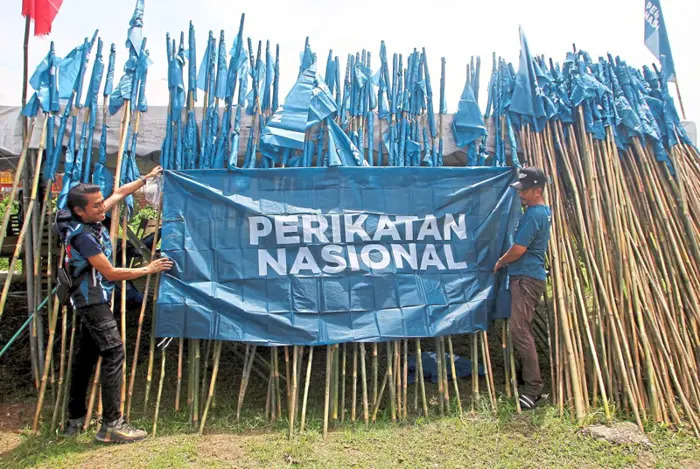
Perikatan Nasional’s direction remains uncertain after Bersatu president Tan Sri Muhyiddin Yassin and his supporters quit their coalition posts and passed the problem to PAS.

Within Bersatu, MPs aligned with deputy president Datuk Seri Hamzah Zainuddin have been targeted and face disciplinary action, including sackings.

But for Malaysia’s unity government, structural reform in areas such as governance, subsidies, or institutional independence inevitably creates winners and losers.

On that front, Anwar has struggled to convince a sceptical public that reform is moving fast enough.

However, by acting on Jan 5, before the narrative of race and religion resumes, before Parliament settles into routine, before crisis dictates agenda, and before critics can frame the year as another exercise in delay – Anwar has seized the narrative initiative.

He is no longer responding defensively to accusations of slowness; he is defining the year on his own terms.

The message is unmistakable: reform is not something to be revisited later in the term, but the organising principle of governance in 2026.

An early-year announcement signals confidence and intent. In short, the narrative is that the PM is willing to spend political capital rather than hoard it. When reforms are announced late, they are seen as tactical – designed to placate voters ahead of elections.

When they are announced early, they appear strategic, even ideological. That distinction matters for credibility.

From a purely political standpoint, this early start is a good tactical move. Reform takes time, not just to legislate, but also to implement, communicate, and normalise.

Coalition partners who might quietly resist change find it harder to do so when reform is publicly framed as a priority from the outset of the year.

In that sense, Jan 5 was not just a signal to voters, but a disciplining mechanism for the coalition itself.

But Anwar has to make sure that this acceleration has to materialise in clear timelines, measurable benchmarks, and visible enforcement. It should not be mere promises.

An early start also raises expectations; failing to meet them would reinforce the very narrative he is trying to escape.

Anwar’s greatest political test in 2026 will not be whether he can announce reform, but whether he can sustain it when resistance emerges — from within institutions, from vested interests, and even from allies.


Anwar making an announcement of reforms and other initiatives on Jan 5. — Bernama

He does not need to call for an early election this year although the temptation is there with the opposition in disarray.

The current ground remains uncertain as there are many grievances, especially the increasing cost of living.

But the PM’s announcement that all Malaysian adults aged 18 years old and above will receive the second round one-off Sumbangan Asas Rahmah (Sara) RM100 credit on Feb 9, 2026, is welcomed news.

Sara is a cash aid from the government which is utilised to purchase essential goods at participating supermarkets and retail outlets.

Anwar has two more years to go and that is still plenty of time. There is no reason why he should not go for the full term. It would be better that he does so, while focusing on fulfilling these reforms.

So is the extension to 2027 for the implementation of e-invoices for businesses with an annual turnover of below RM5 million a year. It will bring relief to many as this is a hugely unpopular move for many small businesses.

In fact, the entire process should be ended for these small businesses.

If he succeeds, Jan 5 may be remembered not as another announcement, but as the moment reform finally reclaimed the driver’s seat of Malaysian politics.

What now after Muhyiddin’s bombshell?


Will Perikatan crumble in the face of a state political feud reaching the national level? — Bernama

IT was a political bomb that dropped perfectly, just before the year ended – and its loud impact is still being felt even as we enter into the second week of the new year.

Tan Sri Muhyiddin Yassin’s decision to step down as Perikatan Nasional chief has been followed by a cascade of resignations among state-level leaders.

The Bersatu president’s decision to walk away from the post is as good as a farewell to the Opposition front and certainly its most serious internal rupture.

There will be attempts to put on a brave front, with a top-level meeting involving its component leaders being planned.

But the real test will be for Islamist party PAS now that Bersatu has left a huge crater. The other Perikatan partners, Gerakan and the Malaysian Indian People’s Party, have virtually no influence.

The fact is that Muhyiddin has been the coalition’s glue: a former prime minister with national name recognition, acceptable to Malay conservatives yet not threatening to fence-sitters uneasy about PAS’s ideological edge.

His departure strips Perikatan of that moderating influence and exposes the coalition’s underlying imbalance of power.


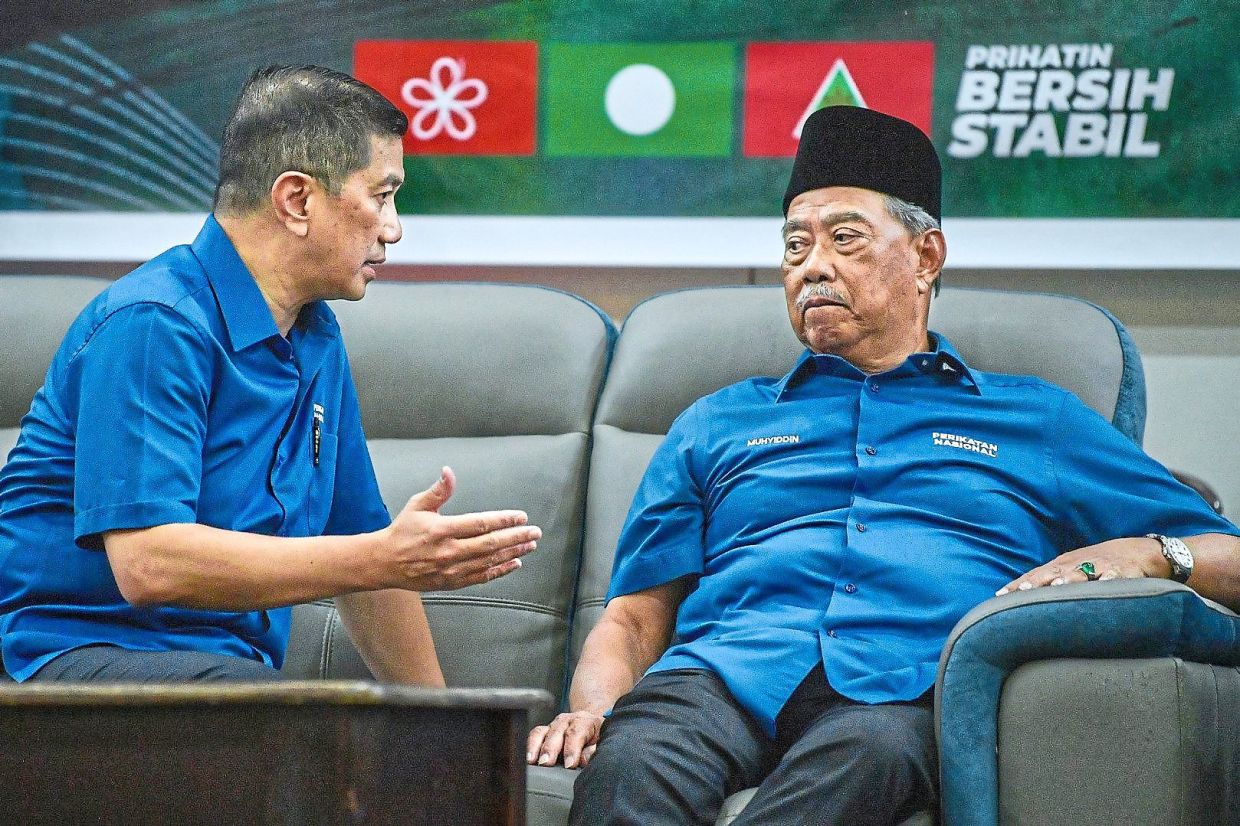
National figure: Muhyiddin (right), here seen with Azmin, has been Perikatan’s glue – acceptable to Malay conservatives yet not threatening to fence-sitters uneasy with PAS’ ideological edge. — Bernama

There is really nothing to gain for PAS, which no doubt feels betrayed by the coup in Perlis, the country’s smallest state, where its mentri besar was replaced by a Bersatu assemblyman.

PAS has made its anger known, and while it has expressed support for the new MB, none of the PAS representatives will be in the new state government line-up.

The political feud can now be expected to reach the national level as Perikatan crumbles.

PAS will surely be tempted now to take on the lead role, believing that a possible Malay tsunami is on the horizon and it has nothing to lose. After all, over the past several election cycles, PAS has emerged as Perikatan’s electoral workhorse.

It delivered votes, mobilised grassroots machinery and has dominated parliamentary representation within the coalition.

Bersatu, by contrast, has struggled to build durable party structures beyond its leadership elite. The mass resignations of state chiefs – many of whom were already under pressure or facing credibility issues – underscore this weakness. While Bersatu thins out, PAS remains embedded.

The reality, though, is that PAS is only strong in the predominantly Malay states of Kedah, Kelantan, Perlis, and Terengganu, all of which have demonstrated only mediocre economic performances.

PAS simply lacks appeal in urban and mixed constituencies, which have always depended on reassurance that PAS’s Islamist agenda would be tempered by coalition politics.

Without a figure like Muhyiddin at the helm, that narrative becomes harder to sell.

The support for PAS in the Malay heartland is undeniable but national power requires a broader appeal.

A PAS-led Perikatan will completely turn off non-Malay voters and moderate Malays.

There is no way that the clerics, who call the shots in the party, will allow professionals like Terengganu MB Datuk Seri Dr Ahmad Samsuri Mokhtar to helm the coalition.

He may be a PAS vice president but the clerics decide, and even if leaders like him are put there, they would merely serve as political cosmetics with no real clout.

Decision-making authority is dispersed among religious councils and senior ulama, which lends moral legitimacy but limits decisiveness.


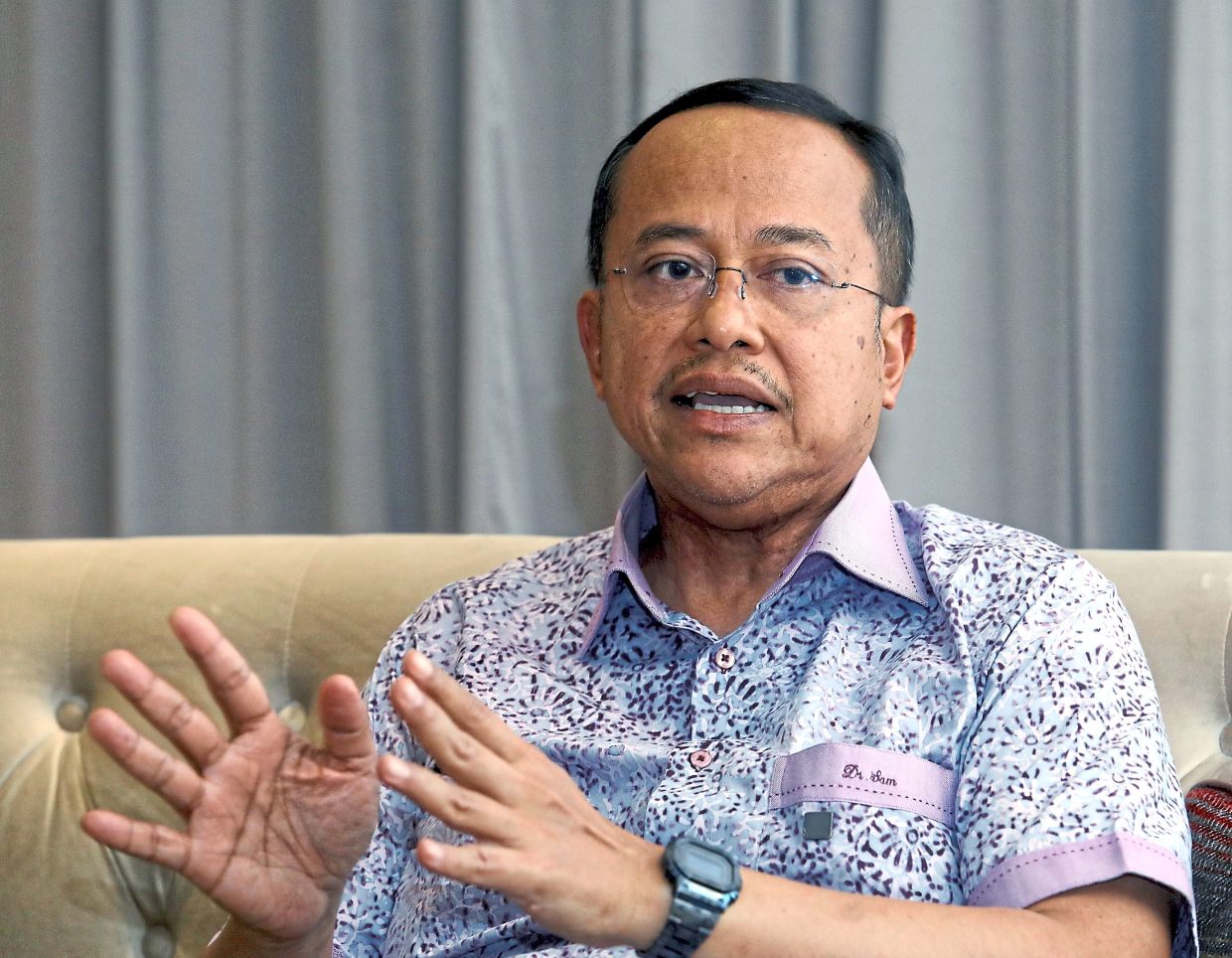
Technocract Ahmad Samsuri is popular but the powerful clerics call the shots in the party. — AZLINA ABDULLAH/The Star

What helped Perikatan grow was not just PAS’ organisational muscle, but the promise of a multi- party front that could govern inclusively.

It served as a realistic option to the Umno-led Barisan Nasional or PKR-helmed Pakatan Harapan.

There is also the question of succession and leadership style. Muhyiddin was a unifying, if pragmatic, figure.

With the senior Bersatu leaders having quit en masse, it will be odd for deputy president Datuk Seri Hamzah Zainuddin, the Opposition leader, to take over the driver’s seat.

His differences with his party boss, Muhyiddin, and secretary-general Datuk Seri Azmin Moha-mad Ali, are an open secret.

He has maintained his silence following Muhyiddin’s departure but he should not nurture any hope of taking over.

Negri Sembilan Bersatu chief Hanifah Abu Baker has expressed support for PAS president Tan Sri Abdul Hadi Awang to replace Muhyiddin, but one wonders if this was even a sincere proposal.

The 78-year-old theologian is in a wheelchair, has earned the unenviable title of being the Member of Parliament with the worst attendance record in the august House, and had nothing much to show for his time as Terengganu mentri besar (1999-2004).

The other options are PAS deputy president Tuan Ibrahim Tuan Man, the MP for Kubang Kerian, and secretary-general Takiyuddin Hassan.

These top figures command loyalty within the party and respect among grassroots supporters, but none have broad appeal across Perikatan’s non-PAS components or among swing voters.

Steering a national coalition in turbulent political waters requires not only ideological clarity but tactical flexibility, something PAS will need to demonstrate more convincingly in the post-Muhyiddin era.

If Muhyiddin’s resignation creates a leadership vacuum, it does not automatically follow that PAS can – or should – fill it.

A PAS leader elevated to Perikatan chief would remain constrained by internal consultative structures, reducing the agility expected of a coalition leader.

The Islamist party will continue to face the problem of optics and a PAS-led Perikatan would almost certainly intensify fears about its ideological rigidity.

For urban Malays and non-Malays, a PAS Perikatan chief could harden resistance and shrink the coalition’s already limited reach in competitive constituencies.

PAS has not made any serious attempt to change the minds of non-Muslim voters who see the party as a hardline one wanting to impose an Islamic State. Worse, it has taken on a racist tone as well now.

Umno Youth leader Akmal Saleh’s call for a revival of the Muafakat Nasional Muslim-dominated front sounds more idealistic than realistic as PAS is not going to give up its dominance for Umno.

Muafakat Nasional was a shortlived political alliance formed by PAS and Umno in 2019 with the intention of consolidating the Malay-Muslim vote.

Umno tried to work with PAS and failed. The same type of bad marriage between Bersatu and PAS has now flopped.

The question is why PAS continues to be a poor choice for any political marriage? Blaming DAP and proclaiming Malay unity is the easy out. The reality is Bersatu-PAS backstabbed each other in Perlis.