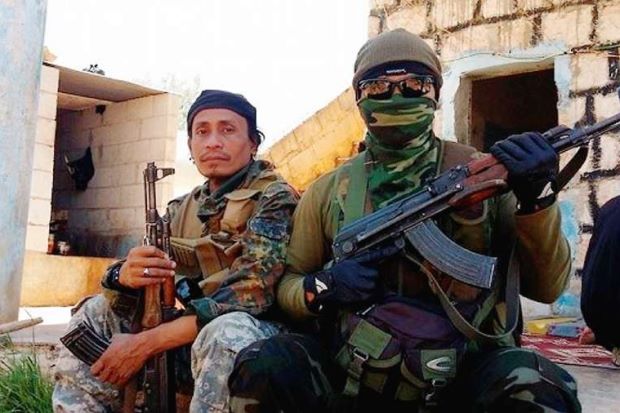
Ready for action: Lotfi (left) with another militant jihadist in Syria.
For years, radical Malaysians have been fighting alongside jihadist militants overseas but they kept a low profile at home to avoid detection by the authorities. Nowadays, some are using social media to flaunt their ‘heroics’.
UNTIL Ustaz Lotfi Ariffin got thrust into the limelight by heading to Syria to wage a war against the Shias in the Syrian civil war, his only claim to fame was being a regular face in the political-religious ceramah circuit in the northern states, especially his home state of Kedah.
But the sacked Kedah PAS Youth information chief has always been a firebrand, who preached to his listeners of mostly farmers and traders that it is a heroic and religious duty to die as a martyr (syahid) in a holy war against enemies of Islam.
So influential was he that the Pakistani-trained religious scholar was elected into the Islamist party’s powerful PAS ulama council at federal level.
In fact, in the official Kedah PAS Youth blog site, the party announced a book written by Lotfi, entitled Siasah Syar’iyyah, detailing his detention under the Internal Security Act, and a short biodata boasting his involvement in militant activities with al-Qaeda leader Samir Saleh Abdullah al-Suwailim in the Tajikistan civil war in the 1980s.
The Saudi-born Samir, also known as Emir Khattab, died in 2002. He fought in Chechnya against the Russians and was credited with forming the Islamic International Brigade with many foreign fighters.
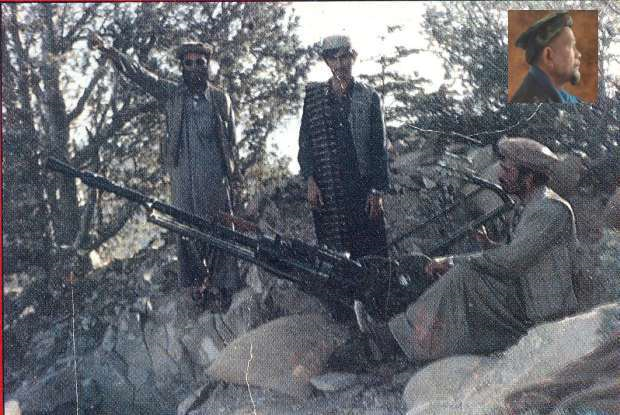
Lotfi was one of the followers of the gun-toting bearded and turbaned commander, who had turned into a legend among terrorist groups.
But Lotfi’s radical actions had been closely monitored by our police and in 2001, he was arrested on his return to Malaysia and detained in Kamunting, Perak, until 2006.
The blog also proudly declared that Lotfi had fought alongside the mujahideens in Afghanistan against the Russians. The mujahideens eventually turned into the al-Qaeda movement.
But the PAS leadership has now distanced itself from Lotfi, saying he has been sacked since May 11 following the party’s investigation into his militant activities while Lotfi claimed in his Facebook that he had actually quit in April.
Still, from his postings on YouTube and Facebook, he must have left a strong impression on the young. From what can be discerned in the video clips featuring the Malaysian militants, the Bahasa Malaysia spoken had a northern accent, indicating they are likely to be Kedahans, and likely to be influenced by Lotfi.
But Lotfi isn’t the first PAS leader to have gone into jihad. In the late 1980s, before the age of the social media, they were already fighting for the cause, but most of the Malaysian militants preferred to be shadowy and low profile, to stay away from police attention.
Back in May 2010, I had written a comment about their exploits, “Path of martyrs taking wrong turn”.
One jihadist, Zainon Ismail, wrote about his exploits in a book entitled Jihad Anak Melayu di Afghanistan – Merintis Jalan Syuhada (Young Malays in Afghanistan – Following the Syahid Route).
The then PAS branch committee member used a pseudonym, C.N. Al Af Ghani, and while giving sketchy details of himself, used pictures of himself dressed up as a mujahideen, in his book.
The 112-page book also carried pictures of other heavily-armed Malaysians who had decided to fight the Russians, who occupied Afghanistan then.
But everyone in PAS and the Special Branch knew the author was Zainon, a farmer who was active in the party’s grassroots operations.
He had made his way to Peshawar, Pakistan, before heading towards Afghanistan to join a group which called itself Harakat Ul Jehad al Islami, headed by commander Khalid Zubir.
The author wrote about his experience in using the famed Russian made AK-47 automatic rifle, favoured by terrorists, in his jihad pursuit. In the group was another Malaysian, one Fauzi Ismail.
Upon his return to Malaysia, Zainon was eventually arrested under the ISA together with seven others for alleged involvement in Kumpulan Mujahideen Malaysia (KMM), a local militant religious group with international links.
The eight, aged between 32 and 45, were picked up in Terengganu, Perak, Kedah and Johor in August, 2001.
Zainon, like Lotfi, was also sacked by the party but in Zainon’s case, it was due to his big fight with the PAS leadership over the use of funds collected for party members and their widows in the Memali incident.
In the 1985 incident, 18 people including four policemen were killed in Memali, Baling, during the clash between the police and followers of Ibrahim Libya, a PAS member who believed jihad was the only way to topple the Government.
In the case of the KMM members, they were detained under the ISA for alleged links to the murder of Lunas assemblyman Dr Joe Fernandez in 2000. They were also believed to be responsible for bombing a church and a Hindu temple, and also the attack on the Guar Chempedak police station on Feb 4, 2001.
Then Inspector-General of Police Tan Sri Norian Mai said the seven were Sungai Benut PAS branch chief Noorashid Sakid, Larut PAS youth committee member Ahmad Tajuddin Abu Bakar, Solihan Abdul Ghafar, Alias Ngah, Abu Bakar Che Dol, Asfawani Abdullah and Ahmad Pozi Darman.
Subsequently arrested and detained were Nik Adli Abdul Aziz, son of then Kelantan Mentri Besar Datuk Nik Aziz Nik Mat, and Lotfi.
Nik Aziz admitted that his then 34-year-old son went to Afghanistan to support the Muslims there in the struggle against the Russian invasion.
Members of the KMM were said to have received military training and fought in “holy wars” in Afghanistan and also in Ambon, Indonesia.
But one of the most dangerous detainees was former army captain Yazid Sufaat, a US-trained biochemist, who was detained under the ISA for seven years.
He had fought against the Christians in Ambon, Indonesia, before going to Afghanistan, where he put to use his chemistry training.
Yazid, who has been accused of being a Jemaah Islamiah leader, has openly boasted of his meetings with Osama bin Laden in Afganistan.
If there is one thing that is consistent in the PAS agenda, it is its ambition to push for the implementation of hudud laws and to turn Malaysia into an Islamic state.
But more than that, there are also members who are cheering for the militants in Syria and it comes as no surprise that many PAS members have ended up with radical groups in hot spots like Pakistan, Afghanistan and now Syria.
But now, they have become more daring by openly uploading selfies, blogging about their experiences on Facebook with videos on YouTube.
There is another difference – their targets are no longer Russians and Americans but Syiahs, Muslims from another school of Islam.
Unnecessary ill will
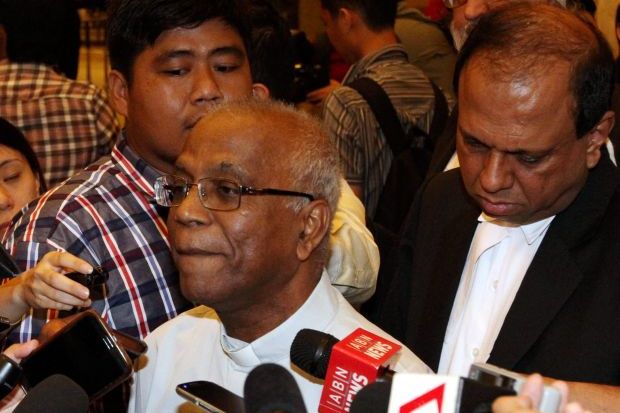
‘The Herald’ editor Rev Lawrence Andrew speaking to the media outside the court in Putrajaya. – filepic
What’s in a name? Well, in Malaysia, it is a big issue and, as events have shown, there are no winners even if the matter has been decided by the apex court.
LET me, right from the beginning, point out that I am a Christian. I am a Protestant, which is different from being a Catholic.
Protestants do not regard the Pope as the leader of the church, unlike the Catholics. The priests and nuns in Catholic churches practise celibacy.
In simple language, they are all unmarried and abstain from sex whereas pastors in Protestant churches can get married and have families.
In Malaysia, both priests and pastors are lumped together and referred to as paderi in Bahasa Malaysia. I do not know why, but that’s how things are.
The fact that there are differences within a faith is not exclusive to Christianity. All the major faiths have different schools of thought.
So when some Muslim groups in the country got angry with the Catholics over the Herald case, it was a Protestant church in Desa Melawati that ended up being hit with Molotov cocktails.
In Malaysia, because of our history, many Catholic churches are easily recognised by their large cathedrals with very distinct architecture.
The mainstream Protestants who came earlier, like the Methodists and the Anglicans, also have distinct churches but the newer Protestant churches tend to be located in shophouses, shopping malls, warehouses and even above coffee shops.
And that’s because the local authorities – the councils – make it difficult for churches to be built.
The conditions forbid the cross from being displayed openly and even putting the word “church” on the signboard is taboo. Many churches simply substitute the word “church” with words like “community centres”.
It is convenient to blame the federal government for everything but much of the authority is vested in state hands.
The church I go to in Petaling Jaya is located in an office block. As far as I am concerned, it is a church to me. To everyone else in the congregation, it is a church.
What is the point I am driving at? Simple. We need some common sense here, which is definitely missing from some of our religious and political elites. There are those who have been speaking a lot of gibberish while some have chosen to remain silent, hoping that the problems will vanish into thin air.
What’s in a name? Well, in Malaysia it is a big issue and, as events have shown, there are no winners even if the matter has been decided by the apex court.
There are only losers. All of us are affected by the negative media attention, especially the bad press overseas. And the sad and painful reality is that so much unnecessary ill will has been generated that threatens to tear at the social fabric that is keeping us together.
Have we managed to resolve anything? No, if you ask me. Many Malaysians remain just as unsatisfied and unsettled, and confused.
The federal government has correctly pointed out that Christians can still use the word “Allah” in churches and that the court ruling is confined only to the Catholic Herald, which had used the word “Allah” in its Bahasa Malaysia edition.
It’s just being practical. Anyone can insist on a blanket ban but how does one enforce such a ruling? By stationing policemen at all churches?
The 10-point agreement, for example, makes it clear that Christians in Sabah and Sarawak can use the Al-kitab and the word “Allah” over there. We can engage in a debate as to what happens when they are in the peninsula, but seriously, how would it be possible to stop them from doing the same here?
There are many Sabahans and Sarawakians in the peninsula who are here to study and to work. It just shows up the ignorance of the peninsular Malaysians when they assume that anyone with a Malay-sounding name and who looks Malay is a Muslim.
The Malays must not forget that the bumiputras comprise many ethnicities who have different faiths as well.
Umno may be strong on its Malay-Muslim agenda but there are actually many Christian bumiputras who are members of the party, something which is lost on some delegates at the annual assembly.
We may see the UiTM, where the recent controversial conference was held, as a fully Malay/Muslim institution but the fact is there are many Christian bumiputra students at the campus, some 3,500 at last count.
In a reply to a parliamentary question, the Education Ministry said the Christology Nusantara conference was an intellectual discourse but one can imagine the dire consequences on any Christian organiser who dares to hold a similar “intellectual” discourse at another public university or college.
What irks many Malaysians is why there seem to be different standards on such matters. Some groups seem to get away with just about anything while action is promptly taken against other groups or individuals.
We should make it clear that anyone who insults another, whether as an individual or as a group, on the basis of race or religion should not be spared.
If the authorities close an eye to these political thugs, it would encourage them to further divide the nation and, worse, send the wrong message that they are endorsed by the authorities.
At the same time, Christians must be honest enough to admit that in most churches, the word “Allah” is hardly used and I doubt the congregation, especially those in English-speaking churches, feel comfortable using the word, instead of “Lord”.
While Christians have fought for the right to use the word, the reality is that it is rarely used – except in services involving Sabahans and Sarawakians. Well, the babas in Malacca would also argue that they, too, refer to God as “Allah”.
One thing is clear. The Al-kitab, mostly printed in Indonesia, will continue to be studied and distributed, like it or not, by Christians who are more comfortable with the Malay language.
After all, our education system has produced a generation of Malaysians, regardless of their ethnicity, who are more at home with Bahasa Malaysia than English.
And let’s also be practical here. This is the generation who can find anything online. You can ban the printed version of the Bible in Bahasa Malaysia but anyone can simply download the entire version online.
The Penang mufti, Dr Wan Salim Wan Mohd Noor, has correctly said that while the word Allah is used by Christians in Arabic countries, there is a need to consider whether it is suitable in our community.
“From what I can see, the majority of Muslims in Malaysia are still unable to accept it. Maybe over time, views can change,” he said.
This is the impression I have received speaking to many of my Muslim friends and colleagues, too.
Of course, they are aware that Allah is commonly used by the Christians in Arabic countries, just as Dr Wan Salim said. But the concern of our Muslim friends goes beyond that – it is that sense of belonging that connects them to Allah that is unique and special.
The reality is there is a fine line between right and wrong in religion, especially if it involves cultural practices.
The churches in Sabah and Sarawak that conduct services in Bahasa Malaysia, read the Al-Kitab in Bahasa Malaysia and refer to Allah, probably also pray quietly in Bahasa Malaysia.
Likewise, I spent a decade in a Catholic school, spent much time in Catholic churches and have many Catholic friends.
Although I am a Protestant, I still pray like how a Catholic would do, in my mind and heart, because of my school legacy.
And it’s between me and God. How I pray and how it is done, or for that matter, how I call God, is my private and personal concern. No one should decide for me nor judge me.
At the end of the day, we should be more fearful of God than men, who are but mere mortals.
Way out of line!
The statements of Datuk Seri Jamil Khir Baharom, the Minister in the Prime Minister’s Department, border on the absurd with his bizarre interpretations of the laws and court decisions of this country.
IS this Datuk Seri Jamil Khir Baharom, the Minister in the Prime Minister’s Department, for real, because he seems to have chalked up a record for contradicting what the Cabinet has decided and practised?
Like many Malaysians, we want to know whether he has been making these statements in his personal capacity, or on behalf of the Malaysian Government.
If he is speaking on behalf of the Government, then we would like to know what the other ministers have to say. And as for the component parties of the ruling coalition, while some have spoken out strongly against his views, others have kept strangely quiet.
The statements of the retired major general, who served in the military religious corps before being appointed to the Cabinet, are bordering on the absurd with his bizarre interpretations of the laws and court decisions of this country.
He has quoted Article 3 of the Federal Constitution, which states that Islam is the religion of the Federation as the basis for his claim that Malaysia is not a secular state.
He went on to justify his claim by stating that “Malaysia is not a secular state as, historically, the country was established based on an Islamic Malay Sultanate government, with the Sultans being the head of Islam in their respective states”.
To him, that is enough to mean that Malaysia is not a secular state. To many of us, his line of reasoning is simply unbelievable.
And even as the debate is raging on, he came out with another statement in Parliament that the unilateral conversion of a child is allowed under the Constitution.
This is not only incorrect but is a direct contradiction of the Cabinet’s decision in April 2009 on the conversion issue.
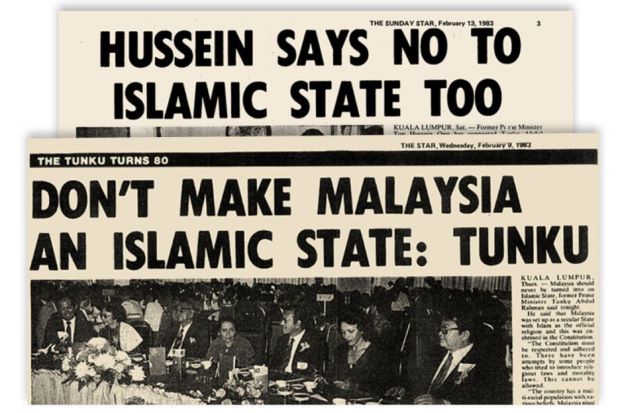
I would like to refer Jamil Khir to a news report in The Star on Feb 9, 1983, when our first Prime Minister and founding father, Tunku Abdul Rahman, said clearly that Malaysia was set up as a secular state with Islam as the official religion and that this is enshrined in the Constitution.
“The Constitution must be respected and adhered to. There have been attempts by some people who tried to introduce religious laws and morality laws, this cannot be allowed.
“This country has a multi-racial population with various beliefs. Malaysia must continue as a secular state with Islam as the official religion,” the Tunku, known as our Bapa Merdeka, was quoted as saying.
He reiterated that Malaysia should never be turned into an Islamic state, reminding all that “no single race could have obtained independence for this country and no single race by itself can rule this country”.
A few days later, Tun Hussein Onn expressed support for Tunku’s statement that Malaysia should never be turned into an Islamic state.
“Any move of this kind is neither wise nor practical. The nation can still be functional as a secular state with Islam as the official religion,” he was quoted as saying in The Star on Feb 13, 1983.
Our third Prime Minister said Malaysia was set up as a secular state, but there were groups who had made use of this issue for their own interest and if this was not checked, the survival of the whole country would be threatened.
“We must think of the other communities with whom we have to live and if we do not have unity, there would be chaos and disorder,” he said.
On moral laws, Hussein Onn said the legal system adopted in this country did not go into the right and wrong as it was all a matter of concept.
“What is immoral to one may be perfectly all right with another and this is what complicates matters,” he said, adding that whenever Islamic laws were discussed, “it was the punishment that was emphasised and not the other aspects which pertain to good living”.
Another more famous Prime Minister, Tun Dr Mahathir Mohamad, however, did create a lot of controversy at the opening of the Gerakan annual delegates conference in September 2001 when he declared that Malaysia is already an Islamic state.
In responding to the current debate, Mahathir has said that “Malaysia is neither an Islamic state nor a secular state, it’s just an ordinary state that recognises Islam as the official religion of the country”.
Many Malaysians are pretty sure by now that Jamil Khir, or at least the officers who drafted the reply for him in Parliament, has a poor understanding of the law and Constitution or possibly chose to read it according to their wishes.
But we hope that he will at least read up what these two Prime Ministers have to say about Malaysia being a secular state instead of trying to give us the flimsy answer of this country’s history being premised on an Islamic Malay Sultanate government.
If Jamil Khir takes the trouble to read up the historical documents, including the Reid Reports 1957 and the minutes of the meetings between the Tunku and leaders of the Alliance, he would be aware of the repeated emphasis that the constitution was framed on the basis that the Federation would be a secular state.
We also want to refer Jamil Khir to the Supreme Court decision in Che Omar bin Che Soh v Public Prosecutor (1988) when the five-man bench comprising Tun Salleh Abas LP, Wan Suleiman SCJ, George Seah SCJ, Hashim Yeop A. Sani SCJ and Syed Agil Barakbah unanimously declared that Malaysia is a secular state and not Islamic.
We salute our two former Prime Ministers and the judges for stating in clear terms that Malaysia is a secular state.
Over the past few years, it is clear that religious figures and PAS theologian-politicians have been pushing hard for their Islamist agenda. They have been chipping in slowly but seemingly effectively into our political and judicial structures.
The result today is that the authority of our leaders, the police and the judges has been compromised. Many Malaysians have the perception that these people dare not stand up against the powerful religious bodies.
What is of concern is that their fear may be due to the fact that they share the same faith and ethnicity, and anything they say can be easily labelled as speaking out against their own community.
This is not how it should be. The people in all our branches of government, from the executive, the legislative and the judiciary, all take their oath of office to uphold the Constitution, which is the supreme law of the nation. Their personal faith issues cannot interfere with how they carry out their duties.
The non-Muslims, meanwhile, are beginning to feel apprehensive over the direction that this country is taking, which they have known to be moderate and secular. Suddenly, the religious tide seems to be stronger in all spheres of life.
Not too long ago, Jamil Khir reportedly said the Government is prepared to support any bill on the implementation of hudud.
Until now, he has not clarified if that was his personal opinion because, as we know, there has been no such official move by the ruling government, despite the occasional bravado by some Umno politicians trying to show they are more Islamic than PAS.
Malaysians would like to know whether any of our politicians will be brave enough to say our Bapa Merdeka, who was instrumental in drawing up our Federal Constitution and other vital documents to seek our independence, had been wrong all this while.
Halt the overzealous theocrats
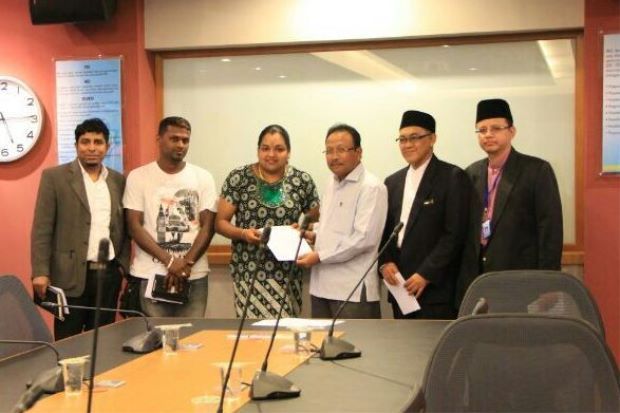
Zarena and Mohamad Adzib showing the press statement to reporters after their meeting while her family members and Jais officers look on.
IT is said that weddings and funerals have many things in common. They are emotional ceremonies that bring people, especially family members and friends, together.
They also bring out the best and the worst in people, so the saying goes. And going by recent events, this couldn’t be further from the truth.
We are talking here about our religious authorities, who seem to have created a record of sorts, not to mention grabbing international media attention, for Malaysia.
They have long been known to show up at funerals to take away the bodies of those they believe were Muslims and therefore ought to be buried according to Islamic rites. They may have the records of the conversion, but problems arise when the families themselves are not aware, more so when the individual had not lived as a practising Muslim.
In our multi-ethnic, multi-cultural and multi-religious society, such cases are more common than thought.
On June 1, the Selangor Islamic Religious Department (Jais) supposedly stopped the Hindu wedding ceremony of Zarena Abdul Majid to question her religious status.
Although a subsequent meeting between Zarena and the Selangor Islamic Religious Council (Mais) ironed out the issue with a joint statement that said “Jais had conducted its investigations in a proper manner without hurting the feelings of the family and guests who attended the wedding”, the damage had been done.
Here’s the complication – Zarena was brought up as a Hindu but her estranged Muslim convert father had registered her as a Muslim when she was a child. Her mother, a Hindu, brought her up as a Hindu.
The incident has once again focused attention on the position and powers of Jais in its dealings with the non-Muslim community.
The seizure of 321 copies of the Bahasa Malaysia and Iban language Bibles from the Bible Society of Malaysia on Jan 2, for example, certainly put the department in the spotlight and on Wednesday, the Attorney-General finally issued a statement which would hopefully bring the case to closure.
The Attorney-General said investigation papers showed that the seized books were essentially Bibles in Bahasa Malaysia, and that the Al-Kitab Berita Baik contained materials from the Bible, Torah and Psalms. The statement pointed out that the seized items were not “controlled items” and that it was not a national security issue.
While the A-G stopped short of directing Jais to return the seized Bibles, he said it was now up to Jais to take “the next course of action” in accordance with the law.
In a statement yesterday following the latest developments, both Mais and Jais are standing firm not to return the seized Bibles. Mais said the Selangor state government did not have the right to order for the return of items confiscated in the course of investigation.
“As such, both the council and Jais would not abide by the instruction,” the statement said.
Malaysians are disturbed, if not outraged, over the manner in which Jais has been carrying out its work, especially when it intrudes into the affairs of non-Muslims.
While Jais has blamed the media for using emotive words like “raids” to describe their actions, it cannot be denied that Jais is perceived, rightly or wrongly, as high-handed and insensitive in carrying out their work.
It would appear that Jais, although under the jurisdiction of the state’s higher authorities, is more powerful than the Mentri Besar of Selangor himself.
In the Zarena case, Tan Sri Khalid Ibrahim said he was “embarrassed” while the BSM issue showed how he was simply ignored and had to turn to the federal authorities, like the A-G, for help.
Meanwhile, in Penang, the Penang Islamic Religious Department (Jaipp) cut short a funeral ceremony on Sunday afternoon and claimed the body which they said was that of a Muslim convert.
The Jaipp said its records showed that the deceased, known as Teoh Cheng Cheng, 38, converted to Islam 17 years ago and registered her Muslim name as Nora Teoh Abdullah.
The Syariah High Court declared she was not a Muslim and Judge Zaim Md Yudin ordered her body to be returned immediately to her family for burial.
Penang state executive councillor Datuk Abdul Malik Abul Kassim had to apologise on behalf of Jaipp for the manner in which its officials interrupted the Taoist-style funeral, admitting its actions were “insensitive”.
Both these incidents have left many Malaysians disheartened and even angry at what this country is turning into and, worse, how elected state leaders seem to have their powers usurped by these moral and religious police.
In the child custody disputes involving Muslim fathers who refuse to return their children to their Hindu mothers despite court orders, Malaysians, especially non-Muslims, have the right to question the reliability of the police as law enforcers.
Even when the bench gives them clear directions, the police are claiming that they are caught in the middle because of conflicting orders from the civil and syariah courts.
At the heart of the two current situations is the fact that both marriages were registered under civil law and the jurisdiction of the civil courts cannot be disputed, nor can its orders be ignored. That the husbands subsequently converted does not mean that any Syariah court decision must take priority, as there are non-Muslim parties involved over which the religious courts have no authority.
The police are now claiming they are “sandwiched” between the syariah and civil courts but the bottom line is that they have failed to obey court orders that the children be returned to their mothers.
Fair-minded Malaysians, regardless of their faiths, have reasons to be angry – it is the job of the police to enforce the laws and NOT to interpret the laws. If the police is unsure, they should ask the Attorney-General.
It is preposterous for the police to suggest that these affected children be placed in welfare homes when it is so clear that it should be the mothers who should have the priority in these cases. Let the children grow up and decide what faith they wish to profess.
Firdaus Husni, the Bar Council’s constitutional committee chairman, reportedly said that although Article 121 (1A) of the Federal Constitution stipulates that civil courts have no jurisdiction over any matter within the purview of Syariah courts, the law was not meant to give the latter superiority over the former.
Or, as the Ipoh High Court judge puts it, “In as much as a Civil High Court would restrain from and refuse to entertain a custody application of a parent in a marriage under Muslim law, so also would a Syariah Court refrain from and refuse to entertain a custody application in a civil marriage.
“Both legal systems in the Civil Courts and the Syariah Courts and the streams flowing from it must be kept pure and that involves respecting each other’s jurisdiction as conferred by the Federal Constitution, the federal laws and the State Enactments.”
Can we see some common sense, decency and justice prevail instead of letting religion, whether imagined or otherwise, cloud our judgments?
Malaysians have never seen the police ignore the orders of the High Court judges – and that has set off a dangerous precedent because it has given the impression that these judges, just like the state executives, are powerless.
We have not become a theocratic state, at least not yet, but those with religious powers appear to now enjoy the upper hand, wielding the kind of clout that has never been seen before.
Against this highly disturbing trend, with the push for the implementation of hudud laws, it is shocking that there are non-Muslims who are prepared to place their future in the hands of theologian-politicians.
I do not think that our founding fathers, especially Tunku Abdul Rahman, would want Malaysia to head in this direction. It has to stop.
Power of (mis)perception
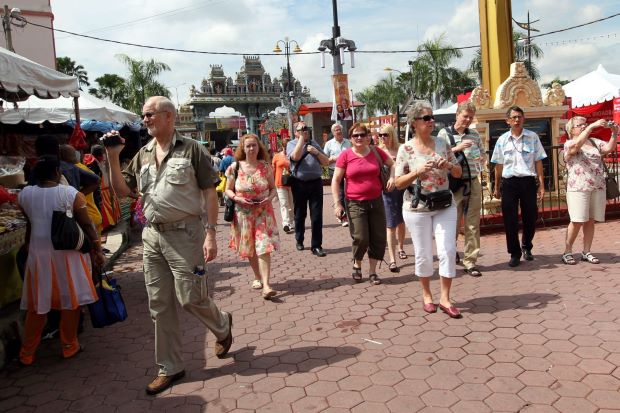
TWO incidents, which took place over the past one week, have really troubled me. These are real incidents that this writer has experienced up close and personal.
They are a strong reminder about the power of perceptive reality, and how the actions of a few can have more far-reaching ramifications than one can possibly imagine.
The first involves a student friend from Hong Kong who was planning to make his first visit to Kuala Lumpur. He had wanted to fly to Malaysia with his Malaysian friend on Malaysia Airlines.
But his father insisted that they flew on Cathay Pacific instead. He did not want them to take chances with MAS following the bad publicity over the MH 370 incident. In short, as far as he was concerned, our national airline has been deemed unsafe.
This young man, however, was rational and did not buy into his father’s fears. But because the old man was paying for the air ticket, it didn’t make sense to argue with him, and so he took his advice.
One has to ask, how many passengers did MAS lose in this period simply because there is such a strong perception about its safety record, although the reality is that our airline has one of the best records in the aviation industry.
In the other case, a British national, who made her maiden trip to Malaysia last week, was concerned over Malaysia’s purported strict adherence to Islamic rules. So she was careful to pack the most conservative clothes for her trip.
She and her lawyer husband had been reading news reports in the United Kingdom about Malaysia’s plans to impose syariah laws, the raids by religious authorities, and how the country was increasingly turning conservative. And yes, my friend has also read about the Chinese tourist who was abducted at the Semporna resort.
It didn’t end there. On the plane, she was advised by the passenger seated next to her that she needed to be careful when walking the streets of KL because of the many snatch thefts! The passenger, a fellow Briton, happened to be an expatriate who has stayed in Malaysia for the last 20 years. So, she was regarded as someone who could speak with authority based on experience.
Imagine what must have been going through her mind even before she touched down in our world-renowned KLIA. And so, despite the humid weather in KL, she not only brought along thick clothing, but was all dressed up to fit into a “conservative society”. Imagine how shocked she was to see many Malaysians walking about in shorts and skirts.
Let’s be honest here. The current perceptions about our country are bad. And we all know that perception can be more powerful than reality.
Like it or not, Malaysia has a serious image problem right now and we really need to get our act together.
We can be defensive and act like those silly politicians who will be quick to blame the Western media for putting us in a bad light with their biased reporting. But the reality is that we are responsible, in one way or another, for this negative media image.
Those of us in the media business know instinctively what kind of news will make it to the international press and we seem to be churning out a lot of such news in recent times.
No amount of money spent to promote tourism (this is Visit Malaysia Year, after all) will work if we do not tackle these problems at source.
Don’t we hate it, as Malaysians, when we hear foreigners talking about us in this manner? But in our heart of hearts, we know some of these are true, and the truth hurts.
Of course, we get upset when Kuala Lumpur is listed as one of the most dangerous and unsafe cities in the world. Just Google it.
We can moan and question the credibility of these websites but the point is that there will be thousands, if not millions, of tourists who will surf the Net every hour all over the world and they will read such negative reports. After all, we also do our own Internet research when we want to visit a city overseas.
And the fact of the matter is that we know that many petty criminals do roam our streets, and we all have stories to share about what happened to friends and relatives.
Perception aside, it will be better if these sites can tell surfers that Malaysia is safe because there is always a strong presence of the police at our airports and the streets, as well as the major tourist centres.
Just check out Changi Airport in Singapore. We always seem to be able to spot armed policemen around and even in Orchard Road, we will see them.
Likewise, at our isolated diving resorts in Sabah, we really need to station well-armed soldiers there. The owners cannot have the right to turn away our men in uniform because the national image is at stake here.
We cannot keep on giving verbal promises to tourists that these abductions are isolated cases and that Sabah is safe when we are never sure when the next abduction will happen. To these Filipina kidnappers, as long as such places are not well-secured, it will be business as usual.
The Semporna waterfront town itself, located in Tawau, also needs a serious facelift, if we wish to meet the image and standards of an international tourist gateway.
Just key in the words “Semporna, dirty” in Google search and see what you get.
Tourism is Malaysia’s second largest foreign exchange earner and the seventh largest contributor to the economy, contributing RM47.2bil to our Gross National Income (GNI) in 2012.
By 2020, Malaysia is expected to earn RM168bil from the targeted 36 million tourist arrivals under the Malaysia Tourism Transformational Plan (MTTP), according to Tourism and Culture Minister Datuk Seri Mohamed Nazri Abdul Aziz.
In 2012, Malaysia welcomed 25 million foreign tourists, placing it firmly as the 10th most popular tourism destination in the world, according to the United Nations World Tourism Organisation (UNWTO). It ranked 13th in international tourism receipts of RM60.6bil.
According to Nazri, “we are targeting high net-worth tourists and continue to welcome arrivals to our high-end world’s best hotels and resorts”.
This writer knows for a fact that this minister works hard, even until the late hours, when he is on his overseas trips, meeting officials and tour operators, to get them to come to Malaysia.
But we do not want him to labour in vain. We also need to ensure that tourists feel safe and that in their minds, Malaysia is a safe place for them to visit. After all, in case we forget, there are many choices out there. Like switching airlines because of perception, heading to another country is also just a click away.
Hudud is not the answer
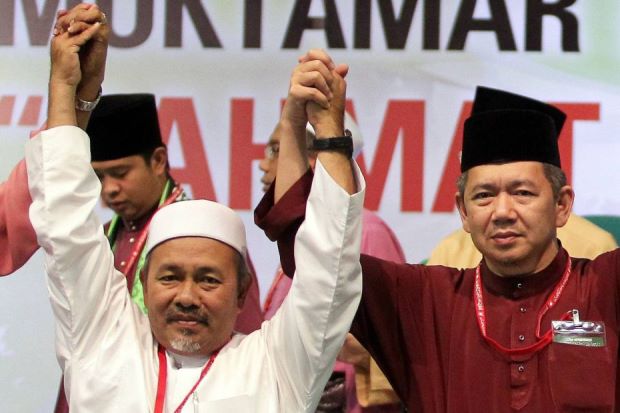
Pas Vice President , Datuk Tuan Ibrahim Tuan Man (left) and Salahudin Ayub raising their hands at the 59th Muktamar at Stadium Melawati in Shah Alam.
PAS leaders should look at their backyard first before blaming the existing criminal laws for the spike in rape cases in the country.
THE highly publicised gang rape involving a 15-year-old schoolgirl by more than 10 men in the district of Ketereh near Kota Baru seems to have given PAS a reboot to push for hudud laws.
Its vice-president Tuan Ibrahim Tuan Man has, reportedly, quickly said that the gang-rape case was proof that existing criminal laws were ineffective, and that hudud is the solution.
But if I were him, I wouldn’t be so quick to jump into this. He had better check his facts first because in PAS-controlled Kelantan, the number of rape cases is simply mind-boggling.
It has been reported that from January to February 2011 alone, of the 41 rape cases reported in the supposedly conservative state, 38 involved youths under the age of 17. This was an 8% increase from the 38 cases reported over the corresponding period the year before.
In fact, as far as rape cases are concerned, the state seems to have constantly held on to pole position against the other states. And this is despite the PAS’ leaders obsession with ensuring that the women in the state are dressed properly, so as not to entice the men into committing such horrendous deeds.
Unfortunately, the statistics show that the victims were mainly rural females, who were conservatively dressed. And what about the schoolchildren, who can hardly be accused of being sexually provocative?
There is, of course, the infamous statement made by former PAS Kelantan Mentri Besar Datuk Seri Nik Aziz Nik Mat that girls who did not cover their aurat (parts of body that should remain covered) deserved to get raped.
PAS leaders should look at their backyard first and explain why Kelantan has the highest number of reported rape cases in the country.
In 2010, there were 97 cases reported. In 2011, there was an interesting scenario where in the two weeks of the month of Ramadan alone, the number of rape cases in Kelantan involving victims aged between 13 and 15 was more than the reported rape cases in the first eight months of that year.
Another startling revelation is that Kelantan also had the highest number of HIV cases in the country for three consecutive years from 2008 to 2010.
In 2010, the number of Kelantanese diagnosed with HIV was 28.2 people for every 100,000 population. The national ratio is 12.9 people for every 100,000 population.
In 2009, a total of 616 HIV/AIDS cases were detected, of which 16% were women. Of the figure, 40% were housewives.
In 2010, Malaysians were shocked by news reports of the marriage of two girls, aged 10 and 11, to men in their 40s in Kelantan. Days later, the 11-year-old was found abandoned and in a state of shock.
All these figures seem to run contrary to claims by PAS leaders that all is well and fine in their puritanical state.
Tuan Ibrahim has argued that in the rape case involving the 15-year-old schoolgirl, the offenders cannot be prosecuted under hudud law because of several ambiguities in the case.
They include the absence of impartial witnesses and the fact that the victim had followed some of the men to the house.
The incident allegedly took place last week, where the female victim was lured to an empty house where she was ambushed and more than 10 men took turns to rape her. Now, if this doesn’t worry you, I don’t know what will.
There are some ill-informed non-Muslims who, consistent with their anti-government stance, argue that the chopping of hands is only for Muslims and not non-Muslims. Well, I have bad news for you. Think again. If your daughter gets raped by four Muslims, and they ask to be tried under syariah laws, you may wish to think again whether it affects you. And as Tuan Man said, there is a need to look for four men of good integrity. I am not sure where you are going to locate them.
Right now, under the common criminal law, even if one man is arrested, that is good enough to haul the rapist to court.
The laws of evidence will take its course.
Then, there are cases involving business transactions, where it may involve partners of different faith, and what happens if one chooses to have his case heard in the syariah courts?
Would it put the non-Muslim parties in a spot, similar to how some custody cases involving a converted husband and non-Muslim wife have turned out?
So, do not say that it would not affect you, non-Muslims, because this is what the PAS leaders want you to believe in the hope that you will send more of them to Parliament.
Give them enough numbers and you show you have endorsed their policies, thank you very much.
But Tuan Ibrahim said that although they may not be charged with rape under PAS hudud, they can still be prosecuted under takzir (discretion-based judgment), a component of the Islamic penal code for crimes where the punishments are not spelled out in the Quran.
Here’s a surprise for PAS leaders – the safest countries in the world are mostly in Europe and those in Asia include Singapore, Japan and Hong Kong. There will be different forms of measurements and criteria but it’s always the same countries that pop out and none of these countries are imposing PAS-styled hudud laws.
I’d like to find out whether PAS leaders would prefer sending their children to live in Norway or Singapore, or to live in Pakistan, Syria or Afghanistan.
If PAS leaders continue to judge women with prejudices, instead of educating men and children to respect women, then that’s where the problem begins.
PAS leaders in Kelantan also have to look at the root causes of social ills in their backward state which includes high unemployment, lack of career opportunities and higher education prospects.
Stand up and speak up

The large crowd gathered outside Penang State Assembly building last week to protest against Seri Delima DAP assemblyman R. S. N. Rayer.
Moderate Malaysians have the right to tell our politicians that we want the liberal, secular and plural ways.
SOME of our politicians seriously need to have their heads examined. They need psychiatric treatment and the sooner they get it, the better it will be for Malaysia because they are a danger to all of us.
The unruly behaviour of some these political aspirants, and luckily for us they are only at the lowest level of their party echelon, does not augur well for the future of our democracy which is premised on proper practices, in words and in deeds.
No matter how much the politicians may disagree with one another, there is a code of gentlemanly conduct that cannot be breached, lest we descend into the kind of chaos that makes a mockery of our system.
If they aspire to be honourable members of any House, then they had better learn the meaning of honourable behaviour. To most Malaysians, they acted more like thugs and gangsters who were seemingly unable to control their emotions.
Our political landscape is changing. And many of the protagonists, from all sides of the divide, seem unable to argue on any issue in a convincing manner due to their poor intellectual and language skills.
And they now have to address an electorate that is more sophisticated and better-informed, one that will not tolerate the low-level antics that they employ.
You do not win votes by shouting down or threatening your opponents, especially with a religious or racial slant, whether via the social media, protest gatherings or at press conferences. Politicians and their supporters simply have to be clear about that.
I am talking about the group of protesters comprising members of Umno and non-governmental organisations who stormed into the Penang State Assembly last week, which led to 12 persons being arrested by the police.
They were part of a larger group who had gathered outside the assembly to demand an apology from DAP assemblyman R. S. N. Rayer.
They had angrily entered the building after violently shaking the gate open. They entered the chambers, stood in front of the Speaker’s rostrum, and looked for Rayer who was not around at that time.
This is pure intimidation. If it isn’t, try telling us level-headed Malaysians what it is.
Mob behaviour should be condemned, and these trespassers must be charged in court soon. We must show that there is justice in this country and that we do not condone gangsterism and thuggery.
It is right that the Penang Umno chairman Datuk Zainal Abidin Osman has expressed regret over the incident and put on record his disagreement with the act of the demonstrators.
The party should take disciplinary action against these protesters in the wider interest of the Barisan Nasional coalition. At a time when the component parties are working hard to restore voter confidence – with the Gerakan candidate fighting hard to win back Teluk Intan – such actions by one party will surely have negative ramifications.
At the same time, the DAP leadership should also give Rayer and other rabble-rousers within its ranks a dressing down.
Words like “celaka”, which loosely translated means damn, should not be simply bandied around with racial and religious connotations as they can be offensive, insensitive and hurtful.
The DAP is already the Penang state government but, unfortunately, some of its leaders are acting as if they are in the opposition.
For God’s sake, get out of the ceramah mode and act and talk like leaders, not mere macai (low level) politicians.
The most pathetic DAP leader has to be former publicity chief Hew Kuan Yau who is fond of using lewd remarks at his ceramah. He is nicknamed “Superman” because he loves to wear T-shirts sporting the Superman insignia.
This Taiwanese graduate, who actually has a doctorate degree, has essentially imported the worst political behaviour from Taiwan to Malaysia, especially the no-holds-barred and rude political culture.
Supporters may love him but the party probably knew he might be a Super Liability should he be chosen to stand in Teluk Intan.
The crude and brash Superman should be sent to Westminster to learn the meaning of good parliamentary practices. But we are not quite sure if he is capable of following the debates in English.
Last week, we read about how the Independent candidate in the Bukit Gelugor by-election, Abu Backer Sidek Mohamad Zan, tried to stop the official car of the Penang Chief Minister Lim Guan Eng by “fainting” in front of the vehicle.
An ambulance arrived to ferry the lawyer to the hospital but he reportedly regained consciousness on the way there.
This man has entered the wrong contest. He should be running for the Raja Lawak (King of Comedians) contest on TV. Someone has to tell him, without hurting his pride and over-inflated ego, that he is making a fool of himself. If he doesn’t believe us, let’s wait for the by-election results.
We are seeing more of such personalities because they seem to get generous space in the media, especially on online news portals.
Like it or not, this is part of democracy and if we want different opinions to be heard, including outlandish ones by the most colourful of characters, we cannot shut them down.
But moderate Malaysians must also stand up and speak their minds. Many of us cherish the moderate, liberal, secular and plural ways, and we have the right to tell our politicians that is the only way forward. We need to keep Malaysia sane!
Slipping into our racial cocoons

Seriously I find it disturbing that the voices of mono-ethnicity and mono-religion are becoming louder in Malaysia. They may be the minority but not many of us seem ready to tell them off, and the result is they remain unchallenged.
Major countries all over the world, at least the ones that matter, are embracing and celebrating diversity and pluralism.
They proudly put on the badge of multi-culturalism as a showcase to tell us that they have real cosmopolitan cities.
The irony is that Malaysia had a head start. Of all the Asean countries, with the exception of Singapore which was then part of us, no other country in the region could regard itself as a plural society.
From the many places of worship of different religions to the diverse choice of food and the make-up of our demography, Malaysia has the perfect credentials to tell the world that we are truly Asia.
Take a walk down Jalan Mesjid Kapitan Keling in Penang and we find a mosque, a Chinese temple, an Indian temple and a church standing next to one another.
No one has ever complained that this centuries-old cluster of religious places has caused uneasiness to the people.
Now, try to do the same in modern Malaysia. Try building all these places of worship of different faiths today and see how our extremists react.
They will tell us that it is politically and religiously incorrect and there will be howls of protests from various non-governmental organisations.
These instant NGOs, with a membership of five persons, including the wives and children of the presidents, will claim that they represent a particular race or religion.
And yet many of us, including those in authority, fall for such pressures and demands. The rest of us, mainly rational and level-headed moderates, are not quite prepared to argue our case. Silence, unfortunately, can be interpreted as consent.
Suddenly, pluralism, moderation and secularism are politically incorrect words, regarded as threats to the fabric of nation building. It’s astounding. Since when did this degeneration of proper thinking begin?
It’s only in Malaysia, and only in recent times, where we argue insanely over whether we should be Malaysian first, or Malay, Chinese, Indian and lain-lain (others). And yet these same people, when asked the same question overseas, will dutifully and proudly declare themselves Malaysian.
But on their return to Malaysia, possibly even during the flight home, they will transform themselves, in typical Dr Jekyll and Mr Hyde fashion, into their racial cocoons. Or is it caves?
So last week, we had an online news portal outlining the achievements of non-Malays, presumably to rebut Malaysian Muslim Solidarity (Isma) president Abdullah Zaik Abdullah Rahman who referred to non-Malays as trespassers and who had questioned the contributions of non-Muslims to the nation.
The Malaysian Insider’s top 10 list included badminton hero Lee Chong Wei, international shoe maker Jimmy Choo and world squash champion Nicol Ann David.
Soon, the infamous controversial lecturer Ridhuan Tee Abdullah joined
in the fray and listed out the achievements of Malays. Repeat: Malays, not Muslims.
The lists of achievements from the portal and Ridhuan, seriously, are childish. I think most Malaysians are embarrassed. We like to see ourselves as Malaysians and at every sports event, we are cheering for our Malaysians. When Lin Dan squares off with Chong Wei in Kuala Lumpur, we know who to cheer for, even if both are ethnic Chinese.
And Abdullah Zaik’s Isma is supposed to represent Muslims. He has forgotten that a Chinese, Indian or a Kadazan can be Muslims. Ridhuan can think and dream like a Malay but he is still a Chinese. The fact also remains that Ridhuan was given the name of Tee Chuan Seng by his parents.
Surely, he is not going to ask his family members to pack up and leave the country if they are unhappy.
Most of us feel sorry for him. He seems to suffer from an identity crisis problem. No matter how much he tries, the reality is that one cannot change one’s ethnicity. Even his religion does not require him to do so.
He doesn’t need to be an apologist for anyone, or to prove that he is more Malay and more Muslim than others. There is no need for him to make damaging, presumptuous and racist remarks.
Even his argument about who pays the most tax is flawed when he could not make a distinction between personal and corporate tax. It is also incorrect to equate government-linked companies with Malay entities.
Someone needs to tell him that it is perfectly all right to be a Muslim and Chinese at the same time. Just ask the 25 million Muslims in China, which is more or less the official figure, though some claim that the number could be as high as 100 million.
Malaysia has a long history of pluralism from the days of the Malacca Sultanate with its huge influence from the outside world.
It is a fact that our past and present Prime Ministers all can trace their lineage to the land of Siam, the Bugis, the Turks, the Indians and the Chinese, and some of our royalty have Western blood in them.
But at the end of it all, it doesn’t really matter because the colour of our blood is red. What does matter is that we are all Malaysians.
My father comes from Kuah, Langkawi. He speaks Bahasa Malaysia with a northern Malay accent. He uses his hand to have his meals and the curry dish is compulsory. I still eat with my hand, like many of my family members.
My mum wears the sarong, as did my grandmother, as nyonyas. Wearing the songkok and sarong does not make one a Muslim as these paraphernalia have no religious bearings.
Be that as it may, there are certain aspects of our citizenship that we should take seriously, including our love for our national language.
As a Malaysian, I cringe each time a Chinese struggles to speak in Malay. I get upset when the Chinese cannot speak Malay or refuse to speak Malay. If one can speak English or Mandarin well, why can’t they speak Malay just as well? It’s a disgrace.
As I mentioned in last week’s column, I continue to deepen my understanding of Islam and Malay Literature, which I began in my Sixth Form and Universiti Kebangsaan Malaysia days. I will continue to defend the need to study these subjects.
All of us, regardless of our race, have contributed to make Malaysia what it is today.
The Chinese and Indians, with their contributions in the tin mining and the rubber industries, helped Malaya to bloom.
The Malays, who made up the majority in the government administration, including the police and security forces, made the country safe.
Without the many Malay teachers to educate our children, Malaysia would not have been possible.
So can we stop the nonsense of whether any of us have contributed to this great nation of ours?
Why can’t we think and talk as Malaysians? Only we, Malaysians of all races, care deeply for Malaysia. No one else does because he or she does not have a reason to. But we do because this is our one and only home.
Our right to speak up
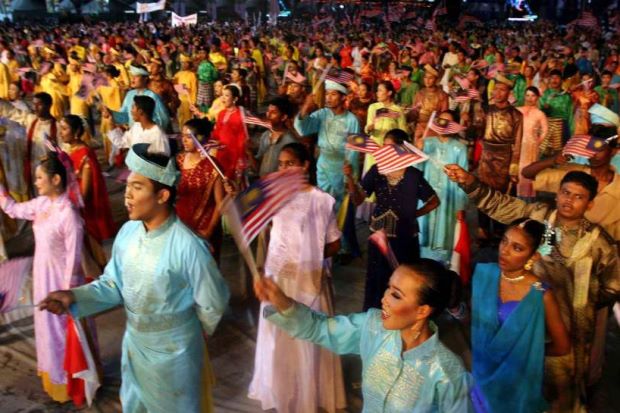
We live in a multi-racial, multi-religious and multi-cultural Malaysia, where any law, whether hudud or civil, will affect all of us.
SERIOUSLY, I am fed up of being told that I should not comment on the proposed hudud laws by PAS and the party’s fans because I am not a Muslim.
The argument is that I have no right, and also no understanding of hudud, thus I am automatically disqualified from discussing it.
Another naïve retort is that this issue should be left to learned Islamic scholars.
So we have the likes of people like the Muslim activist group Ikatan Muslimin Malaysia (Isma) chief Abdullah Zaik Abdul Rahman taking this line of argument further. In his inability to articulate his views convincingly and fairly, he has resorted to threats.
In linking the non-Muslims who oppose the introduction of hudud to a particular ethnic group, he has even called the Chinese citizens in this country “immigrants” and “trespassers” and told them to be grateful for what they have enjoyed in Malaysia.
I wonder if the Isma president is aware that although our Constitution defines Malays as those who profess the Muslim faith, it does not mean that all Muslims in Malaysia are ethnically Malay. What about the converts from other races?
I know so many wonderful people who are ethnically Chinese or Indian, but are also good Muslims. How will all these saudara baru feel to be told off that they are “immigrants” and “trespassers”?
And all my Muslim friends who have been to Mecca always tell me how surprised they all were to see Muslims from all over the world, of all nationalities and ethnicities. It is estimated that there are 25 million Muslims in China, far more than the number of Muslims in most of the Arab countries.
And then the Isma president tells us that PAS’ hudud laws should be applicable to non-Muslims – which runs contrary to his argument that non-Muslims have no say. If hudud is going to be imposed on us, non-Muslims, then why shouldn’t we have a say?
Like it or not, the reality is that we live in a multi-racial, multi-religious and multi-cultural Malaysia, where any law, whether hudud or civil, will affect all of us.
We have a sad situation in Malaysia when one is unable to advocate intellectually or, rather, intelligently. Many of us are unable to take part in a discourse with a rational mind, preferring to shut down or, rather, shout down those who take a different stand.
And the saddest part is that these threats mostly take on a religious and racial slant. That seems to be the way Malaysia is heading.
Until now, non-Muslims are waiting for an answer, or to be convinced, as to how a rape victim would be treated under PAS hudud laws if there is a need to produce four male witnesses.
And just because four witnesses cannot be found, it does not mean a rape did not take place. It also doesn’t mean that the woman has committed adultery.
A non-Muslim wants to know how the law would be applied, since the victim and the rapist can be of different religions in plural Malaysia.
Why should the non-Muslim be regarded as hostile, with no rights whatsoever to even bring up such questions?
For that matter, I am sure Muslims themselves would want to know how this situation would be dealt with as well.
To bring it to another level, if the PAS hudud isn’t about amputation of hands and limbs with regard to petty theft, then non-Muslims surely want to know whether those who steal the country’s money via corruption would also be subjected to such punishment?
And, as one writer rightly argued, “What about civil servants, developers and politicians who allow the rape of our forests in the name of development? What kind of laws would these greedy people be subjected to?”
There are many Malaysians, and I dare say both Muslims and non-Muslims, who are disturbed by what is happening in our country.
Those of us who are in our 50s would remember how, during our school days, it was constantly drummed into us that Malaysia is a plural society or masyarakat majmuk. We live in a country of many races and religions, or berbilang kaum dan agama.
We took all this very seriously, and rightly so too. We memorised the five principles of the Rukunegara – Belief in God (Kepercayaan kepada Tuhan), Loyalty to King and Country (Kesetiaan kepada Raja dan Negara), Supremacy of the Constitution (Keluhuran Perlembagaan), the Rule of Law (Kedaulatan Undang-undang), and Courtesy and Morality (Kesopanan dan Kesusilaan).
Then little disturbing changes began creeping into our text books.
We began to notice that Parameswara had disappeared from our history books and was soon followed by Yap Ah Loy, whose founding of Kuala Lumpur was put in doubt.
Surely Abdullah Zaik is old enough to note the contributions of the Chinese and Indians in opening up the country’s economy, unless he failed his exams in school or is too proud and too blind to accept the contributions of other races who have made Malaysia what it is today.
He surely cannot be blind to the sacrifices of non-Muslims in the security forces who dedicated their lives to fighting the communists in the Emergency, and the many MCA leaders who were killed because they were regarded as traitors by the communists.
Ignorant fools and bigots like him should not be allowed to get away with their remarks. If the authorities choose to look the other way, it is as good as telling many of us that such people are tolerated or, worse, even endorsed by them.
Wrong is wrong, and we are glad that former Prime Minister Tun Dr Mahathir Mohamad has the courage to tell Abdullah Zaik off.
And let us not forget the administrators at Universiti Institut Teknologi Mara, who allowed two foreigners – in this case, Indonesians – to speak at a seminar which was essentially a threat to racial and national unity. If it isn’t, most of us do not know what it is.
Again, we would like to know how two foreigners can preach anti-Christianity sermons in a state-financed university whose students also include many Christians from Sabah and Sarawak.
As a student in Universiti Kebangsaan Malaysia, I had to do Islamic Studies, which was a compulsory subject. But I enjoyed the lectures. I appreciated the opportunity to learn about Islam and until today, I defend the wisdom to teach the subject.
I have continued to deepen my study of Islam and I have continued to collect books on Islam on a monthly basis. My private library has one of the best collections of books on Islam, I dare to say.
And as a Sixth Form student, I signed up for Islamic History and in my first year at UKM, I signed up for the Malay Letters Department. On a personal level, there are Muslims in my family too.
I may not be an expert in religion but, like many of us, we will defend our right to speak up. Do respect our rights as citizens too, and our wish to keep Malaysia moderate, which was what our founding father Tunku Abdul Rahman had set out to do for this beloved country of ours.
Fight to keep Malaysia secular
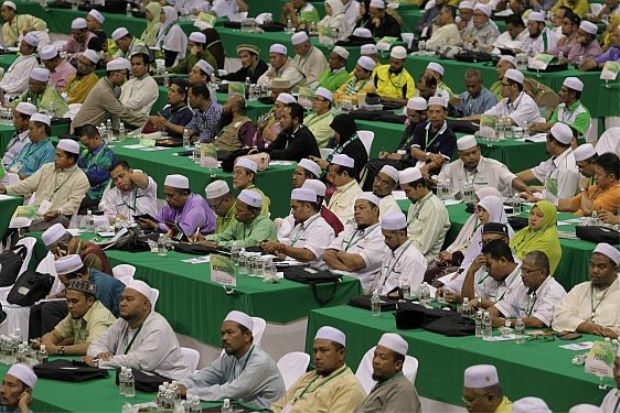
PAS members attending the 59th muktamar at Stadium Melawati in Shah Alam. – Filepic
It is simply wrong for anyone to suggest that non-Muslims have no right to debate on the hudud issue on the basis that they do not understand Islamic laws.
ONE of the biggest misunderstandings in the current debate on the push by PAS to implement hudud in Kelantan is that it will not affect non-Muslims, and that being the minority, they have no say on the matter.
This line of argument ignores the fact that Malaysia is a multi-racial and multi-religious country. Nothing is isolated within one community itself.
Hudud is essentially the Islamic penal code and because a crime can be committed by anyone, Muslim and non-Muslim alike, there are bound to be consequences on how any criminal offence will be handled.
In the case of rape, what if the victim and the accused are of different faiths? How would such cases be tried and under which law? Must a non-Muslim victim bring four reliable male witnesses to prove her case against the Muslim accused if the case were tried in a syariah court?
And what if two buddies, one Muslim and one non-Muslim, are charged with robbery? How will the sentence be meted out, and in which court?
There can never be two sets of penal laws in this country, where hudud can be implemented in Kelantan or Terengganu, for example, while the rest follow the federal Penal Code.
Is PAS also saying that if it were to form the federal government, hudud laws would be implemented entirely?
It is simply wrong for anyone to suggest that non-Muslims have no right to debate on this issue on the basis that they do not understand Islamic laws.
Worse, there are non-Muslim groups who naively believe that non-Muslims are not involved at all. They are either being politically misty-eyed or simply reluctant to enter the fray. Or they do not want to oppose the move by PAS because of political expediency.
Then, at the other extreme, there are groups like the Ikatan Muslimin Malaysia (Isma), whose president Abdullah Zaik Abdul Rahman was quoted as saying that “non-Muslims in the country have no right to oppose the plan to implement hudud and they should understand that there are limitations to what they could say”.
Non-Muslims, said Abdullah, “should be thankful that they have more than what they need in this country”.
“I don’t see what their contributions are for them to be given so many privileges in the first place,” he had reportedly said, adding that “their strong stand against hudud gives the impression that they are in a dream world; they must realise that they have no say in determining the future of Muslims in this country.”
Even without hudud, we have already seen how complicated it can be in conversion cases as well as marital disputes involving Muslims and non-Muslims due to jurisdictional issues of the civil and syariah courts.
Until now, we have not seen how the authorities intend to resolve the case of a Muslim convert who has taken away his son from his Hindu wife, whom he has divorced.
The civil court granted a custody order to the Hindu wife while the syariah court issued the same order to the Muslim ex-husband. And the police have said they are caught in the middle as both orders are binding.
After all, the Federal Constitution states clearly that the civil and syariah courts have equal status but perform different functions.
If we extrapolate further, what about business disputes and cases of criminal breach of trust? People of different faiths work together, and they are bound to be involved in such issues at some point.
Surely all Malaysians have the right to ask how these cases would be dealt with?
There are existing laws to deal with these issues, but what if hudud also comes into play?
What if different parties opt to go to different courts, insisting on their religious rights and obligations?
There is plenty for PAS to explain, even if Kelantan is predominantly Muslim and the state government is controlled by PAS, because the stakeholders are not just Muslims.
If its partners in Pakatan Rakyat claim they are not aware of what the Islamist party is up to, then the implications are even more serious.
In Selangor, where PKR leads, the state religious authorities have seized Bibles which carry the word Allah and the state government is powerless in dealing with the issue.
The state religious body, in short, has become more powerful than the Mentri Besar and the other state executive councillors who appear to be sending out the message that there’s nothing they can do.
One lesson that has emerged is that when it comes to religious laws, there are some who will conveniently shut down any argument or dissent from non-believers, simply on the premise that they have no such rights or understanding.
But with secular laws, opposing sides can bring any matter to the open court and argue their cases. Fight to keep Malaysia secular, that’s the only choice to keep the country moderate.