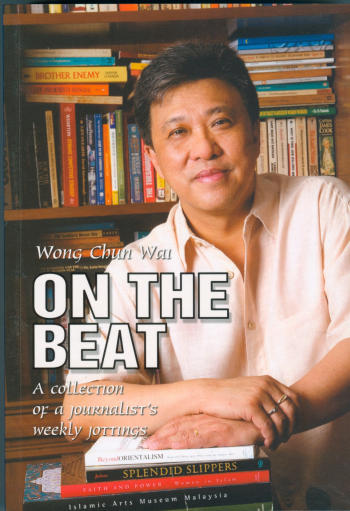
Author Archives: wcw

Land of many contradictions

Middle Class Malaysia is a pretty confused group. But then, the country is confused anyway.

THE Malaysian middle class, especially those living in Petaling Jaya and Subang – easily the biggest suburbs of middle class residents in the country – prides itself as educated, active in social media, well-read and surely the bastion of democracy, human rights and all things fashionably liberal.

Well, it’s also a pretty confused group. But then, the country is confused anyway.

Point One: We hear the middle class grumbling, whining and complaining about foreign labour – and we do this insensitively in front of our foreign workers, especially the maids!

Aiyoh, how can the government allow so many foreigners to come in one? Why the government cannot be like Singapore where they only let in clever, skilled foreigners? Sorry, expatriates. Not cheap labourers.

In the same breath, the middle class also gets uptight because of the long wait for Indonesian maids! Eh, what’s wrong with the government ah? Cannot even get Indonesian maids. So incompetent one.

Point Two: So, we also hear Middle Class Malaysia agreeing that we must never, never rely on foreign maids. We must be resilient. We will clean up the house ourselves. We will train our kids to be independent. But we tell our kids: Ah Boy ah, why you go and clean the plates? Leave the plates on the table lah. We got a maid what. Let Kak do the cleaning lah. Go, go away from the kitchen. Duh!

Point Three: Middle Class Malaysia is aghast at the seemingly corrupt practices in the country. There is fear that corruption has become entrenched. It’s so sickening. How can the politicians be so corrupt? We must stop corruption. But in the same breath, we tell our kids. Eh, Ah Boy, can you ask your driving instructor whether can pay coffee money to pass the driving test ah? Got package ah? Better settle lah, so no need to sit for many driving tests. It’s costly, you know?

And we say we are against graft.

Point Four: Middle Class Malaysia must be one of the biggest accomplices in intellectual theft. We have zero respect for intellectual property. It’s not even our SOP to educate our children to stop buying pirated movies.

Ah Boy, please do not buy original DVD or CD, okay? Just buy from the pasar malam, you only watch once. Don’t waste money buying original on Amazon, okay? You hear me?

Ma, no need to buy DVD any more lah. Can just download for free one. No need to pay one!

That’s my boy, clever. Please teach Ma how to do, okay?

So, the entire family has become pretty good at this crime. After all, we are the only nation to have pirated DVDs that include a clip at the beginning to warn viewers about buying pirated DVDs!

Point Five: Still on fighting corruption. At every political ceramah, the crowd gets into a frenzy when the speakers expose corruption involving leaders and their wives, or their second or third wives. But we have also become pretty sophisticated in choosing who to condemn despite the mantra, “wrong is wrong and right is right”.

Aiyah, Ah Boy, these politicians only makan a bit only what. All the politicians makan one. They makan more and bigger. So if our favourite politicians makan, it’s okay lah. We must still support them, Ah Boy. Come, come, don’t ask any more. Do your homework. You don’t understand politics.

Point Six: We hate corrupt traffic cops. If anyone stops us, we know the road blocks are probably not sanctioned. It seems to be more frequent when the festivals approach.

We all hate cops who want to “settle” an offence instead of just issuing a summons. And yet many of us are guilty of offering bribes to dirty cops despite our sworn war against corruption.

Ah Boy, you mad ah? You never kau tim (settle in Cantonese) with the policeman ah? You think you are very rich ah? You actual­ly ask for a summons? You seow (crazy in Hokkien) ah?

And this is the best part: Middle Class Malaysians will wait and delay paying until the police offers a discount for unpaid summonses! No extra penalty, no compounded interest but a reward – a discount! Only in Malaysia!

Point Seven: Middle Class Malaysia is very particular about what schools their kids go to. It must be the best one. It must have school kids who come from good, well-off families. Cannot afford to have their kids mingling with poor schoolmates. But the problem is not everyone stays in the neighbourhood where the good schools are located. So we instil this value very early in our kids, that we must cheat to get ahead in life!

Ah Boy, don’t worry. Even if we do not stay near the school, we use my friend’s address lah. I also changed my credit card and phone bills already, got proof! Sure, you can get into that school. Don’t tell people, okay?

In short, cheating is okay. Only politicians cannot cheat.

Point Eight: Middle Class Malaysia parents cannot imagine that their kids have been selected for National Service. Horrors of horrors! It’s for other kids! Even if their own kids are excited with the new adventure, their parents cannot imagine their kids being packed off to a camp. What happens if they die eating horrible food? What happens if they get bullied?

OMG, mixing with kids of other races? What happens if they fall in love with someone from another race? And in the same breath, they will tell their kids: Ah Boy ah, why can’t this country be more multi­racial? Why must we always talk about race, race and race? I am so sick.

Malaysians don’t sit down and eat together any more. Not like during my time! What? You got selected for National Service? Why are you so sway (bad luck in Hokkien) one? Go and find a way to get out lah. Don’t go!

Point Nine: Middle Class Malaysia gets very angry at the increasing price of sugar and cannot imagine how rice is traded in this country. But they get really mad when their teh tarik is still so sweet despite asking for kurang manis! What’s wrong with this mamak fella? Want me to die ah, with so much sugar?

And then we continue the whining with the government increasing the price of sugar.

Rice? Don’t eat rice lah. Better stop eating. Too much carbo. You want to get diabetes? Better stop eating rice if you want to stay slim. Take my advice, don’t be so stubborn. Stop nasi lemak, stop nasi kandar, stop chicken rice. Hear me.

And in the same breath, we complain about the price of rice, which we all think should be cheaper. Ah Boy, I tell you, I don’t know what’s wrong with this government. Why is the price of rice so expensive? If we don’t eat rice, what do we eat?

Boy, you hear me or not? Going out again at this time? Don’t eat rice at the mamak shop okay? Rice is no good for you. Just eat chapatti­, okay?

Point Ten: And finally … there are still some good things to say about Middle Class Malaysia, and most Malaysians for that matter. We are super polite people. Most of us don’t call people names unless you are a politician or intellectually weak and unable to argue in a debate, especially on social media.

We also don’t call each other by name because we simply do not address people by name. We never call each other Mr or Miss or Madam. Everyone older than us is automatically an uncle or aunty, even though we are not related.

For some strange reasons, we call many people Boss! Hello, Boss, can get me a burger ah? Sure, Boss, satu burger special!

Or everyone is a brother. Eh, Brother, bagi satu kopi. No problem, Brudder!

We all seem to be so family. I love Middle Class Malaysia! This is home! This is the Land of the Confused!
The circus is in town

Our politicians should spare us the blushes and sign up for media engagement courses.

WE are indeed still in a silly season. From gaffes over the price of kangkung to comparing a politician to the likes of Winston Churchill. From idolising this same politician as godsent and world-class material to producing a distasteful Chinese New Year video, it simply means our politicians are lousy at media engagement.

Even the Prime Minister has suggested that Cabinet members should take media engagement courses, pointing out the importance of giving out “clear and proper explanations” on government policies. We assume that includes himself.

Here are 11 points that politicians should accept before they even bother signing up for such a course.

Point No 1: The world has changed. No one has a monopoly on the distribution of news. The last thing politicians, especially those in government, should do is to dictate terms on how news should be skewed and written to benefit them. Only one politician still has the privilege of doing that – Kim Jong-un. Well, he has total control over everything, everyone and every piece of kimchi in Pyongyang.

Point No 2: Learn to laugh at yourselves. Humour seems to be lacking in our politicians. They confine themselves too much in a straitjacket. They are too sensitive to criticism and are easily upset. That’s being thin-skinned, which is strange because all politicians are supposed to be thick-skinned. The only exception, again, is if you are the Dear Leader of the Democratic People’s Republic of Korea, which is anything but democratic.

Humour is also possibly scarce in Taliban country. How can they possibly smile and laugh when they are stuck in caves most of the time with only camels as their companions?

Just take a leaf from London Mayor Boris Johnson, who sportingly joked and laughed at himself when he was stuck dangling in mid-air while riding a zip wire as part of the 2012 Olympics celebrations. He has also cleverly used his many guffaws to endear himself to the voters.

The Chinese New Year video by the MCA Youth taking a dig at that superbly ridiculous “Love Is In The Air” election video by the Bukit Bintang MCA is refreshing. Learn to laugh at yourself.

Point No 3: Chicken is simply food to people. Chickens are not used for political purposes. Older Chinese may insist on slaughtering chickens in temples to prove their innocence but to most of us, a lie detector would do a better job. Besides, what have these innocent chickens done to politicians that they have to be sacrificed in this manner? You can slap my back for laughing at silly video jokes but why must you offer me RM1,200 to slap someone on her face? Now, that could be slapstick comedy! Pakatan politician Teresa Kok can be likened to a fighting cock and her video may be full of cock and bull. But it’s best we leave the animals out of the fight. Just leave that to the real political animals.

Point No 4: Can we cut the charade of addressing every Tan Sri, Puan Sri, Datuk Seri, Datin Seri, Datuk-Datuk, Datin-Datin …? This whole salutation takes up too much time. Can we just get straight to the point? Most journalists find such salutations a complete waste of time. The only ones excited are these titled people. Surely, not the ordinary people. The time will be better used explaining what needs to be said by our leaders. We are no longer feudal although we respect the traditions.

Point No 5: Never talk down to the people. The rakyat are not stupid. Don’t lecture us and don’t expect Malaysians, especially the taxpayers, to be thankful, grateful and blindly loyal to politicians for just doing what they are voted in to do. Politicians are supposed to serve the people and not the other way around. So if that point is made clear, our leaders will be able to communicate more effectively with the people. It’s that simple, really.

Point No 6: Stop paying a bomb to spin doctors calling themselves media consultants. It’s really a con job. How would these guys know the political behaviour of Malaysians when they don’t even know their way around town? Except maybe Bangsar? So, forget about giving fat contracts to these expatriate self-declared experts with their fanciful graphs and power point presentations.

There’s a battalion of Malaysian ex-newsmen working as press secretaries, advisers and aides in Putrajaya. They know the job better.

Point No 7: Politicians get into trouble because they tell different things to different audiences. That’s what happens when their mouths are bigger than their brains. Everything and anything can now be captured as pictures, sound bites or video clips via the smartphone. Voters love to expose politicians and these videos have a way of going viral on social media.

Point No 8: Be clever. Using those instant one-man outfits disguised as non-governmental organisations to carry out your dirty tricks, and then disassociating from these political jesters, won’t work. The public hates it. The media hate it. Everyone can see through these devious schemes except the politicians who think we don’t. Does anyone actually join the Persatuan Mukabuku Malaysia?

Point No 9: Be straight to the voters. If you want to quit politics and land yourself a teaching job, just do as you have promised. If you want to contest a state seat, just say so, rather than deny a fact or give us runaround answers. And if you want to be a Mentri Besar, then just admit it. Surely, no godsent and world-class politician want to be just an ordinary state assemblyman who is expected to look at dengue-infested longkang (drains)?

Point No 10: Press freedom and freedom of expression mean accepting being criticised, belittled, ridiculed and scolded. All of us have seen how the biggest advocates of the freedom of expression show the same intolerant behaviour when they get into power. They clamp down and bully the media and critics. Of course, these brutes would not have done that without the blessing from their masters – the same politicians who get voted into power talking about accountability, freedom and justice.

Point No 11: Finally, the best and most important point of all. No amount of training, classes and advice could really help unless you think before you open your mouth to talk to the press and people. We all know that most politicians treat the microphone like some strange, desirable objects that they cannot let go of.

But keep it short and simple. Don’t sound like a philosopher when your degree is purchased online. Remember, our attention span is short. We need to run off to watch the football match on TV. When players don’t wallop each other, officials do it, at least in Malaysia.

How the tide has turned

THE celebrations of the Chinese New Year, now in its third day, have progressively undergone dramatic changes — much more than we Malaysians, especially those who are ethnically Chinese — realise.

And I am not just talking about traditions and the good old days but also the major socio-economic, geo-political and demographic changes which have a great impact on the lives of the Chinese in Malaysia.

Some of us may be caught in a time warp and think that things remain the same. But here are 10 paradoxes that are already so apparent as we usher in the Year of the Horse.

Paradox One: Today, many Malaysian Chinese families are seeking to trace their ancestral roots now that there are no more barriers to travelling back to China. Journeys back to the Chinese provinces where their ancestors originated, especially during the CNY season, have become something of a fad.

But here’s the shocker many Malaysians have encountered — their once impoverished Chinese relatives are now better off than the Malaysians!

If Malaysians once dreaded visiting these rural simpletons who lived in near collapsed houses where the toilets were located outside, the scenario has changed dramatically. Many have become wealthy and live in modern suburbs, and they certainly do not need their overseas relatives to give them any handouts.

Thanks to capitalism thriving, ironically in a Communist country, they are now telling their Malaysian family members not to bother visiting them during CNY. “We are going on holiday… err, not to Malaysia, Singapore or Thailand but to Europe. Thanks but it’s okay. Visit us another time. We will let you know when.”

Paradox Two: Our forefathers left their mainland Chinese wives, mostly in the southern provinces, in search of a better life in the Land of Honey — Malaya — in the 1920s or even earlier. Their wives remained faithful despite the distance. But the men would get married to the local Chinese women or nyonya in Malaya and have new families here. Now, the reverse is taking place in modern Malaysia — many Malaysian men now leave their wives behind in search of new Chinese wives-companions-girlfriends in China!

Paradox Three: Still on our forefathers. They would keep every single penny they could save, with the exception of the few spent on the occasional opium puffs, to be sent back to China. When they travelled back home, they would bring along plenty of gifts from Malaya for their near-starving Chinese family members. Well, the world has changed. China is now the world’s biggest factory. The country is producing everything you can imagine — or not imagine. So, it’s the other way around. Fast forward to 2014. We go to China now to do serious shopping and bring them back to Malaysia!

Paradox Four: My grandfather, Wong Ah Fook, landed in Langkawi. He remains a man of mystery to me because my father simply refuses to talk about him. My grandpa was born in the fruit planting county of Kochow or Gaozhou, in the southwestern Guangdong province of southern China.

As my father refuses to tell me anything about him, for a while I thought he was a discredited politician or maybe a crooked mandarin who sought refuge in Malaya.

But I was wrong. He was simply a peasant. I am not sure what he planted in Langkawi. It was also highly possible they told him he had landed in Penang. He may have gotten off on the wrong island. All islands looked alike in the 1920s.

Sometimes I wonder if there are Chinamen working in the canals in Kochow who look like me. Or whether there are any rich look-alikes who have made a fortune and are now living a life of luxury in the United States.

Paradox Five: We have all read about the all-important CNY reunion dinners. But do you want to know what has been happening? Well, more and more Malaysians are holding their CNY reunion dinners at restaurants. In the Klang Valley, most restaurants are fully booked with three dining sessions: 5pm, 7pm and 9pm. If you can’t finish your dinner, some restaurants insist you must pack up the food to make way for waiting diners.

I have also heard that the pot luck has become fashionable as busy modern families can no longer find the time to cook. To ensure that the CNY dinner does not erupt into a war, a compromise has been struck. Come to the patriarch’s home with your contribution. The old folks are just too tired to cook for a battalion of family members anyway.

Paradox Six: My father celebrates his 90th birthday this year. It’s amazing. He can enjoy his food — no diabetes, no hypertension, no cholesterol and he doesn’t exercise. My mother turns 84 this year. She eats everything too.

Like most elderly people, they talk about the old times when life was tough. The Japanese occupation is always a favourite topic.

They can’t understand why many family members refuse to eat rice and spend a fortune trying to lose weight when Africans are starving. For old Chinese parents, eating rice is good. So can you imagine not touching carbohydrates at a CNY dinner? Asking for trouble, man!

Paradox Seven: The days of wearing everything red — from bras to underwear — are slowly diminishing. Red is still the preferred colour but with the Red Devils losing practically every football match, that association is also quickly changing. Sure, Liverpool and Arsenal fans are also in red but that’s a different story.

Wearing dark colours seems more tolerable now compared to the past, when anyone in any colour remotely perceived as mourning, such as dark blue or even green, would earn the wrath of our parents. Sure kena lecture one! (“It’s sure to invite a lecture!”) Don’t even think of wanting to look like the late Apple boss Steve Jobs or our advertising guru Tan Sri Lim Kok Wing, who are always in their trademark black.

Paradox Eight: Okay, this one is a super sensitive subject. We are not talking about politics. We are talking about the increasing number of family members, especially women, who have refused to get married.

It’s a tense situation during CNY dinners. You can be sure some idiotic loudmouth (usually an insensitive daughter-in-law) will bring it up. Not sure if she wants to brag about getting pregnant again or just embarrass the hubby’s sisters.

But welcome to the modern Malaysian Chinese family — the population is shrinking fast. Plunging, to be more precise, and soon in danger of falling into the category of “dan lain-lain (others)” as more Nepalese, Myanmar, Indonesians, Bangladeshis, Pakistanis, Indians, Cambodians, Vietnamese, Iranians, Iraqis and Nigerians land in Malaysia.

Paradox Nine: After a week of pre-CNY yee sang, 10-course meals and more of the same food during CNY, most of us would much prefer going back to our more palatable Malaysian-style food, from mamak nasi kandar to Kajang satay. Yes, Kajang satay is great and does not need politicians to boost the business. More so those politicians who give us silly excuses on why this by-election has to be held. We do not need any convincing to eat other kinds of food during the festive season. Some politicians think they can take us for fools, believing they are world-class material just because they can talk about Winston Churchill and other world leaders who had humble beginnings!

Paradox Ten: And finally, what is it that the Malaysian Chinese want? The same as our forefathers who migrated here. They heard about how great Malaya was. We want Malaysia to remain great, so we can all be proud.

Malaya was thriving and a good place to make a living, and that was what our forefathers found. Likewise, we want the same in modern Malaysia.

And why did our forefathers leave China? Because they were sick of the corrupt nationalists and later the silly communists. They chose Malaya over other countries in huge numbers because of the moderation and openness here. That’s what we want too in modern Malaysia. Keep it moderate.

It’s not enough to be good. Let’s make Malaysia truly great! And we are sure we will be talking about this over CNY dinners because we truly love Malaysia.

Eight Chinese New Year posers

It’s eight because the number 8 is auspicious for the CNY, it rhymes with fatt or prosperity in Cantonese, and it is a favourite number of the community.

THE Chinese New Year celebrations are just days away. Amidst the festivities, there are still some things that remain a mystery to us. Here are eight points worth pondering upon as we head home for the reunion dinner.

One: Kuih bakul aka ning gao (Cantonese) aka tni kuih (Hokkien) aka nien kao (Mandarin) is a traditional Chinese New Year delicacy but I am finding it hard to swallow the folklore that it is actually used to ensure a good report from the Kitchen God!

The story is that this sweet sticky rice cake must be offered to the Kitchen God before the CNY so that his mouth is full of sticky cake, and he is thus unable to say negative things about the family. In short, we get to bribe the Kitchen God before he hands over his annual report to the Jade Emperor! This is a serious offence, man!

Actually, I like the kuih bakul steamed and covered with grated coconut for dessert but I shudder at the thought that we can use this delicacy to bribe a Chinese God. Hello, are you serious? Get out of here! It sounds bizarre.

Can you imagine this line, “Tuan, macam nama mau selesai? Boleh kasi kuih bakul settle kah?” Or try using this line to a bigwig official with powers to approve a contract, “Boss, can we do a deal, can I sweeten your mouth with kuih bakul?”

Two: There is an indefinite ban on fire crackers. No compromise. The authorities will not tolerate any attempt to smuggle in such fireworks. We will leave no stone unturned in our move to ensure a safe Chinese New Year: That’s how cops talk or that’s how reporters make them sound. Memang dilarang!

But I can never understand why, on the first day of CNY and on the eighth night – which is when the Hokkiens prepare to celebrate the Jade Emperor’s birthday on the ninth day (or pai thi kong) – the whole of Penang and Klang, these self-declared Hokkien nations, end up louder than the whole of Syria under fire.

I mean where did all this “fire power” come from? We all thought that the authorities and their tiada kompromi (no compromise) statements will ensure that such dangerous explosives cannot be brought in. Maybe both these towns, being port cities, find it easier to get these fireworks.

Three: I have booked my tickets for a short holiday. I am choosing the Japanese city of Hokkaido for a badly needed rest. There is only so much politics that a Malaysian can take. I have to fill up my forms carefully. Got to make sure I am not denied entry for no good reason.

Got to make sure I don’t get myself mixed up over “intention of visit” when filling in the disembarkation form. You never know, we sometimes get confused with melawat and meliwat. So I’d better be sure.

Four: There was a time when I would look forward to CNY movies from Hong Kong. They were usually movies that made you happy and cheerful. It’s CNY, after all. I used to look forward to the movies by Sam Hui and his brothers, Michael and Ricky. Then there were action movies by Jackie Chan but with a twist of humour. They were always released during CNY.

But this year, it looks like the movie we should all be watching is The Wolf of Wall Street. That’s a howler! Hey, its lead star Leonardo DiCaprio did take home the award for Best Actor in a Musical or Comedy at the 71st Golden Globe Awards but it’s not known yet whether the censorship board here will allow the film to be shown in our cinemas. If not, Malaysians will just have to go to their usual joints at Petaling Street or elsewhere to look for a copy.

Five: For some strange reasons, the price of oranges goes up every year. The distributors will blame it on the weather and transportation costs. Wonder who they will blame this time and still get away with it. In Singapore, they usually blame the weather, whether it is the drought or the terrible winter in parts where the mandarin oranges come from.

In Malaysia, we are usually more creative. The Government is blamed for just about every­thing, even when Manchester United loses. MU kalah lagi? Sial betoi, ini semua hal gomen lah! Takda direction, bro!

Six: Kangkung will never be an issue for CNY. Stay calm. Relax. It is not an essential item as far as CNY cooking is concerned. So the PM can be assured that he would not be a target of creative jokes during the CNY reunio­n dinner. But we may still talk about how creative Malaysians are. So talented one! So funny one!

So there is no need for Perkasa to get jumpy and overreact. Perkasa reportedly said the kangkung furore can lead to racial clashes similar to May 13. Duh.

Are they saying we will go down in Malaysian history, where students will have to learn from their history books, that we clobbered each other over kangkung? I repeat, over kangkung? That’s a big duh!

Seven: For some strange reasons, the rubbish collectors and council workers will show up at the right time during CNY. They seem so visible during the festive season, even if it’s a public holiday. Maybe it’s because I leave the house too early and come back too late to see them at work on other days. The rubbish is collected regularly after all. But I am sure they know my presence during CNY. Okay, I am getting the ang pow ready. I get the hint.

Eight: I am not sure whether it’s a Chinese excuse but from young, there have been older relatives who reminded me if I wanted to be good in Maths, I must learn to gamble. It will be good for speed and mental arithmetic. Others also told me that if I do not wish to be senile, lose my memory and end up sufferin­g from Alzheimer’s Disease, I must take up mahjong.

I didn’t take their advice. My parents imposed a total ban on gambling in the household. But these Chinese-educated relatives of mine are good at Maths. I am not sure if they have elephant’s memory but, for sure, they have selective memory.

The many non-gambling friends seem to have gone on into journalism, advertising and law while a few have become politicians, with guaranteed selective memory. Oh? Saya ada buat janji ke? Janji ditepati, apa tu?

There are eight points for this article because the number 8 is auspicious for the CNY. Eight rhymes with fatt or prosperity in Cantonese and is a favourite number of the community. In any case, I could only come up with eight points this time.

The stuff of legends

In our beloved country, where the rural heartland is deemed a political stronghold, any tale spun for the benefit of the rural residents is particularly potent.

AN urban legend, so the term suggests, is a myth, but as it continues to be circulated, it has a tendency of becoming the truth. Very much like how a lie, if told a thousand times, becomes fact.

An urban legend does not mean that the myth only originates from the cities. In the case of Malaysia, where the rural heartland is deemed a political stronghold, any tale spun for the benefit of the rural residents is particularly potent. So, here’s my list of “10 rural legends”.

One: The country has produced hundreds of thousands of brilliant students, all with a string of distinctions, some up to 18As. All believe they will save Malaysia and the world by becoming doctors, scientists and engineers.

But the reality is that most of our students, even those with many As, have to settle for local universities and colleges. Many of them find it impossible to enter the prestigious universities in the world. The main factor is their low command of English and their inability to have open minds. The As are over-rated because the passing rates are marked down.

What happened to our young geniuses or the top scorers who get all the media attention each time the PMR and SPM results are announced? Many of them could well be among the thousands of unemployed graduates who enter the labour market each year.

Two: We are supposed to have world class education to produce students with “skills, knowledge, strong moral values and who are capable of competing with their peers from other countries”. That’s what the Malaysia Education Blueprint 2013-2025 says. For our children’s sake, we’d better achieve it. We can’t do it overnight because the current state of affairs is not particularly rosy.

The World Bank says Malaysia needs to fix its education system. The 2012 Programme for International Student Assessment (PISA) placed Malaysia in the bottom third, ranking 52 out of the 65 countries surveyed.

The Pisa 2012 test reportedly showed that secondary school students in Malaysia learn only as much as the primary school pupils in Singapore and South Korea. Malaysian students also scored below Vietnam in all the tests, including the one on literacy.

Are we worried? Relak lah, bro, they are just jealous of our success. It’s a just a survey. It’s probably a Zionist plot.

Three: Kuala Lumpur is a bad place. A terrible, maksiat city. It’s filled with Malay gangsters who speak a smattering of Cantonese such as “lan see” (arrogant) and “tai kor” (big boss) and their conversations are filled with Hokkien words like “lu” (you) and “gua” (me) which will send the language purists to Institut Jantung Negara. They also fight one another in Jalan Petaling aka Chinatown. That’s what it looks like in the box-office Malay movies like Gangster KL and Gangster KL 2, and all the movies about Mat Rempits.

But in the real world, most real gangsters have graduated to become corporate figures, businessmen and politicians. Well, some become policemen. It’s called organised crime.

Four: Malaysia is rural based. Their elected representatives are hard-working, service-oriented and live near to the people and grassroots. They hike up mountains and ford treacherous rivers to stay in touch with the people.

Strangely enough, many of these YBs from the rural heartland seem to be always in Kuala Lumpur and Putrajaya. Their favourite joints are the coffee houses in five-star hotels and shopping centres, like those in Bangsar. Forget the humble kopitiam; it’s the branded coffee outlets that prove you have arrived. Strategic lah bro. Must be seen. Kena salam lah dengan VVIP yang singgah kat Bangsar.

Five: English is a language of the colonists. English is for the elites. It’s not used in rural areas. English is used by the liberals who think greatly of Britain. It’s okay if you do not have a good command of the language.

But try calling our elected representatives. Their favourite destination? Yes, London, you guessed it. Hello YB Datuk, where are you? You kat mana? Breaking ini. Tak dengar. Oh, kat London. Shopping ke? Okay, okay, makan aje, kat Bayswater. Okay, okay. Bila balik?…allo, allo… YB banjir semalam… allo, allo… (phone line dead).

Six: Rural folks believe that most Datuks in KL stay in bungalows, eat Western food at dinner time, have children who are spoilt brats, and call all the shots when making multi-million ringgit deals. That’s what the Malay dramas on TV seem to portray.

But at the rate we are giving out titles, every­one will soon be a Datuk. Now, everyone can be a Datuk, like the AirAsia tagline. While we have controlled prices for petrol, sugar and certain food items, Datukship is not a controlled item. Well, like religion, it’s a state matter.

So, Malaysians are now assuming that certain states seem to confer awards practically every day. Not everyone is a Datuk Seri or Datuk Sri. Many are also Datuk Dr, without the need to slog for a thesis.

Seven: The Allah-quoting Christians are a threat and are seeking to convert all the Muslims in this country. This is a national security problem.

But is that for real? What’s the secret recipe – not talking about the cake kind, but the religious-political kind – of these Christian evangelists? Christians only make up close to 10% of the country’s population, the majority in Sabah and Sarawak, but they can be seen as a danger to the 60% Muslims of the 28 million population.

Eight: All the liberals are supporters of lesbians, gays, bisexuals and transgenders (LGBT). They usually belong to non-governmental organisations, are English-educated, attend international conferences, and write columns for the media. Ground for suspicion – many are unmarried.

But what about the macho name-calling right wingers, the nationalists, and the male-oriented politicians? They are the real men who go through multiple weddings and occasionally get caught in controversies with starlets. But blame the press lah. Takda benda nak lapur ke? Report lah pasal pembangunan.

We will teach these LBGT busybodies a lesson. Wait for the Dewan Rakyat to reconvene, you wait for my speech.

Nine: Kangkung aka morning glory aka water convolvulus aka Chinese water spinach must be an obsession with Malaysians. Kampung folks can just pluck it by the river but urban folks have gone berserk! It has become a hot political commodity, who would have thought?

But that’s how Malaysian politics have gone – the kangkung way. Now, we hear the social media has also picked on the innocent taugeh aka bean sprouts, because it rhymes with tau-gay! As someone says on social media, there isn’t mushroom, oops, much room left, in Malaysian politics now. Politically terkangkang, I guess. Too much kangkung is, after all, bad for health. Turns one lembek (soft), some urologists believe.

Ten: Malaysia is a conservative and religious country where its people will quarrel passionately and emotionally on religious matters. At the same time, these issues are sensitive and must be carefully handled.

But it’s hard to explain that amidst all of us, the God-fearing Malaysians, we are still living in a rather sinful nation – grappling with the high number of corrupt and greedy Malaysians in all sectors, drugs, sex and crime. As we all say, only God knows what’s wrong with us!

But I guess that’s what makes us Malay­sians legendary, urban or rural!

Hit by a hard rock

So much fuss over a purported plan to set up a Hard Rock Cafe in Putrajaya – and we know it’s not even going to happen.

I WAS reading the newspaper in a kopitiam when I spotted the controversy over the purported plan to set up a Hard Rock Café (HRC) in Putrajaya.

I really couldn’t believe what I was reading. Like most Malaysians, I almost choked on my food.

To put it bluntly, I felt as if I had been hit by a hard rock while at the café – okay, kopitiam.

Here are 10 reasons why I find the purported plan silly.

Reason No 1: It was another classic case of Malaysian over-reaction. Perkasa was screaming its head off even though Putrajaya Corporation chief Tan Sri Aseh Che Mat said there was no application to open a HRC in the administrative capital. The local Hard Rock Café franchise holder Tan Sri Syed Mohd Yusof Syed Nasir also confirmed that there was no such plan. So what was the fuss all about?

Reason No 2: Have any of the critics ever set foot inside a HRC outlet? Seriously, do they know what they are talking about? The last time I was there, the Strollers Two was playing.

Hello, only uncles and aunties will know who the Strollers are.

Please lah. Tempat maksiat? Duh! HRC all around the world have a reputation for hosting family gatherings. Maybe the steaks are a little over-priced but it’s the last place you want to go for a pick-up, unless cougars are your preferences. Footnote: Cougars are not animals despite their somewhat animalistic demands.

Reason No 3: HRC will destroy morality! This will surely go down as one of the best jokes for 2014. But hey, it’s only January. We’ve got 11 more months to go!

Reason No 4: Liquor cannot be served if a HRC is opened in Putrajaya. In the first place, it’s an unusual statement because no one is planning to open one there. No liquor in Putrajaya? Well, try visiting the hotels there.

Reason No 5: Malaysia is in danger of becoming a country with two systems and two sets of laws. HRC Kuala Lumpur can have liquor but cross over to another part of the Federal Territory – Putrajaya – and it won’t be allowed, even if it is a HRC.

Reason No 6: We know it’s not going to happen. Aseh says no, Syed Yusof says no and HRC International isn’t going to ever say yes.

But if it should ever happen, we could have the first HRC to serve sugar-saturated air bandung and teh tarik to the Putrajaya officials as they huddle together to discuss ways to fight the evil of diabetes.

Reason No 7: Tun Dr Mahathir Mohamad has said Putrajaya is dull. It should be boring, really.

No one can deny what he has said. He is, after all, the brains behind the administrative capital, and he has apologised for not thinking of the entertainment aspect.

The place is close to being deserted after office hours, unless sitting under the bridge or hearing the buzz of mosquitoes has become a new Malaysian pastime.

You’ll like Putrajaya if you are a thrill seeke­r testing the limits of being hit by dengu­e fever or risking being caught for “immoral behaviour” with your girlfriend under the bridge by the religious authorities.

Reason No 8: It is so dull you can count with one hand the number of Cabinet members, deputy ministers and political secretarie­s who actually stay there. It is also probably the only administrative capital in the world where no foreign countries want to set up an embassy.

Reason No 9: Thank you, Dr Mahathir, for revealing that Putrajaya was inspired by the Champs Élysées, the main boulevard in Paris, which is totally different from Perkasa’s claim that it was modelled after the Muslim holy city of Medina.

In reality, the Putra Mosque, particularly its basement wall, is reportedly constructed to resemble that of the King Hassan Mosque in Casablanca, Morocco, while the minaret is influenced by the design of the Sheikh Omar Mosque in Baghdad.

So, Mr Perkasa has been caught shooting off his mouth without thinking, which is not unusual.

Reason No 10: And finally, religious hymns or worship songs, of any religion, in an entertainment outlet? Good try.

It’s great to be home!

Malaysia, for all its strange happenings and political foibles, is truly a wonderful place to come home to – and here are 10 good reasons why I feel this way.

IT’S good to be back in Malaysia after taking a short break for the New Year. And you know you are coming back to this wonderful and glorious homeland the moment you board the flight home.

Even before the plane lands, you are already reminded that you are about to enter the airspace of the Land of Contradictions. It’s really amazing to be back to face the politicians and the bosses, again, as we start work and plan the next holiday. Isn’t Malaysia great? And here are my 10 reasons.

Reason No 1: You know this is truly Malaysia when your onboard movie is interrupted because Malaysia Airlines has to play the new upbeat Malaysia Truly Asia song to promote our country – this is Visit Malaysia Year after all. You can’t help but feel proud as you look at the faces of the tourists sitting next to you. They must love us. And then, just after the wonderful welcome is over, the steward comes on air to warn all the passengers that they will be hanged if caught and convicted of possession of drugs. Again, I look at the faces of the Mat Sallehs and, of course, the Iranians and Ugandans, if any of them looks like one.

Reason No 2: It’s so good. So darned good to hear the captain of Malaysia Airlines welcoming all Malaysians back home. I love the genuine smiles of our MAS cabin crew. It’s real. Not plastic, unlike other airlines. But you also ask yourself why we are truly Malaysian at this point and then the moment we walk out of KLIA, we are reminded, by some quarters, that we are Malay, Chinese, Indian or lain-lain. Malaysia, according to some, is not really our “home”. Because when we disagree with them, they tell us to “go home”.

Reason No 3: You know you are in KLIA because our Malaysian politicians and VIPs love their entourage! They love attention. They love to be sent off on trips and they also love to be welcomed back. What an insecure lot they are. They must be seen in the company of at least 30 hangers-on. For a division leader, at least 10, I reckon. I also cannot fathom how they have bag carriers who can obtain security passes. Malaysian VIPs, you see, don’t wait for bags at the conveyor belt, like us commoners. Maybe they know the luggage takes ages to arrive and have found a clever way for their bags to arrive first!

Reason No 4: It’s Visit Malaysia Year 2014. I love to see the airport filled to the brim with real tourists. Plenty and plenty of them. It will happen for sure. We have a year ahead. Right now, the airport seems to be filled with cheap foreign labourers, with their dazed and lost looks, as their contractors bark out orders. Where are the real tourists?

Reason No 5: From your window seat, you see KLIA as the plane taxies down the runway. KLIA looks great. You feel proud but hey, it’s also pretty quiet and deserted. And then, as we drive home, we find another airport that’s almost identical and about to be opened, despite the many misses, and you wonder why we are building another airport if the present one is pretty empty. But hey, this is Malaysia. Don’t ask unpatriotic questions. And don’t whine about the cost of KLIA 2!

Reason No 6: Speaking of “them”, you know you are heading home to Malaysia as you read the one-day-old Malaysian newspapers. It’s humorous. There is another Malaysian politician who told us to leave the country if we don’t like Malaysia – obviously someone has to tell her that Malaysia does not belong to any political party. Can we ask the politicians to leave Malaysia if they continue to be racist or corrupt? And vice-versa, we have voters who cannot differentiate between the government of the day and the country. Getting all mixed up, they condemn the country for any government wrongdoing. But hey, look on the bright side, this is Malaysia. We are utterly confused, most of the time by the politicians!

Reason No 7: And this is the latest mind-boggling national news. The Jabatan Agama Islam Selangor (Jais) raids the Bible Society of Malaysia and seizes 321 copies of the Alkitab, 10 copies of the Iban Bible, Bup Kudus, and 20 copies of Luke’s Gospel in Malay.

And then it says it FORGOT to inform the Selangor government. I am told they also FORGOT to inform the Sultan of Selangor and we can assume, Jais also FORGOT to get a warrant. Amidst this provocative action, many of us have FORGOTTEN in the age of the Internet, you can click and download just about any religious publication in whatever language. Raid Google next?

Reason No 8: More news from the day-old newspapers. Politicians lecturing us on the need for rationalisation, subsidy cuts, price increases, the need to save, to be prudent and to be more productive. Stop updating Facebook aka Buku Muka at work. No Candy Crush. No more kuih muih and bee hoon at meetings. Also, please stop talking about our pay rises, which we all voted for anyway. And so what if we want to buy new expensive cars? We deserve it. We worked hard. We got discounts, ok? (chuckle). And of course burning up jet fuel. I love our politicians. World-class answers.

Reason No 9: This one has to be one of the best reasons why it will be stupid to migrate – even if some of our politicians keep reminding us to do so. We love long weekends. All our public holidays can be connected to our weekends, so we get long stretches to take a well-deserved break. We have tolerant employers too. We can’t get back to work immediately after Jan 1, boss. Kena hantar anak pi sekolah, first day at school. Boss, I will report for work on Jan 6, Monday. No point coming back on Friday lah, already weekend. Boss, no flights back, all full, Jan 7 Tuesday, ok ah?

Reason No 10: You know you are back in Malaysia because the malls and shops have started the Chinese New Year sales. The decorations are up. The mood is being built up. Christmas and New Year holidays are over but now, we plan our CNY holidays. We simply love Malaysia. So many, many holidays. And this does not include football holidays! And then there is “emergency leave” to help us recover from the holidays. So you see, for all our screw-ups, fiascos and contradictions, it’s good to be back in Malaysia!

Penang’s Kelawi Road where the Eurasians set words to music

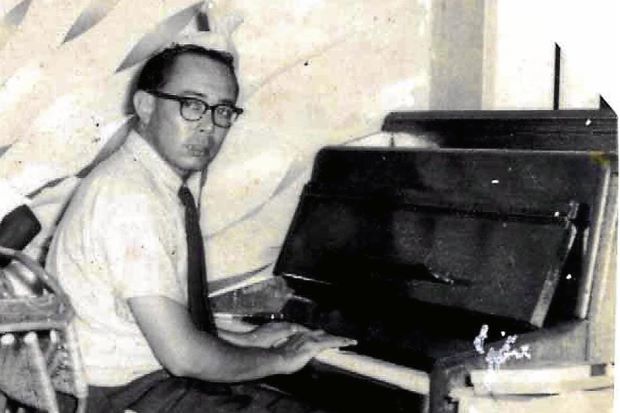
Jazz pianist: The late Jimmy Boyle was of Eurasian descent.

Jazz pianist: The late Jimmy Boyle was of Eurasian descent.

KELAWAI Road, sometimes spelled Kelawei Road, is one of the busiest roads in Penang. But it will probably have little historical significance to most Penangites, especially the current generation who never saw the quaint street of British-styled bungalows and village houses it was before it got transformed into a modern thoroughfare.

It will probably be referred to by most Penangites as the road leading to the more famous Gurney Drive or the popular neighbourhood of Pulau Tikus.

“The name Kelawei is actually the British transliteration of ‘Kuala Awal’, the local name for the first northern estuary from George Town,” wrote history blogger Timothy Tye.

“This name comes from the original Malay settlement located along Kelawei Road, a remnant of which, known as Kampung Syed, is still found adjacent to Masjid Jamek Al-Munauwar Kelawei, between Edgecumbe Road and Jones Road.”

According to Khoo Su Nin, the mosque, together with another one nearby in Burmah Lane – Masjid Lama Jamek – were founded in the early 1800s and rebuilt at the turn of the century.

In writing about the streets of Penang, I have made extra effort not to focus too much on physical structures but more on the people. In this context, Kelawai Road is famed for its Eurasian community, commonly referred to as the Seranis.

According to writer Khoo, the most famous son of the Penang Eurasian community was the outstanding Malaysian composer and jazz musician, Jimmy Boyle.

Boyle, who died in 1971, was educated and later taught at the St Xavier’s Institution, my alma mater. His most famous composition was undoubtedly Putera Puteri (sometimes spelled, Putra Putri). We often listen to it over RTM, especially during National Day, and because of its melodic tune and poetic lyrics, it is often showcased as a truly Malaysian song overseas.

In 2007, Putera Puteri was performed live in Beijing by the Operafest Children’s Choir in conjunction with Malaysia Week and the 50th National Day celebrations.

Boyle was also a graduate of the Raffles College in Singapore, according to James A. Rozells and Kathleen Rodrigues, who have written extensively on the history of Eurasian musicians in Penang,

According to them, Boyle’s “compositions and piano playing have been beamed throughout the world by the BBC and Voice Of America and commented favourably by top jazz critics like Jerry Muchigan.”

“International jazz musicians like Charles Lloyd and Jack Teagarden (who played his songs) rated him highly,” they wrote.

“For 25 of his 49 years, Jimmy composed, arranged, played and recorded his music for national and state functions, for radio and television, for schools and associations and night-clubs.

“He was also a judge of Malaysian Tune Writing and Radio Singing Contests since 1958.”

Boyle composed the first Malaysian Jamboree song Kemegahan Negara Ku, which was played at midnight in conjunction with the birth of Malaysia in 1963.

Among his other notable compositions were Ingat Ingat, Jauh Jauh, Rayuan Mesra or Melody Of Love, Api Dan Air, Bunga Negara, Megah Rasa, Chendering, Tepi Pantai, Berdendang Ria, Sang Bayu, Ke-Hulu Ke-Hilir, Pantun Melayu, Gemaran Bulan, Bertugas and Sungai Pahang.

They wrote that, “a national song on the Rukunegara is one of several unpublished works left behind by Jimmy.”

“A state anthem for Penang and scores of beautiful Malaysian melodies were among other legacies that his family had discovered in Jimmy’s treasure chest.

“One week before his fatal heart attack, he had submitted his Rukunegara piece (his last composition) to Radio Malaysia in the hope that singing it would help bring together the various races in the country.”

My biggest regret as a student at St Xavier’s Institution was not signing up for any music course. I cannot recall any other school in Malaysia, during the 1960s until 1970s, where there was a full orchestra.

Another historic part of Kelawai Road was the extravagant home of Chung Thye Phin, the last Kapitan China of Perak, according to Tye.

At the time of his death in 1935, the tin miner and rubber planter was the richest man in Penang.

He was born in Taiping but raised in Penang, where he also studied at St Xavier’s Institution, and chose to retire on the island.

According to a Wikipedia posting, “The fabled Chung Thye Phin Mansion at Gurney Drive on Penang island (the address at the time was No 2 Kelawai Road) with its subterranean passageways and chambers was, after his death, sold and turned into a hotel (The Shanghai Hotel) in the late 1930s, but was later demolished in 1964 and on its footprint now stands an imposing condominium (1 Gurney Drive).”

Writing about the mansion in her book, Memoirs of A Nyonya, Queenie Chang described the dining room that was actually built under the sea.

“When I happened to look up at the ceiling, I saw that it was not painted as I had first thought. It was a glass dome through which I could see fishes swimming about.

“Seeing my amazement, Mrs Chung explained amiably: ‘Yes, they are real fishes. My husband designed this room himself and had it built under the sea’.”

According to my parents, Wong Soon Cheong and Yeoh Poh Choo, their wedding banquet was held at the Shanghai Hotel.

The mansion, of course, has long been demolished and is now the location of the twin condominiums called 1, Persiaran Gurney.

Some of the biggest names in Malaysia have put their mark on Kelawai Road, and yet, so little is known and remembered.

Goodbye to the streets of Penang

IT has been one fantastic journey as I walked the streets of Penang and, in the process, relived much of my own story via this column which began on Jan 5 last year.

Through this column, I have learnt much about Penang’s history, much of which remains unknown and undocumented.

And the learning process has been a dynamic one as many readers wrote in to share their stories as well,and in some cases, pointed out errors in my articles.

In its own strange way, this column has made the streets of Penang come alive and made us more aware of preserving our history and rich heritage.

Today marks one full year since this column started and I am bringing the series to closure, not because everything has been covered, but because we need to move on.

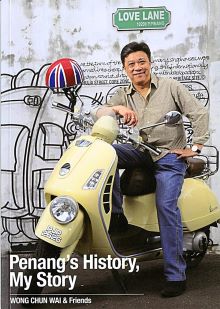
I intend to focus on the buildings of Penang next, after taking a short break. And the good news is that we are embarking on publishing a book based on this series.

So stay tuned. – WongChun Wai


For the record: On Jan 5, 2013, Penang’s History, MyStory made its debut with this introduction.

Wong Chun Wai may have left Penang more than two decades ago to settle down in the Klang Valley.

But his heart remains in his hometown. Now, in this column aptly titled Penang’s History, MyStory, Chun Wai makes the streets ofGeorge Town come alive by taking a walk into the past to unravel the personalities and events that made Penang what it is today.

It is history, and also his story, as the writer juxtaposes the stories with those of his growing-up years in the heart of George Town.

The weekly column begins today in StarMetro.

New Year resolutions for Malaysian politicians

Kept or not, they are bound to give us a good laugh as we herald 2014.

AS we say goodbye to 2013 and welcome 2014, here are 10 New Year resolutions for some Malaysian politicians. They are naturally meant to be broken, like most election promises.

Resolution No. 1: If I don’t have anything clever to say, I will not say anything.

This is probably one of the most difficult tasks for any politician. Politicians are required to say something. Anything. But there is always a way out, no matter how ridiculous I sound. I can always blame the press for asking me all sorts of questions in the first place.

Resolution No. 2: I will listen more attentively during Parliament debates.

Oh no! This is really a tough one! I know I can learn a lot from all the YBs, even those on the other side of the House. I can even agree with them, but come on, I need to get my name into the media. I need to act silly. I need to interrupt. I need to yell. Anything for my name to be printed in the papers.

Resolution No. 3: I will refrain from getting suspended from Parliament or State Assembly so I can go back to the courts to attend to my clients’ needs.

That’s unfair! Why is the press picking on the lawyers? Or has it become an obvious pattern already? Really? It’s that bad, ah?

Resolution No. 4: I will speak up on the importance of the English language for our children.

Of course, I will not keep this resolution. If I promote English, the rural voters will be upset. I need to appear to be a nationalist. I must fight for Malay rights. You understand, kan? The rural voters decide. Don’t be naive. I also need to champion the Chinese language mah. Also the Indian vote, so Tamil is important. English? Aiyah, that’s for the noisy urban voters. Anyway, I am sending all my children to UK to study. I am not being selfish. I am giving a chance to others, I sacrificed my children. Let other Malaysians get their places in universities. So I support English, ok? Jangan tanya banyak banyak.

Resolution No. 5: I will re-affirm to the voters that all the 2013 general election promises will be fulfilled including reducing the toll rates gradually.

Aiyoh, don’t be like that bro. 2013 lain, 2014 lain lah. Everything has gone up. Beyond our control. External factors. We must think of the long run. It’s good for us. Too much subsidies will not help us. Deficit is bad. Please understand.

Resolution No. 6: I promise to use more common sense in my political work.

This one isn’t too difficult. I always think of the common people. Priority to the common people.

Resolution No. 7: I will speak up for press freedom and the integrity of the media.

Of course, I value press freedom. I always support the media. But please remember to always write good, positive things about me and my party. You have a role to play. You must think of the country. If you write bad things, you must have an agenda. Political agenda, you know? But you can wallop my opponents, it’s ok. That is pointing out the truth.

Resolution No. 8: I will consider retiring from politics and give way to the young.

Please, please, please. It’s not that I do not know how to give up but the people want me to stay. My supporters say I cannot go. Perjuangan belum selesai. I need to fight for justice. Yes, it’s not about myself but for the rakyat. So I can’t give up. 60s is now the new 50s lah.

Resolution No. 9: I must remind the people to be prudent, spend less, save more. Don’t always ask for pay rise but talk more about productivity.

This one is good. Very good. Yes, we must cut down on spending. Jimat, jimat. But please don’t ask about the pay rise for elected representatives, ok? Naik sikit aje. Bukan besar. Tausah ungkit yang bukan bukan. Ok? Yes, where were we? Yes, we mustn’t always ask for pay rise. Ask how much more work we can do. Malaysians must be competitive and productive, you know?

Resolution No. 10: I will avoid words like “transformation”, “world class”, “transparent”, “robust,” CAT and colours like jingga and blue in every sentence of my speeches.

OK. OK. OK. I am bored myself. And I think my speechwriters sometimes also run out of ideas. I will do selfies this year, OK? At least, I will keep one New Year resolution!

Finally, wishing all my readers a very Happy New Year and that’s a real wish!

Penang’s most famous son P. Ramlee lives on in our hearts 40 years after his death

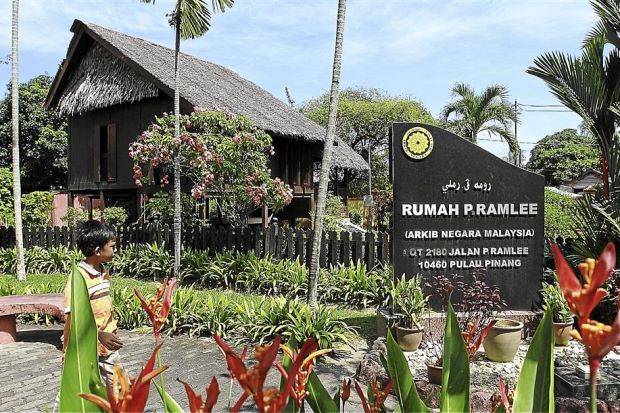
A glimpse of his past: The house where P. Ramlee grew up in has been converted into a museum.

A glimpse of his past: The house where P. Ramlee grew up in has been converted into a museum.

NO STORY on the streets of Penang can be complete without the mention of the legendary P. Ramlee, who is certainly one of the most famous Penangites of all time.

Although Malaysia’s most famous entertainer made his name in Kuala Lumpur and Singapore, his roots began in Penang.

P. Ramlee, whose birth name was Teuku Zakaria, was truly one of a kind. He was an actor, director, producer, writer, composer, singer and musician.

According to a report, P. Ramlee was born on March 22, 1929, the son of an Acehnese sailor, Teuku Nyak Puteh.

He attended a Malay school, Sekolah Melayu Kampung Jawa, in George Town and later enrolled at the Francis Light Primary School.

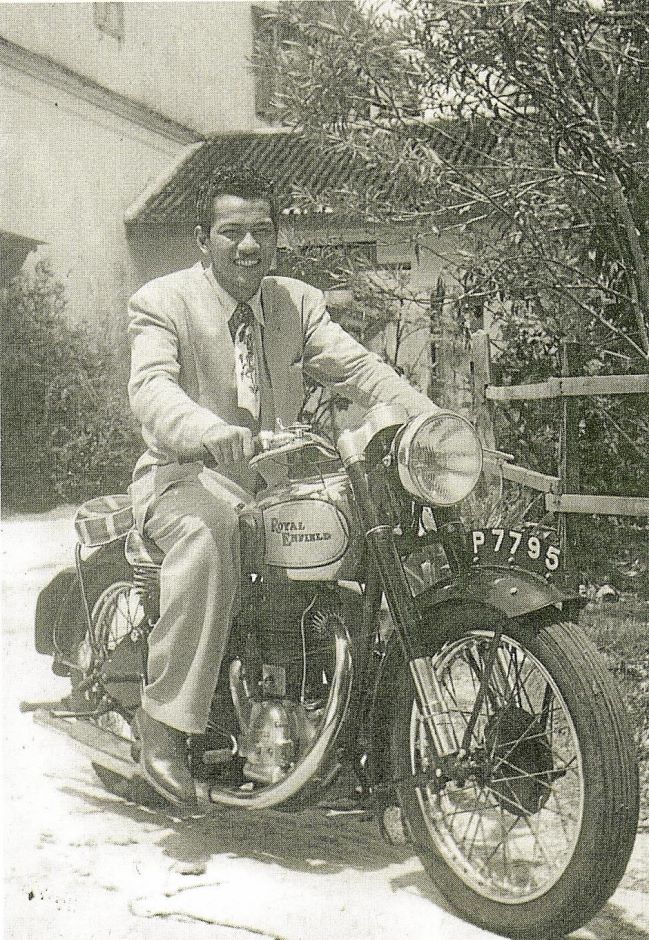
The late Tan Sri P. Ramlee (1928-1973) became famous as a screen star in the 1950s. In this photo, he is on a motorcycle in front of a house in Macalister Road; P Ramlee is named after him. Although he is not of Indian blood, Ramlee is perhaps the most famous 'urban' Malay. Glimpses of Old Penang, pg45

Urbane man: The late P. Ramlee on a motorcycle in front of a house in Macalister Road. -‘Glimpses of Old Penang.

He was picked to attend the premier Penang Free School but the Second World War broke out, which disrupted his studies.

“While growing up, he learnt to sing Malay and Tamil songs, and became involved with a local bangsawan troupe,” wrote Khoo Su Nin in the Streets of George Town, Penang.

His musical talent began to be noticed in 1947, when he won first place in a song competition organised by Penang Radio.

“P. Ramlee left his hometown on Aug 8, 1948. At that time, the trains were very slow and he only reached Kuala Lumpur at 7.30pm and it was the first day of Hari Raya. He reached Singapore the next day,” the late entertainer Ahmad Daud, another famous son of Penang, said in an interview with The Star.

“He was my father’s (Mohd Hashim Eshak) student at PFS. During recess, he (P. Ramlee) had to get sireh for my father from our house,” he recalled.

Ahmad Daud, whose daughter Fauziah, better known as Ogy Daud, has also made her mark in the entertainment industry, said he used to call P. Ramlee abang (brother).

He recalled the day when P. Ramlee won the singing competition in Bukit Mertajam, which eventually gave him a chance to penetrate the movie business.

“He sang a song he had composed, Azizah. What he did not realise then was that he had the chance to act in the movie to be filmed in Singapore, after he had won the contest.”

By the time P. Ramlee retired, he had directed and acted in 66 films and written over 300 songs.

Today, the P. Ramlee family house has been converted into a museum and Caunter Hall Road has rightly been renamed P. Ramlee Road.

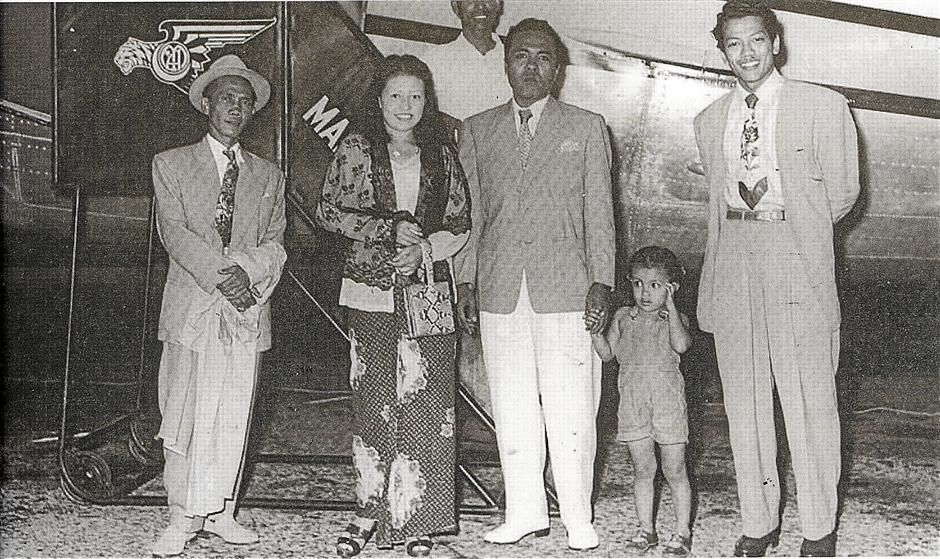
The late Tan Sri P. Ramlee (extreme right) is seen here with actress Kasma Booty and her husband Jacob Booty. The man in the hat is the late D. Harris, P. Ramlee's father-in-law and fellow actor. Datuk Mohd Noor Ahmad stands behind themGlimpses of Old Penang, pg75

Going places: The late P. Ramlee (right) is seen here with actress Kasma Booty and her husband Jacob Booty. The man in the hat is the late D. Harris, P. Ramlee’s father-in-law and fellow actor. Datuk Mohd Noor Ahmad stands behind them. – ‘Glimpses of Old Penang’ 

“The house where P. Ramlee was born was reconstructed on the same site and turned into a historic personality museum,” wrote Khoo.

“Established by the National Archives, the museum features biographical information, artefacts and educational displays related to the artiste’s early years in Penang.

According to history blogger Timothy Tye, “P. Ramlee was born in his grandmother’s house located at an offshoot of the main road. P. Ramlee is of Acehnese descent, which may be incidental considering Jalan P. Ramlee itself borders on Acehnese settlements that follow the meandering Sungai Pinang River nearby.”

P. Ramlee died on May 29, 1973, at the age of 44 from a heart attack but it was only in 1983 that the Penang authorities saw it fit to name the road after him. In Kuala Lumpur, Jalan Parry was renamed Jalan P. Ramlee a year earlier.

Older Penangites would remember Caunter Hall – the original name of the road – as a place which was constantly hit by floods. I am sure the iconic figure’s house, in his teenage days, wasn’t spared from the floods.

According to various articles, George Caunter was the Acting Superintendent of Prince of Wales Island (1797) who was sent to Kedah to negotiate the purchase of Province Wellesley from the Sultan of Kedah. Caunter Hall was supposed to be the name of his home in Penang.

Little of P. Ramlee’s childhood and teenage years has been recorded by historians, which leaves a void in the story of this great man.

His entertainment career, especially his movie days in Singapore and Kuala Lumpur, are well-documented, however.

In my growing-up years, we always looked forward to Friday when RTM would show the Malay movies, hoping that the P. Ramlee movies would be shown.

We looked forward to his comedies such as the Do-Re-Mi and Bujang Lapok series. He also starred in movies about the Malay Sultanate which appealed to all Malaysians. And we could never forget the horror movies as well, including Sumpah Orang Minyak.

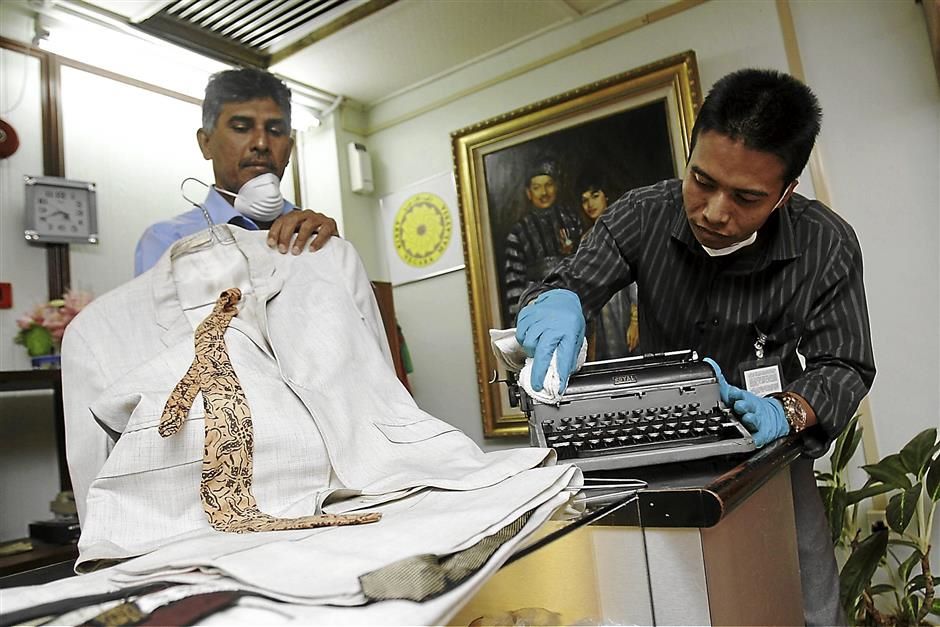
(BRIEF CPTION) Rumah P.Ramlee Asst.Manager,Mohd Shaiful Izham Muhammad Faudzi,31 (right) cleaning the typewriter wich is used by P.Ramle to type lyrics of the song after arrange and Mohamed Mathivanan Suhaibudeen,49 checking on an apparel used by P.Ramlee when acting in 1953.All personal items belonging to P. Ramlee will be on display at level3 in Komtar inconjunction with  P. Ramlee festival organise by Penang Institute at level 3 in Komtar this 7 January 2013.

Memorabilia: Rumah P. Ramlee assistant manager Mohd Shaiful Izham Muhammad Faudzi, (right) cleaning the typewriter once used by P. Ramlee while Mohamed Mathivanan Suhaibudeen checks a suit worn by the late artiste in 1953. 

These days, when I walk into the record shops, I see that his movies are also available on DVDs but I do wonder if the younger generation will watch these classics.

As for his music, who can forget Bunyi Gitar, which was brilliantly played by Roger Wang, the guitar maestro from Sabah? Or Getaran Jiwa?

In the P. Ramlee Cyber Museum (www.p-ramlee.com), the list of his most popular songs had Bunyi Gitar at No 2, just after Azizah, with Getaran Jiwa at No 6.

And, as a Penangite, I truly enjoyed P. Ramlee The Musical that was produced by Tiara Jacquelina. Penang must surely be proud to have P. Ramlee to be counted as another anak Pulau Pinang!

READERS WRITE

Datuk Seri Shaik Daud Ismail writes: Your article on Argyll Road Penang brought tears to my eyes. It brought back wonderful memories because I too was born and brought up in Argyll Road.

Our family home was at 167, Argyll Road. The bungalow was in front of the then London Hotel and next to Sin Tong Ah Hotel. It is still there but is now, I believe, a Chinese club.

Chun Wai replies: Thank you for sharing.

Jelutong Boy writes: I grew up in a time when soft drinks were indeed a luxury and only available in our home during the Chinese New Year.

My father, who was a clerk, got at the end of the year, would normally order two crates of 24 bottles each to last all 15 days.

And the visitors got priority while we would wait for the remnants.

There were only two flavours – orange and sarsi – although we would occasionally get some bottles of “ice cream soda”.

The bottles were recycled and sold back to the “ting-ting bottle man.”

The caps, when attached to a string, provided hours of fun in those growing-up years.

I also remember Radio Malaysia coming by to my school to record quiz shows sponsored by F&N.

One of the challenges was to spell out sarsaparilla, which is the long word for sarsi. It normally takes a few to get the spelling wrong before someone gets it right and is rewarded with a bottle of sarsi.

Chun Wai replies: Your colourful memories are similiar to what many of us go through.