Author Archives: wcw

Ties with China enter new level

COMMENT
By WONG CHUN WAI

Many of the Chinese capital’s 15 million population have begun leaving for their homes in the provinces for Chinese New Year.

Unlike the weather, MCA president Datuk Seri Ong Tee Keat has been warmly received by top Chinese leaders and officials.

The visit of the high-powered party delegation is unprecedented as this is the largest MCA team ever to go to China.

Among the delegates are secretary-general Datuk Wong Foon Ming, vice-presidents Datuk Kong Cho Ha, Datuk Liow Tiong Lai and Datuk Tan Kok Hong, Youth chief Datuk Dr Wee Ka Siong, Wanita chief Datin Paduka Chew Mei Fun and treasurer-general Tan Sri Tee Hock Seng.

To top it all, he has two prominent businessmen on the trip – Tan Sri Syed Mokhtar Al-Bukhary and Tun Daim Zainuddin.

The timing of the trip is significant – the MCA is celebrating its 60th anniversary this year. It is also the 60th anniversary of the Communist Party of China rule in China.

The year 2009 is special as it marks the 35th year of the establishment of diplomatic relations between China and Malaysia.

Since arriving here on Sunday, Ong has lined up to four meetings each day with Chinese leaders. Talks mostly focused on expanding aviation and port activities.

Trade between the two sides rose to US$46.4bil (RM167bil) in 2007 from US$30.7bil (RM110bil) two years earlier. The official number is expected to surpass US$50bil (RM180bil) for this year.

Although China, as with the rest of the world, has been affected by the global financial crisis, the fact remains that China is an economic power with the world’s largest market.

Ong’s visit has attracted the attention of China Central Television (CCTV) and Phoenix Television.

Yesterday, the Transport Minister found he had only 15 minutes for lunch as he took four press interviews in one go.

“Politics is the MCA’s core activity but it is important that we help to create jobs and business opportunities. We must help keep entrepreneurship afloat,” he said.

Ong said he wanted to drive home the message that such efforts were essential in these difficult times.

The MCA delegation was accorded a meeting with China’s top political advisor and fourth-most senior official, Jia Qinglin, at the Great Hall of The People. Jia represented president Hu Jintao.

The former Beijing mayor is the head of the People’s Political Consultative Conference and a member of the powerful Politburo.

The trip is meaningful because the results would mean more air routes between Kuala Lumpur and Chinese cities and more investments in Malaysian ports.

The Bank of China in Kuala Lumpur is also expected to assist small- and medium-sized businessmen with loan facilities, a subject of discussion between Ong and Jia.

Halal hub opportunities, with China’s 22 million Muslims in mind, and scholarships for Muslim students are also in the offing.

“We also hope Chinese-Muslim businessmen will use Malaysia’s halal hub as a gateway to the Middle-East market,” he said.

Ong also hopes to create another unprecedented move – to get a top Chinese university to set up a branch campus in Johor.

The Australians and British have set up branch campuses in Malaysia but a top Chinese branch campus in Malaysia would be the first in the world.

“We are also working with the Hong Kong Polytechnic University which has offered scholarships and internships to Malaysians so they can have exposure to China,” he adds.

There will be plenty of opportunities as a follow-up to the groundwork laid by Ong and his team.

Certainly, when Deputy Prime Minister Datuk Seri Najib Tun Razak takes over the leadership, his official visit would be greatly welcomed by the Chinese.

His father, Tun Abdul Razak Hussein, paved the way for full diplomatic ties 35 years ago, and his son will now take the friendship to another level.

Big deal, and more to come

On The Beat
By WONG CHUN WAI

IT’S a big deal – the RM50mil direct financial assistance to Chinese schools under the government’s economic stimulus.

The decision is unprecedented as the money will go straight to the boards of directors.

With a stroke of the pen, the move means cutting down the layers of red tape and allowing school managements to have a greater say in the running of the schools.

The unprecedented move means greater democratisation for these school boards as such an allocation is tantamount to “the biggest test of trust” given by the Government to the Chinese schools.

But more importantly, it is a reaffirmation of the Government’s stand to protect vernacular schools.

No doubt, there will be criticisms surrounding the timing of the announcement on Thurs­day, so close to the Kuala Terengganu by-election. But the point is this – regardless of the outcome of the contest, the money will still go to these schools.

Last week, Najib said a total of 237 Chinese schools nationwide would receive a total of RM27mil, adding that the rest would be given out in due time.

The funding includes various payments for development, improvement works and equipment purchases.

Najib went a step further – the money must be used by the end of the year. That means more funds should be coming next year.

More to benefit

Next on the list would be missionary schools, Tamil schools and schools in Sabah and Sara­wak.

In fact, many reporters missed an important point – for the first time, the RM200mil package for schools announced by Najib in Novem­ber would be split equally among the national schools, vernacular schools, Islamic religious schools and missionary schools.

The direct funding also means schools would no longer have to depend on the Works Department (JKR) and relevant authorities who appoint their own contractors to carry out renovations and expansion in schools.

There have been plenty of complaints of delays, cost overruns, use of shoddy material and sub-standard work in the past. In all these instances, the schools have little or no say at all, even if at times they suspect possible waste and corruption.

In 2005, a teacher in SJK (C) Keat Hwa, Alor Setar, was killed when the wooden flooring on the school’s second floor gave way as it was heavily infested with termites.

Two years ago, for example, Datuk Seri Hisham­muddin Tun Hussein Onn, expressed his disgust that the JKR took 10 years to build a school in Rawang.

In fact, MCA president Datuk Seri Ong Tee Keat was censured in 2006 for speaking up against shoddy work by a contractor at the Kung Yu school in Muar, Johor, when he was Deputy Higher Education Minister.

The school was billed RM30,000 for work valued at only RM3,000 and worse, it was a patchy job.

No one should put up with this nonsense as our students and teachers should not be exposed to these risks in schools.

It is good that the problems have been pursued and a proper solution identified as it now means the schools themselves can select the best contractors who can offer the best prices.

For a long time, many Chinese schools preferred to rely on the community, businessmen and the MCA for fund raising but the direct funding is a shot in the arm.

It is pertinent also to note that the funds will go to the board of directors instead of the Parent Teachers Association, as accountability is important since money is involved.

In small schools, where such boards do not exist, obviously some form of mechanism needs to be worked out.

Despite the occasional erratic outbursts by some politicians on vernacular schools, the latest commitment by Najib shows that the working relationship between Umno, the MCA and the MIC has been consistently strong.

There are bound to be hiccups and unhappiness even in the best marriages, but it has been tested partnership.

Moderation works

At times, the method of working has been put to the test with component parties reluctant to shout about their inputs and work in closed-door Cabinet meetings.

The result is that the MCA is sometimes seen as subservient but while the politics of consensus has worked, the political landscape has changed radically over the past years.

The young electorate expect their leaders to speak up and MCA leaders in the mould of Ong Tee Keat, Datuk Liow Tiong Lai and Dr Wee Ka Seong who dare to speak their mind are needed in the party.

The Chinese schools, with their high standards of teaching and discipline, have produced some of the best leaders at political and corporate levels.

MCA leaders have had to balance the demands of Chinese educationists and the pressure of Malay nationalists but moderation has succeeded again.

The direct funding would be to help all schools equally, and not just Chinese schools. For example, missionary schools, which have a strong tradition and history, need all the help they can get.


Lulled into complacency

LET’S get the argument straight: The plan by PAS to implement hudud laws if it forms the next federal government is not just about applying the laws to Muslims but it is also a radical change to our legal system.

Malaysia’s legal system is founded and based on secular laws. That is the basis of our laws. Our parliamentary system is Westminster-style democracy, and we want to keep it that way.

Clear-cut lines: Separate payment counters for male and female customers at a shop in Terengganu. Many early opponents of hudud laws have began to lull their supporters into believing that hudud and the Islamic state is for Muslims only

Now, we hear Opposition Leader Datuk Seri Anwar Ibrahim coming out in the open to support the Islamist party’s hudud plan.

We cannot have apologists coming out to support this because an endorsement of this is the beginning of the creation of an Islamic state, which PAS wants to set up.

Neither should anyone buy the pathetic excuse that PAS, on its own, cannot push its Islamic programme, which it has consistently advocated.

Let’s handle this with eyes wide open and not say we were never given advance notice by PAS. It has been consistent. Only some of us are not.

There are some non-Muslim supporters who refuse to believe what PAS plans to do for political reasons of their own.

Haven’t we heard before that PAS on its own cannot muscle enough votes to push through its agenda? Of course, it can with enough support from PKR and others.

DAP leader Karpal Singh must be saluted for his outright objections against Anwar. He has never backed down from his relentless opposition to any attempt, however feeble, to push hardline Islamic plans that run against the fabric of a multi-racial Malaysia.

The veteran DAP leader has correctly pointed out that in Arab countries, where the Islamic laws are implemented, it covers non-Muslims as well. And PAS has never told us what model it has in mind or promised to keep the status quo of the legal system.

But Karpal Singh has become a lone voice now. There seems to be less angry voices, or none at all, from politicians who see nothing wrong in compromising their stand with hopes of capturing power no longer a distant mirage.

The acceptance of PAS’ conservative agenda has crept in much faster than we think. We hear those who stand up to PAS’ anti-concert demonstrations being dismissed as indulging in petty issues, without seeing the larger picture of interference in choice.

Suddenly, many early opponents of hudud laws have began to lull their supporters into believing that hudud and the Islamic state is for Muslims only.

Do we really believe that under PAS rule, the theologians and ideologues would allow the existing secular court structure to remain?

Do they really believe they will allow us to continue the liberal lifestyle of non-Muslims and moderate Muslims?

The first step must never be allowed to begin and if we let down our guard, they will begin tearing down the present secular structures.

It’s already bad enough that those who speak up have been intimidated, shouted down, bullied and threatened with the tired arguments that opponents are against the religion. Or simply that you are religiously unqualified to talk about the subject.

Now, doesn’t that tell you a lot about the future scenario when such an argument is pushed into your face?

Lobby for end to Gaza killings


ON THE BEAT WITH WONG CHUN WAI

IT’S sheer madness. The Israeli attacks on the Gaza Strip which have killed more than 400 people and wounded 2,000 others are a shocking start to the new year.

Something is tragically wrong when innocent people in homes, places of worship, schools and even ambulances are hit.

We are told of the sophistication of the Israeli intelligence and its precise targets against Hamas fighters. They talk about the so-called safe targets and the use of drone planes, detailed maps, balloons fitted with cameras and up to the minute phone calls.

Yet, the casualties of the attacks include children coming out from schools and women in their homes.

At the last count, over 25% of the deaths have been civilians, and not quite the targets the Israelis wanted. But we will hear the same defensive res­ponse – Hamas fighters hiding inside mosques.

The United States has reportedly demanded the disarmament of Hamas, which Israel says has been smuggling weapons through tunnels under Gaza’s border with Egypt, as the first step to a truce.

The threat is the air attacks, the deadliest over the last 30 years, is just the first stage. Ground attacks, using tanks, could roll into the Israeli blockaded Gaza Strip.

The White House has reportedly said the ground offensive is entirely an Israel option and for many, it would mean approval. The only condition set is to avoid civilian casualties and the free flow of humanitarian aid.

It’s really pathetic and laughable because the world knows that’s not going to happen.

President-elect Barack Obama has stayed clear of the issue, using the logic of “one president at a time” but it would be naive for the world to expect Obama to react differently.

Let’s remind ourselves that his constituency is the US, and its powerful Jewish lobbyists, not the rest of the world.

Personally, I find it disappointing that he has not come out with a strong condemnation of the attacks. Politicians always have something to say and his excuse is pretty pathetic.

Despite the outcry by the Arab world, the harsh reality is that these Arab countries, with their national self interests and rivalry, have not done enough to help the 1.5 million Palestinians stuck in the conflict.

For the rest of the world, the organised killings must be condemned. It is not just about Palestinians and Hamas fighters. It is about the killing of innocent people and, certainly, it is an issue that transcends all races.

In fact, there should be more protests involving all faiths as this is not merely a Muslim issue.

Focus on the economy, please


ON THE BEAT

BY WONG CHUN WAI

THE year will go down as a roller-coaster in history with extraordinary dramas that have altered the country’s political landscape.

It has left many of us in the media exhausted and dazed. With days before the year finally closes, it won’t be a surprise if there are more dramas waiting to unfold.

The year opened with the resignation of MCA senior politician Datuk Seri Dr Chua Soi Lek from all party posts for his involvement in the sex DVD scandal.

It was one of the biggest scandals to hit the country but it was more stunning when Dr Chua made a strong comeback as MCA deputy president after his political obituary was written.

It appears that the story hasn’t quite ended and political analysts peering into their crystal balls have not ruled out related political turbulence in 2009.

Ringing in changes

The year saw the election of a new MCA president, Datuk Seri Ong Tee Keat. History was also created when his predecessor Datuk Seri Ong Ka Ting stepped down under a system which limits the tenure of a party chief.

Tee Keat, who is known for his outspokenness, is expected to bring dynamic changes to the party.

Datuk Seri Anwar Ibrahim was another big newsmaker for 2008. He found himself embroiled in yet another sex controversy but got himself elected and returned to Parlia­ment in spite of it.

The comeback kid had led an opposition coalition in the March 8 general election, winning an impressive number of seats in Parlia­ment, with his Pakatan Rakyat capturing Penang, Selangor, Perak, Kedah and Kelantan.

For the first time in the country’s history, the Barisan Nasional lost its two-thirds majority in the Dewan Rakyat. Even during the 1969 election, the results were not this bad for the ruling party.

This year’s general election witnessed the booting out of many big names, in some cases by mere unknowns from the Opposition.

The biggest victors were our democracy and electoral system. Despite questions raised by the Opposition against the Elections Com­mission, the results showed that any party can win an election and that outcomes can be accepted, no matter how painful.

Like it or not, Anwar is certainly a dominant force in Malaysian politics today. But his political fortune and future will be on the edge in 2009 when the trial for his alleged homo­sexual acts begins.

It will certainly be one of the most explosive court dramas. Malaysians will be looking out to see whether the prosecution can put up a stronger and tighter case against the opposition leader in Round Two of the battle. The stakes are high because it could mean Anwar going back to jail.

If the prosecution fails and he walks away, the political backlash would be disastrous for the Barisan.

Passing the baton

The 2008 political tsunami also signalled the premature exit of the Prime Minister Datuk Seri Abdullah Ahmad Badawi. In a case of hero to zero, he led the coalition to its worst results despite having won the biggest victory for the Barisan in 2004.

Pressure mounted within the ranks of Umno and 2009 will see the leadership baton passed on to his deputy Datuk Seri Najib Tun Razak.

Najib is expected to take over the helm in April after Umno’s general assembly in March. The results of the party’s polls will also reflect Umno’s new leadership profile.

A new Cabinet line-up is also expected when Najib becomes the Prime Minister. Eyebrows won’t be raised if certain personalities make way for new appointees.

But it waits to be seen whether he will cut down the size of the administration as it would not be easy.

Battling crisis

The main story for 2009 will be the impact of the global financial crisis on Malaysians. No other issues, however much they grab the headlines, deserve more attention.

Malaysians are already feeling the effects of the shocking oil price hikes and the subprime mortgage fallouts that led to the financial crisis in 2008, The impact will certainly be felt much harder in 2009.

Jobs will be cut along with retrenchment of workers in the electronic sector. Many employers are also expected to give only mini­mal increments or none at all, as they brace for the tough year ahead.

But taking strong decisions to cut wastage will help keep companies intact and save jobs during hard times.

As we celebrate the year end, let’s reflect and review its lessons. If 2008 was a nerve-wracking year, 2009 looks like a year for which we need plenty of prayers.

It should be a year for Malaysians to put aside political trivialities and focus on economic issues.

More than ever before, political stability is of paramount importance to the survival of Malaysia.

With the elections of the major parties set to be concluded by the first quarter of 2009, let’s hope that we can finally see the end of communal heroes who are only good at playing to the gallery.

It’s time that political leaders focus on what matters most – enabling ordinary Malaysians to put food on the table for their families.

Children caught in the middle

On The Beat
By WONG CHUN WAI

IT is a touchy subject and one that probably crops up only in Malaysia. Where else could the teaching of Maths and Science in schools possibly develop into an issue with political and racial implications?

Malay and Chinese educationist groups are unhappy with the use of English to teach these subjects, saying it has not helped improve English among our students.

Malay nationalists and politicians argue that rural Malay students are suffering because they cannot understand the language.

Chinese educationists, particularly the Dong Jiao Zong (DJZ), have threatened to stage a nationwide protest against the continued use of English.

The DJZ, which comprises the Dong Zong (United Chinese School Committees Association) and the Jiao Zong (United Chinese School Teachers Association) from our 1,200 Chinese primary schools, has stood firm that the Government should revert to using mother tongue languages in teaching Maths and Science.

The protest was originally made by Jiao Zong president Ong Chiaw Chuan but the group’s officials have since reportedly distanced themselves from the threat.

Caught in the middle is Education Minister Datuk Seri Hishammuddin Tun Hussein, who will be holding a fifth round of meetings with the DJZ.

He has the Umno party elections ahead of him, and he has to balance the interest of the Chinese-based parties in Barisan Nasional and the future of our Malaysian students.

No one can deny that the teaching of Maths and Science, especially in Chinese, has been effective. These schools have produced the best students in these subjects because of the teaching method which relies on the language.

But Hishammuddin cannot adopt different rules for different schools or he will be accused of practising double-standards.

The decision to use English to teach these two subjects – the brainchild of Tun Dr Mahathir Mohamad in his last years in office – has been decisive, and much emotion has been generated by it.

Emeritus Prof Tan Sri Dr Khoo Kay Kim found himself on the firing line following his statement that non-Malays needed to compromise and give up Chinese or Tamil education in favour of a single-school education system.

MCA information and communications chief Lee Wei Keat said the MCA was offended, saying Khoo’s stand revealed his gross misconception of history and the foundation of vernacular schools in the country.

Dr Khoo is entitled to his views but he certainly has little inclination of the Chinese community’s pulse. In fact, most times he is out of touch. Prof, read the Federal Constitution, please.

Asking the non-Malays to give up their schools is unconstitutional and would be unacceptable.

But what is missing from the whole debate is this – the standard of English among our students has gone to the dogs. So, too, has that of our school teachers and university lecturers.

While Chinese and Malay groups fight over the issue, the reality is that our children continue to suffer on a massive scale.

It has affected children of all races but the rural Malays would suffer the most from the Government’s decision to abandon the use of English as a medium of instruction.

Go to any shopping complexes now and you will find young Chinese salespersons who cannot speak anything else except Cantonese or Mandarin.

We have a situation where schools have become mono-ethnic by design or simply by circumstances. National schools are predominantly Malay because non-Malays think they are too religious while in Chinese primary schools, it’s almost entirely Chinese because the perception is that the teaching standards and discipline are much better.

So, we have the young Malays and Chinese going back to their respective homes speaking their mother tongue, watching Malay or Chinese channels on TV and having only friends of their own races.

We dream of the days when there were English medium schools where real friends, not functional friends, of all races were made.

The standard of English was high and all you needed were five As in the MCE, not 16 or 17As in the SPM, to prove your capability.

Chinese schools then paled when compared to English schools. The Han Chiang High School in the 1970s had to depend on Thai and Indonesian students to survive and was almost on the verge of shutting down because of falling attendance.

Parents, especially Chinese, sent their children to English schools because they had good teachers and, of course, it helped that England was a powerhouse then. It had nothing to do with history or heritage.

But now, many English-educated Chinese parents are sending their children to Chinese primary schools because they want their children to acquire the ability to speak and write Chinese. They do this because of the emergence of China as the economic superpower.

You can be a lawyer, banker, businessman or journalist but if you cannot speak Mandarin, you would experience more difficulties in China.

But having said that, don’t forget that Chinese nationals are learning English the American way, not our flat intonation ala Malaysian or Singaporean English, which the former think is bad English.

Malaysians who are better off are sending their children to private and international schools where English is used. At college level, they go to private universities, locally or overseas.

So what about our graduates in local universities who are deprived of these opportunities? We can argue until the cows come home about nationalism, culture, race and heritage but the reality is that without English language skills, they are not marketable.

They will pay the price for the fallacies of our selfish and narrow-minded politicians, nationalists and educationists who, for all their bravado, may even be sending their children to private and international schools.


Silly season far from over

On The Beat

By : Wong Chun Wai

IT has to be the most sensible statement of the week by a politician as Malaysians cringed with embarrassment at the ludicrous remarks made by our legislators.

Datuk Seri Najib Tun Razak told Malaysians there was no time for politicking but to focus on overcoming the economic challenges ahead and to create opportunities for the people.

The Deputy Prime Minister said the general election was over and “this is the time when we, as a nation, must come together and unite to face the grave external economic challenges”.

Opening the Malaysian Capital Market Summit organised by the Asian Strategy and Leadership Institute (Asli) last week, he echoed what most Malaysians are saying but we hope the politicians got his message. The impression among the people, and by that we mean the man on the street, is that ambitious and selfish politicians are too busy playing communal heroes ahead of the party polls.

Unfortunately, the perception is that some of these politicians belong to his own party – Umno. Ordinary people are too busy trying to feed their families and pay off their household bills.

We don’t have time to indulge in politicking because we have work to do, unlike politicians who can find time and afford to criss-cross the country to garner votes.

They are shooting themselves in the foot and losing more votes for the Barisan Nasional with their sometimes ill-conceived statements, and we are worried that this silly season will drag on until March.

This does not come as a surprise. It is the job of politicians to be involved in politicking although many claim they want to serve the rakyat and are not politicking. But the Pakatan Rakyat politicians are just as guilty. Changing road signs should hardly be a priority for a state government that’s hardly eight months old.

With factories cutting production and retrenchments in the pipeline, the last thing on the Penang state government’s mind should be changing these signs, which won’t help increase tourist arrivals for sure.

But it did create a storm in a tea cup, which is a good political distraction. Whatever the merits of putting additional languages, which is actually a harmless exercise, the point still remains if it would help us solve our economic problems. Investors in the region are concerned, if not alarmed, at our seeming lack of concern in dealing with the global economic issues, which would be felt even more in months to come.

The perception is that except for a few senior leaders like Najib, there is a lack of interest among our MPs. How many of them have taken the trouble to speak about it? Instead, they grab media headlines by acting dumb and dumber. It has come to a point where some have to be offensive and foul-mouthed in the Dewan Rakyat to get national attention.

Now, that’s serious politicking – and a complete waste of taxpayers’ money. Najib is right in saying that Malaysians must unite. Politi­cians and vernacular newspapers, especially, should not be raising issues that disunite the nation.

While some of the Rulers have become more progressive in their statements, some politicians, on the other hand, have become more insular and backward, unable to grasp the changing political landscape.

They have become political dinosaurs, whipping up racial issues when there is none and creating insecurity among the people. Najib, as the Prime Minister-in-waiting, has pressed the right buttons so far. He has come out as a fair-minded person who speaks for all Malaysians and has handled a few recent controversies by dousing the fire quickly.

He has been careful in dealing with the perception of people supposedly close to him, as the media speculates on the membership of his inner circle. Names like Rohana Mahmood and Omar Mustapha Ong have cropped up but these talented people have actually moved on.

Mustapha was a special officer to Najib and remains in touch with the office, helping out in certain areas, while Rohana has more interest in the corporate sector now. In short, she is not a member of the elite club.

Najib has kept tight his choice of advisers around him, preferring not to favour anyone and is certainly upset, if not angry, with people who use his name as well as that of his family members.

There will be businessmen and political analysts who claim to be close to Najib or are perceived to be so but they need not necessarily be beneficiaries of his administration.

Malaysians will back him if he can lead us through the rough economic challenges ahead. But please crack your whip on recalcitrant politicians who do not give second thoughts to using the race card to advance their political careers.


Exclusive interview with the Sultan of Selangor

By WONG CHUN WAI

ON POLITICS, THE SOCIAL CONTRACT AND TOLERANCE

Your Royal Highness, since the March 8 elections, Malaysia has seen a lot of changes in the political landscape. Selangor, for example, is now under the Pakatan Rakyat while many national political figures come from the state. What is your general impression on politics?

As a rule, I do not get involved in politics. I am expected to remain neutral and above politics and I am very conscious of this. But I wish to say that the expectations of Malaysians have increased. They want their elected representatives to be more mature and to have more depth.
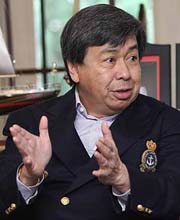
Sultan Sharafuddin: ‘There is a need for more common sense. I hope the politicians will take note of this.’

For example, I am disturbed that some of our politicians, regardless of their political parties, prefer to dwell on trivial issues. They are harping on issues that have no relevance to the country. With the global economic crisis, I would expect them to focus their energy and resources on how best they could help Malaysians face this financial uncertainty. But the issues that these politicians have brought up are disappointing. I am concerned with the manner some politicians exploit racial issues for their own agenda.

Malaysia belongs to all races, not just the Malays. The country is what it is today because of the contributions of all races and that is something we must acknowledge.

I am concerned with the quality of some politicians. I hope the leaders will put some thought into grooming and succession. This is like a race. The baton must be passed to the best runner to finish the race. We are talking about the future of our children. They deserve the best leaders.

Tuanku, at the recent Conference of Rulers meeting, a statement was issued defending the country’s social contract, stressing the need for Malays to be united and assuring non-Malays of their rights under the Federal Constitution. Was it at the initiative of Tuanku?

Yes, it was my initiative but it was made collectively following consultations with my brother Rulers. People need to understand that the social contract is a primary basis on the formation of Malaysia.

It has held the country together. The general principles have been accepted by all races. The country has been successful because of the spirit of give and take. Let’s not debate it because it is better for the rakyat to understand the history behind the social contract and know how Malaysia’s independence came into being.

The rights of the Malays are well protected, no one can just take away these rights and they cannot be amended without consent from the Conference of Rulers.

Malay unity is important. Any form of dispute – political or factional – is bad. As Rulers, we want to see the people, especially the country’s largest ethnic group, to be focused on more important things.

That was why after the last Rulers Conference, we came out with the statement that the non-Malays should not feel apprehensive over their rights. These are rights guaranteed under the federal and state Constitutions. We took great pains to ensure the statement was carefully worded, taking into account how sensitive this matter is.

ON YOGA AND FATWAS

Could Tuanku comment on the controversy surrounding the fatwa prohibiting Muslims from practising yoga?

State religious matters come under the jurisdiction of the Rulers. It is a state matter. In states with no Sultans, it is the King who decides. It is not the prerogative of the Mentri Besar or Chief Minister, let’s be clear.

In the case of a fatwa, there are many steps to be taken before it can be gazetted. The state Fatwa Council, chaired by the Datuk Mufti, has to deliberate on such matters. Anyone can make proposals but finally, it is the Ruler who has the final say.

Islam is a beautiful religion. It is a practical religion. It must be known for its values and compassion. It is not about punishments or banning this or that. This has unfortunately happened. Islam is not about force. Substance is more important, let’s not forget.

I noticed that in the case of the yoga issue, some people seemed eager to jump the gun by making announcements to show their authority when they have none. The result is confusion. Muslims and non-Muslims are confused.

An indepth and thorough study by the state Fatwa Council must be conducted before any decision is sent to me for approval.

ON APPOINTMENTS AND STATE AWARDS

Tuanku, recently there was controversy over the appointment of a non-Malay as acting general manager of the Selangor State Develop-ment Board (PKNS). What is your opinion?

I think it was a non-issue. The person has served in PKNS loyally and effectively for 30 years, so why should her promotion be questioned? If she’s not good, she would have been sacked a long time ago.

Her job as acting general manager, which is only temporary, is only to ensure the smooth running of daily operations. She cannot make any decision that runs contrary to the objectives of PKNS, as raised by some quarters. The Mentri Besar is still the PKNS chairman and also the board will decide on policy matters.

Moreover, she would just be an acting general manager while the state government looks for a chief executive officer as replacement. The PKNS must function effectively while the search is continuing for a suitable candidate. I don’t know why her appointment should be an issue.

Your Royal Highness, you have made it a point to limit the number of Datukships but the perception is that certain states have been over-generous in awarding these titles. Some feel that Datukships have lost their prestige.

I do not want to talk about other states. But as far as Selangor is concerned, there is a limit. It has been my practice to award fewer than 30 people Datukships even though the state limits it to 40. Only people who have contributed to the state or country deserve the title. It should not be given to any Tom, Dick or Harry. It should not be perceived that you can buy them. If that happens, or has happened, then those responsible must examine themselves.

This year, I have decided that only a few people would be awarded Datukship, two Dato Seri and one Dato Setia.

There would be no politicians, either from the past or present government. The present government is barely eight months old and it would need to prove itself first. Even a baby takes nine months to be born. We must give them enough time to show their work.

I am sure there are deserving cases in the present state government but let us wait first. Let them focus on their work, not awards or rewards. Titles should not come with positions.

As I said, I do not want to comment on the position of awards in other states but in Selangor, I wish to maintain its prestige and exclusiveness. It must be branded so people would value it and people would have high regard for the recipients.

BEHAVIOUR OF SELANGOR STATE ASSEMBLYMEN AT THE STATE ASSEMBLY

I understand that Tuanku has taken steps to check the behaviour and decorum of state assemblymen.

I have asked palace officials and even my brother to attend State Assembly meetings. I want them to report to me how these assemblymen, that means the state government and opposition, prepare themselves for these meetings. Do they know what they are talking about and have they done their homework? Are they taking part or just sitting quietly to observe the proceedings with no contribution.

This decision is not aimed at any particular party. It doesn’t matter if they are in Pakatan or Barisan. If they behave badly or ignore decorum, I will have a word with them. This is not political interference. I repeat not political interference. I just want them to know they represent Selangor, so they should be at their best.

ON CRIME AND POLICING IN SELANGOR

Tuanku, crime has continued to be a major concern in Selangor which has the highest crime rate in this country.

I continue to receive complaints from the rakyat on the ground situation. I read about crime in the newspapers and even at dinner conversations. People talk about it. It’s not just a Selangor problem but a national problem. In Selangor, we have the highest crime rate because the population is now the biggest in Malaysia. This is also a place which attracts outsiders and foreigners because of job opportunities. Social problems such as crime comes naturally unfortunately. It is expected.

I have been told that crime prevention has improved. The Selangor police are saying that this is their most successful period in the last 10 years with the state index showing a marginal increase. Gombak, Ampang, Shah Alam, Kuala Langat, Hulu Selangor and Sepang districts show decreases overall.

I am sure the police are trying their best but perceptions are important. If the public do not feel safe on the street or even at home, no amount of assurances would be good enough. Even the homes of police officers are burgled. That is bad. There should be more policemen on the streets. People feel safe when they see policemen on patrol. Traffic cops alone are not good enough.

What about the larger use of closed-circuit television (CCTV) in more parts of Selangor?

I am glad you asked that question. This has been bothering me for some time. I am in fact frustrated at the delay in implementing the CCTV project in Selangor. I had suggested this to the previous state government and now, we have a new state government. Nothing has happened, so excuses and more excuses.

The CCTV project has been successfully implemented in Subang but I do not understand what’s holding it back from being implemented statewide by the state government.

There is no point having the best roads or best homes if people don’t feel safe. In Britain, there are thousands and thousands of CCTVs being installed in strategic areas. I cannot understand this delay in Selangor.

Tuanku, what is your hope of the new state government which is now under Pakatan Rakyat?

There is much expectation and anticipation for sure. They were voted in by the rakyat. We have demonstrated that we believe in democracy and the new state government has been formed.

At the same time, we have to understand that the new government is also on a learning curve. However, Selangor is a developed state and the most important state in Malaysia, so the new government must understand the impatience of the people.

People expect them to know their job from day one. On that score, they must understand these demands.

For example, investors would not like it if there are delays in applications for projects. I also do not want them to complain to me that projects are being held up for no good reason.

What is your birthday wish?

It’s simple. I like to see the people of all races live together in harmony. We have been able to do that for the last 50 years and even before independence and I believe the ordinary people love peace. What they want in life is simple – to live happily, have a decent life and see their children have a future in Malaysia.

I share their aspirations and I hope the politicians would also understand the need for this. Let us all adopt a give and take approach. Let there be consensus.

There is a need for more common sense. I hope the politicians will take note of this. If you have a degree from Oxford or Cambridge, it does not mean you have common sense and I have to stress that common sense is important.

I also wish to see less friction or less emphasis on trivialities. We tend to focus on trivial issues which serve no purpose.

Some people are quick to make judgments or quick to react without understanding a matter thoroughly or studying it in-depth first.


Cost-cutting can lead to reinvention

ON THE BEAT
By WONG CHUN WAI

WE are just a week away from December and usually by now, I would have received a few diaries and calendars. But not this year.

I have only one diary and my colleagues tell me I am lucky because they don’t even have one. We figured companies are cutting back on expenses and giveaways are almost certain to top their list of cost-cutting measures.

Traditionally printed Christmas and New Year greeting cards are expected to be replaced by e-cards this season as well.

It takes a little getting used to for most, particularly if there are no bonuses, and workers are told that they are lucky to keep their jobs as the global economic crisis takes its toll.

In Malaysia, most of us have not been seriously bitten by the credit crunch as its impact would be clearer only by the middle of next year.

But in Penang, US-owned factories have already cut down production and workers have been told to go off during the holiday season.

Previously, this would have been the busiest time of the year as workers rush to meet the deadline. And now, there could be retrenchments eventually.

Rosy forecast: Forbes believes that the world is still flush with cash, unlike the generally-held belief that the world has run out of liquidity.

The buzzword today is cost cutting. From a ban on staff recruitment to travelling on budget airlines for company trips to closing down unprofitable branches, employers are taking tough measures to keep their expenses down.

It’s simple – when the patient is bleeding, you have to stop it before it worsens. Then, the treatment begins.

For obvious reasons, salaried workers would not like cost cutting measures. Nobody likes changes, particularly if it means changes to their lifestyles and working habit. Sometimes, it could even mean sacrificing basic items for the family, including college education for the children because of a salary cut.

But cost cutting can also lead to reinvention and restructuring. It need not be disruptive but innovative as it means cutting away the fat and making the company leaner. The same is applicable to the public sector, which has more reasons to apply these austerity measures as they use taxpayers’ money.

There is a Chinese saying that in times of crisis there are also opportunities. One of the most uplifting comments I have read of late, in the midst of gloom and doom stories dominating the media, must be from Forbes magazine editor-in-chief Steve Forbes.

He believes that the world is still flush with cash, unlike the generally-held belief that the world has run out of liquidity.

“It’s frozen because of fear, but the cash is there. Productivity gains are burgeoning,” he wrote in his latest commentary “How Capitalism Will Save Us” in the magazine’s latest edition.

He even predicts that the global boom “will resume next year, slowly at first and then with increasing momentum” but warns that it would depend on the “political aftermath.”

That means political leaders need to pursue policies that promote growth, including cutting tax rates, as “taxes don’t just raise revenue, they are also a price and a burden” and that the “tax you pay for income is the tax you pay for working.”

Certainly a lot of middle class, salaried Malaysians would share their frustrations over the tax regime we have.

But as in previous financial crises, when jobs are hard to come by, or young people do not find it attractive working with reduced wages, many have become successful entrepreneurs.

In the same issue, Forbes publisher Rich Karlgaard pointed out that in the 1970s, when the economic outlook was eerily similar as stocks took a beating, names like FedEx, Microsoft, Genentech, Apple, Oracle and Southwest Airlines were born.

It was high income tax and a lousy stock market, he wrote, that drove bright young people into unconventional careers.

Recently, I met a group of Universiti Kebangsaan Malaysia graduates of 1984. It was a bad time to leave university then as jobs were scarce and many jobless graduates were paid allowances to just sit in government departments.

The circumstances drove many to become businessmen and to create jobs. We met for the first time in 25 years and I was pleased to learn many were running their own companies, and doing better than those who secured jobs.

Over-reliance on the government by graduates, especially those who are not marketable because they lack language and social skills, would complicate matters in a financial crisis.

Start-ups with lower pay could in the end be more financially rewarding. Risk-taking and innovation are what the nation needs.

In times of difficulties, there can still be a silver lining as new ideas would emerge to ensure survival.

For our kids sake, check the slide

On The Beat
By WONG CHUN WAI

THERE was a time when being a top public scorer meant getting 5As in the Lower Certificate of Examination (LCE) in Form Three and failing was not an option – it means dropping out of school at 15 years old or entering a private school to re-sit the examination.

Private schools were not elitist, unlike now, as they were perceived to be a place for failures, second-raters or students with disciplinary problems.

The LCE also required a candidate to pass Bahasa Malaysia and English as they were compulsory subjects. A distinction then really meant a distinction.

Then, there was the Malaysian Certificate of Examination (MCE) where a top student was equivalent to someone who scored 9As or 10As.

These were the students who eventually got scholarships to study in Harvard, Cam­bridge or Oxford, and their achievements would be published in the newspapers.

Before this, there were the Queen’s Scholars who were sent by the British to be educated in the United Kingdom.

We could recognise the best of the best. It was much simpler then trying to gauge the scholastic achievements of our students.

Now, we read of students in the UPSR for Year Six getting 7As while at the PMR level for Form Three students, they can get up to 9As. In the SPM, there are even those with 16As or more.

It’s good that the choice of exam papers has become wider and candidates have the options of taking their pick. But some principals also impose a restriction on the number of papers a candidate can sit for while some insist on their students taking specific subjects.

But there is a nagging feeling that the standards have dropped. Parents and students get a sense of unrealistic expectations when they get these result slips with straight distinctions.

Students who have slogged hard, particularly with moral support from their parents, deserve the results they get, no doubt, but they should also be a little guarded.

Our students who scored As in English at PMR or SPM levels may think they are tops and are able to browse through works of Shakespeare with ease.

But the reality is that at college entrance examinations for UK and US colleges, many of them have fared badly.

At job interviews, employers are shocked to find that these A scorers can’t even string a sentence in English correctly and many cannot communicate in the language well.

Parents who have the means to send their children to international or private schools after PMR have found their children being rejected by these schools because tutors found these A scorers not as proficient in the language as their test results suggest.

Many also take a highly sceptical view of the Mathematics and Additional Mathematics results at SPM level because the perception is grading has been lowered.

In short, it is easy to score distinctions because the bell curve is adjusted to reduce the number of failures.

The point is this – we have compromised the quality of our education. We have refused to admit it, preferring to live with the delusion that all is well. Worse, our politicians get carried away sometimes with their rhetoric of “world class education” when they should worry more about the basics of the education system.

We have so many students with so many As who think they deserve to be in medical schools now and get JPA scholarships. It is a bottleneck created by the administration and it doesn’t help that every year, there is a feeling of unfairness in the awarding of these scholarships.

There are now over 60,000 unemployed graduates simply because they are not marketable or they are ill prepared for the job market because of poor linguistic and social skills.

Many are unable to express themselves because of poor communication skills, thus limiting their job options.

We will continue with our euphoria of top scorers, three times a year, and newspapers carry the same stories of such top scorers.

We also know we are not attracting dedicated fresh teachers in schools because we are not paying as much as they deserve.

We know that the level of English among our students are at ICU level, to borrow a hospital term, but we are unlikely to do anything because we lack the political will to face the narrow-minded nationalists, many of whom benefited from the English medium schools of yesteryear or they just lack proficiency in English themselves.

To cover up their inadequacies, they use race and nationalism to stop the advance of English, not realising that those who suffer the most would be the young Malaysians, regardless of their race.

The rich would not be affected because they would be sending their kids overseas but the rest would have to cope with the system.

This is the reality – in 2006, the number of college students who spoke and could write English in India was reportedly 100% while in 10 years, it has been estimated that China would have the largest number of English speakers. As they say, who would have expected this 60 years ago?

English is the language of commerce and science and now, the Internet. Don’t let the slide continue; our children deserve better.