Author Archives: wcw

Please grow up, will you?

ON THE BEAT
By WONG CHUN WAI

LET’S not lie to ourselves or let the politicians tell us otherwise. Malaysia, like all other economies that depend on international trade, will not be spared from the effects of the global economic turmoil.

Already, private sector employers are adopting cost-cutting measures before the full effects of the financial tsunami are felt next year.

That means no new recruits, reducing business travel, spending less on entertainment, lowering operating costs and even downsizing or retrenchment in some cases.

The reality is that most businesses expect less revenue next year. In order to stretch the dollar, clients are now taking a longer time to settle their bills.

The outlook for next year is not good at all. The general perception is that the effects of the global economic turmoil will run long haul. You don’t have to be an economist to foresee that the problems will not disappear overnight.

To keep their operations afloat, businessmen are keeping a tight control of their budget while seeking new revenue-making avenues.

Ahead of the bad times, Malaysians are looking to our politicians for leadership and assurances – which seem to be lacking.

We want to hear more about the measures that will be taken to soften the blow. It should not just come from Finance Minister Datuk Seri Najib Tun Razak. What have the others to say?

We are still squabbling about the 30% bumiputra equity under the New Economic Policy even when the cake is shrinking fast. No one seems to be talking about how Malay­sians, regardless of race, should work together to expand the cake.

What’s the point of quarrelling over how many slices when the cake may disappear soon?

For the vast majority of Malays – from wage-earners to traders – their needs will be greater in the months to come.

Surely, it makes sense for a policy to address the needs of those who are truly disadvantaged; and need rather than race should be the criterion.

There’s no legitimate reason to help those with political connections – regardless of whether they are Malay, Chinese or Indian – to become richer and more powerful while the majority stays the same.

It is equally baffling that there should be a controversy over the decision of the Penang state government to use more languages on a handful of signboards in tourist areas.

It’s not something new. Signages in English, Chinese, Japanese and Arabic are already prevalent at the KL International Airport.

Soon, we may even see Russian signages as the country’s new rich begin to travel extensively. Already the Russian market has been identified as the next “frontier”.

In Kuching and Miri, signs on main roads are in Bahasa Malaysia and Chinese and have been there for decades.

Certainly, the identity of the national language will not be threatened nor will the dominant position of the Malays.

We can choose to believe those politicians who spew racist and narrow nationalistic remarks to win votes in party elections or we can be pragmatic and open-minded in a world that has become more competitive and connected.

It is no secret that some of these hypocritical communal champions prefer to holiday in London and send their children, even at primary school level, to study in Britain or Australia. At the same time, they extol “the world-class standard” of our education system.

Fifty years after independence, many politicians, whether in government or the opposition, are still talking about the same issues that have either been resolved or are no longer relevant.

All of a sudden, we have to look up the history books to learn whether the social contract was cast in stone. Worse still, those who brought up the subject do not know much about it.

There seems to be a vacuum for fresh politics. Some of our more youthful leaders are parroting their elders, either out of reverence or for self-preservation. The result is we are getting more of the same.

The sad, if not frightening, part is that many of our politicians do not realise how detached they are from the New Politics of Malaysia, where the minds and hearts of the electorate have so radically changed after March 8.

With 2009 weeks away, Malaysians have to prepare to face a year of uncertainty.

By March, a new political leadership takes over. There’s hope and opportunity if the country is led along the right path.

The results of the general election show that Malaysians have grown up, yet many of our politicians have not.

It’s time they change or be changed.

Yes, Obama can!

ON THE BEAT

By WONG CHUN WAI

 BARACK Obama gets my pick for the United States’ presidential election – not that I can vote or that my views would make any difference to the neck-and-neck race.

But he has become an icon of hope. To people all over the world who are watching an American presidential campaign with such intensity for the first time, he represents hope, courage and change.

All over the world, people can relate to what is taking place in the US. They have had enough of more of the same from their own politicians who sell the same snake oil medicine by stoking racial fears and imagined foreign threats.

Those who watched the debates between John McCain and Obama on issues affecting the Americans must wonder why the same kind of intellectual discourse cannot take place on our side of the world, where some politicians seem to prefer to whip people’s emotions up with petty issues and remarks.

But more important, people are now saying we have come of age. In a globalised world where narrow nationalism is taking a back seat, race is fast becoming a secondary issue.

No doubt, race is still a factor in deciding the outcome of the US elections. The polls, favouring Obama at this stage, could be misleading because it has been said that many white respondents do not want to be regarded as racists and prefer to give politically correct answers.

Their votes, in short, could still go to McCain. After all, in the last two elections, the pollsters got it wrong.

But the fact that Obama has come so far is itself the biggest change that has already taken place. The impact on the psyche has been enormous, not just in the US but all over the world, especially in countries with a plural society.

Changed perception

African-Americans would no longer be seen as just foul-mouthed hip-hop singers, gangsters, boxers and athletes in the eyes of the world.

Obama, a political main player with a law degree from Harvard Law School, will change all that.

He is now on the threshold of making history. Nobody could imagine that a black man is now about to sit in the White House.

His critics are now saying he is not Ameri­can enough, a euphemism for he is not white, and that his name is foreign sounding.

On the contrary, his worldview, shaped by his upbringing in multi-ethnic Hawaii and his multi-racial family, would make him a better leader of today and an asset for the US.

He may lack the experience of war hero McCain but he would see the world differently. His is a world of Blackberry and the Internet while his opponent’s views are still very much affected by the history of the Cold War and the Vietnam War.

McCain, like many politicians of his age, has a point in saying we must learn from history. But we must never be bogged down by the baggage of history.

Even in Malaysia, politicians talk about history which the young can no longer relate to, or simply refuses to accept. Certainly, these history lessons won’t help these politicians get the votes. When they lose these votes, they sometimes wonder why.

In Obama’s book, Dreams of My Father, he wrote about how his mother made an impact on him with her working in distant villages in Asia and Africa for over 10 years.

He had a Kenyan father and an Indonesian stepfather. Today, Obama has a Chinese brother-in-law (a professor at the University of Hawaii) whose parents originated from Sabah.

In contrast, McCain’s running mate Sarah Palin just got her passport last month. Like many Americans, we can assume the world is the US and the US is the world for her.

But we must also be realistic as many of us cheer for Obama. If we are quick to condemn those who reject Obama because they are white, how many of us can honestly say that our preference for Obama is not prejudiced by the fact that we would like a non-white for a change?

Besides his youthful looks and eloquence, words like “hope and change” are merely campaign slogans and the fact is that his resume is thin.

He has been a lawyer, a law professor and a community activist but he has no economics background, which is essential for any political leader these days as financial management becomes more complicated.

No free lunch

As my colleague Karim Raslan has pointed out, Obama’s constituency is the US, not Asia or Africa. So, let’s not be naive in thinking that he would deal with us differently.

More seriously, the Democrats have a history of interfering in other countries’ political affairs in comparison to the Republicans who put business as their priority.

Remember former vice-president Al Gore’s remarks during the reformasi movement when he visited Kuala Lumpur? The Holly­wood Democrats were also busy bashing China ahead of the Beijing Olympics for Tibet. Yes, it’s the same Obama crowd.

There is also the close tie between Demo­crats and the powerful trade unions, which have pumped US$200mil into Obama’s coffers. There’s no such thing as a free lunch and we can expect the unions to make their demands.

We will hear more of “sweat shops” and “child labour” accusations in the American media, nearer to Christmas, and probably louder now as many Americans lose their jobs with the country already in a recession.

Asian factory workers do not realise how much the American elections have an impact on their jobs.

But we are privileged to be around to watch one of history’s most important events unfold itself next week. Whether it is a black president or the oldest president or the first woman vice-president, it is history in the making.

Heed the calls for reforms

On The Beat

By WONG CHUN WAI

A NEW MCA line-up has been formed with Datuk Ong Tee Keat as president and Datuk Seri Dr Chua Soi Lek as his deputy.

Along with them are four first-time vice-presidents: Datuk Kong Cho Ha, Datuk Liow Tiong Lai, Datuk Dr Ng Yen Yen and Datuk Tan Kok Hong.

When the celebrations are over, their task will begin and it certainly won’t be an easy one with the massive changes in the country’s political landscape.

As his parting shot, outgoing party president Datuk Seri Ong Ka Ting did not mince his words. He devoted almost his entire speech to express how resentful the people were of the Government.

He said Malaysians had negative perception of Barisan Nasional and were angry with the arrogance of racist politicians, the increasing crime rate and unfair treatment by government agencies towards non-Malays.

It would not be wrong to regard it as the pent-up frustrations of a political leader whose party had suffered massively in the polls.

There was more from Ka Ting: he also said the people’s perception was that Barisan had yet to carry out any reform and that Barisan must change before it was changed.

This is where the Herculean task begins for the new line-up who have campaigned with the pledge to be bold in speaking up for Malay­sians, not just the Chinese community.

Obviously, from the thrashing that the MCA has been receiving at the hands of the Pakatan Rakyat, it is not good enough resolving issues within the confines of the Cabinet meeting and the so-called proper channels.

Meeting expectations

No doubt the expectations of Malaysians are high but the fundamental concern for the new line-up must be how they can be effective in government.

It is one thing to speak up openly but quite another to resolve the grievances, or at least some of them, before the next general election. It would be a tough one. We recognise the frustrations but the question is: Can you solve them or at least some of them?

Announcing relocation of Chinese schools, raising funds for Chinese schools and Datuk Michael Chong helping the people don’t seem to be enough any more. The people see these as the duties of a political party now, that’s all.

Unlike Gerakan, where some of its leaders mulled about leaving the Barisan, the MCA has consistently stuck to the decision to stay firmly with the coalition.

Still, it is no secret that within the MCA, there is frustration at Umno for its refusal to acknowledge the need to carry out serious reforms.

Despite open unhappiness at the arrogance of some Umno leaders, the MCA also realises the reality of this country is that the Chinese must work with the Malays and Indians, and vice-versa.

The choice is Umno or PAS’ Islamic State objective. PKR has remained largely a personality-driven party based on the popularity of Datuk Seri Anwar Ibrahim.

If Anwar isn’t there, leadership of the Pakatan Rakyat, which would certainly be Malay for all purposes and intentions, could be from PAS.

Early this year we saw how some PAS leaders flirted with the idea of working with Umno because of their uneasiness with Anwar and the liberal policies of PKR, displaying their discomfort with the many non-Malay leaders in PKR.

But PAS spiritual leader Datuk Seri Nik Aziz Nik Mat put a stop to the attempt and those involved in the plan are now keeping a low profile.

MCA has chosen to stick with Umno not only because of their historic ties but also because the MCA is not a fair-weather partner. They have gone through the high and low points in the country’s 51 years of history together.

Facing up to reality

The point is this €“ as a loyal partner of Umno, the MCA has every right to bring up its grievances because it is a time-tested relationship.

It was easier when the Alliance was just Umno, MCA and MIC but now the Barisan has 13 component parties.

Yes, party leaders meet at Cabinet meetings but how well do Barisan leaders know each other at the personal level like our founding fathers did?

The time has come for Barisan to form a Barisan presidential council that meets every month and not just at the supreme council level.

The new Umno and MCA leaders must realise they can bring freshness to Barisan but this could well be their last chance.

They cannot put their head, like ostriches, in the sand: the risk of losing to Pakatan in the next election is very real.

Umno can choose to regard the March 8 election result as a fluke and continue playing the communal heroes or take the calls, if not cries, for quick reforms from the MCA seriously, and sincerely too.

It is human nature €“ but more so among politicians €“ to only want to hear praises and not the bad news. But the fact is that among large sections of Malaysians, Umno is not just unpopular, it is resented.

Change or be changed

ON THE BEAT

By : Wong Chun Wai

BY Saturday, the MCA would have a new leadership. A new party president, deputy president and possibly a new line-up of vice-presidents. The clear favourite to win the party presidency at this point is Datuk Ong Tee Keat, who is being challenged by former Health Minister Datuk Chua Jui Meng. Ong has a huge task ahead for him as we must acknowledge that the political landscape has changed after March 8. It cannot be business as usual. Like Umno, the MCA must realise it has to change or be changed in the next general election. But the MCA, despite the opposition onslaught, still has 15 MPs, which provides the party a decent position to bargain. This is unlike the MIC and Gerakan, which have only two MPs each and face a Herculean task of rebuilding themselves. For a start, the MCA cannot continue its mono-ethnic features, even if the fact remains that it is a communal-based party. Its leaders have to learn to use English and Bahasa Malay­sia, in a much stronger manner, at their meetings, conventions and even on their banners. It must also take up issues affecting other communities. Unless it makes a serious effort to be more multi-racial in outlook, it will face serious competition from multi-racial parties like Parti Keadilan Rakyat and the DAP. MCA leaders can be defensive about this by arguing about the racial dominance of Malays or Chinese in these parties but the point is that their doors are open to all. Neither can the MCA continue to depend on its excellent service centres, financial support for Chinese schools, Kolej Tunku Abdul Rahman and Universiti Tunku Abdul Rahman. Changed expectations The young voters, who make up over 60% of the electorate, regard such support as the right of taxpayers and responsibility of a political party. Yes, it is unfortunate that they don’t ask the same from PKR, PAS or the DAP, and it seems unfair, but that is the reality that the MCA and other Barisan Nasional parties have to live with. The expectations of Malaysians have changed. They expect MCA leaders to be arti­culate, not just in Mandarin, but to speak up intelligently and to be a voice of Malaysians. They expect to see MCA leaders with dignity and respect and that can only happen if the MCA leaders win back the respect of the community and Malaysians. They have followed the American presidential election debates on TV and they expect a similar kind of quality from their leaders, regardless of their parties. They see a black man about to make history by winning the election and they ask why race, religion and gender should continue to feature so strongly in Malaysia. To put it blunt­ly, they are sick of the kind of race politics in Malaysia. They want change and the first warning was on March 8. There will be no more signals four years down the line if the Barisan continues to sell the same product and formula, even as the voters are crying loudly for change. We cannot deny that for the last 50 years, the Alliance and Barisan have performed well and developed Malaysia to this level. In all fairness, we need to revisit and recognise the contributions of Umno, the MCA and the MIC. The Barisan has brought stability and develop­ment to Malaysia; no one can deny this, not even the Opposition. But history doesn’t sell. We can talk about Merdeka and the wisdom of our founding fathers and we can remind everyone of the Social Contract but it will just draw a blank look from our young. In their lingo, it’s like “Duh?” To the Internet and I-pod generation, these politicians don’t connect. The link is down, as they say in computer language, but these politicians sadly don’t seem to realise this. Multi-racial outlook Neither can we brush aside corruption, the abuse of power and arrogance of power. They see has-been politicians with tainted reputation seeking to stage a comeback. Can Malay­sians be blamed if they have a cynical, if not downright pessimistic, view of their future? Malaysians want to see a more transparent, more democratic, cleaner and fairer government. They want to see a more multi-racial outlook. They want to feel safe at home and on the streets, and they wonder why the Govern­ment and the police cannot carry out this simple task and prefer to blame the press, foreigners and everyone else for the rising crime rate except themselves. The young generation, so used to the freedom of expression on cyberspace, want to speak up freely without the threat of the Internal Security Act being thrown at them. The MCA has to speak the language of the new Malaysians. Changes cannot be made overnight but steps need to be taken now. Reforms alone in the MCA would not help the Barisan as the lead has to come from Umno too, as the dominant party of the ruling coalition. The new leaders in MCA would have to face the New Malaysians from next week. Their duty is to bring in new ideas and adopt new approaches.

Now the wild scramble begins

ON THE BEAT

By : Wong Chun Wai

THE 191 Umno divisions will begin their nominations for the top party posts from Thursday, which means that party leaders aspiring for senior positions must make known their plans within the next few days.

That means party president Datuk Seri Abdullah Ahmad Badawi would have to announce whether he wishes to defend his post or begin his retirement plan.

The consensus is that Pak Lah is unlikely to defend his post and will make it known to the Barisan Nasional supreme council, which is expected to meet over the next few days, that the leadership transition plan has begun.

In short, Pak Lah will pass the baton to his deputy Datuk Seri Najib Tun Razak, and that over the next six months, he will make plans to exit from the leadership.

With the quick pace of Umno politics, party leaders are already busy making their move to fill up the vacancies although most have not announced their plans, preferring to wait for Pak Lah to state his position first.

Dark horse

The only exception is former youth chief Datuk Ahmad Zahid Hamidi, 55, who confirmed last week that he would be contesting for the deputy president post.

On Thursday, the Minister in the Prime Minister’s Department explained that he made the announcement simply because he believed that Najib would take over the leadership.

That means it is a foregone conclusion that embattled Pak Lah would be retiring for sure and that there would be no last-minute changes in plans, although some of his supporters harbour hopes that he will fight on.

It is an unlikely scenario as Pak Lah is too weak to take on a fight and his stepping down is imminent and irreversible.

Umno and Barisan Nasional component party leaders have made it known that they want Najib, 55, to take over the driver’s seat soon to provide him sufficient time to carry out the repair job following the damage of the March 8 election.

The attention has now shifted to the num­ber two spot as party aspirants begin scrambling to fill up the vacancies.

Within the Umno circle, Zahid, a popular figure with the press, has been described as a “dark horse” in the race because he is relatively junior, having served previously as a deputy minister and now barely six months as a full minister.

Considering the seniority of the deputy president post, which by tradition and convention also means the deputy prime minister post, Zahid’s short resume would be used against him by his opponents.

He is said to have been picked to check Inter­national Trade and Industry Minister Tan Sri Muhyiddin Yassin, the most senior vice-president who is almost certain to vie for the number two slot.

Muhyiddin, 61, has stepped on the toes of powerful figures in Umno with his constant calls for Pak Lah to step down; certainly for Pak Lah’s supporters, it is payback time now ahead of the nominations.

But Muhyiddin has enjoyed an early boost with two divisions, Cheras and Titiwangsa, saying they would be picking Najib and Muhyiddin for the top two posts.

Not to be outdone, Malacca Chief Minister Datuk Seri Mohd Ali Rustam has said he would be joining in the fray for the deputy president.

The decisions by Zahid and Rustam are likely to trigger more announcements over the next 48 hours and the possible candidates may include Datuk Seri Dr Rais Yatim, Datuk Seri Hishammuddin Tun Hussein and Tan Sri Muhammad Muhammad Taib.

Crucial contest

Umno delegates must bear in mind that their pick of the number two post is crucial. It is not a popularity contest.

Eloquence in Bahasa Malaysia and strong heartland relations will not be sufficient. The country expects our top two to have the ability to grasp economic issues and win the confidence of the financial community.

The deputy must be able to articulate confidently at international forums and, more importantly, he must not have a tarnished reputation.

It would be a mockery if the deputy prime minister is not held in high regard by Malay­sians and the world. Fulfilling one’s ambition is one thing but the ability to represent Malay­sia on a competitive global stage is another.

We can take comfort in the fact that Najib is a British-trained economist, has vast experience and speaks perfect English. We can ill-afford a Sarah Palin situation.

The position of Tengku Razaleigh Hamzah, 71, remains unclear. He has expressed interest in contesting the presidency for the third time. He needs 58 nominations to make a fresh bid for the post and certainly it would be a Herculean task.

Although he is qualified for the post, he faces a generation gap with the delegates as many do not know him. It is unlikely he will settle for any lesser post, which requires fewer nominations.

Candidates vying for the deputy president and vice-president posts only need 38 and 19 nominations respectively. .

The leadership transition plan begins this week and Malaysians will witness the beginning of a new leadership era.

Clinton cause comes to Asia


By WONG CHUN WAI

IT was 9.30pm when former United States president Bill Clinton walked into his duplex suite at the Sheraton Manhattan.

He had just finished attending the second day of the Clinton Global Initiatives (CGI) meeting, which was attended by a galaxy of international personalities, ranging from politicians, activists and businessmen to journalists, scholars and celebrities.

“Grab a beer before we get started and try the sushi (from the famous Nobu restaurant); it’s good,” he said, pointing at the spread of food and drinks along the corridor outside his room which was catered for his Secret Agents and aides.

Just minutes before, he had presented awards to outstanding recipients at an event at which Senegalese singer Youssou Ndour and his American counterpart James Taylor performed. As their performance came to an end, the room took on a different note with The Beatles’ Here Comes The Sun.

The CGI meeting has always been hip, as are most of Clinton’s fund-raising gatherings, drawing young liberals and democrats as well as beautiful people like Brat Pitt and Angelina Jolie.

This year, the attendees included former vice-president Al Gore, cyclist Lance Armstrong, singers Bono and Wyclef Jean, presidential candidate John McCain and his running mate Sarah Palin, Afghan president Hamid Karzai, British Prime Minister Gordon Brown, Queen Rania Abdullah of Jordan and even boxing legend Muhammad Ali.
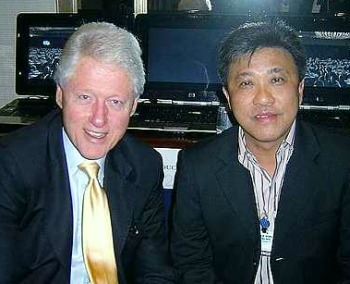
Clinton and Wong Chun Wai

Philanthropic movement

But it is also a world summit. Coinciding with the annual United Nations general assembly, it has sometimes attracted more media attention than the UN assembly taking place at the other side of town.

The CGI is a global philanthropic movement initiated by Clinton in 2005 to bring together influential people to commit themselves to resolve health, energy and poverty problems across the globe.

People pay US$25,000 (RM88,000) to be members and, so far, they have made over 1,000 commitments amounting to over US$30bil (RM105bil) to provide help for over 200 million people in over 130 countries, mainly in Africa.

“The CGI meetings must be the only one where people pay to attend and they end up paying more at the meetings,’’ the 42nd president joked.

Clinton is tall, and I had to look up at him when he spoke.

But he quickly put his interviewee at ease and the task was easy as he had much to say. In fact, he doesn’t know how to stop talking; you have to cut short his answers sometimes.

“So, I understand you attended the Forbes CEO Conference (in Singapore) recently. So, what’s the difference. Tell me, I’d like to hear,” Clinton asked me as an ice breaker.

The Forbes conference is presided over by Steve Forbes who once campaigned to be a Republican presidential nominee. The meeting’s format is conservative and the list of speakers even more conservative – and older.

Forbes makes no excuses for his endorsement of McCain while the Clinton crowd shouts for Barack Obama although if they had their way, it would be for Hillary Clinton, Senator for New York.

Since he left office as the US president, Clinton has devoted his time and energy to the CGI, with emphasis on tackling climate change, poverty, education and AIDS.

It is no secret that he now sounds and acts like a statesman. The CGI, in fact, makes him look like a global president.

It is an image he has successfully cultivated and the Economist recently wrote that the CGI meetings “are inextricable from the man himself” and at the meetings, it appears like “we are a nation under Bill.”

Clinton personally conducts some of the plenary sessions, posing questions and giving his views.

The CGI meeting has received global billing too with his appearances at talk shows hosted by Larry King, Jon Steward, Whoopi Goldberg and David Letterman. But at this interview, Clinton wants to talk about his coming CGI meeting in Hong Kong in December — the first outside the US.

He wants to involve Asian businessmen in his causes and get them to commit to them financially too. He is aware of the strong resources of Asian corporate donors from China and India but said that many were not aware that the CGI had projects in many parts of Asia.

“I am aware the perception is that we are focused on Africa but that’s because the most acute problems are in that continent. We have on-going projects in Vietnam, East Timor and Papua New Guinea.”

Urban migration and poverty, he said, had become central issues in China, India and Indonesia. The Hong Kong CGI would focus on energy and climate change, public health and education.

Clinton said the list of speakers and invitees were being drawn up but Singapore leader Lee Kuan Yew has confirmed his participation. Martial arts actor Jet Li, who heads the One Foundation, is also expected to speak.

He said the plan was to promote “actionable outcomes” by providing participants with “meaningful opportunities to articulate their own commitments.”

Malaysian businessman Datuk Vinod Shekar, who runs the tyre recycling Green Rubber Global group, is the underwriter for the HK meeting.

Vinod, who heads the Petra Group, is involved in developing a Jatropha biofuel facility in the Caribbean nations of St Vincent and the Grenadines as well as in Guyana to help eradicate poverty and promote biofuel as part of the CGI commitment.

Ahead of the meeting, Asia’s largest wind turbine maker, Tulsi Tanti, has committed US$5bil (RM17bil) in total value project through his company Suzlon to develop over 35,000 megawatts of green power assets around the world. He has been ranked eighth among India’s richest.

“If we want to build a more sustainable world for future generations, we have to work together. We need more partners and fewer enemies.

“The HK meeting will see the participation of Asian leaders talking about issues of importance in Asia, an increasingly important part of the 21st century world.

“Asian leaders have a large and growing capacity to shape our economy, climate, health and security.”

He said Hong Kong was chosen because of its accessibility but he acknowledged that hehad been mesmerised by what he saw at the opening of the Beijing Olympics.

Clinton said money was not the main criterion in CGI; he was also looking for ideas and talents in Asia to help make the difference.

The CGI already has an office in Hong Kong headed by Nancy Hernreich Bowen, Clinton’s former assistant and director of the Oval Office.

He hopes to visit Malaysia after the meeting in Hong Kong and this would be his first here.

“I have been invited by Vinod to see Malaysia. I don’t know if Hillary would pick Malaysia; she would want a say on where we should go. I don’t even know if she’ll join us as she would be involved in trying to deal with the financial crisis.

“Obviously, I want to see places where I haven’t been to. I am not that young anymore, you know,” said the 62-year-old who is still regarded as youthful and exuberant. Dubbed the “Charmer in Chief,” his charm is regarded by his admirers as his greatest political gift but a weakness by his detractors. Against the backdrop of China and India as Asia’s giants, he said, Malaysia hasn’t done too badly, and he pointed out the impressive economic growth of Malaysia.

“You guys have had some pretty impressive growth rates in Asia. I remember that,” he said.

Vinod, who is a pioneer strategic partner of CGI, said there has been a growing mind shift among Asian leaders and businessmen.

“It is not just about giving money but, more importantly, to be part of a cause. Young Asian leaders want to make a difference.”

The CGI, he added, was about bringing people together, people who had ideas but needed financial backing.

“The CGI essentially holds your hand and helps you see through your commitments. If you have a problem, they will help you resolve it but if you don’t fulfil your pledges, you are dropped.”

Stress on environment

Environment features strongly in the CGI, where Americans see strong potential in environment-related stocks. Businessmen like Vinod and Tanti, who participate in the CGI meetings, have certainly had a higher profiling. For Vinod, environment projects should not merely be in the form of subsidies but also be sustainable if they were profitable.

Said CGI chief executive officer Bob Harrison: “Asian businessmen, for example Chinese companies, are now spread across the globe. They can make an enormous impact in countries where they are involved with projects that can enrich the lives of the people, including in Africa.”

When Clinton arrives in Hong Kong, his message to Asian political, business and social leaders would be that they need to be involved in global concerns beyond their shores.


The political drama unfolds

ON THE BEAT

By : Wong Chun Wai

IT has been a truly dramatic week for Malaysians. Just weeks ago, we were told that the leadership transition plan would take effect in 2010 when Datuk Seri Abdullah Ahmad Badawi passes the baton to his deputy.

But the political changes have accelerated with the Prime Minister possibly leaving office even earlier.

He has now been given a six-month breathing space with the party elections, scheduled for December, postponed to March.

The conclusion from the supreme council meeting is that Najib, who is already shouldering bigger responsibilities with his appointment as Finance Minister, would take over the leadership soon.

In short, the countdown has begun and the handover is imminent. The date, for some analysts, is merely a face-saving gesture to ensure he gets a respectful and graceful exit.

But it is imperative to note that Pak Lah has put in some caveats – he is not going on leave and that he would only decide on his political future by Oct 9.

For his supporters, who have found the decision difficult to accept, it is premature to write Pak Lah off.

Still the reality is that there is very little time left as Oct 9, when the 191 Umno divisions begin to name their nominations, is barely 10 days away. The divisions have until Oct 31 to decide their choices.

There are only two available options for Pak Lah – if he decides not to defend his presidency, it means retirement but if he decides to fight, Umno, and Malaysians, are in for a roller-coaster ride.

It could well mean a bruising fight with Najib as the latter has already been facing tremendous pressure for his reluctance, even refusal, to challenge the status quo.

The odds have been stacked up against Pak Lah since the heavy losses suffered by the Barisan Nasional on March 8.

It was the worst electoral defeat of the ruling coalition and even the 1969 election results were not as bad as that of 2008.

In short, it was no longer tenable for Pak Lah, badly wounded from the results, to hold on to his position.

The worsening economy due to the rising fuel prices, among others, hurt him further, as it did all heads of governments the world over.

Known as Mr Nice Guy, he suddenly found himself an unpopular leader, a fact his supporters and friends find hard to understand.

Should Pak Lah decide to fight on after Oct 9, it could possibly lead to a three-cornered fight with Tengku Razaleigh Hamzah joining in the fray – if he can secure enough nominations.

The conventional wisdom is that the Kelantan prince would not get the required 58 nominations to contest the post.

But it is obvious that efforts have been made by Pak Lah and Najib to put the party above their interests by preventing possible contests.

Even Tan Sri Muyhiddin Yassin, who has been open in his criticism of the leadership, acknowledged that Pak Lah has been magnanimous.

For most of the supreme council members, the message has been made clear and that Pak Lah has come to terms with it.

The events would develop naturally and there are no reasons to rush into details such as dates. There would be no pressure of any kind, in short, as the crux of the issue has been resolved.

This week, Malaysians can expect to see more as the political drama continues to unfold.


Spooked by political scenario

IT’S been six months since the March 8 general election but the perception is that many Malaysians just do not know how to stop politicking, to the point that we are in danger of becoming a political basket case.

Let’s start with Umno, the backbone of the Barisan Nasional. Despite being whipped by the Pakatan Rakyat in the elections, the perception is that it has failed to make serious changes.

Some of the leaders acknowledge the need to reinvent the party to win back the votes and to assess why it suffered such massive losses. But if there is any serious remake of the party, it has not been seen.

Politically, the perception given is that it believes that the losses would have not happen had the Malay swing to the opposition not materialised, and it believes that segments of the Malays now regret the political shift.

Some of the older Umno leaders, who have lost connection with the younger Malay electorate, cherish the old ways of politics, believing that if it worked during their time, it would work again.

Some push the race card, preferring to still talk of race supremacy, refusing to accept that this would only further alienate Malaysians who have long grown sick of such race politics.

In states under Pakatan Rakyat, there are Umno leaders who still act as if they are in the government, still referring to the new state government leaders as opposition.

Old schools

Many Umno leaders in these Pakatan-controlled states are unable to function as opposition figures. In fact, some have not even come to terms with this harsh reality after six months.

Some in the old schools of politics are still unable to comprehend the New Media as the new tool of politics.

The newspapers continue to be scanned for criticism, however mild they may be, while the free-wheeling comments on the Net are perceived as near anarchy by them.

From indecisive actions to downright silly responses, some Umno leaders are still wondering why the party has become unpopular as some continue shooting themselves in the foot.

And instead of regaining the trust of the people after the March 8 damage, they channel their resources and energy to their Umno polls €“ as the rakyat watch and shake their heads in disbelief.

By the way, Datuk Seri Anwar Ibrahim’s gathering in Kelana Jaya last week was broadcast “live” on his blog with clear visual and sound bites, and surely this must be news for many Umno leaders.

And speaking of Anwar, his impatience has always been his Achilles’ heels, as the manner he has pushed for the defections of Barisan Nasional elected representatives has raised many questions.

Everything may be fair game in a war, as his supporters have justified in their efforts to topple the government. But the result is that the Pakatan is now accused of wooing backbenchers with offers of government positions and money, which goes against the principles of what it is supposedly fighting for.

Even if these allegations are baseless, it is not correct for elected representatives to defect, no matter how convincing the arguments.

But Sept 16 was never meant to be a reality. It fired up the imagination of many Malay­sians against an unpopular government but if Anwar truly had the numbers, it would have been game over.

Political antics

It was merely a clever political poker tactic, which his critics would call a bluff, but the truth shall eventually prevail.

If it were true, these defectors would have stood behind Anwar at the press conference and declared their new political allegiance.

The biggest losers would be ordinary Malaysians, not the politicians waiting to reap the rewards, because investors have become jittery about the Malaysian market.

The Pakatan should just get on with the task of governing their states, and the perception is that in Penang and Selangor, the Chief Minister and Mentri Besar are performing reasonably well.

Prove their worth, take the fight in the next round and they could just finish off the Barisan Nasional this time, if the coalition still cannot handle themselves well.

The endless, if not mindless, politicking has dented our image abroad as Malaysia is no longer seen as a place for serious investment.

Why should investors put up with speculations over whether the federal government would collapse, the sexual preferences of our politicians, who would be hauled up under the Internal Security Act next and whether our Ministers are in their offices to listen to an investment proposal or out busy campaigning for their party polls.

Malaysians want to see politicians doing some real work, not taking a trip to Taiwan supposedly to learn about agriculture or wooing MPs to switch camps.

Punish not the messenger


Tan was released yesterday following a 24-hour detention, which saw her being picked up at her Bukit Mertajam home and told that she would be taken to Bukit Aman in Kuala Lumpur. She was informed of her release midway through the journey.

The arrest will also go down in Malaysian history as the most controversial, if not the most ridiculous.

Home Affairs Minister Datuk Seri Syed Hamid Albar has since clarified that Tan’s detention order did not come from him but from the police. He also said Tan was taken into custody because her life was threatened and that the police wanted to get to the bottom of it.

Tan is not the first journalist to be arrested under the ISA; the late Tan Sri Samad Ismail is the most famous ISA detainee but he was arrested for alleged communist activities.

Years later, it was acknowledged that he was held on trumped-up charges between 1976 and 1981. Since then, no reporter has ever been arrested under the ISA, not even during Operasi Lallang in 1987.

Among older Malaysians, the perception is that the ISA is used against the communists and, in recent years, members of Islamic terror groups and those who made fake passports and identity cards.

Defiant politician

Malaysia Today website editor Raja Petra Kamaruddin is not regarded as a journalist in the true sense – he is more of a writer and, certainly, a political player. As a critical writer, he makes no bones of his plans to bring down the Government and openly speaks at ceramahs for the Opposition.

He is facing various charges, including criminal defamation, and the latest ISA arrest is RPK’s second.

But the same cannot be said about Tan, who has worked as a reporter for the past nine years since graduating from Universiti Sains Malaysia.

Her crime, if there is one, was to report the racist remarks made by Bukit Bendera Umno division chief Datuk Ahmad Ismail, who has refused to apologise for saying that the Chinese are “squatters” in this country.

Despite being suspended from Umno for three years he has remained defiant, believing he has become a hero who dared to champion the cause of his race.

To many Malaysians, his punishment is merely a slap on the wrist, as they feel he should have been be charged under the Sedition Act.

The action should have ended the controversy that strained race relations and the ties among Barisan Nasional component parties but the arrest of Tan has unwittingly rekindled the issue.

There is a sense of injustice and hurt among people that the perpetrator has been let off scot-free while the messenger has been penalised. It’s bad enough that her newspaper has been issued a show-cause letter but she also ended up being detained under the ISA, albeit briefly.

The sledgehammer treatment must have come as a shock for her, as it did to the press fraternity and rational-thinking Malaysians.

Tan may have been released but the damage is already done. To put it bluntly, the arrest was outrageous and went against the grain of natural justice.

The Barisan Nasional government, which is trying to revive its popularity after the March 8 elections, has lost more goodwill and, more importantly, votes.

In the eyes of the world, we are becoming more like a political basket case each day as old politicians attempt to bring back their outdated tricks, believing that the attempts to bring reforms and broaden democratic space can end.

A new world

They want to see the press shackled, preferring to read only about themselves, forgetting that the world has changed. A New Malaysia has emerged, don’t they realise this?

You can keep the bad press out of the printed media but not on the Internet, and a credible media is certainly necessary in a democracy.

As political undercurrents become stronger in Umno with attempts to get the Prime Minister to quit before the two-year period becoming more open, the innocents are in danger of finding themselves caught in the crossfire.

Leave the journalists, who are merely doing their work, out of politics. If Tan and Sin Chew Daily have misreported Ahmad’s remarks, he should have demanded a correction the next day instead of letting it drag on for 10 days.

It was irresponsible on his part to let the controversy continue. Worse still, he made more racist remarks, which are sufficient to get him charged under the Sedition Act or even to be detained under the ISA.

But the ISA is a draconian and archaic law. It shouldn’t be used even against Ahmad, as this deprives him of the right to defend himself in open courts.

Freedom of speech does not mean freedom to defame others or to create chaos but, certainly, we can all tell when there is a miscarriage of justice.

Nation built on toil of all races

ON THE BEAT
By WONG CHUN WAI

IT’S hardly convincing. More than 10 days after the controversy over Datuk Ahmad Ismail’s racist remarks, the Bukit Bendera Umno chief has finally appeared to give his side of the story.

He has not only refused to apologise but has remained defiant and has instead demanded an apology from Sin Chew Daily, which reported his remark, attacking the newspaper for “manipulating” his speech on Aug 23.

Ahmad has admitted that he made the remark that the Chinese were squatters in the country but within the pre-Merdeka context.

The newspaper, he charged, had instead turned the remark into a racial and sensitive issue.

The Penang politician’s reply smacks of arrogance. If the newspaper had indeed misreported his remark, then he should have demanded a correction and an apology to be made immediately.

The question is: Why did he do a disappearing act?

Even Prime Minister Datuk Seri Abdullah Ahmad Badawi said he could not reach him, like so many other reporters who were seeking his reply.

In short, he was given a chance to make a rebuttal but he did not use it. Instead, he decided to take his time to come up with a defence and allowed the issue to drag on. In the process, Deputy Prime Minister Datuk Seri Najib Tun Razak had to apologise on his behalf.

Sorry issue

Najib has been magnanimous in making the apology on Ahmad’s and Umno’s behalf, but his act is appreciated by his fellow Barisan Nasional component leaders. The apology was supported by Pak Lah the next day, reflecting their maturity and wish to end the issue.

But the apology by the two leaders was unnecessary, as the matter involves a small-time politician and it should just be confined to that level.

A simple apology from him would have sufficed and would have prevented the widening of the issue.

As the saying goes, “To err is human, to forgive, divine.”

It takes a man to apologise and, certainly, in the eyes of many politicians now, Ahmad is hardly one. Perception is everything in politics but we are sure he would not want to be remembered as a racist, even if he says he is not one.

Assuming that his remark was wrongly reported, his reply and mannerism, as seen on television, would not earn him much forgiveness. In fact, it was a case of poor public relations.

He has said that he was away in Bangkok attending a sepak takraw tournament, but surely he could have answered all the allegations from there. Surely he doesn’t need a pigeon to send his statement.

Yes, the Chinese were immigrants but so were most other Malaysians, including many Umno leaders and former prime ministers whose ancestry can be traced to India, Pakistan, Yemen, Bangladesh, Indonesia, Thailand, China and even Turkey.

A certain former mentri besar is a second-generation Malaysian: his parents came from Indonesia, but he made it to be the leader of a state. That’s good because Malaysia is a land of opportunity.

Many Umno politicians, especially from Penang, have ancestors from India but there is no reason to question that. They are surely not pendatang and it shouldn’t be an issue at all.

If we have to dwell on immigration, we should be celebrating it, not making it a reminder for patronage. Malaysia is a land of diversity, and that’s an asset.

As we celebrate the country’s 51st anniversary, let us remind the likes of Ahmad Ismail that this country is built on the blood, sweat and tears of all communities, not just one race.

Thanks to the political maturity, wisdom and skills of the Malays, the country has remained stable and peaceful. It was, and still is, the Malays who protected this country as soldiers and policemen. As administrators, they have done a superb job.

The Chinese contribution through the tin mining industry built the country’s economy and their entrepreneurial skills strengthened the many financial institutions.

The Indians, especially Tamils, worked in the rubber estates, a main pillar of Malaysia’s economy.

Correct perspective

Without each of these components, Malaysia would have been nothing, and the contribution of each race must be recognised and appreciated.

And remember also that there would have been no Malaysia without Sabah and Sarawak. They did not join Malaysia; they helped to make up Malaysia. Never forget, so we can get our history facts correct.

If we wish to talk about history, then this would perhaps put the perspective right in a more rational and mature manner.

A decade or two from now, our politicians would need to win the votes of Malaysians with ancestry from Myanmar, Indonesia, Bangladesh, Vietnam and Cambodia, as this would be the eventual price for bringing in foreign workers.

It’s very much like the American politicians having to count on the votes of the Hispanic and Latino voters.

Whatever our colour, language and religion, we are the same. Don’t let the politicians tell us otherwise as there are only two kinds of people – the good and the bad.