Author Archives: wcw

Making little political sense

ON THE BEAT

BY : Wong Chun Wai

IT’S a difficult decision to defend. In fact, the whole exercise to shut down Raja Petra Kamaruddin’s website serves little purpose except to infuriate more Malaysians, especially the urban middle class who have become increasingly disillusioned with the Government.

Energy, Water and Communications Minister Datuk Shaziman Abu Mansor has said that it was not the Government’s decision to block access to the Malaysia Today news website but a directive from the Malaysian Communication and Multimedia Commission.

In short, it was not my decision, blame them but I will support them. If it was not politically motivated, as Shaziman said, then what is it? A decision based on sports, economics or entertainment reasons? Surely, he cannot expect Malaysians to believe this.

But for sure, the decision would not help the Barisan Nasional government because it is hugely unpopular, unjustified and gives the impression that the Barisan is unable to take on a fight and it has to resort to shutting down a website which has given the coalition a nightmare.

Shaziman has, in fact, admitted that the commission decided to block the website after receiving numerous complaints about the site’s contents.

He said that this year alone, 127 blogs and websites, among them get-rich-quick schemes sites, were blocked by the commission for contravening the Communications and Multimedia Act.

Just as RPK has a large following of fans, he also has an equal number of critics who find him irresponsible and offensive with what he has written. Certainly, he is daring, highly imaginative and critical, something amiss in the mainstream media, but he has little regard for accuracy.

Police reports and statutory declarations are hardly taken seriously any more, let alone regarded as evidence, although they are put up to back his claims.

But the best way is to rebuke him, insist on a right to reply and, of course, sue him or arrest him for criminal defamation. That will allow him to defend himself in the court of law. In fact, RPK is already facing criminal defamation and other charges for his postings.

Yes, he has made the rich and powerful shiver each time he sends a posting with his allegations of corruption and abuse of power and the rakyat has cheered each time; these leaders, who are perceived as untouchables, are walloped.

But those on the receiving end, especially the families of those who are innocent, have also suffered with what he has written.

Politics is about perception and convincing the voters with your arguments. If RPK has managed to attract a large following, with some actually swallowing as gospel truth whatever he writes, then the Government has failed to counter him effectively, credibly and intelligently.

It is the job of the ruling government, with all the resources at its disposal, to find the right talents to argue why the Barisan is still the best option, in the wake of mounting pressure to replace the Government.

Datuk Seri Anwar Ibrahim may not meet his Sept 16 deadline to topple the Government but the next general election is just four years away, and one year will fly by soon.

The Government may not realise it, and many ministers would never see it or admit it, but it is simply shooting itself in the foot with the latest decision, and all Anwar needs to do is to sit back and enjoy the backlash.

Shahziman cannot compare get-rich-quick schemes with Malaysia Today because it’s like comparing oranges and apples. Such an argument is illogical and unconvincing.

Has the Government realised that after blocking RPK’s website, his followers can still read them on a mirror site, which makes the entire decision a mockery and exercise futile? The move will only make RPK more popular and give the impression that our leaders and members of the commission are computer illiterate with little understanding of what they have done.

More than half of the people in this country are below the age of 23 and this is the largest concentration of computer users; most of them must be wondering what was on the mind of those who made this decision and how they could lead them, if they cannot apprehend how the Internet works.

The political fight is increasingly being fought on the Net, a tool which the Pakatan Rakyat has embraced effectively. In the United States, presidential hopeful Barrack Obama can’t live without his Blackberry but his opponent John McCain has admitted that he does not even know how to send an e-mail, reflecting the digital divide of the generations and how he would lack an understanding of young minds.

Yes, small meetings, ceramah and personal contacts are still major Malaysian campaign weapons, especially in rural settings, but it would be foolish to dismiss the power of the Net from now.

So, if tomorrow RPK decides to start another website, would the commission be shutting down that website?

The Government cannot be using the same method, which it has done for the last 51 years, to tackle the demands of the New Malaysia. It has to offer new answers because the electorate is new, and even the opponents are new – this is something they need to reflect on during the long National Day holidays.

The National Day is not just about parades and fireworks but an appropriate time for the nation, especially our leaders, to review what we have done or failed to do. And more importantly, where we, as a nation, are heading towards.

Tracking the transport system

On The Beat 

By WONG CHUN WAI 

 IT was slightly over 10.30am when the Prime Minister reached his single-storey colonial style house in Jalan Bellamy, behind Istana Negara, after spending the morning taking the KTM Komuter and LRT rides on Thursday.

He had decided to see for himself how commuters jostled to get onto trains and the delays they had to put up with during the morning rush hour.

Datuk Seri Abdullah Ahmad Badawi arrived at the Serdang Komuter KTM station at 8.15am but could not board the first train that arrived because it was packed. He got on the next train that came 15 minutes later and headed for KL Sentral.

There was another wait for a while before he switched to the Kelana Jaya LRT Line to get to Masjid Jamek station because, again, the first train to arrive was full.

On both trains, he stood among the passengers, some of whom offered seats to him but he politely declined. A few asked to pose for photographs with him.

Except for Bernama, the national news agency, which was asked to record the ride, none of the media was informed of Pak Lah’s plan. He did not want people to think that it was a publicity stunt. Still, the media organisations soon got wind of it.

“The commuters brought up their complaints, left and right,” he said, smiling and gesturing at his ears as he narrated his experience. The Prime Minister was then told he should try riding the trains in the evening, when the public was leaving for home.

“It was something that I had wanted to do for some time. I have been getting complaints that all is not well at LRT and KTM stations. I am fully aware and I want to improve the situation,” he said.

The LRT or light rail transit has been an important transport link for the Klang Valley since 1998. The city’s rail-based system comprises two LRT lines, one monorail, a commuter rail system with four lines, and a high-speed commuter train service, which shares the lines with the airport rail link known as KLIA Ekspres.

Pak Lah’s verdict after the rides: he was not happy with the train system and said it had to be fixed. He said existing services were not systematic and did not link up properly, there were not enough coaches, and coverage was not comprehensive enough.

While the Government had to shoulder the responsibility of improving the services, Pak Lah also felt that Malaysians needed to be more civic conscious, pointing out that they did not queue up and commuters pushed their way into coaches.

The train ride is believed to be a personal experience that Pak Lah wanted as he put the final touches on the setting up of a Commission of Land Transportation, which would recommend and formulate ways to improve land transportation, including public buses.

A comprehensive network of efficient public bus systems in major towns, especially in the Klang Valley, is vital and the proposed commission, which would be allocated a substantial amount of funds, is expected to be announced during the Budget speech on Aug 29.

Unlike in other cities, only 16% of people in the Klang Valley use public transport regularly, citing the poor quality of bus and train link-up as one reason. But it has also been found that 80% of road users in Kuala Lumpur do not originate from the city, hence most prefer to drive their own cars.

But Pak Lah has to review the current regulating structure for the public transport system, as there is no single authority at present.

The Commercial Vehicle Licensing Board (CVLB), which issues permits for buses and taxis, comes under the Entrepreneur and Cooperative Development Ministry while the KTM Komuter is under the Transport Ministry although it does not directly control the LRT.

City Hall and other relevant municipal authorities are in charge of the location of bus stops and bus lanes.

Pak Lah may also want to fast-track plans to extend the LRT network, including the new 40km line from Cheras to Kota Damansara, which is expected to be ready by 2012. However, until now, construction has not even started and any delay would affect plans for a more effective rail system in the city.

The 7.2km KTM Komuter extension from Sentul to Batu Caves, with new four stations, will also help ease congestion and it is expected to be ready by next year.

Everyone knows the public transport system in KL, Penang and Johor Baru badly needs to be improved and certainly a lot has been done, especially in the Klang Valley.

But it will never be enough.

The people of KL hope that an immediate improvement of the public transport system in Klang Valley must be one of Pak Lah’s main priorities over the next two years.

Lee is our true Malaysian patriot

On The Beat

By WONG CHUN WAI

LEE Chong Wei has to be the true Malaysian hero as the nation prays that he will deliver the first Olympics gold medal for the country. That would be the best National Day gift!

At a time when some of our politicians are spewing racist and intolerant religious views, watching our badminton hero keep the national flag flying is so refreshing and motivating.

Our champ: Lee has proven what sheer grit and training can do if we set our hearts and minds to doing something.

On Friday night, the nation cheered as Lee made history by becoming the first Malaysian badminton singles player to reach an Olympics final.

The 26-year-old Penangite is now assured of at least a silver medal following his victory over South Korea’s Lee Hyun-il. The last Olympics medals were a silver and a bronze, won by badminton players Cheah Soon Kit and Yap Kim Hock in the men's doubles and Rashid Sidek in the men's singles respectively at the Atlanta Games in 1996.

But it was the front-page picture yesterday that said it all – a victorious Lee hugging his coach Misbun Sidek.

There is so much Malaysians can do if we put aside race and religion and focus on commonalities instead of differences.

We can talk of being a global player only when we can devote our attention to competitiveness and excellence. The world waits for no one; and on the international stage no one will have the patience to hear any kind of whining.

Like Rashid, Lee has proven what sheer grit and training can do if we set our hearts and minds to doing something. They prove that Malaysians, regardless of their race, can make it at the international stage where the rules are the same.

Lee is now one step away from achieving greater history. Certainly, we all believe that the gold medal is on Lee's mind, not just the RM1mil incentive.

When he steps into the court today to face Lin Dan – currently the world's no 1 – he knows the whole of Malaysia is behind him.

For a moment at least, no one would bother to listen to the negativity expounded by some of our politicians.

Lee is our champion – not the self-declared champion of their races, the very same people who extolled the virtues of our education system in the name of nationalism and yet packed off their children overseas, even at primary school level.

Not the ruffians who cannot tolerate a divergence of views and forcibly broke into the Bar Council forum.

Or the self-proclaimed heroes of our respective communities who talk about patriotism but whom we suspect of squandering the nation’s wealth.

Then there are the self-appointed moral guardians who decide for us what we can hear or see from their narrow perspective, and they haven’t even become the government.

If Malaysians are disgusted by our politicians, they have plenty of good reasons for being so, and since Aug 8, many have been seeking refuge by following the Olympics.

From fencing to equestrian, where we have little knowledge of how the scores are awarded, these sports are making more sense to us than the silly antics of some politicians and activists.

Together with my family members and friends, we are ready with our Jalur Gemilang to support Lee and we fervently hope he will beat China’s Lin Dan.

We are Malaysians, and like the rest of ordinary Malaysians, we want him to bring back the best Merdeka gift for all of us.

Let’s set the mood for National Day by celebrating our diversity as an asset for unity and achievements.

Chong Wei, thanks for what you have done. Malaysia is proud of you; you are a true patriot!

Nothing short of betrayal

ON THE BEAT BY WONG CHUN WAI

IT’S pathetic. Four months ago, police announced a record-breaking seizure of nearly RM50mil worth of assorted narcotics from illegal drug labs in three locations in Johor Baru. But last week, everything went terribly wrong when syabu worth RM1mil disappeared from the Johor state police headquarters.

When a theft takes place in a police station, even a child can tell you that it is an inside job. In short, the thief or thieves were cops: Crooks in police uniform, to be precise.

The stolen syabu was part of the seizure from an operation in March, where 12 suspects were arrested, including three Singaporeans and a Thai woman.

They were said to be involved in manufacturing the drugs, which were meant for export, at the makeshift laboratories.

Now, what is troubling is that after the news were reported by The New Straits Times, its reporters were immediately summoned to the police station, where their statements were recorded.

The police, it seemed, were unhappy that they had reported that acid had been used to melt the padlock to the storage room.

That is beside the point. The fact is that the drugs, which were evidence in the pending court case, had been stolen. The cops should have been busy recording statements from their colleagues in the police station.

Tarnished image

It may not be the intention of the police to harass or intimidate the reporters but, unfortunately, that is the perception given.

Johor state police chief Deputy Comm Datuk Mohd Mokhtar Mohd Shariff is expectedly aghast with the theft since it has taken place under his nose and has said two policemen have been detained for investigations. The policemen, he added, were low-ranking personnel.

This is not the first time that drugs kept inside police stations have been stolen and, unless a serious review of the operating procedures is properly conducted, we would be reading more of such news.

In fact, what would be more essential is to have more honest cops.

In April 2005, the Shah Alam High Court was told that over 60,000 psychotropic pills, which were to be used as evidence in a trial, disappeared. Worth RM1mil, the drugs were stolen from a vault at the Selangor Narcotics Department. Those present at the trial watched in shock when each of the three boxes in which the pills were supposed to be stored turned out empty.

Malaysians reading these news have good reason to be shocked and angry because not only do they have plenty of reasons to suspect the culprits in uniform have become thieves but also that they are drug distributors all in one.

It is right for Mohd Mokhtar to come out strongly in the news. He said a police report was made by officers attached to the Johor Narcotics Department on July 31. His press conference was on Aug 6 after the news broke out – almost a week after the theft.

The damage is done. Now, the police have to regain their credibility by acting swiftly against the dirty policemen. If found guilty, they should be jailed, and not transferred.

Malaysians are finding it hard to accept that civil servants, including those at enforcement agencies, are merely transferred to another desk when there’s evidence of their wrongdoings. Such inaction, akin to a slap on the wrists, just cannot be tolerated.

In the case of the break-in in Johor, the Anti Corruption Agency should also step in to carry out its own probes.

While Selangor has the highest crime rate in Malaysia, the perception is that Johor is a crime-infested state because of the number of high-profile crime cases there.

Betrayed trust

The police in Johor may be short-handed and face a unique problem of having a long coastal area facing two countries. But the break-in at the Johor police station has caused serious damage to the credibility of the police force.

If even the vault of the Johor police headquarters isn’t safe, what kind of confidence can the Johor state police instil in the common people?

Inspector-General of Police Tan Sri Musa Hassan has described those involved in the theft of the syabu as traitors who have brought shame to the force.

Now, he must take personal interest in this case and mete heavy punishment on the crooked policemen. It would not be enough to merely justify that there would always be some black sheep in the force.

Odds are against BN in by-election

On The Beat

By WONG CHUN WAI

DATUK Seri Anwar Ibrahim in Permatang Pauh will contest as a favourite contender when the by-election is held following the decision of his wife, Datuk Seri Dr Wan Azizah Wan Ismail, to step down as the Member of Parliament.

His admirers believe it will be a shoo-in for him, with little need for heavy campaigning.

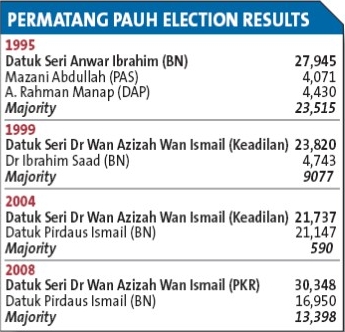
It is a homecoming to his old parliamentary constituency, which he first won as a Barisan Nasional candidate in 1995 with a majority of over 23,000 votes. His opponents then were two featherweights from PAS and DAP. (* CORRECTION : Anwar first won the seat as a Barisan candidate in 1982, and also subsequently in 1986,
1990 and 1995.)

In 1999, Anwar’s former ally, Datuk Seri Dr Ibrahim Saad, was given the job of challenging Wan Azizah. Despite the anger over Anwar’s jail sentence, the former put up a credible fight and managed to reduce the majority to 9,077.

By 2004, with Datuk Seri Abdullah Ahmad Badawi’s popularity at its height, particularly his call for reforms, Wan Azizah managed to pull through with only a 590-vote majority.

But the March 8 polls was a different story. Wan Azizah’s majority shot up to 13,398 votes while Barisan's candidate Datuk Dr Pirdaus Ismail managed to garner 16,950 votes.

Going by past results, the Barisan has a base of 14,000 to 17,000 voters while PKR has between 20,000 and 30,000.

In the 2008 elections, Barisan must have lost the Chinese and Indian voters, who could have been depended on previously to deliver their votes.

There were losses in votes from many pro-Barisan Malays voters who favoured the PKR this time as the political tsunami swept the country.

Datuk Seri Najib Tun Razak, who is expected to lead the by-election campaign, has set a realistic tone by declaring Barisan to be the underdog.

It cannot be business as usual. Any declaration of victory, as many Umno leaders often like to proclaim, would be a bad start.

By being the underdog, the Barisan campaigners would realise that the odds are against them and they would be entering a fight they have never fought before.

They would need to work hard and, certainly, keep their fancy cars at home when campaigning.

The opponent is, after all, Anwar Ibrahim and the Barisan candidate is likely to be a less formidable contender.

In any by-election, the opposition is the favoured choice as voters perceive that the political status quo would not be affected if an opposition member was voted in to help check the government better.

The resources of the opposition would also be channelled into one area and this time, the opposition is no longer the “poor party” as evident during the 2008 polls. With five states under its control now, financial contributions are no longer an issue.

The Barisan is still unpopular, as evident from the massive losses in the general election, and the recent fuel price hike has not reduced the resentment towards the leadership.

It’s a problem affecting heads of government all over the world and the Prime Minister is no exception. A survey by the independent Merdeka Centre for Opinion Research has showed that Pak Lah’s popularity has dipped to below 50% from an all-time high of 91% in 2004.

It has been reported that 59% of the respondents said economic problems were the most important issue today, with the majority expressing concern over the direction of the country.

Executive director Ibrahim Suffian said the unhappiness among respondents was not just on the fuel and food prices hike but also on the political uncertainties in the country.

The Pakatan seems to have fared better with 57% of respondents saying they were “somewhat satisfied” and “very satisfied” with the opposition, but the survey also showed that the respondents had more faith in the Barisan delivering their promises than Pakatan.

It is best that Barisan is not quick to dismiss the findings but to find ways to repair its image instead.

With the looming arrest of Anwar for sodomy, the by-election campaign and the trial could be held at the same time.

The decision for Wan Azizah to give up her seat is obviously a preemptive strike by Anwar before he is charged. He will surely treat the by-election as a referendum of sorts with the sodomy charges used as the main campaign issue.

The Barisan, if it plays by the rules, would have its hands tied as it would be sub-judice for the media and the leaders to talk about it. But it’s a free-for-all on the Internet and the ceramahs with little possibility of contempt of court.

Politics is all about perception and winning votes. With the prices of crude oil going down, it’s also time for Malaysians to pay less for their petrol.

This would be one of the many measures it can take to gain popularity ahead of Permatang Pauh.

sah

Cut out the political antics

ON THE BEAT

By WONG CHUN WAI

MALAYSIANS are going through extraordinary times, certainly not the best, as we grapple with global economic and local political uncertainties.

With the general election already concluded, we expect our politicians, whether they are federal or state leaders, to steer us through these rough times. We have a right to demand that they set their priorities right.

To put it bluntly, while these political controversies make good reading in the newspapers, many Malaysians are genuinely concerned with the direction we are heading with our excessive, never ending kind of politicking.

Certainly, issues like justice, democracy and human rights are important, but for many wage earners struggling to put food on the table with countless bills to pay, the antics of some of our politicians are becoming distasteful.

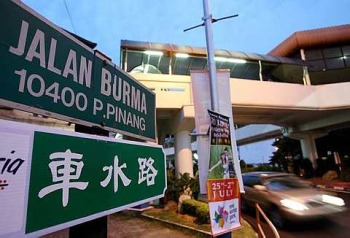
Political gimmick? One of the six road signs in Chinese put up by Gerakan in Penang recently.

More than six months after the polls, the perception is that the country is still trapped in a fierce political campaign. Not only are foreign investors confused, so also are many Malaysians who find the on-going political developments disturbing.

Just glance through the newspapers and you can see that they are not creating a pro-business climate in the country that will prepare Malaysians to face the effects of a global economic recession or addressing how we should adopt cost-cutting measures without impeding growth and remaining competitive in the region.

Instead of Malaysian unity, we hear of Malay and Muslim unity. In Penang, we read of attempts to put up Chinese language road signs, which has never been an issue in the state.

For years, Gerakan, which has been the dominant Barisan Nasional party in the state, did not find it a necessity to put up such signs; but now that they are in the opposition, they resort to such gimmicks to gain popularity.

If Gerakan’s attempt was to score points, it has ended up shooting itself in the foot. It did not affect DAP’s position but stirred up a hornet’s nest with Umno expressing its unhappiness. In the end, the municipal council took down the illegal road signs.

But Gerakan leaders in Penang said it wanted to remind the DAP that the party did the same thing a few years back. Now that it is running the state government, it would appreciate the problems facing Gerakan then.

The only place in Malaysia where road signs and signboards in government offices are in Bahasa Malaysia and Chinese is Kuching.

But it makes sense to put signboards in various languages such as English, Arabic and Chinese in heritage areas in Penang to explain the historical background of these places for tourists.

In Terengganu, Mentri Besar Datuk Ahmad Said has found himself in a controversy over the purchase of 14 Mercedes Benz cars at RM3.43mil, putting the BN in an embarrassing situation.

He may have good reasons for his preferences over the Proton Perdana, but the timing is certainly not right for the purchase of foreign cars. In short, he was not being very clever.

At the Federal level, Umno and PAS leaders are persuading their members – as well as non-Muslims – on the need for talks on Muslim unity.

PAS president Datuk Seri Abdul Hadi Awang himself has said in Harakah, the party’s newspaper, that he was disturbed at the increasing representation of non-Muslim legislators and parliamentary seats in Sabah and Sarawak.

Non-Muslims reading his comments must be wondering why this should be an issue – has Hadi forgotten that many non-Muslims voted for PAS in the March 8 elections, despite the party’s consistent Islamic state agenda?

Then, we have PKR adviser Datuk Seri Anwar Ibrahim who is determined to continue the political fight with an attempt to force a by-election in the Kulim-Bandar Baharu parliamentary seat soon.

He has also reiterated that his Sept 16 deadline of toppling the Federal Government with defections from Sabah and Sarawak BN MPs is not a bluff.

In the midst of all these, Anwar remains in a precarious position with the police still not telling us the results of the sodomy investigations. Will the case be dropped or would Anwar be formally charged, which would certainly shoot up the political temperature.

We can expect another eventful week or two.


MCA gears up for party polls

ON THE BEAT WITH WONG CHUN WAI

THE stage is set for the fight for the party president’s post in the MCA elections in October following the decision of incumbent Datuk Seri Ong Ka Ting not to seek re-election.

On Friday evening, vice-president Datuk Ong Tee Keat announced his candidacy, ahead of the party division elections next weekend.

The elections involving 191 divisions are crucial as they would be selecting the delegates to the general assembly in October.

Tee Keat, an engineer-turned-politician, is known for being outspoken, an image his supporters said would help him secure the top post in the current political climate.

It has never been easy for Tee Keat, 52, who started off his political career taking on the late Selangor Mentri Besar Datuk Harun Idris in the 1989 Ampang by-election, where the latter contested as a Semangat 46 candidate.

Tee Keat won the seat with a 4,500 vote majority. Tee Keat, a Universiti Malaya graduate, came from a humble background. His father was a fishmonger while his mother was a washerwoman.

As MCA Youth leader, he also took on his then DAP counterpart Lim Guan Eng in a public debate at the Chinese Assembly Hall, witnessed by thousands.

The debate was conducted in Bahasa Malaysia, Chinese and English.

Tee Keat’s candidacy is said to be endorsed by Ka Ting, 52, and his deputy, Chan Kong Choy, 53; the party president took Tee Keat with him on a road show recently.

Dropping hints that he was stepping down, he had also indicated that Tee Keat would be taking on a bigger role before announcing he was not seeking re-election on June 28.

But Tee Keat is expected to face a challenge from Datuk Dr Chua Soi Lek, 61, who has been meeting grassroots leaders despite having stepped down from all positions early this year after the video clip scandal.

Another Johor leader, Datuk Seri Chua Jui Meng, 65, is attempting to make a comeback but he has not indicated which position he would be eyeing. Jui Meng was a vice-president.

Attention would also be on the deputy president’s post. There is no clear indication who would be vying for the slot although names like vice-president Datuk Donald Lim, 53; secretary-general Datuk Ong Ka Chuan, 54; and Youth chief Datuk Liow Tiong Lai, 47; have been mentioned.

So far, Donald, the former PJ Selatan MP, has been the most active campaigner, with most political observers expecting him to contest the number two post.

Liow is also tipped to contest one of the four vice-president posts and is almost certain to leave his Youth chief post.

Current secretary-general Dr Wee Ka Siong, 40, is almost certain to contest that post.

Many expect deputy chairman Datuk Ling Hee Leong, 39, believed to be aligned to Soi Lek, to challenge Dr Wee but now there is talk that Ling may even contest a vice-president post.

History would also be created when Wanita chief Datuk Dr Ng Yen Yen, 62, vies for one of the vice-president posts. The women’s wing secretary-general Datuk Paduka Chew Mei Fun, 44, is likely to contest the Wanita post.

The only possible contest, political analysts say, could be from Penang MCA Wanita chief Ooi Siew Kim.

Chew could have a relatively easier passage with the resignation of MCA central committee member Datuk Paduka Dr Tan Yee Kew from the party.

Dr Tan, who is believed to have been offered a position in Pakatan Rakyat, quit MCA last week.

But as the party leaders gear up for the fight, they are also aware that the party can ill afford a fractious campaign, particularly after being badly bruised in the March 8 polls, which saw the party holding on to 15 MP seats.

More importantly, the MCA needs to face the reality that the fight to represent the community does not just come from the Gerakan in the Barisan Nasional but also the DAP and PKR now.

And with communal politics getting unfashionable, the MCA has to re-invent itself – in its image and the manner it operates in a multi-racial context – in the quickest possible time to stay relevant.

Race against time for reforms

On The Beat

By WONG CHUN WAI

THERE were three reactions when Datuk Seri Abdullah Ahmad Badawi said he was quitting as Prime Minister and Umno president in two years’ time.

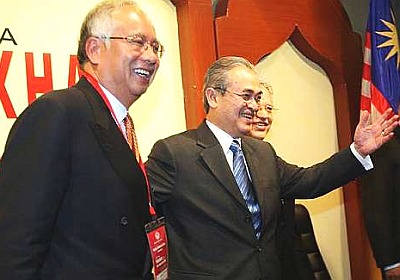
The first reaction was that he finally has a succession plan with his deputy Datuk Seri Najib Tun Razak as his successor, thus setting a smooth leadership transition.

Big news: Abdullah’s announcement that Najib (left) will take over from him in two years’ time has met with criticism from some quarters.

Then, there are some who said two years is a long time and that would be unfair to his successor, as anything can happen in two years. But there are also those who said that Abdullah should not even have announced the date as that would make him a lame duck PM. In short, Abdullah can never expect to please everyone.

Datuk Seri Dr Mahathir Mohamad, who led the country for 22 years, stayed on for 16 months after saying he was quitting.

Tuanku Abdul Rahman, who became the first prime minister since independence in 1957, dragged on for a year after the May 13 racial riots, when he knew he had to go.

Abdullah, as a seasoned politician, must have weighed the pros and cons of the deadline before finally making the formal announcement. Obviously, he had to ensure Umno would not be destabilised in the transition process and that his deputy would be loyal to him until his exit.

By securing Najib’s support not to challenge him, Abdullah has secured his position in the upcoming party polls in November. By winning his party post unchallenged, it would be an honourable exit for him come 2010.

But those who expect Abdullah to be an ineffective PM would be wrong. He has told his supporters and friends that he would devote his next two years to reforms, which he has committed to the rakyat.

It would be much easier for Abdullah now as he would no longer be too preoccupied with seeking popularity as all politicians do.

From reforms in the judiciary to fighting corruption, he would be fighting against time to make all the positive changes – and in the process make it easier for Najib when he takes over.

Among the changes Dr Mahathir implemented in the final stage of his administration was to introduce English in the teaching of Mathematics and Science. For 22 years, despite being aware of the deteriorating standards of English, he did not do much, presumably fearing that there would be a backlash from the Malay nationalists.

Having made the changes, there is still pressure from the Chinese educationists who are against the decision.

It has not been easy for Abdullah for the past few months – the Barisan Nasional lost five states and its two-thirds majority in Parliament. Reeling from the losses, he ran into a global price hike.

Now, he has to implement what he needs to do so that history will judge him more kindly, with reforms as his priority.

It will not be easy, as reformist leaders like Datuk Shahrir Samad, Datuk Zaid Ibrahim and Datuk Ahmad Shabery Cheek have found out.

While many are convinced that only major changes in the policies of the Government and party can reinvent Umno, there are also many who feel these reforms have hurt them actually.

The setting up of an independent inquiry into the VK Lingam video clip issue hurt Abdullah in the general election. The incident took place during the administration of his predecessor but despite the pressure from some quarters, Abdullah went ahead with the setting up of the panel.

Some want Umno to go back to its old ways, believing that a strong and firm leadership is the answer.

Abdullah has allowed more democratic space than all the previous leaders although many may not agree, including those who want instant changes, not aware that powerful forces are also attempting to reverse the clock.

With the clock ticking away, Abdullah must race against time to push for meaningful reforms.

Fed up with the political drama

On The Beat

By WONG CHUN WAI


WE are becoming a basket case as far as politics is concerned. This whole sodomy episode has become one big joke with Malaysians at a loss as to what and who to believe.

Anal sex and sodomy are terms that have become so frequently used that newspapers, seen as a product read by the family, are finding it impossible to keep such terms out of their reports.

The issue has also divided the nation. You either believe that Datuk Seri Anwar Ibrahim is a compulsive sodomite or he is a frequent victim of a government conspiracy to prevent him from becoming the next prime minister.

After all, politics is all about perception. But in Malaysia, with the credibility of the government, judiciary, police and media in question, facts and evidence no longer matter.

And who can blame Malaysians? You have a private investigator P. Balasubramaniam who made incredulous allegations against Deputy Prime Minister Datuk Seri Najib Tun Razak in a statutory declaration, which ranged from anal sex to commission for a submarine deal, and then retract them barely 24 hours later.

The man should be arrested and charged in court. The perception of Malaysians now is that a statutory declaration can be written by anyone, in the presence of any lawyer, and sealed for RM6 in front of any commissioner of oath.

It’s like a licence to shoot off allegations against anyone under the protection of the law. The next day, you can change your mind, whether under duress or pleasure, and retract the entire content.

The statutory declaration is in danger of becoming a piece of toilet paper. You can file a document, say the nastiest things, with no evidence except “reliably informed”. What the people choose to believe will depend on their political allegiance.

Malaysia is now on the radar screen, not because we are an attractive place for foreign direct investments, but for our political theatrics.

Investors also perceive our leaders and public servants as corrupt, and therefore assume that doing business in Malaysia is more expensive.

But as the sodomy allegations become juicier and more confusing – and the quest for power getting out of hand – the reputation of the country gets more tarnished.

The real issues have been neglected, even ignored, by those out to grab power and those wresting to stay in power. Investors no longer regard Malaysia as a politically stable country.

The perception is that the federal government will fall any time as the world waits for Sept 16, the deadline by which Anwar has promised he would be prime minister. Such political uncertainties will certainly not help bring in the investors.

Our strong point in Asia has always been our stability, economically and politically, but this has been challenged – and investors’ confidence has been seriously eroded.

Malaysia’s business is suffering; please stop this political drama.

These allegations may be good reading and help sell newspapers but many Malaysians are fed up with our politicians. The general election is over and politicians should focus on running the states and country.

The Pakatan Rakyat should prove that they are able to better govern the five states they control than the Barisan Nasional and take on the BN at the federal level in the next round.

The federal government needs to build the confidence of the people and show that it can steer them out of the troubled waters as the price of crude oil continues to climb. Businesses have slowed down and jobs are being lost all over the world.

Airline companies are going bust as stock market prices plunge; the last thing we need is a political fight which will pull us down deeper.

Press conferences are held daily not to talk about fighting inflation, saving jobs and putting food on our table but about sodomy and more sodomy.

Pak Lah needs to take a firm leadership. It’s not good enough being nice.

He is the Prime Minister and he has to make sense of what is troubling Malaysians, show he is the boss and use all the resources under his control to implement all the reforms in the judiciary, the civil service, the police and all other sectors.

We are not seeing enough of this at present. Use the stick, if you have to, and stop the rot.


Visit my blog at www.chunwai08.blogspot.com 

The MCA transition has started


HE had been mulling over the decision not to defend his position as party president for months, telling close friends and party leaders that this could be his last term.

In turn, they had told Datuk Seri Ong Ka Ting that he should only make public his views nearer to the October elections.

The first step had been taken when he decided not to accept a Cabinet position after the March 8 polls. But yesterday, Ka Ting announced his decision much earlier than had been expected.

The first indication of his plan came during a meeting with grassroots members in Penang recently, where Ka Ting introduced the “new team” of party leaders. And, as he was winding up his speech, he joked that he might have to campaign for votes in the future.

The little hints were enough for the grassroots to realise that Ka Ting, 52, already had plans to let someone else take over the party’s helm.

Deputy president Datuk Seri Chan Kong Choy, 53, who did not contest in the March 8 general election, is almost certain to follow in Ka Ting’s footsteps.

The Chinese newspapers had also speculated that party vice-president Datuk Ong Tee Keat, 52, already had the endorsement of the two leaders to take over.

MCA Youth chief Datuk Liow Tiong Lai, 47, is also expected to move up the ladder.

The Health Minister’s party post is likely to be filled by the youth wing’s secretary-general Dr Wee Ka Siong, 40.

Both Ka Ting and Chan have taken their line-up to various states since last month on a roadshow introducing them to grassroots leaders – ahead of the party divisions’ meeting next month.

But before that happens, they need to be tested out first. Former MCA vice-president Datuk Seri Dr Chua Soi Lek has been speculated to contest the president’s post with vice-president Datuk Donald Lim eyeing the number two spot.

At the same time, veteran party leader Datuk Seri Chua Jui Meng is also seeking a comeback although he has not committed himself to which position he is going to contest.

The development in MCA is the beginning of a rejuvenation process in the party, where younger party leaders have been identified and groomed, and, in this case, even pave the way for them to take over the leadership.

It has not been an easy process. Ka Ting fielded a large number of young candidates in the general election, which saw many defeated.

Some party members attributed the losses to the large number of veterans being replaced. But the likelihood is that even if the veterans had been retained, there was no way the political tsunami could have been stalled. And the results could have been even worse than the party’s line-up of 15 MPs now.

So far, the party election campaign has been restrained. Despite the snoop squad controversy, where party rivals were said to be targeted, it has been relatively composed.

The decision of the two top leaders not to seek re-election would also remove the possible emotions of a fractious contest that could have an impact on the MCA, which is carrying out reforms to rebuild the party.

A new leadership would also bring hope, freshness and rejuvenation, which the party needs badly after the disastrous outing on March 8.

The Chinese community expects their leaders to speak up both in and outside the Cabinet. That challenge will now rest on the shoulders of the younger leaders in Cabinet.

They also want the MCA leaders to relate and communicate with them, to be their voices and not merely a loyal partner of Umno. With the country’s 54% of population being less than 24 years old, the social contract and the friendship of the Alliance means little, if nothing, to them.

In the age of Facebook and the Ipod, they want change now. As in today, and not tomorrow! Failure to meet the expectations of a young electorate, which has a disdain for communal politics, would mean the decline of the race-based parties.

Ka Ting is still an MP and would surely be watching from the sidelines, giving a hand or two when necessary, but the transition has started