Author Archives: wcw

End the political uncertainties

THE Winner Hotel, located in the heart of Kota Kinabalu, is one of the earliest landmarks in the state capital. What was once a prominent spot has now been overtaken by other hotels.

The budget hotel, with just over 30 rooms, was built by the father of Datuk Yong Teck Lee, the president of the Sabah Progressive Party, who is now embroiled in a political storm.

His father, a timber tycoon, had sent Yong to the prestigious London School of Economics, to study law.

The moustachioed and side-burned politician rarely goes to the hotel these days except to sample its famous steamed pork with salted fish, a popular Hakka dish, at the coffee house – and for very private meetings.

In Sabah’s political circle, the joke is that Yong is the “YTL of Sabah”, in reference to Tan Sri Yeoh Tiong Lai, the founder of one of the biggest Malaysian conglomerates.

There is no question that Yong is SAPP and SAPP is Yong. He has a solid grip on the party and his deputy Datuk Raymond Tan poses little threat, if at all, to Yong, who has rebelled against the Prime Minister with a challenge to table a no-confidence motion against him.

With the SAPP supreme council endorsing the motion, Yong is now waiting for the sack by the Barisan Nasional leadership. He has moved on to his roadshow to garner support.

Tan, who failed to swing the SAPP leaders to his side on Friday, with his supporters, has now said he would remain with the coalition.

But it remains to be seen whether Yong will emerge a winner in the whole scheme of things. For now, there is little to lose in taking this political gamble as Yong holds no federal position. With only two MPs in Parliament, his party commands little respect.

Tired of being regarded as a mosquito party, Yong has decided to flex his muscle and now wants to be taken seriously, particularly with the wooing of Datuk Seri Anwar Ibrahim. Indeed, he is now front-page news.

The two have had a strange relationship, proving that there are no permanent friends or enemies in politics. When Yong was Chief Minister for two years from 1996, he openly clashed with Anwar, then Deputy Prime Minister, over the state’s defiance to allow Olympic Bhd to re-establish a gaming licence.

Tired of his authority being challenged, Anwar made public allegations of corruption in the state but Yong, barely 40 years old then, remained unshaken.

Fast forward to 2008. Yong and Anwar have met to discuss the political possibilities ahead of Sept 16, the date set by Anwar to topple the Barisan federal government.

The media-savvy Yong realises that he needs to move now. In his own words, this is the window period that will be closed after August.

By then, he said, “the public attention would be on the Olympics” and that the national press would have suffered “fatigue” over Sabah issues, unless there is action to be seen.

Coverage would centre on the Umno and MCA division elections while by September, politics would come to a standstill when the fasting month begins. The school exams would start with plans made for holidays by the year-end.

Yong, like Anwar, realises that he needs to create the momentum and stay in the news. Anwar also needs to convince that his Sept 16 promise is real and not just hype, as many seem to think now.

The SAPP looks set to be sacked while a huge demonstration against the fuel price hike that will take place on July 5 seems to fit in the grand plan.

At the same time, Umno leaders seem too preoccupied with their party elections which, to Pakatan Rakyat, would be the perfect timing for a political onslaught. And adding to that would be an electorate angry with a higher cost of living.

It’s an explosive political situation ahead. While all politicians have their own agenda and ambitions to fulfil, they must never lose sight of the national interest as the stock exchange continues to take a beating. The uncertainties are bad for business with nervous investors holding back their money. It needs to end, at some point, so we can all move on.

Food for thought

On The Beat

By WONG CHUN WAI


IT’S not a good time to be the head of a government. The skyrocketing prices in fuel and food have led to rioting in 22 countries, at the last count, and at least one government has collapsed because of these problems.

In April, the Haiti government fell after 16 senators in the Caribbean nation sacked Prime Minister Jacques-Edouard Alexis following a week of rioting against the rocketing prices of rice, beans and cooking oil.

The World Bank said at least 33 countries were being threatened with social and political unrest.

In European Union countries, in at least 15 nations, the inflation rate has soared, the highest since 1994 following the increases.

From Africa to Europe and Asia, people have taken to the streets to protest against this crisis.

Last week, in Kuala Lumpur, a huge crowd demonstrated against the fuel price hike after Friday prayers. It is an issue that touches the nerve of Malaysians, as their pockets have been burnt and any move to increase prices would always be unpopular.

But any promises to reduce fuel or food prices can only be regarded as far-fetched although the quantum of any price hike is debatable. Populist decisions are popular but unsustainable, even harmful, to the country in the long run.

Economists have singled out the Philippines for introducing popular wide-scale food subsidies that can lead to a dangerous level of food stock shortages eventually. It has also increased food imports by jacking up the budget deficit.

Since the last 30 decades, oil prices have soared at least five times and that means everything needed for food production – from fertilisers to transportation – have shot up.

It has not helped that extreme weather conditions have hit wheat- and rice-exporting countries such as Russia, Kazakhstan, Australia, Vietnam, Myanmar and Bangladesh.

Besides export controls and bans by India and Vietnam on rice, Ukraine, for example, has export quota. After harvesting more wheat than they could sell at home, farmers were forced to toss US$100mil of rotten grain into the Black Sea early this year – just when many countries were facing a shortage of food.

Last week, the Konrad-Adenauer-Stiftung brought together editors from Europe and Asia to Bangkok to meet rice producers, traders and experts to review the declining stock of rice among exporting nations.

Asian Development Bank executive director Sebastian Paust, who spoke to editors, warned that the prices of wheat, grain and rice might stabilise but highlighted that food had become a commodity that was now heavily bet on.

The Chicago Mercantile Exchange, he said, had showed the volume of contracts increased by 20% since January to more than a million contracts a day. There is also the Multi Commodity Exchange of India in Mumbai.

Hedge funds alone this year amounted to about US$40bil in financial markets, with shares in food-related companies being snapped up.

AMP Capital Investors Shane Oliver reportedly said traders and speculators flocked to commodities, including food, this year because it was one of the few investments that provided solid returns.

But Paust said structural factors such as neglect of rural areas, insufficient investments, insecure land tenure rights, urban migration, rising energy prices, lack of incentives in agricultural products and the massive demand for food consumption, especially in India and China, were also contributing factors.

Rice trader Vichai Sriprasert said the prices of rice would not go down, citing climate change as a serious threat, but dismissed speculations on rice futures. He said Thai politicians, wanting popularity, would keep prices at a minimum.

The Thai Rice Exporters Association president said hoarding and panic buying could lead to a periodic price increase but it could also mean lower demand.

But it’s not all bad news. International Rice Research Institute development director Duncan Macintosh said new hybrids for unfavourable environments had been successfully tested, with vast improvement in biotech for breeding efficiency.

Rice expert Dr Ammar Siamwalla of the Thailand Development Research Institute predicted the price of rice would slide back, if there were no climatic disasters.

Paust said India planned to make speculative future trading more costly at the commodity exchange, adding that countries should make agriculture a political priority. There are also calls to strengthen social safety nets through targeted income support for the poor rather than generalised food subsidies or trade measures.

Countries are now also re-looking the biofuel trend as cereals should not be used to feed machines but people. Since 2000, cereal use for industrial purposes like biofuel jumped by more than 25%, according to reports. It is a sin to do so in the name of environment.

There’s also a lesson for all government leaders – don’t ignore food production for manufacturing and cash crop commodities.

For editors, agriculture stories may not sell newspapers and they are ignored until there is a food shortage. It’s food for thought for all.

Be prudent with taxpayers money

On The Beat

By WONG CHUN WAI

THE people had anticipated that prices of fuel would go up, but what they did not expect was the sharp 41% jump in petrol prices while diesel went up by 63%.

A gradual price increase would have been less painful but it appeared that the Government was unable to hold the spiralling RM50bil oil subsidy as global oil prices continue to shoot up.

At the same time, the tariff for electricity will also go up, which is another blow for Malaysians who will now have a really tough time juggling their monthly budget as prices of other essential items go up in tandem.

Actually, Malaysian motorists still enjoy a 30 sen subsidy and our fuel prices are still among the lowest in the region, but many salaried workers are not in the mood to listen to politicians who compare the country with Thailand and Singapore.

Singapore, which has an excellent public transport system, cannot be used as a yardstick.

Any attempt to explain the need to cut the subsidies on fuel, which will help to sustain the economy in the long term, is now regarded as apologetic in nature and is bound to go down badly.

Yet, the fact is that those leading the protests against the fuel price hikes have not been able to explain how they intend to tackle the fuel subsidy structure if they were in charge.

For Datuk Seri Abdullah Ahmad Badawi, the decision to increase the fuel prices must surely have been a burden. Less than three months after losing five states to the Opposition, he now had to make a decision that would lead to a further dip, if not dive, in his political standing.

He is already facing a tough internal battle in Umno and the latest decision will not help boost his position for sure.

Right decision

Lifting a substantial part of the subsidies is the right decision, painful as it can be, but the timing for Pak Lah has not been a good one.

Obviously, he has tried to postpone the decision because of the March polls and, for strategic reasons, he could not have allowed a price hike. The consequences would have been even greater than losing five states.

In predominantly middle class Malaysia, human rights and democracy normally take a back seat in comparison to issues such as inflation, which hits the pockets of consumers, and crime.

Any attempt to launch an austerity drive from now on has to be practical and reasonable, given the hostility of the general population.

One newspaper reader has suggested that Malaysians cycle to work and even the return of trishaws. We may be celebrating World Environment Day but that is certainly ludicrous. So is asking us to plant kangkong and sawi at home.

To ask Malaysians, especially wage earners, to change their lifestyles would also be hypocritical and certainly laughable when most of us are struggling to pay off our bills with our meagre take-home pay.

The rebates promised by the Government have been received cynically, probably because most income tax payers have yet to see the return of the money they overpaid in their monthly scheduled deductions to the Inland Revenue Department.

But what Malaysians may likely want to see would be a more prudent and frugal kind of management by the Government, especially the RM13.7bil saved from the new subsidy structure.

They are asking, for example, how we can justify spending RM39mil on the angkasawan programme, especially when they had been assured that the Russians were playing for the trip in view of our purchase of the 18 Sukhoi planes. Sure, they paid RM75mil to offset the cost but, in the end, we still paid a bomb.

The Government can expect Malaysians to be less forgiving from now when they come across extravagant projects and schemes, which see little return for the country.

There is a need for a great leap forward in improving our public transport system. Users of the LRT and KTM can tell you how much they have to suffer every day.

Thus, it is good that Pak Lah has made public transport a priority on his list of plans to ease the burden of Malaysians, along with expanding the list of controlled items, cost-cutting in government departments and agencies, and increasing support for small and medium-sized industries.

If the people are expected to change their lifestyles, they, too, expect the Government to change the way taxpayers’ money are spent.

Give them a dressing down

THE last time Malaysians had to put up with the notoriety of the Persatuan Kebangsaan Pelajar Islam Malaysia was when it called for the ban of the Gwen Stefani concert last year.

The student body claimed the singer was too sexy and that her concert would lead to immorality.

Now, the same movement has made another ridiculous statement.

Its vice-president Munirah Bahari condemned the school uniforms worn by girls in government schools, saying they were too sexy and would cause rapes and sexual immorality.

The white blouse, she said, was too transparent for girls and could cause distraction to men, adding the Government should review the uniform to ensure that it would conform to Islamic ideals.

She said it was important to “cover up” to fend off social ills such as rapes, sexual harassment and premarital sex, which could lead to babies born out of wedlock and even prostitution.

Now if you think that’s comical, wait until you hear this. Munirah blamed some female students for using the white blouse to lure men, suggesting the colour should be changed.

How white can sexually arouse men is something I, and certainly most Malaysians, cannot fathom. We have to ask our Cik Munirah, who seems to be quite an expert in this area.

And the National Union of Muslim Students leader is not even talking about the white blouse with knee-length skirt or pinafore, which is the preferred choice of most non-Muslim female students.

We can guess she will come to the length of the skirt next, if her student body has her way with the white blouse and other nonsense.

The student body is hardly known today but in the 1990s, it was a prominent movement with protests against so-called western hedonism and nihilism, and was in the news for protesting against the “Salem Cool Concerts.”

Datuk Seri Anwar Ibrahim headed the student movement from 1968-1971, where the emphasis was on social injustices.

Fast forward to 2008.

The organisation seems to be preoccupied with dressing and thanks to Munirah’s statement, Malaysia has made international news, again, for the wrong reason.

But what is disturbing is the trend to embrace the Arab culture in the name of religion and those who seek answers are immediately shut off for being insensitive to the religion of others.

It has come to a point where many people have become too timid to question individuals and groups like these, worried about the backlash against them, and the result is that their decibels get higher as they impose their values on us in the name of morality.

There are supporters of this student group who are pushing for “thicker material” for these blouses; heaven forbid that we come to a point where some groups get to push for greater conservatism in Malaysia.

If there is any review of our school uniforms, we should be allowing our students to wear collared T-shirts like in Australia, which suits our tropical weather much better. It is also healthier.

In the Arab countries, it is dusty and at times, even windy, but in Malaysia, it is humid and we know how sticky and uncomfortable we become after the physical education lesson, as our schools do not have shower facilities.

Common sense must prevail, just like the views of the majority. Don’t let anyone tell us how and what to dress.

Time to close chapter on May 13

ON THE BEAT WITH WONG CHUN WAI

IT has been 39 years since May 13, 1969, when the country’s darkest history occurred. The racial riots have continued to remain a traumatic experience and a scar that won’t go away after almost four decades.

More than 60% of the country’s 26 million population, if not a little more, did not experience that shameful part of the nation’s journey, and yet it is still taboo to talk about it.

More than 54% of Malaysians are below 24 years old. Add another 10% who are probably between 30 and 40 years old, or slightly older, and we will find that for all these people, the incident is a distant memory.

The more elderly Malaysians prefer not to talk about it and even if they do, it is done in a guarded manner. As for the history textbooks in schools, it is an episode to be remembered through a few paragraphs but best not to be discussed openly.

For some opportunistic politicians, the May 13 tragedy is used to invoke fear among the people and to protect the politics of communalism.

Unfortunately, in our reluctance to talk about May 13 openly, the best of Malaysian stories, even in the worst of Malaysia, have not been narrated.

There have been many fantastic uplifting stories, where Malaysians of different races protected each other and these stories should be told.

I am 47 years old and was only in Standard Two when May 13 took place. My home then was at Kampung Melayu in Air Itam, where my parents still live. As the name suggests, it is a predominantly Malay area and while many flats have since been built, it was essentially a semi-urban village then.

The rows of terrace houses were the only ones occupied by Chinese and when the fights broke out, we were caught in a frightening situation. Although I was only eight years old then, I remember my father taking me to the fiery Gerakan rallies, where the eloquence of the speakers, especially the Gerakan founder the late Datuk Lim Ee Heong, mesmerised me.

On the eve of the 1969 election, my father carried me on his shoulders at the mammoth Gerakan rally in Esplanade so that I could get a good view of the stage, where the speakers stood. He would explain to me what the loud clapping was about whenever I seemed lost as to what the speakers were saying, which was often.

The crowd cheered when the opposition called on the voters to “sink the Alliance boat” at the Esplanade sea the next day.

I recalled Lim telling the voters in Hokkien that if the federal government refused to build the Penang bridge, “we will ask China” to build the bridge, as he built up the communal rhetoric.

Ironically, the Penang bridge was built by the South Koreans and the new one would be built by the Chinese.

History was created as the Gerakan was voted into power the next day.

In Kuala Lumpur and Selangor, which saw the opposition making sweeping gains, the same euphoria erupted and a victory procession soon took place, which sparked the start of the racial riots.

When news of these disturbances broke out, my family had to make a choice – move to my grandmother’s house in Chulia Street, a Chinese majority area, where we would be safe, or stay behind in Kampung Melayu.

I was too young to ask my father why he decided we should stay back but we all did – my parents and three brothers. We stored plenty of food but no weapons even though my father sold hardware, believing that nothing would happen to us.

After all, the many Malay friends who stayed in the village knew us; even those who did not know us personally would greet us as they passed by our home daily. They were friendly, if not helpful, Malay neighbours.

We were right. Nothing happened during the riots. Kampung Melayu was one of the safest places in Penang for the Chinese.

Like all curious children, I would peer through the window to see if any fights had taken place during curfew but all I saw were some Federal Reserve Unit officers on patrol. No action at all.

The police had sent Chinese FRU officers to our village, knowing their presence would make the minority population feel safe. When the curfew hours were lifted, we mingled with these policemen who were friendly. I was fascinated with the weapons, especially the gas canisters they carried.

But the Malay and Chinese neighbours also came out, assuring each other that all was well and that there was no reason to fear any racial clashes. At the nearby field, where I played football with the Malay boys, we talked about when we would start our games again, and when we should catch dragonflies and little fishes at the stream that passed through our village.

For many of us, May 13 was also a phase that interrupted the interaction of Malaysians. For the Malay, Chinese and Indian boys in Kampung Melayu, we just wanted to carry on with our games. We heard about the clashes from my parents and in our innocence, many of us wondered why.

Of course, there were also unluckier ones, who had to live through a more traumatic experience, where they saw fighting taking place and lives snatched away. It will not be easy for them to forget.

But for many Malaysians, now in their late 40s and mid-50s, May 13 is just a flicker in their memory. It’s time to have a proper closure, a lesson learnt and not to be used to create fear.

Mideast investors still keen on Malaysia

But there’s hope. Here’s a piece of good news. Malaysia remains a good place to pump funds into. At least that seems to be the view of top investors from the Middle East, especially Abu Dhabi, who have been making steady enquiries about opportunities here.

Tomorrow, two important agreements will be inked between Abu Dhabi institutions and Malaysian parties, cementing the special bilateral ties between Malaysia and one of the richest nations on earth.

The first agreement will see the Abu Dhabi Commercial Bank (ADCB) buying a 25% stake in RHB Capital Bhd. The acquisition will see ADCB emerge as the second largest shareholder in the financial services group after the Employees Provident Fund, which after its disposal, would have its stake in RHB Cap reduced to 57.23%. RHB Cap owns RHB Bank Bhd, the nation’s fourth largest lender.

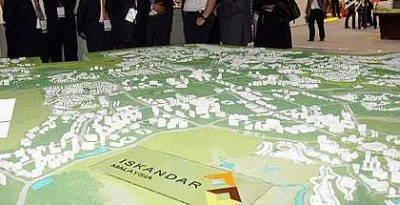
The Iskandar Malaysia booth during the Cityscape Asia 2008 exhibition held in Singapore recently. Government officials say Abu Dhabi decision-makers are keen to use Malaysia as a gateway to the region, despite serious overtures from Singapore.

The second agreement will witness Mubadala, the investment agency of Abu Dhabi, confirm its commitment to develop Node 1 of Iskandar Malaysia. But, as important as the two agreements will be the presence of senior officials from the emirates.

Leading the entourage will be chairman of the Crown Prince Court Sheikh Hamed Zayed al-Nahyan, chairman of the Executive Affairs Authority of Abu Dhabi/Mubadala chief executive officer Khaldoon al-Mubarak and ADCB chairman Said al-Hajeeri.

The chairman of the Crown Prince Court has a standing higher to that of the prime minister while the Executive Affairs Authority handles the day-to-day running of Abu Dhabi.

This visit is important because in the last 10 months there has been growing interest from the Middle East in investing in Malaysia. Businesses from the United Arab Emirates, Kuwait and Saudi Arabia have been scouting for opportunities in real estate and infrastructure projects here.

They weree attracted by Malaysia’s strong economic fundamentals, political stability and investor-friendly climate.

But the election results, which saw Barisan Nasional lose its two-thirds majority in Parliament and control of Perak, Selangor, Kedah and Penang, has introduced an element of uncertainty into Malaysia, claim political analysts and economists.

These people argue that foreign investors from Singapore, the US, the Middle East and the European Union will be cagey about pouring money into a country where there appears to be a few centres of power. Rumours and speculation of a leadership change have not helped either.

But the continued interest by Abu Dhabi investors in funding projects here or taking strategic stakes in Malaysian businesses shows that their faith in the country’s economy is largely intact.

Mubadala has stakes in a string of businesses, including Ferrari, the Carlyle Group and oil exploration in several countries. It is said to be keen on teaming up with Malaysian partners to jointly undertake infrastructure projects here and in the Middle East.

Malaysian government officials say that Abu Dhabi decision-makers are keen to use Malaysia as a gateway to the region, despite serious overtures from Singapore.

They also believe that there should be more joint ventures between their institutions and Malaysian financial services houses to promote Islamic banking further. This could help Malaysia cement its position as the global Islamic finance centre.

The signing ceremony tomorrow will be witnessed by Deputy Prime Minister Datuk Seri Najib Tun Razak. From there, the key imperative now is to make sure that Iskandar Malaysia succeeds, thus augmenting further confidence in Malaysia as an investment destination.

Time to review press laws

The Prime Minister has made positive moves in the judiciary and in the fight against corruption. He cannot allow this opportunity to slip by; he must now look at the changes taking place in the media.

Malaysia can never be the same again after the March 8 political tsunami. The people have now realised the power that they have in their hands. They have spoken out loudly for the changes they want.

They have expressed their unhappiness at the things which they found are not right in this country. The mainstream media is certainly one of them, and this newspaper is no exception.

As Bernama journalist Datuk Azman Ujang said, the people have spoken up about the government they want and the media that they want.

There will be certain sections of the political establishment and the media who refuse to change but they do so at their own peril. The demand for changes, particularly for more openness, in Malaysia is good for the country.

Understandably, there will be cynics who see the mainstream media as an unchanged leopard, or as chameleons to some, but many things have changed since the political tsunami. Those who initiate positive changes should be encouraged, not condemned or ridiculed.

The old ways of doing things have failed. Certainly, the old laws that tied down the press, too, have to go. They include restrictive laws like the Printing Presses and Publications Act 1984 and the annual renewal of publishing permits. Then, there are other related laws like the Internal Security Act and the Official Secrets Act.

On a more practical level, newspapers and journalists are being sued almost every other day. These legal actions take up a lot of time, and certainly money, and no business is as complicated as the newspaper industry.

Journalists, and their owners, are on the firing line every day. From the establishment to the readers, who want to have a say over how the newspaper should be run. If politicians face the voters every four or five years, the media does it every day, and that’s good for an active democracy.

For the print media, which still dominates the Malaysian media scene in terms of readership and revenue, it now faces healthy competition from the Internet media, which has effectively neutered the powers of government.

Bloggers are no longer just posting their comments but are also breaking news on their blogs.

More and more, we will see the convergence of the old and new media, as both sides crosslink with each other.

But irrespective of the medium, journalists and bloggers share one thing in common: they want to see greater democratic space and one of them is the freedom of expression. Regardless of their political belief, this common principle is shared by everyone in the media.

Malaysian voters must demand the level of commitment from their elected representatives on press freedom. As we mark World Press Freedom Day, how many politicians have pledged their support for press freedom, either in a press statement or a post on their blogs over the past few days?

How many politicians, regardless of their parties, can tolerate dissent or critical opinions against them, even as they speak about the freedom of the media?

Home Minister Datuk Seri Syed Hamid Albar has said that he would like to propose that the annual renewal of newspaper permits be waived. It should be repealed, but it’s an important first step.

We are not even sure Syed Hamid will have his way as there has been no response from other Cabinet members since he made the proposal. But Malaysians must push for it.

Likewise, Information Minister Datuk Ahmad Shabery Cheek must also remember that his job is to make information more accessible to Malaysians and not control it, as a freed press contributes to a healthy democracy.

Certainly, his job must not be to complain against newspapers, which the Government perceives to be unfair, at Cabinet meetings.

He has pressed the right buttons by allowing live telecast of question time at Parliament and even interviews with critical bloggers on RTM.

The Government may not agree with the views and even accuracy of some of these bloggers but, at least, they put their names and faces on their blogs.

Sad to say, some journalists and bloggers who made their identities known have found themselves exposed to libel and even harassment, in some cases.

Let’s not expect overnight changes but this is the time to demand that laws that stifle the freedom of expression must end.


Check out Wong Chun Wai's blog at www.chunwai08.blogspot.com 

Perk up service with better perks

The parliamentary committee on corruption, to comprise representatives of the Barisan Nasional and Pakatan Rakyat, is also moving in the right direction.

Beefing up the ACA workforce and adding another 90 lawyers as Assistant Public Prosecutors to assist the Deputy Public Prosecutors to expedite the handling of cases in the lower cases all help in the quest for justice.

But at the same time, the Government must seriously look at the salary structure of our civil servants, especially the law enforcement agencies such as the police, army and Customs department.

The extra allowances, especially for the police constables, have helped them meet the increasing cost of living better but they do not make up part of the fixed salaries, so when these officers retire, the allowances don’t count.

For high-ranking officers, their salaries are decent, even comparable with the private sector, but given the tasks they handle, it is, again, nothing to shout about.

The Inspector-General of Police Tan Sri Musa Hassan almost never has a day off, even on Hari Raya, and has had his leave forfeited for years.

For many police constables, it is a struggle to feed the family. Some, which we have become familiar with, resort to lurking behind trees and setting up questionable roadblocks with speed traps to pounce on unsuspecting errant motorists.

Many in the Klang Valley and Johor Baru take up part-time jobs and become taxi drivers, security guards, bodyguards and pasar malam traders. That’s the reality.

For clean cops, taking their children to fast-food outlets is a luxury, they will tell you.

Of course, there’s another group of corrupt officials – those who want to live lavish lifestyles, even excessively extravagant lives, and have more than one family.

Their living standard is incongruous with their pay scales – unless they are so good at the stock market.

For the ACA to work effectively, the Government needs to review the salary structure.

Good salaries attract good officers; right now, many are not civil and neither do they see themselves as servants to the public.

Make it financially attractive for Malaysians to serve the Government and it will cut down financial costs that are often passed on to the taxpayers as projects are delayed and become expensive.

The culture of kickbacks, essentially bribery, between the public and private sector has become entrenched with many foreign investors openly running us down, with disdain, at our shameful practice.

Cabinet Ministers, too, deserve better pay – like their Singaporean counterparts – to encourage good, qualified, ethical and decent people to take part in politics.

Of course, there will always be greedy people. For them, no amount of money is sufficient but, generally, professionals would not risk their reputation and dignity by being corrupt if they are comfortably off.

In Hong Kong, Taiwan and Singapore, the civil servants are well paid and the punishment for those caught is severe. That’s a good deal.

The fight against corruption has to run parallel with a better salary scheme for civil servants, especially the law enforcement officers.

The latter is a special category; no other civil servant should compare himself with those in these high-risk jobs.

An amnesty period may not be popular with most Malaysians but a fresh start, instead of a witch-hunt, would be more effective.

We want politicians to commit themselves to this initiative to fight corruption.

Many are no doubt feeling uneasy with Datuk Seri Abdullah Ahmad Badawi’s reforms but the Prime Minister needs the backing of his party leaders to make it work. Unfortunately, the perception is that many Umno politicians lack the credibility to fight bribery.

Cafe Latte with the Home Minister: Homing in on Home issues

Sunday April 20, 2008

Datuk Seri Syed Hamid Albar is responsible for one of the most important, if not powerful, ministries in the Cabinet. Speaking to The Star’s Group Chief Editor Datuk Wong Chun Wai, the senior politician talked about his tasks from heading law enforcement agencies to deciding on the role of the media, his upcoming plans for the ministry, Umno, and the country's political outlook.

What are your plans for the Home Ministry?

Syed Hamid: The Home Ministry is the second biggest with a staff of 159,000. I think the most interesting part of it is bringing it into its original state. We are undertaking the merging exercise of both the Internal and Home Ministries. Now we are more open to public scrutiny. This is a challenging and interesting ministry and it’s close to the people's hearts.

If you talk on matters of immigration, visas, passports, the National Registration Department, permanent residence and citizenship status, all are in the limelight.

In the case of newspapers, you have the licensing. I'm conscious of a lot of things that need to be adjusted. A few people have spoken about our successes in implementing the delivery system. One thing that is crystal clear about the Home Ministry is that things are moving very fast now, like the issuance of passports. The ministry is like a ministry of “till death do us part” – from the registration of death in one section, the other section is freedom.

You are holding the portfolio of one of most powerful ministries. In the changing political scenario in Malaysia, how do you see yourself handling this portfolio?

Since Pak Lah came to power, there has been a paradigm shift. We try to be more liberal and free, but at a cost, because our intention of creating a harmonious and peaceful society is still in the process of being moulded. It's tough. I consider it challenging because as a person who believes in due process and freedom, whatever I do, I will search my conscience first.

Public rallies or demonstrations create public debate and excitement. I will not interfere. I will ask the police to access it and see the perception of their threat to national security, peace and public order. We are just like being on a trapeze. We provide the balance and we do want freedom. But we also fear the consequences if we keep on inciting and adding fuel to the fire and that will not help. My thinking is that we are not going to control you (media).

One factor behind why the Barisan Nasional did badly in the recent elections was the issue of the Government not being able to tackle crime. Even as the police want to hire more personnel, the Government needs to race against time to stop this problem. It's still a lingering concern of the Government.

It's a question of whether you believe in absolute numbers, whether you believe in percentages or in relative comparison with other countries. On that score, we have done very well. We need the public to have confidence in the police. Most importantly, the force must be more visible and be seen as a protector of the people. The thing that jeopardises our efforts is the question of high-profile cases. We need to solve them.

We have improved anti-crime efforts through Rakan Cop and community policing at the police station or district level. These have produced results. I want to see the police improve their overall performance through better pay, welfare and assets. The police don't even have enough MPVs. I’ve told the ministry to get these things done.
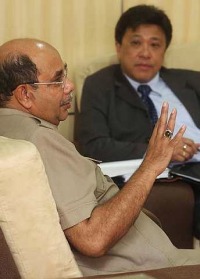
No holds barred: Syed Hamid expressing his thoughts freely with Wong during the Cafe Latte Chat last week.

For KL International Airport, security is under the Malaysia Airports Bhd. I’ve decided that this place is an important target area, which the ministry has gazetted, so we want to be involved. On the recent robbery there, the transfer of money to the moneychangers is being done in the millions, they’ve been doing it quietly. This time it’s an inside job. The worst part of it, for example, is that only 30% of the CCTVs are working. You can’t have that. The static CCTVs were also not turned on and you cannot replay the recordings. I said this is ridiculous. I’ve given instructions. We are going to have special units at the airport. It's done that way all over the world. I've also asked for a discussion about this with the Transport Minister.

The Chinese community is not happy with the police. We need to have more Chinese officers. We have asked, but not many want to join. We have to go on another campaign. We asked that we take action on secret societies. I said I don’t like detention orders. I want them to be charged in the courts. But they told me the witnesses are not willing to talk. Now we taking in retired soldiers. The police are doing many things including moving people to fill up the posts. I told them it’s still not enough. Let’s try and see how we can revamp and see how to give the best service.

One way for the Government to lighten the burden of the police is by employing volunteer policemen to do simple crowd control like they do in the United Kingdom, where the community police are involved in crowd control. Can that be done here?

It’s not as simple as that. For example, people who have been placed under restricted residence for drug offences are being put under observation by the police, especially by the anti-narcotics department. The police have to do that. I’m trying to get the anti-narcotics agency to study this. Our drug problem is that we have 10,000 undergoing rehabilitation while 300,000 are in the anti-drug community programme. The police have to observe all these people. We need to get more volunteers. We are utilising Rela and Immigration Department officers along with the police.

But many Rela officers are not well trained, as seen in several negative incidents reported in the past.

We have got 500,000 Rela members. The Rela is a good concept because it is a multi-racial organisation. We now use smaller trained units, not the ordinary Rela personnel, because of a lot of complaints before this. We are giving a lot of emphasis on training. We still need a lot of public feedback on how to improve Rela.

What are you going to do about the influx of illegal foreigners in Malaysia?

Malaysia cannot take more foreign workers. There are three million of them here and at least one million are illegal. Everyone is asking for new workers to be brought in. I think it’s wrong. People are complaining to me from all sides. I think we must have a certain minimum wage for workers. Otherwise we will continue to see foreigners as security guards, lift attendants and restaurant workers. I asked (MIC president) Datuk Seri S. Samy Vellu why so many young Indians are unemployed, but yet there are young barbers coming in from India? Can’t you train Malaysian Indians? He got angry with me. The Indians have a lot of social problems because they are unemployed. So why can’t we train our own people? Have we actually searched enough for our own people?

Is there a timeline for these plans?

Taiwan has a population of 23 million, whereas the number of foreign workers is only 400,000, and it's a very competitive country. We need to look at our salary structure. Part of the problem is also our political problem. You must think of your country, we are our own stakeholders. We must stick to the rules that professional foreign workers work here for 10 years and five for unskilled workers and not more, and they should be sent back. In Singapore it’s two years. Sometimes these foreign workers leave their children here. We have stateless persons –people without documents – and their country of origin don't want them back. We're stuck. I'm addressing this. Malaysians must recognise that.

Public perception about the huge number of illegal immigrants here is it’s due to corruption and bad enforcement. What's your take on this argument?

That is a possibility. We have long maritime borders, over 3,000km long, and the land is porous. I've asked all our enforcement agencies to look for the source and kill the demand, which means that we can tackle the illegal immigration problem from both sides. Otherwise we cannot succeed. We need public cooperation too. A lot of people use shortcuts (in employing illegal foreign workers) because they can pay low wages; they don't have to pay Socso or EPF benefits. The matter of tackling illegal immigration should be made a Malaysian agenda because it's for the good of the country.

Does the experience of having served in so many ministries make you more than qualified to become Home Minister?

Usually this portfolio is held by the Prime Minister and the Deputy Prime Minister because the ministry handles a lot of sensitive issues. The foreign diplomats met me recently and said the thing that kept people very happy and that the country is okay is when I was appointed Home Minister. That is quite nice to hear. People see that I'm a tough person but at the same time I’m fair. I've never taken emotions or sentiments into my decision-making process.

You are the first Home Minister who is not Prime Minister or Deputy Prime Minister since Tan Sri Ghazali Shafie held that post.

He was the last Home Minister. The other part is that I also don't have political ambitions. I'm not an Umno vice-president and I don't seem to be aspiring for anything. I've never considered a job as part of the party position. I'm in the old school mould – I think people should recognise me for what I can do. Pak Lah sees me and thinks: “This guy works hard.” My wife always tells me that I'm a workaholic.

One month after the general election, the public perceive, rightly or wrongly, that Umno has not changed in the way it tackles issues.

Umno has not found its direction. It's still in a state of shock and there's the infighting within the party. We have produced different cultures and values. I'm not surprised the public is watching with dismay the squabble in the party and calls for the leaders to step down, which is not the Umno style. If there is any problem and when one wants to bring down the leaders, it's done very subtly. It's a new culture.

People must recognise that we have moved away from the elections. We have to start doing something that the public wants, and we have quite a number of issues that we need to tackle. It should be that Umno leaders are serving the public; we don't want abuse of power and we are not corrupt. When we talk about corruption, we must be whiter than white.

The message is to teach us a lesson. The non-Malays were dissatisfied with Umno; everyone is blaming Umno. But everyone has got a share in tackling these things, especially in the Barisan.

The Barisan has not come together cohesively because the component parties suffered badly.

The Pakatan Rakyat governments have introduced a lot of populist decisions. How does Umno intend to counter these with its own reforms?

On the giving of land titles in Perak, we have issued over 50,000 titles but that is actually an accumulation over time. You don't see that but when it's a new thing, people can see straight away and pick these things up. It's because you're not being judged yet. You are starting on a clean sheet.

We have done so much and yet the people rejected us. We planted the trees and now they are bearing fruit and other people are plucking them. Our problem is that we didn't package ourselves well, and in this election, there were a lot of issues that we didn't address properly, like crime, tackling corruption and countering allegations of bloggers, where all sort of things tend to become the truth.

The sentiment is that Umno as the biggest party has a chance to represent Malaysians. Why does it choose to talk about Malay issues only, when it can talk about Malaysian issues and represent everyone?

Since independence, Umno has always represented everyone. It has done very well for everybody – the current policies; the economic growth of non-Malays has been very good. Sometimes when we emphasise things, it's as if it's for the Malays.

During the NEP process, for example, the economic growth rate and equity ownership of the non-Malays was bigger than during the British administration period. We need to realign our policies. We need to help the people who are left behind. I feel Umno has done so much to create a multi-racial society. Otherwise this country will be in turmoil and it will become a failed state. The Chinese schools are better now than before.

The industries are controlled by non-Malays, but the non-Malays have not taken their money out. Instead they have reinvested into the country. They are Malaysians. Let's make the country grow. Unfortunately, when you start to talk of the NEP, it's about the Malays. No, NEP is for everyone – problems affecting the Malays, the Chinese and Indians are a national problem.

Don't you think that now is a good chance to overhaul and repackage the policies?

They have to repackage. An example such as the eradication of poverty has succeeded across racial lines. We can say that we have a national economic policy or the Wawasan economic policy. People say it's only the Malays who are benefiting, that the ketuanan Melayu (Malay dominance) concept is a Malay concept. My Chinese friends told me: How can you say ketuanan Melayu when they were born and lived here for 50, 60 years.

I think we need to mould the concept properly that this is Malaysia and it should be recognised that they are indigenous and we have built the country together. When we want to move forward, we have to work together. But we cannot work together from a racial perspective. My idea, and I told (Deputy Prime Minister) Datuk Seri Najib Tun Razak the other day about this, is that we need to reinvent or revisit the ways that we do things as a political party.

Do you see Barisan becoming a single entity gradually?

We need to, but we need to also revisit the power-sharing concept. The Pakatan Rakyat used our concept. But they are a coalition formed after the elections. They are not bound by strictures of accommodation and compromises, which will make everyone unhappy. The only compromise they made was not contesting against each other – a PAS or PKR candidate for a Malay area, the DAP for Chinese area, the Indian representatives go to mixed areas. They are improvising what we have done.

But what you are suggesting is very difficult (to implement). You need to introduce a new way of looking at things. The role of the media is also important. The media is still arguing on the basis of race. It's very difficult – the media is saying that this community is not benefiting. I read the Tamil papers: it's terrible. I was looking at the number of arrests – there are quite a number of Malays who have been put to trial for treason, put under the Internal Security Act and hanged because of extremism.

There is no place for extremism in this country. Of about 50-over ISA detainees, over 40 of them are Jemaah Islamiah members and some have been held for six years. This is not about an ethnic issue. It's because of what extremism can bring. Extremism is like a spark – when you cannot control it, it will become very bad.

The game of politics is about presenting populist ideas. So far I've not been successful in bringing forward my suggestions. I've suggested that the Government should give this or that. I'll also suggest that the bottom 15% of the poor should receive free schooling and university scholarships.

I once suggested that we should have an anti-corruption body like Hong Kong's Independent Commission Against Corruption, and judges should be given back their integrity and credibility. – Transcribed by ZULKIFLI RAHMAN


Time for all of us to move on

ON THE BEAT with WONG CHUN WAI


THE general election results would have been very much different if the Barisan Nasional government had acted on certain matters earlier.

Last week, the Prime Minister announced the setting up of a Judicial Appointments Commission.

Promising reforms in the judiciary, Datuk Seri Abdullah Ahmad Badawi also said ex-gratia payments would be made to the judges who were sacked or suspended in the 1988 judicial crisis.

The decision will certainly help to restore confidence in the judiciary, maybe not overnight, but important steps have been taken.

It was also the closure of one of the darkest chapters in our country’s history. It’s now time to move on.

Surely it has not been easy for Abdullah as there were leaders who expressed their reservations, if not disappointment, at his decision.

There were concerns, even within the Cabinet, that the decision could split Umno further as supporters of his predecessor would not be comfortable, and even alienate Abdullah further.

Even some of his supporters asked if this was correct, given the massive loss in votes during the polls when voters punished Abdullah’s administration over the V.K. Lingam video clip issue. It was the Prime Minister who allowed the public inquiry and he paid heavily for the decision.

Then, there are those who feel the announcements were no more than “political cosmetics” by the Barisan to make up for the loss in the polls.

But the move to reform the judiciary must go beyond politics. DAP chairman Karpal Singh said the Opposition was prepared to support the Government in providing two-thirds majority required to amend the Federal Constitution.

The Bar Council and Government have also rightly invited Opposition Leader Datin Seri Dr Wan Azizah to the dinner last week.

But there will be plenty of work to do. The criteria and scope of the judicial commission would have to be drawn up and made known.

While legal experts, judges and lawyers would make up the board, the Government should also pick representatives from non-governmental organisations.

Minister in the Prime Minister’s Department Datuk Zaid Ibrahim said consultations would possibly involve former Lord President Tun Salleh Abas.

There was also another piece of good news – Datuk Seri Mohamed Nazri Abdul Aziz reportedly said the Anti-Corruption Agency wants to be independent and has suggested it should operate like the Hong Kong Independent Commission Against Corruption.

It was reported that the Minister in the Prime Minister’s Department and ACA director-general Datuk Ahmad Said had seen Abdullah over the proposal.

There is no reason why the Government should not support the proposal. The leaders have nothing to worry about if they are clean.

The public has long called for the independence of the ACA and that is what a credible anti-graft agency should have. Its work in weeding out corruption should not be meddled with by politicians.

Malaysians are not impressed with statements like the ACA also probed a RM9.90 bribe. Please! We are more interested in bribes ranging from RM9mil to RM90mil and more.

One popular dinner conversation among businessmen in Malaysia is why certain projects are allegedly over-priced and why taxpayers should be burdened with these extra costs from kickbacks.

Down the line, among ordinary wage earners and traders, we hear about corruption involving enforcement workers from the Customs and police to the local councils.

These lower rung government officers feel they should ask for some coffee money if the “jaws” are getting away with it.

And among Umno delegates, the word often used is money politics but seriously, it’s just a euphemism for corruption. Let’s not kid ourselves with the juggling of words for vote buying.

Malaysians also want to see a pro-active ACA which does not wait for reports to be lodged before it carries out investigations. And certainly broad terms like “abuses of power” have long confused Malaysians, who see them as punitive action against political rivals.

Abdullah needs to carry out these reforms quickly if the Barisan is to stay relevant in the next four years.

The pledges to reform the judiciary and to fight corruption were part of his 2004 election promises.

Malaysians are glad that he has finally started to carry them out.